Abstract
Paper 496 showed that when the light of uniformly placed stars is added shell by shell, the 4πr² that increases the number of stars and the 1/(4πr²) that dims their light cancel, and the sum keeps growing in proportion to the radius. Paper 1106 showed that when a density thins out as the n-th power of the distance in d dimensions, the weight of one shell goes as the radius to the power d−1−n, and the difference d−n decides at which end the sum overflows. This paper does not add up the light of the same stars but counts them by brightness. A source of luminosity L is brighter than S when it is nearer than r(S) = √(L/(4πS)), so the number N(>S) brighter than S is the number inside the ball of radius r(S) and is proportional to S to the −3/2. The 3 is the exponent of the volume of the stacked shells and the 2 is the exponent of the area of the shell over which light spreads. The sources brighter than S are those inside the ball whose area is L/S, and the volume of a ball is 1/(6√π) times its area to the 3/2. This paper claims no new theorem or law.
Placing sources on the points of the integer lattice and counting them (without random numbers), over a range of S of a factor 100 the count runs from 36136 to 36083360, the slope of the logarithms is −1.499454, and the coefficient at radius 205 is 0.0940222, agreeing with 1/(6√π) = 0.0940316 to a relative 9.95×10⁻⁵. In the coefficient written with brightness, 4π remains in the form 1/(3√(4π)). The light of the sources brighter than S is 3S·N(>S) = ν L r(S) (ν is the number density), and written with the distance the 4π disappears (Paper 496).
The luminosity distribution enters only the height. Adding group by group, the count is proportional to the mean of the luminosity to the 3/2 (symbolic computation). Twenty million sources were placed uniformly in a ball of radius 100 (random numbers with seed 1121), and the same positions were given luminosities in three ways: all 1; 1, 10, 100 in turn; and ln L uniform from 0 to ln 100. The slopes are −1.5026, −1.4959 and −1.5038 (least-squares widths 0.0033, 0.0023, 0.0037), and the height changes by the mean of the luminosity to the 3/2, 344.2076 and 144.6201 times (counted: 344.353 and 144.698). Among the counted sources, the group of luminosity 100, one third by number, takes 0.968408, and this share does not depend on S.
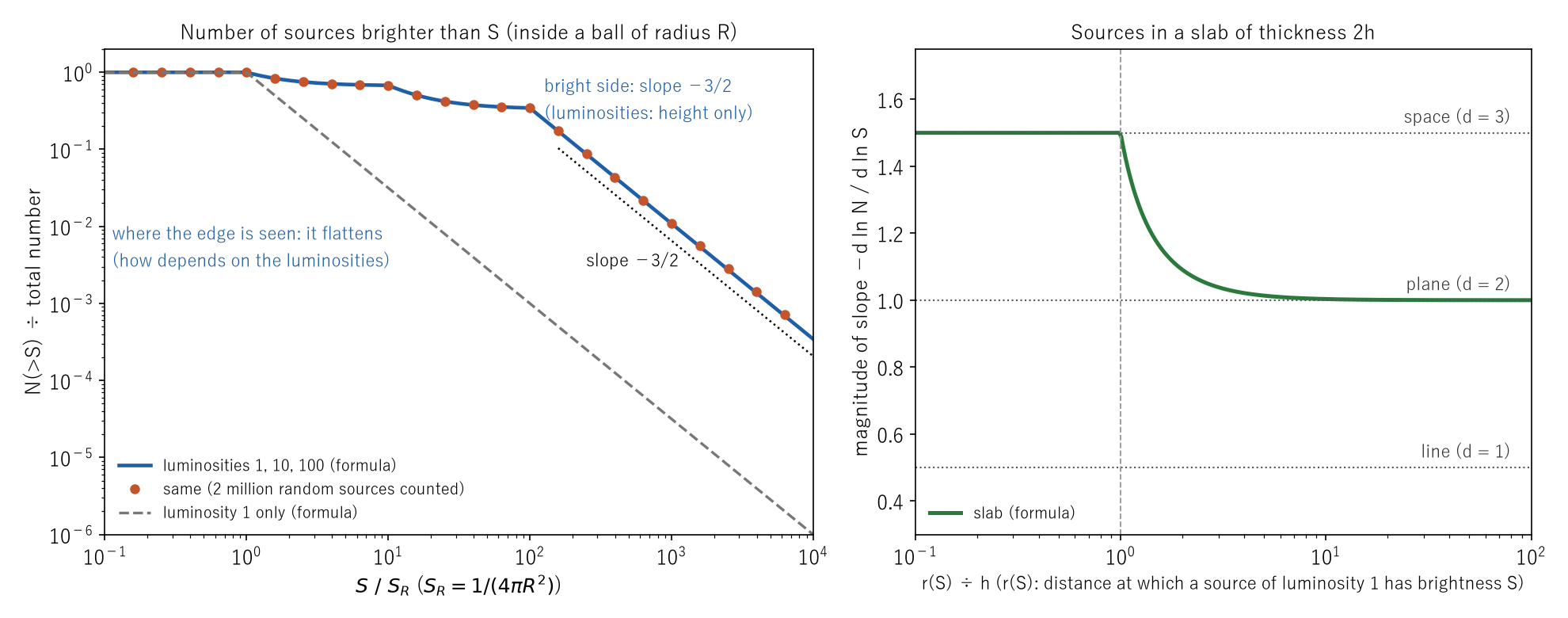
Geometry moves the slope. In a space where light dims as 1/(4πr²), sources filling a line, a plane and space give slopes −1/2, −1 and −3/2 (−0.5008, −0.9993 and −1.5026 in the catalogues). Counting from inside a slab of thickness 2h, the slope moves from −3/2 where r(S) is nearer than h to −1.003344 at 10h. In a d-dimensional world where light spreads over its shell the slope is −d/(d−1); the catalogues gave −2.0027 for d = 2 and −1.3306 for d = 4. In general it is the ratio d/n of the dimension d that the sources fill to the exponent n with which brightness dims. If sources exist only inside a radius R, the slope flattens at the faintness where the edge is seen. For luminosities 1, 10 and 100 it is −0.24847 when S is 30 times the brightness of a source of luminosity 1 placed at R, while with a single luminosity it stays at −3/2 and breaks to 0 at the edge. In a slab too, with no edge of a ball, at the brightness where the distance r(S) of a source of luminosity 1 is 0.3h, the slope is −3/2 for luminosity 1 only and −1.0677 for luminosities 1, 10 and 100. Reading slope and height separately holds only over the range of brightness where no length scale of the source distribution (the edge of a ball, the thickness of a slab) is seen.
On the map of Paper 1106, the difference d−n of the same two exponents decides the end of the sum of light, and the ratio d/n decides the slope of the count. Since the sum of light is the count multiplied by brightness and added up, the ratio exceeding 1 and the light of the night sky overflowing outward on the faint side are the same condition. The sum of light grows in proportion to r(S) in space (the R of Paper 496), grows by the same amount for every factor 10 in r(S) on a plane, and levels off on a line. In magnitudes, in space the count grows by 10 to the 0.6 = 3.98107170553 times for every magnitude fainter. In a d-dimensional world where light and gravity follow Gauss’s flux, the count goes as d/(d−1) and the exponent of Kepler (Paper 28) as d/2 (the eigenvalue count of Paper 204 is d/2 in every dimension), and they meet only in three dimensions. In the count and the eigenvalue count, the d in the numerator comes from counting points inside a ball and shares a root, while the 2 in the denominator comes from distinct roots. The separator is whether a change moves the slope (the dimension the sources fill, the dimming, a length scale of the source distribution) or only the height (a luminosity distribution independent of distance, the value of a uniform number density).
Keywords: source counts, luminosity function, inverse-square law, spatial dimension, Olbers’ paradox, magnitude, separator.
Scope (what is not claimed)
This paper claims no new theorem or law. That in a uniform, static, flat space the number of sources brighter than S is proportional to S to the −3/2 (often called the Euclidean counts) together with its derivation (the count goes as the cube of the distance and the brightness as its −2nd power), that its slope does not depend on the luminosity distribution, that the counts flatten on the faint side if the distribution of sources has an edge, and that selecting by brightness picks out bright sources in excess (known as an observational bias and often cited under the name of Malmquist) are all standard (the literature has not been checked here). That sources filling a line or a plane give slopes −1/2 or −1, and in general sources filling D dimensions give S to the −D/2, also appears to be known (not checked). It also appears to be known (not checked) that whether the counts of radio sources deviate from −3/2 was used in the debate on whether the universe changes with time. This paper writes no observed values of the counts. It also appears to be known (not checked) that the overflow on the faint side of the summed light of the counted sources, when the slope of the counts is steeper than 1, is the night sky of Olbers (Olbers 1826, Harrison 1987) seen from the side of the counts. What is added is placing that 3 and that 2, as the exponent of the volume of stacked shells and the exponent of the area of the shell over which light spreads (the d−1 on the side of the spherical shell in Paper 1092), on the two coordinates of the map of Paper 1106, and lining up that the ratio d/n is the slope of the counts while the difference d−n decides the end of the sum of light; reading the coefficient 1/(6√π) as the volume of the ball of area L/S and counting it along two routes, lattice points and a random catalogue; giving three sets of luminosities to the same positions to separate slope and height; counting that this separation breaks where a length scale of the source distribution (the edge of a ball, the thickness of a slab) is seen; and separating three 3/2s according to how the dimension is moved. The expansion of the universe, redshift, curvature of space, evolution of the sources, obscuration and absorption by nearer matter, noise and overlap of sources in observation, and distributions of sources of non-integer dimension are not treated. Paper 496 added up the light of the same stars shell by shell, showed that 4π and r² cancel and the sum diverges in proportion to the radius, and put evolving luminosity functions outside its subject in its scope note. This paper keeps the luminosity function fixed and counts, in a static space, that the luminosity distribution enters only the height. Paper 1106 made the map of the weight of one shell, the radius to the power d−1−n, and of the difference d−n that decides the overflowing end, and placed the night sky at (3, 2) on it. Paper 204 measured that the number of eigenvalues counted grows as a power equal to half the dimension, and Paper 521 showed that this count is one and the same count as the ν² of black-body radiation and the T³ of the heat capacity at low temperature. Paper 28 wrote that the 3/2 of Kepler’s third law is not a dimension and becomes d/2 in d dimensions following Gauss’s flux. Paper 1092 showed that of the 2s in 1/r² the 2 on the side of the spherical shell is d−1, and Paper 1094 showed that on a map the square of the distance is the exponent at the border of the sum. The definition of magnitudes follows Paper 214. This paper sits beside them and computes the slope of counts by brightness.
1. Counting instead of adding the light
Paper 496 showed that when stars of luminosity $L$ are placed with uniform number density, the number of stars in the shell of radius $r$ and thickness $dr$ times the light $L/(4\pi r^2)$ arriving from one star makes both $4\pi$ and $r^2$ cancel, and the sum keeps growing in proportion to the radius. Here the number density is written $\nu$ (it is the $n$ of Paper 496; $n$ is used only for the thinning exponent of Paper 1106). The number of stars in the shell is $\nu 4\pi r^2dr$ and the product is $\nu L dr$. Paper 1106 showed that when a density thins out as $r^{-n}$ in $d$ dimensions, the weight of one shell is $r^{d-1-n}$ and the difference $d-n$ decides at which end the sum overflows, and placed the night sky at $(d,n)=(3,2)$ on that map.
This paper does not add up the light of the same stars but counts them. What is counted is the number $N(>S)$ of celestial objects (called sources below) brighter than $S$. The brightness $S$ is the amount of light arriving here (the irradiance in the sense of Paper 214), and the luminosity $L$ is the total light a source emits (the astronomers’ usage, a different quantity from the visual luminous intensity of Paper 214). The brightness of a source of luminosity $L$ at distance $r$ is $S=L/(4\pi r^2)$, so the sources brighter than $S$ are those with
$$r<r(S)=\sqrt{\frac{L}{4\pi S}},$$and their number is
$$N(>S)=\nu\,\frac{4\pi}{3}\,r(S)^3=\frac{\nu\,L^{3/2}}{6\sqrt\pi}\,S^{-3/2}$$(checked with symbolic computation). The 3 is the exponent of the volume of the shells $4\pi r^2dr$ stacked up to $r(S)$, and the 2 is the exponent of the area $4\pi r^2$ of the shell over which light spreads. In other words, the sources brighter than $S$ are those inside the ball whose area is $L/S$, and the volume of a ball is $1/(6\sqrt\pi)$ times its area $A$ to the 3/2 ($V=A^{3/2}/(6\sqrt\pi)$). This derivation itself is standard.
The numbers were checked along three routes: counting sources placed on the points of the integer lattice (no random numbers); counting, without using the formula, a catalogue of sources placed with random numbers of fixed seed 1121; and closed formulas with symbolic computation in sympy and 30-digit numbers in mpmath. Luminosity and number density are in arbitrary units, and nothing is predicted about the numbers in the real sky. The counts of the random catalogues fluctuate, so each slope is given with a width. The width is the standard deviation of the least-squares slope fitted over all grid points. The numbers brighter than $S$ are nested (the count on the faint side contains the count on the bright side), so the covariance of the counts at two grid points was taken as the count on the bright side times one minus the fraction of the whole counted on the faint side (binomial).
2. Counting on a lattice
With number density 1 and luminosity 1, sources were placed on the points of the integer lattice, except the origin (the observer). Moving $r(S)$ from 20.5 to 205 (a factor 100 in $S$), the count runs from 36136 to 36083360, and the slope of $\ln N$ fitted against $\ln S$ is $-1.499454$. $N(>S) S^{3/2}$ is 0.0941594 at radius 20.5 and 0.0940222 at 205, agreeing with $1/(6\sqrt\pi)=0.0940316$ to a relative $9.95\times10^{-5}$ at radius 205.
In the coefficient $1/(6\sqrt\pi)=1/(3\sqrt{4\pi})$ written with brightness, $4\pi$ remains. On the other hand, the light of the sources brighter than $S$ is
$$F(>S)=\int_S^\infty S'\,\Bigl|\frac{dN}{dS'}\Bigr|\,dS'=3S\,N(>S)=\nu L\,r(S)$$(symbolic computation), and written with the distance $r(S)$ the $4\pi$ disappears. This is the $nL dr$ of Paper 496 (the $\nu L dr$ here) added up to $r(S)$. Whether $4\pi$ cancels is decided by whether the same stars are lined up by distance or by brightness.
3. The luminosity distribution enters only the height
If groups of luminosity $L_j$ make up fractions $f_j$ by number, adding group by group gives
$$N(>S)=\frac{\nu\,\langle L^{3/2}\rangle}{6\sqrt\pi}\,S^{-3/2},\qquad \langle L^{3/2}\rangle=\sum_j f_j\,L_j^{3/2}$$(symbolic computation). The luminosity distribution enters only the height, and the luminosity is averaged with the weight $L^{3/2}$. This needs $\langle L^{3/2}\rangle$ to be finite and, if the distribution of sources has an edge, a brightest source to exist (Section 4).
This formula was checked by counting without using it. Twenty million sources were placed uniformly in a ball of radius 100 (number density 4.774648; they were placed uniformly in a cube and those outside the ball were discarded, so the route of drawing radii with the weight $r^2$ was not used). The same positions were given luminosities in three ways. The fits were made over the range of brightness in which every source lies inside the edge (for sources of luminosity 100, where $S$ is brighter than $10^{-3}$).
| luminosities | fitted $S$ | count | slope | width |
|---|---|---|---|---|
| all 1 | $3.24\times10^{-5}$ to $3.16\times10^{-3}$ | 2477 to 2441290 | $-1.5026$ | 0.0033 |
| 1, 10, 100 in turn | $10^{-3}$ to $10^{-1}$ | 4956 to 4888984 | $-1.4959$ | 0.0023 |
| $\ln L$ uniform from 0 to $\ln 100$ | $10^{-3}$ to $10^{-1}$ | 1999 to 2054369 | $-1.5038$ | 0.0037 |
All three slopes agree with $-3/2$ within three widths (deviations of 0.78, 1.74 and 1.05 widths). What changes is the height. The coefficient $N(>S) S^{3/2}/\nu$ of the catalogue with all luminosities 1 is 0.09412 ($S=3.24\times10^{-5}$, count 2441290), agreeing with the lattice value 0.0940316 within three times the relative Poisson width $6.40\times10^{-4}$. Dividing the count at $S=10^{-3}$ by the count of the formula for luminosity 1 gives 344.353 for the catalogue with 1, 10, 100 and 144.698 for the catalogue with $\ln L$ uniform, agreeing with $\langle L^{3/2}\rangle$ of 344.2076 and 144.6201. They are not the mean luminosity to the 3/2 (225.0622 and 99.6745).
What is counted also changes. In the catalogue with 1, 10, 100, the share of the group of luminosity 100 among the counted sources is 0.9684, 0.9691 and 0.9667 at $S=10^{-3}$, $10^{-2}$ and $10^{-1}$, agreeing with the formula $100^{3/2}/(1+10^{3/2}+100^{3/2})=$ 0.968408 within three times the binomial width at each point (at most 1.64 times). The group of luminosity 10 takes 0.030624 and the group of luminosity 1 takes 0.000968. By number the three groups are one third each, so among the counted sources the group of luminosity 100 has grown to 2.905224 times one third. The share does not depend on $S$ because the count of every group is proportional to $S^{-3/2}$.
4. Where the edge is seen, the slope flattens
Let the sources exist only inside a radius $R$. Write $S_R=1/(4\pi R^2)$ for the brightness of a source of luminosity 1 placed at $R$ ($7.96\times10^{-6}$ for $R=100$). The group of luminosity $L$ has been counted completely once $S$ is fainter than $L S_R$, and does not grow further. The slope of the logarithms $d\ln N/d\ln S$ from the formula is listed.
| $S/S_R$ | slope (luminosities 1, 10, 100) | slope (luminosity 1 only) |
|---|---|---|
| 1000 | $-1.5$ | $-1.5$ |
| 300 | $-1.5$ | $-1.5$ |
| 30 | $-0.24847$ | $-1.5$ |
| 3 | $-0.13167$ | $-1.5$ |
| 0.5 | 0 | 0 |
For luminosities 1, 10 and 100, at $S=30S_R$ the group of luminosity 100 has been counted completely and only the other two groups grow as $S^{-3/2}$, so the slope is $-1.5\times0.198536/(1+0.198536)=-0.24847$ (0.198536 is $(1/3)^{3/2}+(1/30)^{3/2}$). With a single luminosity the slope stays at $-3/2$ down to $S_R$ and breaks to 0 there. Counting the random catalogue at 40 points from $0.2S_R$ to $2000S_R$, the relative difference from the formula was at most $5.23\times10^{-3}$, and the deviation was at most 3.12 binomial widths.
Where the edge is seen, how the slope flattens depends on the luminosity distribution. The slope is blind to the luminosity distribution only over the range of brightness where the edge is not seen even for the brightest sources. For a luminosity distribution with no upper limit there is no brightest source, and no such range exists. Placing in a ball of radius $R$ sources with $L\ge1$ and density $2L^{-3}$ ($\langle L^{3/2}\rangle$ is finite), with $x=S/S_R$ the count is $4x^{-3/2}-3x^{-2}$ times the whole and the slope is $(-6+6x^{-1/2})/(4-3x^{-1/2})$: $-1.34455$ at $10S_R$, $-1.48785$ at $1000S_R$ and $-1.49881$ at $10^5S_R$, approaching $-3/2$ only slowly (numerical integration and numerical differentiation give the same values).
5. The dimension the sources fill
Keeping light dimming as $1/(4\pi r^2)$ in three-dimensional space and placing the sources on a line, on a plane or in space, the number brighter than $S$ is proportional to the first, second or third power of $r(S)$, and the slope is $-1/2$, $-1$ or $-3/2$. For the line, 4 million sources were placed on a length of 2000, and for the plane 4 million in a disc of radius 1000; the fits were made for $r(S)$ from about 30 to 300. For the $d$-dimensional world where light spreads over the shell of its own dimension (brightness $L/(|S^{d-1}| r^{d-1})$), 4 million sources were placed in a ball of radius 1.
| where the sources are (dimming) | power of $r(S)$ in the count | slope (formula) | slope (catalogue) | width |
|---|---|---|---|---|
| line ($1/(4\pi r^2)$) | 1 | $-1/2$ | $-0.5008$ | 0.0006 |
| plane ($1/(4\pi r^2)$) | 2 | $-1$ | $-0.9993$ | 0.0032 |
| space ($1/(4\pi r^2)$) | 3 | $-3/2$ | $-1.5026$ | 0.0033 |
| two-dimensional world ($1/(2\pi r)$) | 2 | $-2$ | $-2.0027$ | 0.0039 |
| four-dimensional world ($1/(2\pi^2 r^3)$) | 4 | $-4/3$ | $-1.3306$ | 0.0026 |
In general, if the sources fill $d$ dimensions and brightness dims as $r^{-n}$, then $N(>S)\propto S^{-d/n}$. If light dims as $1/(4\pi r^2)$ in three-dimensional space, $n=2$ and the slope is $d/2$. In a world where light spreads over the shell of its own dimension, $n=d-1$ and the slope is $d/(d-1)$. Both families pass through $3/2$ at $d=3$.
Counting from inside a slab of thickness $2h$ ($h=1$, 8 million sources in a cylinder of radius 30), $N=\nu (4\pi/3) r(S)^3$ for $r(S)\le h$ and $N=\nu\pi (2h r(S)^2-2h^3/3)$ for $r(S)>h$, and the slope moves from $-3/2$ for $r(S)\le h$ through $-1.090909$ at $2h$ and $-1.003344$ at $10h$ to the $-1$ of a plane. The counts of the catalogue agreed with the formula at four points, $r(S)/h$ = 0.502, 1.997, 10.009 and 25.142, within at most 1.63 Poisson widths. Nearby it looks like space, far away like a plane.
With luminosities 1, 10 and 100 in equal numbers in the slab (the slab extends without limit sideways, and there is no edge of a ball), the slope is as follows ($r(S)$ is the distance at which a source of luminosity 1 has brightness $S$; checked with the formula and with numerical differentiation).
| $r(S)$ | slope (luminosity 1 only) | slope (luminosities 1, 10, 100) |
|---|---|---|
| $0.3h$ | $-1.5000$ | $-1.0677$ |
| $h$ | $-1.5000$ | $-1.0091$ |
| $3h$ | $-1.0385$ | $-1.0010$ |
| $30h$ | $-1.0004$ | $-1.0000$ |
Sources of luminosity 100 are seen ten times farther, so the brightness at which the thickness starts to show differs from group to group, and at $r(S)=0.3h$ the slope of the whole is $-1.0677$ while the group of luminosity 1 still has the $-3/2$ of space. When the source distribution has a length scale (here the thickness of the slab), the luminosity distribution enters the slope even without the edge of a ball.
6. The ratio is the slope, the difference is the end of the sum
The coordinates of the map of Paper 1106 are the two exponents of the weight $r^{d-1}\cdot r^{-n}$ of the sum. In the sum of light of the night sky, $d$ is the dimension the sources fill and $n$ is the exponent with which brightness dims, the same two exponents as in the counts here. Of the same two exponents, the ratio $d/n$ is the slope of the counts and the difference $d-n$ decides the overflowing end of the sum of light. The light of the sources fainter than $S_{\text{top}}$ and brighter than $S$, as $S$ is made fainter, grows as $S^{1-d/n}=r(S)^{d-n}$ if $d/n>1$ (symbolic computation), grows as $\ln r(S)$ if $d/n=1$, and levels off if $d/n<1$. Since $d/n-1=(d-n)/n$ with $n>0$, the slope exceeding 1 and the difference $d-n$ being positive are the same condition.
In the catalogues of luminosity 1, the light from $S_{\text{top}}=1/(4\pi)$ (the brightness at $r=1$) down to $S$ was added up while moving $r(S)$. The formulas are $\nu (r(S)-1)$ in space, $(\sigma/2)\ln r(S)$ on a plane and $(\lambda/2\pi)(1-1/r(S))$ on a line ($\sigma$ and $\lambda$ are the number densities on the plane and the line). The values of the sums themselves deviate a little from the formulas. The deviation is within 1.23 times the fluctuation of the sum added from $r=1$ (the square root of the expected sum of the squared brightness of the sources in the shell), and more than half of that variance (at least 0.51 in every row) comes from the near sources with $r$ between 1 and 2. The fluctuation of the near sources rides on every row alike, so the increases between rows were compared. The width of the fluctuation of an increase was found from the expected sum of the squared brightness of the sources in the shell.
| sources | $r(S)$ | increase (catalogue) | increase (formula) |
|---|---|---|---|
| space | 10 to 30 | 95.429 | 95.493 |
| space | 30 to 90 | 286.695 | 286.479 |
| plane | 10 to 100 | 1.4676 | 1.4659 |
| plane | 100 to 1000 | 1.4656 | 1.4659 |
| line | 10 to 100 | 28.4632 | 28.6479 |
| line | 100 to 1000 | 2.8623 | 2.8648 |
The six increases agreed with the formulas within three Poisson widths (at most 2.35). In space (slope $3/2>1$) the sum of light grows in proportion to $r(S)$, the $R$ of Paper 496. The plane ($d=n=2$, slope 1) sits on the border of the map of Paper 1106, and keeps growing by $(\sigma/2)\ln10=1.4659$ for every factor 10 in $r(S)$. This is the same border at which Paper 1094 counted the square of the distance on a plane where people live. On the line (slope $1/2$) the increases shrink by a factor 10 each time and approach $\lambda/(2\pi)=318.3099$. On a line, conversely, the sum overflows on the near (bright) side (the side of Paper 1106 where $n>d$ and the centre overflows); this paper cut that side at $S_{\text{top}}$. The overflowing of the night sky is what the slope of the counts being steeper than 1 looks like at the faint end.
7. Written in magnitudes
Magnitudes are a logarithmic scale of brightness, and one magnitude is a factor $100^{1/5}=2.51188643151$ (Paper 214). Writing $N(>S)\propto S^{-d/n}$ in magnitudes, the count grows by $10^{0.4d/n}$ times for every magnitude fainter: $10^{0.6}=3.98107170553$ times in space, 2.51188643151 times on a plane and 1.58489319246 times on a line (30-digit computation). In space, for every magnitude fainter, the brightness threshold for counting falls to about 1/2.5 and the count grows about 4 times.
8. Three 3/2s
The series has two other 3/2s. Paper 28 wrote that the 3/2 of Kepler’s third law is not a dimension, and that with gravity following Gauss’s flux in $d$ dimensions the period goes as the radius to the power $d/2$. Paper 204 measured that the number of eigenvalues counted from the smallest grows as the eigenvalue to the power $d/2$, and Paper 521 showed that this count is one and the same count as the $\nu^2$ of black-body radiation and the $T^3$ of the heat capacity at low temperature. To compare the three, how the dimension is moved (the family) has to be fixed. In the family where both light and gravity follow Gauss’s flux in $d$ dimensions (family A; light spreads over the shell of its own dimension), the exponent of the counts is $d/(d-1)$ and that of Kepler is $d/2$. The $d/2$ of the eigenvalue count does not depend on Gauss’s flux and is $d/2$ for a box of any dimension.
| $d$ | source count (family A) $d/(d-1)$ | Kepler (Paper 28, family A) and eigenvalue count (Paper 204) $d/2$ |
|---|---|---|
| 2 | 2 | 1 |
| 3 | 3/2 | 3/2 |
| 4 | 4/3 | 2 |
| 5 | 5/4 | 5/2 |
In family A, the only positive dimension at which the $d/(d-1)$ of the counts equals $d/2$ is $d=3$ (symbolic computation). In the family where sources fill $d$ dimensions in three-dimensional space (family B; light still dims as $1/(4\pi r^2)$), the slope of the counts is also $d/2$, the same form as the eigenvalue count in every $d$. In the counts and the eigenvalue count, the dimension in the numerator comes, in both, from counting points inside a ball. The 2 in the denominator comes here from the exponent of the area of the shell over which light spreads in three-dimensional space (the $d-1$ on the side of the spherical shell in Paper 1092), and in the eigenvalue count from the eigenvalue of the Laplacian being the square of the wave number. The $d/2$ of Kepler and the $d/2$ of the eigenvalue count are the same number in every dimension in family A, but this paper does not decide whether they share a root.
9. Same root or distinct roots
The quantities of this paper are sorted with the test of Paper 300.
(1) Slope and height: the slope is fixed by $d$ and $n$, and the height by the value of the number density, $\langle L^{3/2}\rangle$ and the $4\pi$ in the form $1/(6\sqrt\pi)$. Giving three sets of luminosities to the same positions, the slope stayed at $-3/2$ and only the height changed, by 344.2076 and 144.6201 times. Over the range of brightness where no length scale of the source distribution (the edge of a ball, the thickness of a slab) is seen, their roots are distinct. This is the form, in the counts, of the overall coefficient and the exponent of the weight of one shell that Paper 1106 separated. Where a length scale is seen, the luminosity distribution also enters the slope, and they cannot be separated (the edge of a ball in Section 4, the slab in Section 5).
(2) The $4\pi$ that cancelled in Paper 496 and the $4\pi$ that remains in the coefficient here: the difference is whether the same stars are lined up by distance or by brightness, so they share a root.
(3) The slope $d/n$ of the counts and the difference $d-n$ of Paper 1106: the sum of light is the count multiplied by brightness and added up (the $F(>S)$ of Section 2), so the growth $S^{1-d/n}=r(S)^{d-n}$ of the sum of light follows directly from the slope of the counts. That is why their borders (ratio 1 and difference 0) are the same condition, and they share a root.
(4) Three 3/2s: moving the dimension in family A, the counts go as $d/(d-1)$ and Kepler and the eigenvalue count as $d/2$, and they meet only in three dimensions. The $d$ in the numerator of the counts and of the eigenvalue count comes, in both, from counting points inside a ball and shares a root, while the 2 in the denominator has distinct roots (the exponent $d-1$ of the area of the shell over which light spreads, and the eigenvalue of the Laplacian being the square of the wave number). In family B the counts also take the form $d/2$, but since the 2 in the denominator comes from a different place, the agreement of form is not taken as evidence of a shared root (a criterion collected in Paper 300: agreement of numbers alone is not taken as a shared root).
10. The separator
The separator is whether a change moves the slope or only the height. What moves the slope is the dimension the sources fill, how brightness dims, and a length scale of the source distribution (the edge of a ball, the thickness of a slab). What moves only the height is a luminosity distribution independent of distance and the value of a uniform number density, and $4\pi$ also enters the height as $1/(6\sqrt\pi)$. Where a length scale is seen, however, the luminosity distribution also changes how the slope flattens.
Closing
In a uniform space, the number of sources brighter than S is proportional to S to the −3/2. The 3 is the exponent of the volume of the stacked shells and the 2 the exponent of the area of the shell over which light spreads; the sources brighter than S lie inside the ball of area L/S. A luminosity distribution independent of distance, a uniform number density and 4π enter only the height, and counting by brightness picks out the bright groups in excess. Sources filling a line, a plane or space give slopes 1/2, 1 and 3/2, and in general the slope is the ratio d/n of the dimension to the dimming exponent. The difference d−n of the same two exponents decides the overflowing end of the sum of light on the map of Paper 1106, and the ratio exceeding 1 and the sum of the night sky overflowing outward are the same condition. At brightnesses where a length scale of the source distribution (the edge of a ball, the thickness of a slab) is seen, the luminosity distribution also enters the slope.
References
- Harrison, E. (1987). Darkness at Night: A Riddle of the Universe. Harvard University Press.
- Olbers, H. W. M. (1826). Ueber die Durchsichtigkeit des Weltraums. Astronomisches Jahrbuch für das Jahr 1826.
- Yamagishi, Y. (2026). The Yamagishi-Kepler Equation [Paper 28]. YOI: https://www.yamagishiyuuki.com/yoi/28; DOI: 10.5281/zenodo.21430531
- Yamagishi, Y. (2026). The Power in the Eigenvalue Count Is Half the Dimension [Paper 204]. YOI: https://www.yamagishiyuuki.com/yoi/204; DOI: 10.5281/zenodo.22110032
- Yamagishi, Y. (2026). A Lens Can Brighten and Cannot Increase Brightness [Paper 214]. YOI: https://www.yamagishiyuuki.com/yoi/214; DOI: 10.5281/zenodo.22119392
- Yamagishi, Y. (2026). The Three Hundredth Census: Whether Two Things Share a Root Is Decidable [Paper 300]. YOI: https://www.yamagishiyuuki.com/yoi/300; DOI: 10.5281/zenodo.22171914
- Yamagishi, Y. (2026). The 4π Appears Twice, Cancels, and Then the Sum Diverges [Paper 496]. YOI: https://www.yamagishiyuuki.com/yoi/496; DOI: 10.5281/zenodo.22760174
- Yamagishi, Y. (2026). The ν², the T³ and the Eigenvalue Count Are One and the Same Count [Paper 521]. YOI: https://www.yamagishiyuuki.com/yoi/521; DOI: 10.5281/zenodo.22867484
- Yamagishi, Y. (2026). The “2” of the Inverse-Square Density Is Two 2s, and the 2 of the Shell Mass Meets the 2 of the Horizon Balance Only in Three Dimensions [Paper 1092]. YOI: https://www.yamagishiyuuki.com/yoi/1092
- Yamagishi, Y. (2026). The “Squared Distance” in Retail Gravity Models Is, on a Map, the Exponent at the Border Where the Total Number of Customers Stops Converging [Paper 1094]. YOI: https://www.yamagishiyuuki.com/yoi/1094
- Yamagishi, Y. (2026). A Physical Infinity Is Set by How Fast Things Thin Out against the Dimension, Not by the Mass [Paper 1106]. YOI: https://www.yamagishiyuuki.com/yoi/1106
Reference
Yamagishi, Y. (2026). The Number of Sources Brighter than S Goes as S to the −3/2, and the 3/2 Is the Ratio of the Exponent of the Volume of Stacked Shells to That of the Area of the Shell over Which Light Spreads [Paper 1121]. YOI: https://www.yamagishiyuuki.com/yoi/1121
ORCID: 0009-0006-8587-3450
PDF (English) · PDF (Japanese) · Date proof of the English PDF (OpenTimestamps .ots) · SHA256SUMS
The record page for this paper (in Japanese, with the PDFs in each language and the date proof): YOI 1121. This paper is a preprint and has not been peer reviewed.