Yamagishi Complexity
Torus Lab
Yamagishi Lab (山岸勇輝ラボ)
A micro-institute exploring the deep geometry of existence. Papers in mathematical physics are written one at a time, each with its own numerical checks, and public data in medicine, finance and regions are read in the same way. All papers are preprints that have not been peer reviewed.
From thinking to syncing.
The foundations of this work
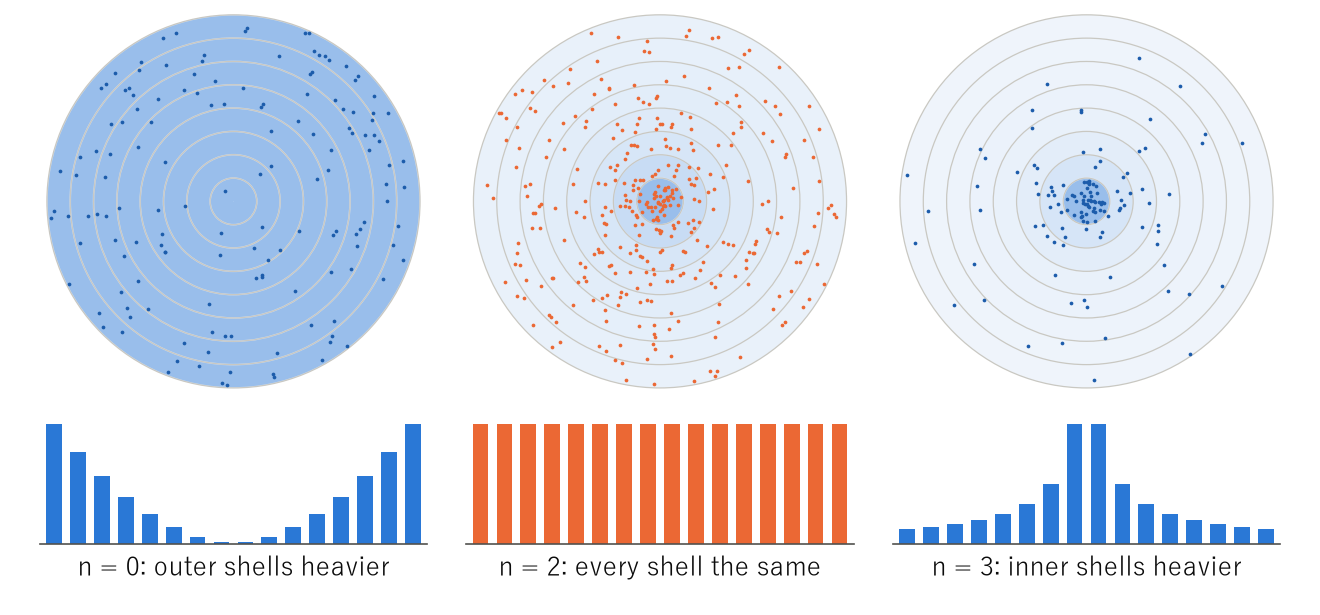
The n = 2 Uniqueness Theorem: Spherical Shells Weigh the Same Only When Density Falls as 1/r²
Divide a ball into thin shells like an onion, and every shell weighs the same only when the density falls as the inverse square of the distance. This theorem is the starting point of all my papers. Check it with figures you can move, and read it side by side with Noether’s theorem and others.
Read it and try it →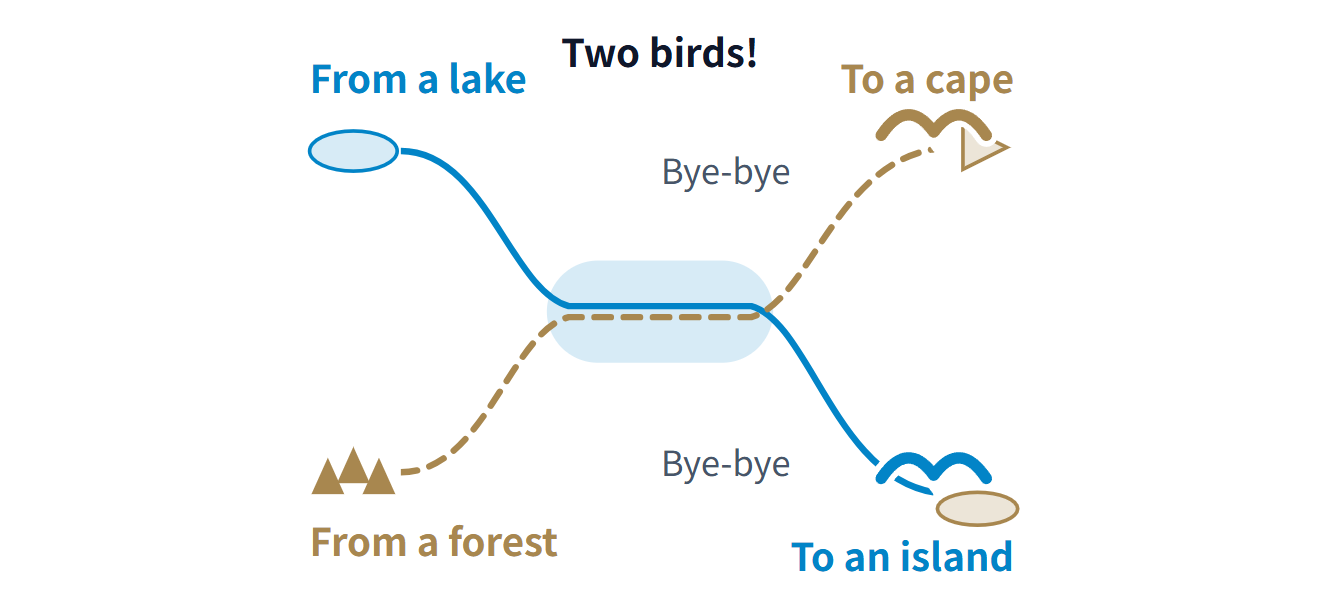
Move Something to Tell Two Look-Alikes Apart: What Is a Separator?
Is the bird flying across the sky really just one bird? With pictures of migrating birds, a tree drinking dyed water and two salmon, this page explains the separator, a way to tell two look-alikes apart by moving something, in words that children in primary school can follow.
Read it with pictures →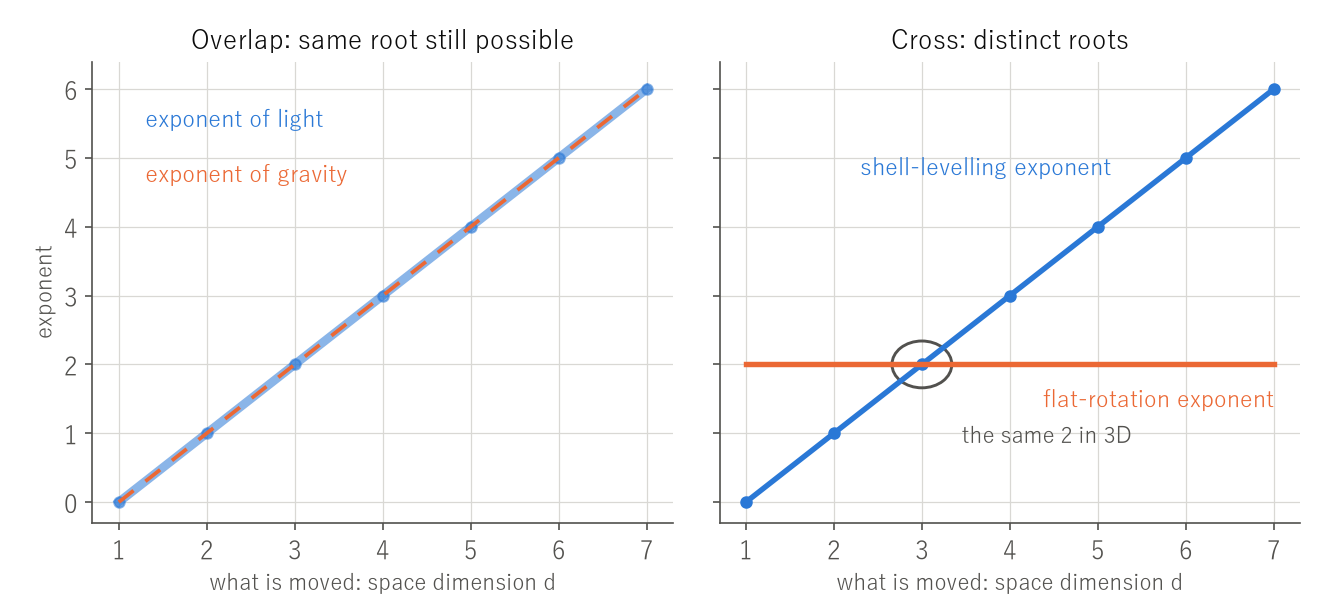
What Is a Separator? Telling Two Look-Alikes Apart by Moving Something
The same 2, the same 4π, the same name. Physics is full of things that look the same but come from different sources. A separator is the tool that says what must be moved for them to become different things. This page explains it from the beginning, with figures you can move.
Read it and try it →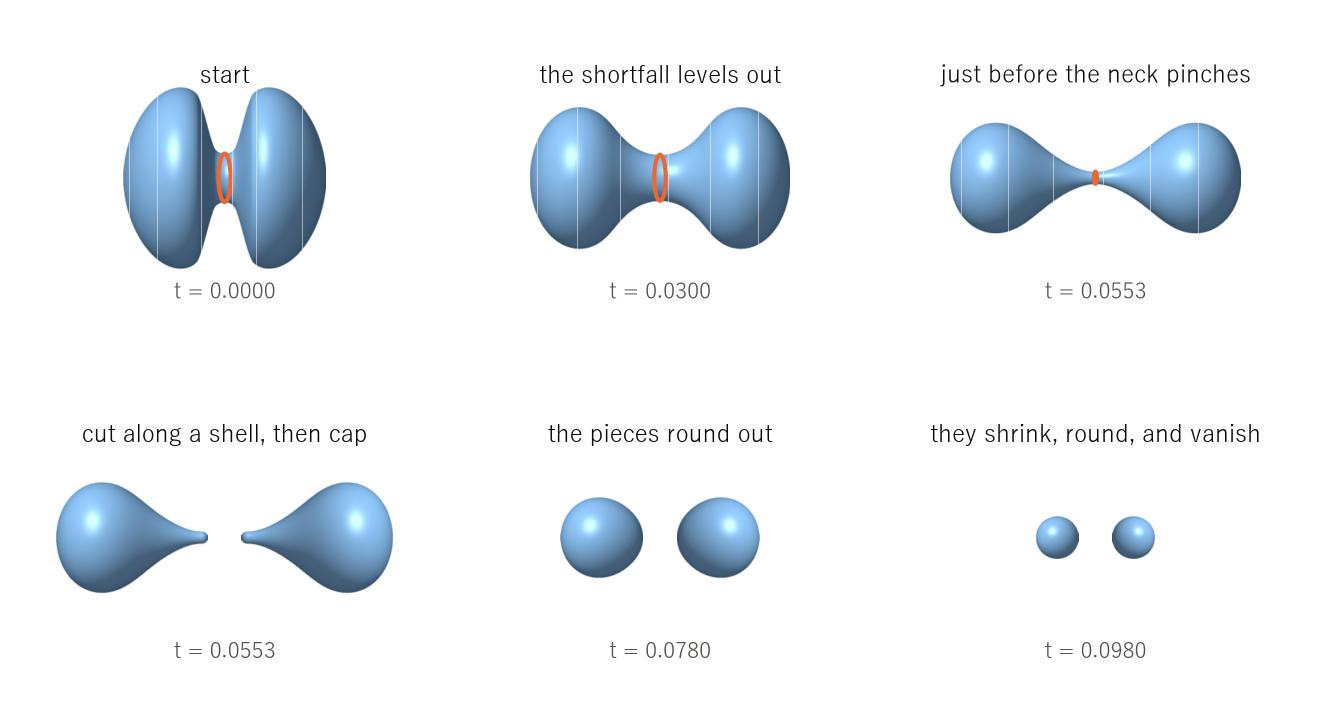
Reading the Poincaré Conjecture from the Uniqueness Theorem: Only in Dimension 3 Does the Curvature of a Shell Close at 4π
The density 1/r² of my theorem is the curvature of a sphere of radius r, and its 4π is really at work in the last push of the proof by Perelman and others. Solve Ricci flow in your browser, pinch a neck, cut it, and read the Poincaré conjecture from three dimensions to four in the language of shells.
Read it and try it →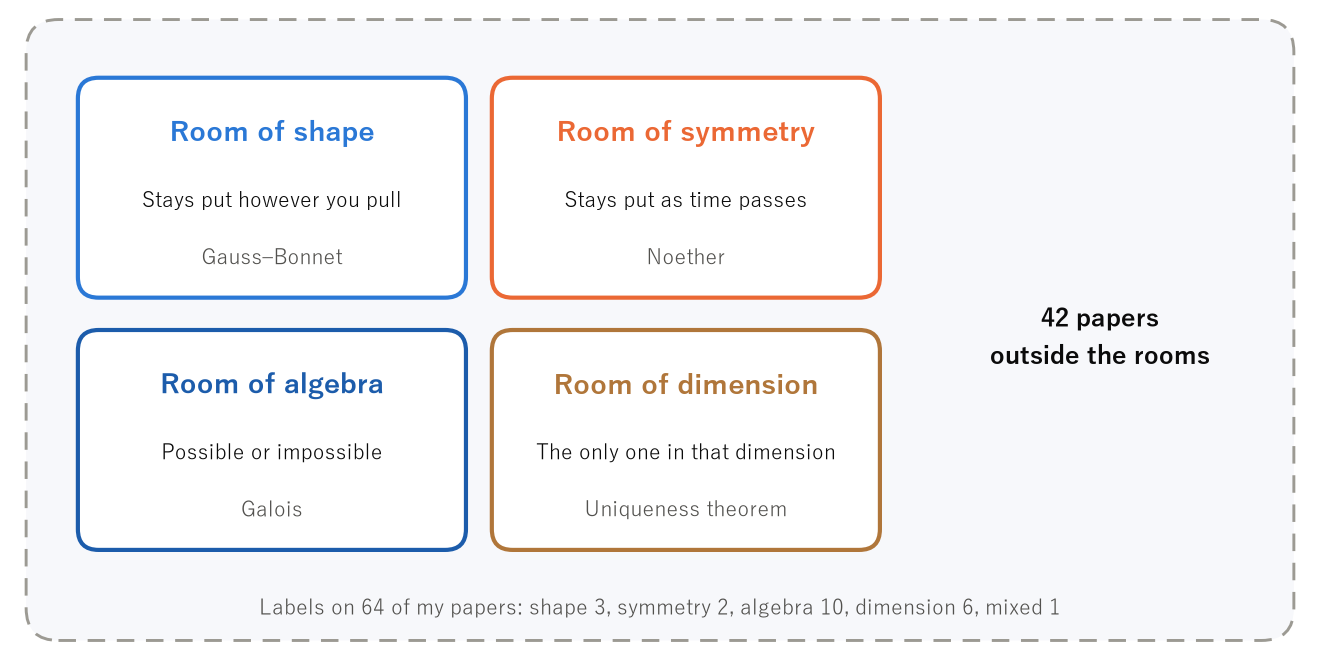
Why Must It Be So? The Four Rooms of Necessity and the 42 Papers Left Outside
Deform a sphere however you like and its total curvature stays 4π. The equation of degree 5 has no formula. Both are called fixed, but not in the same way. Walk through four rooms, breaking things by hand, and then meet the 42 papers left outside.
Read it and try it →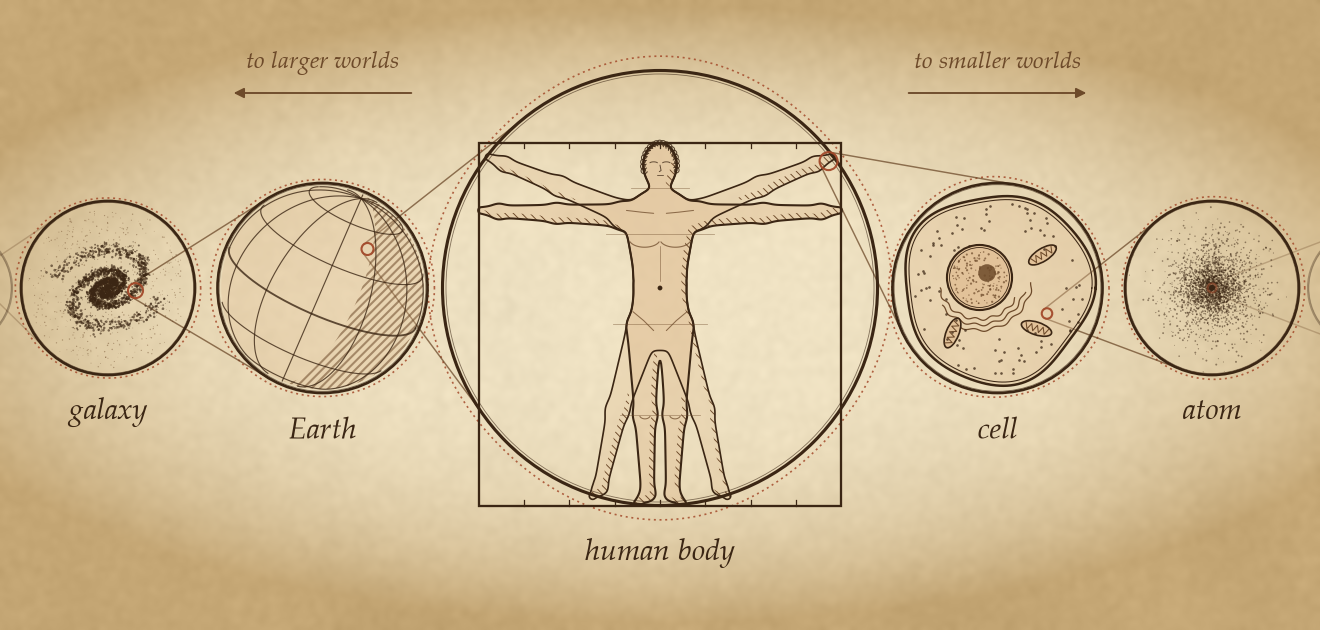
Rearrange the Inside of a Box and the Gravity Outside Does Not Change at All: From Outside, Only One Skin’s Worth of Numbers Can Be Read
Rearrange the density inside a cube as much as you like and the gravity outside does not change. What can be read from outside is one number per angular pattern, the pattern that fits on a single skin. What decides this is not the contents but the form of the field equation. Five interactive experiments check it.
Read it and try it →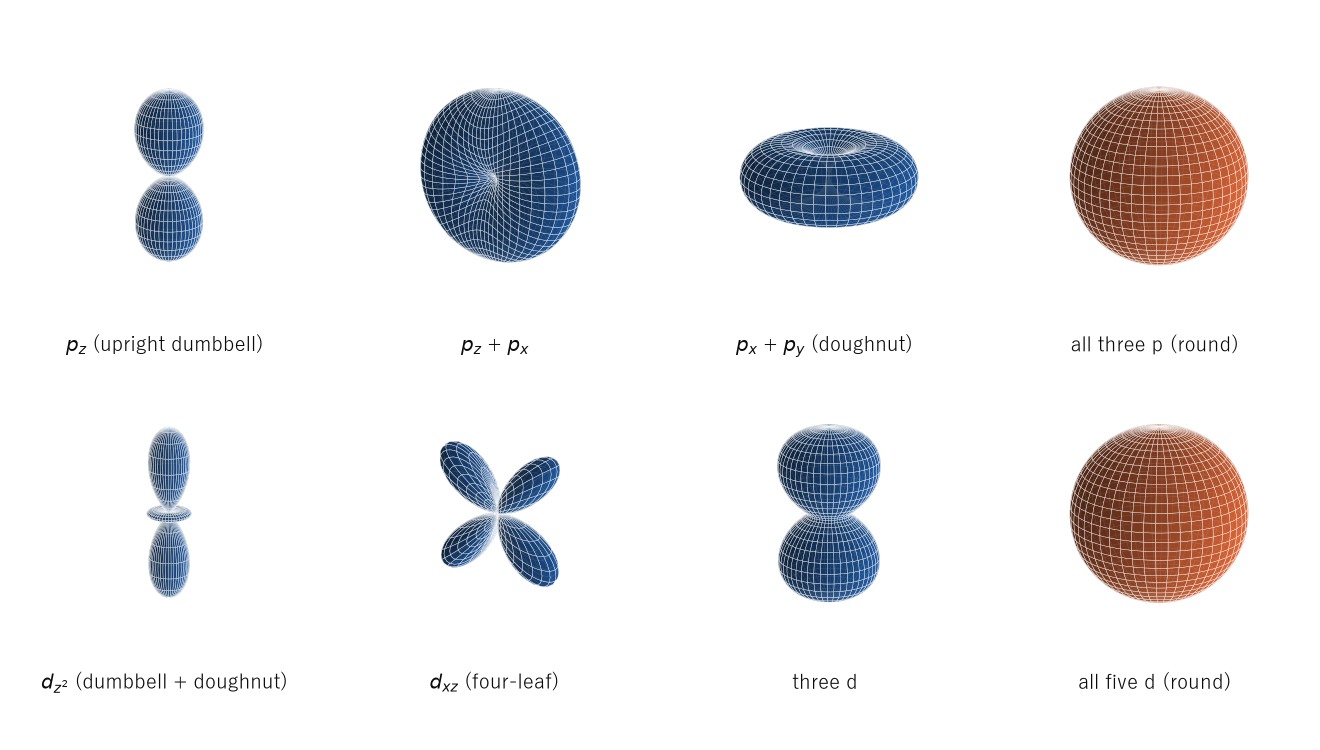
Fill the Dumbbell and Doughnut Clouds and They Turn Round Again: From Outside, a Half-Full or Full Shell Shows No Shape
Can the dumbbells and doughnuts of electron clouds be seen from outside? Put electrons into a shell one at a time and count the numbers that leave: at exactly half full and at full there are none, and the cloud turns round again. Stack the rooms and you get a square, the same count as the patterns on a four-dimensional sphere. Three interactive experiments check it.
Read it and try it →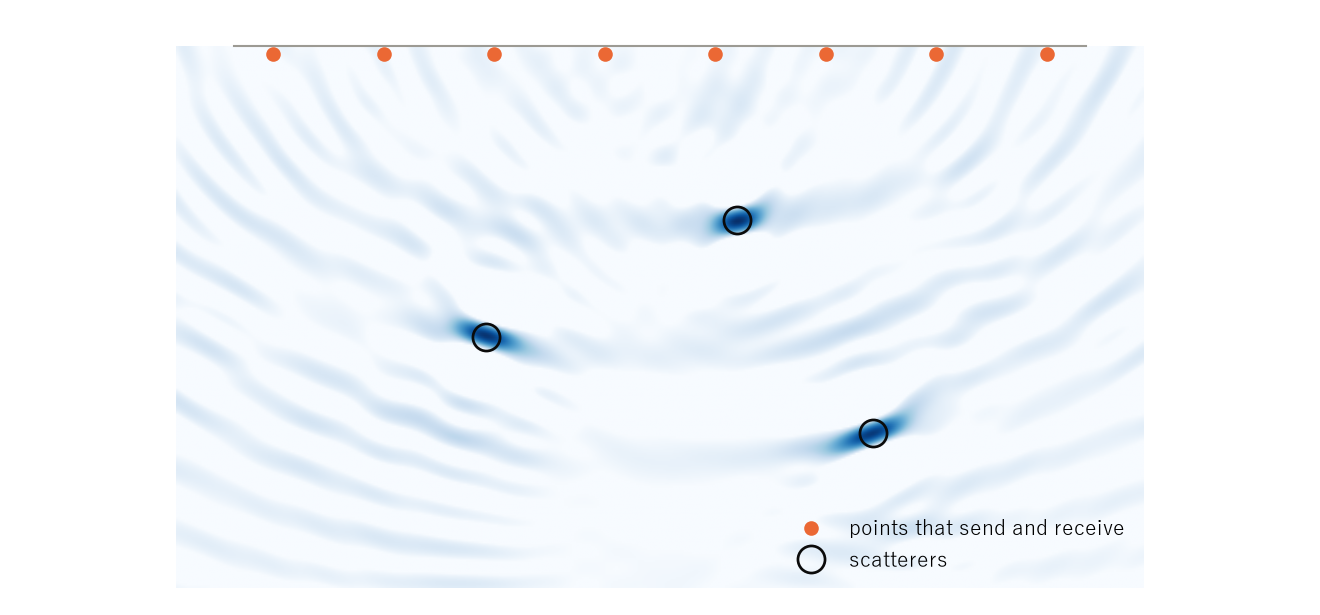
An Invisible Rearrangement Becomes Visible When the Frequency Changes: To Read the Inside from Outside, Add a Frequency or a Second Point
If one only receives, just one skin’s worth of numbers can be read from outside. But moving the frequency, or measuring with two points, one that sends and one that receives, makes the inside readable. We also check that the scattering-field equation of Kenjiro Kimura and colleagues at Kobe University describes only how waves travel through an empty region, and for a single bounce holds without approximation. Four interactive experiments let you try it.
Read it and try it →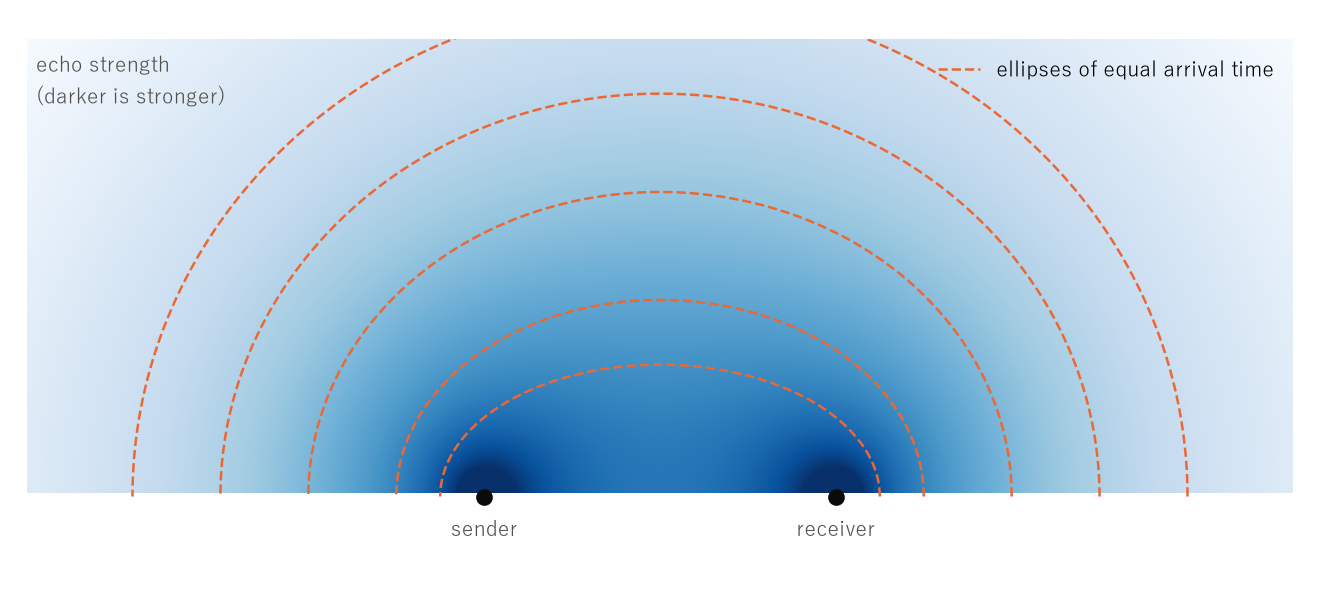
Only in Three Dimensions Does an Echo Come Back with Its Shape Unchanged: It Passes Through Two Skins There and Back, and the Time Tells the Path
When the point that sends and the point that receives are separated, an echo passes through two skins, one out and one back, and the points whose echoes arrive at the same time lie on a spheroid (an ellipse in cross-section). And in three dimensions the echo arrives, weakening, in the emitted shape. The reason is that the exponent of the uniqueness theorem and the exponent of the solution of Laplace’s equation meet only in three dimensions. Three interactive experiments check it.
Read it and try it →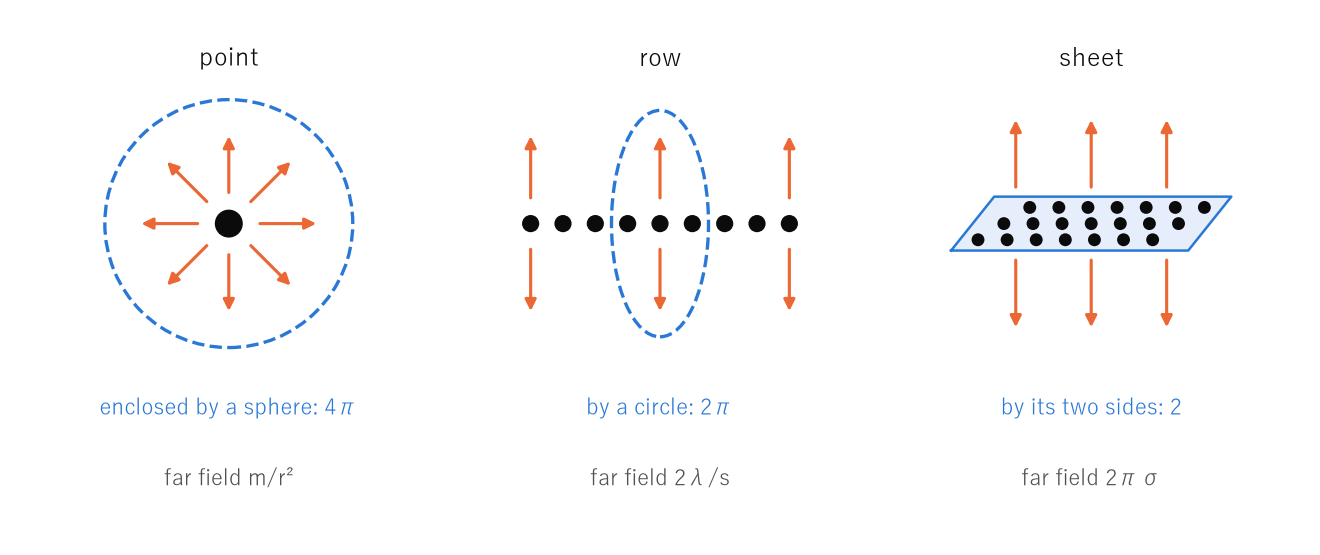
4π Surrounds a Point: In a Row or a Sheet the Law Changes, and the Line’s 2π and the Sheet’s 2π Trade Places with the Units
A ball of density 1/r² has mass 4π, the size of a sphere around one point. Lay the masses in a row or a sheet, and at about the spacing the law of a line or a sheet takes over. The 2π of a line and the 2π of a sheet are different things that trade places when the units change. Two interactive experiments check it, down to the Bouguer slab of gravity surveying.
Read it and try it →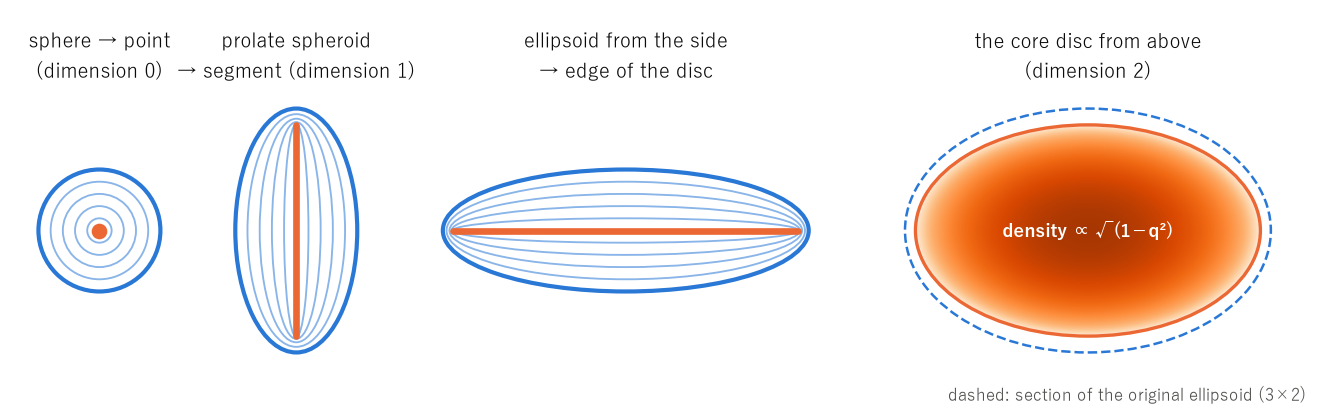
From Outside, a Solid Ellipsoid Cannot Be Told Apart from a Flat Disc: A Sphere Looking Like a Single Point Is the Case in Which That Disc Shrinks to a Point
Seen from outside, the gravity of a uniformly filled ellipsoid is the same as that of a flat disc placed inside it. Shrunk while staying confocal, a sphere becomes a point, a prolate spheroid a segment and an ellipsoid a disc. And a sphere is not the only shape whose skin has no force inside. Two interactive experiments check this.
Read it and try it →E=mc², read the other way round
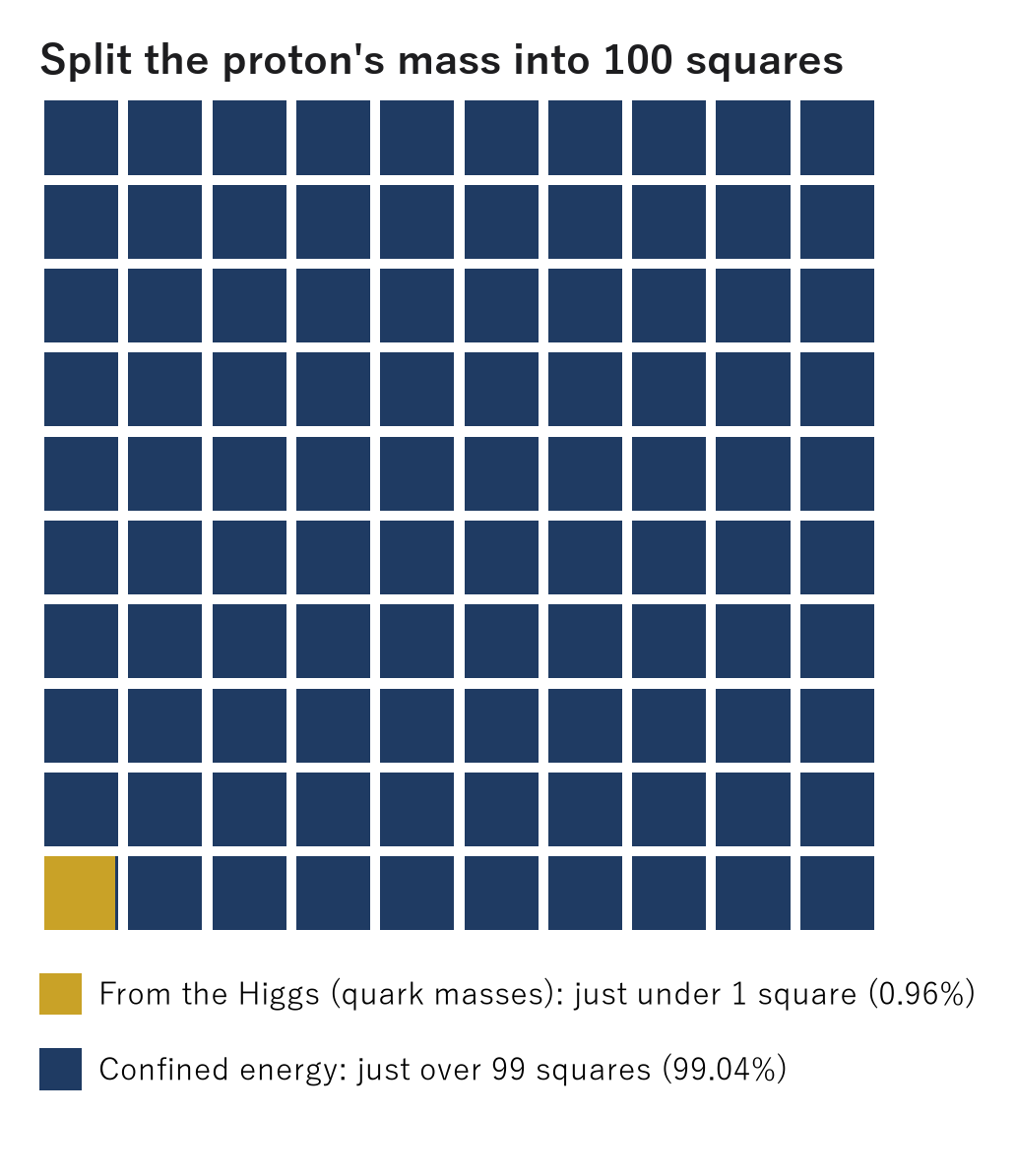
99% of Your Body Weight Comes from E=mc²
The Higgs gives only about 1% of your body weight. The remaining 99% or so is energy confined inside protons and neutrons, showing up as mass through E=mc².
Read →- Methane’s 109.47 Degrees Come from Counting Alone: Water’s Angle Departs Because Its Four Neighbours Are Unequal
- Why Do Round Atoms Stick? Their Momentary Lopsidedness Lines Up and Attracts
- If the Mass Is Set to 4π, Do the Infinities of Physics Disappear? What Decides Them Is How Fast Things Thin Out, and the Dimension
At a glance
Counts as of November 11, 2026, when this site was built.
Recent articles in English
The newest English articles on this site.
- Mathematical physics[Paper 615] In a Stable Matching, the Side That Proposes Comes Out Ahead
Collections
Mathematical physics
English editions of the papers in mathematical physics.
Medical statistics
Analyses of published aggregate medical data.
FX and finance
Checks on FX and finance numbers, with the procedure written out.
Industry data
Numbers by industry, read from Japanese government statistics.
Regional data
Numbers for towns and regions, read from Japanese government statistics.
Papers in five languages
Papers that can be read in Japanese, English, German, French and Italian.
YOI records (Japanese pages)
Each paper has a record page with the PDFs in Japanese and English and a date proof.
Start here
The n = 2 uniqueness theorem
The theorem all my papers start from, with figures you can move.
The separator, explained with pictures
Migrating birds, a tree drinking dyed water and two salmon show how to tell two look-alikes apart by moving something. Easy enough for primary school.
What is a separator?
The tool for telling two look-alikes apart by moving something, from Paper 300, the most cited of my papers, with figures you can move.
Reading the Poincaré conjecture from the uniqueness theorem
Where the 4π of the shell works inside the proof by Perelman and others, followed while Ricci flow runs in your browser.
Why must it be so?
“Fixed” comes in kinds. Walk through the four rooms of Gauss–Bonnet, Noether, Galois and the uniqueness theorem, breaking things as you go, and count the 42 papers left outside.
From outside, one skin’s worth of numbers
Rearrange the inside of a box and the gravity outside does not change at all. From outside a closed skin, one number per angular pattern can be read, and what decides this is the form of the field equation, not the contents.
Electron clouds that turn round when filled
The dumbbells and doughnuts of electron clouds vanish when a shell is exactly half full or full, and the cloud turns round again; then no shape can be read from outside. Stacking the rooms gives the number of patterns on a four-dimensional sphere.
To read the inside, add a frequency or a second point
If one only receives, one number per angular pattern goes out. Moving the frequency, or adding a point that sends, widens what can be read into the inside. The scattering-field equation of Kenjiro Kimura and colleagues at Kobe University holds without approximation for a single bounce.
Only in three dimensions does an echo keep its shape
Separate the point that sends from the point that receives, and an echo passes two skins, out and back; the points whose echoes arrive together lie on a spheroid. A spherical wave that weakens and still keeps its shape exists only in three dimensions.
4π is the number that surrounds a point
Lay masses in a row or a sheet, and at about the spacing the 4π of a point gives way to the law of a line or a sheet. The 2π of a line and the 2π of a sheet are different things that trade places when the units change. Move the figures, down to the Bouguer slab of gravity surveying.
The flat core of an ellipsoid
Seen from outside, the gravity of a uniform ellipsoid is the same as that of a flat disc. Shrunk while staying confocal, a sphere becomes a point, a prolate spheroid a segment and an ellipsoid a disc. The force inside a skin vanishes not only for spheres.
About this corpus
How the papers are organized, and where to start reading.
What is E=4πc²?
E=mc² with 4π put in for m, and how my papers read and use it.
What is E(3D)=(4/3)πc³?
E=4πc² stacked over the radius into a volume shape, and the volume of the velocity ball.
Papers
The index of papers with English editions.
List of Zenodo papers
Papers published on Zenodo, with their DOIs.
Profile
Who writes these papers.
Related sites
Videos, the paper archive and research records of Yamagishi Lab elsewhere on the web.