Abstract
Among central forces, only two make every bounded orbit close: the inverse-square attraction and the force of a spring (Bertrand’s theorem). This paper checks numerically that in the plane the two are joined by one map. Writing the plane in complex numbers and squaring the orbit of a spring gives the orbit of Kepler. The result goes back to Bohlin (1911) and Kasner (1913) and was presented by Arnold in a book (1990). No new theorem or law is claimed.
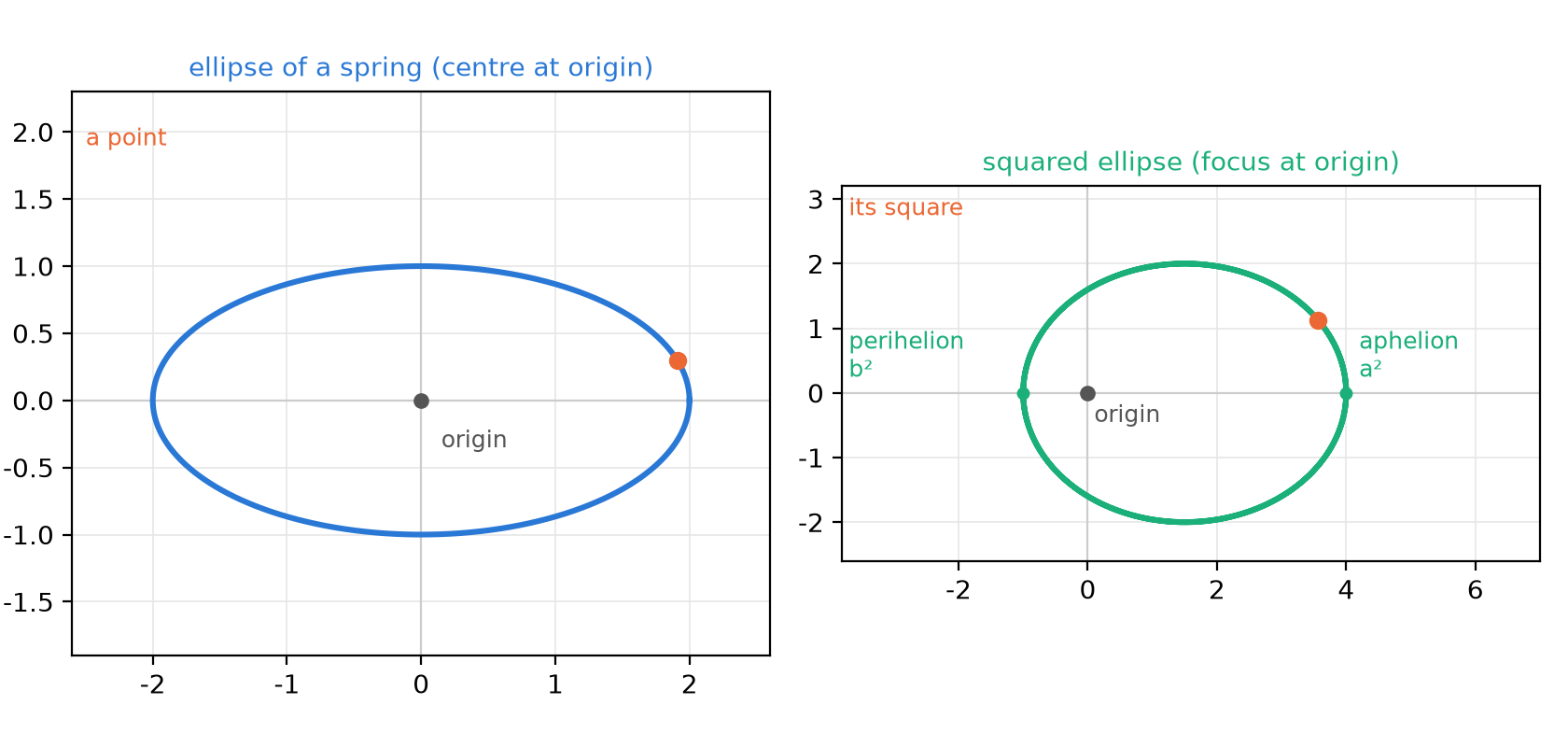
First, and this is the core of the paper: squaring an ellipse of a spring, centred at the origin, gives an ellipse with a focus at the origin. The ellipse with radii 2 and 1 maps to an ellipse with semi-major axis $\mathbf{2.500000}$ and eccentricity $\mathbf{0.600000}$, and the spread of the sum of distances to the two foci is at most $\mathbf{1.421}$×10⁻¹⁴ over the four ellipses tried. While the spring goes round once, the image goes round the origin twice.
Second, time does not carry over unless it is measured anew. In the original time the areal velocity moves from $\mathbf{2.000000}$ to $\mathbf{8.000000}$, but stretching the time step by the square of the distance from the origin reduces its spread to $\mathbf{2.072}$×10⁻¹⁵. Then the stiffness of the spring becomes the energy of Kepler, and the energy of the spring becomes the strength of Kepler’s attraction.
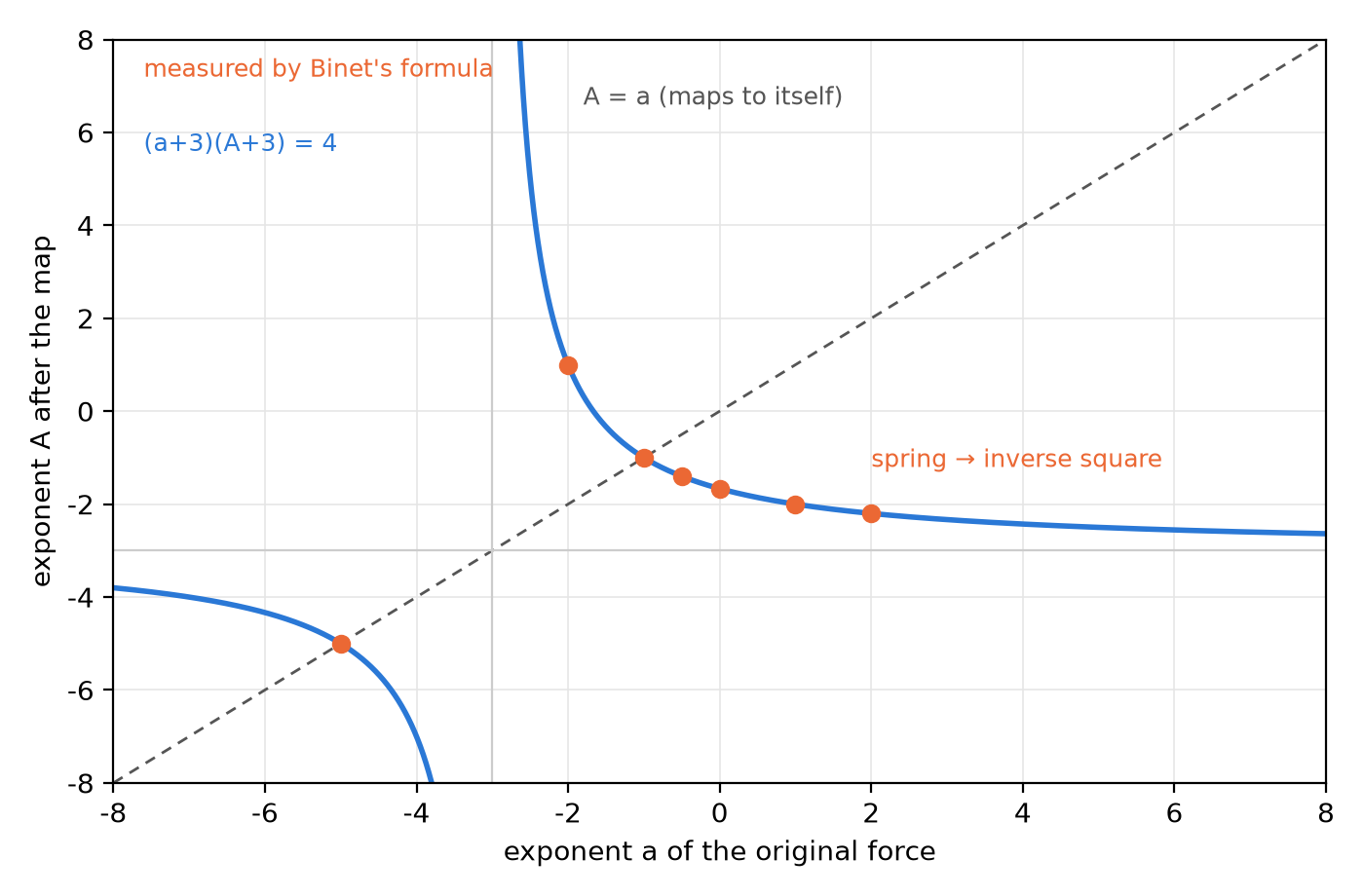
Third, the exponents of force pair up by (a+3)(A+3)=4. Mapping an orbit of a force with exponent a by the power (a+3)/2 and working back to the central force that makes the image an orbit, all seven exponents tried came out as predicted. The spring’s +1 maps to $\mathbf{-2.000000000}$ and the constant force’s 0 to $\mathbf{-1.666666667}$, and shifting the exponent by 0.1 makes the spread jump to at least $\mathbf{1.383}$×10⁻².
Fourth, two exponents map to themselves and one has no partner. The force inversely proportional to distance (the map does nothing) and the force inversely proportional to the fifth power (the map is an inversion) map to themselves, while for the inverse-cube force the power of the map becomes 0 and there is no partner.
Fifth, a collision is, on the side of the spring, just a passage through the origin. Making the spring’s ellipse thinner drives the eccentricity of the Kepler image towards 1, up to $\mathbf{0.999950001}$, and its maximum speed diverges up to 400, while the spring’s speed stays at 2. Flattened completely, the Kepler side becomes a fall into the sun and a bounce, and the speed times the square root of the distance settles at $\mathbf{4.000000000}$.
Sixth, the conserved quantities map with the angle doubled. With the principal axis of the spring’s conserved tensor at angle 0.3, the perihelion of Kepler points at $\mathbf{3.741592654}$, which is π plus twice the angle.
Stated plainly, what is shown is a planar result. The extension to three dimensions and the quantum story are not entered.
Keywords: ellipse of a spring, Kepler ellipse, squaring map, Bertrand’s theorem, change of time, collision regularization, pairing of force exponents, separator.
Scope (what is not claimed)
No new theorem or law is claimed: Bertrand’s theorem, the joining of the orbits of a spring and of Kepler by a squaring map (Bohlin, Kasner, Arnold), and the regularization of collisions (Levi-Civita) are all known. Only the plane is treated; the transformation extending this to three dimensions (Kustaanheimo and Stiefel) is not entered. No quantum story is told; the correspondence between the hydrogen atom and the oscillator is not touched. Symmetry groups are not mapped; what is shown stops at the direction of the conserved quantities, and the relation between groups is not discussed. Nothing is called one root, because the shape is joined by one map while time and the conserved quantities do not carry over without being measured anew. Numerical integration is not written up as proof; the pairing of exponents is checked by working back from numerically solved orbits. Relation to earlier papers: this paper takes the seat of the scope note of Paper 1002, “collision regularization and motion after a collision are not treated” (no earlier occupant). Paper 79 wrote that the central forces with closed orbits are the inverse square and the spring, and that their hidden symmetries differ; here the two are shown to be joined, in the plane, by one map of shapes. That the symmetries differ is left intact. Paper 01 showed that the flux is independent of radius only for the inverse square; here that inverse square appears at the far end of the spring’s map. Paper 258 showed that raising the dimension of the source by one turns the reciprocal into a logarithm; here the force inversely proportional to distance, the force of a point source in the plane, is seen to map to itself. Paper 68 took a census of the 2 of the Born rule and the 2 of the Hopf map; the squaring map here is also two to one, and the transformation into three dimensions uses the Hopf map, which is not entered. Paper 300 showed that whether two things share a root is decidable; by that criterion, two things joined only in shape are not called one root. What is added is: checking numerically that the focus of the squared ellipse sits at the origin, measuring that the change of time exchanges energy and the strength of attraction, working back the pairing of exponents for seven exponents, showing numerically that a collision is a passage through the origin on the side of the spring, and measuring that the direction of the conserved quantity maps with the angle doubled.
1. The question and the shape of the answer
Among forces directed to a centre, only two make every bounded orbit close: an attraction inversely proportional to the square of the distance and the force of a spring proportional to the distance. This is Bertrand’s theorem (1873). Paper 79 wrote that the two close for reasons lying in different hidden symmetries.
Are the two then entirely unrelated? In the plane they are not. Write a point of the plane as a complex number $z$ and map the orbit of a spring by $w=z^2$: the result is an orbit of Kepler. The correspondence goes back to Bohlin (1911) and Kasner (1913), and Arnold presented it in his book Huygens and Barrow, Newton and Hooke (1990). Needham (1993) organized it as a correspondence between forces of general power.
This paper checks the correspondence numerically, separating what carries over from what does not. What carries over is the shape of the orbit. Time does not carry over unless it is measured anew. Energy and the strength of the force exchange roles, and the conserved quantities carry over with the angle of their direction doubled.
2. Squaring brings the focus to the origin
Under the spring force $-kz$, an orbit is an ellipse centred at the origin, $z=a\cos\tau+i b\sin\tau$. Squaring it gives
$$w=z^2=\frac{a^2-b^2}{2}+\frac{a^2+b^2}{2}\cos2\tau+i\,ab\sin2\tau,$$an ellipse with centre $(a^2-b^2)/2$, semi-major axis $(a^2+b^2)/2$ and semi-minor axis $ab$. The distance from the centre to a focus is $(a^2-b^2)/2$, so one focus sits exactly at the origin.
This was checked on four ellipses. Whether the sum of distances to the two foci (the origin and $a^2-b^2$) is constant was measured with one turn divided into 200,000 points.
| $a$, $b$ | semi-major | semi-minor | eccentricity | spread of the sum | perihelion, aphelion |
|---|---|---|---|---|---|
| 2, 1 | $2.500000$ | $2.000000$ | $0.600000$ | $3.553\times10^{-15}$ | $1.000000$, $4.000000$ |
| 3, 0.5 | $4.625000$ | $1.500000$ | $0.945946$ | $1.421\times10^{-14}$ | $0.250000$, $9.000000$ |
| 1.5, 1.2 | $1.845000$ | $1.800000$ | $0.219512$ | $4.441\times10^{-15}$ | $1.440000$, $2.250000$ |
| 1, 1 | $1.000000$ | $1.000000$ | $0.000000$ | $1.554\times10^{-15}$ | $1.000000$, $1.000000$ |
The perihelion is $b^2$, the aphelion $a^2$, and the eccentricity $(a^2-b^2)/(a^2+b^2)$. A circle maps to a circle. Because squaring doubles angles, while the spring goes round once the image goes round the origin $2.000000$ times.
3. Time does not carry over unless it is measured anew
The shape carried over, but the pace of the motion does not. Measured in the spring’s original time $\tau$, the areal velocity of the image (the area swept per unit time as seen from the origin) is not constant. Kepler’s second law holds only when the time step is stretched as $dT=|z|^2d\tau$, by the square of the distance from the origin.
Then the energy on Kepler’s side is $-2k$ and the strength of attraction (the quantity playing the role of the sun’s mass) is $4h$. Here $k$ is the stiffness of the spring and $h$ its energy. The stiffness of the spring becomes an energy, and the energy of the spring becomes the strength of a force: they exchange roles.
| $a$, $b$, $k$ | areal velocity, original time | spread, new time | energy | strength | period |
|---|---|---|---|---|---|
| 2, 1, 1 | $2.000000$ to $8.000000$ | $1.776\times10^{-15}$ | $-2.000000000$ | $10.000000$ | $7.853981634$ |
| 2, 1, 2 | $2.828427$ to $11.313708$ | $1.570\times10^{-15}$ | $-4.000000000$ | $20.000000$ | $5.553603673$ |
| 3, 0.5, 1 | $0.375000$ to $13.500000$ | $2.072\times10^{-15}$ | $-2.000000000$ | $18.500000$ | $14.529866023$ |
The period is the new time accumulated over half a period of the spring, and it agrees with Kepler’s third law $2\pi\sqrt{A^3/\mu}$ in all nine printed digits. The spread of the energy is at most $2.416\times10^{-13}$. The shape carries over as it is, while time carries over only when stretched by the square of the distance. This is where the separator of the paper lies.
4. The exponents of force pair up by (a+3)(A+3)=4
The spring and Kepler are one pair in a larger correspondence. Mapping an orbit of a force proportional to the $a$-th power of the distance by $w=z^{\alpha}$, $\alpha=(a+3)/2$, gives an orbit of a force proportional to the $A$-th power, with
$$(a+3)(A+3)=4$$(what Needham 1993 calls the Kasner--Arnold theorem). The spring is $a=1$, the map is the square, and the partner is $A=-2$.
This was checked by working backwards. An orbit of the force with exponent $a$ is solved numerically, and for the mapped curve $R(\Phi)$ the central force making it an orbit is obtained from Binet’s formula $F=L^2u^2(u''+u)$ ($u=1/R$). The derivatives were not taken by differences but computed directly from the position and velocity on the orbit. If the force is proportional to $R^A$, then $F/R^A$ is constant along the orbit.
| original $a$ | power of map | predicted $A$ | measured slope | spread of $F/R^A$ | exponent shifted by 0.1 |
|---|---|---|---|---|---|
| $+2$ | 2.50 | $-2.200000$ | $-2.200000000$ | $4.201\times10^{-13}$ | $4.635\times10^{-2}$ |
| $+1$ | 2.00 | $-2.000000$ | $-2.000000000$ | $6.590\times10^{-13}$ | $7.394\times10^{-2}$ |
| $0$ | 1.50 | $-1.666667$ | $-1.666666667$ | $2.215\times10^{-12}$ | $7.115\times10^{-2}$ |
| $-0.5$ | 1.25 | $-1.400000$ | $-1.400000000$ | $2.158\times10^{-12}$ | $6.919\times10^{-2}$ |
| $-1$ | 1.00 | $-1.000000$ | $-1.000000000$ | $2.635\times10^{-12}$ | $4.262\times10^{-2}$ |
| $-2$ | 0.50 | $+1.000000$ | $+1.000000000$ | $9.463\times10^{-12}$ | $3.841\times10^{-2}$ |
| $-5$ | $-1.00$ | $-5.000000$ | $-5.000000000$ | $3.997\times10^{-13}$ | $1.383\times10^{-2}$ |
For all seven exponents the spread of $F/R^A$ stays at most $9.463\times10^{-12}$, while shifting the exponent by 0.1 makes it jump to at least $1.383\times10^{-2}$. None of the orbits is a circle: $R$ ranges over a factor of $1.147$ to $2.041$. Mapping Kepler’s $a=-2$ by the square root returns the spring’s $A=+1$.
5. Exponents that map to themselves, and one with no partner
The correspondence is an exchange: mapping twice returns to the start.
| $a$ | partner $A$ | power of map $(a+3)/2$ |
|---|---|---|
| $+7$ | $-2.600000$ | 5.000 |
| $+2$ | $-2.200000$ | 2.500 |
| $+1$ | $-2.000000$ | 2.000 |
| $+0.5$ | $-1.857143$ | 1.750 |
| $0$ | $-1.666667$ | 1.500 |
| $-0.5$ | $-1.400000$ | 1.250 |
| $-1$ | $-1.000000$ | 1.000 |
| $-2$ | $+1.000000$ | 0.500 |
| $-2.5$ | $+5.000000$ | 0.250 |
| $-5$ | $-5.000000$ | $-1.000$ |
Two exponents map to themselves, $a=-1$ and $a=-5$, the solutions of $(a+3)^2=4$. For $a=-1$ the power of the map is 1 and the map does nothing. This is the form of the force of a point source in the plane, where Paper 258 showed that raising the dimension of the source by one turns the reciprocal into a logarithm. For $a=-5$ the power of the map is $-1$ and the map is the inversion about the origin, $w=1/z$. Mapped by inversion, the orbits of a force inversely proportional to the fifth power return to orbits of the same kind.
For $a=-3$, the inverse-cube force, the power of the map becomes 0 and the map collapses. This force has no partner. The larger a positive exponent, the closer its partner comes to $-3$, and exponents just below $-3$ have large positive partners.
6. A collision is, on the side of the spring, just a passage through the origin
Paper 1002 stopped its integration as three bodies approached a collision and did not treat collision regularization. For a collision of two bodies in the plane, the regularization is exactly this map (Levi-Civita 1920).
Make the spring’s ellipse thinner. Keeping the radius $a=2$ and shrinking $b$, the Kepler image approaches eccentricity 1 and its speed at perihelion diverges. Yet the maximum speed on the spring’s side stays at $a$.
| $b$ | eccentricity | perihelion distance | Kepler’s maximum speed | spring’s maximum speed |
|---|---|---|---|---|
| 1.00 | $0.600000000$ | $1.000000$ | 4.000 | 2.000 |
| 0.30 | $0.955990220$ | $0.090000$ | 13.333 | 2.000 |
| 0.10 | $0.995012469$ | $0.010000$ | 40.000 | 2.000 |
| 0.01 | $0.999950001$ | $0.000100$ | 400.000 | 2.000 |
Flattened to $b=0$, the spring oscillates along a line through the origin, $z=2\cos\tau$. The image is $w=4\cos^2\tau$, moving only on the positive real axis: it falls into the origin and bounces back. Near the origin (distance below $10^{-6}$), Kepler’s speed times the square root of the distance lies between $3.999999508$ and $4.000000000$ and settles at the value $\sqrt{2\mu}=4.000000000$ required by conservation of energy. The speed diverges as the inverse square root of the distance. On the spring’s side, though, the particle simply passes the origin at speed 2 and nothing special happens. The singularity of the collision has been pushed onto the map.
7. The conserved quantities map with the angle doubled
Kepler’s orbit conserves the Laplace--Runge--Lenz vector pointing to perihelion. The spring’s orbit conserves a second-rank tensor $T_{ij}=\dot z_i\dot z_j+k z_iz_j$ (the Fradkin tensor) describing the direction of the ellipse’s axes. Rotate the spring’s ellipse by an angle $\psi$ and map it: Kepler’s perihelion comes to point in the direction $\pi+2\psi$.
| rotation $\psi$ | spring’s principal axis | Kepler’s perihelion direction | $\pi+2\psi$ |
|---|---|---|---|
| 0.00 | $0.000000000$ | $3.141592654$ | $3.141592654$ |
| 0.30 | $0.300000000$ | $3.741592654$ | $3.741592654$ |
| 1.00 | $1.000000000$ | $5.141592654$ | $5.141592654$ |
| 2.50 | $2.500000000$ | $1.858407346$ | $1.858407346$ |
Both conserved quantities are constant along the orbit, with deviations of at most $3.55\times10^{-15}$ on the spring’s side and $2.56\times10^{-14}$ on Kepler’s side. The magnitude of the vector divided by the strength of attraction is $0.600000000$, the eccentricity itself. The conserved quantity carries over with the angle of its direction doubled. What carries over, however, is only the direction; the relation between the groups to which the two conserved quantities belong is not entered here.
8. The separator: carrying the shape of the orbit, or the ticking of time
The map carries the shape as it is. Ellipses go to ellipses, the centre to a focus, angles to doubled angles. But it does not carry the ticking of time. The areal velocity is constant only when the step is stretched by the square of the distance from the origin; in the original time it moves by a factor of more than 4. And once time is measured anew, the stiffness and energy of the spring exchange roles with the energy and strength of attraction of Kepler.
The separator is whether one carries the shape of the orbit or the ticking of time. The shape is joined; time and the roles of energy are not. That is why Paper 79’s “the two closed forces close by different symmetries” and this paper’s “in the plane they are joined by one map” stand together.
9. Relation to earlier papers
This paper takes the seat of the scope note of Paper 1002, “collision regularization and motion after a collision are not treated” (no earlier occupant). Section 6 showed numerically that a collision of two bodies in the plane is, on the side of the spring, just a passage through the origin.
Paper 79 wrote that the central forces with closed orbits are the inverse square and the spring, and that their hidden symmetries differ. Here the two were shown to be joined, in the plane, by one map of shapes. That the symmetries differ was left intact.
Paper 01 showed that the flux is independent of radius only for the inverse square. Here that inverse-square force appeared at the far end of squaring the spring.
Paper 258 showed that raising the dimension of the source by one turns the reciprocal into a logarithm. Here the force inversely proportional to distance, the force of a point source in the plane, mapped to itself (Section 5).
Paper 68 took a census of the 2 of the Born rule and the 2 of the Hopf map. The squaring map here is also two to one, sending $z$ and $-z$ to the same point. The transformation extending it to three dimensions uses the Hopf map, but this paper stays in the plane.
Paper 300 showed that whether two things share a root is decidable. By that criterion, two things joined in shape but not in time or in the roles of energy are not called one root.
Closing
Closing: squaring the ellipse of a spring gives the ellipse of Kepler. An ellipse centred at the origin maps to an ellipse with a focus at the origin: the ellipse with radii 2 and 1 becomes one with semi-major axis $\mathbf{2.500000}$ and eccentricity $\mathbf{0.600000}$, and the spread of the sum of distances is at most $\mathbf{1.421}$×10⁻¹⁴. Time does not carry over unless measured anew: the areal velocity moves from $\mathbf{2.000000}$ to $\mathbf{8.000000}$ in the original time, and stretching the step by the square of the distance brings the spread to $\mathbf{2.072}$×10⁻¹⁵. The stiffness and energy of the spring exchange roles with Kepler’s energy and strength of attraction. The exponents of force pair up by (a+3)(A+3)=4: the exponents worked back for seven cases are as predicted, and the spring’s +1 maps to $\mathbf{-2.000000000}$. A collision is, on the side of the spring, just a passage through the origin: Kepler’s speed times the square root of the distance settles at $\mathbf{4.000000000}$, while the spring’s speed stays at 2. The conserved quantities map with the angle doubled: the perihelion points at $\mathbf{3.741592654}$, π plus twice the angle. Stated plainly, this is a planar result, and the extension to three dimensions and the quantum story are not entered. The separator: whether one carries the shape of the orbit or the ticking of time. The shape is joined; time and the roles of energy are not.
References
- Arnold, V. I. (1990). Huygens and Barrow, Newton and Hooke. Birkhäuser.
- Bertrand, J. (1873). Théorème relatif au mouvement d’un point attiré vers un centre fixe. Comptes Rendus de l’Académie des Sciences.
- Bohlin, K. (1911). Note sur le problème des deux corps et sur une intégration nouvelle dans le problème des trois corps. Bulletin astronomique.
- Kasner, E. (1913). Differential-Geometric Aspects of Dynamics. American Mathematical Society Colloquium Publications.
- Kustaanheimo, P., & Stiefel, E. (1965). Perturbation theory of Kepler motion based on spinor regularization. Journal für die reine und angewandte Mathematik.
- Levi-Civita, T. (1920). Sur la régularisation du problème des trois corps. Acta Mathematica.
- Needham, T. (1993). Newton and the Transmutation of Force. The American Mathematical Monthly.
- Yamagishi, Y. (2026). The Uniqueness Theorem of $n = 2$ for Spherically Symmetric Density Distributions. [Paper 01]. YOI: https://www.yamagishiyuuki.com/yoi/1; DOI: 10.5281/zenodo.21403186
- Yamagishi, Y. (2026). The Qubit as a Hopf Fibration [Paper 68]. YOI: https://www.yamagishiyuuki.com/yoi/68; DOI: 10.5281/zenodo.21642238
- Yamagishi, Y. (2026). The Hidden Symmetry Unique to n=2 [Paper 79]. YOI: https://www.yamagishiyuuki.com/yoi/79; DOI: 10.5281/zenodo.21732820
- Yamagishi, Y. (2026). $4\pi$ Appears Only When the Source Is a Point [Paper 258]. YOI: https://www.yamagishiyuuki.com/yoi/258; DOI: 10.5281/zenodo.22169011
- Yamagishi, Y. (2026). The Three Hundredth Census: Whether Two Things Share a Root Is Decidable [Paper 300]. YOI: https://www.yamagishiyuuki.com/yoi/300; DOI: 10.5281/zenodo.22171914
- Yamagishi, Y. (2026). The Three-Body Moment of Inertia Is a Parabola Only in Four Dimensions, Where the Spinning Triangle Has Zero Energy [Paper 1002]. YOI: https://www.yamagishiyuuki.com/yoi/1002; DOI: 10.5281/zenodo.22823542
Reference
Yamagishi, Y. (2026). Squaring the Ellipse of a Spring Gives the Ellipse of Kepler [Paper 1072]. YOI: https://www.yamagishiyuuki.com/yoi/1072
ORCID: 0009-0006-8587-3450
PDF (English) · PDF (Japanese) · Date proof of the English PDF (OpenTimestamps .ots) · SHA256SUMS
The record page for this paper (in Japanese, with the PDFs in each language and the date proof): YOI 1072. This paper is a preprint and has not been peer reviewed.