Abstract
A map of the surface of a doughnut (the torus) to itself that is continuously connected to the identity has Lefschetz number 0. That 0 is the same whether every point is fixed or none is, and it says nothing about the number of fixed points (Paper 161). The critical points of a function on the torus, by contrast, have a floor: there are at least 4 (Paper 203). Arnold (1965) conjectured that a map keeping area and having zero average shift (flux) has the same floor as a function; on the torus Conley and Zehnder (1983) proved it. This paper checks it numerically. No new theorem or law is claimed.
First, and this is the core of the paper: a map keeping area and flux always has at least four fixed points. Over 60 maps built from shears in four directions, the number of fixed points moved from 4 to 26 (mean $\mathbf{13.833}$), and the non-degenerate ones never fell below 4. The index sum was always 0, and the number was always even.
Second, for small amplitude the fixed points of the map sit on the critical points of a function. The number of critical points of the function generating the shears equalled the number of fixed points for all eight functions, and the distance halves as the amplitude is halved (the last ratios lie between $\mathbf{1.912}$ and $\mathbf{2.004}$).
Third, adding flux removes the floor. Adding an average shift while keeping area, the fixed points fall from 6 to 4 and 2, and at a shift of 0.30 to none. The index sum stays 0.
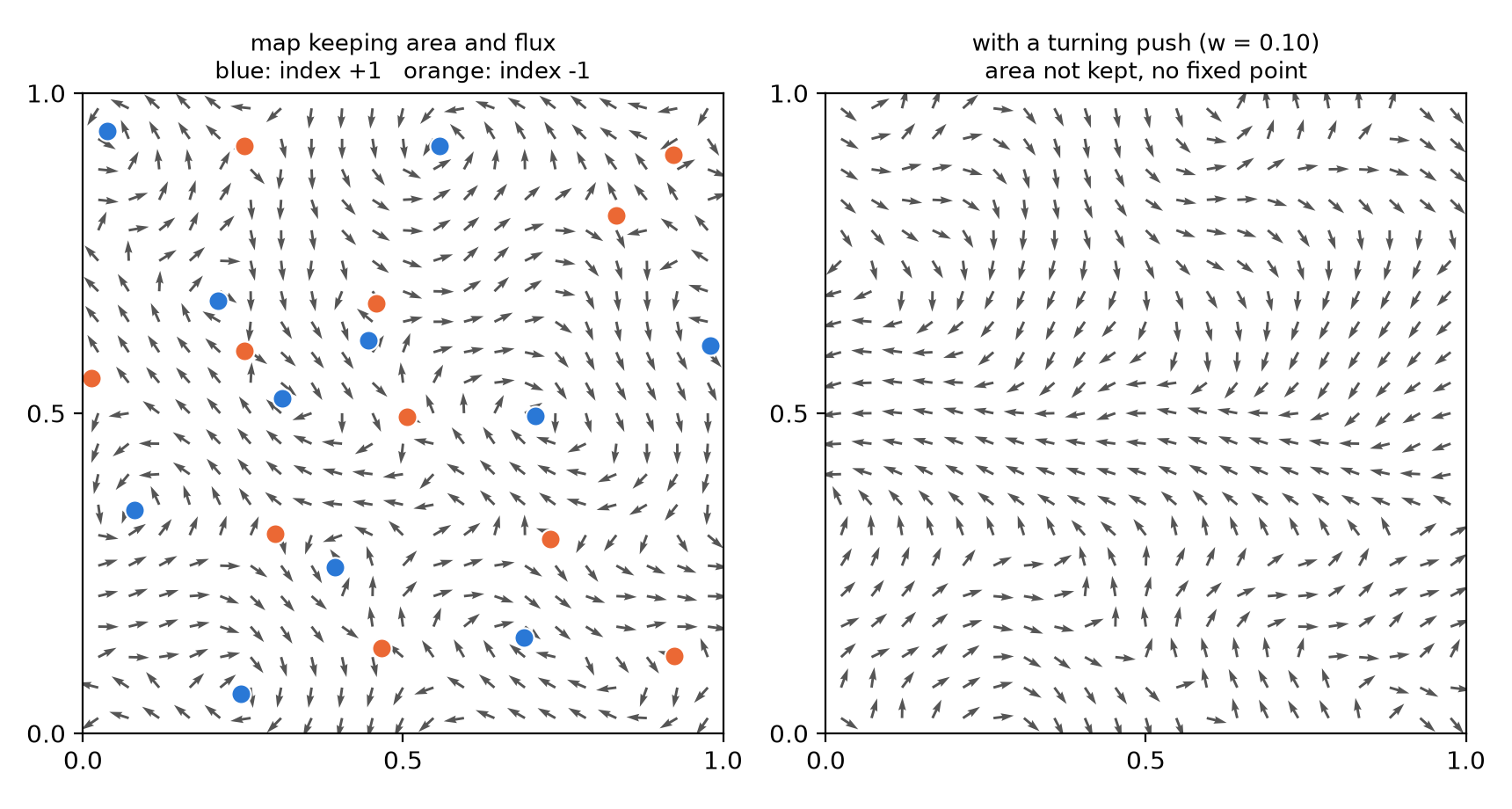
Fourth, dropping area removes the floor too. Keeping the average shift at 0 but adding a push whose direction turns, so that area is no longer kept, a map with no fixed point at all appears at push 0.10. The factor of stretching then lies between $\mathbf{0.372}$ and $\mathbf{1.628}$, so the surface is not folded.
Stated plainly, two expectations failed. One function’s ratio approached 2 slowly; I expected the reason to be that its critical points were close to degenerate, but that was not the case. The reason has not been measured.
Keywords: fixed point, Lefschetz number, Arnold conjecture, area-preserving map, flux, critical point, torus, separator.
Scope (what is not claimed)
No new theorem or law is claimed: the Lefschetz fixed-point theorem, the Morse inequalities, and the Arnold conjecture with its proof on the torus (Conley and Zehnder) are all known. The conjecture is not proved; what is shown stops at counting that the floor is not broken by the maps built here. Only the torus is treated; higher dimensions and general surfaces are not entered. Floer theory is not entered; the tools of the proof in the general case are not touched. Degenerate fixed points are not counted; allowing degeneracy lowers the floor to 3, but only the non-degenerate case is counted here. No reason is guessed; the reason why one function’s ratio approaches 2 slowly is not written, because the expectation failed. Relation to earlier papers: Paper 161 showed that on the torus both the identity and a rotation have Lefschetz number 0, and that this 0 says nothing about whether there are fixed points. Here it is counted that keeping both area and flux makes a floor of 4 appear within that silence. Paper 203 showed that the counts of critical points of a function on the torus move a great deal while the alternating sum is always 0, with a floor of 4. Here the fixed points of the map are measured to sit on the critical points of a function as the amplitude shrinks, showing the same floor on the side of maps. Paper 1070 showed that preserving volume and being unsqueezable part company from four dimensions on. Here, in two dimensions, adding zero flux to keeping area is seen to fix the floor of fixed points. Paper 128 treated the index sum being the Euler characteristic. The index sum 0 here is the Lefschetz number of a map connected to the identity, equal to the Euler characteristic 0 of the torus. Paper 300 showed that whether two things share a root is decidable. By that criterion, since dropping area or flux leaves the index sum unmoved and removes only the floor, the floor and the index sum are not called one root. What is added is: counting that the floor of 4 is not broken by maps built from shears in four directions, measuring that the distance between fixed points and critical points shrinks in proportion to the amplitude, setting side by side that dropping either flux or area removes the floor, and recording the expectations that failed.
1. The question and the shape of the answer
Consider a map sending the points of the surface of a doughnut (the torus) to points of the same torus. A point the map does not move is a fixed point. For a map continuously connected to the identity, the sum of the indices of the fixed points (the Lefschetz number) is always 0. Paper 161 showed that the identity (every point fixed) and a rotation (no fixed point) both have Lefschetz number 0, and wrote that this 0 says nothing about the number of fixed points.
A function on the torus, on the other hand, always has critical points: minima, saddles and maxima. Paper 203 showed that their numbers move a great deal while the alternating sum is always 0, and that in the non-degenerate case the floor is 4 (the sum 1+2+1 of the Betti numbers of the torus).
Arnold (1965) drew a line between the two. His conjecture is that a map keeping area and with zero average shift (flux), that is, a map coming from the flow of one function, has the same floor for its fixed points as a function has for its critical points. On the torus it was proved by Conley and Zehnder (1983). This paper checks it numerically and sets side by side that dropping either of the two conditions removes the floor.
2. How the maps are built
Represent the torus as a periodic square. A “shear” along a direction $d=(d_1,d_2)$ moves a point in the direction $d$ by a function $h(s)$ of the transverse coordinate $s=d_2x-d_1y$: $p\mapsto p+\varepsilon h(s) d$. If $h$ has mean 0, the average shift (flux) is 0, and the determinant of the Jacobian is exactly 1, so area is kept.
Shears in the four directions $(1,0)$, $(0,1)$, $(1,1)$ and $(1,-1)$, each with a random function, are composed. The composition still keeps area and flux; the determinant differed from 1 by at most $8.882\times10^{-16}$. The function generating these shears is $K=\sum_k\Phi_k(s_k)$ with $\Phi_k'=-h_k$, and for small amplitude $\varepsilon$ the map is close to the flow of $K$.
There is a reason for not using only two directions. With only horizontal and vertical shears, the fixed points are pairs of a zero of the horizontal function and a zero of the vertical function, and since a function with mean 0 has at least 2 zeros, “at least four” would follow without counting. Composing four directions breaks that pairing. Fixed points were found by running Newton’s method from every starting point of a grid.
3. Keeping area and flux, there are always at least four fixed points
Sixty maps with amplitude $\varepsilon=0.06$ were built and their fixed points counted.
| fixed points | 4 | 6 | 8 | 10 | 12 | 14 | 16 | 18 | 20 | 22 | 24 | 26 |
|---|---|---|---|---|---|---|---|---|---|---|---|---|
| maps | 2 | 1 | 7 | 12 | 10 | 5 | 6 | 7 | 4 | 1 | 2 | 3 |
The number of fixed points moved from 4 to 26, with mean $\mathbf{13.833}$. No map had fewer than 4 non-degenerate fixed points. The only value the index sum took was 0; fixed points of index $+1$ and $-1$ were always equal in number, so the count was always even. As with the critical points of functions in Paper 203, the count moves a great deal, the alternating sum does not move, and the floor is at 4.
To check for missed points, 10 maps were searched with a grid of starting points of $40\times40$ and of $80\times80$. The counts were the same for all 10 (14 to 26).
4. For small amplitude, fixed points sit on critical points
That the map “comes from the flow of a function” is checked directly. For eight random functions $K$, the critical points were found and compared with the fixed points of the map built from the same function. The amplitude was halved from $0.004$ down to $0.000125$.
| function | critical points (extrema, saddles) | smallest Hessian determinant | distance (0.004) | distance (0.000125) | first ratio | last ratio | at 0.06 | at 0.25 |
|---|---|---|---|---|---|---|---|---|
| 1 | 18 (9, 9) | 10.844 | $3.467\times10^{-3}$ | $1.005\times10^{-4}$ | 2.086 | 2.004 | 16 | 24 |
| 2 | 12 (6, 6) | 26.945 | $1.233\times10^{-2}$ | $6.669\times10^{-4}$ | 1.679 | 1.912 | 12 | 12 |
| 3 | 12 (6, 6) | 17.587 | $4.559\times10^{-3}$ | $1.518\times10^{-4}$ | 1.934 | 1.996 | 12 | 14 |
| 4 | 34 (17, 17) | 102.728 | $4.668\times10^{-3}$ | $1.477\times10^{-4}$ | 1.987 | 1.999 | 34 | 30 |
| 5 | 22 (11, 11) | 103.356 | $2.810\times10^{-3}$ | $8.801\times10^{-5}$ | 1.998 | 2.000 | 22 | 22 |
| 6 | 8 (4, 4) | 161.100 | $4.608\times10^{-3}$ | $1.445\times10^{-4}$ | 1.996 | 2.000 | 8 | 14 |
| 7 | 10 (5, 5) | 22.734 | $4.213\times10^{-3}$ | $1.302\times10^{-4}$ | 2.011 | 2.001 | 12 | 8 |
| 8 | 12 (6, 6) | 41.853 | $2.447\times10^{-3}$ | $7.673\times10^{-5}$ | 1.996 | 2.000 | 12 | 12 |
In all six steps from $0.004$ to $0.000125$, the number of fixed points equalled the number of critical points. The distance approaches half each time the amplitude is halved, and the ratios in the last step lie between $\mathbf{1.912}$ and $\mathbf{2.004}$. Extrema and saddles of the critical points were always equal in number, so the alternating sum is 0. Increasing the amplitude to $0.06$ and $0.25$ can change the count, but it never falls below 4.
One expectation that failed is recorded here. At first I expected the ratios of the first two halvings to lie between 1.9 and 2.1, but function 2 alone missed at 1.679. Its ratio approached 2 monotonically from below as the amplitude was lowered: 1.679, 1.729, 1.793, 1.858, 1.912. I expected the reason to be that its critical points were close to degenerate (a small Hessian determinant), but function 2’s smallest Hessian determinant, 26.945, was only the fourth smallest of the eight, so the expectation failed. The reason has not been measured.
5. Adding flux removes the floor
Keeping area, a horizontal average shift $c$ is added at the end. This is a rotation (translation) component, moving towards Paper 161’s example with no fixed point.
| average shift $c$ | 0.00 | 0.02 | 0.05 | 0.10 | 0.15 | 0.20 | 0.30 |
|---|---|---|---|---|---|---|---|
| fixed points | 6 | 6 | 6 | 4 | 2 | 2 | 0 |
The 6 fixed points present at zero flux fall to 4 and 2 as the shift is added, and at 0.30 none remain. The index sum is 0 at every step. Even when area is kept, carrying flux removes the floor.
6. Dropping area removes the floor too
Now the flux is kept at 0 and area is not kept. After the four shears, a push of constant size whose direction turns with $y$, $w(\cos2\pi y,\sin2\pi y)$, is added. The mean of the push itself is $(6.139\times10^{-17}, 4.832\times10^{-17})$, so the average shift is 0. But because its size is constant and only its direction turns, there is no point where it stops.
| push size $w$ | fewest fixed points | most | mean | factor of stretching (determinant) |
|---|---|---|---|---|
| 0.00 | 8 | 24 | 13.60 | 1.000 to 1.000 |
| 0.02 | 6 | 24 | 12.70 | 0.874 to 1.126 |
| 0.05 | 4 | 26 | 11.70 | 0.686 to 1.314 |
| 0.10 | 0 | 16 | 7.30 | 0.372 to 1.628 |
Each row uses the same 20 maps. At push 0.10 a map with no fixed point at all appeared. The determinant then stays positive, between $\mathbf{0.372}$ and $\mathbf{1.628}$, so the surface is not folded. At push 0.20 the determinant falls to $-0.257$ and the surface folds, so that case was not used as a control. The index sum is 0 in every row. The Lefschetz number does not see area, so dropping area leaves it at 0 and silent.
7. The separator: whether the map comes from the flow of one function
Set the three cases side by side. A map keeping both area and flux comes from the flow of one function, and its fixed points have the same floor of 4 as the critical points of a function. Adding flux removes the floor even when area is kept. Dropping area removes the floor even when the flux is 0. In every case the Lefschetz number stays 0.
The separator is whether the map comes from the flow of one function. If it does, its fixed points behave like critical points; if not, it returns to the silence of the Lefschetz number.
8. Relation to earlier papers
Paper 161 showed that on the torus both the identity and a rotation have Lefschetz number 0, and that this 0 says nothing about whether there are fixed points. Here it was counted that keeping both area and flux makes a floor of 4 appear within that silence.
Paper 203 showed that the counts of critical points of a function on the torus move a great deal while the alternating sum is always 0, with a floor of 4. Here the fixed points of the map were measured to sit on the critical points of a function as the amplitude shrinks, showing the same floor on the side of maps (Section 4).
Paper 1070 showed that preserving volume and being unsqueezable part company from four dimensions on. Here, in two dimensions, keeping area alone was not enough: only with zero flux added was the floor of fixed points fixed.
Paper 128 treated the index sum being the Euler characteristic. The index sum 0 here is the Lefschetz number of a map connected to the identity, equal to the Euler characteristic 0 of the torus.
Paper 300 showed that whether two things share a root is decidable. By that criterion, since dropping area or flux leaves the index sum unmoved and removes only the floor, the floor and the index sum are not called one root.
Closing
Closing: the fixed points of maps keeping area and flux have the same floor as the critical points of functions. Over 60 maps keeping the two, the fixed points moved from 4 to 26 (mean $\mathbf{13.833}$), and the non-degenerate ones never fell below 4. For small amplitude, the number of fixed points equals the number of critical points of the function, and the distance shrinks in proportion to the amplitude (last ratios $\mathbf{1.912}$ to $\mathbf{2.004}$). Adding flux, the fixed points fall from 6 to 0. Dropping area, a map with no fixed point appears at push 0.10, with factors of stretching from $\mathbf{0.372}$ to $\mathbf{1.628}$. The Lefschetz number is 0 in every case and says nothing. Stated plainly, I expected the slow ratio of one function to come from critical points close to degenerate, which was not the case, and the reason has not been measured. The conjecture is not proved. The separator: whether the map comes from the flow of one function. If it does, its fixed points behave like critical points; if not, it returns to the silence of the Lefschetz number.
References
- Arnold, V. I. (1965). Sur une propriété topologique des applications globalement canoniques de la mécanique classique. Comptes Rendus de l’Académie des Sciences de Paris.
- Conley, C. C., & Zehnder, E. (1983). The Birkhoff--Lewis fixed point theorem and a conjecture of V. I. Arnold. Inventiones mathematicae.
- Floer, A. (1989). Symplectic fixed points and holomorphic spheres. Communications in Mathematical Physics.
- McDuff, D., & Salamon, D. (2017). Introduction to Symplectic Topology. Oxford University Press.
- Yamagishi, Y. (2026). $4\pi=2\pi\chi$ Holds in Three Dimensions and Nowhere Else [Paper 128]. YOI: https://www.yamagishiyuuki.com/yoi/128; DOI: 10.5281/zenodo.22079576
- Yamagishi, Y. (2026). A Fixed Point Is Not One Theorem [Paper 161]. YOI: https://www.yamagishiyuuki.com/yoi/161; DOI: 10.5281/zenodo.22092530
- Yamagishi, Y. (2026). The Counts of Critical Points Move a Great Deal, and Their Alternating Sum Never Moves at All [Paper 203]. YOI: https://www.yamagishiyuuki.com/yoi/203; DOI: 10.5281/zenodo.22109443
- Yamagishi, Y. (2026). The Three Hundredth Census: Whether Two Things Share a Root Is Decidable [Paper 300]. YOI: https://www.yamagishiyuuki.com/yoi/300; DOI: 10.5281/zenodo.22171914
- Yamagishi, Y. (2026). Preserving Volume and Being Unsqueezable Part Company from Four Dimensions On [Paper 1070]. YOI: https://www.yamagishiyuuki.com/yoi/1070; DOI: 10.5281/zenodo.22944894
Reference
Yamagishi, Y. (2026). Fixed Points of Maps Keeping Area and Flux Have the Same Floor as Critical Points of Functions [Paper 1073]. YOI: https://www.yamagishiyuuki.com/yoi/1073
ORCID: 0009-0006-8587-3450
PDF (English) · PDF (Japanese) · Date proof of the English PDF (OpenTimestamps .ots) · SHA256SUMS
The record page for this paper (in Japanese, with the PDFs in each language and the date proof): YOI 1073. This paper is a preprint and has not been peer reviewed.