Abstract
In a model of a rotor kicked at regular intervals (the standard map of Chirikov, 1979), weak kicks leave curves that cross the phase plane (invariant curves), and a point cannot pass from below such a curve to above it. As the kick grows, the curves break one by one. Greene (1979) judged that the curve with the golden rotation number survives longest and determined the kick at which it breaks. This paper measures, by one method, the kick at which three curves break: the golden one, and those whose continued fractions have every partial quotient equal to 2 or to 3; it sets them side by side and names what orders them. It claims no new theorem and no new law.
First, the method. A periodic orbit of rotation number p/q is found on a symmetry line, and the kick at which its residue (a number built from the trace of the Jacobian over one period) reaches 0.25 is taken as the mark of breaking (Greene’s method).
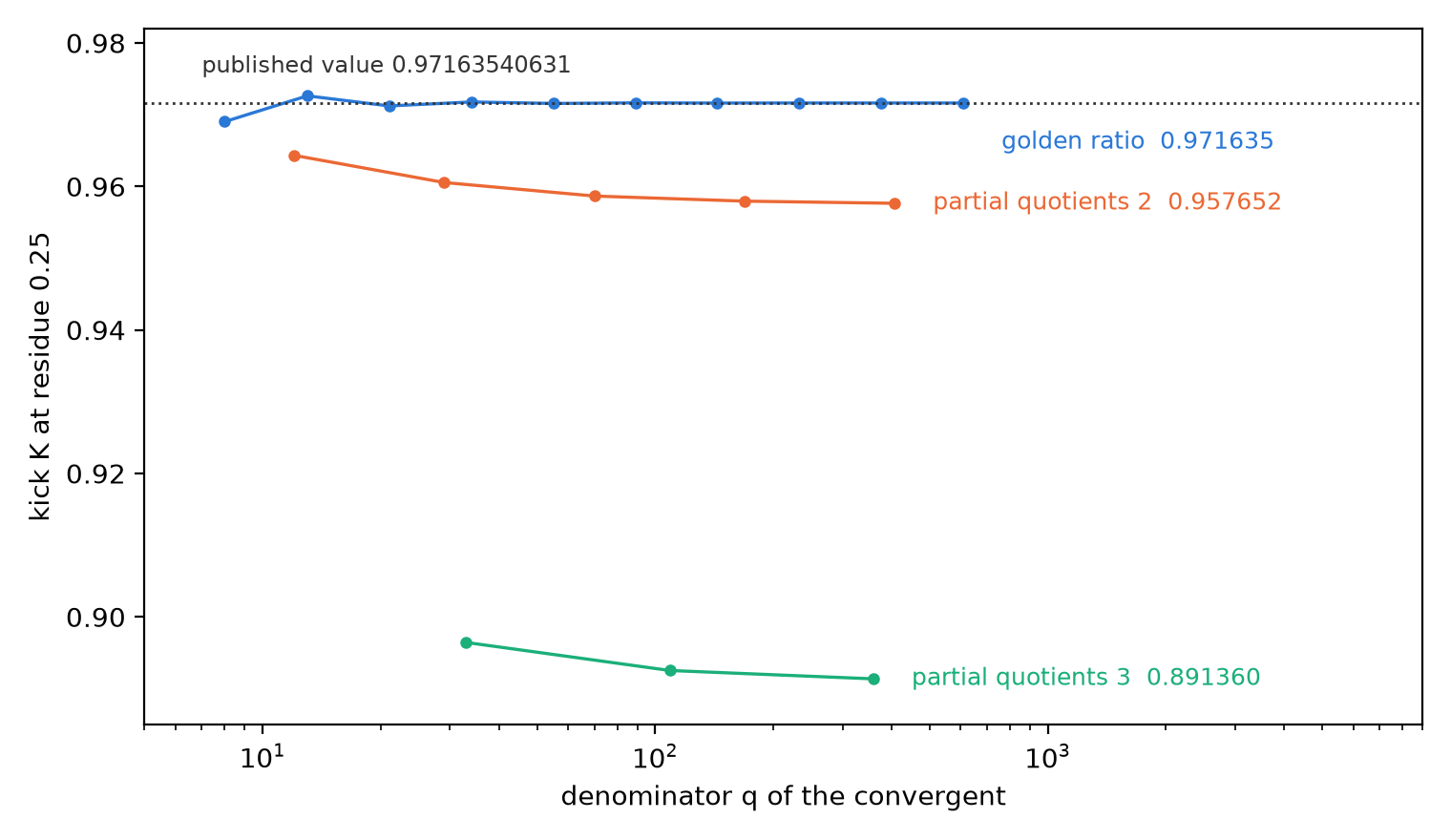
Second, the golden ratio. Refining the convergents from 5/8 to 377/610, the marked kick approaches the published value $\mathbf{0.97163540631}$; at 377/610 it is $\mathbf{0.971635313}$, a difference of $9.32$×10⁻⁸.
Third, and this is the core of the paper, the larger the partial quotients, the earlier the curve breaks. The number whose partial quotients are all 2 (√2 − 1) reaches the mark at $\mathbf{0.957652029}$ and the one whose partial quotients are all 3 at $\mathbf{0.891360492}$, both before the golden ratio. Their distances from the golden value are 46.4 and 68.8 times the change produced by the last refinement of the convergents.
Fourth, this order is the order of how hard the numbers are to approach by convergents. The limit of q|qα − p| over the convergents p/q is $\mathbf{0.447213596}$ for the golden ratio (the value of Paper 812), $\mathbf{0.353553391}$ for partial quotients 2 and $\mathbf{0.277350098}$ for partial quotients 3. All three are quadratic irrationals with continued-fraction period 1; what separates them is not the period but the size of the partial quotients.
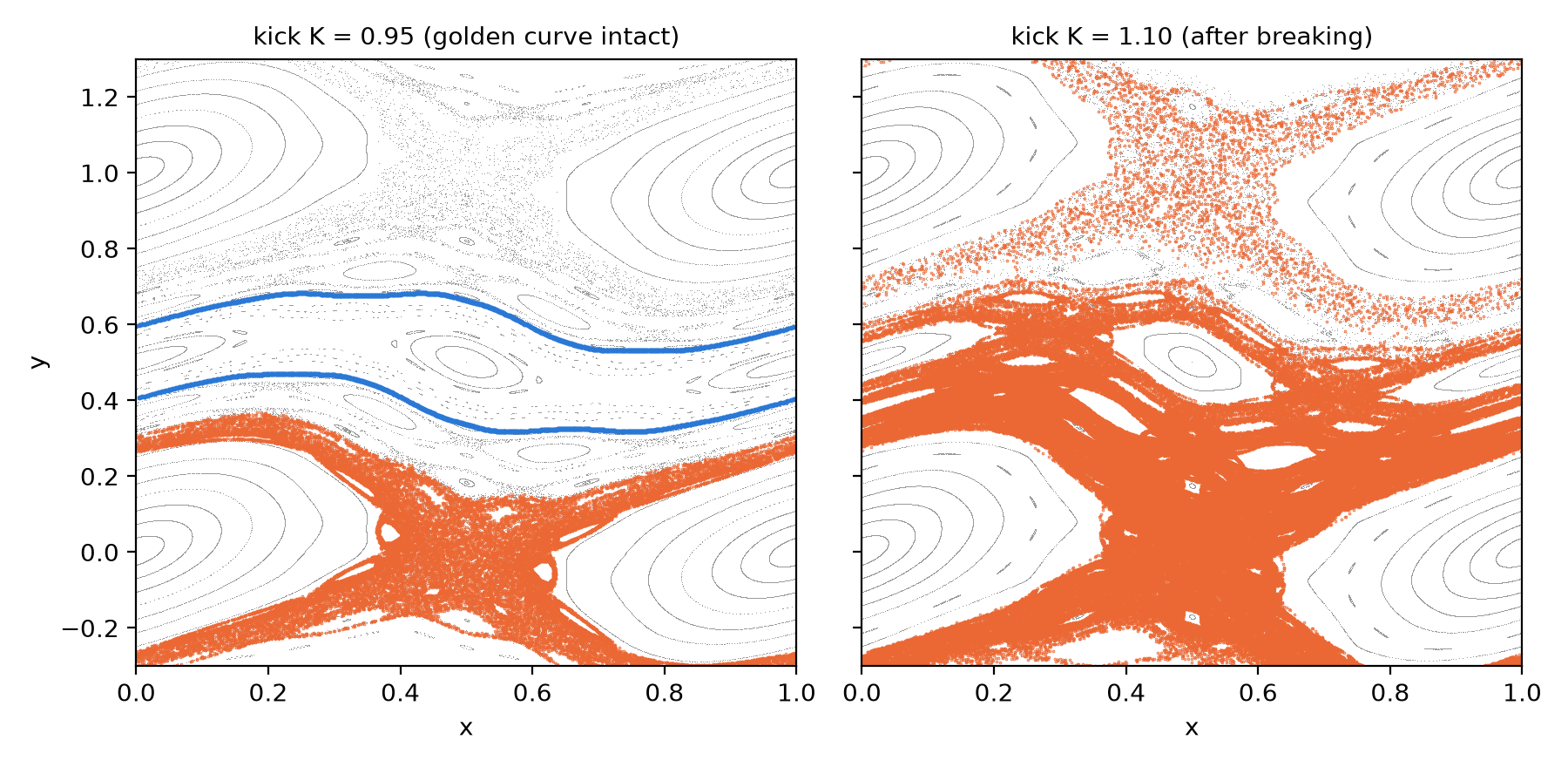
Fifth, a check that does not use residues. Moving 2000 points started below the curve for 100000 steps each, none escaped upward at kicks 0.95 and 0.97, while a little over 3 in 10 escaped at 1.10 and a little over 8 in 10 at 1.30.
To be candid, four expectations failed. The sign of the difference from the published value alternated up to 233/377 but kept the same direction at 377/610. The difference was expected to shrink at every step but grew once at 233/377. For convergents with denominators near 1000, the orbit with positive residue could not be followed stably in double precision, so the sequence stops at denominator 610. At kick 1.00, which exceeds the published value, not a single point escaped in 100000 steps.
Keywords: standard map, invariant curve, residue, golden ratio, continued fraction, convergent, KAM theorem.
Scope (what is not claimed)
No new theorem and no new law is claimed. The standard map, the survival of curves with irrational rotation numbers under weak kicks (the theorem of Kolmogorov, Arnold and Moser), the residue criterion (Greene, 1979), the value of the kick that breaks the golden curve, and the view that the golden curve breaks last (Greene, 1979; MacKay, 1983) are all known. The KAM theorem is not proved. It is only cited. It is not claimed in general that the golden curve is last. Only three numbers are compared. Whether the golden curve breaks last among all rotation numbers is Greene’s view and has not been proved. Renormalisation theory is not entered. The paper counts the marked kicks of convergents and stops there. No real system is addressed. Neither particles in accelerators nor asteroids in the solar system are treated. No cause is guessed. Why the alternation of signs stops at 377/610, why the orbit is lost near denominator 1000, and why no point escaped at kick 1.00 were not measured. Relation to earlier papers: Paper 310 declared in its scope note that it does not treat KAM theory, leaving open whether invariants survive in non-integrable systems. This paper takes that seat of the scope note (no earlier occupant). It counts how far the curve of each rotation number survives as the kick grows. Paper 213 showed that quasi-periodic motion never returns exactly yet comes arbitrarily close, with the approach governed by the denominators of a continued fraction. Here the same continued fraction decides the strength of a curve inside a nonlinear map. Paper 811 showed that a period of a continued fraction marks being a root of a quadratic, and Paper 812 showed that how easily a number is approximated is decided by whether its partial quotients are bounded. Here three numbers with period 1 and bounded partial quotients are compared, and the size of the partial quotients falls in the same order as the breaking kicks. Paper 1053 obtained the golden ratio from an eigenvalue of the substitution matrix of tiles. Here the golden ratio appears as the number hardest to approach by convergents. Paper 1073 counted fixed points of maps that keep area. The standard map also keeps area, and its periodic orbits are used here. Paper 1074 saw Arnold’s cat map keep mixing on the continuum. The standard map keeps area as well, yet under weak kicks it leaves curves. Paper 300 showed that shared or distinct roots can be decided. By its criteria, the golden ratio of the tiles of Paper 1053 and the golden ratio here are not called one root, because what moves them differs (the substitution rule versus the partial quotients of the rotation number). What is added: the marked breaking kicks of three numbers measured by one method and set side by side, the golden convergents followed to denominator 610 with the difference from the published value measured, a check that the mirrored rotation number gives the same kicks from different orbits, a check by a route that does not use residues (whether points escape), and a record of the expectations that failed.
1. The Question and the Shape of the Answer
Consider a rotor kicked at regular intervals. Let $x$ be its angle (one turn counted as 1), $y$ its angular speed and $K$ the strength of one kick; each kick applies the following map once (the standard map of Chirikov, 1979).
$$y' = y - \frac{K}{2\pi}\sin 2\pi x,\qquad x' = x + y' .$$At $K=0$, $y$ never changes and every horizontal line of the phase plane is kept. With kicks, the horizontal lines become distorted curves (invariant curves); some survive and some break. While even one curve remains, a point cannot pass between below and above it.
If the kicks are weak, curves survive whose rotation number (the average advance of $x$ per step) is an irrational that convergents approach with difficulty. This is how the theorem stated by Kolmogorov and proved by Arnold (1963) and Moser (the KAM theorem) looks in this map. Then which curve survives longest as the kick grows? Greene (1979) judged it to be the golden one. This paper measures the golden curve and the curves whose continued fractions have every partial quotient equal to 2 or to 3 by one method, sets them side by side, and shows that what orders their breaking is the size of the partial quotients.
2. The Method: Residues of Periodic Orbits
An irrational curve is hard to catch directly, so fractions $p/q$ close to its rotation number are used. A periodic orbit that advances $x$ by exactly $p$ in $q$ steps and returns to its start was searched for, starting from the symmetry lines of the map ($x=0$ and $x=1/2$). With $M$ the product of the Jacobian matrices over one period, Greene’s residue is
$$R = \frac{2 - \mathrm{tr}\,M}{4} .$$As the convergents are refined, the residue tends to 0 at kicks where the curve survives and grows without bound at kicks where it has broken. Following Greene, the kick at which the larger residue of the orbits on the two symmetry lines reaches 0.25 is taken as the mark of breaking.
The map keeps area at every kick (the determinant of its Jacobian is 1). As a check of the method, the $8/13$ orbit at $K=0.9$ returned after 13 steps with a remainder of $2.776\times10^{-15}$, and its residue was $0.089359825$.
3. Convergents of the Golden Ratio
The fractional part of the golden ratio, $(\sqrt5-1)/2 = 0.618033989$, has the continued fraction $[0;1,1,1,\dots]$, with every partial quotient equal to 1. Its convergents are ratios of Fibonacci numbers, $5/8, 8/13, \dots$. For each, the kick at which the residue reaches 0.25 was found.
| Convergent | Value | Kick $K$ at residue 0.25 | Difference from the published value |
|---|---|---|---|
| $5/8$ | $0.625000000$ | $0.969029008$ | $-2.61\times10^{-3}$ |
| $8/13$ | $0.615384615$ | $0.972634324$ | $+9.99\times10^{-4}$ |
| $13/21$ | $0.619047619$ | $0.971223839$ | $-4.12\times10^{-4}$ |
| $21/34$ | $0.617647059$ | $0.971777084$ | $+1.42\times10^{-4}$ |
| $34/55$ | $0.618181818$ | $0.971571920$ | $-6.35\times10^{-5}$ |
| $55/89$ | $0.617977528$ | $0.971653414$ | $+1.80\times10^{-5}$ |
| $89/144$ | $0.618055556$ | $0.971624952$ | $-1.05\times10^{-5}$ |
| $144/233$ | $0.618025751$ | $0.971637086$ | $+1.68\times10^{-6}$ |
| $233/377$ | $0.618037135$ | $0.971633392$ | $-2.01\times10^{-6}$ |
| $377/610$ | $0.618032787$ | $0.971635313$ | $-9.32\times10^{-8}$ |
The published value is $0.97163540631$, as quoted by Meiss (2008). The difference shrank from $2.61\times10^{-3}$ at $5/8$ to $9.32\times10^{-8}$ at $377/610$.
Two expectations failed here. The sign of the difference changed at every step from $5/8$ to $233/377$, so it was expected to keep alternating, but $377/610$ kept the same negative direction as $233/377$. The difference was also expected to shrink at every step, but the difference at $233/377$ ($2.01\times10^{-6}$) was larger than that at $144/233$ ($1.68\times10^{-6}$). The cause of neither was measured.
In addition, for convergents with denominators near 1000 (such as $377/987$), the orbit with positive residue could not be followed stably in double precision and was lost when the kick changed only slightly. The sequence therefore stops at denominator 610.
4. A Check with the Mirrored Rotation Number
The map returns to itself under $(x,y)\to(-x,-y)$, which exchanges the rotation number $\omega$ with $1-\omega$. $1-0.618033989$ is about $0.381966$, the reciprocal of the square of the golden ratio; its continued fraction is $[0;2,1,1,1,\dots]$ and its convergents are $5/13, 8/21, \dots, 233/610$. Convergents with the same denominator should give the same kick.
Searching for a different set of orbits and repeating the computation, all nine convergents agreed with the golden convergent of the same denominator, with a largest difference of $2.0\times10^{-10}$. This checks that the method does not depend on the choice of orbit.
5. Partial Quotients 2 and 3
Next, the same was done for the number whose partial quotients are all 2, $\sqrt2-1 = 0.414213562$ (continued fraction $[0;2,2,2,\dots]$), and the one whose partial quotients are all 3, $(\sqrt{13}-3)/2 = 0.302775638$ (continued fraction $[0;3,3,3,\dots]$).
| Number | Convergent | Value | Kick $K$ at residue 0.25 |
|---|---|---|---|
| Partial quotients 2 | $5/12$ | $0.416666667$ | $0.964345844$ |
| $12/29$ | $0.413793103$ | $0.960550761$ | |
| $29/70$ | $0.414285714$ | $0.958665291$ | |
| $70/169$ | $0.414201183$ | $0.957953484$ | |
| $169/408$ | $0.414215686$ | $0.957652029$ | |
| Partial quotients 3 | $10/33$ | $0.303030303$ | $0.896435455$ |
| $33/109$ | $0.302752294$ | $0.892527184$ | |
| $109/360$ | $0.302777778$ | $0.891360492$ |
The change of the kick at each refinement was $3.80\times10^{-3}$, $1.89\times10^{-3}$, $7.12\times10^{-4}$ and $3.01\times10^{-4}$ for partial quotients 2, and $3.91\times10^{-3}$ and $1.17\times10^{-3}$ for partial quotients 3; both became smaller at every step. The number with partial quotients 3 is still moving at the $10^{-3}$ level, so its last value is a mark only.
Even so, the order does not move. The distances from the golden value $0.971635$ are $0.013983$ for partial quotients 2 and $0.080275$ for partial quotients 3, which are 46.4 and 68.8 times the change of the last refinement. Among the three, the curve with partial quotients 3 breaks first, then that with partial quotients 2, and the golden curve survives longest.
6. Correspondence with How Hard a Number Is to Approach
How closely a convergent $p/q$ approaches is measured by $q|q\alpha-p|$. For a number whose partial quotients are all $a$, this tends to $1/\sqrt{a^2+4}$. Computed with 80 decimal digits, the values at the thirtieth step were as follows.
| Number | $K$ of the last convergent | $q|q\alpha-p|$ at step 30 | Closed value |
|---|---|---|---|
| Golden ratio ($a=1$) | $0.971635313$ | $0.447213596$ | $0.447213595$ |
| Partial quotients 2 ($a=2$) | $0.957652029$ | $0.353553391$ | $0.353553391$ |
| Partial quotients 3 ($a=3$) | $0.891360492$ | $0.277350098$ | $0.277350098$ |
The golden value $0.447213596$ is the same as the value $0.447214$ that Paper 812 gave as the extreme of approximability. The larger the value, the harder the convergents approach, and the three fall in exactly the same order as the kicks at which the curves break.
All three have continued-fraction period 1 and are roots of quadratic equations (Paper 811). Their partial quotients are all bounded (Paper 812). Still, their breaking kicks differ, and what separates them is neither the period nor boundedness but the size of the partial quotients itself. The golden ratio, whose partial quotients are all 1, is the hardest to approach by convergents, and its curve survives the strongest kick.
7. A Route without Residues: Do Points Cross the Curve?
The residue is a mark read indirectly from periodic orbits, so a separate route was used to check whether the curve itself acts as a wall. 2000 points were placed just next to the unstable fixed point $(1/2, 0)$ and moved 100000 steps each, counting those that escaped above the golden curve to $y \ge 1$.
| Kick $K$ | Fraction escaped | Median step of escape | Range of final $y$ |
|---|---|---|---|
| $0.95$ | $0.0000$ | -- | $-0.439$ to $0.445$ |
| $0.97$ | $0.0000$ | -- | $-0.456$ to $0.455$ |
| $1.00$ | $0.0000$ | -- | $-0.629$ to $0.582$ |
| $1.10$ | $0.3295$ | $44586$ | $-3.471$ to $3.792$ |
| $1.30$ | $0.8195$ | $7241$ | $-17.561$ to $17.846$ |
At kicks 0.95 and 0.97, where the golden curve survives, no point escaped upward. Kick 0.97 is stronger than the mark at which the curve with partial quotients 2 breaks (0.957652), so the wall that stops the points there is not the curve with partial quotients 2. Which curve is the wall cannot be told by this count. At 1.10 and 1.30, where the curve has broken, fractions 0.3295 and 0.8195 of the points escaped.
One more expectation failed here. Kick 1.00 is stronger than the published value, so the curve should be broken, yet not a single point escaped in 100000 steps. How fast points escape just after breaking was not measured.
8. Relation to Earlier Papers
Paper 310 declared in its scope note that it does not treat KAM theory, leaving open whether invariants survive in non-integrable systems. This paper takes that seat of the scope note and counted how far the curve of each rotation number survives as the kick grows.
Paper 213 showed that quasi-periodic motion never returns exactly yet comes arbitrarily close, with the approach governed by the denominators of a continued fraction. Here the same continued fraction decided the strength of a curve inside a nonlinear map.
Paper 811 showed that a period of a continued fraction marks being a root of a quadratic, and Paper 812 showed that how easily a number is approximated is decided by whether its partial quotients are bounded. Here three numbers with period 1 and bounded partial quotients were compared, and the size of the partial quotients fell in the same order as the breaking kicks.
Paper 1053 obtained the golden ratio from an eigenvalue of the substitution matrix of tiles. Here the golden ratio appeared as the number hardest to approach by convergents. By the criteria of Paper 300, the two are not called one root, because what moves them differs (the substitution rule versus the partial quotients of the rotation number).
Paper 1073 counted fixed points of maps that keep area. The standard map also keeps area, and the residues of its periodic orbits were used here. Paper 1074 saw Arnold’s cat map keep mixing on the continuum. The standard map keeps area as well, yet under weak kicks it leaves curves, which break one by one as the kick grows.
Closing
Closing: the invariant curve with the golden rotation number survives stronger kicks than those with partial quotients 2 or 3. The kick at which the residue of a periodic orbit reaches 0.25 approaches $\mathbf{0.971635313}$ at the golden convergent 377/610, a difference of $9.32$×10⁻⁸ from the published value. The number with partial quotients all 2 breaks earlier at $\mathbf{0.957652029}$ and the one with partial quotients all 3 at $\mathbf{0.891360492}$; their distances from the golden value are 46.4 and 68.8 times the change of the last refinement. The order is the order of how hard they are to approach by convergents ($\mathbf{0.447213596}$, $\mathbf{0.353553391}$, $\mathbf{0.277350098}$). By the separate route of escaping points too, none escaped at kicks 0.95 and 0.97, and points escaped at 1.10 and 1.30. To be candid, four expectations failed: the alternation of signs, the steady shrinking of the difference, the orbits near denominator 1000, and the absence of escapes at kick 1.00; the cause of none was measured. The separator is whether every partial quotient of the rotation number is 1 or some are larger. All three numbers are quadratic irrationals of period 1, and what separates them is the size of the partial quotients.
References
- Arnol’d, V. I. (1963). Proof of a Theorem of A. N. Kolmogorov on the Invariance of Quasi-Periodic Motions under Small Perturbations of the Hamiltonian. Russian Mathematical Surveys.
- Chirikov, B. V. (1979). A Universal Instability of Many-Dimensional Oscillator Systems. Physics Reports.
- Greene, J. M. (1979). A Method for Determining a Stochastic Transition. Journal of Mathematical Physics.
- MacKay, R. S. (1983). A Renormalisation Approach to Invariant Circles in Area-Preserving Maps. Physica D.
- Meiss, J. D. (2008). Visual Explorations of Dynamics: The Standard Map. Pramana.
- Yamagishi, Y. (2026). Coming Back Has Distinct Roots [Paper 213]. YOI: https://www.yamagishiyuuki.com/yoi/213; DOI: 10.5281/zenodo.22119380
- Yamagishi, Y. (2026). The Three Hundredth Census: Whether Two Things Share a Root Is Decidable [Paper 300]. YOI: https://www.yamagishiyuuki.com/yoi/300; DOI: 10.5281/zenodo.22171914
- Yamagishi, Y. (2026). “Conserved” Has Two Distinct Roots, and Noether Explains Only One [Paper 310]. YOI: https://www.yamagishiyuuki.com/yoi/310; DOI: 10.5281/zenodo.22172372
- Yamagishi, Y. (2026). The Period of a Continued Fraction Marks Being a Root of a Quadratic, Not Being Easy to Approximate [Paper 811]. YOI: https://www.yamagishiyuuki.com/yoi/811; DOI: 10.5281/zenodo.23015470
- Yamagishi, Y. (2026). What Decides How Easily a Number Is Approximated Is Whether Its Partial Quotients Are Bounded [Paper 812]. YOI: https://www.yamagishiyuuki.com/yoi/812; DOI: 10.5281/zenodo.23015472
- Yamagishi, Y. (2026). Weakening Scale Invariance to a Single Ratio Loses the Uniqueness of the Exponent [Paper 1053]. YOI: https://www.yamagishiyuuki.com/yoi/1053; DOI: 10.5281/zenodo.22904428
- Yamagishi, Y. (2026). Fixed Points of Maps Keeping Area and Flux Have the Same Floor as Critical Points of Functions [Paper 1073]. YOI: https://www.yamagishiyuuki.com/yoi/1073
- Yamagishi, Y. (2026). The Same Matrix Keeps Mixing on the Continuum and Always Returns the Picture on Pixels [Paper 1074]. YOI: https://www.yamagishiyuuki.com/yoi/1074
Reference
Yamagishi, Y. (2026). The Invariant Curve with the Golden Rotation Number Survives Stronger Kicks than Those with Partial Quotients 2 or 3 [Paper 1075]. YOI: https://www.yamagishiyuuki.com/yoi/1075
ORCID: 0009-0006-8587-3450
PDF (English) · PDF (Japanese) · Date proof of the English PDF (OpenTimestamps .ots) · SHA256SUMS
The record page for this paper (in Japanese, with the PDFs in each language and the date proof): YOI 1075. This paper is a preprint and has not been peer reviewed.