Abstract
Whether it looks like an egg or a kidney, a closed curve that does not cross itself has at least four points where the bending is locally strongest or weakest (vertices). This is the four vertex theorem (shown for convex curves by Mukhopadhyaya in 1909). Why four, and not two or three? For convex curves, this paper checks by numbers what the condition of closing removes from the bending function and shows that four comes from there. It claims no new theorem and no new law.
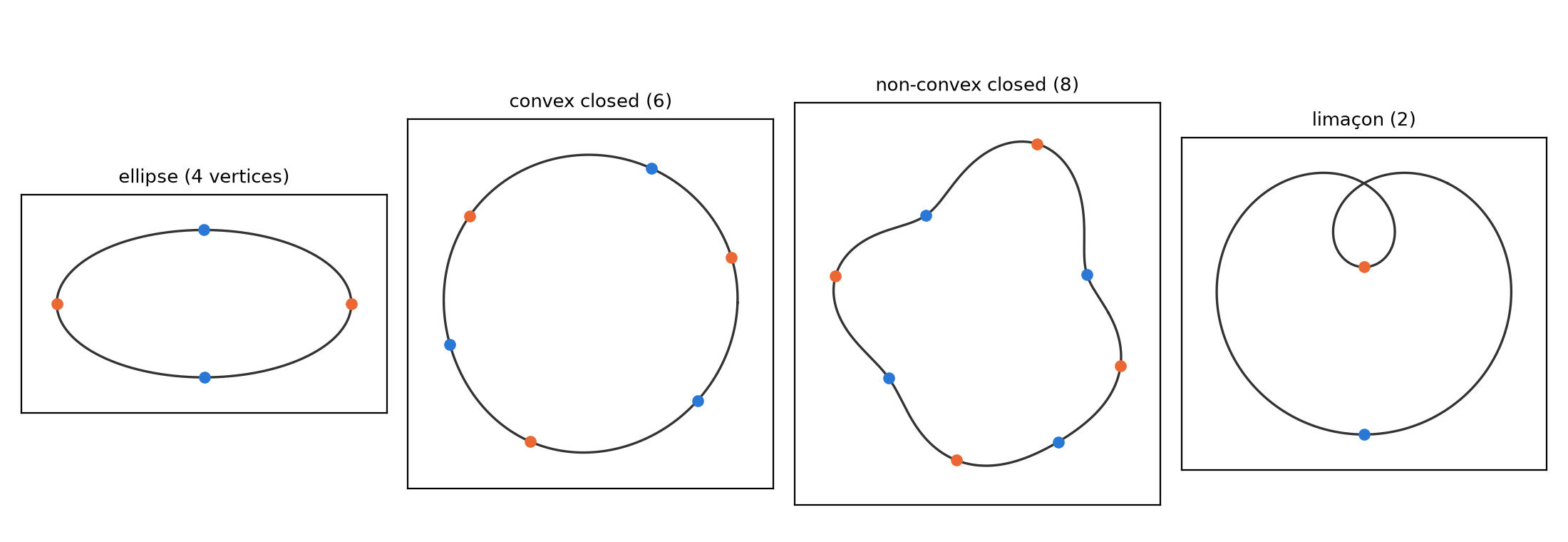
First, there are at least four vertices. Random closed curves made by perturbing the radius, 1000 convex ones and 1000 non-convex ones that do not cross themselves, all had an even number of vertices, at least four. Only the self-crossing limaçon managed with two.
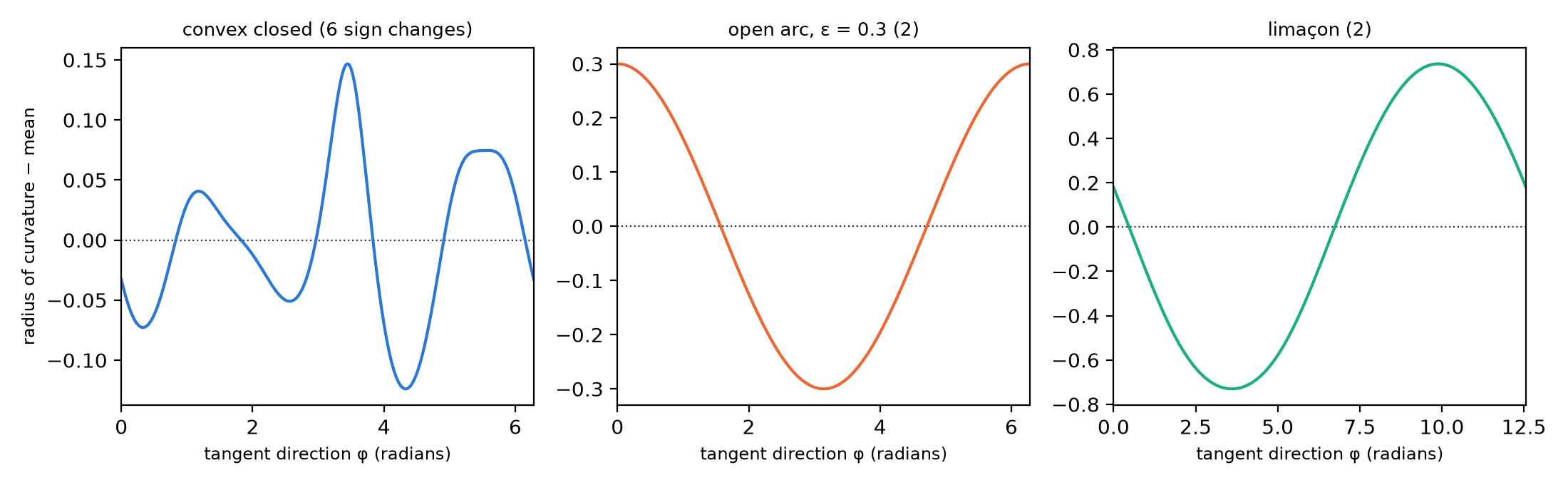
Second, and this is the core of the paper, closing removes exactly the first harmonic of the radius of curvature. Viewed as a function of the tangent direction, the first harmonic of the radius of curvature is the very gap by which the curve fails to close, so it vanishes for a closed curve (at most 2.8 times 10 to the minus 16 over 300 curves). The lowest remaining harmonic is the second, so the difference between the radius of curvature and its mean changes sign at least four times, and there are at least four vertices.
Third, when the first harmonic remains, two suffice. An arc with a first harmonic does not close after a full turn: its ends miss by $\mathbf{0.942477796}$. For the limaçon, which closes only after turning twice, closing removes only the first harmonic; a half-frequency component remains, and it has two vertices.
Fourth, the lower bound is twice the lowest remaining harmonic. A curve whose radius of curvature has only the harmonic of order k has exactly 2k vertices, and one with harmonics from order k upward has at least 2k (k from 2 to 6).
Fifth, the sphere has a number of the same kind. Over 1000 curves dividing the sphere into equal areas, every curve had at least four inflection points (points where the geodesic curvature is zero), as in the tennis ball theorem named by Arnold. By the Gauss-Bonnet theorem, bisecting makes the total geodesic curvature zero. Shifting the same curves north so that they no longer bisect produced curves with no inflection points at all.
To be candid, the mechanism is shown by numbers only for convex curves. Non-convex curves were only checked to have at least four, and why the sphere gives four rather than two is not derived with the tools of this paper. Two errors in the measurement were corrected.
Keywords: four vertex theorem, curvature, radius of curvature, Fourier series, tennis ball theorem, geodesic curvature, Gauss-Bonnet theorem.
Scope (what is not claimed)
No new theorem and no new law is claimed. The four vertex theorem (Mukhopadhyaya, 1909; Kneser, 1912), its proof for convex curves by the Fourier series of the radius of curvature, the lower bound on the number of zeros of a periodic function (the Sturm-Hurwitz theorem), the proof by Osserman (1985), and the tennis ball theorem (Segre, 1968; Arnold, 1994) are all known. The theorem is not proved. The paper builds curves, counts, and checks each step of the mechanism by numbers. The mechanism is shown only for convex curves. Non-convex curves are only counted; the mechanism of Kneser’s case is not entered. The reason for four on the sphere is not given. It is shown that bisecting makes the total geodesic curvature zero, but from that alone only two or more sign changes follow. The converse theorem is not entered. Which curvature functions come from closed curves (DeTurck and others, 2007) is not treated. No extension to space curves or higher dimensions is made. On the name: the Sturm-Hurwitz theorem here is different from the Hurwitz theorems (on approximation and on groups) cited elsewhere in the corpus. Relation to earlier papers: Paper 224 counted that the total angle deficit of a polyhedron is always 4π. Here the total curvature of a plane closed curve is always 2π (4π for a curve turning twice), and for a curve on the sphere the total geodesic curvature is 2π minus the enclosed area. Paper 1014 showed that the coordination defects always sum to 12 while the number of fivefold sites varies. Here too the total curvature does not move while the number of vertices ranges from 4 to 16; what does not move is the lower bound of 4. Paper 67 read 4π as the product of 2π and the Euler characteristic of the sphere. Here the number of turns fixes the total curvature, and the number of turns also changes the lower bound on vertices. Paper 1010 counted that the path of the Moon seen from the Sun is always convex. Here the paper counts how far the bending of a convex curve cannot stay uniform. Paper 300 showed that shared or distinct roots can be decided. By its criteria, the four of the plane four vertex theorem and the four of the tennis ball theorem are not called one root, because the mechanism on the sphere was not measured. What is added: the measurement of curvature checked against the ends of ellipses and the known values of the limaçon, 1000 convex and 1000 non-convex closed curves counted, the first harmonic of the radius of curvature measured as zero with the second remaining, an open arc and a curve turning twice set as controls, the lower bound set side by side as twice the lowest remaining harmonic, bisection and inflection points counted on the sphere, and a record of the errors in measurement.
1. The Question and the Shape of the Answer
Walking along a closed curve, the bending (curvature) changes from place to place. A point where the curvature is a local maximum or minimum is called a vertex. A circle bends the same everywhere, so its vertices are not defined, but a closed curve other than a circle has at least four. For an ellipse, they are the four ends of the long and short axes. This is the four vertex theorem: Mukhopadhyaya (1909) showed it for convex curves, and Kneser extended it in 1912 to all curves that do not cross themselves (as summarised by DeTurck and others, 2007).
Maxima and minima alternate, so the number of vertices is even. Then why are two not enough? For convex curves, this paper checks by numbers that the condition of closing removes exactly the first harmonic from the bending function, and that four is the next number after twice that removed harmonic.
2. Measurement and Checks
Each curve is represented by 4096 points, and every derivative is taken by the fast Fourier transform of a periodic function. The curvature is
$$\kappa = \frac{x'y'' - y'x''}{(x'^2 + y'^2)^{3/2}} ,$$and vertices are counted as the places where the derivative of the curvature changes sign.
As a check, the ellipse with semi-axes 2 and 1 has curvature $2.000000000$ at its maximum and $0.250000000$ at its minimum, as the formulas $a/b^2$ and $b/a^2$ say. With semi-major axis 5 the values are $5.000000000$ and $0.040000000$; both ellipses have four vertices.
A second check is the limaçon $r = 1 - 2\sin\theta$, which DeTurck and others (2007) give as an example of a curve with only two vertices. It has a small inner loop and crosses itself. The measured curvature has minimum $0.555555556$ and maximum $3.000000000$, matching the article’s values 5/9 and 3, and there are two vertices. The total curvature (curvature summed along the length) is $12.566370614$, that is, 4π,because the tangent direction turns twice before the curve returns.
3. Counting Random Closed Curves
Closed curves were made by perturbing the radius, $r(\theta) = 1 + \sum_k c_k\cos(k\theta + \delta_k)$. If the radius is positive everywhere, the curve does not cross itself. Small perturbations give convex curves; larger ones produce dents.
| Curve | Number | Fewest vertices | Most vertices | Fraction with exactly 4 |
|---|---|---|---|---|
| Convex closed curves | 1000 | 4 | 16 | $0.192$ |
| Non-convex closed curves (not self-crossing) | 1000 | 4 | 16 | $0.065$ |
| Limaçon (self-crossing) | 1 | 2 | 2 | -- |
Convex or not, every curve had an even number of vertices, at least four. For every convex closed curve the total curvature differed from 2π by at most $1.8\times10^{-15}$: it turns once and returns.
4. Mechanism: Closing Removes the First Harmonic
On a convex curve, the tangent direction $\varphi$ passes once through every value from $0$ to $2\pi$ in one circuit. So view the radius of curvature $\rho = 1/\kappa$ as a function of $\varphi$. The points of the curve can be written as
$$x(\varphi) = \int_0^{\varphi} \rho(u)\cos u\,du,\qquad y(\varphi) = \int_0^{\varphi} \rho(u)\sin u\,du ,$$so the condition of returning after one circuit is $\int_0^{2\pi}\rho\cos\varphi d\varphi = \int_0^{2\pi}\rho\sin\varphi d\varphi = 0$. This is nothing but the vanishing of the first harmonic of the Fourier series of $\rho$.
Measured over 300 random convex closed curves, the size of the first harmonic was at most $2.8\times10^{-16}$, while the second harmonic remained with minimum $8.849\times10^{-4}$ and median $2.960\times10^{-2}$. The condition of closing removes exactly the first harmonic.
The only harmonic below the first is the mean (order zero); subtracting it, $\rho - \bar\rho$ is built from harmonics of order two and above. If the harmonics of a periodic function start at order $k$, its sign changes at least $2k$ times (the Sturm-Hurwitz theorem). Indeed, for all 300 curves the sign of $\rho - \bar\rho$ changed at least four times (at most 16), and for every curve the number of vertices was not below this number of sign changes,because a maximum or a minimum always lies between two sign changes.
5. Controls: When the First Harmonic Remains, Two Suffice
Now see what happens without the condition of closing. Taking the radius of curvature $\rho = 1 + \varepsilon\cos\varphi$ around one full turn, the first harmonic remains, so the curve does not close and its ends miss.
| Curve | Gap between the ends | πε | Extrema of curvature |
|---|---|---|---|
| Open arc (ε = 0.1) | $0.314159265$ | $0.314159265$ | 2 |
| Open arc (ε = 0.3) | $0.942477796$ | $0.942477796$ | 2 |
The gap is πε, and there are only two extrema of curvature. If the first harmonic is allowed, two vertices suffice.
The limaçon is closed, yet it has two vertices. On this curve the tangent direction turns through 4π in one circuit (measured total curvature $12.566370614$). The condition of closing removes only the first harmonic (the component with period 2π in the direction); the half-frequency component, which goes around once while the direction turns through 4π, is not removed. Measured, the half-frequency component remains at $0.743891$ and the first harmonic is $2.8\times10^{-17}$. Since the lowest component is the half frequency, $\rho - \bar\rho$ changes sign twice, and there are two vertices.
6. The Lower Bound Is Twice the Lowest Remaining Harmonic
The radius of curvature $\rho(\varphi)$ was fixed first, and the curve was built by the integrals above. Without a first harmonic, the curve closes. Measuring the curvature again from the built curve gave agreement with $1/\rho$ to at most $2.5\times10^{-9}$ (a separate check of the measurement of curvature).
| Radius of curvature | Gap in closing | Vertices |
|---|---|---|
| $1 + 0.3\cos 2\varphi$ | $3.9\times10^{-16}$ | 4 |
| $1 + 0.3\cos 3\varphi$ | $1.7\times10^{-16}$ | 6 |
| $1 + 0.3\cos 4\varphi$ | $3.5\times10^{-16}$ | 8 |
| $1 + 0.3\cos 5\varphi$ | $5.2\times10^{-16}$ | 10 |
| $1 + 0.3\cos 6\varphi$ | $5.2\times10^{-16}$ | 12 |
With only the harmonic of order $k$, there are exactly $2k$ vertices. Next, 300 curves each were built by random superposition of harmonics from order $k$ to order 10; the fewest vertices were 4 for $k = 2$, 6 for $k = 3$ and 8 for $k = 4$. The fraction with exactly $2k$ was small, $0.003$, $0.013$ and $0.010$; superposing harmonics tends to give more vertices than the bound. What fixes the lower bound is the order of the lowest remaining harmonic. For a plane closed curve, closing removes the first harmonic, so the lowest is the second and the bound is four.
7. The Sphere: Curves That Bisect the Area
Arnold (1994) called it the “tennis ball theorem” that a curve dividing the sphere into equal areas, like the seam of a tennis ball, has at least four inflection points (points where the geodesic curvature is zero); a close result appears in Segre (1968). A curve on the unit sphere was represented by its deviation $g(\varphi)$ from the equator and a uniform shift $c$, with $c$ chosen so that the northern area is exactly 2π.
| Curve | Number | Fewest inflections | Most | Note |
|---|---|---|---|---|
| Bisecting curves | 1000 | 4 | 12 | fraction with exactly 4: $0.001$ |
| Same shapes shifted north | 1000 | 0 | -- | fraction with 0: $0.005$; with 2: $0.015$ |
| Centrally symmetric curves | 300 | 6 | 10 | fraction with exactly 6: $0.263$ |
Every bisecting curve among the 1000 had an even number of inflection points, at least four. The tennis-ball-like curve $\theta = \pi/2 + 0.5\cos 2\varphi$ has a northern area of $6.283185307$ without any shift and exactly four inflection points. Shifting the same shapes north so that the northern area fell to between $2.737$ and $2.999$ produced curves with zero or two inflection points. Centrally symmetric curves made only of odd harmonics had at least six inflection points in all 300 measured.
What bisection removes is seen from the Gauss-Bonnet theorem. On the unit sphere, the total geodesic curvature is 2π minus the enclosed area (measured difference at most $1.8\times10^{-15}$). Bisection makes the total zero, that is, the mean of the geodesic curvature vanishes. A mean of zero forces at least two sign changes. But four or more were measured. Why four rather than two is not derived with the tools of this paper.
8. Relation to Earlier Papers
Paper 224 counted that the total angle deficit of a polyhedron is always 4π. Here the total curvature of a plane closed curve was always 2π (4π for the limaçon, which turns twice), and on the sphere the total geodesic curvature was 2π minus the enclosed area.
Paper 1014 showed that the coordination defects always sum to 12 while the number of fivefold sites varies. Here too the total curvature did not move while the number of vertices ranged from 4 to 16; what did not move was the lower bound of 4.
Paper 67 read 4π as the product of 2π and the Euler characteristic of the sphere. Here the number of turns fixed the total curvature, and the number of turns also changed the lower bound on vertices from 4 to 2.
Paper 1010 counted that the path of the Moon seen from the Sun is always convex. Here the paper counted how far the bending of a convex curve cannot stay uniform.
Paper 300 showed that shared or distinct roots can be decided. By its criteria, the four of the plane four vertex theorem and the four of the tennis ball theorem are not called one root, because the mechanism on the sphere was not measured.
Two errors in the measurement were corrected and are recorded here. The difference between the curvature of the built curves and $1/\rho$ was expected, before measuring, to be below $10^{-9}$, and it was not (measured $2.5\times10^{-9}$). Also, the most vertices on a non-convex curve were once counted as 898. Where the derivative of the curvature was nearly zero, rounding made its sign flicker and each flicker was counted as a vertex; places smaller than $10^{-9}$ times the largest value are now not counted, and the most became 16.
Closing
Closing: a convex closed curve has at least four vertices because closing removes the first harmonic of its radius of curvature. All of 2000 random closed curves had an even number of vertices, at least four, and only the self-crossing limaçon had two. Viewed as a function of the tangent direction, the first harmonic of the radius of curvature is the very gap in closing; it vanishes for a closed curve, the lowest remaining harmonic is the second, and the sign changes at least four times. An open arc keeps the first harmonic and misses by πε, and the limaçon, which turns twice, keeps a half-frequency component; both manage with two. With harmonics from order k upward there are at least 2k vertices; the lower bound is twice the lowest remaining harmonic. All of 1000 curves bisecting the sphere had at least four inflection points, and bisection makes the total geodesic curvature zero. To be candid, the mechanism was shown only for convex curves, and why the sphere gives four was not derived. The separator is which harmonics a global condition removes from the bending function. Closing after one turn removes the first and sets the bound at four; closing after two turns leaves the half frequency and sets the bound at two.
References
- Arnol’d, V. I. (1994). Topological Invariants of Plane Curves and Caustics. American Mathematical Society.
- DeTurck, D., Gluck, H., Pomerleano, D., & Vick, D. S. (2007). The Four Vertex Theorem and Its Converse. Notices of the American Mathematical Society.
- Mukhopadhyaya, S. (1909). New Methods in the Geometry of a Plane Arc. Bulletin of the Calcutta Mathematical Society.
- Osserman, R. (1985). The Four-or-More Vertex Theorem. The American Mathematical Monthly.
- Segre, B. (1968). Alcune proprietà differenziali in grande delle curve chiuse sghembe. Rendiconti di Matematica.
- Yamagishi, Y. (2025). The Euler-Characteristic Origin of the $4\pi$ Patch [Paper 67]. YOI: https://www.yamagishiyuuki.com/yoi/67; DOI: 10.5281/zenodo.21642170
- Yamagishi, Y. (2026). Flat Wherever You Touch It, and Four Pi in Total [Paper 224]. YOI: https://www.yamagishiyuuki.com/yoi/224; DOI: 10.5281/zenodo.22120836
- Yamagishi, Y. (2026). The Three Hundredth Census: Whether Two Things Share a Root Is Decidable [Paper 300]. YOI: https://www.yamagishiyuuki.com/yoi/300; DOI: 10.5281/zenodo.22171914
- Yamagishi, Y. (2026). The Moon’s Path around the Sun Is Always Convex, and Convexity Fails Near the Point Where the Sun and Earth Pull Equally [Paper 1010]. YOI: https://www.yamagishiyuuki.com/yoi/1010; DOI: 10.5281/zenodo.22823955
- Yamagishi, Y. (2026). The Optimal Arrangement in the Thomson Problem Is Unknown, but the Coordination Defects Always Sum to Twelve [Paper 1014]. YOI: https://www.yamagishiyuuki.com/yoi/1014; DOI: 10.5281/zenodo.22829288
Reference
Yamagishi, Y. (2026). A Convex Closed Curve Has at Least Four Vertices Because Closing Removes the First Harmonic of Its Radius of Curvature [Paper 1076]. YOI: https://www.yamagishiyuuki.com/yoi/1076
ORCID: 0009-0006-8587-3450
PDF (English) · PDF (Japanese) · Date proof of the English PDF (OpenTimestamps .ots) · SHA256SUMS
The record page for this paper (in Japanese, with the PDFs in each language and the date proof): YOI 1076. This paper is a preprint and has not been peer reviewed.