Abstract
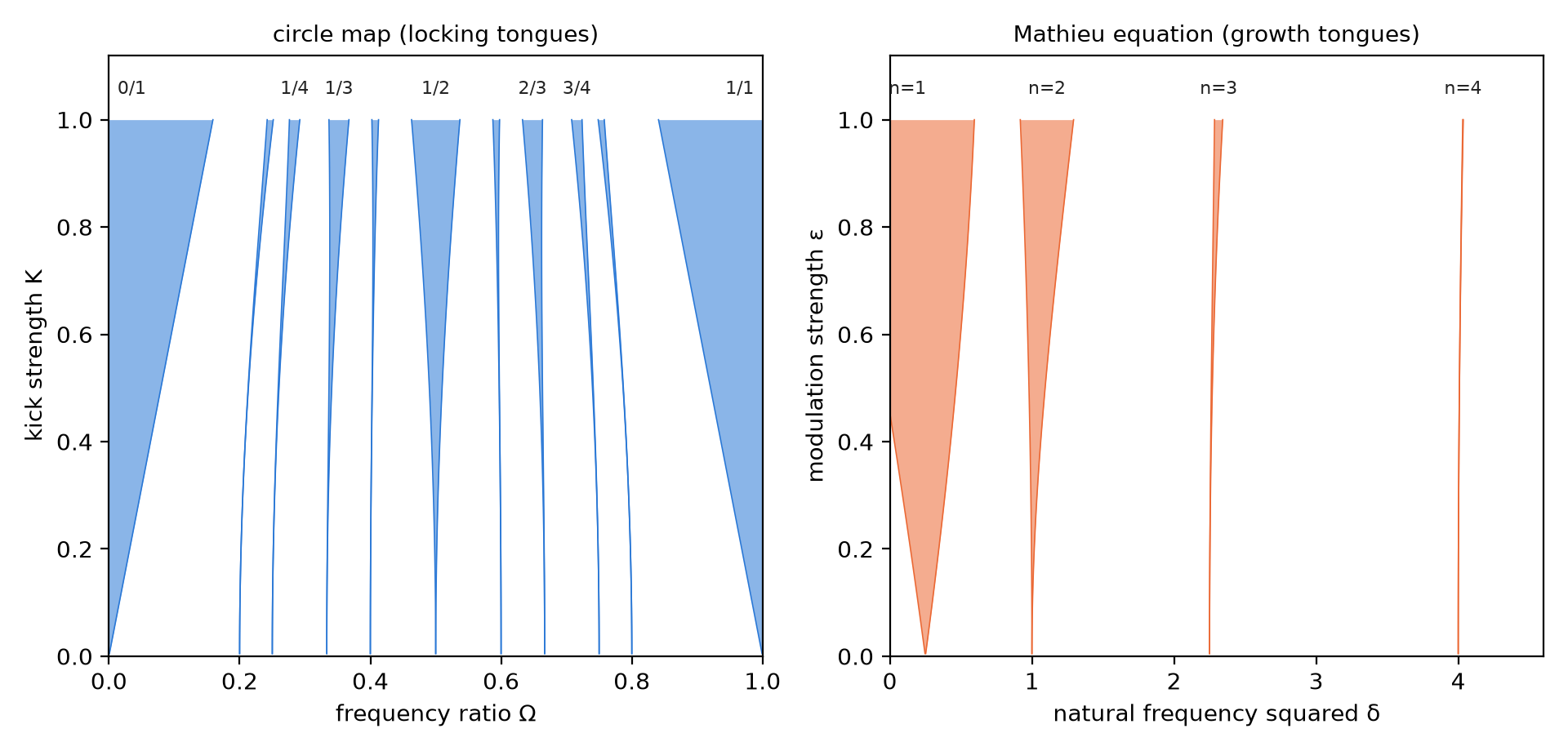
Two different things are called Arnold tongues. One is the range in which a rotating object kicked periodically is locked to a rational multiple of the kicking frequency (the circle map). The other is the range in which a pendulum whose length is modulated periodically swings with growing amplitude (the Mathieu equation; pumping a swing while standing). Both have the shape of a tongue that shrinks to a point as the strength goes to 0. This paper checks by numbers whether the two are the same mechanism. It claims no new theorem and no new law.
First, the widths open with the same power. The width of the p/q tongue of the circle map opens as the q-th power of the kick (log-log slopes 1.0000 to 4.9804 for q from 1 to 5), and the width of the n-th tongue of the Mathieu equation as the n-th power of the modulation (0.9996 to 3.9998 for n from 1 to 4).
Second, the power is fixed by the order at which the drive produces the needed harmonic. Putting that harmonic directly into the drive makes both widths open at first order (slopes 1.0447 and 0.9455).
Third, and this is the core of the paper, only the sign of the exponent inside the tongue differs. Inside both tongues the rotation number (for the Mathieu equation, the Floquet phase) is pinned at 1/2. But the Lyapunov exponent of the circle map is $\mathbf{-0.510826}$, so nearby points are drawn in, while the Floquet exponent of the Mathieu equation is $\mathbf{0.144236}$, so the swing grows. The Mathieu equation keeps area (the monodromy matrix has determinant 1), so its multipliers come as a pair, one growing and one shrinking.
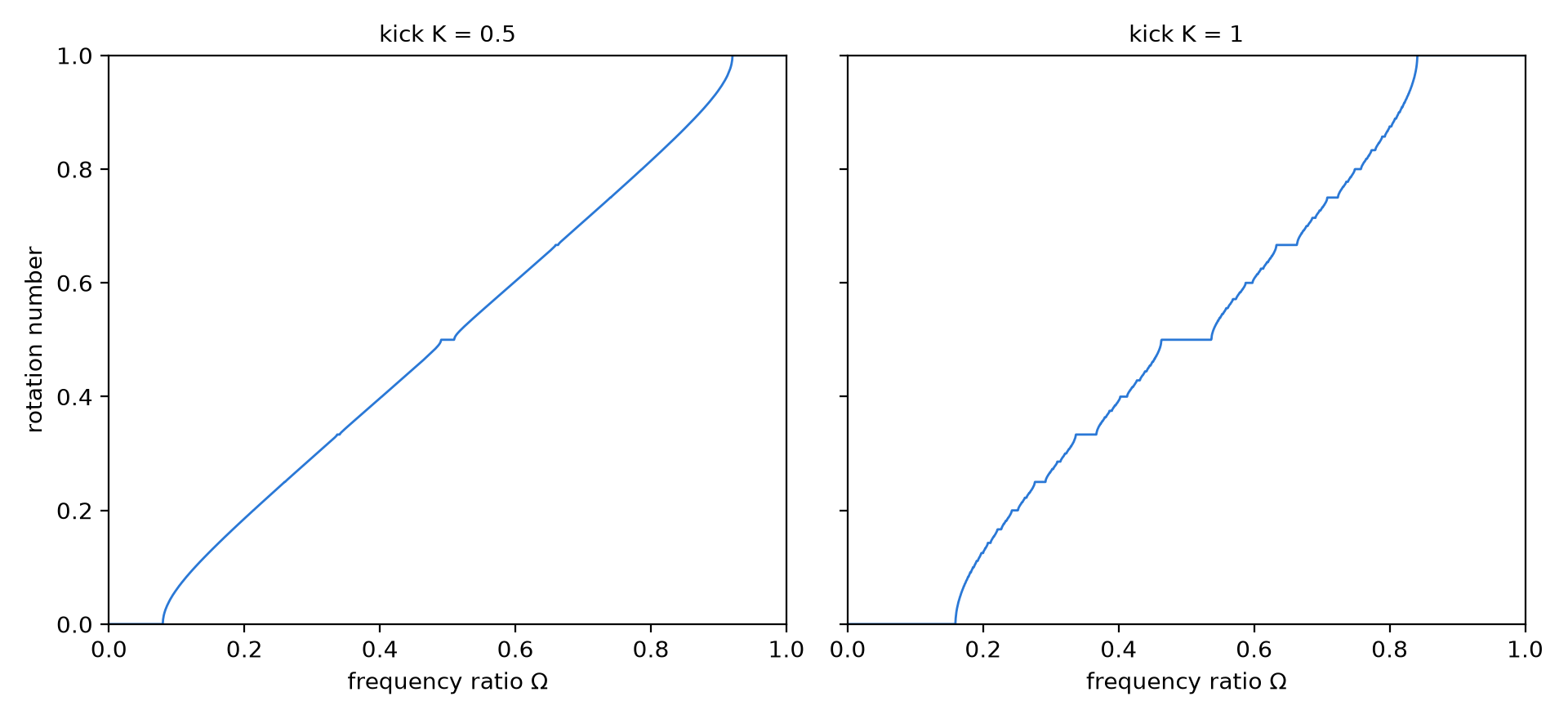
Fourth, the total width of the tongues. At kick 0.5 the total width of the tongues with denominators up to 30 almost stops at $\mathbf{0.192135}$ (the growth from denominator 20 to 30 is $6.4\times10^{-6}$). At kick 1 the total keeps growing as the denominator increases and is $\mathbf{0.708840}$ at denominator 30.
Fifth, to the swing. When pumping by modulating the length, the tongue for pumping at twice the frequency (n=1) is $\mathbf{20.0759}$ times wider than the tongue for pumping at the same frequency (n=2), at modulation strength 0.1.
To be candid, three errors in the measurement were corrected: the centre of the circle-map tongue was assumed to sit at p/q although it shifts, the search range for the Mathieu equation spilled into another unstable region, and a threshold was set before measuring. That the tongues fill everything at kick 1 is a result of the literature; this paper only saw the total keep growing up to denominator 30.
Keywords: Arnold tongue, circle map, Mathieu equation, mode locking, parametric excitation, devil’s staircase, Floquet exponent.
Scope (what is not claimed)
No new theorem and no new law is claimed. The circle map and the Arnold tongues (Arnold, 1961), the complete devil’s staircase and its fractal dimension (Jensen, Bak and Bohr, 1983), and the stability chart and tongues of the Mathieu equation (as reviewed by Kovacic, Rand and Sah, 2018) are all known. No theorem is proved. The paper measures the widths of the tongues, sets the powers side by side and counts the sign of the exponent inside. The complete devil’s staircase is not shown. That the tongues fill everything at kick 1, and the fractal dimension 0.87 of what remains, are cited from the literature only. This paper only saw the total keep growing up to denominator 30. The two tongues are not called one root. The power of the width is fixed by the same mechanism, but the sign of the exponent inside is fixed elsewhere (whether area is kept). Chaos is not entered. Neither the circle map with kick above 1 nor the Mathieu equation with damping or nonlinearity is treated. No real system is addressed. Hearts, tides and circuits are not treated. For the swing, only pumping by modulating the length is discussed; nothing is said about pumping while sitting (forced oscillation). Relation to earlier papers: Paper 351 declared in its scope note that it would not enter the exact theory of the stability regions of the Mathieu equation (the Arnold tongues) and would only name them. This paper takes that seat of the scope note and counts the widths of the tongues and the exponent inside. The damping item of the same scope note was taken by Paper 584. Paper 695 showed, by the width of entrainment, that a body clock need only be reset each day. The width there was the single 1:1 tongue and was proportional to the strength. Here there is a tongue for every rational, and its width opens as a power of the strength given by the order. Paper 313 showed that only the fifth sense of "synchrony" in the corpus (entrainment) has a threshold. The tongues here open from strength 0 and have no threshold. Paper 1075 counted that the curve with the golden rotation number survives longest in the standard map. Here, at kick 0.5, a fraction 0.807865 of the frequency ratios lies in no tongue, and there the motion has an irrational rotation number. Paper 300 showed that shared or distinct roots can be decided. By its criteria, the two tongues share the mechanism of the power of their widths, but what moves the sign of the exponent inside differs, so they are not called one root. What is added: the widths of the two tongues measured by the same procedure with their powers set side by side, the boundaries of the Mathieu equation matched by two methods, eigenvalues and numerical integration, the power seen to drop to first order when the needed harmonic is put in directly, the pinning of the rotation number and the sign of the exponent inside set side by side, the total width of the tongues compared at kicks 0.5 and 1, and a record of the errors in measurement.
1. The Question and the Shape of the Answer
When a rotating object (a pendulum, a heart, a clock) is kicked periodically, its rate of rotation can be locked to a rational multiple of the kicking. Drawn on the plane of kicking frequency and strength, the range of locking has the shape of a tongue opening upward from a single point at strength 0. These are the Arnold tongues of the circle map.
On the other hand, when the length of a pendulum is modulated periodically, the swing grows in some range of frequency. Pumping a swing while standing is of this kind, and Paper 351 showed that one pumps at twice the natural frequency. The range of growth also has the shape of a tongue and is also called an Arnold tongue.
Are these two, with the same shape and the same name, the same mechanism? This paper checks by numbers that the way their widths open is fixed by the same mechanism, but what happens inside is opposite: in one, points are drawn in; in the other, the swing grows.
2. The Two Tongues and How They Are Measured
The circle map is
$$\theta' = \theta + \Omega - \frac{K}{2\pi}\sin 2\pi\theta ,$$where $\Omega$ is the ratio of frequencies and $K$ the strength of the kick. The range of $\Omega$ in which the rotation number (the average advance of $\theta$ per step) is pinned at $p/q$ is the $p/q$ tongue. The map is locked when the $q$-fold map minus $\theta + p$ vanishes somewhere in $\theta$. The left and right boundaries were found by bisecting separately for the $\Omega$ at which its maximum and its minimum vanish.
The Mathieu equation is
$$x'' + (\delta + \varepsilon\cos t)\,x = 0 ,$$where $\delta$ is the square of the natural frequency and $\varepsilon$ the strength of the modulation. The $n$-th tongue starts from $\delta = (n/2)^2$. On its boundaries the solution is exactly periodic, so the boundaries were found as eigenvalues when the solution is written as a Fourier series (the characteristic values of the Mathieu equation).
Two checks of the measurement were made. The width of the $0/1$ tongue of the circle map is exactly $K/\pi$, and the difference from the measured width ($4.909\times10^{-9}$ at $K=0.05$) matched the estimated error of taking the maximum and minimum on a grid of 4000 points in $\theta$, to a remainder of $7.4\times10^{-17}$. For the Mathieu equation, at the boundaries given by the eigenvalues ($0.198780967$ and $0.298718515$ for $n=1$ at $\varepsilon=0.1$), the trace of the numerically integrated monodromy matrix had magnitude exactly 2 (difference at most $6.1\times10^{-13}$). Two independent methods agree.
3. The Widths Open with the Same Power
The widths of the tongues were measured while the strengths of kick and modulation were varied.
| Tongue | Strength 0.05 | Strength 0.1 | Strength 0.2 | Log-log slope |
|---|---|---|---|---|
| Circle map $0/1$ | $1.592\times10^{-2}$ | $3.183\times10^{-2}$ | $6.366\times10^{-2}$ | $1.0000$ |
| Circle map $1/2$ | $1.989\times10^{-4}$ | $7.951\times10^{-4}$ | $3.173\times10^{-3}$ | $1.9978$ |
| Circle map $1/3$ | $4.385\times10^{-6}$ | $3.504\times10^{-5}$ | $2.792\times10^{-4}$ | $2.9963$ |
| Circle map $1/4$ | $1.326\times10^{-7}$ | $2.116\times10^{-6}$ | $3.350\times10^{-5}$ | $3.9906$ |
| Circle map $1/5$ | $5.080\times10^{-9}$ | $1.617\times10^{-7}$ | $5.063\times10^{-6}$ | $4.9804$ |
| Tongue | Strength 0.02 | Strength 0.05 | Strength 0.1 | Log-log slope |
|---|---|---|---|---|
| Mathieu $n=1$ | $2.000\times10^{-2}$ | $4.999\times10^{-2}$ | $9.994\times10^{-2}$ | $0.9996$ |
| Mathieu $n=2$ | $2.000\times10^{-4}$ | $1.249\times10^{-3}$ | $4.978\times10^{-3}$ | $1.9975$ |
| Mathieu $n=3$ | $5.000\times10^{-7}$ | $7.811\times10^{-6}$ | $6.245\times10^{-5}$ | $2.9995$ |
| Mathieu $n=4$ | $5.555\times10^{-10}$ | $2.170\times10^{-8}$ | $3.471\times10^{-7}$ | $3.9998$ |
The $p/q$ tongue of the circle map opens as the $q$-th power of the kick, and the $n$-th tongue of the Mathieu equation as the $n$-th power of the modulation. The difference between slope and order was at most $0.0196$ for the circle map and $0.0025$ for the Mathieu equation.
4. The Power Is Fixed by the Order at Which the Needed Harmonic Appears
The kick of the circle map is $\sin 2\pi\theta$ and has only the first harmonic. Locking at $1/2$ needs the second harmonic, which first appears when the kick is applied twice. The modulation of the Mathieu equation is also $\cos t$; the second tongue needs $\cos 2t$, which first appears when the modulation is applied twice.
So the needed harmonic was put directly into the drive and the widths measured again. Adding the second harmonic to the circle map at a fraction $0.5$ lowered the slope of the $1/2$ tongue from $1.9978$ to $1.0447$. Adding $\cos 2t$ to the Mathieu equation at a fraction $0.5$ lowered the slope of the $n=2$ tongue from $1.9975$ to $0.9455$. The powers of the two tongues are fixed by the same mechanism.
5. Inside the Tongue the Rotation Number Is Pinned, and the Sign of the Exponent Is Opposite
Inside and outside the $1/2$ tongue were set side by side, for the circle map ($K=0.8$) and the Mathieu equation ($\varepsilon=0.3$). The "rotation number" of the Mathieu equation is the Floquet phase obtained from the trace of the monodromy matrix.
| System | Place | Rotation number or phase | Exponent |
|---|---|---|---|
| Circle map | $\Omega=0.50$ (inside) | $0.500000$ | $-0.510826$ |
| Circle map | $\Omega=0.45$ (outside) | $0.452195$ | $+0.000020$ |
| Circle map | $\Omega=0.40$ (outside) | $0.393773$ | $+0.000043$ |
| Mathieu | $\delta=0.20$ (inside) | $0.500000$ | $+0.146622$ |
| Mathieu | $\delta=0.25$ (inside) | $0.500000$ | $+0.144236$ |
| Mathieu | $\delta=0.30$ (inside) | $0.500000$ | $+0.126402$ |
| Mathieu | $\delta=0.40$ (outside) | $0.446982$ | $+0.000000$ |
Inside both tongues the rotation number is pinned at $1/2$. Outside, it does not stop at a rational and the exponent is nearly 0. What differs is the sign of the exponent inside: negative for the circle map (nearby points are drawn in), positive for the Mathieu equation (the swing grows).
The Mathieu equation keeps area. At $\delta=0.25$ the determinant of the monodromy matrix was $1.000000000000$, and the two multipliers were $-0.404032930$ and $-2.475045786$ (product 1). Inside the tongue a growing solution and a shrinking one always come as a pair. Locking in the circle map has only the shrinking direction.
6. The Total Width of the Tongues
The widths of the tongues of all rationals with denominator up to $Q$ were added.
| Kick | Up to 5 | Up to 10 | Up to 20 | Up to 30 |
|---|---|---|---|---|
| $K=0.5$ | $0.191133$ | $0.192053$ | $0.192129$ | $0.192135$ |
| $K=1$ | $0.524189$ | $0.598876$ | $0.673682$ | $0.708840$ |
At kick $0.5$, raising the denominator from 20 to 30 increases the total by only $6.4\times10^{-6}$. A fraction $0.807865$ lies in no tongue, and there the rotation number is irrational. At kick 1, raising the denominator from 20 to 30 increases the total by $0.035158$, and it does not stop. At denominator 30, $0.291160$ remains.
It is known that at kick 1 the tongues fill everything (a complete devil’s staircase) and that the set of points left over has fractal dimension $0.87$ (Jensen, Bak and Bohr, 1983). This paper only cites that result; it saw only that the total keeps growing up to denominator 30.
7. To the Swing
Paper 351 showed that pumping while standing is a parametric excitation that modulates the length, at twice the natural frequency. In terms of the Mathieu equation, modulating at twice the frequency is the $n=1$ tongue, and modulating at the same frequency is the $n=2$ tongue.
| Modulation strength | $n=1$ (twice) | $n=2$ (same) | Ratio |
|---|---|---|---|
| $0.05$ | $0.049992$ | $0.001249$ | $40.0381$ |
| $0.10$ | $0.099938$ | $0.004978$ | $20.0759$ |
| $0.20$ | $0.199502$ | $0.019657$ | $10.1493$ |
The weaker the modulation, the wider the tongue at twice the frequency is compared with the other. The width for $n=1$ is proportional to the modulation, and that for $n=2$ to its square. When pumping by modulating the length, twice the frequency is the easiest to match. Pumping while sitting (forced oscillation by an outside force) is a different mechanism, and this paper says nothing about it.
8. Relation to Earlier Papers
Paper 351 declared in its scope note that it would not enter the exact theory of the stability regions of the Mathieu equation (the Arnold tongues) and would only name them. This paper takes that seat of the scope note and counted the widths of the tongues and the exponent inside. The damping item of the same scope note was taken by Paper 584, which showed that the effect of damping reverses with the ratio of periods.
Paper 695 showed, by the width of entrainment, that a body clock need only be reset each day. The width there was the single $1:1$ tongue and was proportional to the strength. Here there was a tongue for every rational, and its width opened as a power of the strength given by the order.
Paper 313 showed that only the fifth sense of "synchrony" in the corpus (entrainment) has a threshold. The tongues here open from strength 0 and have no threshold.
Paper 1075 counted that the curve with the golden rotation number survives longest in the standard map. Here, at kick $0.5$, a fraction $0.807865$ of $\Omega$ lying in no tongue remained as motion with an irrational rotation number.
Paper 300 showed that shared or distinct roots can be decided. By its criteria, the two tongues share the mechanism of the power of their widths (the order at which the needed harmonic appears), but what moves the sign of the exponent inside (whether area is kept) differs, so they are not called one root.
Three errors in the measurement were corrected and are recorded here. For denominators 3 and above in the circle map, the centre of the tongue was assumed to be at $p/q$ and bisected from there, which measured the shift of the centre rather than the width (the centre shifts by the order of the square of the kick). When the first tongue of the Mathieu equation was searched by numerical integration, the search range spilled into the other unstable region at $\delta<0$, and for the third and higher tongues the centre lay outside the tongue. The method was therefore changed to finding the boundaries as eigenvalues, with numerical integration kept as a check. The third was setting a threshold on the difference between the width of the $0/1$ tongue and $K/\pi$ before measuring.
Closing
Closing: the two Arnold tongues open with the same power, and only the sign of the exponent inside differs. The p/q tongue of the circle map opens as the q-th power of the kick and the n-th tongue of the Mathieu equation as the n-th power of the modulation; the power is fixed by the order at which the drive produces the needed harmonic (putting it in directly gives first order). Inside both tongues the rotation number is pinned at 1/2, but the Lyapunov exponent of the circle map is $\mathbf{-0.510826}$ and points are drawn in, while the Floquet exponent of the Mathieu equation is $\mathbf{0.144236}$ and the swing grows. The Mathieu equation keeps area, and its multipliers come as a growing and shrinking pair. At kick 0.5 the total width of the tongues almost stops at $\mathbf{0.192135}$; at kick 1 it keeps growing as the denominator increases. For a swing pumped by modulating the length, the tongue at twice the frequency is $\mathbf{20.0759}$ times wider than that at the same frequency, at modulation 0.1. To be candid, the complete devil’s staircase is a result of the literature, and this paper saw only up to denominator 30. The separator is whether the amplitude around the pinned rotation number is drawn in or grows. The mechanism that fixes the shape and the power of the tongues is the same; what happens inside is opposite.
Revision Record
2nd Edition (October 2026): The total widths of the tongues were corrected. The check of the 1st edition searched each tongue only within $p/q\pm1/(2q)$ and counted a tongue outside that range as width $0$ (at kick $1$ the $1/q$ tongues crowd towards the edge of the $0/1$ tongue and leave the range from denominator $8$). Solving the tongue edges by Newton’s method at the tangency of the periodic orbit gives $0.598876$, $0.673682$, $0.708840$ at kick $1$ up to denominators $10$, $20$, $30$ (1st edition: $0.585892$, $0.629319$, $0.641851$), and $0.192129$, $0.192135$ at kick $0.5$ up to denominators $20$, $30$ (1st edition: $0.192113$ for both). The fourth item of the abstract, the scope note, Section 6, the relation to earlier papers and the closing were corrected. “Stops” at kick $0.5$ now means that the growth shrinks to $6.4\times10^{-6}$. The core (the power of the widths, the sign of the exponent inside the tongue, the swing’s $20.0759$) does not change.
References
- Arnol’d, V. I. (1961). Small Denominators. I. Mapping the Circle onto Itself. Izvestiya Akademii Nauk SSSR, Seriya Matematicheskaya.
- Jensen, M. H., Bak, P., & Bohr, T. (1983). Complete Devil’s Staircase, Fractal Dimension, and Universality of Mode-Locking Structure in the Circle Map. Physical Review Letters.
- Kovacic, I., Rand, R. H., & Sah, S. M. (2018). Mathieu’s Equation and Its Generalizations: Overview of Stability Charts and Their Features. Applied Mechanics Reviews.
- Yamagishi, Y. (2026). The Three Hundredth Census: Whether Two Things Share a Root Is Decidable [Paper 300]. YOI: https://www.yamagishiyuuki.com/yoi/300; DOI: 10.5281/zenodo.22171914
- Yamagishi, Y. (2026). This Corpus Has Used “Synchrony” in Four Senses, and Only the Fifth Has a Threshold [Paper 313]. YOI: https://www.yamagishiyuuki.com/yoi/313; DOI: 10.5281/zenodo.22174953
- Yamagishi, Y. (2026). Standing and Sitting on a Swing Are Two Mechanisms [Paper 351]. YOI: https://www.yamagishiyuuki.com/yoi/351; DOI: 10.5281/zenodo.22695649
- Yamagishi, Y. (2026). More Damping in a Base Isolator Transmits More Shaking on One Side [Paper 584]. YOI: https://www.yamagishiyuuki.com/yoi/584; DOI: 10.5281/zenodo.23014359
- Yamagishi, Y. (2026). A Body Clock Need Not Be Accurate; It Need Only Be Reset Each Day [Paper 695]. YOI: https://www.yamagishiyuuki.com/yoi/695; DOI: 10.5281/zenodo.23014881
- Yamagishi, Y. (2026). The Invariant Curve with the Golden Rotation Number Survives Stronger Kicks than Those with Partial Quotients 2 or 3 [Paper 1075]. YOI: https://www.yamagishiyuuki.com/yoi/1075
Reference
Yamagishi, Y. (2026). The Two Arnold Tongues Open with the Same Power, and Only the Sign of the Exponent Inside Differs [Paper 1077]. YOI: https://www.yamagishiyuuki.com/yoi/1077
ORCID: 0009-0006-8587-3450
PDF (English) · PDF (Japanese) · Date proof of the English PDF (OpenTimestamps .ots) · SHA256SUMS
The record page for this paper (in Japanese, with the PDFs in each language and the date proof): YOI 1077. This paper is a preprint and has not been peer reviewed.