Abstract
A line where light rays gather and brighten is called a caustic. A rainbow is a caustic, and so is the bright pattern on the bottom of a coffee cup. With rays alone, the brightness on a caustic is infinite. With waves, it stays finite, and it grows as the wavenumber is made larger. This paper counts what sets the rate of that growth. It claims no new theorem and no new law.
First, the number of rays that meet. In a rainbow, two rays arrive on the bright side and none on the dark side (a fold). In the coffee-cup pattern, three rays pass inside the pointed tip and one outside (a cusp).
Second, the growth is set by how many rays meet. The brightest point of the rainbow grew as the 0.3388 power of the wavenumber, the cusp of the coffee-cup pattern as the 0.4967 power, and the focus of a parabolic mirror, where all rays meet at one point, as the 1.0000 power. When m rays meet, the phase starts to bend at power m+1, and the brightness grows as the power 1 - 2/(m+1) (1/3 for two rays, 1/2 for three).
Third, the supernumerary bows. The spacing of the bright fringes inside the rainbow narrows as the -0.6660 power of the drop size (ka), and its ratio to Airy’s estimate approached 1 as closely as 0.999675. For one colour, it is 1.9897 degrees for a drop of radius 0.1 mm and 0.4269 degrees for 1 mm.
Fourth, and this is the core of the paper, a perfect focus breaks, and a cusp survives. The first-power growth at the focus of a parabolic mirror breaks when the light is tilted by only 0.02 radians: the caustic becomes a single curve without a cusp, and the growth drops to powers from 0.2667 to 0.3185. When the circular mirror is changed into an ellipse, the cusp survives and grows as the 0.4929 power.
To be candid, five errors in the measurement were corrected. That only folds and cusps survive as stable caustics in the plane is a result of the literature; this paper checked it with only one tilt and one ellipse. Fresnel coefficients, polarization, the mixing of colours and the size of the sun are not included, so nothing is said about whether supernumerary bows are actually seen.
Keywords: caustic, rainbow, supernumerary bow, Airy integral, Pearcey integral, cusp, fold, catastrophe optics.
Scope (what is not claimed)
No new theorem and no new law is claimed. Airy’s theory of the brightness near a caustic (Airy, 1838), the wave near a cusp (Pearcey, 1946), the classification of singularities (Arnold, 1975) and catastrophe optics (Berry and Upstill, 1980) are all known. The classification is not proved. That only folds and cusps survive as stable caustics in the plane is cited from the literature; this paper only tilted a parabolic mirror by one angle and changed a circular mirror into one ellipse. No complete optics is built. The wave is scalar, with no Fresnel coefficients, polarization or absorption. The mirrors are curves in the plane (cylindrical mirrors). Nothing is said about whether supernumerary bows are seen. The computation uses a single colour; the mixing of colours and the size of the sun’s disc are not treated. The three powers are not called one root. 1/3, 1/2 and 1 are different cases of one count: the power at which the phase stops being flat. Caustics in three dimensions are not treated. Swallowtails, umbilics and other caustic surfaces are left out. Relation to earlier papers: Paper 325 declared in its scope note that it would not treat supernumerary bows, as they belong to Airy’s theory. This paper takes that seat of the scope note. Paper 325 showed that the size of the drop is not in the angle of the rainbow. Here the size is seen to enter the brightness of the rainbow (the 1/3 power) and the spacing of the supernumerary bows (the -2/3 power). Paper 198 showed that an optical caustic and a conjugate point are the same zero of the same equation. Here the shape of the caustic (fold or cusp) and the growth of its brightness as a wave are counted. What is added: the rays counted in a rainbow and in the coffee-cup pattern, the growth of brightness set side by side for the rainbow, a fold, a cusp and a focus, the spacing of the supernumerary bows matched against Airy’s estimate, a perfect focus measured to break with a tilt and a cusp to survive in an ellipse, and a record of the errors in measurement.
1. The Question and the Shape of the Answer
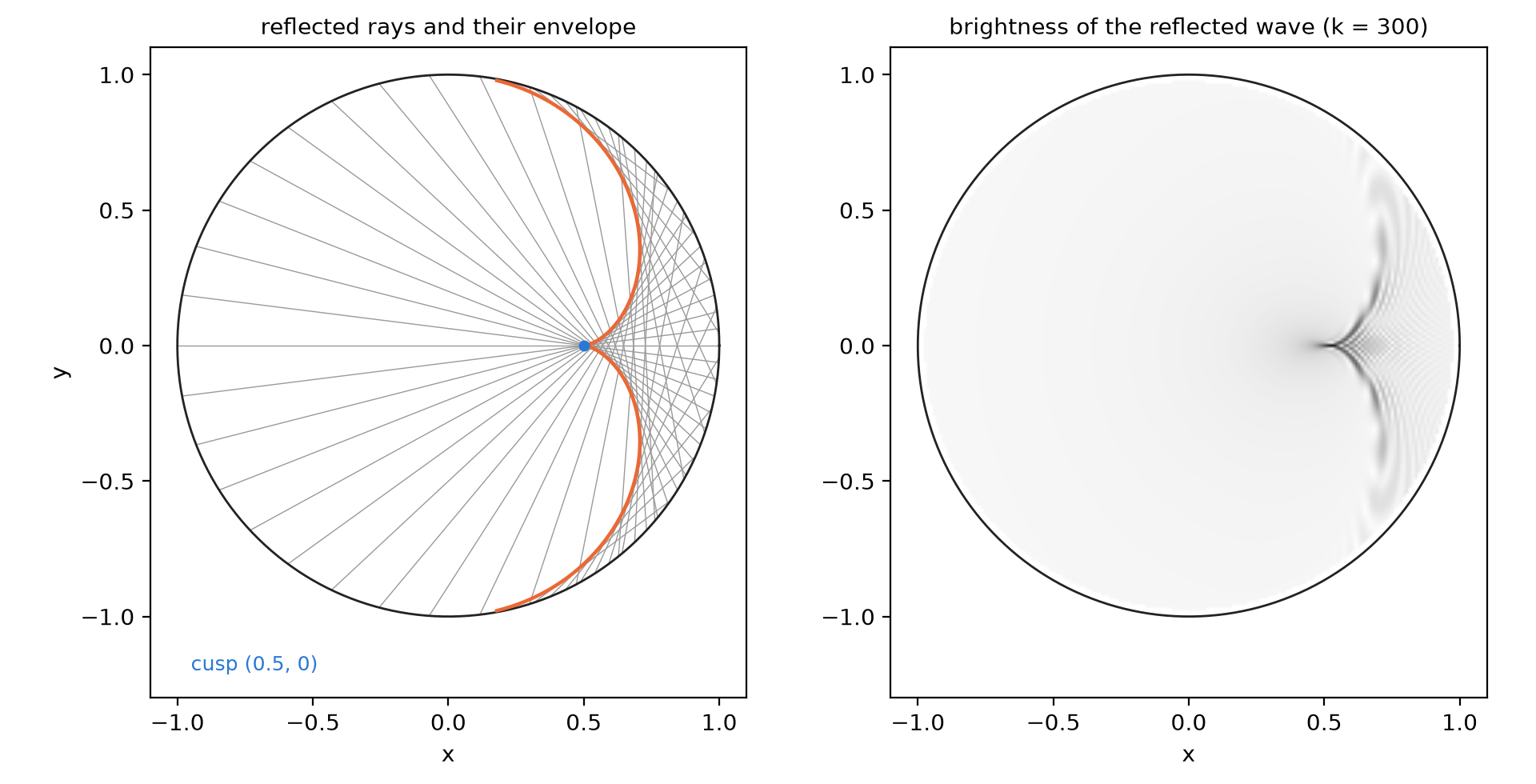
Look into a coffee cup on a sunny day and a bright curve appears on the bottom, pointed in the middle. A rainbow after rain is also a bright line made by gathering rays. With rays alone, the brightness is infinite on the line where rays touch one another (the envelope). This line is called a caustic.
Real light is a wave, so the brightness stays finite. But the larger the wavenumber (the inverse wavelength times the size), the brighter the caustic. This paper counts the power of that growth in a rainbow, a coffee cup, a parabolic mirror and an elliptical mirror. The answer is that it is set by how many rays meet at one point.
2. One Drop and Three Mirrors
Let $D(b)$ be the deviation of light that is reflected once inside a water drop (refractive index 1.3330). Here $b$ is the height of incidence divided by the radius of the drop. The deviation is smallest at the height $b_0 = 0.860835060$, the smallest deviation is 137.921892620 degrees, and the rainbow angle obtained by subtracting it from 180 degrees is 42.078107 degrees (the same value as Paper 325).
In the wave computation, the bending of a ray is the slope of the phase, so the phase was written as the integral of the deviation.
$$I(\theta) = \frac{ka}{2\pi}\left|\int w(b)\,e^{ika\Phi(b,\theta)}\,db\right|^2,\qquad \Phi(b,\theta) = \int_{b_0}^{b}\bigl(D(b')-\theta\bigr)\,db'$$$w$ is a smooth window, chosen so that diffraction from the ends does not act. Amplitude weights such as the Fresnel coefficients are not included.
The mirrors are the right half of a circle of radius 1 (the inside of a coffee cup), an ellipse (semi-axes 1 and 0.8) and a parabola (focal length 0.5). A plane wave is sent onto them, and only the reflected light is added up as
$$\Psi(P) = \sqrt{\frac{k}{2\pi}}\int w\,\frac{e^{ikS}}{\sqrt{|P-m|}}\,dl ,$$where $S$ is the phase of the incoming wave plus the path from the mirror point $m$ to the point $P$.
Five checks of the measurement were made. The Airy integral, integrated numerically along a bent path, matched Ai to within $1.24\times10^{-10}$. The Pearcey integral at the origin matched the closed form $2\Gamma(5/4)e^{i\pi/8}$ to within $1.19\times10^{-11}$. The envelope of the rays reflected by the circular mirror matched the closed-form nephroid to within $1.40\times10^{-10}$. For the parabolic mirror the spread of the path to the focus was $1.11\times10^{-16}$, so all rays meet at one point. At the cusp $(0.5, 0)$ of the circular mirror, the path departs from $1.5$ by $-1/4$ times the fourth power of $\varphi$ ($-0.250022$, $-0.249994$, $-0.249995$).
3. The Number of Rays That Meet
| Place | Number of rays | Kind of caustic |
|---|---|---|
| Rainbow: deviation 136.776 degrees (dark side) | 0 | |
| Rainbow: deviation 139.068 degrees (bright side) | 2 | edge of the fold |
| Rainbow: deviation 155.111 degrees | 2 | |
| Rainbow: deviation 174.270 degrees (beyond $D(1)$) | 1 | |
| Cup: $(0.45, 0)$ (before the cusp) | 1 | |
| Cup: $(0.55, 0)$ (inside the cusp) | 3 | inside the cusp |
| Cup: $(0.7, 0.05)$ | 3 | |
| Cup: $(0.7, 0.3)$ | 1 |
The ends of the rainbow deviation are $D(0) = 180.000000$ degrees and $D(1) = 165.573494$ degrees; before the smallest deviation no ray arrives, and beyond it two do. The edge where two rays merge into one and vanish is a fold. On a grid of 1193 points inside the coffee cup, 1050 points are crossed by one reflected ray and 143 by three, and no other number occurred. The tip of the three-ray region is the cusp, where three rays meet at one point.
4. The Power at Which the Brightness Grows
The wavenumber $k$ ($ka$ for the rainbow) was raised by factors of 4, and the brightness measured.
| Place | Rays meeting | 1st | 2nd | 3rd | 4th | Log-log slope |
|---|---|---|---|---|---|---|
| Brightest point of the rainbow | 2 | 7.663170 | 12.385132 | 19.747479 | 31.396932 | 0.3388 |
| Fold point in the cup | 2 | 17.6413 | 28.3294 | 44.9713 | 71.3875 | 0.3358 |
| Cusp in the cup | 3 | 47.5407 | 94.3147 | 187.8745 | 374.9968 | 0.4967 |
| Point off the caustic $(0.3, 0.3)$ | 1 | 1.1189 | 1.1187 | 1.1187 | 1.1187 | no growth |
For the rainbow $ka$ runs from 2000 to 128000, for the fold point $k$ also from 2000 to 128000, and for the cusp and the point off the caustic from 500 to 32000. The fold point is the point $(0.640503, 0.110195)$ on the envelope for the ray $\varphi = 0.5$ reflected by the circular mirror; the third ray through that point ($\varphi = -0.707388$) was placed outside the window, and only the two meeting rays were measured. The brightness at the point off the caustic does not move: its maximum and minimum differ by a ratio of 1.0001.
The difference in growth is explained by how flat the phase is. When $m$ rays meet at a point, the phase starts to bend there at the power $m+1$. The size of the integral is then the power $1/2 - 1/(m+1)$ of $k$, and the brightness, its square, grows as
$$I \propto k^{\,1 - 2/(m+1)} .$$Two rays (a fold) give $1/3$ and three rays (a cusp) give $1/2$; at a perfect focus, where the phase is flat to every order, the power approaches 1. The slopes of the rainbow and the fold point are close to $1/3$, and that of the cusp is close to $1/2$.
5. The Spacing of the Supernumerary Bows
Inside a rainbow, bright fringes (supernumerary bows) line up. The spacing between the first and second bright places was compared between the wave computation and Airy’s estimate. Airy’s estimate was built from the curvature of the deviation at its minimum, $D''(b_0) = 9.798390$, and the zeros of the derivative of Ai, $-1.018793$ and $-3.248198$.
| $ka$ | Wave computation (degrees) | Airy’s estimate (degrees) | Ratio |
|---|---|---|---|
| 2000 | 1.362654 | 1.366679 | 0.997055 |
| 8000 | 0.541214 | 0.542367 | 0.997874 |
| 32000 | 0.215101 | 0.215238 | 0.999361 |
| 128000 | 0.085390 | 0.085417 | 0.999675 |
The log-log slope of the spacing is $-0.6660$, close to the $-2/3$ power of $ka$. The ratio approached 1 as the drop grew. Paper 325 showed that the size of the drop is not in the angle of the rainbow, but the size is in the brightness and in the spacing of the supernumerary bows.
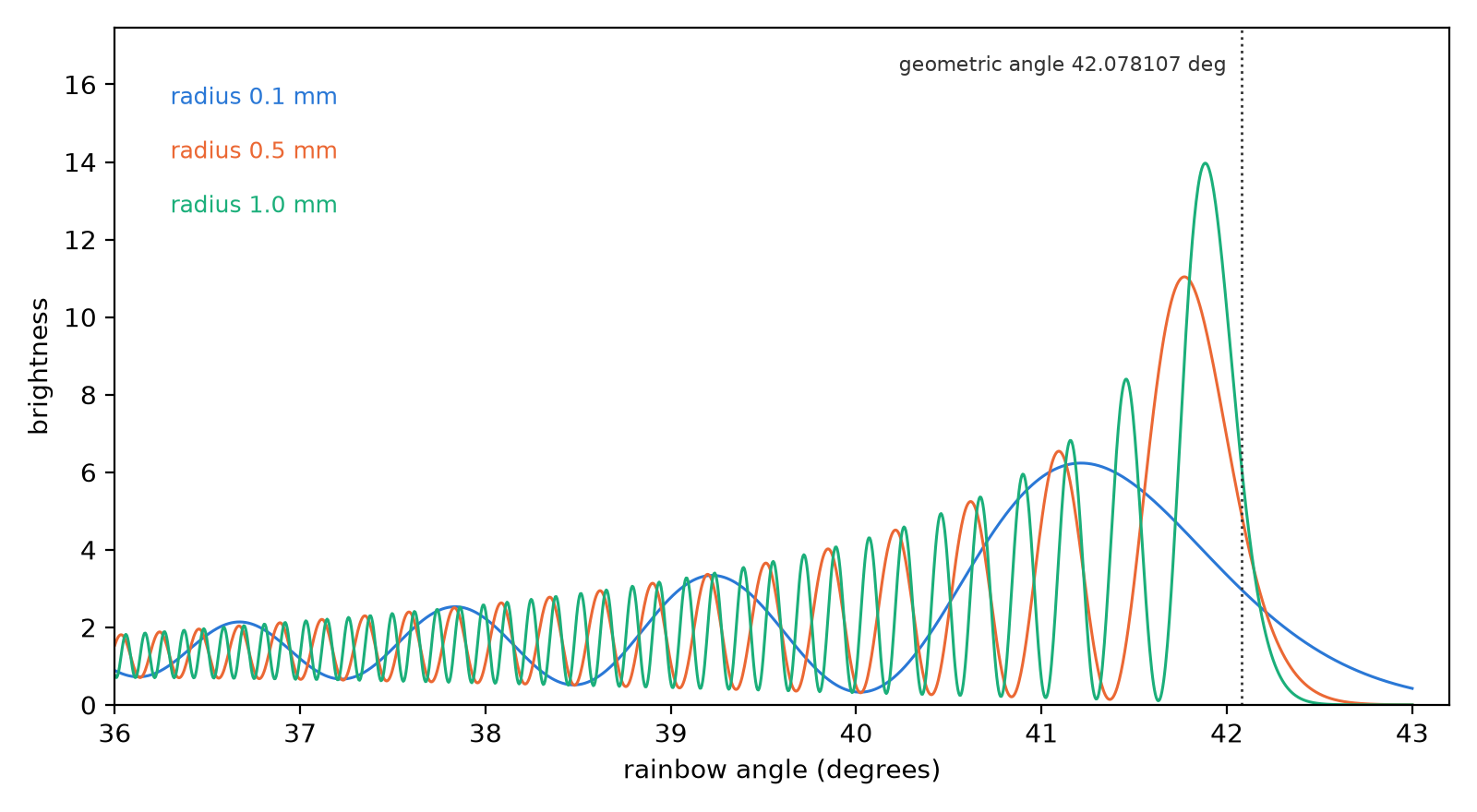
Drops of real sizes were computed for a single colour of wavelength 0.55 micrometres.
| Radius | $ka$ | Shift of the brightest place (degrees, inward) | Spacing to the second (degrees) |
|---|---|---|---|
| 0.1 mm | 1142.4 | 0.8651 | 1.9897 |
| 0.5 mm | 5712.0 | 0.3072 | 0.6776 |
| 1.0 mm | 11424.0 | 0.1946 | 0.4269 |
The smaller the drop, the further inward the brightest place moves from the geometric rainbow angle, and the wider the spacing of the supernumerary bows. Whether supernumerary bows are actually seen depends on the mixing of colours and on the size of the sun, which this paper does not treat.
6. A Perfect Focus Breaks, and a Cusp Survives
| Mirror | $k=500$ | $k=2000$ | $k=8000$ | Slope |
|---|---|---|---|---|
| Focus of the parabolic mirror (straight) | 114.3325 | 457.3300 | 1829.3199 | 1.0000 |
| Maximum on the caustic, parabolic mirror tilted by 0.02 rad | 104.9054 | 159.3065 | 239.1002 | 0.2667 to 0.3185 |
| Cusp of the elliptical mirror $(0.680000, 0)$ | 48.4064 | 95.1691 | 188.7236 | 0.4929 |
In a parabolic mirror all rays meet at one point, so the brightness grows as the first power of $k$. But when the light is tilted by 0.02 radians, the caustic becomes a single curve of finite length, and the speed along it is at least $3.000\times10^{-2}$ and never 0 (there is no cusp). The brightest place on the caustic continues to 346.0738 and 538.2090 as $k$ runs from 500 to 128000, and the slopes between neighbours are 0.3014, 0.2929, 0.2667 and 0.3185, dropping to near the $1/3$ of a fold. At $k = 8000$ it is 1829.3199 when straight and 239.1002 when tilted.
On the other hand, when the circular mirror is changed into an ellipse, a cusp survives at the point $x = 1 - 0.8^2/2 = 0.680000$ on the axis, and the brightness grows as the 0.4929 power (the cusp of the circle grows as the 0.4967 power). Gathering all rays at one point needs the phase to be flat to every order, and a slight tilt breaks that condition. A cusp needs only three rays to meet, so a slight change in the shape of the mirror only moves it. That only folds and cusps survive as stable caustics in the plane is known as a result of Arnold’s classification of singularities (Arnold, 1975). This paper only checked that behaviour by numbers with one tilt and one ellipse.
7. Relation to Earlier Papers
Paper 325 declared in its scope note that it would not treat the secondary fringes due to interference (supernumerary bows), as they belong to Airy’s theory. This paper takes that seat of the scope note and counted the spacing of the supernumerary bows and the brightness of the rainbow with waves. Paper 325 showed that the size of the drop is not in the angle of the rainbow. Here the size entered the brightness (the 1/3 power) and the spacing (the $-2/3$ power). Paper 325 placed its separator at whether geometric optics can be used; what happens on the inside of that boundary was put into numbers here.
Paper 198 showed that an optical caustic and a conjugate point are the same zero of the same equation. Here the shape of that zero (a fold where two rays meet, or a cusp where three meet) and the growth of the brightness as a wave were counted.
The three powers (1/3, 1/2 and 1) are different cases of one count, the power at which the phase stops being flat, so they are not called one root.
Five errors in the measurement were corrected and are recorded here. First, the grid used to count rays in the circular mirror contained exactly $\varphi = 0$, where a sign change was counted twice, so that one ray was counted as two and three as four. Second, the rays of the rainbow were counted from $b = 0.3$, which dropped the one ray on the backward side. Third, the range searched for supernumerary bows was too narrow, and the second bright place was not in it. Fourth, when the fold point was measured from $k = 500$, the width of the window was comparable to the width over which the pair of rays merges, and the slope came out below 1/3. Taking $k$ on the larger side gave 0.3358. Fifth, when the brightest place of the tilted parabolic mirror was searched on a grid in the plane, the coarseness of the grid made the slopes scatter widely. The measurement was changed to one on the caustic.
Closing
Closing: the brightness of a caustic grows at a rate set by how many rays meet there. A rainbow (a fold where two rays meet) brightened as the 0.3388 power of the wavenumber and the cusp of the coffee-cup pattern (three rays) as the 0.4967 power; when m rays meet, the brightness grows as the power 1 - 2/(m+1). The spacing of the supernumerary bows narrowed as the -0.6660 power of the drop size, and its ratio to Airy’s estimate approached 1 as closely as 0.999675. The size of the drop is not in the angle of the rainbow, but it is in its brightness and in the spacing of the supernumerary bows. The first-power growth at the perfect focus of a parabolic mirror broke with a tilt of only 0.02 radians into a caustic without a cusp, and the growth dropped to powers from 0.2667 to 0.3185. In an elliptical mirror the cusp survived and grew as the 0.4929 power. To be candid, that only folds and cusps are stable in the plane is a result of the literature, and this paper checked it with only one tilt and one ellipse. The separator is how many rays meet at one point. Two rays give the 1/3 power and three give the 1/2 power, while a focus where all rays meet is fragile.
References
- Airy, G. B. (1838). On the Intensity of Light in the Neighbourhood of a Caustic. Transactions of the Cambridge Philosophical Society.
- Arnol’d, V. I. (1975). Critical Points of Smooth Functions and Their Normal Forms. Russian Mathematical Surveys.
- Berry, M. V., & Upstill, C. (1980). Catastrophe Optics: Morphologies of Caustics and Their Diffraction Patterns. Progress in Optics.
- Pearcey, T. (1946). The Structure of an Electromagnetic Field in the Neighbourhood of a Cusp of a Caustic. The London, Edinburgh, and Dublin Philosophical Magazine and Journal of Science.
- Yamagishi, Y. (2026). “Straight” Does Not Mean “Shortest”, and There Are Two Fences [Paper 198]. YOI: https://www.yamagishiyuuki.com/yoi/198; DOI: 10.5281/zenodo.22107954
- Yamagishi, Y. (2026). The Size of the Drop Is Not in the Angle of the Rainbow [Paper 325]. YOI: https://www.yamagishiyuuki.com/yoi/325; DOI: 10.5281/zenodo.22209848
Reference
Yamagishi, Y. (2026). The Brightness of a Caustic Grows at a Rate Set by How Many Rays Meet There [Paper 1078]. YOI: https://www.yamagishiyuuki.com/yoi/1078
ORCID: 0009-0006-8587-3450
PDF (English) · PDF (Japanese) · Date proof of the English PDF (OpenTimestamps .ots) · SHA256SUMS
The record page for this paper (in Japanese, with the PDFs in each language and the date proof): YOI 1078. This paper is a preprint and has not been peer reviewed.