Abstract
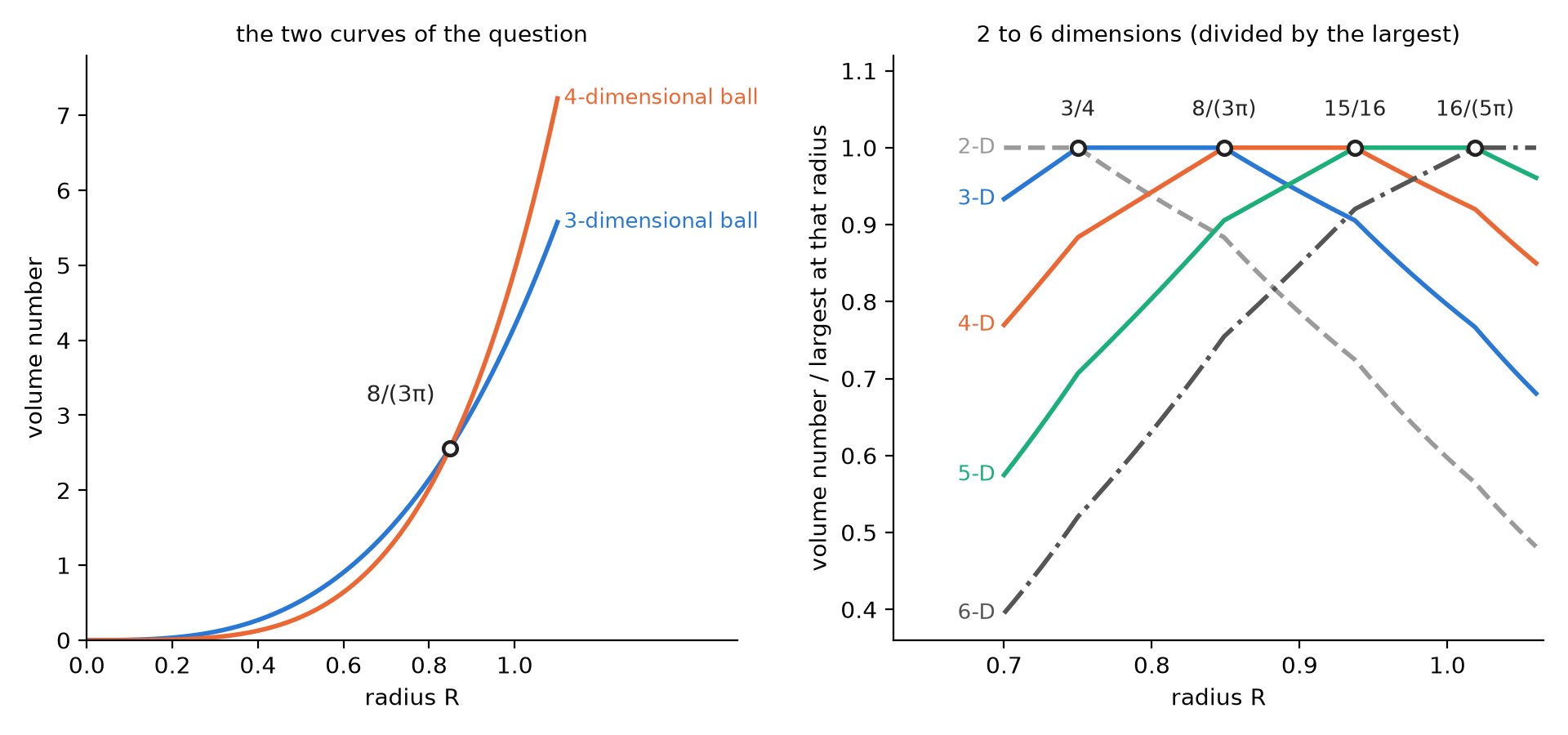
The volume of a ball of radius c is (4/3)πc³ in three dimensions and (π²/2)c⁴ in four. With c = 1 the two numbers are $\mathbf{4.188790205}$ and $\mathbf{4.934802201}$, the four-dimensional one being larger. They become the same number at the radius c = 8/(3π) = $\mathbf{0.848826363}$. This paper counts what that radius is and what it is not. It claims no new theorem and no new law.
First, the sequence of crossings. The radii at which the volumes of balls in neighbouring dimensions are the same number (called crossings here) run 1/2, 2/π, 3/4, 8/(3π), 15/16, 16/(5π), alternating between a rational number and a rational number divided by π. The product of two neighbouring crossings is (n+1)/(2π).
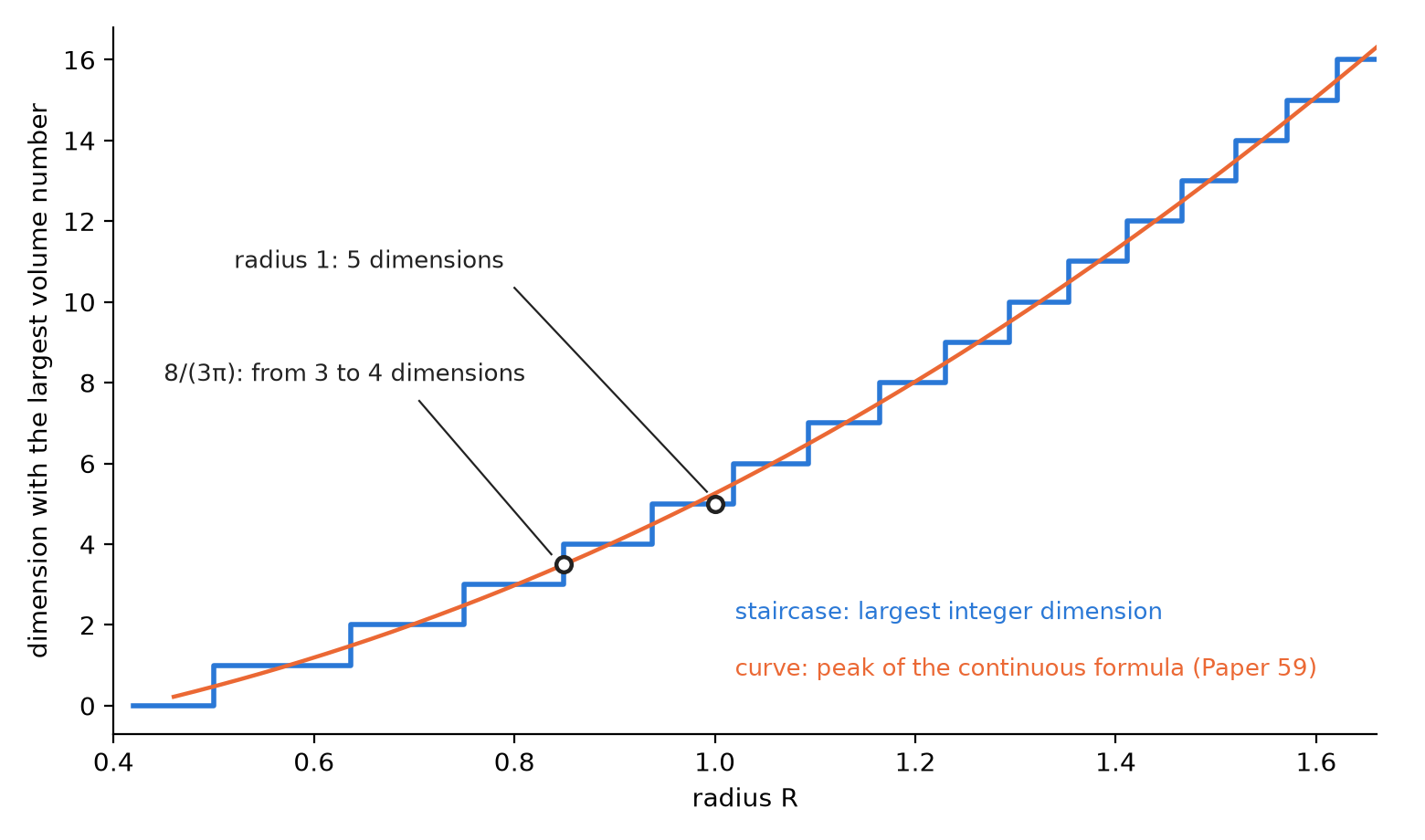
Second, and this is the core of the paper: a crossing is where the dimension with the largest volume number changes. Fix a radius and list the volume numbers dimension by dimension; the largest belongs to the last dimension whose crossing lies below the radius, as checked for 14 radii. Three dimensions are the largest only while the radius lies between 3/4 and 8/(3π), an interval of width $\mathbf{0.098826363}$. The radius 1 lies between 15/16 and 16/(5π), so the classical fact that the unit ball is largest in five dimensions (Paper 59) is one step of this staircase.
Third, the crossing moves with the unit. If the unit of length is made 100 times smaller, the length at which the two numbers agree becomes $\mathbf{0.008488264}$ in the original unit; if it is made 1000 times larger, it becomes $\mathbf{848.826363157}$. With the speed of light in m/s the ratio of the two numbers is $\mathbf{3.531847}$×10⁸, and in km/s it is $\mathbf{3.531847}$×10⁵; they agree when the unit of speed is taken to be $\mathbf{353184668.870}$ m/s. The number 8/(3π) is not a constant of the world; it states which unit was chosen.
Fourth, what does not move is the ratio to the circumscribed cylinder. Put the ball inside the cylinder whose base is the ball one dimension lower and whose height is the diameter. The fraction the ball occupies is π/4, 2/3, 3π/16, 8/15 from two dimensions upward, independent of the radius and of the unit. The 2/3 in three dimensions is the ratio of Archimedes; in four dimensions it becomes 3π/16 = $\mathbf{0.589048623}$. The ratio of the surfaces is the same as the ratio of the volumes. A crossing is the reciprocal of twice this ratio.
Fifth, twice that ratio is the Wallis integral. Seen as a stack of thin slices that are balls one dimension lower, a ball has a volume ratio to its lower neighbour given by a single integral. That integral obeys a recursion that skips two steps and has two starting values, π and 2, so π enters only every other term (the two staircases of Paper 115). The amount by which the Wallis product falls short of π/2 equals exactly the ratio of two neighbouring crossings.
Sixth, there is a continued fraction in which the dimension enters as a number. In the continued fraction proved by Bauer (1872) and communicated by Ramanujan in his first letter to Hardy, putting x = 2n + 1 gives the square of the crossing as (x + 1²/(2x + 3²/(2x + ...)))/(4π). For n = 4 the bracket is $\mathbf{9.054147873672}$; divided by 4π it gives $\mathbf{0.720506194790}$, which differs from the square of 8/(3π) by 1.110×10⁻¹⁶.
To be candid, the check failed once. The depth at which the continued fraction is cut off had been fixed at 3000 levels before measuring, and for n = 1 that did not reach 10 digits (10,000 levels are needed). The check now measures the required depth first.
Keywords: volume of the ball, dimension, Wallis integral, continued fraction, Archimedes, choice of unit, Ramanujan.
Scope (what is not claimed)
No new theorem or law is claimed. The volume formula for balls in higher dimensions, the fact that the unit ball is largest in five dimensions (Smith and Vamanamurthy 1989), the ratio 2/3 of a sphere to its circumscribed cylinder (Archimedes), the Wallis integral and product (Wallis 1656), Brouncker’s continued fraction, and the continued fraction for a quotient of gamma functions (Bauer 1872; Chapter 12 of Ramanujan’s second notebook) are all known. The number 8/(3π) is not called a constant of the world. It moves when the unit is changed. What does not move is the ratio to the cylinder. Nothing is said about the origin of the speed of light. Here c is a letter for a radius; the calculation with the speed of light is given only as an example of a number that moves with the unit. Volumes in different dimensions are not called equal. A three-dimensional volume and a four-dimensional volume carry different units. Only the numbers, after a unit has been fixed, can be the same. Higher-dimensional balls are not claimed to exist in the world. The formula is only tabulated over the dimension. The continued fraction is not proved. It is borrowed from the literature and checked numerically. Reading the number inside the continued fraction as a dimension is this paper’s reading. The 4π in the denominator of the continued fraction is not said to share a root with the 4π of the surface of a sphere. No measurement that moves only one of the two was made. Relation to earlier papers: Paper 59 showed that the dimension 5 at which the unit ball is largest follows from setting the radius to 1, showed with a continuous formula that the peak moves when the radius changes, and named the caution needed when volume numbers of different dimensions are compared. Here the same thing is counted as a staircase over integer dimensions, and the edges of the steps turn out to be the radii at which neighbouring volumes are the same number. Paper 115 showed that the recursion for sphere volumes skips two steps and splits into an even and an odd staircase. Here the two staircases appear in the sequence of crossings as the alternation between a rational number and a rational number divided by π, and their origin is the two starting values of the Wallis integral. Paper 12 stacked spherical shells up to radius c and obtained (4/3)πc³, and (π²/2)c⁴ in four dimensions. Here the numbers given by those two formulas are compared. Paper 45 showed that the radius 2 at which an area and a circumference agree is a choice of unit, and Paper 1055 sorted numbers by whether they move when the unit is changed. Here the crossing radius falls on the side that moves and the ratio to the cylinder on the side that does not. Paper 182 showed that a ball in 100 dimensions occupies only 1.87×10⁻⁷⁰ of its circumscribed cube. Here that number is seen to be the product of the cylinder ratios, one for each dimension. Paper 31 showed that no dimension enters the π of Ramanujan’s series. In the continued fraction borrowed here, the dimension enters as x = 2n + 1. Paper 232 treated the book by Carr from which Ramanujan learned, from the side of the status of the equals sign. Here the integral and the Wallis formula in articles 2453 to 2456 of that book are read as ratios of the volumes of balls in neighbouring dimensions. Paper 300 showed that whether two things share a root can be decided. Where that test was not applied, nothing is written about sharing or not sharing a root. What is added: the sequence of radii at which neighbouring volumes are the same number, and the count showing that they are where the largest dimension changes; the demonstration with the number of the speed of light that the crossing moves with the unit; the ratio to the circumscribed cylinder as a statement that does not move with the unit; the link from that ratio to the Wallis integral, to Carr’s book and to Bauer’s continued fraction; and the record of a mistake in the way of measuring.
1. The question
The volume of a ball of radius $c$ is $\frac{4}{3}\pi c^3$ in three dimensions and $\frac{\pi^2}{2}c^4$ in four (the two formulas Paper 12 obtained by stacking spherical shells). With $c = 1$ the three-dimensional number is $4.188790205$ and the four-dimensional one is $4.934802201$; the latter is larger, and the ratio is $3\pi/8 = 1.178097245$. Is there a radius at which the two are the same number? There is.
$$\frac{4}{3}\pi c^3 = \frac{\pi^2}{2}c^4 \quad\Longleftrightarrow\quad c = \frac{8}{3\pi} = 0.848826363 .$$At this radius both volume numbers are $2.561799804$. Shift the radius by one percent and the two numbers differ by $0.026394$.
What does this agreement say? A caution first: a three-dimensional volume and a four-dimensional volume carry different units (a length cubed and a length to the fourth power), so only the numbers, after a unit has been fixed, can be the same (the caution named in Paper 59). This paper therefore does not write that the volumes are equal; it writes that they are the same number. It then counts, in order, what this radius is a boundary of, how it moves when the unit is changed, and what statement does not move with the unit.
2. The volume formula and its checks
Write $V_n$ for the volume of the $n$-dimensional ball of radius 1. For radius $R$ the volume is $V_nR^n$.
$$V_n = \frac{\pi^{n/2}}{\Gamma(n/2+1)},\qquad V_n = \frac{2\pi}{n}V_{n-2},\qquad V_0 = 1,\quad V_1 = 2 .$$The zero-dimensional ball is a point and its volume is counted as 1. The one-dimensional ball is a segment of length 2.
| Dimension | Formula | Value |
|---|---|---|
| 0 | $1$ | $1.000000000$ |
| 1 | $2$ | $2.000000000$ |
| 2 | $\pi$ | $3.141592654$ |
| 3 | $4\pi/3$ | $4.188790205$ |
| 4 | $\pi^2/2$ | $4.934802201$ |
| 5 | $8\pi^2/15$ | $5.263789014$ |
| 6 | $\pi^3/6$ | $5.167712780$ |
| 7 | $16\pi^3/105$ | $4.724765970$ |
| 8 | $\pi^4/24$ | $4.058712126$ |
The formula was checked in three ways. The two-step recursion carried in exact fractions and the gamma-function formula agree from 0 to 8 dimensions with a largest difference of $8.882\times10^{-16}$. As a route that uses no formula, random points were scattered in a cube of side 2 and the volume was counted from the fraction falling inside the ball (200,000 points, 20 times).
| Dimension | Volume counted with random points | Formula | Deviation (in standard errors) |
|---|---|---|---|
| 2 | $3.142073 \pm 0.000637$ | $3.141593$ | $+0.75$ |
| 3 | $4.190432 \pm 0.002114$ | $4.188790$ | $+0.78$ |
| 4 | $4.931584 \pm 0.004224$ | $4.934802$ | $-0.76$ |
| 5 | $5.260032 \pm 0.007929$ | $5.263789$ | $-0.47$ |
| 6 | $5.169056 \pm 0.007064$ | $5.167713$ | $+0.19$ |
From 2 to 6 dimensions the deviation from the formula stayed within 0.78 standard errors.
3. The sequence of radii at which the numbers agree
Write $R^*_n$ for the radius at which the volumes in $n-1$ and $n$ dimensions are the same number, and call it a crossing.
$$V_{n-1}R^{n-1} = V_nR^n \quad\Longleftrightarrow\quad R = R^*_n = \frac{V_{n-1}}{V_n} .$$The $8/(3\pi)$ of the question is $R^*_4$. The same calculation in other dimensions gives the following sequence.
| $n$ | Crossing $R^*_n$ | Value | Width to the next crossing |
|---|---|---|---|
| 1 | $1/2$ | $0.500000000$ | $0.136620$ |
| 2 | $2/\pi$ | $0.636619772$ | $0.113380$ |
| 3 | $3/4$ | $0.750000000$ | $0.098826$ |
| 4 | $8/(3\pi)$ | $0.848826363$ | $0.088674$ |
| 5 | $15/16$ | $0.937500000$ | $0.081092$ |
| 6 | $16/(5\pi)$ | $1.018591636$ | $0.075158$ |
| 7 | $35/32$ | $1.093750000$ | $0.070355$ |
| 8 | $128/(35\pi)$ | $1.164104727$ | $0.066364$ |
| 9 | $315/256$ | $1.230468750$ | |
| 10 | $256/(63\pi)$ | $1.293449696$ |
Three things can be seen. First, the crossings with odd $n$ are rational, and those with even $n$ are a rational number divided by $\pi$ (the reason is in Section 7). Second, the product of two neighbours is
$$R^*_nR^*_{n+1} = \frac{V_{n-1}}{V_{n+1}} = \frac{n+1}{2\pi} ,$$which is the two-step recursion itself (checked in exact fractions for $n = 1$ to 11). For example, the product of $3/4$ and $8/(3\pi)$ is $2/\pi$. Third, the crossings grow with the dimension and the widths between them shrink.
4. A crossing is where the largest dimension changes
Fix a radius $R$ and list the volume numbers $V_0, V_1R, V_2R^2, \dots$ in order of dimension. The ratio of two neighbours is
$$\frac{V_nR^n}{V_{n-1}R^{n-1}} = \frac{R}{R^*_n} .$$Since the crossing $R^*_n$ grows with the dimension (Section 7), the list rises while $R^*_n < R$ and falls once $R^*_n > R$. So the dimension with the largest volume number is the last dimension whose crossing is below $R$.
| Radius $R$ | Dimension with the largest volume number | That volume number |
|---|---|---|
| $0.40$ | 0 | $1.000000$ |
| $0.55$ | 1 | $1.100000$ |
| $0.70$ | 2 | $1.539380$ |
| $0.76$ | 3 | $1.838778$ |
| $0.80$ | 3 | $2.144661$ |
| $0.84$ | 3 | $2.482713$ |
| $0.86$ | 4 | $2.699377$ |
| $0.90$ | 4 | $3.237724$ |
| $0.95$ | 5 | $4.073020$ |
| $1.00$ | 5 | $5.263789$ |
| $1.05$ | 6 | $6.925229$ |
| $1.50$ | 13 | $177.226119$ |
| $2.00$ | 24 | $32372.884977$ |
| $3.00$ | 56 | about $1.4\times10^{11}$ |
For these 14 radii the largest dimension found by computing every dimension from 0 upward agreed with the one read off from the sequence of crossings.
Read the table from the side of the question. Three dimensions have the largest volume number only while the radius lies between $3/4$ and $8/(3\pi)$, that is for $0.750000000 < R < 0.848826363$, an interval of width $0.098826363$. The $8/(3\pi)$ of the question is the upper end of the interval in which three dimensions are the largest; there the largest passes to four dimensions. The radius 1 lies between $15/16 = 0.937500$ and $16/(5\pi) = 1.018592$, so the largest is five dimensions ($5.263789$). The classical fact that the unit ball is largest in five dimensions (Smith and Vamanamurthy 1989; Paper 59) is one step of this staircase.
Paper 59 treated the dimension as a continuous number for a ball of radius $\lambda$ and showed that the peak of the volume is fixed by $\psi(n/2+1) = \ln(\pi\lambda^2)$, where $\psi$ is the digamma function. Solving that equation again gives a peak at $0.4766$ for radius $0.5$, $5.2569$ for radius 1, $24.1261$ for radius 2 and $55.5457$ for radius 3, reproducing the numbers of Paper 59. The largest integer dimensions for radii 1, 2 and 3 are 5, 24 and 56. The continuous peak was also examined at the crossings.
| Crossing | Continuous peak | Difference from $n-1/2$ |
|---|---|---|
| $R^*_1$ | $0.476583$ | $-0.023417$ |
| $R^*_2$ | $1.484580$ | $-0.015420$ |
| $R^*_3$ | $2.488604$ | $-0.011396$ |
| $R^*_4$ | $3.490994$ | $-0.009006$ |
| $R^*_5$ | $4.492567$ | $-0.007433$ |
| $R^*_6$ | $5.493678$ | $-0.006322$ |
| $R^*_{12}$ | $11.496680$ | $-0.003320$ |
At the crossing $R^*_n$ the dimensions $n-1$ and $n$ stand level with the same number. There the continuous peak lay between $n-1$ and $n$ for every $n$ from 1 to 12. Its difference from the midpoint $n-1/2$ ran from $-0.023417$ to $-0.003320$, shrinking with the dimension. The continuous formula of Paper 59 and the integer staircase here are two ways of writing the same thing.
5. The crossing moves when the unit is changed
A crossing is a length. When the unit of length is changed, the length at which the two volume numbers agree changes too. The length whose number in the new unit is $8/(3\pi)$, written in the original unit, is as follows.
| Unit of length | Length at which the two numbers agree (original unit) | 4-volume / (3-volume $\times$ radius) |
|---|---|---|
| Original unit | $0.848826363$ | $1.178097245096$ |
| Unit 100 times smaller | $0.008488264$ | $1.178097245096$ |
| Unit 1000 times larger | $848.826363157$ | $1.178097245096$ |
The length at which they agree moves by five orders of magnitude with the unit. What does not move is the four-dimensional volume divided by the three-dimensional volume times the radius, $3\pi/8 = 1.178097245$, with a spread of $2.220\times10^{-16}$.
The question was posed with $c$ read as the speed of light. So put in the number of the speed of light, $299792458$ m/s.
| Unit of speed | Number of $\frac{4}{3}\pi c^3$ | Number of $\frac{\pi^2}{2}c^4$ | Ratio |
|---|---|---|---|
| m/s | $1.128628\times10^{26}$ | $3.986140\times10^{34}$ | $3.531847\times10^{8}$ |
| km/s | $1.128628\times10^{17}$ | $3.986140\times10^{22}$ | $3.531847\times10^{5}$ |
| Unit in which $c$ is 1 | $4.188790$ | $4.934802$ | $1.178097$ |
The ratio is $3\pi/8$ times the number of $c$, and it moves by three orders of magnitude each time the unit is multiplied by 1000. The two numbers agree when the unit of speed is taken to be $(3\pi/8)c = 353184668.870$ m/s, and the number of $c$ is then $0.848826363$. So $8/(3\pi)$ is not a constant of the world; it states which unit was chosen. Paper 45 showed that the radius 2 at which an area and a circumference agree is a choice of unit, and Paper 1055 sorted numbers by whether they move when the unit is changed. By that sorting the crossing radius is on the side that moves. Nothing about the origin of the speed of light or of $\pi$ can be drawn from this agreement.
6. What does not move is the ratio to the circumscribed cylinder
Look for a statement that does not move with the unit. It is enough to compare the four-dimensional volume with something that carries the same unit, a length to the fourth power. The plainest partner is the four-dimensional cylinder whose base is the three-dimensional ball of the same radius and whose height is the diameter $2R$. The ball fits exactly inside this cylinder. In a general dimension, the fraction of the cylinder occupied by the ball is
$$\frac{V_nR^n}{V_{n-1}R^{n-1}\times 2R} = \frac{V_n}{2V_{n-1}} = \frac{1}{2R^*_n} ,$$and the radius drops out.
| Dimension | Ratio | Ratio of volumes | Ratio of surfaces |
|---|---|---|---|
| 2 | $\pi/4$ | $0.785398163$ | $0.785398163$ |
| 3 | $2/3$ | $0.666666667$ | $0.666666667$ |
| 4 | $3\pi/16$ | $0.589048623$ | $0.589048623$ |
| 5 | $8/15$ | $0.533333333$ | $0.533333333$ |
| 6 | $5\pi/32$ | $0.490873852$ | $0.490873852$ |
| 7 | $16/35$ | $0.457142857$ | $0.457142857$ |
| 8 | $35\pi/256$ | $0.429514621$ | $0.429514621$ |
In two dimensions this is the $\pi/4$ of a circle inscribed in a square. The $2/3$ in three dimensions is the ratio Archimedes established in On the Sphere and Cylinder. In four dimensions it becomes $3\pi/16 = 0.589048623$. Changing the radius to $0.3$, 1 and $2.7$ did not move the ratio; the spread was $2.220\times10^{-16}$. It was also checked by a route that uses no formula. Random points were scattered in the cylinder whose base is the three-dimensional ball, and the fraction falling inside the four-dimensional ball was $0.589199 \pm 0.000212$, which is 0.71 standard errors from $3\pi/16 = 0.589049$.
Archimedes showed that the sphere is $2/3$ of the cylinder not only in volume but also in surface, the bases included. This too does not depend on the dimension. The surface of the $n$-dimensional ball is $nV_nR^{n-1}$. The surface of the cylinder is the two bases $2V_{n-1}R^{n-1}$ plus the side $(n-1)V_{n-1}R^{n-2}\times 2R$, which add up to $2nV_{n-1}R^{n-1}$, so the ratio is again $V_n/(2V_{n-1})$. Numerically, from 2 to 8 dimensions the ratio of surfaces and the ratio of volumes differed by at most $2.220\times10^{-16}$.
The relation to the crossing takes one line. A crossing is the reciprocal of twice this ratio. The number $8/(3\pi)$ is the reciprocal of twice $3\pi/16$, and the agreement in the question, restated in a form that does not depend on the unit, reads: the four-dimensional ball occupies $3\pi/16$ of its circumscribed cylinder. That is what the $2/3$ of Archimedes looks like in four dimensions.
Instead of the cylinder one can compare with the circumscribed cube of side $2R$. Paper 182 showed that a ball in 100 dimensions occupies only $1.87\times10^{-70}$ of the cube. That number is the product of the cylinder ratios taken from one dimension upward.
$$\frac{V_d}{2^d} = \prod_{k=1}^{d}\frac{V_k}{2V_{k-1}} .$$| Dimension $d$ | Ball / cube | Ratio of the last step |
|---|---|---|
| 2 | $7.853982\times10^{-1}$ | $0.785398$ |
| 3 | $5.235988\times10^{-1}$ | $0.666667$ |
| 4 | $3.084251\times10^{-1}$ | $0.589049$ |
| 5 | $1.644934\times10^{-1}$ | $0.533333$ |
| 10 | $2.490395\times10^{-3}$ | $0.386563$ |
| 100 | $1.868182\times10^{-70}$ | $0.125018$ |
In 100 dimensions the product has fallen to $1.868182\times10^{-70}$, yet the ratio of the last step is still $0.125018$. The ball loses to the cube not because the ratio of a single step suddenly becomes small, but because a ratio below 1 is multiplied once for each dimension.
7. Twice the ratio is the Wallis integral
Regard the $n$-dimensional ball as a stack of thin slices, each an $(n-1)$-dimensional ball perpendicular to an axis. At position $x$ on the axis (from $-1$ to 1) the slice has radius $\sqrt{1-x^2}$, so
$$W_n \equiv \int_{-1}^{1}(1-x^2)^{(n-1)/2}\,dx = \frac{V_n}{V_{n-1}} = \frac{1}{R^*_n} .$$With $x=\cos\theta$ this is $W_n = \int_0^\pi \sin^n\theta d\theta$, the integral Wallis (1656) studied in order to find the area of the circle. The ratio to the cylinder is $W_n/2$ and the crossing is $1/W_n$.
| $n$ | $W_n$ | Value by numerical integration |
|---|---|---|
| 1 | $2$ | $2.000000000000$ |
| 2 | $\pi/2$ | $1.570796326795$ |
| 3 | $4/3$ | $1.333333333333$ |
| 4 | $3\pi/8$ | $1.178097245096$ |
| 5 | $16/15$ | $1.066666666667$ |
| 6 | $5\pi/16$ | $0.981747704247$ |
Computed numerically without the gamma function, this integral agrees with $V_n/V_{n-1}$ for $n = 1$ to 12 with a largest difference of $1.033\times10^{-14}$. The table for the cube in the previous section was also built by multiplying these numerical integrals, and it agreed with the gamma-function formula. The integrand becomes smaller as $n$ grows, so $W_n$ decreases with the dimension. That is the statement used in Section 4, that the crossings grow with the dimension.
Integration by parts gives a recursion that skips two steps.
$$W_n = \frac{n-1}{n}W_{n-2},\qquad W_0 = \pi,\quad W_1 = 2,\qquad W_nW_{n-1} = \frac{2\pi}{n} .$$The numerical integrals satisfy the recursion for $n = 2$ to 12 with a largest difference of $1.033\times10^{-14}$, and the product of neighbours for $n = 1$ to 12 with a largest difference of $2.665\times10^{-14}$. There are two starting values, $\pi$ and 2, and the recursion skips two steps, so every even $W_n$ contains one $\pi$ and every odd $W_n$ is rational. That is why rational numbers and rational numbers divided by $\pi$ alternate in the sequence of crossings. Paper 115 showed that the recursion for sphere volumes skips two steps and splits into an even and an odd staircase. When the ratio of neighbouring dimensions is taken, the two staircases appear as the two starting values of one integral.
The Wallis product comes out of this integral. Repeating the recursion gives
$$\frac{\pi}{2} = \left(\prod_{k=1}^{m}\frac{(2k)^2}{(2k-1)(2k+1)}\right)\times\frac{W_{2m}}{W_{2m+1}} ,$$so the amount by which the first $m$ factors fall short of $\pi/2$ is exactly $W_{2m}/W_{2m+1}$. In terms of crossings this is $R^*_{2m+1}/R^*_{2m}$, the ratio of two neighbouring crossings.
| $m$ | First $m$ factors (lower) | Times $(2m+1)/(2m)$ (upper) | Shortfall $W_{2m}/W_{2m+1}$ |
|---|---|---|---|
| 4 | $1.486077098$ | $1.671836735$ | $1.057008637$ |
| 10 | $1.533851903$ | $1.610544498$ | $1.024086043$ |
| 100 | $1.566893745$ | $1.574728214$ | $1.002490648$ |
| 1000 | $1.570403873$ | $1.571189075$ | $1.000249906$ |
| 10000 | $1.570757059$ | $1.570835597$ | $1.000024999$ |
Because $W_{2m+1} < W_{2m} < W_{2m-1}$, the first $m$ factors are below $\pi/2 = 1.570796327$ and their multiple by $(2m+1)/(2m)$ is above it. For $m = 4$ the shortfall $1.057008637$ equals $R^*_9/R^*_8$. That the Wallis product approaches $\pi/2$ means that the ratio of neighbouring crossings approaches 1.
The book by Carr from which Ramanujan learned (Paper 232) contains this integral. Article 2453 is the two-step recursion for the integral of the $n$th power of the sine, article 2454 gives its values, and article 2456 is Wallis’s formula, with a proof that places three integrals in order of magnitude and an example with $m = 4$. Translated into the language of balls, the ordering of those three integrals is the statement that the crossings grow with the dimension.
8. A continued fraction in which the dimension enters as a number
Paper 31 showed that no dimension appears anywhere in Ramanujan’s series for $1/\pi$. Is there no formula in which a dimension does enter? There is. The following continued fraction was proved by Bauer in 1872, written by Ramanujan in Chapter 12 of his second notebook, and communicated in his first letter to Hardy (Corollary 1 of Entry 25 in Berndt, Lamphere and Wilson 1985).
$$\left(\frac{\Gamma\left(\frac{x+1}{4}\right)}{\Gamma\left(\frac{x+3}{4}\right)}\right)^{2} = \cfrac{4}{x+\cfrac{1^2}{2x+\cfrac{3^2}{2x+\cfrac{5^2}{2x+\cdots}}}} .$$With $x = 2n+1$ the left side is $\Gamma((n+1)/2)^2/\Gamma(n/2+1)^2 = W_n^2/\pi$. Since $W_n = 1/R^*_n$, the square of the crossing can be written as a continued fraction.
$$(R^*_n)^2 = \frac{1}{4\pi}\left(x+\cfrac{1^2}{2x+\cfrac{3^2}{2x+\cfrac{5^2}{2x+\cdots}}}\right),\qquad x = 2n+1 .$$The dimension $n$ enters as the number $x = 2n+1$ inside the continued fraction.
| $n$ | $x$ | Left side | Depth reaching 10 digits | Square of the crossing |
|---|---|---|---|---|
| 1 | 3 | $1.273239544735$ | 10000 | $0.250000000000$ |
| 2 | 5 | $0.785398163397$ | 100 | $0.405284734569$ |
| 3 | 7 | $0.565884242105$ | 20 | $0.562500000000$ |
| 4 | 9 | $0.441786466911$ | 12 | $0.720506194790$ |
| 5 | 11 | $0.362165914947$ | 8 | $0.878906250000$ |
| 6 | 13 | $0.306796157577$ | 5 | $1.037528920498$ |
| 7 | 15 | $0.266081080369$ | 5 | $1.196289062500$ |
| 8 | 17 | $0.234890808145$ | 5 | $1.355139814527$ |
Cut off at a finite depth and evaluated from the bottom, the continued fraction agreed with the left side to 10 digits for $n = 1$ to 8. The depth reaching 10 digits is the first depth, among those tried (1, 2, 3, 5, 8, 12, 20, 30, 50, 100, 300, 1000, 10,000 and 100,000 levels), at which 10 digits were reached. The higher the dimension, the fewer levels are needed. For $n = 0$ ($x = 1$) the left side is $\pi$ itself, and the formula is the continued fraction Brouncker obtained in 1655. It converges slowly: even at 100,000 levels it gives $3.141582653790$, which differs from $\pi$ by $1.000\times10^{-5}$.
For the radius of the question, $n = 4$ and $x = 9$:
$$\left(\frac{8}{3\pi}\right)^{2} = \frac{1}{4\pi}\left(9+\cfrac{1^2}{18+\cfrac{3^2}{18+\cfrac{5^2}{18+\cdots}}}\right) .$$The bracket is $9.054147873672$; divided by $4\pi$ it gives $0.720506194790$, which differs from $(8/(3\pi))^2$ by $1.110\times10^{-16}$. As a control, putting 8 instead of 9 for $x$ gives $0.641437209$, which does not match $0.720506195$.
Keeping only the leading term of the continued fraction, $(R^*_n)^2$ is roughly $(2n+1)/(4\pi) = (n+1/2)/(2\pi)$. How well this holds was examined up to large dimensions.
| $n$ | Square of the crossing | $(n+1/2)/(2\pi)$ | Ratio | Remainder $4\pi (R^*_n)^2-(2n+1)$ | Remainder / $\frac{1}{2(2n+1)}$ |
|---|---|---|---|---|---|
| 1 | $0.250000000$ | $0.238732415$ | $1.047197551$ | $0.141592654$ | $0.849556$ |
| 2 | $0.405284735$ | $0.397887358$ | $1.018591636$ | $0.092958179$ | $0.929582$ |
| 4 | $0.720506195$ | $0.716197244$ | $1.006016430$ | $0.054147874$ | $0.974662$ |
| 10 | $1.673012117$ | $1.671126902$ | $1.001128110$ | $0.023690301$ | $0.994993$ |
| 30 | $4.854877645$ | $4.854225764$ | $1.000134291$ | $0.008191776$ | $0.999397$ |
| 100 | $15.995269724$ | $15.995071781$ | $1.000012375$ | $0.002487424$ | $0.999944$ |
| 150 | $23.952951121$ | $23.952818935$ | $1.000005519$ | $0.001661088$ | $0.999975$ |
The ratio is above 1 and approaches 1 as the dimension grows. The remainder beyond the leading term has a ratio to the next term of the continued fraction, $1/(2x)$, that approaches 1.
Two cautions. First, reading the number $x$ inside the continued fraction as a dimension is this paper’s reading. Second, there is a $4\pi$ in the denominator, but it is not said to share a root with the $4\pi$ of the surface of a sphere. The test of Paper 300 (whether one of the two can be moved alone) was not applied.
9. A mistake in measuring, and the relation to earlier papers
The check failed once. The depth at which the continued fraction is cut off had been fixed at 3000 levels before measuring, and for $n = 1$ ($x = 3$) that did not reach 10 digits. The smaller $x$ is, the more slowly the fraction converges, and for $n = 1$ it takes 10,000 levels to reach 10 digits. The check now measures the required depth first and compares at 100 times that depth, and a control was added in which $x$ is not of the form $2n+1$. The mistake was in the way of measuring, not in the formula.
Paper 59 showed that the dimension 5 at which the unit ball is largest follows from setting the radius to 1, and showed with a continuous formula that the peak moves when the radius changes. Here the same thing was counted as a staircase over integer dimensions. The edges of the steps are the radii at which neighbouring volumes are the same number, and they alternate between a rational number and a rational number divided by $\pi$.
Paper 115 showed that the recursion for sphere volumes skips two steps and splits into two staircases. Here, once the ratio of neighbouring dimensions was taken, the two staircases appeared as the two starting values, $\pi$ and 2, of the Wallis integral.
Paper 12 obtained the two volume formulas by stacking spherical shells. Here the numbers given by the two formulas were compared, and the radius at which they agree was seen to move with the unit. One more example has been added to the numbers fixed by a choice of unit that Paper 45 and Paper 1055 described.
Paper 182 showed that in high dimensions the ball loses to the cube. Here that fraction was seen to be the product of the cylinder ratios, one for each dimension.
Paper 31 showed that no dimension enters the $\pi$ of Ramanujan’s series, and Paper 232 treated the book from which Ramanujan learned from the side of the status of the equals sign. Here the Wallis formula printed in that book, and the continued fraction Ramanujan communicated in a letter, were read as ratios of the volumes of balls in neighbouring dimensions. The dimension enters the latter as a number.
Closing
Closing: the radius 8/(3π) at which the volumes of the three-dimensional and four-dimensional balls are the same number is where the dimension with the largest volume number passes from 3 to 4. The radii at which neighbouring volumes are the same number run 1/2, 2/π, 3/4, 8/(3π), 15/16, 16/(5π), and for a fixed radius the largest volume number belongs to the last dimension whose crossing lies below the radius. The interval in which three dimensions are the largest has width $\mathbf{0.098826363}$, and the radius 1 lies in the interval of five dimensions. The crossing moves with the unit; with the number of the speed of light, the two agree when the unit of speed is taken to be $\mathbf{353184668.870}$ m/s. What does not move is the ratio to the circumscribed cylinder: the 2/3 of Archimedes in three dimensions becomes 3π/16 = $\mathbf{0.589048623}$ in four, and the same ratio holds for the surfaces. Twice that ratio is the Wallis integral, and because it has two starting values, π and 2, π enters the sequence of crossings only every other term. In Bauer’s continued fraction the dimension enters as x = 2n + 1, and for n = 4 it reproduced the square of 8/(3π), $\mathbf{0.720506194790}$, to within 1.110×10⁻¹⁶. To be candid, nothing about the origin of the speed of light or of π can be drawn from this agreement. What could be drawn is the four-dimensional form of the 2/3 of Archimedes and a reading of an old integral as a ball. The separator is whether one compares the radius itself or the ratio to the circumscribed cylinder.
References
- Berndt, B. C., Lamphere, R. L., & Wilson, B. M. (1985). Chapter 12 of Ramanujan’s Second Notebook: Continued Fractions. Rocky Mountain Journal of Mathematics.
- Carr, G. S. (1886). A Synopsis of Elementary Results in Pure Mathematics. Francis Hodgson.
- Dutka, J. (1982). Wallis’s Product, Brouncker’s Continued Fraction, and Leibniz’s Series. Archive for History of Exact Sciences.
- Heath, T. L. (1897). The Works of Archimedes. Cambridge University Press.
- Smith, D. J., & Vamanamurthy, M. K. (1989). How Small Is a Unit Ball? Mathematics Magazine.
- Wallis, J. (1656). Arithmetica Infinitorum.
- Yamagishi, Y. (2026). From Boundary Energy to Volume Energy [Paper 12]. YOI: https://www.yamagishiyuuki.com/yoi/12; DOI: 10.5281/zenodo.21404703
- Yamagishi, Y. (2026). The $\pi$ That Carries No Dimension [Paper 31]. YOI: https://www.yamagishiyuuki.com/yoi/31; DOI: 10.5281/zenodo.22090430
- Yamagishi, Y. (2026). An Area Is Not a Solid Angle [Paper 45]. YOI: https://www.yamagishiyuuki.com/yoi/45; DOI: 10.5281/zenodo.21602337
- Yamagishi, Y. (2026). The Volume of the Unit Ball Is Greatest in Five Dimensions [Paper 59]. YOI: https://www.yamagishiyuuki.com/yoi/59; DOI: 10.5281/zenodo.21597865
- Yamagishi, Y. (2026). Two Staircases [Paper 115]. YOI: https://www.yamagishiyuuki.com/yoi/115; DOI: 10.5281/zenodo.21967686
- Yamagishi, Y. (2026). “The Curse of Dimensionality” Is Not One Curse [Paper 182]. YOI: https://www.yamagishiyuuki.com/yoi/182; DOI: 10.5281/zenodo.22104170
- Yamagishi, Y. (2026). Learn from a Book with the Proofs Removed and the Equals Sign Loses Its Type [Paper 232]. YOI: https://www.yamagishiyuuki.com/yoi/232; DOI: 10.5281/zenodo.22127528
- Yamagishi, Y. (2026). The Three Hundredth Census: Whether Two Things Share a Root Is Decidable [Paper 300]. YOI: https://www.yamagishiyuuki.com/yoi/300; DOI: 10.5281/zenodo.22171914
- Yamagishi, Y. (2026). The Speed of Light Is Near Three Hundred Million Because Length Is Decimal and Time Is Sexagesimal [Paper 1055]. YOI: https://www.yamagishiyuuki.com/yoi/1055; DOI: 10.5281/zenodo.22905177
Reference
Yamagishi, Y. (2026). The Radius Where the 3-Ball and 4-Ball Volumes Are the Same Number Is Where the Largest Dimension Changes [Paper 1080]. YOI: https://www.yamagishiyuuki.com/yoi/1080
ORCID: 0009-0006-8587-3450
PDF (English) · PDF (Japanese) · Date proof of the English PDF (OpenTimestamps .ots) · SHA256SUMS
The record page for this paper (in Japanese, with the PDFs in each language and the date proof): YOI 1080. This paper is a preprint and has not been peer reviewed.