Abstract
We count what, and how much, can be read about the contents enclosed by a surface from the field outside alone. For each angular pattern (each single spherical harmonic, fixed by its degree ℓ and its order m) we count, through the singular values of a matrix, how many numbers are carried from the radii of the sources inside to the radii of the observers outside; patterns with the same ℓ give the same count. For the inverse-square kernel 1/r in three dimensions the count is exactly 1 in every pattern. Of the 18 kernels examined, 10 stop at a fixed count: the Yukawa and Helmholtz kernels, the logarithm in two dimensions and the harmonic kernels in four and five dimensions also give 1, the biharmonic kernels give 2 and the triharmonic kernel gives 3. Power kernels falling as the 0.5th, 1.5th, 2nd and 3rd power of the distance, and the Gaussian kernel, do not stop at a fixed count. Every kernel that stops is the fundamental solution of a local equation whose form does not change under rotation, and the number of numbers that leave is half the lowest order of such an equation.
The shape does not matter. Inside a cube of edge 2 we added a rearrangement of the Laplacian form Δφ, with φ a smooth bump living only inside the cube, and moved the density inside from 0.100 to 1.225. For the inverse-square field the change of the field at five points outside the bump (one of them inside the cube) stayed at 10⁻¹⁵ of the size it would have without cancellation, the size of the computing error. The same rearrangement is visible, at the level of 10⁻³ to 10⁻², for the kernel 1/r². When a unit point mass at distance 0.6 from the centre is swept onto the unit sphere, the field outside is the same while the field at the centre differs: 1.000000 for the skin and 1.666667 for the point. For a point at the centre the skin density is 1/(4π) = 0.079577471546 everywhere.
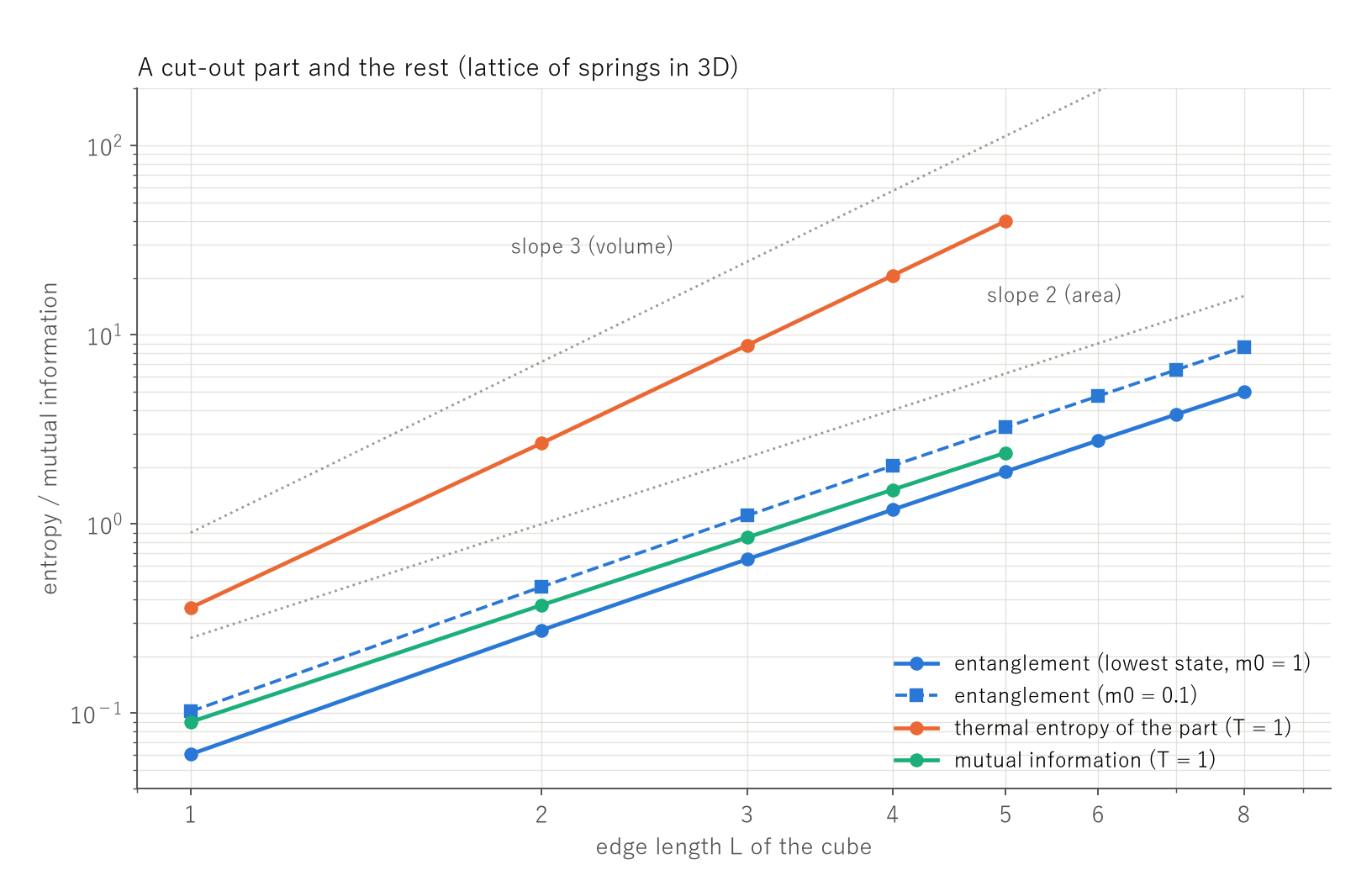
The 4π remains on the skin, that is, the flux of a point source is 4π at every radius, only when the field is massless. For the Yukawa field the flux falls to 11.432834, 9.245819, 5.102020 and 1.150806 at radii 0.5, 1, 2 and 4, yet the count of numbers leaving stays 1 per pattern. That one skin suffices belongs to the equation being of second order (local and of second order); that the 4π remains belongs to the zero mass; the roots differ. The area law, by which information is fixed by the size of the boundary, comes from yet another root, the locality of the interactions (their finite range). In a three-dimensional lattice of springs, the thermal entropy of a cut-out part grew as the 2.9491th power of its edge and the mutual information shared by the part and the rest as the 2.0239th power. The separator is the order of the local equation that the field obeys.
Keywords: inverse source problem, multipole expansion, balayage, order of the field equation, area law, holography, separator.
Scope (what is not claimed)
This paper claims no new theorem and no new law. That the field outside is fixed by the multipole coefficients, that the inverse source problem has no unique solution, the Poisson kernel, the connection coefficients of the Gegenbauer polynomials (DLMF §18.18), the partial-wave expansions of the Yukawa and Helmholtz kernels (Jackson 1998), that a function sent to zero by the Laplacian applied N times (a polyharmonic function) splits into a sum of N harmonic functions multiplied by even powers of |x| and so is written with N radial functions per angular pattern (Almansi’s expansion of 1899), and the area laws of entanglement and of mutual information (Srednicki 1993; Wolf, Verstraete, Hastings and Cirac 2008) are all known. We do not claim to have shown the holographic principle (the bound on gravitational entropy). We do not enter the argument that information sits on the boundary in quantum gravity (Laddha, Prabhu, Raju and Shrivastava 2021), and place beside it only one point, that there the energy becomes a boundary term. Nor do we claim that things like the human body can be divided into modules of some density. What we add is the following: the numbers leaving are counted as an exact count per angular pattern over 18 kernels, and the kernels that stop and those that do not are set out in a table, divided by whether they are fundamental solutions of local equations; for a cube, which is not a sphere, the outside is shown not to change when the inside is rearranged in the form of a Laplacian, together with how far the density moves; the condition for the 4π to remain on the skin (zero mass) is separated from the condition for one skin to suffice (the local equation being of second order); and the area law of information is placed alongside as a third root. The scope note of Paper 258 says that it does not enter inverse problems and looks only in the forward direction, at which solid angle appears once the shape of the source is given. This paper sits in that scope note and counts the reverse direction: what remains about the shape of the source from the field outside. The scope note of Paper 290 mentions that Gauss (1839) separated inner and outer sources from surface data alone, and says that it does not treat inverse problems and stays with the forward expansion. This paper is placed beside that scope note. It does not separate inner and outer sources; it counts, for the inner source, the part visible from outside and the part that is not.
1. What of the Inside Can Be Read from Outside a Closed Skin
Paper 51 wrote that a distant spherically symmetric distribution reproduces the field outside with no error from its total mass alone (Newton’s shell theorem), as a licence to aggregate granted by the exponent $n=2$, and said that the licence reaches only as far as the shell theorem. Paper 124 separated Gauss’s law, the shell theorem and the fast multipole method as dropping terms of the same expansion for different reasons. The shell theorem needs symmetry and in exchange has exactly zero error; the fast multipole method needs no symmetry and in exchange its error is not zero.
This paper asks about what lies between. When contents that are not a sphere are enclosed by a closed surface, what about the contents can be read, exactly, and how much, from the field outside the surface? It is also the question of what each module should be seen as from outside, when a thing is cut into modules. The question of reading the sources inside from the field outside is called the inverse source problem.
Counting by angular pattern makes the answer clear. Let $\rho(\mathbf y)$ be the density of the sources inside and $K(|\mathbf x-\mathbf y|)$ the kernel of the field, and let the field at an outside point $\mathbf x$ be $U(\mathbf x)=\int K(|\mathbf x-\mathbf y|)\rho(\mathbf y) d^3y$. With $r=|\mathbf x|$, $s=|\mathbf y|$ and $\theta$ the angle between the two directions, write the component of pattern $\ell$ of the kernel as
$$K_\ell(r,s)=\int_0^\pi K\bigl(\sqrt{r^2+s^2-2rs\cos\theta}\,\bigr)\,P_\ell(\cos\theta)\,\sin\theta\,d\theta ,$$where $P_\ell$ is the Legendre polynomial (in $d$ dimensions $P_\ell$ is replaced by the Gegenbauer polynomial $C_\ell^{((d-2)/2)}$ and $\sin\theta$ by $\sin^{d-2}\theta$, and in two dimensions $\cos\ell\theta$ and $d\theta$ are used). An angular pattern is one spherical harmonic $Y_{\ell m}$, fixed by its degree $\ell$ and its order $m$. The radial profile $\rho_{\ell m}(s)$ of pattern $(\ell,m)$ of the sources reaches outside only through $\int K_\ell(r,s)\rho_{\ell m}(s)s^2ds$. The number of numbers that leave is the rank of the map $K_\ell(r,s)$ from $s$ to $r$, and does not depend on $m$.
2. The Numbers Carried in Each Angular Pattern
We took 40 radii $s$ of the sources from 0.05 to 0.8 and 40 radii $r$ of the observers from 1.25 to 3.0, arranged the singular values of the matrix $K_\ell(r,s)$ in decreasing order, and counted those whose ratio to the largest exceeds $10^{-11}$. There are 18 kernels; 10 stopped at a fixed count and 8 did not.
| dimension | kernel | equation it obeys | count for $\ell=0$–4 |
|---|---|---|---|
| 3 | $1/r$ | second order (Newton, Coulomb) | 1, 1, 1, 1, 1 |
| 3 | $e^{-r}/r$, $e^{-3r}/r$ | second order (Yukawa) | 1, 1, 1, 1, 1 |
| 3 | $\cos 2r/r$ | second order (Helmholtz) | 1, 1, 1, 1, 1 |
| 3 | $r$ | fourth order (biharmonic) | 2, 2, 2, 2, 2 |
| 3 | $r^3$ | sixth order (triharmonic) | 3, 3, 3, 3, 3 |
| 3 | $r^{-0.5}$ | none (power) | 6, 6, 6, 6, 6 |
| 3 | $r^{-1.5}$ | none (power) | 7, 7, 7, 6, 6 |
| 3 | $r^{-2}$ | none (power) | 7, 7, 7, 7, 7 |
| 3 | $r^{-3}$ | none (power) | 8, 8, 7, 7, 7 |
| 3 | $e^{-r^2}$ | none (Gaussian) | 7, 7, 6, 6, 6 |
| 2 | $-\log r$ | second order (harmonic) | 1, 1, 1, 1, 1 |
| 2 | $1/r$ | none (power) | 7, 7, 7, 7, 7 |
| 4 | $1/r^2$ | second order (harmonic) | 1, 1, 1, 1, 1 |
| 4 | $1/r$ | none (power) | 6, 6, 6, 6, 6 |
| 5 | $1/r^3$ | second order (harmonic) | 1, 1, 1, 1, 1 |
| 5 | $1/r$ | fourth order (biharmonic) | 2, 2, 2, 2, 2 |
| 5 | $1/r^2$ | none (power) | 6, 6, 6, 6, 6 |
For the kernels that stop at a fixed count, in every one of the five patterns the next singular value drops to at most $2.8\times10^{-12}$ of the largest, while the values kept are at least $9.7\times10^{-6}$. For the kernels that do not stop, the singular values fall over the first three steps by a ratio of $1.4\times10^{-3}$ to $5.2\times10^{-2}$ per step and keep falling beyond, and where to cut is decided by the threshold (Figure 1, left). For the inverse square in three dimensions the component of each pattern is $K_\ell(r,s)=2s^\ell/((2\ell+1)r^{\ell+1})$, and its difference from the numerical component was at most $2.4\times10^{-11}$ for $\ell=0$ to 4. Because the component is a product of a function of the source radius and a function of the observer radius, only one number, $\int\rho_{\ell m}(s)s^{\ell+2}ds$, leaves.
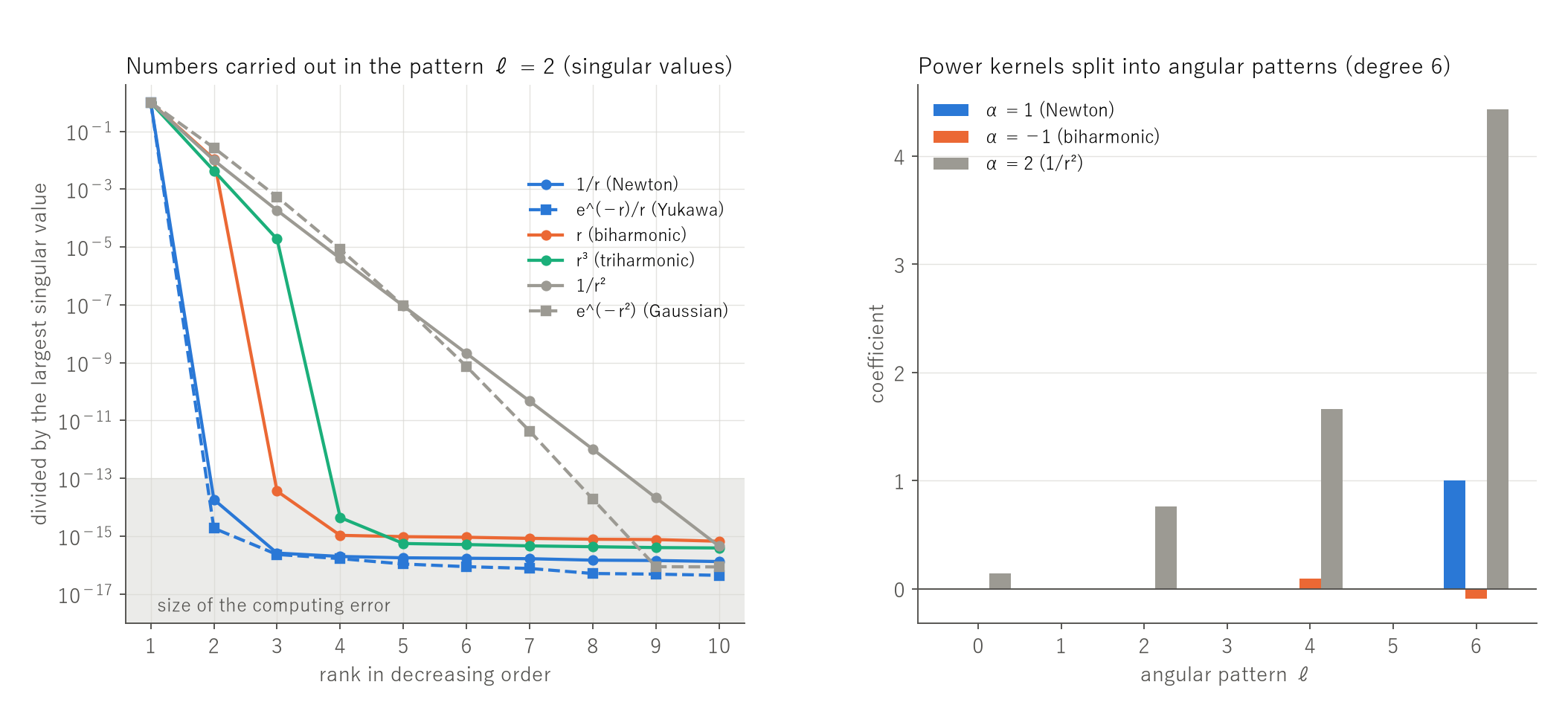
Why the count is fixed can be seen from the form of the expansion of the kernel. For $s<r$ a power kernel expands as $|\mathbf x-\mathbf y|^{-\alpha}=\sum_n C_n^{(\alpha/2)}(\cos\gamma) s^n/r^{n+\alpha}$, and each term is a product of a function of $s$ and a function of $r$. But the angular patterns in $d$ dimensions are $C_\ell^{((d-2)/2)}$, and unless $\alpha=d-2$, $C_n^{(\alpha/2)}$ does not fit into one pattern and splits into the patterns $\ell=n,n-2,n-4,\ldots$. The coefficients of the split carry the factor $(\alpha/2-(d-2)/2)_k$, with $(a)_k=a(a+1)\cdots(a+k-1)$ (DLMF 18.18.16), and this factor vanishes for $k>m$ only when $\alpha=d-2-2m$. Splitting $C_6^{(\alpha/2)}$ into the patterns of three dimensions (Legendre polynomials), for $\alpha=1$ only the coefficient 1.000000 of $\ell=6$ appears, for $\alpha=-1$ only 0.090909 and $-0.090909$ of $\ell=4$ and 6, and for $\alpha=2$ all of $\ell=0$, 2, 4 and 6 receive 0.142857, 0.761905, 1.662338 and 4.432900 (Figure 1, right). If $m+1$ terms enter one pattern, there are $m+1$ powers of $s$ and $m+1$ numbers leave. If without limit many terms enter one pattern, the numbers leaving do not stop. When $d$ is odd or $\alpha>0$, a power with $\alpha=d-2-2m$ is the fundamental solution of the equation with the Laplacian applied $m+1$ times, whose order is $2(m+1)$. When $d$ is even and $\alpha\leq0$, the power becomes a constant or a polynomial and is not a fundamental solution; the fundamental solution then contains a logarithm ($-\log r$ in two dimensions is one of them, and gave 1 in the table).
The Yukawa and Helmholtz kernels are not powers, but the component of each pattern is again a product of a function of the source radius and a function of the observer radius. For Yukawa, $K_\ell(r,s)=(4\kappa/\pi) i_\ell(\kappa s) k_\ell(\kappa r)$ with modified spherical Bessel functions in the convention $i_0(z)=\sinh z/z$ and $k_0(z)=(\pi/2)e^{-z}/z$, and its difference from the numerical component was at most $3.9\times10^{-12}$ for $\ell=0$ to 4. Both are fundamental solutions of local second-order equations, $(\Delta-\kappa^2)u=0$ and $(\Delta+4)u=0$ (for $\cos 2r/r$), and give 1 per pattern. What fixes the number of numbers leaving is not the inverse-square form but the order of the local equation of which the kernel is the fundamental solution.
3. The Shape Does Not Matter: a Rearrangement Inside a Cube That Cannot Be Seen from Outside
If one number per pattern leaves, the part of the sources that does not change that number cannot be seen from outside. For the inverse-square field in three dimensions, densities of the Laplacian form $\Delta\varphi$, with $\varphi$ a smooth function living only inside some region, are such a part, because outside the region of $\varphi$ we have $\int\Delta\varphi(\mathbf y)/|\mathbf x-\mathbf y| d^3y=-4\pi\varphi(\mathbf x)=0$. This property does not use a sphere.
Inside the cube $[-1,1]^3$ of edge 2 we placed a bump $\varphi=\prod_i(1-t_i^2)^4$, with $t_i$ running from $-1$ to 1 across a box of centre $(0.2,-0.1,0.3)$ and half-widths $(0.6,0.7,0.5)$, living only inside that box, and formed $\rho=\Delta\varphi$. The box lies inside the cube, its centre is off the centre of the cube, and its three half-widths all differ. Its total and its dipole are zero. Integrating the field numerically at five points outside the box of the bump (just outside a face of the cube, above, outside a corner, far away, and inside the cube but outside the box), the field for the inverse-square kernel was $1.0\times10^{-15}$ to $1.1\times10^{-15}$ of the size $\int|\rho|K d^3y$ it would have without cancellation, the size of the computing error (Figure 2, right).
Adding this rearrangement, multiplied by $\varepsilon=0.012757$, to a uniform cube of density 1 moves the density inside from 0.100 to 1.225, nowhere below 0 (Figure 2, left). Seen from outside, this cube and the uniform cube cannot be told apart. The inside is this free to move without changing a single value of the field outside.
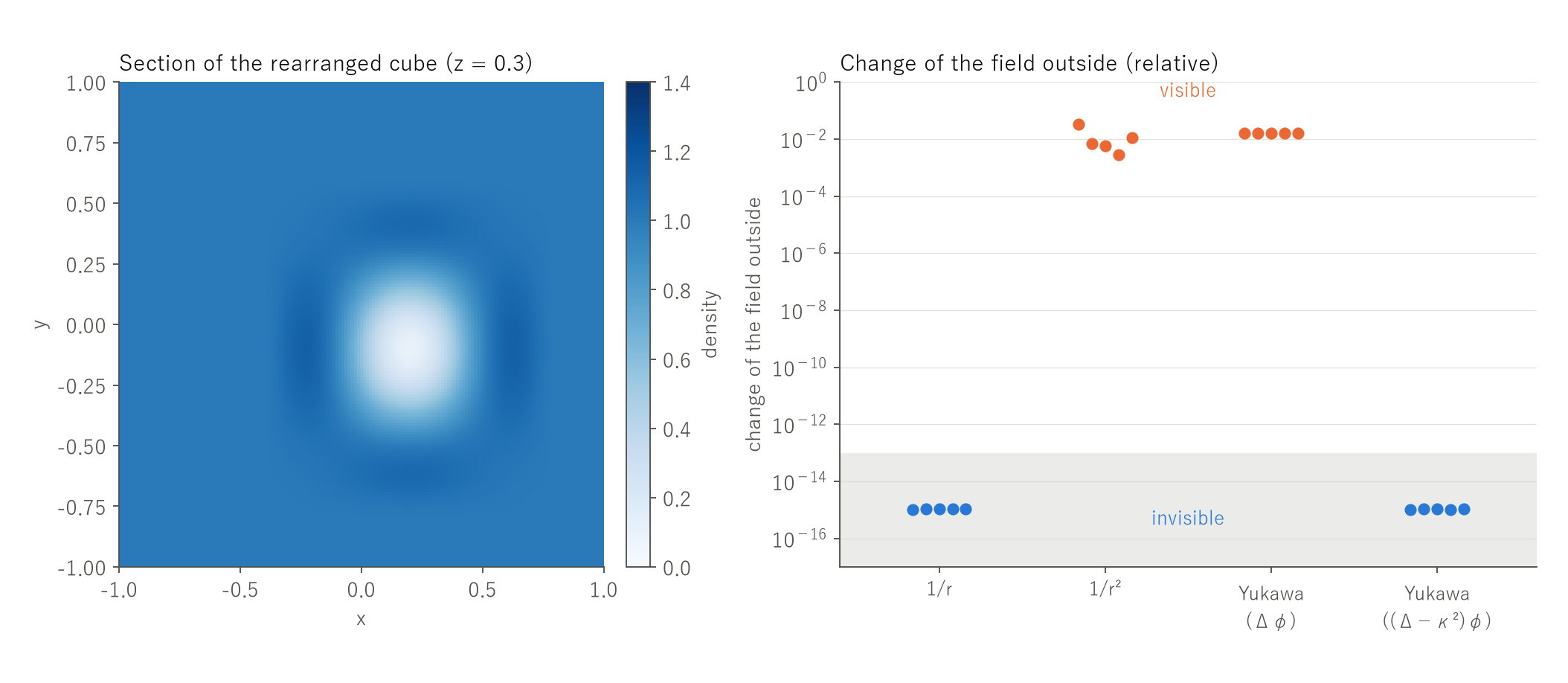
Seen through the kernel $1/r^2$, the same rearrangement changes the field outside by $2.9\times10^{-3}$ to $3.4\times10^{-2}$, which is visible. For the Yukawa kernel $e^{-r}/r$, the rearrangement $\Delta\varphi$ is visible at $1.6\times10^{-2}$, but replaced by $(\Delta-\kappa^2)\varphi$ with $\kappa=1$ it falls to $1.0\times10^{-15}$ to $1.1\times10^{-15}$ and becomes invisible. The form of the invisible rearrangements is fixed by the operator of the field equation itself.
4. Sweeping the Contents onto the Skin
If what can be seen from outside is one number per pattern, moving all the contents onto the skin should not change the outside. We move a unit point mass at $\mathbf y=(0,0,a)$ inside the unit sphere onto the skin with the density
$$\sigma(\mathbf x)=\frac{1-a^2}{4\pi\,|\mathbf x-\mathbf y|^3}$$(the Poisson kernel). The total on the skin is 1, and for $a=0.6$ the field at four points outside agreed with that of the point itself within $1.5\times10^{-14}$. Inside it differs: the field at the centre is 1.000000 for the skin and 1.666667 for the point (Figure 3, right). The ratio of the largest to the smallest skin density is, from the formula, $((1+a)/(1-a))^3$: 6.405248 for $a=0.3$ and 64.000000 for $a=0.6$. The skin remembers where the point was (Figure 3, left). For $a=0$ the skin density is $1/(4\pi)=0.079577471546$ everywhere, and the full solid angle $4\pi$ appears in the denominator.
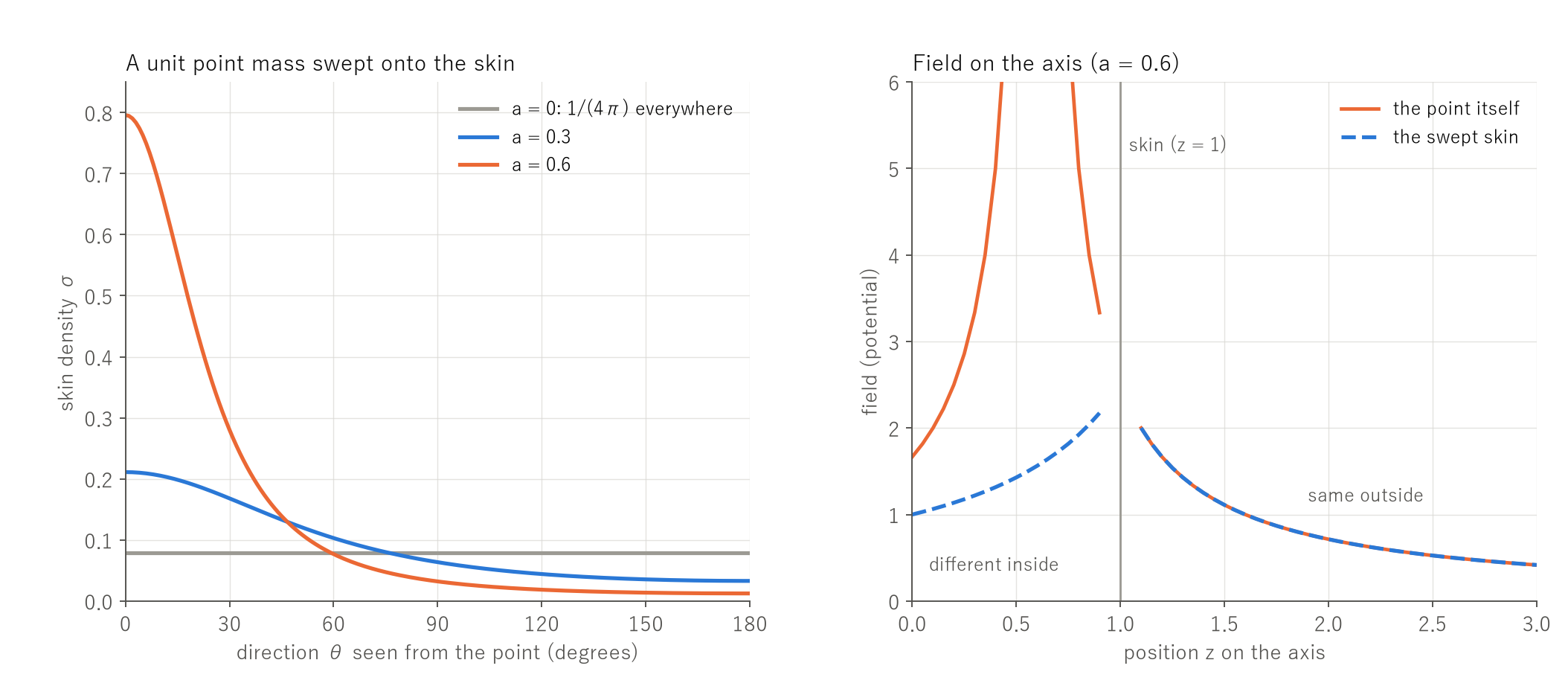
Any arrangement inside can, as far as the outside sees, be replaced by the density of one skin. The skin density is a function of angle and holds one number per angular pattern. This is another way of saying that one number per pattern leaves.
5. The $4\pi$ Remains on the Skin Only When the Field Is Massless
That one number per pattern leaves, and that the total leaving is kept at every radius, are different matters. We took the field of a point source as $e^{-\kappa r}/r$ and counted the flux $4\pi R^2E$ through the sphere of radius $R$, obtaining the field from a numerical derivative of the potential.
| $R=0.5$ | $R=1$ | $R=2$ | $R=4$ | |
|---|---|---|---|---|
| $\kappa=0$ (massless) | 12.566371 | 12.566371 | 12.566371 | 12.566371 |
| $\kappa=1$ (Yukawa) | 11.432834 | 9.245819 | 5.102020 | 1.150806 |
For $\kappa=0$ the flux is $4\pi=12.566371$ at every radius; this is Gauss’s law. For $\kappa=1$ the flux falls as $4\pi(1+\kappa R)e^{-\kappa R}$. Even so, as the previous sections showed, one number per pattern leaves for the Yukawa field too. That one skin can stand for the contents (the equation being local and of second order) and that $4\pi$ is kept on the skin (the field being massless) have different roots.
In electromagnetism, the field being massless corresponds to an unbroken gauge symmetry not allowing a mass term. Paper 107 wrote that, by Noether’s second theorem, the charge of a gauge theory appears as a surface integral at infinity. In the counting of this paper, that is the number of angular pattern $\ell=0$ showing at the same size in the flux through a sphere of any radius. For the Yukawa field one number of $\ell=0$ still leaves, but the flux falls with the radius and no longer shows that number as it is. The numbers with $\ell\geq1$ are not conserved quantities, but as long as the field obeys a local second-order equation, one of them leaves for each pattern. Paper 249 wrote that the $4\pi$ that catches by diffusion and the $4\pi$ that spreads a field share a root. That too is a matter of the flow side, $\ell=0$.
6. Numbers Inside and Numbers Outside
Counting shows how large the invisible part is. Divide the sources inside into $M$ radial steps and angular patterns up to degree $\ell$. The unknowns inside number $M(\ell+1)^2$, the numbers visible from outside $(\ell+1)^2$, and the visible fraction is $1/M$. For $M=20$ and $\ell\leq10$ there are 2420 unknowns against 121 visible numbers; for $M=100$ and $\ell\leq30$, 96100 against 961; the fractions are 0.0500 and 0.0100. The finer the inside is divided, the larger the invisible part. The numbers visible from outside amount to one function on the skin; the numbers inside amount to a volume.
Paper 1051 wrote whether the boundary determines the interior as the difference between the numbers of unknowns and of data. Placing sources on this yardstick, $M-1$ numbers per pattern are missing. In the Calderón problem of Paper 99, the correspondence between voltage and current on the boundary determines the conductivity inside uniquely (when the conductivity does not depend on direction). Both are problems measured on the boundary, yet the conductivity is determined and the source is not. What is measured on the boundary differs: a correspondence from voltage to current (a map from functions on the skin to functions, with as many numbers as the square of the size of the skin) or the values of the field (one function on the skin, with only as many numbers as the size of the skin).
7. Two Other Things Are Fixed by the Size of the Boundary, and Their Roots Differ
That the boundary stands for the contents is also said under the name of holography. But physics has at least three quantities fixed by the size of a boundary, and their roots differ. The first is the number of field numbers in this paper, which comes from the field obeying a local second-order equation.
The second is the amount of information. When matter bound by interactions of finite range is cut into a part and the rest, in a warm state the information shared by the part and the rest (the mutual information) is bounded from above by the interaction terms that cross the boundary alone, and grows with the size of the boundary, not with the volume of the part (Wolf et al. 2008; this holds at any temperature). That the entanglement entropy of the lowest state grows with the size of the boundary was shown numerically by Srednicki (1993) for a massless free field. In the lowest state some systems carry logarithmic corrections, and Wolf et al. also showed that these disappear in warm states. We checked this by cutting a cube of edge $L$ out of a three-dimensional lattice of springs $H=\frac12\sum_i(p_i^2+m_0^2x_i^2)+\frac12\sum_{\langle ij\rangle}(x_i-x_j)^2$ with periodic boundaries (Figure 4). The entanglement entropy of the lowest state grew as the 2.0669th power of $L$ ($m_0=1$) and as the 2.0798th power ($m_0=0.1$) from $L=4$ to 8. In the state at temperature 1, the thermal entropy of the part grew as the 2.9491th power and the mutual information of the part and the rest as the 2.0239th power from $L=2$ to 5. The thermal entropy grows with volume and the shared information with area. No $4\pi$ enters the coefficient (the surface of a cube is $6L^2$). The root here is the locality of the interactions, not the order of the field equation. Paper 88 separated the coarse-grained entropy from the entropy of the horizon area, so as not to conflate them. What appears here is neither of them: the area law of the information shared by ordinary matter.
The third is gravity. Paper 1093 wrote that the entropy of a black hole in three dimensions is the same number as the area of the disk of the horizon’s cross section, and Paper 1092 wrote that the exponent of the density that balances a horizon at every radius is 2 in every dimension. In quantum gravity, that the energy becomes a boundary term is one of the footholds of the argument that a copy of the information sits on the boundary. Appendix A of Laddha et al. (2021) writes that on states satisfying the Hamiltonian constraint the Hamiltonian becomes a boundary term. Placed in the counting of this paper, it means that in gravity the energy appears on the skin as the number of $\ell=0$. We do not enter the quantum-gravity argument beyond that.
8. The Density $1/r^2$ Does Not Make the Property of the Skin
Paper 01 showed that the mass of one spherical shell is independent of the radius only when the density is $1/r^2$, and Paper 02 showed that the mass inside radius 1 is then $4\pi$. The property of the skin in this paper is a different thing from this property of the density. For any arrangement of density, only one number per pattern is seen from outside an inverse-square field, and, as with the rearrangement of the cube, the inside can move unseen from outside as long as the move does not change that number. The reason one skin can stand for the contents lies not in the form of the density inside but on the side of the field equation.
Paper 01 wrote that the $1/r^2$ of Gauss’s flux conservation and of the fundamental solution of Laplace’s equation comes from the same surface area of the sphere as the theorem. Paper 1092 wrote that the 2 of the density $1/r^2$ is two 2s, the 2 of the shell mass and the 2 of the horizon balance. What works in this paper is the 2 on the side of the field. In the judgement of Paper 300, the 2 of the density and the 2 of the field respond differently to what is moved: however the density inside is changed, the property of the skin does not change, while changing the order of the field equation changes it.
Closing
What can be read from outside a closed skin, when the field obeys a local second-order equation, is exactly one number per angular pattern. Fourth order gives two, sixth order three, and power kernels and the Gaussian kernel do not stop. The shape does not matter: rearranging the inside of a cube substantially in the form of a Laplacian does not change the inverse-square field outside. The 4π remains on the skin when the field is massless, which has a different root from one skin sufficing. The area law, by which information is fixed by the boundary, comes from yet another root, the locality of the interactions. When a thing cut into modules is seen from outside, as long as the field obeys a local equation, each module appears as a number of skins equal to half the order of the equation.
References
- Jackson, J. D. (1998). Classical Electrodynamics (3rd ed.). Wiley.
- Laddha, A., Prabhu, S. G., Raju, S., and Shrivastava, P. (2021). The holographic nature of null infinity. SciPost Physics.
- Olver, F. W. J., Olde Daalhuis, A. B., Lozier, D. W., Schneider, B. I., Boisvert, R. F., Clark, C. W., Miller, B. R., Saunders, B. V., Cohl, H. S., and McClain, M. A. (eds.) (2026). NIST Digital Library of Mathematical Functions, Release 1.2.8, §18.18.
- Srednicki, M. (1993). Entropy and area. Physical Review Letters.
- Wolf, M. M., Verstraete, F., Hastings, M. B., and Cirac, J. I. (2008). Area laws in quantum systems: Mutual information and correlations. Physical Review Letters.
- Yamagishi, Y. (2026). The Uniqueness Theorem of $n = 2$ for Spherically Symmetric Density Distributions [Paper 01]. YOI: https://www.yamagishiyuuki.com/yoi/1; DOI: 10.5281/zenodo.21403186
- Yamagishi, Y. (2026). The $4\pi$ Mass Cancellation Theorem [Paper 02]. YOI: https://www.yamagishiyuuki.com/yoi/2; DOI: 10.5281/zenodo.21403931
- Yamagishi, Y. (2026). The Yamagishi Gravitational Multipole Aggregation Theory [Paper 51]. YOI: https://www.yamagishiyuuki.com/yoi/51; DOI: 10.5281/zenodo.21602935
- Yamagishi, Y. (2026). Two Entropies, Not to Be Conflated [Paper 88]. YOI: https://www.yamagishiyuuki.com/yoi/88; DOI: 10.5281/zenodo.21747809
- Yamagishi, Y. (2026). Reading the Interior from the Boundary [Paper 99]. YOI: https://www.yamagishiyuuki.com/yoi/99; DOI: 10.5281/zenodo.21758790
- Yamagishi, Y. (2026). The Two Noethers [Paper 107]. YOI: https://www.yamagishiyuuki.com/yoi/107; DOI: 10.5281/zenodo.21837205
- Yamagishi, Y. (2026). Three Distinct Roots of Aggregation [Paper 124]. YOI: https://www.yamagishiyuuki.com/yoi/124; DOI: 10.5281/zenodo.22057728
- Yamagishi, Y. (2026). The Four Pi That Catches Molecules Is the Four Pi That Spreads a Field [Paper 249]. YOI: https://www.yamagishiyuuki.com/yoi/249; DOI: 10.5281/zenodo.22160409
- Yamagishi, Y. (2026). $4\pi$ Appears Only When the Source Is a Point [Paper 258]. YOI: https://www.yamagishiyuuki.com/yoi/258; DOI: 10.5281/zenodo.22169011
- Yamagishi, Y. (2026). That the Earth’s Field Begins at the Dipole Is Not a Property of the Earth [Paper 290]. YOI: https://www.yamagishiyuuki.com/yoi/290; DOI: 10.5281/zenodo.22171410
- Yamagishi, Y. (2026). The Three Hundredth Census: Whether Two Things Share a Root Is Decidable [Paper 300]. YOI: https://www.yamagishiyuuki.com/yoi/300; DOI: 10.5281/zenodo.22171914
- Yamagishi, Y. (2026). Whether the Boundary Determines the Interior Depends on What Is Measured and How Much [Paper 1051]. YOI: https://www.yamagishiyuuki.com/yoi/1051; DOI: 10.5281/zenodo.22903544
- Yamagishi, Y. (2026). The “2” of the Inverse-Square Density Is Two 2s, and the 2 of the Shell Mass Meets the 2 of the Horizon Balance Only in Three Dimensions [Paper 1092]. YOI: https://www.yamagishiyuuki.com/yoi/1092
- Yamagishi, Y. (2026). In Three Dimensions the Entropy of a Black Hole Is the Same Number as the Area of the Horizon’s Cross-Sectional Disk, and the Shadow Disk in the Photographs Is 27/4 Times Larger [Paper 1093]. YOI: https://www.yamagishiyuuki.com/yoi/1093
Reference
Yamagishi, Y. (2026). When the Field Equation Is of Second Order, the Interior Can Be Read from Outside a Closed Skin Only as One Number per Angular Pattern [Paper 1107]. YOI: https://www.yamagishiyuuki.com/yoi/1107
ORCID: 0009-0006-8587-3450
PDF (English) · PDF (Japanese) · Date proof of the English PDF (OpenTimestamps .ots) · SHA256SUMS
The record page for this paper (in Japanese, with the PDFs in each language and the date proof): YOI 1107. This paper is a preprint and has not been peer reviewed.