Abstract
Paint mass on the skin of a sphere of radius 1, with the same density everywhere. At density 1 the skin’s mass equals its area, 4π. Paper 02 showed that a ball of radius 1 whose density goes as 1/r² has a mass equal in number to the full solid angle, 4π. This paper checks with numbers that the two are the same thing seen from outside, and that the 1/r² ball is that skin puffed out evenly along the radius (the same mass in every width of radius). Units are set so that the gravitational constant is 1 and the radius is 1; when the point, skin and balls are compared the total mass is 4π (only where the table of Paper 02 and the volume restoration are discussed is the normalization of Paper 02, density 1 at radius 1, used).
Moving a ball of radius 1 and density r⁻ⁿ onto its skin without changing the field outside (sweeping it out) gives a skin density of 1/(3−n) everywhere. In units of radius 1 this is the same number that Paper 02 called “the number of 4π layers”: it is 1 at n = 2 and 1/3 for the uniform ball (n = 0). The staircase 2π, 4π, 8π of Paper 02 becomes the skin densities 1/2, 1, 2. Sweeping out only the shells of the 1/r² ball up to radius r gives a skin density of r; for the uniform ball (density 3) it gives r³.
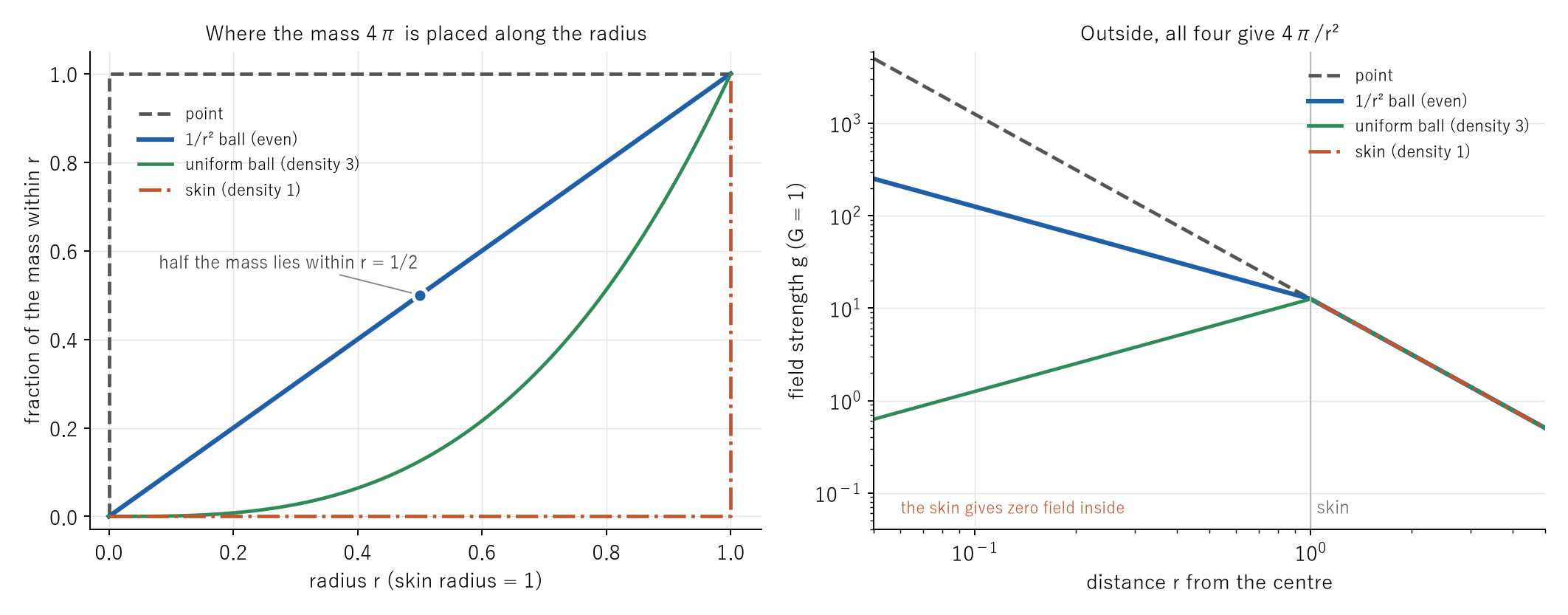
The mass per skin (mass per unit width of radius) is the same at every radius only for n = 2 (Paper 01). Then half the mass lies within radius 1/2, and the mean radius (the radius averaged with the mass) is also 1/2. For the uniform ball these are 0.7937005 and 0.75, for the point 0 and for the skin 1; the 1/r² ball fills the range between them evenly.
The fields of a point, a skin of density 1, a 1/r² ball and a uniform ball, each of mass 4π, were compared: the point by its formula, the other three by integrating the field kernel numerically without using the shell theorem’s answer. At three points outside, the four fields agree with 4π/r² to within 7.89×10⁻³¹; inside they split into 4π/r², 0, 4π/r and 4πr. The gravitational potential energy of coming together is −8π² for the skin, −48π²/5 for the uniform ball and −16π² for the 1/r² ball: the values 1/2, 3/5 and 1 of the coefficient of Paper 1113 at n → −∞, 0 and 2. The field energy outside is the same −8π² for all four, and the whole difference lies inside the skin. The energy the 1/r² ball releases is exactly twice the skin’s.
What can be read from outside is the total mass alone; how the inside is filled is not written there. When a skin and a 1/r² ball are built from the same parts and all the energy released in coming together leaves, the energy that leaves differs, so in the weak-gravity estimate the 1/r² ball is lighter than the skin by Gm²/(2Rc²). If the sum of the parts m and the radius R are known separately, the total mass read from outside gives one number, the coefficient. The 4π/3 of the volume restoration of Paper 12 is the same number as the mass of the uniform ball (n = 0) in the normalization of Paper 02 (density 1 at radius 1), a skin density of 1/3; in the same normalization m = 4π is the mass for n = 2, a density of 1. The separator is whether one looks at the field outside, or at the field inside and the energy released in coming together.
Keywords: 4π, shell theorem, balayage, uniqueness theorem, self-gravity, volume restoration, density exponent, separator.
Scope (what is not claimed)
This paper claims no new theorem or law. Newton’s shell theorem (Newton 1687), Gauss’s law, the Poisson kernel that moves inner mass onto a density on the skin without changing the field outside (sweeping out, or balayage; Kellogg 1929), writing gravitational potential energy as field energy, the mass of a ball of density r⁻ⁿ (Paper 02) and its gravitational potential energy (Paper 1113) are all standard or already published. A ball of density 1/r² is known in astrophysics as the singular isothermal sphere (scope note of Paper 01); the ball here is that sphere cut at radius 1. What is added is reading m = 4π as the mass of a skin of radius 1 painted at density 1 and rereading the number of layers of Paper 02 as the density of the swept skin; counting that at n = 2, where the mass per skin is flat, the mean radius and the half-mass radius are exactly 1/2; laying out in one table that the point, the skin and two balls have the same field outside but different fields and potential energies inside; writing that, built from the same parts, even the mass read from outside differs; and placing the 4π/3 of the volume restoration of Paper 12 as the same number as the mass for n = 0 in the normalization of Paper 02. Paper 1107 computed the sweeping of an inner point onto the skin and wrote that the density 1/r² does not create the skin property. Paper 1096 applied the yardstick that the mass per skin is flat only for density 1/r² to the electron clouds of atoms. Paper 124 and Paper 156 separated what the shell theorem rests on. Paper 60 showed that the 4π of E = 4πc² is not a solid angle but a mass, a choice of unit (a convention). This paper sits beside them and counts the relation between the skin of density 1 and the 1/r² ball. This paper does not say that the skin gives rise to the three-dimensional inside. It says only that the numbers readable from outside can be written as a density on the skin, and that how the inside is filled is not fixed by those numbers. The forces that hold up the skin or the ball and the energy inside them, strong gravity in general relativity, the density profiles of real bodies, and reading E = 4πc² on the skin of a sphere of light are not treated.
1. From a skin to a ball
Paper 02 wrote the mass of a three-dimensional ball of radius 1 with density $\rho(r)=r^{-n}$ as $m(n)=4\pi/(3-n)$ ($n<3$), and showed that at $n=2$ it equals in number the full solid angle, $4\pi$. Paper 01 showed that the mass of one skin (the product of the skin’s area $4\pi r^2$ and the density) is independent of the radius only for $n=2$.
On the other hand, if mass is painted on the skin of a sphere of radius 1 with the same density $\sigma$ everywhere, the skin’s mass is $4\pi\sigma$; for $\sigma=1$ it is $4\pi$. A shared number alone is not taken as a shared root (Paper 300). This paper counts whether the skin of density 1 and the $1/r^2$ ball are the same thing seen from outside, and where they differ. Units are $G=1$ and radius 1. Sections 3 to 6 set the total mass to $4\pi$; Sections 2 and 7 use the normalization of Paper 02 (density 1 at radius 1). Numerical integrals were done to 30 digits.
2. $m=4\pi$ as the density of a skin
Paper 1107 checked, with the Poisson kernel
$$\sigma(\mathbf x)=\frac{1-a^2}{4\pi\,|\mathbf x-\mathbf y|^3},$$that the mass of a point inside a sphere can be moved onto a density on the skin without changing the field outside ($\mathbf y$ is a point at distance $a$ from the centre, $\mathbf x$ a point on the skin). This is called sweeping out, or balayage (Kellogg 1929). Sweeping out one shell of radius $a$ (mass 1) gives, averaged over the shell, a density of $1/(4\pi)$ everywhere on the skin. Integrated numerically at $a=0.3$, $0.6$ and $0.9$, the value is 0.0795774715459 each time.
A spherically symmetric inside can be swept out one shell at a time. The skin density is then the total mass divided by the skin’s area $4\pi$. For a unit ball of density $r^{-n}$,
$$\sigma(n)=\frac{m(n)}{4\pi}=\frac{1}{3-n}.$$In units of radius 1 this is the same number as the $S=1/(3-n)$ that Paper 02 called “the number of $4\pi$ layers”. $\sigma$ is a surface density and $S$ a pure number; both are $m(n)/4\pi$, so the agreement comes from the definitions, but it lets the number of layers be read as a visible density on the skin.
| $n$ | mass $m(n)$ | skin density $m(n)/4\pi$ | in terms of $\pi$ |
|---|---|---|---|
| $0$ | 4.18879020479 | $1/3$ | $4\pi/3$ |
| $1$ | 6.28318530718 | $1/2$ | $2\pi$ |
| $1.5$ | 8.37758040957 | $2/3$ | $8\pi/3$ |
| $2$ | 12.5663706144 | $1$ | $4\pi$ |
| $2.5$ | 25.1327412287 | $2$ | $8\pi$ |
The staircase $2\pi$, $4\pi$, $8\pi$ of Paper 02 becomes the skin densities 1/2, 1, 2. $m=4\pi$ is the mass of a skin of radius 1 painted at density 1.
Paper 60 showed that the $4\pi$ of $E=4\pi c^2$ is not a solid angle but a mass, a choice of unit (a convention). The present reading does not change that. Choosing the unit of mass so that $m=4\pi$ amounts to setting the density of the skin of radius 1 to 1, and the number of the mass so set comes out equal to the skin’s area, $4\pi$. The two numbers are equal because of the convention of density 1; the quantities they stand for, mass and area, differ.
3. Puffing out evenly
In this paper, “evenly” means with the same mass in every width of radius, and “uniformly” means with the same mass in every volume. The mass per skin, $dM/dr=4\pi r^{2-n}$, is independent of the radius only for $n=2$ (Paper 01). With the total set to $4\pi$, the mass is distributed as
$$\frac{1}{M}\frac{dM}{dr}=(3-n)\,r^{2-n}\qquad(0\le r\le1),$$which is 1 for $n=2$: the same mass is placed in every width of radius. Split the skin of density 1 into thin layers of density $dr$ each and shrink them one by one onto shells of radius $r$; each shell then carries $4\pi dr$, and this is the $1/r^2$ ball. Conversely, sweeping out only the shells of the $1/r^2$ ball up to radius $r$ onto the skin gave a skin density of $r$ (0.25, 0.5, 0.75 and 1 at $r=0.25$, $0.5$, $0.75$ and $1$). For the uniform ball (density 3) it is $r^3$: 0.015625, 0.125, 0.421875 and 1.
Where the mass sits along the radius is compared with three quantities: the mean radius (the radius averaged with the mass), $(3-n)/(4-n)$; the half-mass radius, $(1/2)^{1/(3-n)}$; and the fraction of the mass within radius 1/2, $(1/2)^{3-n}$. Each agrees with the numerical integral of the distribution to the digits shown.
| body | $n$ | mean radius | half-mass radius | fraction within $r=1/2$ |
|---|---|---|---|---|
| point | $n\to3$ | 0 | 0 | 1 |
| $2.5$ | 0.333333 | 0.25 | 0.707107 | |
| $1/r^2$ ball | $2$ | 0.5 | 0.5 | 0.5 |
| $1$ | 0.666667 | 0.707107 | 0.25 | |
| uniform ball | $0$ | 0.75 | 0.793701 | 0.125 |
| skin | $n\to-\infty$ | 1 | 1 | 0 |
All three equal 1/2 together only for $n=2$; solving for the $n$ at which the mean radius is 1/2 gives 2. The family $r^{-n}$ runs from the point ($n\to3$) to the skin ($n\to-\infty$), and $n=2$, between them, lays the mass evenly along the radius. The uniform ball has half its mass outside radius 0.793700526 (one over the cube root of 2) and leans towards the skin.
Paper 1096 applied the same yardstick to the electron clouds of atoms, writing that the mass per skin peaks where the local exponent is 2 and that a cloud of density $1/r^2$ everywhere has neither a peak nor a size. The size of the $1/r^2$ ball here comes from the cut at radius 1; the mean radius 1/2 is half of that cut.
4. The same outside, different inside
The fields of four bodies of mass $4\pi$ are compared: a point, a skin of density 1, a $1/r^2$ ball and a uniform ball (density 3). The point uses its formula $4\pi/r^2$. For the other three, the field kernel $(\mathbf x-\mathbf y)/|\mathbf x-\mathbf y|^3$ is integrated twice, over the radius of a shell and over the distance to the points on that shell, without using the shell theorem’s answer. A first integration over the direction on the shell left errors of order $10^{-11}$ to $10^{-10}$, which we take to come from the integrand spiking where the shell passes close to the observation point; the distance was used instead.
| $r$ | point | skin (density 1) | $1/r^2$ ball | uniform ball (density 3) |
|---|---|---|---|---|
| 0.25 | 201.0619298 | 0 | 50.26548246 | 3.141592654 |
| 0.5 | 50.26548246 | 0 | 25.13274123 | 6.283185307 |
| 0.75 | 22.34021443 | 0 | 16.75516082 | 9.424777961 |
| inside | $4\pi/r^2$ | $0$ | $4\pi/r$ | $4\pi r$ |
| 1.5 | 5.585053606 | 5.585053606 | 5.585053606 | 5.585053606 |
| 2 | 3.141592654 | 3.141592654 | 3.141592654 | 3.141592654 |
| 4 | 0.7853981634 | 0.7853981634 | 0.7853981634 | 0.7853981634 |
At the three points outside, the four fields agree with $4\pi/r^2$ to within $7.89\times10^{-31}$. As far as measurements outside go, the four are the same thing. In the language of Paper 1107, the only number that comes out is the one of angular pattern 0, the total mass $4\pi$, and the skin density 1 is that number written on the skin. Inside they split into $4\pi/r^2$ for the point, $4\pi/r$ for the $1/r^2$ ball, $4\pi r$ for the uniform ball and 0 for the skin, with a largest difference from the formulas of $3.16\times10^{-30}$.
The potential energy at the centre (per unit mass, zero at infinity) also splits. Inside the skin it is constant at $-4\pi$; at the centre of the uniform ball it is $-6\pi$. For the $1/r^2$ ball, $\Phi(r)=-4\pi(1-\ln r)$ keeps falling slowly, logarithmically, towards the centre ($-186.177196512$ at $r=10^{-6}$), far more gently than the point’s $-4\pi/r$ ($-1.2566\times10^{7}$ at the same place).
5. The energy released in coming together
The gravitational potential energy of gathering mass from infinity into each shape can be written as field energy, $U=-(1/8\pi)\int g^2 dV$ ($G=1$). The field outside the skin is the same for all four, so the outer part is, for all four,
$$-\frac{1}{8\pi}\int_1^\infty\Bigl(\frac{4\pi}{r^2}\Bigr)^2 4\pi r^2\,dr=-8\pi^2,$$and the numerical integral gave $-78.9568352087$. The whole difference lies inside the skin.
| body | inside | outside | total $U$ | $U/(-GM^2/R)$ |
|---|---|---|---|---|
| skin (density 1) | $0$ | $-78.9568352087$ | $-78.9568352087$ | $1/2$ |
| uniform ball (density 3) | $-15.7913670417$ | $-78.9568352087$ | $-94.7482022505$ | $3/5$ |
| $1/r^2$ ball | $-78.9568352087$ | $-78.9568352087$ | $-157.913670417$ | $1$ |
| point | $-\infty$ | $-78.9568352087$ | $-\infty$ | none |
$U/(-GM^2/R)$ matches the coefficient $\alpha(n)=(3-n)/(5-2n)$ of Paper 1113: 1/2 for $n\to-\infty$ (the skin), 3/5 for $n=0$ and 1 for $n=2$. At $n=-10^6$ it is 0.500000249999; for $n<5/2$, $\alpha(n)-1/2=1/(2(5-2n))$ is positive, so it approaches the skin’s 1/2 from above. The energy released when the $1/r^2$ ball comes together is exactly twice the skin’s, and the whole increase goes into the field inside the skin. The field energies inside and outside are equal at $n=2$ (the outer share 1/2 of Paper 1113); for the skin the inside is 0, and for the uniform ball it is 1/5 of the outside.
6. Built from the same parts
They look the same from outside when their total masses agree. If a skin and a $1/r^2$ ball are built from the same parts (sum of the parts’ masses $m$, each taken apart and at rest) and all the energy released in coming together leaves, then in the same weak-gravity estimate as Paper 1113 the total mass is $m-\alpha Gm^2/(Rc^2)$. The $1/r^2$ ball is lighter than the skin by $(1-1/2) Gm^2/(Rc^2)=Gm^2/(2Rc^2)$, a difference of $Gm/(2Rc^2)$ as a fraction of the parts’ total. The difference between the uniform ball and the skin is one fifth of that (a coefficient of 1/10). The pattern-0 number read from outside is the total mass, not the sum of the parts. So if the sum of the parts $m$ and the radius $R$ are known separately, the total mass read from outside gives one number, the coefficient $\alpha$, and a skin and a ball built from the same parts can be told apart from outside. $m$ alone is not enough: a skin of radius $R$ and a $1/r^2$ ball of radius $2R$ built from the same parts have the same $\alpha/R$ and so exactly the same total mass, and $R$ does not appear in the field outside a skin around both. What is read is that one number, not how the inside is filled.
This estimate holds only when $Gm/(Rc^2)$ is much smaller than 1. The forces that hold up the skin or the ball, and the energy left inside them, are not counted. In a ball held up by the pressure of its own gas, half of the released energy stays inside as heat (Paper 1113).
7. Stacking area, or stacking mass
Paper 12 gave the name volume restoration to the fact that stacking the skin’s area $4\pi r^2$ from radius 0 to $c$ returns the volume $(4/3)\pi c^3$. With the radius set to 1 this is $4\pi/3$, in numbers 4.18879020479, the same number as $m(0)$ of Paper 02, the mass of a uniform ball in the normalization of Paper 02 (density 1 at radius 1); as a skin density it is 1/3. Stacking instead the skin’s mass $4\pi$, the same amount for every width of radius, gives the mass $4\pi R$ of the $1/r^2$ ball.
What is stacked differs. Stacking area gives a volume, which grows as the cube of the radius (33.5103216383 and 113.097335529 at radii 2 and 3). Stacking the skin’s mass evenly grows in proportion to the radius (25.1327412287 and 37.6991118431). What the two share is not the same skin of density 1 but the normalization of Paper 02 (density 1 at radius 1). In that normalization the uniform $n=0$ gives the mass $4\pi/3$ (skin density 1/3) and the even $n=2$ gives $4\pi$ (density 1). Puffing the skin of density 1 out uniformly gives a ball of density 3 and mass $4\pi$ (the uniform ball of Section 4).
8. Same root or distinct roots
The quantities of this paper are sorted with the test of Paper 300.
(1) The field outside: for the point, the skin and the two balls the only number that comes out is the total mass, so they share a root. The skin density 1 is that number written on the skin.
(2) The field inside and the energy released in coming together: these differ among the four, so the roots are distinct. The same field outside does not fix how the inside is filled. Paper 1107 counted that if the inside is cut into steps along the radius, the fraction of numbers visible from outside is one over the number of steps.
(3) The $4\pi$ of $m=4\pi$ and the $4\pi$ of the skin’s area: multiplied by density 1 they become equal, but the quantities differ (mass and area). They are the third (convention) and first (solid angle) of Paper 60. They are equal because of the convention of density 1. The numbers agree but the quantities differ, so they are treated as having distinct roots.
(4) The $4\pi/3$ of the volume restoration and $m=4\pi$: read as masses by multiplying by density 1, they are the masses for different exponents ($n=0$ and $n=2$) in the same normalization of Paper 02, with different skin densities, 1/3 and 1. Their roots are distinct.
Paper 1107 wrote that the reason one skin can represent the inside lies in the order of the field equation and not in the density $1/r^2$. The even puffing of this paper is the other side of that: among the arrangements of the inside that cannot be seen from outside, the density exponent 2 picks one.
9. The separator
The separator is whether one looks at the field outside, or at the field inside and the energy released in coming together. As far as the field outside goes, the skin of density 1, the $1/r^2$ ball that puffs it out evenly and the point at the centre are the same thing, and the skin density 1 is the record of the number readable from outside. Looking at the field inside, they split into $4\pi/r^2$ for the point, $4\pi/r$ for the $1/r^2$ ball, $4\pi r$ for the uniform ball and 0 for the skin, and the energy released in coming together doubles from the skin’s $8\pi^2$ to the $1/r^2$ ball’s $16\pi^2$. Built from the same parts, that difference shows up in the total mass and, if the sum of the parts and the radius are known, can be read from outside as one number.
Closing
m = 4π is the mass of a skin of radius 1 painted at density 1. Sweeping a ball of density r⁻ⁿ onto its skin gives a density of 1/(3−n), so the number of layers of Paper 02 appears, in units of radius 1, as the density of the skin. The mass per skin is flat only for n = 2, and then half the mass lies within radius 1/2 and the mean radius is also 1/2. The 1/r² ball is the skin of density 1 puffed out evenly along the radius. The point, the skin and the two balls give the same field outside and split by the field inside and by the energy released in coming together. The 1/r² ball’s energy is exactly twice the skin’s, and the whole increase lies inside the skin. What can be read from outside is the total mass alone; how the inside is filled is not written there.
References
- Kellogg, O. D. (1929). Foundations of Potential Theory. Springer.
- Newton, I. (1687). Philosophiæ Naturalis Principia Mathematica.
- Yamagishi, Y. (2026). The Uniqueness Theorem of $n = 2$ for Spherically Symmetric Density Distributions [Paper 01]. YOI: https://www.yamagishiyuuki.com/yoi/1; DOI: 10.5281/zenodo.21403186
- Yamagishi, Y. (2026). The $4\pi$ Mass Cancellation Theorem [Paper 02]. YOI: https://www.yamagishiyuuki.com/yoi/2; DOI: 10.5281/zenodo.21403931
- Yamagishi, Y. (2026). From Boundary Energy to Volume Energy [Paper 12]. YOI: https://www.yamagishiyuuki.com/yoi/12; DOI: 10.5281/zenodo.21404703
- Yamagishi, Y. (2026). $c$ as the Ball of Velocity Space [Paper 60]. YOI: https://www.yamagishiyuuki.com/yoi/60; DOI: 10.5281/zenodo.21598012
- Yamagishi, Y. (2026). Three Distinct Roots of Aggregation [Paper 124]. YOI: https://www.yamagishiyuuki.com/yoi/124; DOI: 10.5281/zenodo.22057728
- Yamagishi, Y. (2026). The Inside of a Shell Is Not Flat Because of the Mean Value Theorem [Paper 156]. YOI: https://www.yamagishiyuuki.com/yoi/156; DOI: 10.5281/zenodo.22091565
- Yamagishi, Y. (2026). The Three Hundredth Census: Whether Two Things Share a Root Is Decidable [Paper 300]. YOI: https://www.yamagishiyuuki.com/yoi/300; DOI: 10.5281/zenodo.22171914
- Yamagishi, Y. (2026). The Weight per Skin of the Electron Cloud Peaks Where Its Local Exponent Is Exactly 2, and for Circular States That Radius Is Bohr’s $n^2$ [Paper 1096]. YOI: https://www.yamagishiyuuki.com/yoi/1096
- Yamagishi, Y. (2026). When the Field Equation Is of Second Order, the Interior Can Be Read from Outside a Closed Skin Only as One Number per Angular Pattern [Paper 1107]. YOI: https://www.yamagishiyuuki.com/yoi/1107
- Yamagishi, Y. (2026). A Mass Defect Follows the Sign of the Energy Left Inside, and the Gravitational Energy of a 1/r² Ball Is Exactly −GM²/R [Paper 1113]. YOI: https://www.yamagishiyuuki.com/yoi/1113
Reference
Yamagishi, Y. (2026). m = 4π Is the Mass of a Skin of Radius 1 at Density 1, and the 1/r² Ball Is That Skin Puffed Out Evenly [Paper 1114]. YOI: https://www.yamagishiyuuki.com/yoi/1114
ORCID: 0009-0006-8587-3450
PDF (English) · PDF (Japanese) · Date proof of the English PDF (OpenTimestamps .ots) · SHA256SUMS
The record page for this paper (in Japanese, with the PDFs in each language and the date proof): YOI 1114. This paper is a preprint and has not been peer reviewed.