Abstract
Paper 1107 showed that when the field equation is of second order, as for gravity, what can be read from outside a closed skin is one number per angular pattern, whatever the shape of the box. Paper 1114 showed numerically that, in the spherical case, a point, a skin and a 1/r² ball give the same field outside. This paper asks the same question for a shape that is not a sphere: without changing gravity seen from outside, how small a "core" can the inside be shrunk to within its confocal family? For a uniform ellipsoid the end point is a flat elliptic disc. The gravitational constant and the masses are set to 1; the field outside and the force inside a skin were found by adding up the skin or the body directly, and the force at a point inside a body by adding up, over all directions, the distance from the point to the boundary. Neither the shell theorem nor the formulas for ellipsoids were used for the answers about the field outside and the force inside a skin (the sharing of 4π and the values of Paper 1097 were derived from the formula for the potential inside an ellipsoid).
A uniform ellipsoid with semi-axes 3, 2, 1 and the confocal ellipsoid obtained by subtracting the same number 0.5 from the squared semi-axes (semi-axes 2.9155, 1.8708, 0.7071) differ in their fields at three outer points by a relative amount of 6.81×10⁻¹⁵ to 4.51×10⁻¹⁴, so they cannot be told apart (the theorem of Maclaurin 1742 and Ivory 1809). A non-confocal ellipsoid of the same mass differs by 7.24×10⁻³ to 1.91×10⁻². In the language of Paper 1107, the numbers that survive the mirror symmetries, two for angular pattern ℓ = 2 and three for ℓ = 4, are fixed by the differences of the squared semi-axes alone and do not change under the confocal shift (checked symbolically up to ℓ = 4).
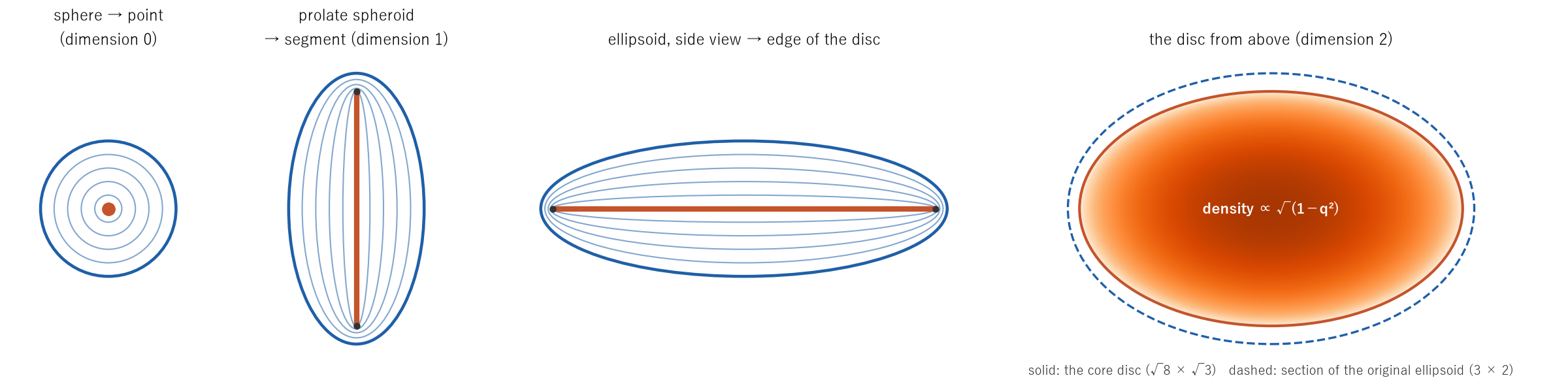
Squeezed as far as possible while staying confocal, the ellipsoid becomes a flat disc with semi-axes √8 and √3 (density proportional to √(1−q²), where q is the distance from the centre measured with the semi-axes of the disc, equal to 1 at its rim), and the relative difference in the field outside is of order 10⁻¹⁴. The prolate spheroid (1, 1, 2) becomes the segment of length 2√3 between its foci, and the oblate spheroid (2, 2, 1) a round disc of radius √3. The confocal family of a sphere only shrinks its radius, so the core is the point at the centre, and the shell theorem is this case. The dimension of the core is 0 for a sphere, 1 for a prolate spheroid and 2 for an ellipsoid. The same outside does not mean the same inside: at the inner point (0, 0, 0.5) of the ellipsoid, the force of the disc differs from that of the solid by 1.911392 times the solid’s force.
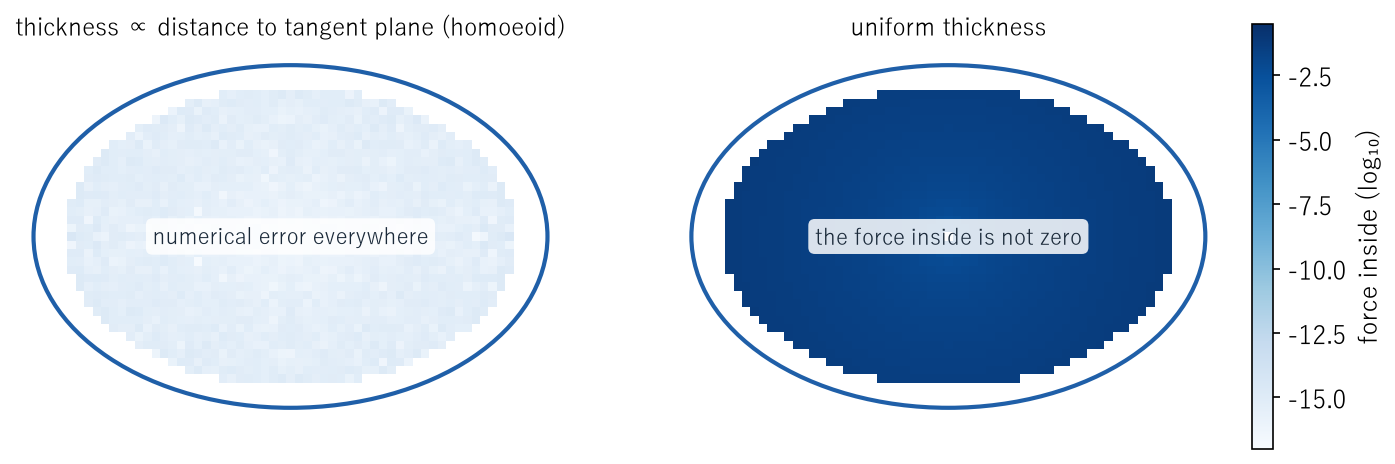
The force inside an ellipsoidal skin depends on how its thickness is distributed. For the skin whose thickness is proportional to the distance p from the centre to the tangent plane (the homoeoid), the force at three inner points is of order 10⁻¹⁵ (the size of the numerical error, which moves with the grid); for a skin of uniform thickness it is of order 10⁻². On the skin p ranges from 1 to 3. On a sphere p is the same everywhere, so the two distributions give the same skin. The force vanishes because the gravitational potential inside a uniform ellipsoid is a quadratic in the coordinates, and the difference between two similar ellipsoids is a constant independent of position (checked symbolically). The second derivatives of this quadratic share the 4π of Poisson’s equation among three directions according to the shape (the depolarization factors, called demagnetizing factors in magnetism; 4π/3 each for a sphere). As Paper 1098 showed, the values 0, 4π/3 and −8π/3 of the dipole lattice sum of Paper 1097 are 4π/3 minus the share along the dipole, for a sphere, a thin needle and a thin plate. For a force falling off as the inverse cube, and for a massive Yukawa field whose equation is still of second order, confocal ellipsoids differ from outside and the force inside the homoeoid does not vanish (for the Yukawa field it does not vanish even inside a spherical skin). The confocal core and the flat inside of the homoeoid rest on the massless Laplace equation. A uniform ball, however, still gives from outside a field of the same form as a point even for the Yukawa field, with only its mass changed by a factor 3/e = 1.103638 (when the radius equals the screening length). The shrinking of a sphere to a point has one more support, symmetry.
If the Earth were a uniform ellipsoid, its core would be a round disc of radius 521.854 km, 0.0818192 times the equatorial radius (this factor is the eccentricity itself). The separator is how the thickness of the skin is distributed, and whether two ellipsoids are confocal.
Keywords: ellipsoid, confocal, homoeoid, shell theorem, focal disc, depolarization factor, separator.
Scope (what is not claimed)
This paper claims no new theorem or law. That the force vanishes in the cavity enclosed by a uniform shell between two similar ellipsoids (a homoeoid; Newton 1687), that confocal uniform ellipsoids of equal mass give the same field outside (Maclaurin 1742 showed it for spheroids; for general ellipsoids it is often cited under the name of Ivory 1809, and the name of Laplace is also given, whose year and original have not been checked), the formula for the gravitational potential inside a uniform ellipsoid (Kellogg 1929, Chandrasekhar 1969) and the depolarization factors (demagnetizing factors in magnetism; Osborn 1945) are all standard. The focal disc as the limit of the confocal family, Poisson’s relation by which the field inside a uniformly polarized body follows from the potential of the uniform body of the same shape, and the charge density on a conducting ellipsoid being proportional to p also appear to be classical (the literature has not been checked here). That the only uniform bodies whose potential inside is a quadratic are ellipsoids is often cited under the names of Dive 1931 and Nikliborc (the original has not been read). Only two distributions of the skin were compared; that the density making the force inside vanish is unique appears to follow from the uniqueness of the charge distribution on a conductor (not checked). What is added is lining up the core reached by squeezing the confocal family as far as possible as the point of a sphere, the segment of a prolate spheroid and the flat disc of an ellipsoid, counting their dimensions as 0, 1 and 2 and checking each by adding up the skin or the body directly; rereading this in terms of the numbers per angular pattern of Paper 1107; writing that the homoeoid and the skin of uniform thickness are the same skin on a sphere; and connecting all this to papers of the series (1084, 1097, 1098, 1107, 1114, 156). Whether arranging the dimension of the core in this way is already in the literature has not been checked. Whether the end point of the confocal family is the smallest of all distributions with the same field outside is not shown here; this question appears to be studied in potential theory as the problem of the "mother body" (not checked here). Paper 1107 showed that how many numbers can be read from outside is fixed by the order of the field equation and does not depend on the shape of the box, and that one skin sufficing (second order) and 4π remaining on the skin (a massless field) have distinct roots. Paper 1114 showed numerically that, in the spherical case, a point, a skin and a 1/r² ball have the same field outside. Paper 51 wrote that what permits aggregation into a point is the force exponent n = 2, and that the permission reaches only as far as the shell theorem; Paper 124 separated three roots of aggregation. These concern aggregation into a point and aggregation that drops terms as an approximation, and do not conflict with the exact aggregation of an ellipsoid into a disc here. Paper 156 separated the reasons why the inside of a spherical shell is flat into being harmonic, spherical symmetry and regularity at the origin. Paper 1084 and Paper 1097 showed numerically that 4π splits into 4π/3 and 8π/3, that the shares move with the shape of a spheroid, and that a dipole lattice sum is decided by the shape of the summation. Paper 1098 showed numerically, for spheroids, that the three values of Paper 1097 come only from a shape term written with the depolarization factor. Paper 787 dealt with the numbers of the Earth’s ellipsoid. This paper sits beside them and computes the core of an ellipsoid. This paper does not say that a flat disc gives rise to a solid inside. It says only that, as far as gravity seen from outside goes, a uniform ellipsoid and its core disc cannot be told apart. The cores of shapes other than ellipsoids, the equilibrium figures of rotating fluids (the Maclaurin and Jacobi ellipsoids), the density and layers of the real Earth, and strong gravity in general relativity are not treated.
1. Not only for spheres
Paper 1107 showed numerically that even when the inside of a cubic box is rearranged strongly by adding the Laplacian $\Delta\varphi$ of a smooth bump $\varphi$, the change of the inverse-square field outside is only the size of the numerical error. It showed that what can be read from outside is one number per angular pattern, that how many is fixed by the order of the field equation, and that the shape of the box does not matter. Paper 1114 showed numerically that, in the spherical case, a point, a skin of density 1, a $1/r^2$ ball and a uniform ball, each of mass $4\pi$, give the same field outside and split inside.
For a sphere, the inside can be shrunk to the single point at the centre without changing gravity seen from outside. This is Newton’s shell theorem, and Paper 51 wrote that this permission to aggregate into a point reaches only as far as the shell theorem. For a shape that is not a sphere, then, how far can the inside be shrunk within the confocal family? This paper computes this by shrinking a uniform ellipsoid within its confocal family. The end point is a flat elliptic disc.
Units are $G=1$ for the gravitational constant and 1 for the masses. The field outside and the force inside a skin were found by splitting the skin or the body into fine points and adding up $(\mathbf y-\mathbf x)/|\mathbf y-\mathbf x|^3$ felt at the point $\mathbf x$ directly (Gaussian quadrature in double precision). The force at a point inside a uniform body was found as $\mathbf g=\rho\oint R(\mathbf n) \mathbf n d\Omega$, adding up over all directions the distance $R(\mathbf n)$ from the point to the boundary (splitting the body into fine points gave values that moved with the fineness of the grid when the point lay inside the region being summed). Neither the shell theorem nor the formulas for ellipsoids were used for the answers. Sections 3 and 6, which look at the reasons, use the formula for the gravitational potential inside a uniform ellipsoid, checked with symbolic computation and with 30-digit numbers. The inverse-square field is the field of the massless Laplace equation.
2. The ellipsoidal skin with no force inside
Paint a thin skin on the surface $x^2/a^2+y^2/b^2+z^2/c^2=1$ of an ellipsoid. Two distributions are compared. In one, the thickness is proportional to the distance $p$ from the centre to the tangent plane. At the point $(x,y,z)$ of the surface,
$$p=\Bigl(\frac{x^2}{a^4}+\frac{y^2}{b^4}+\frac{z^2}{c^4}\Bigr)^{-1/2},$$and this skin is the shell between the original ellipsoid and a similar ellipsoid made slightly larger. It is called a homoeoid. In the other, the thickness is the same everywhere.
For semi-axes 3, 2, 1, $p$ is 3, 2 and 1 at the ends of the axes and ranges from 1 to 3 over the skin. With the mass of the skin set to 1, the magnitudes of the forces at three inner points were compared.
| inner point | $x^2/a^2+y^2/b^2+z^2/c^2$ | thickness $\propto p$ (homoeoid) | uniform thickness |
|---|---|---|---|
| $(0.5, 0.3, 0.2)$ | 0.0903 | $9.54\times10^{-16}$ | $1.28\times10^{-2}$ |
| $(1.8, -0.6, 0.1)$ | 0.4600 | $1.07\times10^{-15}$ | $3.79\times10^{-2}$ |
| $(-0.4, 1.2, -0.5)$ | 0.6278 | $1.10\times10^{-15}$ | $3.08\times10^{-2}$ |
Inside the homoeoid the force is of order $10^{-15}$ at all three points, the size of the numerical error (this order moves with the fineness of the grid). For the skin of uniform thickness it is $1.28\times10^{-2}$ to $3.79\times10^{-2}$ and does not vanish. On a sphere (radius 1), $p$ is 1 everywhere, so the two distributions give the same skin, and the force at the inner point $(0.3, 0.2, 0.4)$ was of order $10^{-15}$ for both. From the flat inside of a spherical shell, the difference between the two distributions cannot be seen.
3. Why the force vanishes inside
The gravitational potential at an inner point of a uniform ellipsoid of density 1 can be written as
$$\Phi(\mathbf x)=-\pi abc\int_0^\infty\Bigl(1-\frac{x^2}{a^2+u}-\frac{y^2}{b^2+u}-\frac{z^2}{c^2+u}\Bigr)\frac{du}{\Delta(u)},\qquad \Delta(u)=\sqrt{(a^2+u)(b^2+u)(c^2+u)}$$(Kellogg 1929, Chandrasekhar 1969). Inside, this is a quadratic in the coordinates plus a constant. For the ellipsoid with all semi-axes multiplied by $k$, the substitution $u=k^2v$ turns the integrand into
$$abc\Bigl(k^2-\frac{x^2}{a^2+v}-\frac{y^2}{b^2+v}-\frac{z^2}{c^2+v}\Bigr)\frac{1}{\Delta(v)},$$and the difference from the original ellipsoid is $abc(k^2-1)/\Delta(v)$, which contains no coordinate. This was checked by symbolic computation. The difference between the potentials of two similar ellipsoids is the same constant everywhere inside the inner ellipsoid, and the force vanishes in the cavity enclosed by the shell between them. Computed to 30 digits, the difference between the ellipsoid scaled by 1.1 and the original was $-4.02684457640873$ at each of the three inner points.
Paper 156 separated the reasons why the inside of a spherical shell is flat into three: being harmonic, spherical symmetry and regularity at the origin. The homoeoid is not spherically symmetric, yet its inside is flat. What takes the place of spherical symmetry here is that the potential inside is a quadratic, together with the special way the thickness is distributed. That the only uniform bodies whose potential inside is a quadratic are ellipsoids is often cited under the names of Dive 1931 and Nikliborc (the original has not been read here).
4. Confocal ellipsoids look the same from outside
The ellipsoid whose squared semi-axes are $(a^2-\lambda, b^2-\lambda, c^2-\lambda)$ is said to be confocal with the original. The ellipsoid with semi-axes 3, 2, 1, the confocal ellipsoid with $\lambda=0.5$ (semi-axes 2.9155, 1.8708, 0.7071) and, for comparison, a non-confocal ellipsoid (semi-axes 2.9155, 1.9644, 0.6734) were each filled uniformly with mass 1, and their fields at three outer points were compared. The relative difference is the magnitude of the difference divided by the magnitude of the force.
| outer point | $x^2/a^2+y^2/b^2+z^2/c^2$ | magnitude of the force | confocal pair (relative) | non-confocal ellipsoid (relative) |
|---|---|---|---|---|
| $(4.0, 0.5, 0.3)$ | 1.9303 | 0.0810583800 | $6.81\times10^{-15}$ | $7.24\times10^{-3}$ |
| $(0.5, 3.0, 1.0)$ | 3.2778 | 0.0923798330 | $4.51\times10^{-14}$ | $1.91\times10^{-2}$ |
| $(1.0, 1.0, 2.5)$ | 6.6111 | 0.0951043183 | $1.74\times10^{-14}$ | $1.21\times10^{-2}$ |
The two confocal ellipsoids differ in their fields at the three outer points by a relative amount of $6.81\times10^{-15}$ to $4.51\times10^{-14}$ and cannot be told apart (Maclaurin 1742, Ivory 1809). The non-confocal ellipsoid differs by $7.24\times10^{-3}$ to $1.91\times10^{-2}$. The two confocal ellipsoids clearly differ in shape: their short semi-axes are 1 and 0.7071.
In the language of Paper 1107, look at the numbers readable from outside. An ellipsoid is mirror-symmetric in the three coordinate planes, so the numbers for odd $\ell$ and, for even $\ell$, those for orientations that are not mirror-symmetric are 0. The remaining numbers are listed, with the squared semi-axes written as $P=a^2$, $Q=b^2$ and $R=c^2$, as averages of harmonic polynomials over a uniform ellipsoid (mass 1).
| pattern | harmonic polynomial | average over a uniform ellipsoid (mass 1) |
|---|---|---|
| $\ell=2$ | $2z^2-x^2-y^2$ | $(2R-P-Q)/5$ |
| $\ell=2$ | $x^2-y^2$ | $(P-Q)/5$ |
| $\ell=4$ | $35z^4-30z^2r^2+3r^4$ | $3(3P^2+2PQ-8PR+3Q^2-8QR+8R^2)/35$ |
| $\ell=4$ | $(x^2-y^2)(7z^2-r^2)$ | $-3(P-Q)(P+Q-2R)/35$ |
| $\ell=4$ | $x^4-6x^2y^2+y^4$ | $3(P-Q)^2/35$ |
Every value is fixed by the differences of $P$, $Q$ and $R$ alone and does not change when the same $\lambda$ is subtracted from all three. This was checked by symbolic computation. The two numbers of angular pattern $\ell=2$ and the three numbers of $\ell=4$ are the same for confocal ellipsoids. For comparison, the average of $z^2$, a quadratic that is not a pattern, is $R/5$ and changes under the confocal shift. The symbolic check reaches $\ell=4$; that the numbers agree for every $\ell$ belongs to the classical theorem that the field outside is the same. Two confocal ellipsoids have the same numbers readable from outside and differ in how the inside is filled.
5. Squeezed as far as possible, it becomes the core
When $\lambda$ is raised to the square $c^2$ of the short semi-axis, the short semi-axis becomes 0 and the ellipsoid becomes a flat disc. The form of its density follows from the surface density of the ellipsoid pressed flat along $z$. With $s^2=x^2/a^2+y^2/b^2$, adding up a uniform ellipsoid along $z$ gives the surface density $2c\sqrt{1-s^2}$, which adds back up to the volume $4\pi abc/3$ (symbolic computation). Every confocal ellipsoid has a surface density of the same form, so the core reached by squeezing the confocal family as far as possible is a disc with semi-axes $\sqrt{a^2-c^2}$ and $\sqrt{b^2-c^2}$ and density proportional to $\sqrt{1-q^2}$, where $q^2=x^2/(a^2-c^2)+y^2/(b^2-c^2)$ is the distance measured with the semi-axes of the disc, equal to 1 at its rim. For semi-axes 3, 2, 1 these are $\sqrt8$ and $\sqrt3$, that is 2.828427 and 1.732051. Adding up a prolate spheroid $(a,a,c)$ along its axis gives the line density $\pi a^2(1-z^2/c^2)$, and the thinnest core is the segment between the foci (half-length $f=\sqrt{c^2-a^2}$, density proportional to $1-z^2/f^2$). The confocal family of a sphere only shrinks its radius, and the core is the point at the centre.
| shape (semi-axes) | core | dimension of the core | relative difference at 3 outer points |
|---|---|---|---|
| sphere $(1,1,1)$ | the point at the centre | 0 | $6.90\times10^{-15}$ to $2.79\times10^{-14}$ |
| prolate spheroid $(1,1,2)$ | segment of length $2\sqrt3$ (density $\propto 1-z^2/f^2$) | 1 | $1.58\times10^{-14}$ to $2.51\times10^{-14}$ |
| oblate spheroid $(2,2,1)$ | round disc of radius $\sqrt3$ (density $\propto\sqrt{1-q^2}$) | 2 | $2.88\times10^{-15}$ to $1.67\times10^{-14}$ |
| ellipsoid $(3,2,1)$ | elliptic disc with semi-axes $\sqrt8$, $\sqrt3$ (density $\propto\sqrt{1-q^2}$) | 2 | $1.24\times10^{-14}$ to $3.82\times10^{-14}$ |
In all four cases the core gave the same field as the original uniform shape at the three outer points (chosen for each shape outside the original). The dimension of the core is 0 for a sphere, 1 for a prolate spheroid, and 2 for an oblate spheroid and a general ellipsoid. The size of the core is fixed by the square roots of the differences of the squared semi-axes. For a sphere all the differences are 0, and the core shrinks to one point. The shell theorem is the smallest case of this end point.
The same outside does not mean the same inside. At the point $(0, 0, 0.5)$ inside the ellipsoid $(3,2,1)$ and outside the disc, the $z$ component of the force of the solid ellipsoid is $-0.1441363$ (agreeing to within $10^{-12}$ with the closed form $g_z=-4\pi\rho N_z z$ using $N_z$ of Section 6; for mass 1, $\rho=1/(8\pi)$, so this is $-N_z z/2$) and that of the core disc is $-0.4196374$; their difference is 1.911392 times the solid’s force.
6. Sharing 4π among three directions
Differentiating the potential of Section 3 twice gives
$$\frac{\partial^2\Phi}{\partial x_i^2}=4\pi N_i,\qquad N_i=\frac{abc}{2}\int_0^\infty\frac{du}{(a_i^2+u)\,\Delta(u)},$$and $N_i$ are called the depolarization factors (the name used in electricity; demagnetizing factors in magnetism; Osborn 1945). Adding the three returns Poisson’s equation $\nabla^2\Phi=4\pi\rho$, so they sum to 1. That the Laplacian of the integrand is $-\frac{d}{du}\bigl(4\pi abc/\Delta(u)\bigr)$, which integrates from 0 to infinity to $4\pi$, was also checked by symbolic computation.
| ellipsoid (semi-axes) | $N_x$ | $N_y$ | $N_z$ | sum |
|---|---|---|---|---|
| $(3,2,1)$ | 0.1563006988 | 0.2671540403 | 0.5765452609 | 1 |
| sphere $(1,1,1)$ | 0.3333333333 | 0.3333333333 | 0.3333333333 | 1 |
| 30 times elongated $(1,1,30)$ | 0.498277896 | 0.498277896 | 0.003444208061 | 1 |
| flattened to 1/30 $(30,30,1)$ | 0.02511087329 | 0.02511087329 | 0.9497782534 | 1 |
$4\pi$ is shared among three directions according to the shape. For a sphere each gets $4\pi/3$ (4.188790205), the number Paper 1084 called the longitudinal share. Paper 1084 also showed numerically that the longitudinal share of a spheroid moves with its shape; this paper extends that to ellipsoids with three different semi-axes and places it beside the homoeoid. Paper 1097 showed numerically that a lattice sum of dipole fields is 0 for a sphere, $4\pi/3$ for a thin needle and $-8\pi/3$ for a thin plate, and used there the depolarization factors of spheroids and the local field of Lorentz. Paper 1098 showed numerically, for spheroids, that the three values come only from a shape term, (full solid angle)$\times(1/3-D)$ with $D$ the depolarization factor. This works because the field inside a uniformly polarized ellipsoid is fixed by the second derivatives of the same quadratic (Poisson’s relation between the potential of a uniform body and the field of a polarized one). This is $4\pi/3-4\pi N$, with $N$ the share along the dipole; putting in 1/3 for the sphere, 0 along the long direction of a thin needle and 1 across the thickness of a thin plate gives the three values. For a needle 30 times elongated the value is 4.14550901, and for 1000 times 4.188707255, approaching $4\pi/3$. For a plate flattened to 1/30 it is $-7.746475329$, and for 1/1000 it is $-8.357866304$, approaching $-8\pi/3$ ($-8.37758041$).
7. If it is not the inverse square
The same computation was done with a force inversely proportional to the cube of the distance. The two confocal ellipsoids then differ at the three outer points by a relative amount of $2.39\times10^{-2}$ to $2.82\times10^{-2}$, and the force inside the homoeoid (for a skin of mass 1) is $1.92\times10^{-2}$ to $1.45\times10^{-1}$, not zero.
Being of second order is not enough. With the massive Yukawa field ($e^{-\kappa d}/d$, $\kappa=1$), whose equation is of second order, the two confocal ellipsoids differ at the three outer points by a relative amount of $3.57\times10^{-2}$ to $5.20\times10^{-2}$, the force inside the homoeoid (for a skin of mass 1) is $1.35\times10^{-2}$ to $4.27\times10^{-2}$, and even inside a spherical skin of radius 1 it is $6.80\times10^{-2}$ at the point $(0.3, 0.2, 0.4)$. Paper 1107 separated one skin sufficing for what can be read from outside (second order) and $4\pi$ remaining on the skin (a massless field) as distinct roots. Being of second order is not enough for the confocal core and the flat inside of the homoeoid: they rest on the field obeying the massless Laplace equation.
A uniform ball, however, still gives from outside a field of the same form as a point for the Yukawa field. The ratio of the forces of a uniform ball of radius 1 and of the point at its centre is $3(\cosh1-\sinh1)=3/e=1.103638$ at all three outer points; only the mass changes. Shrinking a sphere to a point has one more support, symmetry, whereas shrinking an ellipsoid to a disc needs the massless Laplace equation.
8. If the Earth were a uniform ellipsoid
For the Earth’s ellipsoid (WGS84: equatorial radius 6378137 m, flattening 1/298.257223563) the polar radius is 6356752.314245 m and its difference from the equatorial radius is 21384.685755 m, the same as the 21384.686 m of Paper 787 to the digits shown. If the Earth were a uniform ellipsoid, its core would be a round disc of radius $\sqrt{a^2-c^2}$ = 521.854 km. This is 0.0818192 times the equatorial radius, and this factor is the eccentricity of the ellipsoid itself. The real Earth is denser towards its middle and its layers differ in flattening, so its gravity outside is not that of this disc. The number only shows the size of the core of a uniform body of this shape.
9. Same root or distinct roots
The quantities of this paper are sorted with the test of Paper 300.
(1) The point at the centre of a sphere and the flat disc of an ellipsoid: for the massless Laplace field both are the end point of the confocal family, so they share a root. The sphere is the case where all the foci coincide at the centre. The sphere, however, has one more support, symmetry, and even for the Yukawa field it gives from outside a field of the same form as a point (only the mass changes); the disc of an ellipsoid has no such support.
(2) The homoeoid and the skin of uniform thickness: of the two distributions, the force vanishes inside only for the homoeoid, so their roots are distinct. On a sphere the two are the same skin, so looking only at spheres they cannot be separated.
(3) The shares of $4\pi$ moving with the shape of an ellipsoid (the $N_i$ when the three semi-axes differ) and the vanishing force inside the homoeoid: both come from the potential inside a uniform ellipsoid being a quadratic, so they share a root. The $4\pi/3$ of a sphere itself also follows from symmetry alone (Paper 1084).
(4) How many numbers can be read from outside in Paper 1107, and the dimension of the core in this paper: the first is fixed by the order of the field equation and does not depend on the shape, while the dimension of the core is fixed by the shape. Their roots are distinct.
10. The separator
The separator is how the thickness of the skin is distributed, and whether two ellipsoids are confocal. With thickness proportional to the distance to the tangent plane, the force inside an ellipsoidal skin vanishes; with uniform thickness it does not. On a sphere the two are the same skin, so this separator does not act on a sphere. Confocal ellipsoids of equal mass cannot be told apart from outside and share the numbers per angular pattern readable from outside; non-confocal ones differ. The core reached by squeezing the confocal family as far as possible is a point for a sphere, a segment for a prolate spheroid and a flat disc for an ellipsoid; gravity seen from outside is the same for all of them, and they split inside. The confocal core and the flat inside of the homoeoid hold for the massless Laplace equation.
Closing
Seen from outside, a uniform ellipsoid is the same as a flat focal disc. Confocal ellipsoids of equal mass cannot be told apart from outside and share the numbers per angular pattern readable from outside, and the core reached by squeezing the family as far as possible is a point for a sphere, the segment between the foci for a prolate spheroid and a flat disc for an ellipsoid. The dimensions of the cores are 0, 1 and 2, and the shell theorem is the smallest case, in which the core shrinks to one point. Of the two distributions compared, the ellipsoidal skin with no force inside is the shell whose thickness is proportional to the distance to the tangent plane, and on a sphere that distribution and uniform thickness give the same skin. That the potential inside is a quadratic supports both that flat inside and the sharing of 4π among three directions according to the shape. The confocal core and the flat inside of the homoeoid hold when the field obeys the massless Laplace equation.
References
- Chandrasekhar, S. (1969). Ellipsoidal Figures of Equilibrium. Yale University Press.
- Dive, P. (1931). Attraction des ellipsoïdes homogènes et réciproques d’un théorème de Newton. Bulletin de la Société Mathématique de France.
- Ivory, J. (1809). On the attractions of homogeneous ellipsoids. Philosophical Transactions of the Royal Society of London.
- Kellogg, O. D. (1929). Foundations of Potential Theory. Springer.
- Maclaurin, C. (1742). A Treatise of Fluxions.
- Newton, I. (1687). Philosophiæ Naturalis Principia Mathematica.
- Osborn, J. A. (1945). Demagnetizing Factors of the General Ellipsoid. Physical Review.
- Yamagishi, Y. (2026). The Yamagishi Gravitational Multipole Aggregation Theory [Paper 51]. YOI: https://www.yamagishiyuuki.com/yoi/51; DOI: 10.5281/zenodo.21602935
- Yamagishi, Y. (2026). Three Distinct Roots of Aggregation [Paper 124]. YOI: https://www.yamagishiyuuki.com/yoi/124; DOI: 10.5281/zenodo.22057728
- Yamagishi, Y. (2026). The Inside of a Shell Is Not Flat Because of the Mean Value Theorem [Paper 156]. YOI: https://www.yamagishiyuuki.com/yoi/156; DOI: 10.5281/zenodo.22091565
- Yamagishi, Y. (2026). The Three Hundredth Census: Whether Two Things Share a Root Is Decidable [Paper 300]. YOI: https://www.yamagishiyuuki.com/yoi/300; DOI: 10.5281/zenodo.22171914
- Yamagishi, Y. (2026). Chimborazo’s Summit, $2585.39$ m Lower Than Everest’s, Is $2079.524$ m Farther From Earth’s Centre [Paper 787]. YOI: https://www.yamagishiyuuki.com/yoi/787; DOI: 10.5281/zenodo.23015345
- Yamagishi, Y. (2026). 4π Splits into a Longitudinal 4π/3 and a Transverse 8π/3, and the 21 cm Line of Hydrogen Measures the Transverse Part [Paper 1084]. YOI: https://www.yamagishiyuuki.com/yoi/1084
- Yamagishi, Y. (2026). A Lattice Sum of Dipole Fields Is Decided by the Shape of the Summation: 0 for a Sphere, 4π/3 for a Thin Needle, −8π/3 for a Thin Plate [Paper 1097]. YOI: https://www.yamagishiyuuki.com/yoi/1097
- Yamagishi, Y. (2026). In a Lattice Sum Whose Exponent Equals the Dimension, Shape Enters as the Mean Logarithm of the Distance to the Edge [Paper 1098]. YOI: https://www.yamagishiyuuki.com/yoi/1098
- Yamagishi, Y. (2026). When the Field Equation Is of Second Order, the Interior Can Be Read from Outside a Closed Skin Only as One Number per Angular Pattern [Paper 1107]. YOI: https://www.yamagishiyuuki.com/yoi/1107
- Yamagishi, Y. (2026). m = 4π Is the Mass of a Skin of Radius 1 at Density 1, and the 1/r² Ball Is That Skin Puffed Out Evenly [Paper 1114]. YOI: https://www.yamagishiyuuki.com/yoi/1114
Reference
Yamagishi, Y. (2026). A Uniform Ellipsoid Pulls from Outside Like a Flat Focal Disc, and a Sphere Pulling Like a Point Is the Case in Which That Disc Shrinks to One Point [Paper 1116]. YOI: https://www.yamagishiyuuki.com/yoi/1116
ORCID: 0009-0006-8587-3450
PDF (English) · PDF (Japanese) · Date proof of the English PDF (OpenTimestamps .ots) · SHA256SUMS
The record page for this paper (in Japanese, with the PDFs in each language and the date proof): YOI 1116. This paper is a preprint and has not been peer reviewed.