Abstract
Paper 89 called zero-tension the stance of knowing perfectly the reference with no bite (the null) and reading hidden causes from deviations from it. Paper 112 wrote that the picture "A region is given, and within it one is free" appears in six places in physics, and that in the statistical place, spreading uniformly over the allowed region is a postulate (equal a priori probability). This paper takes that postulate as given (it is not derived from mechanics) and, for a gas whose energy alone is fixed, computes how the uniform spread looks from one axis (the shadow), where it ends (the wall), and whether the place where the particle can be (the enclosure) closes into a bounded region (the sign of the total energy). The flat inside of a gravitating skin is reread in the same way. This paper claims no new theorem or law.
Inside a uniform skin of radius 1 and mass 1, the force at the point 0.6 from the centre is −0.217203 (toward the centre) if the force falls off as the first power of the distance and 0.339379 (toward the skin) for the third power, and only for the second power is it of order 10⁻³⁶ or less (zero) at every point 0.3, 0.6 and 0.9 from the centre. In three dimensions the height of a point placed uniformly on the skin is spread uniformly (Archimedes’ theorem on the zones of a sphere), so the squared distance from an inner point to the skin is also spread uniformly, and the average of the inverse-square potential is 1 everywhere inside and 1/s outside (the same computation as the textbook proof of the shell theorem). In four dimensions the shadow of the height is a semicircle and this reading does not apply (the values agree with those of Paper 156).
When the energy of a gas of N molecules is fixed, the 3N momentum components lie on a sphere of dimension 3N. With n the dimension of the sphere and its radius set to √n, the density of one component of a point placed uniformly on it (the shadow of the sphere) is proportional to (1−x²/n) to the power (n−3)/2. For one molecule (n = 3) it is flat from −√3 to √3, again Archimedes’ zone theorem. The kurtosis (the mean fourth power divided by the square of the mean square) is 3n/(n+2): 2.8125 for 10 molecules, 2.980132 for 100 and 2.998001 for 1000, approaching the 3 of the normal (Maxwell) distribution (that the kurtosis is 3n/(n+2) for every n is proved in the 2nd edition). The gap from the normal distribution (total variation distance) shrinks in inverse proportion to n, and n times it approaches 0.350075 (1.167×10⁻⁴ at n = 3000). This 0.350075 can be written in closed form from the 1/n term of the ratio of the shadow to the normal density (its being the limit was checked numerically and is not proved). The 4π in the speed distribution of one molecule is the area of the unit sphere in that molecule’s momentum space, and the mean speed is 1.663353 for 2 molecules and 1.595902 for 1000, approaching from above the √(8/π) = 1.595769 of the Maxwell distribution. For a single molecule the speed is fixed at √3.
When only one particle moves in a potential V and the other particles are in a flat box, the density of position of that particle is proportional to the kinetic energy E−V left at that place, raised to the power (n−2)/2 (n is the number of momentum components that share the energy). The wall is where V = E, and there the momentum sphere shrinks to a point. The shadow is this formula with the component’s own kinetic energy taken as V, which shifts the exponent by one. In a harmonic well the position is one more coordinate of a sphere one dimension higher, and the density of position is exactly the shadow of that sphere. In a harmonic well the share found in the outer 10 percent of the allowed width is 0.287133 for n = 1 (piling up at the wall), 0.1 for n = 2 (uniform over the allowed region for any V), 0.037386 for n = 3 and 6.64×10⁻⁵ for n = 10, and for large n the density becomes the Boltzmann factor. A check with random points in a thin energy shell agreed with the formula within 2.40 standard errors.
A particle in a −1/r well is confined, if its total energy E is negative, to a ball of radius 1/|E|, and its phase-space volume is (2√2π³/3) times |E| to the power −3/2 (82.6834 at E = −0.5 and 29232.9980 at E = −0.01). At E = 0 the volume up to radius R grows without bound as R to the power 3/2, and the enclosure opens. With three mutually attracting particles, however, even at E = −1 the third can be arbitrarily far once two have come within 0.25 of each other (at a distance of 10⁹ the potential energy is −4.000000002). The sign of the energy closes the enclosure when a single particle sits in a fixed well. The separator is the dimension of the momentum sphere (the shape of the shadow and the approach to the wall) and the sign of the total energy of a single particle (whether its enclosure closes).
Keywords: momentum sphere, Maxwell distribution, Archimedes’ zone theorem, Boltzmann factor, shell theorem, equal a priori probability, zero-tension, separator.
Scope (what is not claimed)
This paper claims no new theorem or law. That the force vanishes inside a uniform spherical skin (Newton 1687), that the area of a zone of a sphere depends only on its height (Archimedes; Heath 1897), the Maxwell speed distribution (Maxwell 1860), and the ensemble at fixed energy (the microcanonical ensemble) with equal a priori probability (textbooks such as Huang 1987) are all standard. The computation inside the skin in Section 2 is the same as the textbook proof of the shell theorem that takes the distance to the point of the skin as the variable; this paper only rereads it through Archimedes’ zone theorem. The kurtosis 3n/(n+2) follows simply by dividing the mean fourth power 3/(n(n+2)) of one coordinate of a uniform point on the sphere by the square of the mean square 1/n (stated as Theorem 4.1 in the 2nd edition and checked in Lean 4). That one component of a uniform point on a high-dimensional sphere approaches the normal distribution with a gap shrinking in inverse proportion to the dimension, that at fixed energy the density of position is a power of the remaining kinetic energy, uniform over the allowed region for two momentum components and the Boltzmann factor when the components are many, that in a −1/r well the sign of the total energy decides between closed and open, and that with three or more attracting particles fixing the energy does not close the enclosure also appear to be known (the places in the literature have not been checked here). Equal a priori probability is a postulate, and this paper does not derive it from mechanics (Paper 112). Nor does it say that, for free motion in which the components exchange no energy, the time average reproduces this uniform spread. What is added is ordering the shadow of one component and the approach to the wall as one sequence in the dimension n of the momentum sphere (the shadow is the wall formula with the exponent shifted by one, and in a harmonic well the position becomes a coordinate of a sphere one dimension higher, so that the density of position is the shadow itself); writing the coefficient of the 1/n gap from the normal distribution in the closed form E|He₄(Z)|/8 = 0.350075; and checking all of this with numbers and random points. Whether this coefficient or this arrangement is already in the literature has not been checked. Paper 89 wrote zero-tension as the stance of taking reversible, dissipation-free reference motion as the standard and reading causes from deviations from it. The standard here is the uniform spread on the energy sphere. Paper 112 called the "freedom" of the statistical address a postulate and separated it from the quantum measure (Gleason’s theorem); this paper computes only within that statistical address. Paper 156 separated the reasons why the inside of a spherical shell is flat into being harmonic, spherical symmetry and regularity at the origin, and showed numerically that in four dimensions changing the kernel makes the inside not flat; the four-dimensional values here are the same numbers. Paper 1114 showed numerically that a point, a skin and a 1/r² ball are the same from outside in the spherical case, and Paper 1116 that the force also vanishes inside an ellipsoidal skin (a homoeoid). Paper 1083 showed numerically that dropping two coordinates of a point placed uniformly on a sphere leaves the rest spread uniformly in the ball two dimensions lower; the shadow here keeps only one coordinate, and coincides with the case of Paper 1083 when n = 3. Paper 912 showed numerically, from the Maxwell distribution, that taking m as the area of the unit sphere makes the coefficient of temperature the volume of the unit ball in every dimension. Paper 1103 showed numerically, for planar planetary motion, that the planet stays if the point of zero velocity lies inside the velocity circle and leaves if it lies outside, and mentioned in its scope note that bound orbits can be read on a sphere in momentum space (Fock 1935). Fock’s sphere carries the momenta of one bound orbit and is a different object from the momentum sphere of a gas at fixed energy here. This paper does not say that the walls of a gas box are made of gravitating skins; the inside of the skin is used as one example of a place where the potential is flat. The formula of Section 6 is for the case in which only one particle moves in the potential; two or more particles in the same well are not treated (then the density of position is not flat even with two momentum components). Collisions between molecules, quantum statistics (Bose and Fermi), the equilibrium of many gravitating particles, and general relativity are not treated.
1. The standard: uniform inside the region
Paper 89 took from the stance of a master angler the practice of knowing perfectly the reference with no bite (the null) and reading hidden causes from deviations from it, and called it zero-tension. Paper 112 made a census of the six places in physics where the picture "A region is given, and within it one is free" appears, and wrote that in the statistical place, spreading uniformly over the allowed region is a postulate (equal a priori probability).
This paper takes that postulate as given and computes how the uniform spread looks for a gas whose energy alone is fixed. There are three questions. Seen from one axis, what shape does it take (the shadow)? Where does the spread end (the wall)? Does the place where the particle can be (the enclosure) close into a bounded region (the sign of the total energy)? Before that, it looks at when the inside of a gravitating skin is flat, that is, when there is literally a place inside which no force acts.
The particle mass and the gravitational constant are set to 1. The forces of the skin were found by quadrature to 30 digits, and the densities of the shadow and of the wall by closed forms and quadrature (when integrating the difference of two densities, the points where they cross were put among the break points of the quadrature); the random points were drawn with fixed seeds. Symbolic computations were done with sympy.
2. The inside of a skin is flat only for the inverse square
Inside a uniform skin of radius 1 and mass 1, the outward component of the force at a point at distance $s$ from the centre was computed. The force is attractive and falls off as the $p$-th power of the distance $d$.
| force | $s=0.3$ | $s=0.6$ | $s=0.9$ |
|---|---|---|---|
| $1/d$ | $-0.101873$ | $-0.217203$ | $-0.382888$ |
| $1/d^2$ | $-4.54\times10^{-38}$ | $1.21\times10^{-37}$ | $1.97\times10^{-36}$ |
| $1/d^3$ | $0.111948$ | $0.339379$ | $2.0152$ |
For the inverse square ($p=2$) the force is of order $10^{-36}$ or less at all three points, zero to the digits of the computation. For $p=1$ the point is pulled toward the centre and for $p=3$ toward the skin. Of the three, only the inverse square leaves no force inside (Paper 156 wrote that in $d$ dimensions the inside is flat for the harmonic kernel).
In three dimensions the reason can be read from Archimedes’ theorem on the zones of a sphere. If points are placed uniformly on the unit sphere, their height $u=\cos\theta$ is spread uniformly from $-1$ to $1$ (the area of a zone depends only on its height). The squared distance from a point at distance $s$ from the centre to a point of the skin is
$$t=1+s^2-2su,$$which is linear in $u$, so $t$ is also spread uniformly from $(1-s)^2$ to $(1+s)^2$, with density $1/(4s)$ (symbolic computation). With one million random points on the sphere and $s=0.6$, sorting the squared distance into 10 bins left every count within 1.35 standard errors of the expected 100000. The inverse-square potential is proportional to $1/d=t^{-1/2}$, so its average is
$$\frac{1}{4s}\int_{(1-s)^2}^{(1+s)^2}t^{-1/2}\,dt=\frac{(1+s)-|1-s|}{2s},$$which is 1 everywhere inside ($s<1$) and $1/s$ outside ($s>1$), the same as a point at the centre. This computation is the same as the textbook proof of the shell theorem that takes the distance to the point of the skin as the variable; this paper reads it through Archimedes’ zone theorem. For the inverse-cube force the average of $t^{-1}$ is $\ln\bigl((1+s)/(1-s)\bigr)/(2s)$, which changes with position: 1.031732, 1.155245 and 1.635799 at $s=0.3$, 0.6 and 0.9.
In four dimensions the density of the height of a uniform point on the sphere is $\sqrt{1-u^2}$ (a semicircle), not flat. The kernel that makes the inside flat there is $t^{-1}$ (the $1/d^2$ that is harmonic in four dimensions); with $t^{-1/2}$ the average changes with position, 0.988620, 0.952703 and 0.884177 at $s=0.3$, 0.6 and 0.9. These are the same numbers that Paper 156 found by changing the kernel in four dimensions. The permission for a flat inside is being harmonic, as Paper 156 wrote; a flat shadow is one route to it in three dimensions.
Where the potential inside the skin is flat, a particle that enters has the same kinetic energy everywhere, and the momentum sphere of the next section has the same size everywhere. Paper 1114 computed the field outside and inside a spherical skin, and Paper 1116 showed that the force also vanishes inside an ellipsoidal skin (a homoeoid).
3. Fixing the energy puts the momenta on a sphere
In a gas of $N$ molecules (mass 1) moving freely in a box, fix the total kinetic energy at $E$. The $3N$ momentum components satisfy
$$p_1^2+p_2^2+\cdots+p_{3N}^2=2E$$and lie on a sphere of dimension $3N$. Equal a priori probability puts equal likelihood everywhere on this sphere (the postulate of Paper 112). The area of the $n$-dimensional sphere of radius $r$ is $2\pi^{n/2}r^{n-1}/\Gamma(n/2)$, which is $4\pi$ (12.5663706144) for the unit sphere with $n=3$.
Write the dimension of the sphere as $n=3N$ and set its radius to $\sqrt n$ (each component has variance 1, that is, temperature $kT=1$). The density of one component $x$ of a uniformly placed point is
$$f_n(x)=\frac{\Gamma(n/2)}{\sqrt{n\pi}\,\Gamma\bigl((n-1)/2\bigr)}\Bigl(1-\frac{x^2}{n}\Bigr)^{(n-3)/2},\qquad |x|\le\sqrt n.$$This paper calls it the shadow of the sphere. For $n=3$ (one molecule) the exponent is 0 and the shadow is flat from $-\sqrt3$ to $\sqrt3$ (density 0.288675). This is again Archimedes’ zone theorem, the case of keeping only one coordinate in the statement "dropping two coordinates leaves a uniform spread" computed in Paper 1083. For $n=4$ it is a semicircle, for $n=5$ a parabola.
4. The shadow approaches the Maxwell distribution
The mean square of the shadow is 1, and the kurtosis, the mean fourth power divided by the square of the mean square, is exactly
$$\frac{3n}{n+2}$$(symbolic computation; it is the mean fourth power $3/(n(n+2))$ of one coordinate of a uniform point on the sphere divided by the square of the mean square $1/n$, and quadrature agreed within $10^{-15}$ for nine values of $n$). The kurtosis of the normal distribution is 3. For $N$ molecules $n=3N$, so $n=30$, 300 and 3000 correspond to 10, 100 and 1000 molecules.
Theorem 4.1 (2nd edition): let $n\ge3$ be a natural number and take the density of the shadow as the formula of Section 3, $(1-x^2/n)^{(n-3)/2}$ ($|x|\le\sqrt n$). Then the mean square of the shadow is exactly 1, the mean fourth power is $3n/(n+2)$, and the kurtosis (mean fourth power divided by the square of the mean square) is $3n/(n+2)$. For $n=3$ the density is flat.
Outline of the proof: substituting $x=\sqrt n\cos\theta$ turns density times $dx$ into $\sqrt n \sin^{n-2}\theta d\theta$. From the recurrence $I_{m+2}=\frac{m+1}{m+2}I_m$ for $I_m=\int_0^\pi\sin^m\theta d\theta$ one gets $\int_0^\pi\cos^2\theta\sin^m\theta d\theta=I_m/(m+2)$ and $\int_0^\pi\cos^4\theta\sin^m\theta d\theta=3I_m/((m+2)(m+4))$, and with $m=n-2$ the mean square is 1 and the mean fourth power $3n/(n+2)$.
The moments of one coordinate of a uniform point on a sphere are known (scope note), and this is not claimed as a new theorem. The mathematical content of this theorem was checked by machine in Lean 4 (Mathlib) (https://github.com/yamagishi-lab/yamagishi-math, Yamagishi/Paper1117.lean). The form of the shadow density itself (that one component of a uniform point on the sphere has this density) was given as input and was not checked by the machine, and the reading that the momenta of a gas spread uniformly over the sphere (equal a priori probability) lies outside it as well. The check confirmed the mean square and mean fourth power by quadrature for every $n$ from 3 to 60. The limit of the total variation distance in the next paragraphs is not part of this theorem.
| dimension $n$ of the sphere | kurtosis $3n/(n+2)$ | total variation distance from the normal | times $n$ |
|---|---|---|---|
| 3 | 1.8 | $1.977\times10^{-1}$ | 0.5930 |
| 4 | 2 | $1.276\times10^{-1}$ | 0.5104 |
| 5 | 2.142857 | $9.298\times10^{-2}$ | 0.4649 |
| 10 | 2.5 | $3.970\times10^{-2}$ | 0.3970 |
| 30 | 2.8125 | $1.213\times10^{-2}$ | 0.3640 |
| 100 | 2.941176 | $3.541\times10^{-3}$ | 0.3541 |
| 300 | 2.980132 | $1.171\times10^{-3}$ | 0.3514 |
| 1000 | 2.994012 | $3.505\times10^{-4}$ | 0.3505 |
| 3000 | 2.998001 | $1.167\times10^{-4}$ | 0.3502 |
The gap between the shadow and the normal distribution was measured by the total variation distance, half the integral of the absolute difference of the two densities. The gap shrinks in inverse proportion to $n$, and $n$ times it approaches 0.350075. This is the value $E|\mathrm{He}_4(Z)|/8$ ($Z$ standard normal) that follows from expanding the ratio of the shadow to the normal density as $1-\mathrm{He}_4(x)/(4n)+\cdots$ with $\mathrm{He}_4(x)=x^4-6x^2+3$. Since an antiderivative of $\mathrm{He}_4\varphi$ is $-\mathrm{He}_3\varphi$ ($\mathrm{He}_3(x)=x^3-3x$, and $\varphi$ is the standard normal density), it can be written in closed form,
$$\frac{E|\mathrm{He}_4(Z)|}{8}=\frac{\sqrt6}{2}\bigl(r_1\varphi(r_1)+r_2\varphi(r_2)\bigr),\qquad r_{1,2}=\sqrt{3\mp\sqrt6},$$which agreed with quadrature to 20 digits ($r_1=0.741964$ and $r_2=2.334414$ are the roots of $\mathrm{He}_4$). The points 0.742019 and 2.334111 where the shadow and the normal density cross at $n=3000$ lie close to these roots. The expansion was checked at $x=0$, 1, 2 for $n=3000$ and 30000; the difference went from $5.38\times10^{-4}$ to $5.38\times10^{-5}$, shrinking in inverse proportion to $n$. The difference between $n$ times the total variation distance and 0.350075 also shrinks, $1.33\times10^{-3}$, $3.97\times10^{-4}$ and $1.32\times10^{-4}$ at $n=300$, 1000 and 3000, by a factor of exactly 3.00 from 1000 to 3000. For 1000 molecules the distribution of one component differs from the Maxwell distribution by only $1.167\times10^{-4}$ in total variation distance.
(2nd edition) The limit here means that the value $E|\mathrm{He}_4(Z)|/8$, read from the $1/n$ term of the expansion of the ratio, was written in closed form, and that $n$ times the total variation distance was checked numerically to approach it up to $n=3000$. Carrying the expansion into the total variation distance and showing that the limit is this value needs uniform convergence in the tails and an error estimate, and is not proved in this paper. 0.350075 is to be read as a value found numerically and given a closed form.
This was also checked with random numbers. Normal random vectors were scaled to radius $\sqrt n$, 20 sets of 20000 points were drawn, and the mean kurtosis over the sets was within 1.27, 0.53 and 0.03 standard errors of the exact value for $n=3$, 30 and 3000.
5. The speed of one molecule and 4π
Taking the three components of one molecule together, their density is proportional to $(1-|\mathbf p|^2/n)^{(n-5)/2}$, and the density of the speed $p=|\mathbf p|$ carries the area $4\pi p^2$ of the sphere of radius $p$. The limit of many molecules is the Maxwell speed distribution
$$4\pi p^2\,(2\pi)^{-3/2}e^{-p^2/2},$$and its $4\pi$ is the area of the unit sphere in the momentum space of one molecule.
| number of molecules $N$ | mean speed | total variation distance from the Maxwell distribution | times $N$ |
|---|---|---|---|
| 2 | 1.663353 | $2.491\times10^{-1}$ | 0.4983 |
| 3 | 1.640625 | $1.318\times10^{-1}$ | 0.3954 |
| 10 | 1.609120 | $3.149\times10^{-2}$ | 0.3149 |
| 100 | 1.597099 | $2.939\times10^{-3}$ | 0.2939 |
| 1000 | 1.595902 | $2.920\times10^{-4}$ | 0.2920 |
For a single molecule the speed is fixed at the radius $\sqrt3$ (1.732051) of the sphere, and the distribution is a single point. As the molecules increase, the speed spreads, and its mean approaches $\sqrt{8/\pi}$ (1.595769) from above. Paper 912 showed numerically, from the Maxwell distribution, that taking $m$ as the area of the unit sphere makes the coefficient of temperature the volume of the unit ball in every dimension. This paper looks at how that Maxwell distribution comes out as the shadow of the sphere of fixed energy.
6. The wall is where the sphere shrinks to a point
Only one particle (coordinate $x$) moves in the potential $V$; $n$ momentum components share the energy with it, and the positions of the other particles are where there is no potential (a flat box). At position $x$ the kinetic energy shared by the $n$ components is $E-V(x)$, and the momenta lie on a sphere of radius $\sqrt{2(E-V)}$. The density of position in the ensemble at fixed energy is proportional to the weight of this sphere (the derivative with respect to $K$ of the volume of the momentum ball with kinetic energy at most $K$), namely
$$\rho(x)\propto\bigl(E-V(x)\bigr)^{(n-2)/2}$$(symbolic computation). The particle can be only where $V\le E$; the wall is $V=E$, where the inequality becomes an equality. There the radius of the momentum sphere is 0 and the sphere shrinks to a point.
The approach to the wall is set by the exponent $(n-2)/2$. For $n=1$ it is the power $-1/2$, and the particle piles up near the wall (as a spring’s oscillation slows down at its ends). For $n=2$ the exponent is 0 and the particle spreads uniformly over the allowed region for any potential (for example a single particle moving in a plane with $V$ depending on $x$ alone). For $n=3$ the density goes to 0 at the wall, and the larger $n$, the further it keeps from the wall.
In the harmonic well $V=x^2/2$, $(x,p_1,\ldots,p_n)$ lies on a sphere of dimension $n+1$ and radius $\sqrt{2E}$. The position is one more coordinate of a sphere one dimension higher, and the density of position is exactly the shadow of Section 3 (the exponent is $((n+1)-3)/2=(n-2)/2$). The wall is a pole of that sphere. In the harmonic well, the share found in the outer 10 percent of the allowed width was computed.
| number $n$ of momentum components | share in the outer 10 percent | closed form used as a check |
|---|---|---|
| 1 | 0.287133 | $1-(2/\pi)\arcsin 0.9$ (arcsine distribution) |
| 2 | 0.1 | uniform (for any $V$) |
| 3 | 0.037386 | $1-(2\arcsin 0.9+1.8\sqrt{0.19})/\pi$ |
| 4 | 0.014500 | $(0.1-(1-0.9^3)/3)/(2/3)$ |
| 10 | $6.64\times10^{-5}$ | (by quadrature) |
| 30 | $2.42\times10^{-12}$ | (by quadrature) |
For $n=1$, 2, 3 and 4 the closed forms agreed within $10^{-25}$. For the spring oscillation $x=\cos t$ with $n=1$, the share of one million equally spaced times spent in the outer 10 percent is 0.287132, so the time average gives this arcsine distribution. For large $n$ the density of position approaches the Boltzmann factor $e^{-x^2/(2kT)}$ with $kT=2E/(n+1)$, and the total variation distance is $3.564\times10^{-2}$, $3.506\times10^{-3}$ and $3.501\times10^{-4}$ for $n=10$, 100 and 1000.
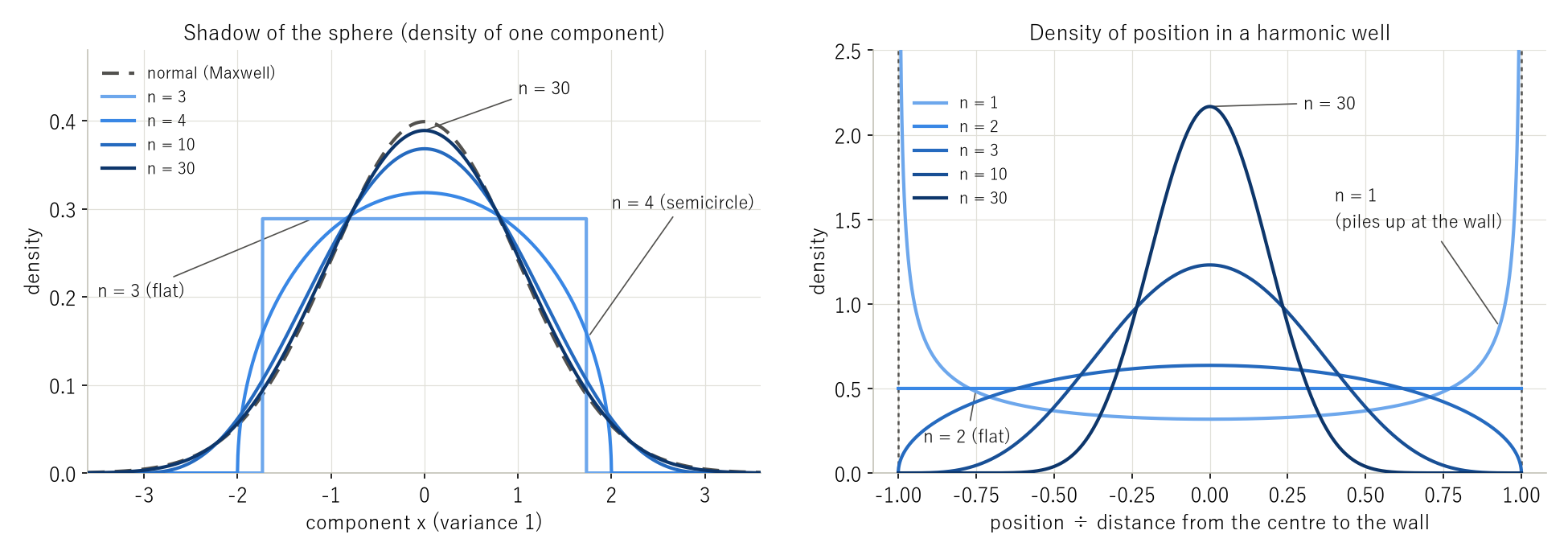
The formula was also checked by a route that does not use it. For $V=|x|$ and $V=x^2/2$ with $n=1$, 2, 3 (six cases), random points were drawn uniformly in the thin energy shell $1\le H\le1.02$ (about 300000 points each) and the positions sorted into 10 bins; the counts agreed within 2.40 standard errors with the formula including the thickness of the shell. For $n=2$, the 8 inner bins that do not reach the wall were flat within 1.57 standard errors for $V=|x|$ and 1.17 for $V=x^2/2$.
This formula is for the case in which only one particle is in $V$. If other particles are also in $V$, the density of position of one particle is an average over the positions of the others, and the formula does not apply. Keeping two momentum components and putting two particles in the same harmonic well, the two positions $(x_1,x_2)$ are spread uniformly in a disc, and the density of position of one particle is not flat but the semicircle $2\sqrt{2E-x_1^2}$ (symbolic computation).
The uniform spread here is a postulate, and nothing is said about the motion realizing it. For the spring with $n=1$ the time average gives the same distribution as the postulate, but in free motion in which the components exchange no energy, no sharing of energy takes place.
7. Whether the enclosure closes is the sign of the total energy
For a single particle in the well $V=-1/r$, if $E<0$ the region $V\le E$ is a ball of radius $1/|E|$, and the enclosure closes. The phase-space volume is
$$\Omega(E)=\int_0^{1/|E|}4\pi r^2\cdot\frac{4\pi}{3}\bigl(2(E+1/r)\bigr)^{3/2}dr=\frac{2\sqrt2\,\pi^3}{3}|E|^{-3/2}$$(coefficient 29.232998; symbolic computation).
| total energy $E$ | radius $1/|E|$ of the allowed ball | phase-space volume |
|---|---|---|
| $-0.5$ | 2 | 82.6834 |
| $-0.1$ | 10 | 924.4286 |
| $-0.01$ | 100 | 29232.9980 |
The volume at $E=-0.5$ is $8\pi^3/3$. As $E$ approaches 0 the volume grows without bound. At $E=0$ the volume up to radius $R$ is $(64\sqrt2 \pi^2/9)R^{3/2}$, which keeps growing, 3138.72, 99254.96 and 3138717.35 at $R=10$, 100 and 1000, and the enclosure opens. The attraction between an electron and a proton has the same $-1/r$ form, so in the classical picture the electron can leave when the total energy is 0 or more. Paper 1103 showed numerically, for planar planetary motion, that the planet stays if the point of zero velocity lies inside the velocity circle and leaves if it lies outside. This paper looks at the same thing as the size of the allowed region.
This, however, is the case of a single particle in a fixed well. When three particles of mass 1 attract each other pairwise as $-1/r$, even with the total energy fixed at $-1$, once two have come within distance 0.25 of each other the potential energy is $-4.002000250$, $-4.000002000$ and $-4.000000002$ for the third at distances $10^3$, $10^6$ and $10^9$, all below $-1$. The remaining kinetic energy is positive, and the third particle can be arbitrarily far away. The region $V\le E$ extends without bound, and the enclosure does not close even though the total energy is negative.
8. Shared root or distinct roots
The quantities of this paper are separated by the criterion of Paper 300.
(1) The shadow of one component becoming the Maxwell distribution (Section 4) and the density of position near the wall (Section 6): the shadow is exactly the formula of Section 6 with $V$ taken as the observed component’s own kinetic energy $x^2/2$ and the energy shared by the remaining $n-1$ components, so its exponent is $((n-1)-2)/2=(n-3)/2$ (symbolic computation). This is why the shadow is flat for $n=3$ and the density near the wall is flat for $n=2$, shifted by one. In a harmonic well the position is one of the coordinates of the same sphere, and its density is exactly the shadow of the sphere one dimension higher. They share a root.
(2) The flat inside of the skin (Section 2) and the flat shadow of one molecule (Section 3): in three dimensions both pass through Archimedes’ zone theorem, but the permission for a flat inside is being harmonic (Paper 156), and in four dimensions the inside of the skin stays flat with a changed kernel even though the shadow becomes a semicircle. The routes merely overlap in three dimensions; the roots are distinct.
(3) The wall (Section 6) and the closing of the enclosure (Section 7): the wall is a local matter at $V=E$, while closing is the global matter of whether the region $V\le E$ is bounded. For a single particle in a fixed well they are the edge and the size of the same set, but with three or more attracting particles they part. The roots are distinct.
(4) The sphere in momentum space mentioned by Paper 1103 (Fock’s) and the momentum sphere here: the name is the same, but they are different objects. The former is a sphere carrying the momenta of one bound orbit; the latter is the surface on which the many components at fixed energy lie.
9. The separator
The separator is the dimension of the momentum sphere and the sign of the total energy of a single particle. If the sphere has dimension 3 the shadow of one component is flat; as the dimension grows the kurtosis approaches 3 as $3n/(n+2)$ and the shadow approaches the Maxwell distribution. The approach to the wall is set by the same dimension. When only one particle moves in $V$ and the other particles are in a flat box, the density piles up for $n=1$, is flat for $n=2$, keeps away from the wall for $n\ge3$, and becomes the Boltzmann factor when the components are many. The shadow is flat for $n=3$ and the density near the wall for $n=2$, shifted by one, because the shadow is the wall formula with the component’s own kinetic energy taken as $V$. The sign of the total energy decides whether the enclosure closes or opens when a single particle sits in a fixed well. With three or more attracting particles, the sign alone does not close the enclosure.
Closing
In a gas whose energy alone is fixed, the momentum components lie on a sphere, and equal a priori probability spreads uniformly over it. The distribution of one component is the shadow of that sphere. For one molecule the shadow is flat (Archimedes’ zone theorem); as the molecules increase the kurtosis approaches 3 as 3n/(n+2) (Theorem 4.1 of the 2nd edition) and the shadow approaches the Maxwell distribution. When only one particle moves in a potential V and the other particles are in a flat box, the density of position of that particle goes as the remaining kinetic energy to the power (n−2)/2, and the wall is where the momentum sphere shrinks to a point. In a harmonic well the position also becomes one of the coordinates of that sphere. For a single particle in a −1/r well the enclosure closes when the total energy is negative and opens when it is 0 or more. In three dimensions the inside of a gravitating skin is flat only for the inverse square, and this too can be read from Archimedes’ zone theorem.
Revision Record
2nd Edition (November 2026): Theorem 4.1 was added. The 1st edition obtained the kurtosis $3n/(n+2)$ of the shadow by symbolic computation and checked it by quadrature for nine values of $n$. The 2nd edition proves for every natural number $n\ge3$ that the mean square of the shadow is 1 and that the mean fourth power and kurtosis are $3n/(n+2)$ (checked by machine in Lean 4; the form of the shadow density was given as input), and says so in the abstract, the scope note and the closing. It also adds to Section 4 and the abstract that the limit 0.350075 of $n$ times the total variation distance is a value checked numerically and given a closed form, and that its being the limit is not proved (the 1st edition’s “this is the value that follows from …” read as if it had been proved). Checks were added. The title, subtitle and numbers are unchanged.
References
- Fock, V. (1935). Zur Theorie des Wasserstoffatoms. Zeitschrift für Physik.
- Heath, T. L. (1897). The Works of Archimedes. Cambridge University Press.
- Huang, K. (1987). Statistical Mechanics. Wiley.
- Maxwell, J. C. (1860). Illustrations of the dynamical theory of gases. Philosophical Magazine.
- Newton, I. (1687). Philosophiæ Naturalis Principia Mathematica.
- Yamagishi, Y. (2026). Zero-Tension and the Inverse Problem [Paper 89]. YOI: https://www.yamagishiyuuki.com/yoi/89; DOI: 10.5281/zenodo.21748664
- Yamagishi, Y. (2026). The Allotted Region and the Freedom Within [Paper 112]. YOI: https://www.yamagishiyuuki.com/yoi/112; DOI: 10.5281/zenodo.21962834
- Yamagishi, Y. (2026). The Inside of a Shell Is Not Flat Because of the Mean Value Theorem [Paper 156]. YOI: https://www.yamagishiyuuki.com/yoi/156; DOI: 10.5281/zenodo.22091565
- Yamagishi, Y. (2026). The Three Hundredth Census: Whether Two Things Share a Root Is Decidable [Paper 300]. YOI: https://www.yamagishiyuuki.com/yoi/300; DOI: 10.5281/zenodo.22171914
- Yamagishi, Y. (2026). Taking $m$ as the Area of the Unit Sphere Makes the Coefficient of Temperature the Volume of the Unit Ball in Every Dimension [Paper 912]. YOI: https://www.yamagishiyuuki.com/yoi/912; DOI: 10.5281/zenodo.22804990
- Yamagishi, Y. (2026). Setting m = 4π Turns h/m into ħ/2, and Its 2 Has a Different Root from the 2 of the Uncertainty Bound [Paper 1083]. YOI: https://www.yamagishiyuuki.com/yoi/1083
- Yamagishi, Y. (2026). A Planet’s Velocity Arrow Traces a Circle, and the Planet Stays If the Point of Zero Velocity Lies Inside It and Leaves If It Lies Outside [Paper 1103]. YOI: https://www.yamagishiyuuki.com/yoi/1103
- Yamagishi, Y. (2026). m = 4π Is the Mass of a Skin of Radius 1 at Density 1, and the 1/r² Ball Is That Skin Puffed Out Evenly [Paper 1114]. YOI: https://www.yamagishiyuuki.com/yoi/1114
- Yamagishi, Y. (2026). A Uniform Ellipsoid Pulls from Outside Like a Flat Focal Disc, and a Sphere Pulling Like a Point Is the Case in Which That Disc Shrinks to One Point [Paper 1116]. YOI: https://www.yamagishiyuuki.com/yoi/1116
Reference
Yamagishi, Y. (2026). One Velocity Component of a Gas at Fixed Energy Is the Shadow of the Momentum Sphere, and the Wall Is Where That Sphere Shrinks to a Point [Paper 1117]. YOI: https://www.yamagishiyuuki.com/yoi/1117
ORCID: 0009-0006-8587-3450
PDF (English) · PDF (Japanese) · Date proof of the English PDF (OpenTimestamps .ots) · SHA256SUMS
The record page for this paper (in Japanese, with the PDFs in each language and the date proof): YOI 1117. This paper is a preprint and has not been peer reviewed.