Abstract
Gabor (1948) showed that if the light from an object is recorded on a photographic plate and the developed plate is illuminated, the same light as came from the object travels on beyond the plate. The plate is two-dimensional, yet it gives a three-dimensional image whose appearance changes as the viewer moves. Paper 1107 showed that when the field equation is of second order, what can be read of the interior from outside a closed skin is one number per angular pattern, and Paper 1111 showed that at one frequency what can be read is one shell of radius k in Fourier space, and that a spherical wave that weakens with distance while keeping its shape exists only in three dimensions. This paper counts the conditions under which a single open plate, rather than a closed skin, determines the light, and the price paid because the plate records only intensity. It claims no new theorem or law. The light is a scalar wave of one component, taken at one frequency (wavelength 1). The fields used for comparison are computed directly from the formula of a point source whose position is shifted in an imaginary direction (an exact solution of the wave equation that travels as a narrow beam), and the fields continued from the plate are built by propagating each transverse wavenumber.
When the light reaches the plate from one side, the values on the plate alone determine it. The field built only from the plate values of three beams arriving from below agreed with the exact field beyond the plate, at z = 3 and 8, with relative differences of 9.83×10⁻¹⁵ and 4.95×10⁻¹⁴, and, propagated back toward the sources to z = −4 (propagating components), with 6.53×10⁻¹⁵. The second function used by Kirchhoff’s integral formula, the derivative normal to the plate, was also determined by the values, to 2.42×10⁻¹⁴. For each transverse wavenumber the equation along the normal to the plate is of second order and has two solutions, one going up and one going down, and light arriving from one side uses only one of them. Two sets of plate values with the same intensity but different phase (u and u*) gave intensities at z = 8 that differ by a relative amount of 1.632566.
Light arriving from both sides is not determined in this way. The field obtained by subtracting the mirror image of the beams from the beams is exactly zero on the plate, yet at z = 3 it is 0.802406 times as large as the beams; using both the values and the normal derivative, it was recovered at z = 1 and 3 with relative differences of 1.84×10⁻¹³ and 1.54×10⁻¹⁰. Even with light from one side, for the fourth-order equation obtained by multiplying the Helmholtz operators of wavenumbers k and 1.3k, one can build a field that vanishes on the plate yet is 0.521287 times as large as the original field at z = 3, and the original field was recovered from the two functions with a relative difference of 1.09×10⁻¹⁴. The number of functions needed on the plate is the number of waves present beyond the plate for each transverse wavenumber, and it is 1 for a second-order equation with light from one side (the open-plate form of the "half the order" of Paper 1107).
The plate records only intensity. When a reference wave is superposed, the object wave enters the terms of first order in the intensity. With the reference on the axis (Gabor’s arrangement), the band of the first-order term is as wide as the object wave, and the 129 real numbers recorded in proportion to the object wave are exactly half of the 258 real numbers the object wave needs (129 complex coefficients); the wave read out differed from the object wave by a relative amount of 0.986210 (object wave 0.1 times the reference) and 0.997859 (0.01 times). The missing half is the twin image, formed by the conjugate wave. Including the term in the squared magnitude of the object wave widens the band of the intensity to 257 real numbers, so that only one, the overall phase, is missing; but the 128 added numbers grow weaker as the object wave grows weaker, and the object wave and its conjugate cannot be told apart even from the whole intensity, so the twin image remains. On the plate the twin image has the same energy as the image, but in the object plane it is blurred and spread out: for a plate of width 60 at distance 20, 0.8929 of the energy of the image lies within one wavelength on either side of the point, against 0.0210 for the twin image. When the reference is tilted off the axis (Leith and Upatnieks 1962), with its transverse wavenumber one more than the upper edge M of the object band, the band up to the edge of the first-order terms holds 259 real numbers; apart from the single DC term, the first-order terms fill exactly the 258 needed, and the object wave and the conjugate wave just separate. The remaining difference was 0.7203 × ε, from the term in the squared magnitude of the object wave (ε is the size of the object wave relative to the reference). Tilted to 3M + 1, the band up to the edge of the first-order terms holds 1.996124 times the number needed and the difference was 4.87×10⁻¹⁴.
A plate carries k²/(4π) complex numbers per unit area; a plate of 1 cm² at wavelength 633 nm carries 7.8405×10⁸. A closed spherical skin of radius a, counting the angular patterns with ℓ < ka, carries roughly (ka)², roughly the same per unit area for a large skin. Light at one frequency arriving from one side, though it spreads through three dimensions, holds only as many numbers as one function on the plate.
That one plate suffices holds also in a two-dimensional world (the plate is a line): light from one side was determined with relative differences of 1.07×10⁻¹⁴ and 1.18×10⁻¹⁴, and with light from both sides a field zero on the plate remained 0.691975 times as large. Light arrives without a tail only in odd dimensions of 3 or more; in two dimensions a tail remains after the wave has passed (Paper 247). Whether one plate suffices is decided by the order of the equation and by the side from which the light comes, and does not change with the parity of the dimension of space (checked in two and three dimensions; the equation for each transverse wavenumber does not depend on the dimension); whether a tail is left is decided by the parity of the dimension. The two have distinct roots. The separator is whether the light reaches the plate from one side or from both sides.
Keywords: hologram, Gabor, reference wave, twin image, Helmholtz equation, Kirchhoff integral, Huygens’ principle, separator.
Scope (what is not claimed)
This paper claims no new theorem or law. Making the object wave again from the light recorded on a plate, and the twin image that remains with a reference on the axis (Gabor 1948); tilting the reference off the axis so that the object wave, the twin image and the term in the squared magnitude of the object wave separate in transverse wavenumber (Leith and Upatnieks 1962); Kirchhoff’s integral formula, and the Rayleigh–Sommerfeld formula, which writes the light beyond a plate from the values on the plate alone (Born and Wolf 1999); propagating light one transverse wavenumber at a time; and Huygens’ principle, by which waves leave no tail only in odd dimensions of 3 or more (Courant and Hilbert 1962), are all standard. That a point source with its position shifted in an imaginary direction becomes a narrow beam (a Gaussian beam) is often cited under the name of Deschamps (1971) (we have not read the original). That the degrees of freedom of a field at one frequency are effectively finite is in Bucci and Franceschetti (1989), and counting the degrees of freedom of an image is cited under the name of Toraldo di Francia (1969) (we have not read the original, and have not checked whether the form π/λ² per unit area appears there). This paper looks only at a scalar wave of one component and does not treat polarisation, recording with fringes stacked inside a thick plate (volume holograms), the distortion and noise in the response of the photographic plate, the coherence of the light, computer-generated holograms, or methods that seek the phase from intensity alone without a reference. The counts cut the transverse wavenumber on a periodic strip; as Paper 266 wrote, on a finite plate a band is never cut exactly. In discussions of gravity, the principle that the bound on information is fixed by the area of a boundary goes by the name of holography (Paper 1093 wrote that it does not claim that principle is correct, and Paper 1107 wrote that it does not claim to have shown it). The name likens it to the optical hologram, and this paper does not treat it. What we add is: splitting the conditions under which one plate suffices into two, that the equation is of second order and that the light comes from one side, and counting with exact beam solutions that the plate values alone do not suffice for light from both sides or for a fourth-order equation; counting the real numbers recorded in proportion to the object wave and the real numbers the object wave needs from the bands of the intensity spectrum, and setting out that with the reference on the axis they are exactly half and that the missing half is the twin image (and checking that the twin image remains when the rank of the map to the whole intensity is counted); setting out that an open plate and a large closed spherical skin carry roughly the same number per unit area; and checking that one plate suffices also in two dimensions, separating this from leaving no tail as a distinct root. Paper 1107 counted that the numbers readable from outside a closed skin are, per angular pattern, half the order of the equation. This paper sits next to it and adds that for an open plate, which is not closed, to suffice, the light must come from one side of the plate. Paper 1111 counted that at one frequency what can be read is one shell of radius k in Fourier space and that a spherical wave that weakens with distance while keeping its shape exists only in three dimensions, and in its scope note placed Huygens’ principle in odd dimensions of 3 or more with Paper 247 and Paper 64. Paper 247 counted that waves in two dimensions leave a tail, and Paper 251 wrote that the dimensions with a tail are one and all even dimensions. This paper separates that tail from one plate sufficing. Paper 906 took as its separator whether one measures intensity alone or measures the phase by interference with a reference. The reference wave of a hologram carries out that interference on the plate. Paper 41 wrote that the position of fringes is fixed by the phase, and Paper 218 counted that the visibility of fringes is fixed by the spectrum of the light. Paper 1051 counted that whether a boundary determines the interior depends on what is measured and how much. This paper counts that in the real numbers on the plate.
1. What one plate determines
Gabor’s (1948) method has two steps. In the first, a reference wave $R$ uniform in direction and phase is superposed on the light $O$ coming from the object, and the intensity $|R+O|^2$ is recorded on a photographic plate. In the second, the developed plate is illuminated with the same reference. The light that passes through the plate contains the same light as came from the object, and when it enters the eye beyond the plate, the object appears to be in its original place. As the viewer moves, the appearance changes. The plate is not a screen on which an image is projected; it is a record of the light that travels on beyond the plate.
There are two questions here. One is why one two-dimensional function, the values on the plate, determines the light beyond the plate. The other is why the phase comes back when the photographic plate records only intensity. This paper counts both.
The light is taken to be a scalar wave of one component that obeys, at one frequency, the Helmholtz equation $(\Delta+k^2)u=0$. The wavelength is taken as 1 ($k=2\pi$). The plate is the plane $z=0$, and the object lies below the plate ($z<0$). The light used for comparison is the field of a point source whose position is shifted in an imaginary direction,
$$u=\frac{e^{ikR-kb}}{R},\qquad R=\sqrt{(\mathbf x-\mathbf x_0-ib\,\mathbf e)\cdot(\mathbf x-\mathbf x_0-ib\,\mathbf e)},$$where the factor $e^{-kb}$ evens out the sizes of beams with different $b$. It satisfies the wave equation exactly outside a disc of radius $b$ around the position $\mathbf x_0$, perpendicular to $\mathbf e$, and travels as a narrow beam in the direction $\mathbf e$. The light continued from the plate values can be compared directly with the values of this formula. Three beams arriving from below were placed, with centres $(0,0,-12)$, $(-5,2,-10)$ and $(4,-3,-14)$, tilts from the $z$ axis of 0, 10 and 8 degrees, azimuths (measured from the $x$ axis) of 0, 20 and 210 degrees, and $b$ equal to 8, 8 and 9. The detailed placement and the random seed are written in the verification script v1119.py. The window of the plate has side 128 and the grid is 1024 × 1024; the values at the edge of the window are $1.47\times10^{-16}$ times the maximum.
2. Light from one side is determined by the plate values alone
When the values $u(x,y,0)$ on the plate are split into transverse wavenumbers $(k_x,k_y)$, the light beyond the plate can be written
$$u(x,y,z)=\iint\hat u(k_x,k_y)\,e^{i(k_xx+k_yy)}\,e^{ik_zz}\,dk_x\,dk_y,\qquad k_z=\sqrt{k^2-k_x^2-k_y^2}$$(for components with $k_x^2+k_y^2>k^2$, $k_z$ is imaginary and the component dies away with distance from the plate). For one transverse wavenumber, the Helmholtz equation becomes the second-order equation $d^2\hat u/dz^2+k_z^2\hat u=0$ in $z$, whose solutions are the two waves $e^{ik_zz}$ going up and $e^{-ik_zz}$ going down. If there is neither source nor reflector beyond the plate and the light comes only from below, only the solution going up remains, and its weight is fixed by the plate values. Because the equation is of second order there are two solutions, and because the light comes from one side one of them is enough. This is why one plate suffices.
| built from the plate values alone | relative difference from the exact field |
|---|---|
| field beyond the plate at $z=3$ | $9.83\times10^{-15}$ |
| field beyond the plate at $z=8$ | $4.95\times10^{-14}$ |
| field on the source side at $z=-4$ (propagating components) | $6.53\times10^{-15}$ |
| derivative normal to the plate $\partial_z u$ | $2.42\times10^{-14}$ |
The share of energy in the dying-away components of the plate values is $4.97\times10^{-29}$, and only the propagating components were used when propagating back toward the sources. The light propagated back to the source side is the light beyond the plate traced back toward the sources; to a viewer beyond the plate, the object appears to be there, behind the plate on the object side (the virtual image). This form too is fixed by the same plate values as the light travelling on beyond the plate.
Kirchhoff’s integral formula writes the light inside a closed surface from two functions, the values on the surface and the derivative normal to it (Born and Wolf 1999). For light from one side, the derivative is fixed by the values through $\partial_z\hat u=ik_z\hat u$, and the second function carries no new numbers. The Rayleigh–Sommerfeld formula, which writes the light beyond a plate from the values on the plate alone, uses this fact.
The plate values are complex numbers and carry two things, intensity and phase. The plate values $u$ and their conjugate $u^*$ have exactly the same intensity on the plate, but their intensities at $z=8$ differ by a relative amount of 1.632566. If the phase is dropped, the light beyond the plate is not determined.
Light at one frequency arriving from one side, though it spreads through three dimensions, holds only as many numbers as one function on the plate. Light at one frequency is a superposition of plane waves whose wave vectors lie on a sphere of radius $k$; among the propagating components, waves going up lie on the upper half of the sphere and waves going down on the lower half. Light from one side uses only the upper half, which carries as many numbers as one function on the plate; light from both sides uses the whole sphere, two functions. Paper 1111 counted that what can be read of the interior at one frequency are the values on one shell of radius $k$ in Fourier space. What the plate sees is the upper half of that shell.
3. Light from both sides, and a fourth-order equation
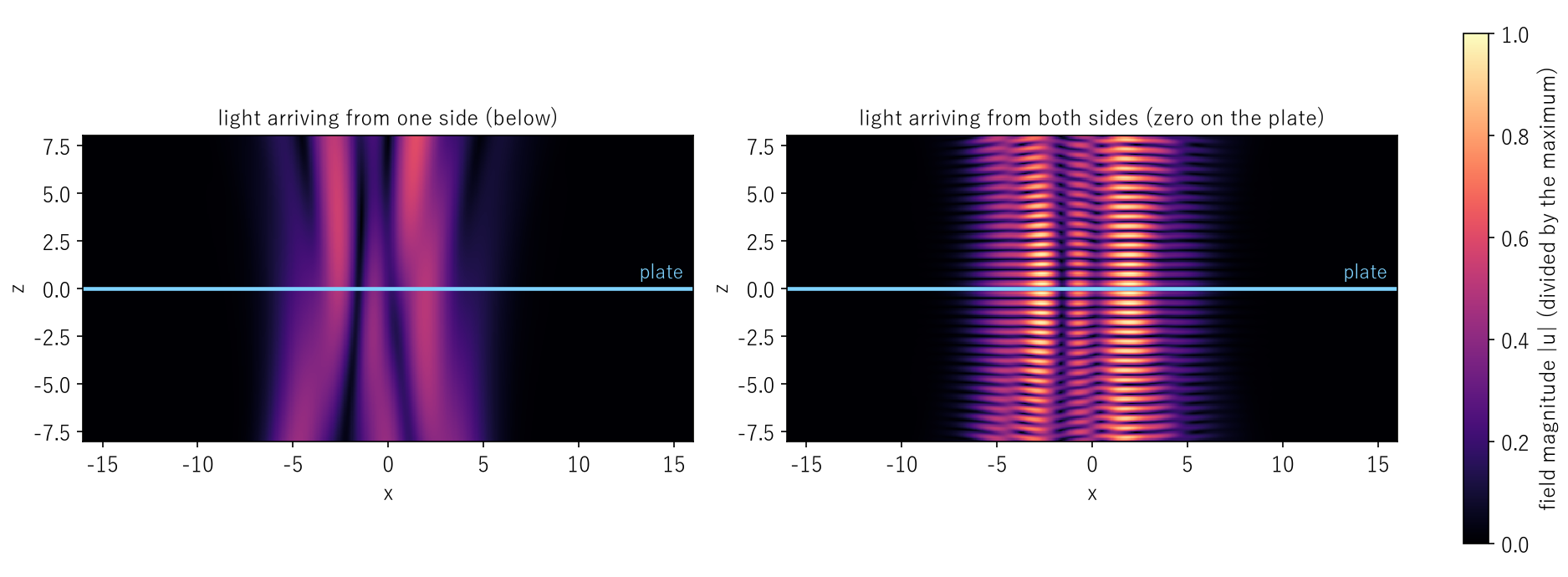
When light comes from both sides of the plate, both the solution going up and the solution going down remain beyond the plate, and the plate values alone do not suffice. Subtracting from the three beams $U(x,y,z)$ of the previous section their mirror image $U(x,y,-z)$ (which travels downward from above the plate) gives
$$F(x,y,z)=U(x,y,z)-U(x,y,-z),$$which is exactly zero on the plate, yet at $z=3$ it is 0.802406 times as large as $U$ (Figure 1 draws the same thing in a two-dimensional world). With two functions, the plate values and the derivative normal to the plate, the upward and downward weights can be separated for each transverse wavenumber, and the field was recovered at $z=1$ and 3 with relative differences of $1.84\times10^{-13}$ and $1.54\times10^{-10}$. The transverse wavenumber was cut at $1.2k$, because the dying-away components of the downward solution grow when followed upward from the plate and the numerical error grows with them; this is why the difference at $z=3$ is larger.
The plate values alone fail not only when light comes from both sides. In the fourth-order equation
$$(\Delta+k^2)(\Delta+(1.3k)^2)\,u=0,$$on which two waves of wavenumbers $k$ and $1.3k$ ride together, there are two upward solutions for each transverse wavenumber. Building a field $G$ from three beams of wavenumber $k$ and two of wavenumber $1.3k$ (centres $(2,-1,-11)$ and $(-3,4,-13)$, tilts 5 and 6 degrees, azimuths 0 and 220 degrees, $b$ equal to 8 and 9), all travelling upward from below, and continuing its plate values with wavenumber $k$ and with $1.3k$ separately and taking the difference, gives a field that is zero on the plate and comes only from below. At $z=3$ it was 0.521287 times as large as $G$. With the two functions, values and derivative, $G$ was recovered at $z=3$ and 8 with relative differences of $1.09\times10^{-14}$ and $4.44\times10^{-14}$.
| case | waves beyond the plate per transverse wavenumber | functions needed on the plate | plate values alone |
|---|---|---|---|
| second order, from one side | 1 | values | suffice |
| second order, from both sides | 2 | values and derivative | do not suffice (0.802406) |
| fourth order, from one side | 2 | values and derivative | do not suffice (0.521287) |
Paper 1107 counted that the numbers readable from outside a closed skin are, per angular pattern, half the order of the equation. Outside a closed skin there are no sources, and the light outside consists only of waves moving away from the skin, so this is the case of light from one side. For an open plate, that the light comes from one side must be laid down separately. The number of functions needed on the plate is the number of waves present beyond the plate for each transverse wavenumber, and it is 1 for a second-order equation with light from one side.
4. The plate records only intensity: the reference wave and the twin image
What the photographic plate records is the intensity $|R+O|^2$, a real number. The object wave $O$ is complex, worth two real numbers at each point. Expanding the intensity gives
$$|R+O|^2=|R|^2+|O|^2+R^*O+RO^*,$$and the object wave enters the two first-order terms $R^*O$ and $RO^*$. When the developed plate is illuminated with $R$, $|R|^2O$ travels on beyond the plate as the object wave and $R^2O^*$ becomes the conjugate wave. With the reference on the axis, the conjugate wave gathers at the mirror position of the object (beyond the plate, at the same distance as the object), and this is the twin image.
Only one transverse direction of the plate is taken, and the count is made on a periodic strip of period $2\pi$ (with two directions, half is still lost on the axis). The transverse wavenumber of the object wave was cut at $-M$ to $M$ ($M=64$), and the coefficients were set by a fixed random draw (normal random numbers from numpy, seed 1119). The object wave has 129 complex coefficients, 258 real numbers. The reference is $R=e^{ik_cx}$, where $k_c$ is the transverse wavenumber that expresses the tilt of the reference. The size of the object wave (root mean square) was set to $\varepsilon$ times the reference, and the object wave was read out from the plate intensity. The upper edge of the band of the first-order term was measured from the intensity spectrum. The number of real numbers in the band up to that edge (2 × upper edge + 1) is called below the real numbers the plate records; the plate must be able to record that fine a detail. On the axis, it is the number of real numbers recorded in proportion to the object wave.
| reference | upper edge of the first-order band | real numbers the plate records | relative difference ($\varepsilon=0.1$) | relative difference ($\varepsilon=0.01$) |
|---|---|---|---|---|
| on the axis ($k_c=0$) | 64 | 129 | 0.986210 | 0.997859 |
| $k_c=M+1$ | 129 | 259 | 0.072034 | 0.007203 |
| $k_c=2M+1$ | 193 | 387 | 0.040551 | 0.004055 |
| $k_c=3M+1$ | 257 | 515 | $4.87\times10^{-14}$ | $4.91\times10^{-14}$ |
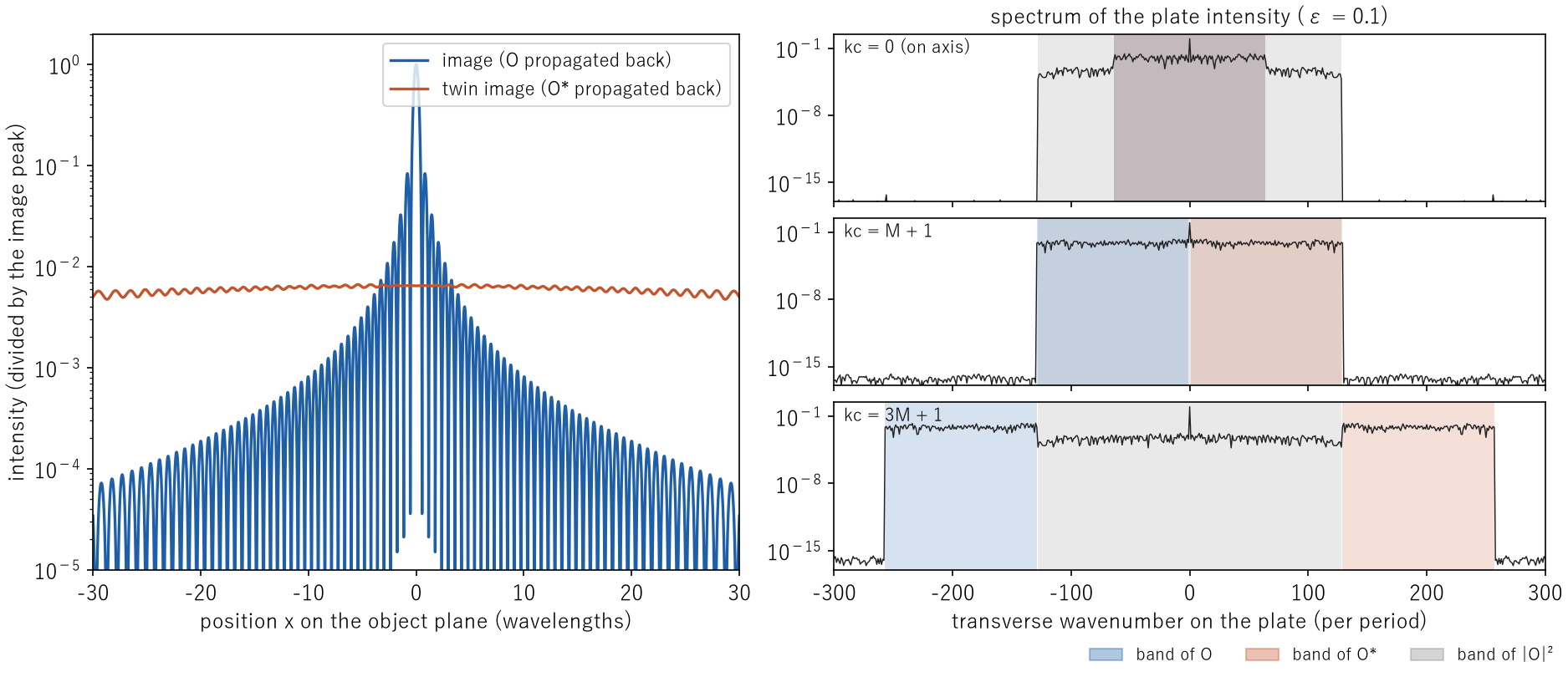
With the reference on the axis (Gabor’s arrangement), $R^*O+RO^*=2 \mathrm{Re} O$ falls on the same band as the object wave, and the 129 real numbers the plate records are exactly half of the 258 needed. The weaker the object wave, the closer the relative difference between the wave read out and the object wave comes to 1. The missing half is the twin image, mixed in at the same size as the object wave. When the reference is tilted off the axis (Leith and Upatnieks 1962), $R^*O$ and $RO^*$ shift to $-k_c$ and $k_c$ in transverse wavenumber and separate. At $k_c=M+1$, $R^*O$ occupies the transverse wavenumbers $-129$ to $-1$ and $RO^*$ occupies 1 to 129, so no first-order term enters the DC term $n=0$ (its coefficient is $3.11\times10^{-17}$). Of the 259 real numbers the plate records, the first-order terms fill exactly the 258 apart from the single DC term, and $O$ and $O^*$ just separate; the DC term holds $|R|^2$ and the mean of $|O|^2$. The remaining difference is the overlap of the term $|O|^2$, which spreads over the band from $-2M$ to $2M$; making $\varepsilon$ ten times smaller made the difference ten times smaller, and the difference divided by $\varepsilon$ was 0.7203 (0.4055 at $k_c=2M+1$). Tilting to $k_c=3M+1$ separates the term $|O|^2$ as well, and the difference falls to the size of the numerical error. The plate then records 1.996124 times the number of real numbers needed (Figure 2, right).
The counts so far are for reading out from the first-order terms. Including the term $|O|^2$, the band of the intensity widens to $2M$ even on the axis and holds 257 real numbers, and the real rank of the map from the object wave to the change of the intensity is also 257: only one direction, which turns the overall phase of $R+O$, is missing (the overlap $|\cos|$ with that direction is 1.000000000000). The rank of the map through the first-order terms alone is 129. But the 128 added directions are written in the square of the object wave, and their singular values run from 0.0800 to $3.19\times10^{-5}$ times the largest ($\varepsilon=0.1$) and from 0.00881 to $3.92\times10^{-7}$ times ($\varepsilon=0.01$), weaker the weaker the object wave. And since $|R+O^*|^2=|R+O|^2$ for $R=1$, $O$ and $O^*$ cannot be told apart even from the whole intensity, and the twin image remains. Methods that seek the phase from intensity alone (which the scope note set aside) rely on exactly this term $|O|^2$.
How much the twin image gets in the way at the place of the image is decided by how it blurs. In a two-dimensional world, a point source was placed at distance $d$ from a plate of width $W$ on the object side, and $O$ and $O^*$ on the plate were each propagated back to the object plane (propagating components only). On the plate the energy of $O^*$ equals that of $O$ (ratio 1.000000), and the overlap of the two, $|\int O^2 dx|/\int|O|^2 dx$, is 0.0660. In the object plane, $O$ gathers at the point and forms the image, while $O^*$ becomes light spreading from a point at distance $2d$ and is blurred (Figure 2, left).
| $d$ | $W$ | numerical aperture | image within one wavelength of the point | twin image in the same range | ratio of amplitude peaks (twin/image) |
|---|---|---|---|---|---|
| 20 | 60 | 0.8321 | 0.8929 | 0.0210 | 0.0816 |
| 40 | 60 | 0.6000 | 0.8802 | 0.0182 | 0.0946 |
The image can be seen even in Gabor’s arrangement because the twin image, while carrying the same energy, spreads widely. Paper 906 took as its separator whether one measures intensity alone or measures the phase by interference with a reference. The reference wave of a hologram carries out that interference on the plate and writes the phase of the object wave as the position of fringes (Paper 41 wrote that the position of fringes is fixed by the phase). In the words of Paper 1051, the question is whether the real numbers the plate records are enough for the real numbers the object wave needs.
5. The numbers a plate carries
Components with transverse wavenumber larger than $k$ die away with distance from the plate. A component with transverse wavenumber $1.5k$ falls to $8.8953\times10^{-4}$ of itself for each wavelength travelled. What reaches a plate far from the object are the components with transverse wavenumber at most $k$, and their number, the area $\pi k^2$ of the disc of transverse wavenumbers divided by $(2\pi)^2$, is $k^2/(4\pi)$ complex numbers per unit area ($\pi/\lambda^2$ in terms of the wavelength). Counting the lattice points with transverse wavenumber at most $k$ on a plate of period $L\times L$ gives the following (wavelength 1).
| period of the plate $L$ | lattice points with transverse wavenumber at most $k$ | $\pi L^2$ (area $\times k^2/(4\pi)$) | ratio |
|---|---|---|---|
| 16 | 797 | 804.2 | 0.990988 |
| 64 | 12853 | 12868.0 | 0.998837 |
| 256 | 205861 | 205887.4 | 0.999872 |
For a plate of 1 cm² at wavelength 633 nm the number is $7.8405\times10^8$. For a closed spherical skin of radius $a$, counting the angular patterns of Paper 1107 up to $\ell<ka$ gives $(ka)^2$, and dividing by the area $4\pi a^2$ of the sphere again gives $k^2/(4\pi)$ per unit area. For $a=10$ ($ka=62.8319$) there are 3969 patterns with $\ell<ka$, close to $(ka)^2=3947.8$, and the weight $|j_\ell(ka)|$ with which a source on the skin of radius $a$ feeds pattern $\ell$ (a spherical Bessel function; the expansion in Paper 1111), divided by its maximum, falls to 0.963 at $\ell=60$, $3.28\times10^{-2}$ at 70 and $5.36\times10^{-5}$ at 80. Where to cut depends on the threshold (cutting at $10^{-6}$ of the maximum keeps up to $\ell=85$), and $(ka)^2$ is a guide for a large sphere. That the degrees of freedom of a field at one frequency are effectively finite is in Bucci and Franceschetti (1989). For a large skin, an open plate and a closed skin carry roughly the same number per unit area.
6. Leaving no tail is a distinct root
In a two-dimensional world too (the plate is a line, and the light is three beams of the form $H_0^{(1)}(kR)$), light from one side is determined by the plate values alone, with relative differences of $1.07\times10^{-14}$ and $1.18\times10^{-14}$ at $z=3$ and 8. The field $F$ from both sides is zero on the plate yet remained 0.691975 times as large as $U$ at $z=3$. Whether one plate suffices is decided in the same way in two dimensions as in three.
On the other hand, waves arrive without a tail only in odd dimensions of 3 or more (Huygens’ principle, Courant and Hilbert 1962). Paper 247 counted that in three dimensions the signal is exactly zero for $t>1.2$, whereas in two dimensions $6.53\times10^{-8}$ remains even at $t=5.0$, and Paper 251 wrote that the dimensions with a tail are one and all even dimensions. Paper 1111 counted that a spherical wave that weakens with distance while keeping its shape exists only in three dimensions.
Seen in time as well, the record on the plate (one function of position on the plate and time) determines the light beyond the plate, frequency by frequency, in the form of the preceding sections. What differs is which times of the record act on a point beyond the plate. In three dimensions, as Kirchhoff’s formula shows, only the value at a single earlier instant (and its rate of change in time) acts, earlier by the travel time from that point of the plate to the observation point. In two dimensions, the values at all times before that instant act, and that is the tail (Courant and Hilbert 1962, Paper 247). Converting the kernel by which a short mark at one point of the plate acts on the point at distance 3 directly above, from the kernel at each frequency into time (smoothed over a width of 0.2, speed 1), gives, past the arrival time 3 at $\tau=5$, 8 and 12, values smaller than $10^{-8}$ in three dimensions (the size of the integration error) and $-1.5319\times10^{-2}$, $-2.3535\times10^{-3}$ and $-6.0997\times10^{-4}$ in two dimensions, which agree with the closed form $-(z/\pi)(\tau^2-r^2)^{-3/2}$, $-1.4921\times10^{-2}$, $-2.3411\times10^{-3}$ and $-6.0879\times10^{-4}$, up to the effect of the smoothing.
In terms of the test of Paper 300, changing the parity of the dimension of space does not change the number of functions needed on the plate ($1.18\times10^{-14}$ in two dimensions as well) and changes only whether a tail is left. Changing the side from which the light comes, or the order of the equation, changes the number of functions needed on the plate. The two respond differently to what is changed, and their roots are distinct.
7. The separator
The separator is whether the light reaches the plate from one side or from both sides. If it comes from one side, only one of the two solutions of the second-order equation remains beyond the plate, and the plate values alone determine both the light beyond the plate and the light of the image seen on the object side. If it comes from both sides, light remains beyond the plate even where the values on the plate are zero, and two functions, values and derivative, are needed. If the equation is of fourth order, two are needed even from one side.
| case | with the plate values alone | number |
|---|---|---|
| second order, one side, three dimensions | determined | $4.95\times10^{-14}$ |
| second order, one side, two dimensions | determined | $1.18\times10^{-14}$ |
| second order, both sides, three dimensions | not determined | 0.802406 |
| second order, both sides, two dimensions | not determined | 0.691975 |
| fourth order, one side, three dimensions | not determined | 0.521287 |
| intensity only, reference on the axis | half the real numbers proportional to the object wave; the twin image remains | 0.997859 |
| intensity only, $k_c=3M+1$ | the plate records 1.996124 times the real numbers; recovered | $4.91\times10^{-14}$ |
That the plate records only intensity is a further step outside this separator. What suffices on one plate is one complex function, and with the reference on the axis the real numbers recorded in proportion to the object wave are only half as many. The reference wave fills the shortfall by using extra transverse wavenumbers on the plate. On the axis it cannot fill it, and the twin image remains.
Closing
A hologram needs only one plate because the equation of light is of second order and, of the two solutions along the normal to the plate, light arriving from one side uses only one. For light from both sides, or for a fourth-order equation, light whose values on the plate are zero remains beyond the plate. A photographic plate records only intensity, so the phase is written into fringes with a reference wave. With the reference on the axis, the real numbers recorded in proportion to the object wave are exactly half of those the object wave needs, and the missing half scatters widely as the twin image, with the same energy as the image. Tilted off the axis, the reference separates them by using extra transverse wavenumbers on the plate. For a large skin, an open plate and a closed skin carry roughly the same number per unit area. That one plate suffices holds in two dimensions as well, while arriving without a tail belongs only to odd dimensions of 3 or more, and the two have distinct roots.
References
- Born, M., and Wolf, E. (1999). Principles of Optics (7th ed.). Cambridge University Press.
- Bucci, O. M., and Franceschetti, G. (1989). On the degrees of freedom of scattered fields. IEEE Transactions on Antennas and Propagation.
- Courant, R., and Hilbert, D. (1962). Methods of Mathematical Physics, Volume II. Interscience.
- Deschamps, G. A. (1971). Gaussian beam as a bundle of complex rays. Electronics Letters.
- Gabor, D. (1948). A new microscopic principle. Nature.
- Leith, E. N., and Upatnieks, J. (1962). Reconstructed wavefronts and communication theory. Journal of the Optical Society of America.
- Toraldo di Francia, G. (1969). Degrees of freedom of an image. Journal of the Optical Society of America.
- Yamagishi, Y. (2026). The Fringes Do Not Remember the Exponent [Paper 41]. YOI: https://www.yamagishiyuuki.com/yoi/41; DOI: 10.5281/zenodo.21436048
- Yamagishi, Y. (2026). The Special-Dimension Distribution Theorem [Paper 64]. YOI: https://www.yamagishiyuuki.com/yoi/64; DOI: 10.5281/zenodo.21616221
- Yamagishi, Y. (2026). The Fringes Die and Come Back [Paper 218]. YOI: https://www.yamagishiyuuki.com/yoi/218; DOI: 10.5281/zenodo.22119760
- Yamagishi, Y. (2026). Splitting by Parity Is Not One Phenomenon [Paper 247]. YOI: https://www.yamagishiyuuki.com/yoi/247; DOI: 10.5281/zenodo.22159832
- Yamagishi, Y. (2026). Special in Two Dimensions Is Not One Phenomenon [Paper 251]. YOI: https://www.yamagishiyuuki.com/yoi/251; DOI: 10.5281/zenodo.22161063
- Yamagishi, Y. (2026). The Sampling Theorem Is Correct and Its Premise Is Never Met [Paper 266]. YOI: https://www.yamagishiyuuki.com/yoi/266; DOI: 10.5281/zenodo.22169765
- Yamagishi, Y. (2026). The Three Hundredth Census: Whether Two Things Share a Root Is Decidable [Paper 300]. YOI: https://www.yamagishiyuuki.com/yoi/300; DOI: 10.5281/zenodo.22171914
- Yamagishi, Y. (2026). Carrying a Polarisation Around a Closed Path Shifts Its Phase by Half the Enclosed Solid Angle [Paper 906]. YOI: https://www.yamagishiyuuki.com/yoi/906; DOI: 10.5281/zenodo.22803812
- Yamagishi, Y. (2026). Whether the Boundary Determines the Interior Depends on What Is Measured and How Much [Paper 1051]. YOI: https://www.yamagishiyuuki.com/yoi/1051; DOI: 10.5281/zenodo.22903544
- Yamagishi, Y. (2026). In Three Dimensions the Entropy of a Black Hole Is the Same Number as the Area of the Horizon’s Cross-Sectional Disk, and the Shadow Disk in the Photographs Is 27/4 Times Larger [Paper 1093]. YOI: https://www.yamagishiyuuki.com/yoi/1093
- Yamagishi, Y. (2026). When the Field Equation Is of Second Order, the Interior Can Be Read from Outside a Closed Skin Only as One Number per Angular Pattern [Paper 1107]. YOI: https://www.yamagishiyuuki.com/yoi/1107
- Yamagishi, Y. (2026). The Inverse Square Hides the Interior from a Static Field and Carries the Echo of a Wave Undistorted [Paper 1111]. YOI: https://www.yamagishiyuuki.com/yoi/1111
Reference
Yamagishi, Y. (2026). A Hologram Needs Only One Plate Because the Equation of Light Is of Second Order and the Light Comes from One Side of the Plate, and This Has a Different Root from Light Arriving Without a Tail [Paper 1119]. YOI: https://www.yamagishiyuuki.com/yoi/1119
ORCID: 0009-0006-8587-3450
PDF (English) · PDF (Japanese) · Date proof of the English PDF (OpenTimestamps .ots) · SHA256SUMS
The record page for this paper (in Japanese, with the PDFs in each language and the date proof): YOI 1119. This paper is a preprint and has not been peer reviewed.