Abstract
Paper 1106 put on one map the fact that, when a density thins out as the n-th power of the distance from the centre, the amount held by one shell in d dimensions is proportional to the radius to the d−1−n, so that whether an infinity overflows at the centre or outside is decided by comparing n with d. There, d was moved to non-integer values only in a calculation, dimensional regularization. This paper counts the same thing for bodies whose mass within radius r grows as r to the D, with D not an integer (fractals). The weight of one shell becomes r to the D−1−n, and the edge moves to n = D. Every sum was found by adding up points directly, with only the remainder beyond the levels counted added as a geometric series. This paper claims no new theorem or law.
The dusts used are made by dividing the unit cube into 27 and keeping m corner cubes, over and over (D = log m/log 3). The number of points within radius r of the point at the origin approaches m times as r is tripled (3.99631 for m = 4, 7.92430 for m = 8). Its coefficient (the number of points divided by r to the D) is not constant but swings over the same range every factor of 3 (0.26925 to 0.64859 for m = 4).
Spreading a charge of 1 over the dust, putting it in a uniform ball for each small cube at level k and computing the field energy, the ratio of successive increments as k advances by one approached 3 to the 1−D = 3/m (within 8.5×10⁻⁵). The arrangement at level k is m copies of that at level k−1 shrunk to a third, so the energy inside the copies becomes 3/m times as large at each level, and the ratio of increments comes from this. For m = 1, the point charge, the energy triples at each level and grows inversely as the cutoff length, like the point charge on the map of Paper 1106. A straight segment grows at each level by an amount approaching ln3/√3 = 0.634284, and the triangular three-corner dust (D = 1), which is not a line, grows by 0.361699 per level. Both are logarithmic, the same growth as the straight current of Paper 1106. For dusts with D greater than 1 (m = 4 to 8), the increments shrink in size by a factor of 3/m from level to level (they are negative for m = 5 to 8) and the energy settles to a finite value.
Placing stars of equal brightness on the points of the dust and adding up, shell by shell, the light 1/r² seen from one star, the ratio between shells approached m/9 = 3 to the D−2 from below (0.885328 for m = 8, with limit 0.888889). The night-sky light of a dust with D below 2 is finite; at D = 2 it grows logarithmically, and for the Menger sponge (D = 2.726833) and the filled cube it overflows outward. Both the self-energy and the night-sky light are finite for the dusts with 1 < D < 2 (m = 4 to 8). Rearranging the corners at the same m = 4 changes the energy summed to the end by a factor of 1.3109, while the two ratios both approach 3/4 and 4/9 and do not move with the arrangement.
Changing the shrinking ratio of the eight-corner dust to bring D from 1.892789 to 1.985490, the sum of night-sky light grows from 7.319117 to 56.301393, while its product with 2−D stays between 0.784688 and 0.816925. The pole of Paper 1106 at d = 2 appears, for a real dust, as a sum growing nearly inversely as 2−D. Past 2, the real sums are infinite on both sides, for the integral of Paper 1106 and for the sum over the dust. A finite value comes, on both sides, from the continued formula (the formula of Paper 1106 gives −18.48902455 at d = 2.726833, and the geometric-series formula of the dust gives −8.6154 at D = 2.093569). For diffusion-limited aggregates of 10 000 particles grown on a two-dimensional lattice, D is 1.6229 to 1.7767 depending on how it is measured (1.5941 to 1.7831 when the fitting range is also moved), and the mean density drops by factors of 0.4188 and 0.3535 from radius 8 to 128. The separator is the dimension D of the body, which sets the weight of a shell, and the dimension of space, which sets how things thin out.
Keywords: fractal dimension, self-similarity, self-energy, Olbers’ paradox, diffusion-limited aggregation, dimensional regularization, separator.
Scope (what is not claimed)
This paper claims no new theorem or law. Non-integer dimensions (Hausdorff dimension, fractal dimension) and the dimension log m/log 3 of a self-similar dust (Mandelbrot 1982, Falconer 2003), the existence, on a set whose dimension exceeds the power of a kernel, of a way of spreading mass for which the energy summed with that kernel is finite (a result of potential theory, often cited under the name of Frostman; Falconer 2003), diffusion-limited aggregation (Witten and Sander 1981), the idea that a hierarchy of star clusters can darken the night sky (cited under the names of Fournier d’Albe 1907 and Charlier 1908 and 1922, and said to have been taken up in fractal terms by Mandelbrot 1982; the originals have not been checked) and dimensional regularization are all known. Values of D for real trees, soot, aggregates or the distribution of galaxies are not given (their sources have not been checked). The branching shapes of trees and blood vessels are not entered. The diffusion-limited aggregates are small clusters on a two-dimensional lattice (two of 10 000 particles), and the value of D moves by about 0.19 depending on how it is measured and over which range it is fitted (1.5941 to 1.7831). Only three-dimensional space was computed, and the window for spaces of other dimensions is given only as a reading. The expansion of the universe, the blocking of light and the lifetimes of stars are not treated. Whether the arrangement in which both sums are finite for dusts with 1 < D < 2 is already in the literature has not been checked. What is added is replacing the d of the map of Paper 1106 by the D of a body and adding up the self-energy and the night-sky light directly on one family of dusts; confirming numerically that the point charge and the straight line sit at D = 0 and D = 1 of that family; showing that the edge does not move even when the coefficient swings log-periodically and changes with the arrangement; setting the growth as D approaches 2 beside the pole of Paper 1106 and confirming, with the sums over a dust as well, that past 2 the continued formula and the real sum part ways; and measuring D and the density of diffusion-limited aggregates. Paper 1106 mapped how the place of an infinity is decided by comparing the exponent of the weight of one shell with the dimension, and wrote that an overall coefficient does not swap finite and infinite, and that dimensional regularization is a calculation that moves d on the map. This paper replaces that d by the D held by a body. Paper 94 separated "dimension" into topological dimension, fractal dimension and the special integer dimensions of the series, and wrote that the value of a fractal dimension is not to be tied to the special numbers of the series by numerical coincidence. This paper does not tie values either. D enters the map through its role as the exponent of the weight of one shell. Paper 1052 showed numerically, for integer dimensions, that the exponent of a shell does not respond to topology and moves only with the dimension. The D here is the dimension of a body rather than of space, and it is not an integer. Paper 354 followed the length of the Hilbert curve as it grows with the order and recovered the dimension 2.001406 from its growth; it is a neighbouring scene in which a quantity overflows because the dimension of the body and that of the measured quantity do not match. Paper 1053 showed that when the magnification has only one ratio, a log-periodic function multiplies the power. The coefficient of the number of points of a corner dust has that form, and this paper counts that the coefficient does not change finite into infinite. Paper 496 showed that the sum of night-sky light diverges even after 4π cancels. Paper 1121 wrote the slope of the counts by brightness as the ratio of the dimension of the sources to the dimming exponent, and wrote that it does not treat distributions of sources with non-integer dimension. This paper sits only on the night-sky-light side of that seat and does not compute the slope of the counts. Whether things share a root is decided by the criterion of Paper 300.
1. The dimension that was moved and the dimension that is measured
Paper 1106 started from the fact that when a density thins out inversely as the $n$-th power of the distance from the centre, the amount held by one shell between radii $r$ and $r+dr$ in $d$-dimensional space is $|S^{d-1}| r^{d-1-n} dr$. The sum is finite at the centre when $n<d$ and finite outside when $n>d$, and at $n=d$ it grows logarithmically at both ends. The overall coefficient $|S^{d-1}|$ ($4\pi$ in three dimensions) does not swap finite and infinite. Paper 1106 also read dimensional regularization, which moves $d$ as a real number, as a calculation that carries a point sideways on the map, and showed numerically that the formula $\pi^{d/2}\Gamma(1-d/2)$ for $1/(k^2+1)$ summed in $d$ dimensions has poles at $d=2$ and $d=4$. There, $d$ took non-integer values only in a calculation.
If a body has a mass within radius $r$ that grows as
$$M(r)\propto r^{D},$$then even when $D$ is not an integer the mass held by one shell is $dM\propto r^{D-1} dr$. Multiplying by a weight that thins out as the $n$-th power of the distance and adding up, the weight of one shell is $r^{D-1-n}$, and the edge moves to $n=D$. This paper counts this for self-similar dusts made by choosing which corners to keep, and for clusters that grow by particles sticking one at a time (diffusion-limited aggregation).
Paper 94 wrote that the value of a fractal dimension is not to be tied to the special numbers of the series by numerical coincidence. This paper does not tie values. $D$ enters the map through its role as the exponent of the weight of one shell. Since the series uses "mass dimension" in the sense of the dimension of units, the $D$ here is called the fractal dimension. Every sum was found by adding up points directly (double precision). A geometric series was used only to add the remainder beyond the levels counted (stated in each section). Ratios of logarithms were found symbolically, and the formula of Paper 1106 with 20-digit numbers.
2. Dusts that keep corners
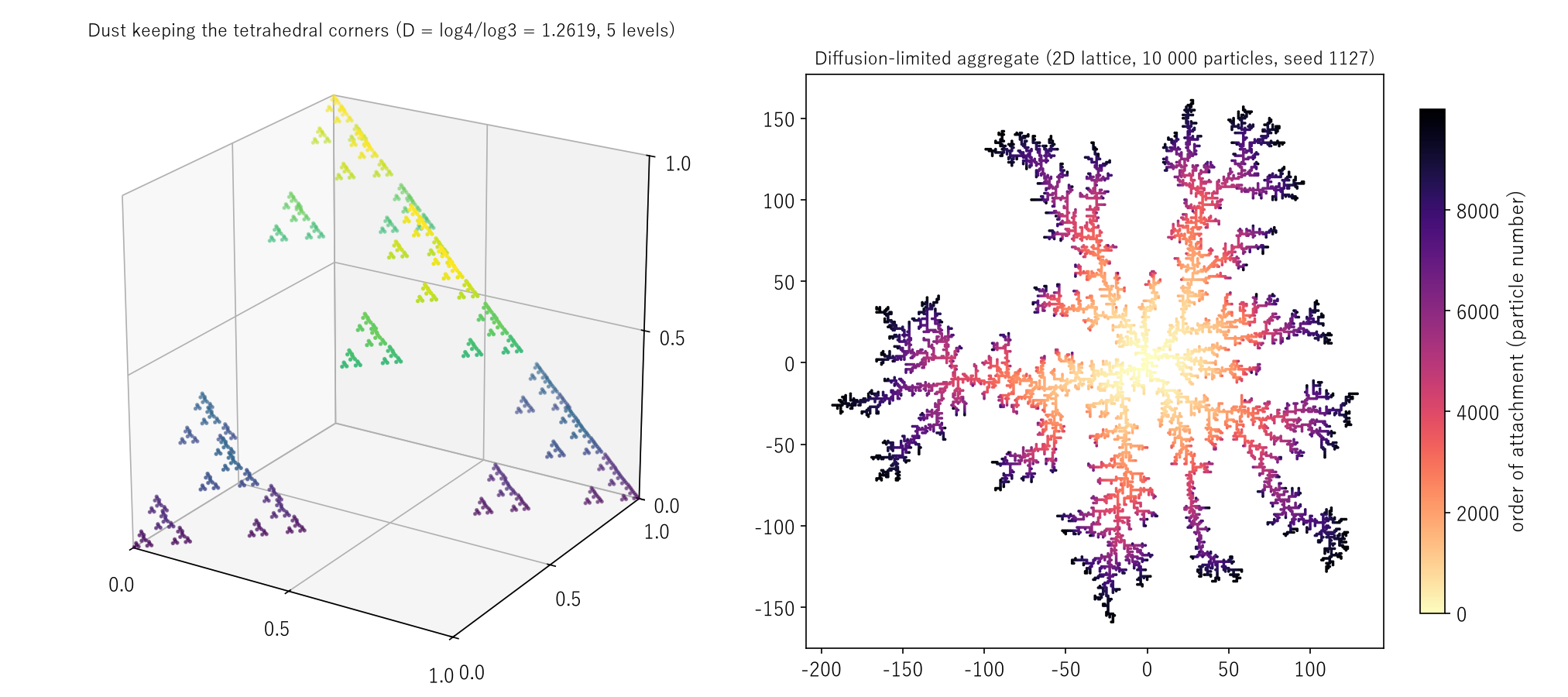
Divide the unit cube into 27 small cubes and keep $m$ of those at the corners. Divide each kept cube into 27 again and keep the same corners, over and over. After $k$ levels there are $m^k$ small cubes of side $3^{-k}$, so the dimension is $D=\log m/\log3$. The kept corners always include the corner at the origin. For comparison, the eight corners with the centre, the Menger sponge and the filled cube are also used.
| small cubes kept | $m$ | $D=\log m/\log3$ |
|---|---|---|
| only the corner at the origin (a point) | 1 | 0 |
| two opposite corners | 2 | 0.630930 |
| three corners of a triangle | 3 | 1 |
| four corners of a regular tetrahedron (and, for comparison, of a square) | 4 | 1.261860 |
| five, six, seven corners | 5, 6, 7 | 1.464974, 1.630930, 1.771244 |
| all eight corners | 8 | 1.892789 |
| eight corners and the centre | 9 | 2 |
| Menger sponge | 20 | 2.726833 |
| filled cube | 27 | 3 |
Seen from the corner at the origin, the dust was blown up so that the side of the smallest cube is 1, and the number $M(r)$ of points within radius $r$ of the origin was counted. The ratio between neighbours at $r=3^j$ is exactly 2 for every $j$ when $m=2$, 3.99631 when $m=4$ (3.99483 for the square arrangement) and 7.92430 when $m=8$, approaching $m$.
$M(r)/r^D$, however, is not constant. Since $M(r)$ jumps at the distance of each point, the maximum was taken just after a jump and the minimum just before one. Over the last factor of 3 counted ($r$ from $3^{12}$ to $3^{13}$ for $m=2$, from $3^7$ to $3^8$ for $m=4$), it moves between 0.45662 and 0.70711 for $m=2$ and between 0.26925 and 0.64859 for $m=4$, and the factor of 3 before it repeats the same range (the difference between the ranges of two periods is $1.7\times10^{-6}$ for $m=2$ and at most $9.6\times10^{-4}$ for the two arrangements with $m=4$). This is the form written in Paper 1053: when the magnification has only one ratio, a log-periodic function multiplies the power. On the map of Paper 1106, this coefficient sits in the seat of $|S^{d-1}|$. Unlike $4\pi$ it is not constant, but for all four of $m=2$, the two arrangements with $m=4$ and $m=8$ it stays between two positive numbers, with the ratio of maximum to minimum between 1.5486 and 2.4089 (for $m=8$ fewer levels were counted, and the ranges of two periods still differ by about $6.4\times10^{-3}$).
3. Self-energy: the point charge and the line sit in one family
Spread a charge of 1 evenly over the dust, and find the energy the charge holds in its own field (the self-energy). For each small cube at level $k$, paint its charge on a uniform ball of radius $\rho=3^{-k}/2$ centred in the cube. The balls do not overlap, so the field energy between two balls is the same as between their centre points, and each ball’s own part is $(3/5)q^2/\rho$. Call the sum $U_k$ and advance $k$ one step at a time. $\rho$ plays the role of the cutoff length $a$ of Paper 1106.
| dust | $D$ | last ratio of increments | $3^{1-D}=3/m$ | growth |
|---|---|---|---|---|
| point ($m=1$) | 0 | 3.000000 | 3 | inversely as the cutoff length |
| two opposite corners | 0.630930 | 1.500000 | 1.5 | as the cutoff length to the $D-1$ |
| three corners of a triangle | 1 | 1.000000 | 1 | logarithmic (0.361699 per level) |
| straight segment | 1 | 1.000832 | 1 | logarithmic (towards $\ln3/\sqrt3$ per level) |
| tetrahedral four corners | 1.261860 | 0.750000 | 0.75 | finite (1.592107) |
| square four corners | 1.261860 | 0.750034 | 0.75 | finite (2.087020) |
| five corners | 1.464974 | 0.599915 | 0.6 | finite (1.171865) |
| six corners | 1.630930 | 0.499954 | 0.5 | finite (1.008134) |
| seven corners | 1.771244 | 0.428547 | 0.428571 | finite (0.914842) |
| all eight corners | 1.892789 | 0.375006 | 0.375 | finite (0.852778) |
The ratio of increments approached $3/m=3^{1-D}$, within $8.5\times10^{-5}$. $m=1$ is the point charge itself: $U_k=(6/5)\cdot3^k$ (relative difference $1.6\times10^{-16}$), tripling each time the cutoff is cut to a third. This is the growth inversely as the cutoff length of item ① on the map of Paper 1106 (the field energy of a point charge, $d=3$, $n=4$). Keeping the three small cubes along the diagonal makes the dust a straight segment, whose increment per level approaches $\ln3/\sqrt3=0.634284$ (the last increment is 0.634020). The sum grows as the logarithm of the cutoff length, the same as the cutoff side of item ⑥ of Paper 1106 (a straight current, $d=2$, $n=2$; the segment here has a finite length, so it does not overflow at the outer end). The triangular three-corner dust, which is not a line, also has $D=1$, and its increment settles to a constant 0.361699 per level. The logarithmic growth comes from $D=1$ rather than from the straightness of a line, and the arrangement changes only the amount per level (the coefficient). For $m=2$ ($D=0.630930$) the increment grows by a factor of 1.5 per level, and the sum grows as the cutoff length to the $D-1$. For $m=4$ to 8, with $D$ above 1, the increment shrinks by a factor of $3/m$ per level (for $m=5$ to 8 the increments are negative and the sum approaches from above), and the sum settles to a finite value.
The ratio of increments is $3/m$ because the dust is made of shrunken copies of itself. The arrangement at level $k$ is $m$ copies of the arrangement at level $k-1$ shrunk to a third; each copy carries a charge $1/m$ and is a third the size, so the energy inside it is $(1/m)^2\times3$ times as large. Hence
$$U_k=\frac{3}{m}\,U_{k-1}+X_k,$$where $X_k$ is the part between the copies and $U_0=1.2$ is a uniform ball of radius 1/2. $X_k$ settles from level to level, the difference between neighbours shrinking by a factor of about 1/9 per level (1/81 for the tetrahedral corners and the eight corners, 1/3 for the segment). For $m=3$ and the segment the increment is $X_k$ itself, with limits 0.361699 and $\ln3/\sqrt3$. For $D>1$ the sum settles to $U_\infty=X_\infty/(1-3/m)$. The finite values in the table were found from $X_\infty$, obtained by continuing the differences of $X_k$ up to the last level counted (6 levels for $m=4$, 5 for $m=5$ to 7, 4 for $m=8$) as a geometric series with the ratio of the last differences (they agree within $1.2\times10^{-6}$ with the values found by adding the remaining increments as a geometric series with ratio $3/m$).
The same infinity is counted in two ways. Paper 1106 added up the field energy over space and took the exponent $d-n$: $3-4$ for a point charge and $2-2$ for a straight current. Here $1/r$ is added up on the body carrying the charge, and the exponent is $D-1$: $0-1$ for a point and $1-1$ for a line. Either way it is $-1$ for a point and 0 for a line. The family of charged dusts connects the range between the point charge and the line ($0<D<1$) and the range beyond ($D>1$).
4. Night sky: stars on a dust
Place a star of equal brightness at every point of the blown-up dust. The light $1/r^2$ seen from the star at the origin was added up in shells. Shell $j$ consists of the stars inside the cube of side $3^{j+1}$ sharing the corner at the origin and outside the cube of side $3^j$ (reading the position of a point as the sequence of corners chosen level by level, these are the stars whose highest level with a choice other than the origin corner is $j$). Shell $j$ holds exactly $(m-1)m^j$ stars for every dust.
| dust | $D$ | last ratio of shells | $3^{D-2}=m/9$ | night-sky light |
|---|---|---|---|---|
| two opposite corners | 0.630930 | 0.222193 | 0.222222 | finite |
| three corners of a triangle | 1 | 0.332938 | 0.333333 | finite |
| tetrahedral four corners | 1.261860 | 0.443914 | 0.444444 | finite |
| square four corners | 1.261860 | 0.443879 | 0.444444 | finite |
| five corners | 1.464974 | 0.553265 | 0.555556 | finite |
| six corners | 1.630930 | 0.664196 | 0.666667 | finite |
| seven corners | 1.771244 | 0.775030 | 0.777778 | finite |
| all eight corners | 1.892789 | 0.885328 | 0.888889 | finite |
| eight corners and the centre | 2 | 0.995727 | 1 | grows logarithmically |
| Menger sponge | 2.726833 | 2.185299 | 2.222222 | overflows outward |
| filled cube | 3 | 2.851027 | 3 | overflows outward (in proportion to the radius) |
For every dust the ratio between shells approached $m/9=3^{D-2}$ from below (within a relative difference of 0.0043 for $m\le9$). For $D<2$ the light decreases from shell to shell and the sum settles to a finite value. For the dust of eight corners and the centre ($D=2$) the ratio approaches 1 and the sum grows logarithmically. For the Menger sponge the ratio approaches 20/9 and for the filled cube 3, and they overflow outward. The filled cube is item ⑤ on the map of Paper 1106 (uniformly placed stars, $d=3$, $n=2$, growing in proportion to the radius).
$n=2$ comes from light spreading over spheres in three-dimensional space and does not depend on the dimension of the body carrying the stars. The edge is decided by comparing that $n$ with the $D$ of the body, and for $D<2$ the night-sky light is finite. The idea that a hierarchy of star clusters can darken the night sky is cited under the names of Fournier d’Albe 1907 and Charlier 1908 and 1922, and is said to have been taken up in fractal terms by Mandelbrot 1982 (the originals have not been checked here). The night sky of Paper 496 is on the $D=3$ side.
5. The two edges side by side
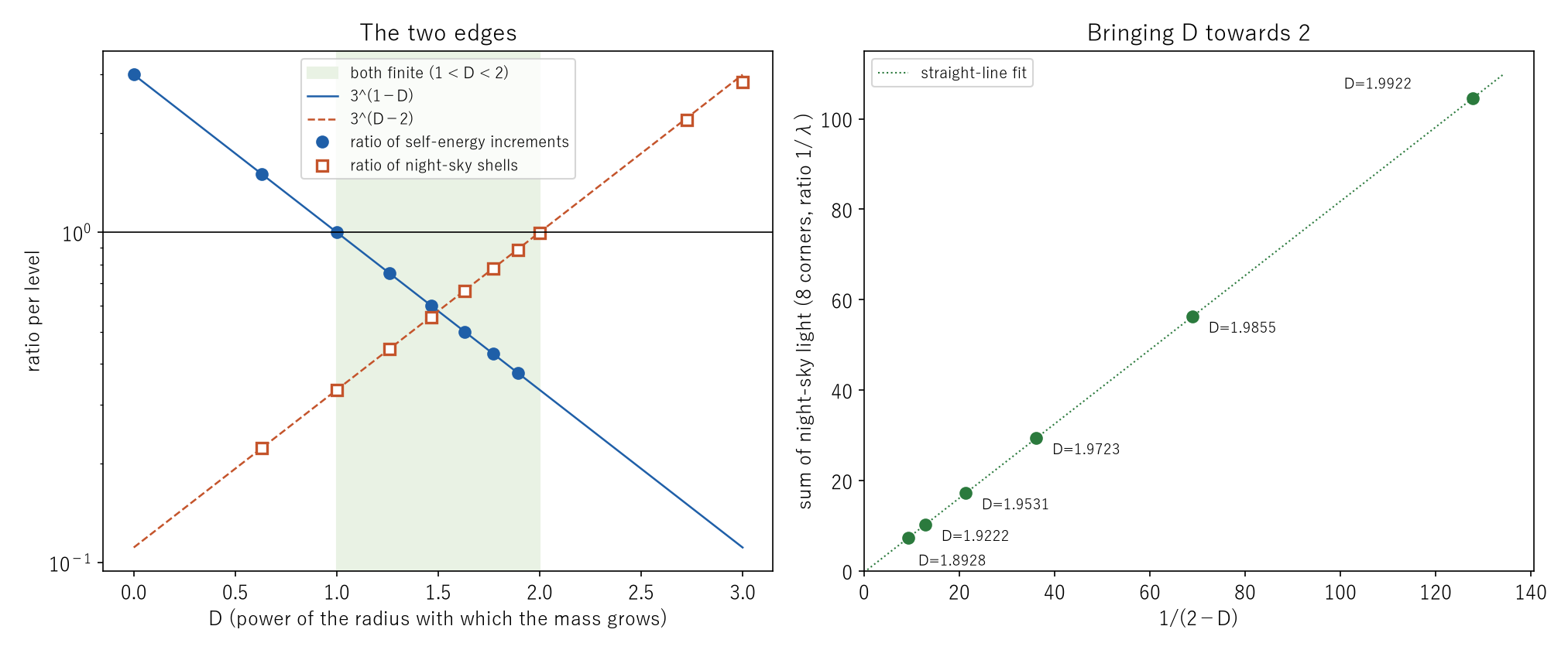
In three-dimensional space, set the two sums side by side. The self-energy summed with the potential kernel $1/r$ has $n=1$ and is finite on the fine side when $D>1$. The night sky summed with the light $1/r^2$ has $n=2$ and is finite on the far side when $D<2$. In both, the edge is $n=D$. $n$ is set by space: $d-2$ for the potential and $d-1$ for light. $D$ is set by the body.
Both ratios are below 1 for $m=4$ to 8, that is, for dusts with $D$ from 1.261860 to 1.892789 (the values are those of the two previous sections). A dust with $1<D<2$ keeps its self-energy finite when looked at finely and its night-sky light finite when looked at far away. $m=1$ and $m=2$ overflow on the fine side (ratios 3 and 1.5), $m=3$ sits at the edge on the fine side and grows logarithmically, $m=9$ sits at the edge on the far side and grows logarithmically, and the Menger sponge and the filled cube overflow on the far side. Moved to $d$-dimensional space, the window reads $d-2<D<d-1$, but this paper computed only $d=3$.
6. Changing the coefficient does not move the edge
At the same $m=4$, the four corners of a regular tetrahedron and the four corners of a square were compared.
| tetrahedral four corners | square four corners | |
|---|---|---|
| range of the coefficient $M/r^D$ | 0.26925 to 0.64859 | 0.41701 to 0.74861 |
| self-energy (summed to the end) | 1.592107 | 2.087020 |
| last ratio of its increments | 0.750000 | 0.750034 |
| light from the first night-sky shell | 0.375000 | 0.625000 |
| last ratio of shells | 0.443914 | 0.443879 |
The self-energy summed to the end differs by a factor of 1.3109, and the range of the swinging coefficient and the light of the first night-sky shell differ as well. Yet the ratio of increments approaches 3/4 and the ratio of shells 4/9, and the two arrangements agree within $3.4\times10^{-5}$. The arrangement moves the coefficient and does not move the edge. The separator of Paper 1106, an overall coefficient or the exponent of the weight of one shell, works even when the coefficient is not constant, swings log-periodically and changes with the arrangement.
7. Near the edge
The $\pi^{d/2}\Gamma(1-d/2)$ of Paper 1106 has a pole at $d=2$. To see what happens when $D$ of a dust approaches 2, the shrinking ratio of the eight-corner dust was changed from $1/3$ to $1/\lambda$. At each level the side of the small cubes becomes $1/\lambda$ times smaller, and $D=\log8/\log\lambda$. Making $\lambda$ smaller from 3 to 2.85 raises $D$ from 1.892789 to 1.985490. The night-sky light was added up shell by shell for seven levels, and the rest was added as geometric series, taking the shell sums divided by $(8/\lambda^2)^j$ to follow $C+c_1\lambda^{-j}+c_2\lambda^{-2j}$ and solving for $C$, $c_1$ and $c_2$ from the last three shells. For $\lambda=3$, adding from six levels or from seven gave sums with a relative difference of $7.9\times10^{-9}$.
| $\lambda$ | $D=\log8/\log\lambda$ | sum of night-sky light | $(2-D)\times$ sum | Paper 1106’s $(2-d) \pi^{d/2}\Gamma(1-d/2)$ |
|---|---|---|---|---|
| 3 | 1.892789 | 7.319117 | 0.784688 | 5.742389155 |
| 2.95 | 1.922196 | 10.258035 | 0.798116 | 5.883263491 |
| 2.9 | 1.953058 | 17.237498 | 0.809167 | 6.037011153 |
| 2.87 | 1.972321 | 29.418725 | 0.814287 | 6.136180645 |
| 2.85 | 1.985490 | 56.301393 | 0.816925 | 6.205447986 |
The sum grows from 7.319117 to 56.301393, a factor of 7.6924, while its product with $2-D$ stays between 0.784688 and 0.816925. The sum grows nearly inversely as $2-D$. The formula of Paper 1106, multiplied by $2-d$, goes from 5.742389155 to 6.205447986 and tends to $2\pi=6.2831853072$ as $d\to2$. The pole at $d=2$ appears, for a real dust, as a real sum growing nearly inversely as $2-D$.
Where the product with $2-D$ tends is a number on the side of the coefficient of the weight of one shell. Writing $C$ for the limit of the shell sums divided by $(8/\lambda^2)^j$, $\sum_j C(8/\lambda^2)^j=C/(1-8/\lambda^2)$, and $1-8/\lambda^2=1-\lambda^{D-2}$ is about $(2-D)\ln\lambda$, so the sum multiplied by $2-D$ approaches $C/\ln\lambda$. For every $\lambda$ of the table, the sum multiplied by $2-D$ lies between $C/\ln\lambda$ at that $\lambda$ (0.676670 at $\lambda=3$) and $C/\ln\sqrt8=0.818965$ at $\lambda=\sqrt8$, where $D=2$. The $2\pi$ of Paper 1106 is the length $|S^1|$ of the unit circle in two dimensions and likewise lies on the side of the coefficient. The values differ because the coefficients differ, which belongs to item (2) of “Shared root or distinct roots” below.
Past 2, the real sums are infinite on both sides. Paper 1106 counted that the three-dimensional sum up to $\Lambda$ grows in proportion to $\Lambda$ (Section 6 of Paper 1106), and the night-sky light of stars placed on the Menger sponge here grows by a factor of 2.185299 per shell. A finite value comes from the continued formula: continuing the formula of Paper 1106 to the $d=2.726833$ of the Menger sponge gives $-18.48902455$. On the side of the dust as well, the closed form of the geometric series used to add the remainder, continued past 2 ($8/\lambda^2>1$), returns a finite negative number ($-8.6154$ at $\lambda=2.7$, $D=2.093569$, while the last three real shell sums keep growing, 1.390, 1.515, 1.659). Multiplied by $2-D$, it is 0.8202 even at $\lambda=2.8$ past 2, continuing the values just before 2. Like the formula of Paper 1106, the formula of the dust is a single formula whose sign changes across 2. What the moved $d$ and the measured $D$ share is the place of the edge and how things grow just before it; past 2 the finite value is, on both sides, the value of a continued formula and not a sum.
8. Diffusion-limited aggregation: a dimension that comes without design
The dusts so far were made by choosing which corners to keep. As an example in which a non-integer $D$ comes out of the way a body grows, diffusion-limited aggregation (Witten and Sander 1981) was counted. One particle is placed at the centre of a two-dimensional square lattice; particles are released one at a time from a circle 5 beyond the farthest particle of the cluster, perform random walks, and stop when they reach a site next to the cluster. A particle that goes beyond three times the circle (at least 60 beyond it) starts again from a uniformly chosen direction on the same circle (this is an approximation, since it does not continue from the direction in which the particle left, and the size of its effect has not been checked). Two clusters of 10 000 particles were grown with random seeds 1127 and 1128.
| random seed | farthest particle | $D$ ($M(r)$ from the seed) | $D$ (growth of the radius of gyration) | $D$ (pair counting) | density $r\le8$ | density $r\le128$ |
|---|---|---|---|---|---|---|
| 1127 | 194.7 | 1.7145 | 1.7308 | 1.6432 | 0.3432 | 0.1437 |
| 1128 | 188.8 | 1.6229 | 1.7767 | 1.6559 | 0.4128 | 0.1459 |
$D$ was fitted, for $M(r)$ counted from the seed, over $r$ from 5 to a third of the farthest particle; for the radius of gyration, from 500 to 10 000 particles; and for pair counting, over $r$ from 3 to a quarter of the farthest particle. $D$ moves from 1.6229 to 1.7767 depending on the method and the cluster. Moving the fitting range (six ranges for $M(r)$ from the seed, four for the radius of gyration, four for pair counting) moves it by 0.03 to 0.14 even within one method, to 1.5941 to 1.7831 in all, but every value lies between 1 and 2. The mean density within a circle of radius $r$ drops by factors of 0.4188 and 0.3535 as $r$ goes from 8 to 128. That a larger circle holds a lower mean density is what $D<2$ means.
Placing light sources of equal brightness on the particles (the light thins out as $1/r^2$ in three-dimensional space), the light seen from the seed was added up in shells doubling in radius. For a filled plane (the lattice points) the sum per shell approaches $2\pi\ln2=4.355172$, and from the shell 4 to 8 to the shell 32 to 64 it changes by a factor of 0.9561, hardly at all. This is the logarithm at the edge, the same as item ⑥ of Paper 1106. For the clusters the same ratio is 0.6293 and 0.4790, decreasing from shell to shell. From the shell 4 to 8 outward, the ratio between neighbouring shells swings from 0.7111 to 0.9336 (from the innermost shell 2 to 4 to the shell 4 to 8 it is 0.4528 and 0.7201). A cluster of 10 000 particles is small, so the value of $D$ is not stated finely from this.
9. Shared root or distinct roots
The quantities of this paper are separated by the criterion of Paper 300.
(1) Items ① (point charge) and ⑥ (straight current) of Paper 1106 and the self-energy of a charged dust: in all of them the growth is decided by the exponent $D-1$ of the sum of the shell weights $r^{D-2}$ (potential kernel, $n=1$), the counterpart of $d-n$ in Paper 1106, so they share a root. ① is the point $D=0$ and ⑥ the point $D=1$, and the dusts fill in between and beyond.
(2) The coefficient (the swinging coefficient of the number of points, the value of the self-energy, the light of the first night-sky shell) and the edge: changing the arrangement moves only the coefficient, not the ratios. Their roots are distinct.
(3) The $d$ moved in dimensional regularization and the $D$ of a dust: the place of the edge and the form of growth inversely as $2-D$ just before it are the same, and both come from the exponent of the weight of one shell approaching the edge. Where the product with $2-D$ tends (0.818965 for the dust, $2\pi$ for Paper 1106) is on the side of the overall coefficient and stands apart from the edge, as in (2). Past 2 the finite value is, on both sides, that of a continued formula, and the real sums are both infinite. As to the place of the edge and the growth they share a root; as to the coefficient their roots are distinct.
(4) The dimension $D$ of the body and the dimension $d$ of space: $D$ sets the weight of a shell, and $d$ sets the power of the kernel ($d-2$ for the potential, $d-1$ for light). In items ①, ⑤ and ⑥ of the map of Paper 1106, both the weight of a shell and the thinning of the field came from the same dimension $d$ of space; for a fractal body they come apart. Their roots are distinct.
10. The separator
The separator is the dimension $D$ of the body, which sets the weight of a shell, and the dimension of space, which sets how things thin out. For a body whose mass within radius $r$ grows as $r^D$, the weight of one shell is $r^{D-1-n}$, and the edge moves to $n=D$. In three-dimensional space, the self-energy summed with the potential is finite for $D>1$ and the night sky summed with light is finite for $D<2$, and both are finite for dusts with $1<D<2$. The point charge ($D=0$) and the straight line ($D=1$) sit at the end and at the edge of this family. The coefficient swings log-periodically and changes with the arrangement, but does not move finite into infinite. As $D$ approaches 2 the sum grows nearly inversely as $2-D$, and past 2 the real sum is infinite.
Closing
For a body whose mass grows as the D-th power of the radius, the dimension that decided the edge of an infinity on the map of Paper 1106 moves from the 3 of space to the D of the body. The increment of the self-energy of a charge spread over a dust changes by a factor of 3 to the 1−D each time the cutoff is cut to a third, and the point charge and the straight line sit at D = 0 and D = 1 of this family. The light of stars placed on a dust changes by a factor of 3 to the D−2 from shell to shell, and if D is below 2 the night-sky light is finite. A dust with D between 1 and 2 keeps its self-energy finite when looked at finely and its night-sky light finite when looked at far away. The pole of a dimension moved in a calculation appears, for a real dust, as the growth of a sum; past 2, on both sides, a finite value comes only from a continued formula, and the real sums are both infinite. The two diffusion-limited aggregates grown on a two-dimensional lattice came, without any design, with a D inside that window.
References
- Falconer, K. (2003). Fractal Geometry: Mathematical Foundations and Applications (2nd ed.). Wiley.
- Mandelbrot, B. B. (1982). The Fractal Geometry of Nature. W. H. Freeman.
- Witten, T. A., and Sander, L. M. (1981). Diffusion-limited aggregation, a kinetic critical phenomenon. Physical Review Letters.
- Yamagishi, Y. (2026). “Dimension” Is Not One Thing [Paper 94]. YOI: https://www.yamagishiyuuki.com/yoi/94; DOI: 10.5281/zenodo.21758581
- Yamagishi, Y. (2026). The Three Hundredth Census: Whether Two Things Share a Root Is Decidable [Paper 300]. YOI: https://www.yamagishiyuuki.com/yoi/300; DOI: 10.5281/zenodo.22171914
- Yamagishi, Y. (2026). Length Can Stop Being the Quantity That Measures a Curve [Paper 354]. YOI: https://www.yamagishiyuuki.com/yoi/354; DOI: 10.5281/zenodo.22696977
- Yamagishi, Y. (2026). The 4π Appears Twice, Cancels, and Then the Sum Diverges [Paper 496]. YOI: https://www.yamagishiyuuki.com/yoi/496; DOI: 10.5281/zenodo.22760174
- Yamagishi, Y. (2026). Two Kinds of Subtracting One: One Counts Holes, the Other Counts Dimensions [Paper 1052]. YOI: https://www.yamagishiyuuki.com/yoi/1052; DOI: 10.5281/zenodo.22903834
- Yamagishi, Y. (2026). Weakening Scale Invariance to a Single Ratio Loses the Uniqueness of the Exponent [Paper 1053]. YOI: https://www.yamagishiyuuki.com/yoi/1053; DOI: 10.5281/zenodo.22904428
- Yamagishi, Y. (2026). A Physical Infinity Is Set by How Fast Things Thin Out against the Dimension, Not by the Mass [Paper 1106]. YOI: https://www.yamagishiyuuki.com/yoi/1106
- Yamagishi, Y. (2026). The Number of Sources Brighter than S Goes as S to the −3/2, and the 3/2 Is the Ratio of the Exponent of the Volume of Stacked Shells to That of the Area of the Shell over Which Light Spreads [Paper 1121]. YOI: https://www.yamagishiyuuki.com/yoi/1121
Reference
Yamagishi, Y. (2026). In a Body Whose Mass Grows as the D-th Power of the Radius, the Dimension That Sets the Edge of an Infinity Moves from the 3 of Space to the D of the Body [Paper 1126]. YOI: https://www.yamagishiyuuki.com/yoi/1126
ORCID: 0009-0006-8587-3450
PDF (English) · PDF (Japanese) · Date proof of the English PDF (OpenTimestamps .ots) · SHA256SUMS
The record page for this paper (in Japanese, with the PDFs in each language and the date proof): YOI 1126. This paper is a preprint and has not been peer reviewed.