Abstract
Paper 1107 showed that when the field equation is of second order, as for gravity, what can be read from outside a closed skin is one number per angular pattern, and Paper 1116 showed that the inside of a uniform ellipsoid can be shrunk to a flat focal disc without changing any of those numbers. In both, the numbers per pattern are decided by the interior. This paper checks with numbers, on the table of Paper 1107, that this is different for a black hole. In general relativity the outside of a black hole that is stationary and rotating in vacuum is limited to the Kerr solution (the uniqueness theorems of Israel, Carter, Robinson and others, also called the no-hair theorem), and the mass multipole and the current multipole of pattern ℓ are the real and imaginary parts of M times ia to the power ℓ (Hansen 1974; M is the mass and a the angular momentum divided by the mass, a length). All the numbers per pattern are fixed by the two numbers M and a. This paper claims no new theorem or law. Units are G = c = 1.
Computing the twist of the time direction directly from the Kerr metric and building the Ernst potential, the coefficients of its expansion on the axis are M times ia to the power ℓ for ℓ = 0 to 11 (symbolic computation). For M = 1 and a = 0.6 the mass multipoles are 1, −0.36, 0.1296, −0.046656 and the current multipoles 0.6, −0.216, 0.07776, each sequence multiplied by −a² when the pattern goes up by two. The mass quadrupole −Ma² is minus the square of the angular momentum J = Ma divided by the mass, fixed by the mass and the spin alone, independent of shape or of how the interior is filled. This sequence is the same as that of one point placed at the imaginary height ia in Newtonian gravity (within 9.70×10⁻¹² after splitting into patterns on spheres). The two numbers that remain can be read as the same values on a skin of any radius: with Komar’s surface integrals, the mass and angular momentum for a = 0.6 agreed with 1 and 0.6 within 2.66×10⁻¹⁴ on six skins of radius 2 to 200.
The fields of the other patterns do not remain. Solving the massless scalar field around a Schwarzschild black hole on a grid of light-ray coordinates, the field of pattern ℓ fades inversely as the (2ℓ+3)th power of time (Price 1972): the powers fitted from time 500 to 1450 are −3.0004 for ℓ = 0, −5.0003 for ℓ = 1 and −7.0003 for ℓ = 2 (the values were held as sums of two doubles; in plain double precision ℓ = 2 reaches a floor of rounding error of order 10⁻¹⁴). At time 500 the sizes are 2.603×10⁻⁶, 1.429×10⁻⁹ and 5.183×10⁻¹³, so higher patterns vanish faster. In flat space the field of ℓ = 1 stays below 7.54×10⁻¹⁹ after the bump has passed, leaving no tail.
The shape of the sequence alone does not decide whether something is a black hole. The real source of the point at imaginary height is a disc of radius a (with negative density, −M/(2πa²) at the centre, growing without bound towards the rim) and a ring at the rim; cut at 10⁻⁶ of the radius inside the rim, the ring weighs 707.106958. This differs from the focal disc of Paper 1116, whose density is positive and 0 at the rim. Even an ordinary body, a spherical skin of radius larger than √3a, can give the same mass sequence with positive density everywhere (Bonga and Yang 2021; here too within 6.13×10⁻¹⁵ for ℓ ≤ 10 at radius 2a, the bound being the radius at which the density at the poles is 0, found by bisection as 1.73205081a). The ratio M₄M₀/M₂² is 1 for Kerr, 1.5 for a thin ring, 15/7 for any uniform spheroid and 1 for two rings placed at cosθ = ±1/√17 on the sphere of radius 1, but M₆M₀²/M₂³ splits them into 1, 2.5, 125/21 and −0.119534.
The quadrupole divided by the square of the spin, q = −M₂M/J² (times c² in SI), is 1 for Kerr whatever a is, and 4.1314×10⁹ for the Earth (from J₂ of Paper 1038 and J of Paper 169). For a uniform Newtonian ball in the slowly rotating limit, q is 25/8 divided by the compactness GM/(Rc²). The numbers readable from outside are two, and the area of the horizon is fixed by those two as well, yet the entropy counted by the area is 1.0489×10⁷⁷ for the mass of the Sun (Papers 73 and 1093). The separator is whether the sequence of outside numbers is chosen by the interior or fixed to one by the horizon.
Keywords: black hole, no-hair theorem, Kerr solution, multipole moments, angular pattern, Price tail, module, separator.
Scope (what is not claimed)
This paper claims no new theorem or law. That the outside of a stationary black hole in vacuum is limited to the Kerr solution (Kerr 1963) (the uniqueness theorems of Israel 1967, Carter 1971, Robinson 1975 and others; their assumptions include vacuum, stationarity, flatness far away and a smooth horizon, and the assumptions of the originals have not been checked one by one here), that the multipoles of Kerr are given by Hansen’s formula (Hansen 1974; the definition of the multipoles is in Geroch 1970 and Hansen 1974), the form of the Ernst potential of Kerr (Ernst 1968), the formula linking the expansion coefficients on the axis to the multipoles (Fodor, Hoenselaers and Perjés 1989; the formula itself has not been checked here), Komar’s surface integrals (Komar 1959), that fields around a black hole fade pattern by pattern as powers of time (Price 1972; the numerical method follows the form of Gundlach, Price and Pullin 1994), the view placing a disc of radius a as the source of the Kerr solution (Israel 1970), that a quarter of the horizon area is the entropy (Bekenstein 1973, Hawking 1975), and Newtonian bodies imitating the multipole sequence of Kerr (a thin spherical skin of positive density whose density is nowhere negative if a/R is at most 0.57735, and the current multipoles matched as well by how the skin rotates; Bonga and Yang 2021) are all known. The potential of a point placed at an imaginary height is sometimes cited under the name of Appell, and is often mentioned together with the procedure that builds the Kerr solution by an imaginary shift (Newman and Janis 1965), but the originals have not been checked here. The phrase "a black hole has no hair" is often attributed to Ruffini and Wheeler (1971) (not checked). The uniqueness theorems meant here are distinct from the uniqueness theorem of n = 2 in Paper 01. The module meant here follows the usage of Paper 1107: each piece of a thing cut into pieces, seen from outside a closed skin. It is distinct from the modules of Paper 113 (the range covered by one theory, such as Newtonian mechanics, relativity or quantum theory, whose border is not a wall but a limit and lies where a dimensionless number crosses 1) and from the module staircase of Paper 01 (the values 2π, 4π, 8π, 16π, each double the last, taken by the mass inside the unit ball). Nor is it a module over a ring in the sense of algebra; a module here is a component, as in engineering. Still, the compactness on the horizon, GM/(r₊c²), is 1/2 for a = 0, 0.555556 for a = 0.6 and approaches 1 as a approaches 1 (with M = 1), so a black hole sits on the border of Paper 113 (the compactness at the Earth’s surface is 6.953485×10⁻¹⁰). This paper only compares the sequences of multipole numbers on the two sides of this border, and does not extend the Newtonian formulas beyond it (Section 7). This paper does not prove the uniqueness theorems; it borrows their assumptions as they are. Charge is not included. The inside of a black hole and the region within the horizon are not entered. The Newtonian image (the point at imaginary height, the disc of negative density and the ring at its rim) is not said to be the inside of a black hole. Only the sequences of multipole numbers are compared; the Kerr metric is not read as a Newtonian field. The tails are computed for a scalar field, and the tails of perturbations of gravity itself are not computed. For q of neutron stars only reports in the literature are mentioned, without computation. The holographic principle and the debate about where information goes are not entered; only the point that the shape is the same is written. Paper 1107 showed that how many numbers can be read from outside is fixed by the order of the field equation, and that one skin sufficing (second order) and 4π remaining on the skin (a massless field) have distinct roots. This paper places the black hole on that table. Paper 1116 shrank a uniform ellipsoid to a flat focal disc while keeping the outside numbers. Paper 1114 showed numerically that, for a sphere, a point, a skin and a 1/r² ball have the same field outside. Paper 107 wrote, through Noether’s second theorem, that the charge of a gauge theory appears as a surface integral at infinity. Paper 1111 showed numerically that in three dimensions a spherical wave arrives without changing its shape. Paper 73 anchored the quarter in the entropy as a composite of the solid angle 4π and the 2π of temperature, and Paper 1093 showed numerically that in three dimensions the entropy is the same number as the area of the horizon’s cross-sectional disc. Paper 887 computed the energy extractable from a rotating black hole through the irreducible mass and the horizon area. The series has other papers dealing with the Kerr solution, but none dealing with the numbers per pattern readable from outside (the multipoles). What is added is placing the black hole on the table of numbers per pattern of Paper 1107 and checking by direct computation from the Kerr metric that those numbers form a geometric sequence; reading the two remaining numbers as surface integrals on a skin, and lining up the powers with which the fields of the other patterns fade for ℓ = 0, 1, 2 on one grid, compared with flat space; lining up the Newtonian image giving the Kerr sequence (a disc of negative density and a ring at its rim) with the positive focal disc of Paper 1116; lining up, through the ratios M₄M₀/M₂² and M₆M₀²/M₂³, that ordinary bodies (a ring, spheroids, two rings) can imitate part of the same sequence; writing the bound √3a of the positive skin of Bonga and Yang as the place where the density at the poles of the skin becomes 0, and counting the range in which the density decreases monotonically towards the poles (radius larger than about 1.376a); and comparing with q.
1. The most strongly squeezed module
Paper 1107 counted what of the interior can be read from outside a closed skin. When the field equation is of second order, what comes out is exactly one number per angular pattern (each spherical harmonic fixed by its degree $\ell$ and order $m$), and the rest of the interior cannot be seen from outside. Paper 1114 showed numerically that, for a sphere, a point, a skin and a $1/r^2$ ball give the same field outside, and Paper 1116 showed numerically that the inside of a uniform ellipsoid can be shrunk to a flat focal disc without changing any number per pattern. In all of these, the numbers per pattern are decided by the interior. Rearranging the interior, the numbers per pattern can be chosen freely. When a thing is cut into modules and seen from outside (the usage of Paper 1107; distinct from the modules of Paper 113, which mean the range covered by one theory, and not an algebraic module), each module shows outward the sequence of its numbers per pattern, like a name tag.
For a black hole, this name tag shrinks to two numbers. In general relativity the outside of a black hole that is stationary and rotating in vacuum and becomes flat far away is limited to the Kerr solution (Kerr 1963). These are the uniqueness theorems of Israel (1967), Carter (1971), Robinson (1975) and others, also known by the phrase that a black hole has no hair (the no-hair theorem). The uniqueness theorems meant here are distinct from the uniqueness theorem of $n=2$ in Paper 01. Since the Kerr solution is fixed by two numbers, the mass $M$ and the angular momentum $J=Ma$, all the numbers per pattern readable from outside are fixed by these two as well. Hansen (1974) showed that the mass multipole $M_\ell$ and the current multipole $S_\ell$ of pattern $\ell$ are
$$M_\ell+iS_\ell=M(ia)^\ell$$(the definition of the multipoles is in Geroch 1970 and Hansen 1974). Giving out few numbers is not unusual in itself (a sphere gives only its mass: Paper 1114). What differs for a black hole is that, however it was formed, it cannot give out anything but the sequence fixed by two numbers; that is, it cannot choose its name tag. This paper places this on the table of Paper 1107, checks it with numbers, and in that sense reads a black hole as the module that squeezes its outside numbers most strongly (what shrinks is not how many numbers go out but how many can be chosen). Units are $G=c=1$, and only the numbers for the Earth and the Sun are written in SI.
2. The outside numbers of Kerr form a geometric sequence
Writing the Kerr metric in Boyer–Lindquist coordinates, for the timelike Killing vector $\xi=\partial_t$ we computed symbolically $f=-\xi\cdot\xi=1-2Mr/\Sigma$ and the twist $\omega_\mu=\epsilon_{\mu\nu\rho\sigma}\xi^\nu\nabla^\rho\xi^\sigma$ (with $\Sigma=r^2+a^2\cos^2\theta$). The twist equals the gradient of $\psi=-2Ma\cos\theta/\Sigma$: at six randomly chosen points the ratio for the $r$ and $\theta$ components agreed with 1 within $10^{-20}$. The Ernst potential $\mathcal E=f+i\psi$ is
$$\mathcal E=1-\frac{2M}{r-ia\cos\theta}$$(the form of Ernst 1968; checked symbolically), and on the axis $\zeta=(1-\mathcal E)/(1+\mathcal E)$ becomes, with $z=r-M$,
$$\zeta=\frac{M}{z-ia}=\sum_{\ell\ge0}\frac{M(ia)^\ell}{z^{\ell+1}}.$$The coefficients $m_\ell$ of the expansion in $1/z$ were $M(ia)^\ell$ for $\ell=0$ to 11 (symbolic computation). The values for $M=1$ and $a=0.6$ are listed below.
| pattern $\ell$ | real part of the axis coefficient $m_\ell$ (for Kerr $M_\ell$) | imaginary part (for Kerr $S_\ell$) |
|---|---|---|
| 0 | 1.000000 | 0 |
| 1 | 0 | 0.600000 |
| 2 | $-0.360000$ | 0 |
| 3 | 0 | $-0.216000$ |
| 4 | 0.129600 | 0 |
| 5 | 0 | 0.077760 |
| 6 | $-0.046656$ | 0 |
| 7 | 0 | $-0.027994$ |
| 8 | 0.016796 | 0 |
Each time the pattern goes up by two, the number is multiplied by $-a^2$. Written as exact decimals, the mass sequence is 1, $-0.36$, 0.1296, $-0.046656$, 0.01679616 and the current sequence 0.6, $-0.216$, 0.07776, $-0.0279936$. The mass multipoles appear only for even patterns and the current multipoles only for odd ones, and both are geometric sequences. The differences of products of neighbouring coefficients, $m_im_j-m_{i-1}m_{j+1}$, were all 0 for $i\le10$ and $j\le9$. This restates that the sequence is geometric; for the sequence of a flattened uniform spheroid (focal distance $f$), taken for comparison, $m_2m_0-m_1^2=-M^2f^2/5$ is not 0. The general formula linking the coefficients on the axis to the multipoles is in Fodor, Hoenselaers and Perjés (1989) (the formula itself has not been checked here). The sequence obtained here is the same as Hansen’s formula.
The mass quadrupole is $M_2=-Ma^2=-J^2/M$, minus the square of the spin dipole $S_1=J$ divided by the mass (checked symbolically). That $m_2m_0$ and $m_1^2$ in the Kerr sequence are both $-M^2a^2$ and cancel restates this. For an ordinary body the ratio of the quadrupole to the square of the spin (the $q$ of Section 7) is not fixed to one value, and changes with the compactness and with how the interior is filled (in a rotating fluid the spin decides the shape, but the ratio depends on the compactness: Section 7). Since a horizon requires $|a|\le M$, the size $a$ of the ratio between neighbouring numbers of the sequence does not exceed $M$.
3. The two remaining numbers read the same on a skin of any radius
Of the numbers per pattern, the two numbers mass and angular momentum can be read as surface integrals on a skin (Komar 1959). Using $\xi=\partial_t$ for the mass and the rotational Killing vector $\eta=\partial_\phi$ for the angular momentum, they are written
$$M=\frac{1}{4\pi}\oint\sqrt{-g}\,\nabla^r\xi^t\,d\theta\,d\phi,\qquad J=-\frac{1}{8\pi}\oint\sqrt{-g}\,\nabla^r\eta^t\,d\theta\,d\phi$$(the signs were chosen so that Schwarzschild gives $M$ and Kerr gives $J=Ma$). For $a=0.6$ (horizon radius $r_+=1.8$), adding these up numerically on six spheres of radius 2 to 200, just outside the horizon and beyond, gave mass 1 and angular momentum 0.6, with deviations of at most $2.66\times10^{-14}$ and $1.61\times10^{-14}$. For $a=0$ the angular momentum was 0, and for $a=0.99$ it was 0.99. For comparison, averaging $-g_{tt}$ over the solid angle on the skin (in closed form $1-(2M/a)\arctan(a/R)$) gives 0.214850, 0.800239 and 0.990000 at radii 2.5, 10 and 200. Only the two numbers written as surface integrals do not depend on the radius of the skin.
Paper 1107 tied the flux of a point source being $4\pi$ through a sphere of any radius to the field being massless. The Komar mass can be read as the general-relativistic form of reading the number of pattern $\ell=0$ as a flow on the skin. The angular momentum is the number of the flow in pattern $\ell=1$. Paper 107 wrote, through Noether’s second theorem, that the charge of a gauge theory appears as a surface integral at infinity. The two numbers remaining for a black hole are both conserved quantities that can be written as integrals over a skin. It is explained that, since gravitational waves have only patterns $\ell\ge2$, the numbers for mass and angular momentum do not oscillate as waves and remain as conserved quantities on a skin. The waves of $\ell\ge2$ do carry energy and angular momentum away, however, so the two values decrease by that amount (not checked here).
4. The fields of the other patterns fade with a tail
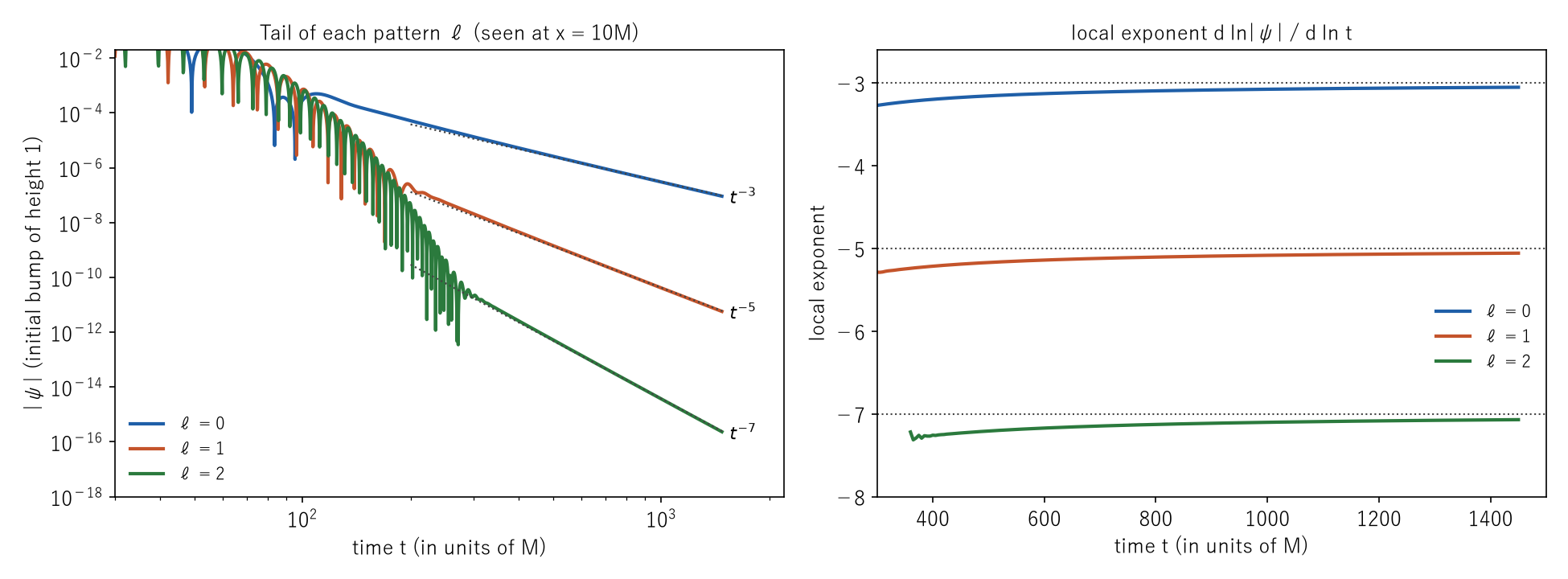
What happens to the numbers of patterns other than the remaining two? We solved the massless scalar field around a Schwarzschild black hole ($M=1$), pattern by pattern, as
$$\psi_{,tt}-\psi_{,xx}+V\psi=0,\qquad V=\Bigl(1-\frac{2M}{r}\Bigr)\Bigl(\frac{\ell(\ell+1)}{r^2}+\frac{2M}{r^3}\Bigr)$$(with $x=r+2M\ln(r/2M-1)$). On a grid of light-ray coordinates $u=t-x$ and $v=t+x$ we used the diamond difference scheme (the form of Gundlach, Price and Pullin 1994), placed a smooth bump $(1-s^2)^8$ ($s=(v-20)/10$, 0 outside the bump) on the line $u=0$, and set the line $v=0$ to 0 (no initially static multipole). Looking at $x=10$, we solved with two grid spacings, 0.2 and 0.1, holding the values as sums of two doubles (double-double precision). The two sets of values agree within a relative $1.13\times10^{-3}$ from $t=300$ to 1475 for all of $\ell=0$, 1 and 2. The local power $d\ln|\psi|/d\ln t$ was taken from the difference between the two points $t\pm25$, and was fitted to $n(t)=n_\infty+c/t$ (and $+d/t^2$) from $t=500$ to 1450 for all three patterns (the table is for spacing 0.1; with spacing 0.2 the value up to $c/t+d/t^2$ for $\ell=2$ is $-7.0002$, and the others are the same).
| pattern | expected power | fitted power ($t=500$ to 1450) | $|\psi|$ at $t=500$ |
|---|---|---|---|
| $\ell=0$ | $-3$ | $-3.0004$ (up to $c/t+d/t^2$), $-2.9970$ (up to $c/t$) | $2.603\times10^{-6}$ |
| $\ell=1$ | $-5$ | $-5.0003$ (up to $c/t+d/t^2$), $-4.9976$ (up to $c/t$) | $1.429\times10^{-9}$ |
| $\ell=2$ | $-7$ | $-7.0003$ (up to $c/t+d/t^2$), $-6.9974$ (up to $c/t$) | $5.183\times10^{-13}$ |
The field of pattern $\ell$ fades as $t^{-(2\ell+3)}$ (Price 1972, when there is no initially static multipole). Higher patterns vanish faster, and the size at $t=500$ drops by about 3 orders of magnitude each time $\ell$ goes up by one (Figure 1). The local powers of all three patterns approach from the steeper side ($-3.1980$, $-5.2148$, $-7.2572$ at $t=400$ and $-3.0511$, $-5.0561$, $-7.0689$ at $t=1475$). Holding the values in plain double precision, $\ell=2$ stays on a floor of order $10^{-14}$ (the root mean square of $|\psi|$ from $t=850$ to 1000 is $7.2\times10^{-15}$ and $7.8\times10^{-15}$), and the two grids no longer agree. In double-double precision the two grids agree within $3.89\times10^{-4}$ at the same $t=1000$, where $\psi$ is $3.655\times10^{-15}$. The floor is rounding error.
For comparison, using the same scheme in flat space ($M=0$, $V=\ell(\ell+1)/r^2$, $\psi=0$ at the centre; the bump centred at $v=40$), the field of $\ell=1$ stays at $|\psi|$ below $7.54\times10^{-19}$ from $t=100$ to 500 after the bump has passed $x=10$ (double-double precision; below $1.69\times10^{-14}$, the size of rounding, in double precision), leaving no tail. Around the black hole, $\ell=1$ is $7.233\times10^{-4}$, $2.061\times10^{-8}$ and $1.429\times10^{-9}$ at $t=100$, 300 and 500. Paper 1111 showed numerically that in three dimensions a spherical wave arrives without changing its shape. The tail around a black hole is explained as coming from the field scattering off the curved spacetime (Price 1972).
For the scalar field every pattern fades, including $\ell=0$; a black hole has no scalar hair either. Price (1972) showed that perturbations of gravity itself fade with powers of the same form, but this is not computed here. For gravity, the numbers of $\ell=0$ and $\ell=1$ (mass and angular momentum) remain as the conserved quantities of the previous section, and the rest of the free part fades, so the outside can be read as settling to the Kerr sequence fixed by $M$ and $J$ (with $M$ and $J$ smaller than at the start by what the waves carried away).
5. The Newtonian image: one point placed at an imaginary height
In Newtonian gravity the potential of a point of mass $M$ placed at height $z_0$ on the axis is $-M/|\mathbf x-z_0\hat{\mathbf z}|$, and its number for pattern $\ell$ is $Mz_0^\ell$. Placing it at the imaginary height $z_0=ia$ gives $M(ia)^\ell$, the same sequence as Kerr. With $a=0.6$, splitting $-M/\sqrt{x^2+y^2+(z-ia)^2}$ into patterns on spheres of radius 1.2 and 1.8, the numbers for $\ell\le8$ agreed with $M(ia)^\ell$, in both real and imaginary parts, within $3.36\times10^{-13}$ and $9.70\times10^{-12}$. Only the sequences of multipole numbers are compared; the Kerr metric is not read as a Newtonian field.
The real part $-M \mathrm{Re} [1/\sqrt{\rho^2+(z-ia)^2}]$ has a jump in the $z$ component of its field across the disc of radius $a$ ($\rho<a$, $z=0$). The density of the disc obtained from the jump is
$$\sigma=-\frac{Ma}{2\pi(a^2-\rho^2)^{3/2}},$$which agreed with the formula within a relative $1.19\times10^{-9}$ at $\rho=0$, 0.3 and 0.54. The density is negative, $-M/(2\pi a^2)$ at the centre ($-0.442097$ for $a=0.6$), and grows without bound towards the rim. Cutting the disc at radius $\rho_0=a(1-\varepsilon)$ and placing the remaining mass on a ring at the rim, the ring weighs $M/\sqrt{2\varepsilon-\varepsilon^2}$ (symbolic integration): 7.088812, 70.712446 and 707.106958 for $\varepsilon=10^{-2}$, $10^{-4}$ and $10^{-6}$. $M_2$ approaches the Kerr value $-0.36$ as $-0.30921575$, $-0.35490896$, $-0.35949088$, and $M_4$ approaches 0.1296 as 0.10235841, 0.12685102, 0.12932508 (the deviation of $M_2$ is $Ma\sqrt{a^2-\rho_0^2}$, going to 0 in proportion to $\sqrt\varepsilon$). The image is the sum of a disc of negative density and a positive ring of unboundedly large mass. The view placing a disc of radius $a$ as the source of the Kerr solution is in Israel (1970), and the singularity of the Kerr metric also lies on a ring of radius $a$ in Kerr–Schild coordinates. This paper does not say that this disc is the inside of a black hole.
Compare with the focal disc of Paper 1116. The disc reached by shrinking a uniform ellipsoid within its confocal family has positive density proportional to $\sqrt{1-q^2}$ ($q$ is the distance that equals 1 at the rim of the disc), and it vanishes at the rim. The disc giving the Kerr sequence has negative density growing without bound at the rim, with the ring at the rim carrying the rest. Both are flat images keeping the outside sequence of numbers, but the former is shrunk from an interior and the latter is worked back from the sequence of numbers.
6. Ordinary bodies can choose the sequence
We compare the shape of the sequence of numbers per pattern through ratios divided by the mass and the quadrupole. From the mass multipoles $M_\ell=\int\rho r^\ell P_\ell(\cos\theta) dV$ of a body symmetric about its axis we form
$$h_4=\frac{M_4M_0}{M_2^2},\qquad h_6=\frac{M_6M_0^2}{M_2^3},$$which for Kerr are $h_4=h_6=1$ whatever $a$ is. For the uniform spheroids the interior was split into fine points and added up directly (Gaussian quadrature).
| body | $M_2$ (mass 1) | $h_4$ | $h_6$ |
|---|---|---|---|
| Kerr ($a=0.6$) | $-0.360000$ | 1.000000 | 1.000000 |
| thin ring (radius 1) | $-0.5$ | 1.500000 | 2.500000 |
| uniform spheroid $(2,2,1)$, $(3,3,1)$, $(1,1,2)$ | $-0.6$, $-1.6$, $0.6$ | 2.142857 | 5.952381 |
| two rings (on the sphere of radius 1, $\cos\theta=\pm1/\sqrt{17}$) | $-0.411765$ | 1.000000 | $-0.119534$ |
| skin of positive density at radius $2a$ ($a=0.6$) | $-0.360000$ | 1.000000 | 1.000000 |
The ratios of uniform spheroids are $15/7$ and $125/21$ whether flattened or elongated, independent of the shape. A thin ring gives 1.5 and 2.5. Placing two rings on the sphere of radius 1 at $\cos\theta=\pm1/\sqrt{17}$, $h_4$ is exactly 1, so they imitate Kerr up to $\ell=4$ while keeping the flattened orientation ($M_2=-7/17<0$), but $h_6$ is $-41/343$ ($-0.119534$) and they split.
The whole mass sequence can also be imitated (Bonga and Yang 2021). Painting a spherical skin of radius $R$ with density
$$\sigma(\theta)=\frac{M}{4\pi R^2}\,\mathrm{Re}\,\frac{1-t^2}{(1-2t\cos\theta+t^2)^{3/2}},\qquad t=\frac{ia}{R},$$the outside numbers per pattern become the Kerr mass sequence $\mathrm{Re} M(ia)^\ell$ (sweeping by the generating function of the Poisson kernel, $\sum_\ell(2\ell+1)t^\ell P_\ell(\mu)=(1-t^2)/(1-2t\mu+t^2)^{3/2}$). Splitting the skin finely and adding up $\ell\le10$, it agreed with the Kerr sequence within $6.13\times10^{-15}$ at radius $2a$. Divided by $M/(4\pi R^2)$, the density is largest at the equator, $(1+b^2)/(1-b^2)^{3/2}$, and decreases towards the poles, where it is $(1-3b^2)/(1+b^2)^2$ (with $b=a/R$; it decreases monotonically towards the poles when the radius is larger than about $1.376a$). At radii $1.5a$, $\sqrt3a$, $2a$ and $3a$ the poles give $-0.159763$, 0, 0.160000 and 0.540000 and the equator 3.488266, 2.449490, 1.924501 and 1.325825. Since the density at the poles is 0 at $b=1/\sqrt3$, the bound beyond which the density is positive everywhere is $\sqrt3a$ (also $1.73205081a$ by bisection), the same as the bound $a/R\le0.57735$ of Bonga and Yang (2021) (Figure 2).
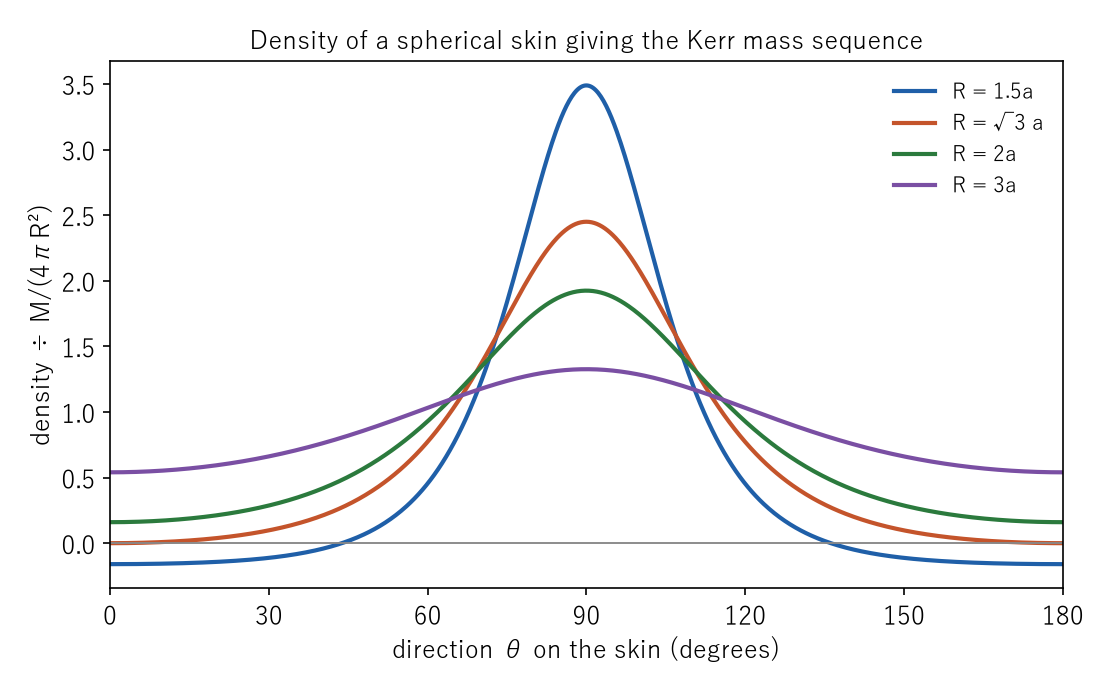
In Newtonian gravity a skin of positive density with radius larger than $\sqrt3a$ gives exactly the same mass sequence as Kerr (the current sequence was not compared here; that it can also be matched by rotating the skin at differing speeds is in Bonga and Yang 2021). The same name tag can be worn by a skin of positive density as well; a name tag does not fix the interior to one (Paper 1107). The shape of the sequence is not a mark of a black hole. What differs for a black hole is that it cannot choose the sequence: however it was formed, the outside can only be this sequence.
7. The quadrupole divided by the square of the spin
The quadrupole divided by the square of the spin, $q=-M_2M/J^2$ (times $c^2$ in SI), is 1 for Kerr whatever $a$ is (checked for $a=0.1$, 0.6 and 0.99). For ordinary bodies $q$ is not fixed to one value. For the Earth, from $J_2=1.0826298213\times10^{-3}$ of Paper 1038 ($M_2=-J_2MR^2$), the angular momentum $J=5.84571\times10^{33}$ kg m$^2$/s of Paper 169, $GM=3.986004418\times10^{14}$ m$^3$/s$^2$ and the equatorial radius 6378137 m, one gets $q=4.1314\times10^9$. The dimensionless spin of the Earth, $cJ/(GM^2)$, is 736.2; for a black hole it would be at most 1.
For a uniform rotating Newtonian fluid (a Maclaurin spheroid), $q$ multiplied by the compactness $GM/(Rc^2)$ (with $R$ the equatorial radius) depends only on the eccentricity, and was 3.124997991, 3.124799106, 3.104900278 and 2.943300913 for eccentricities 0.001, 0.01, 0.1 and 0.3 (computed with 50 digits). Expanded symbolically, $q GM/(Rc^2)=25/8-(225/112)e^2+\cdots$ (with $e$ the eccentricity); the difference from $25/8$ divided by $e^2$ is 2.0089287 at eccentricity 0.001. In the slowly rotating limit $q=(25/8)Rc^2/(GM)$, so the smaller the compactness, the larger $q$. A uniform ball of the Earth’s size and mass would give $4.4941\times10^9$, and the real Earth’s $q$ is 0.919287 times that. For neutron stars, which are much more compact, $q$ is reported to be several times larger than 1 (Laarakkers and Poisson 1999; not checked here). Since the Newtonian formula cannot be used in strong gravity, we do not say that this trend reaches 1 when extended to large compactness.
8. The two numbers readable from outside, and the area of the horizon
The area of the horizon is also fixed by the two numbers readable from outside. Taking the larger root of $\Delta=r^2-2Mr+a^2=0$ as the horizon radius $r_+$ and integrating $\sqrt{g_{\theta\theta}g_{\phi\phi}}$ of the metric over the horizon, the area agreed with $4\pi(r_+^2+a^2)$ within a relative $2.69\times10^{-14}$. For $M=1$ and $a=0$, 0.6 and 0.99, $r_+$ is 2, 1.8 and 1.141067, the area 50.265482, 45.238934 and 28.678151, and the entropy, a quarter of it (Bekenstein 1973, Hawking 1975; $\hbar=k_B=1$), 12.566371, 11.309734 and 7.169538. The value 12.566371 for $a=0$ is the same as the number ($4\pi M^2$) of Paper 1093. For a non-rotating black hole of the mass of the Sun ($GM=1.3271244\times10^{20}$ m$^3$/s$^2$), $S/k_B=4\pi GM^2/(\hbar c)=1.0489\times10^{77}$.
Paper 73 anchored the quarter as a composite of the solid angle $4\pi$ and the $2\pi$ of temperature, and Paper 1093 showed numerically that in three dimensions the entropy is the same number as the area of the horizon’s cross-sectional disc. Neither enters what the entropy counts, and neither does this paper. The numbers readable from outside are two, and the area is a function of those two, yet the quantity counted by the area is of order $10^{77}$. The shape in which few numbers can be read from outside while the quantity counted by the area of the boundary is large is the same shape as the argument that information is written on the boundary (holography), but this paper does not enter it.
9. Shared or distinct roots
Using the criterion of Paper 300, we separate the quantities of this paper.
(1) The focal disc of Paper 1116 and the disc giving the Kerr sequence: both are flat images keeping the outside sequence of numbers, but the former has positive density, from shrinking a uniform interior confocally, and the latter has negative density with a ring at its rim, worked back from the sequence of numbers. Their roots are distinct.
(2) The two remaining numbers (mass and angular momentum) and the numbers of the other patterns: the former are conserved quantities written as surface integrals on a skin, with the same value at any radius. The latter are fixed for Kerr by the former as a geometric sequence, and their free part fades with a tail. The reason for remaining (conservation) and the reason the others are fixed (the uniqueness theorems) have distinct roots.
(3) The number of numbers readable from outside and the quantity counted by the area of the horizon: the area is a function of the two numbers, but its size is unrelated to how many numbers can be read from outside. Their roots are distinct.
(4) One number per pattern in Paper 1107 and the two numbers of this paper: the former is fixed by the order of the field equation and is the count when the interior can choose the numbers. The latter comes from the vacuum solutions with a horizon being limited to one. Their roots are distinct.
10. The separator
The separator is whether the sequence of outside numbers is chosen by the interior or fixed to one by the horizon. For ordinary bodies the numbers per pattern can be chosen by rearranging the interior: two rings give the same mass sequence as Kerr up to $\ell=4$, and a skin of positive density with radius larger than $\sqrt3a$ gives it for every pattern. For a black hole, as long as it is stationary and rotating in vacuum, the outside sequence is only $M(ia)^\ell$, the fields of the other patterns fade with a tail, and the two remaining numbers are read as conserved quantities on a skin.
Closing
A black hole can be read as a module that squeezes its outside numbers to the two numbers mass and angular momentum. The numbers on the axis computed from the Kerr metric form a geometric sequence multiplied by −a² each time the pattern goes up by two, the same sequence as that of one point placed at the imaginary height ia. The two remaining numbers read the same as surface integrals on a skin of any radius, and the fields of the other patterns faded inversely as the (2ℓ+3)th power of time (checked for a scalar field). Ordinary bodies can also choose the mass sequence, and a skin of positive density with radius larger than √3a imitates it for every pattern (the current sequence too can be matched by choosing how fast the skin rotates: Bonga and Yang 2021), so the shape of the sequence is not a mark of a black hole. What differs is that a black hole cannot choose its sequence.
References
- Bekenstein, J. D. (1973). Black holes and entropy. Physical Review D.
- Bonga, B., and Yang, H. (2021). Mimicking Kerr’s multipole moments. Physical Review D. arXiv:2106.08342.
- Carter, B. (1971). Axisymmetric black hole has only two degrees of freedom. Physical Review Letters.
- Ernst, F. J. (1968). New formulation of the axially symmetric gravitational field problem. Physical Review.
- Fodor, G., Hoenselaers, C., and Perjés, Z. (1989). Multipole moments of axisymmetric systems in relativity. Journal of Mathematical Physics.
- Geroch, R. (1970). Multipole moments. II. Curved space. Journal of Mathematical Physics.
- Gundlach, C., Price, R. H., and Pullin, J. (1994). Late-time behavior of stellar collapse and explosions. I. Linearized perturbations. Physical Review D.
- Hansen, R. O. (1974). Multipole moments of stationary space-times. Journal of Mathematical Physics.
- Hawking, S. W. (1975). Particle creation by black holes. Communications in Mathematical Physics.
- Israel, W. (1967). Event horizons in static vacuum space-times. Physical Review.
- Israel, W. (1970). Source of the Kerr metric. Physical Review D.
- Kerr, R. P. (1963). Gravitational field of a spinning mass as an example of algebraically special metrics. Physical Review Letters.
- Komar, A. (1959). Covariant conservation laws in general relativity. Physical Review.
- Laarakkers, W. G., and Poisson, E. (1999). Quadrupole moments of rotating neutron stars. The Astrophysical Journal.
- Newman, E. T., and Janis, A. I. (1965). Note on the Kerr spinning-particle metric. Journal of Mathematical Physics.
- Price, R. H. (1972). Nonspherical perturbations of relativistic gravitational collapse. I. Scalar and gravitational perturbations. Physical Review D.
- Robinson, D. C. (1975). Uniqueness of the Kerr black hole. Physical Review Letters.
- Ruffini, R., and Wheeler, J. A. (1971). Introducing the black hole. Physics Today.
- Yamagishi, Y. (2026). The Uniqueness Theorem of $n = 2$ for Spherically Symmetric Density Distributions [Paper 01]. YOI: https://www.yamagishiyuuki.com/yoi/1; DOI: 10.5281/zenodo.21403186
- Yamagishi, Y. (2026). The “$1/4$” in Black-Hole Entropy [Paper 73]. YOI: https://www.yamagishiyuuki.com/yoi/73; DOI: 10.5281/zenodo.21666086
- Yamagishi, Y. (2026). The Two Noethers [Paper 107]. YOI: https://www.yamagishiyuuki.com/yoi/107; DOI: 10.5281/zenodo.21837205
- Yamagishi, Y. (2026). Modules Are Not Walls but Limits [Paper 113]. YOI: https://www.yamagishiyuuki.com/yoi/113; DOI: 10.5281/zenodo.21962996
- Yamagishi, Y. (2026). Sciama’s Famous Coincidence Is an Identity [Paper 169]. YOI: https://www.yamagishiyuuki.com/yoi/169; DOI: 10.5281/zenodo.22093563
- Yamagishi, Y. (2026). The Three Hundredth Census: Whether Two Things Share a Root Is Decidable [Paper 300]. YOI: https://www.yamagishiyuuki.com/yoi/300; DOI: 10.5281/zenodo.22171914
- Yamagishi, Y. (2026). Extractable Energy from a Rotating Black Hole Starts to Grow as the Square of the Spin and Reaches at Most 0.292893 of the Mass [Paper 887]. YOI: https://www.yamagishiyuuki.com/yoi/887
- Yamagishi, Y. (2026). The Geoid Is the Surface on Which Clocks Run at the Same Rate [Paper 1038]. YOI: https://www.yamagishiyuuki.com/yoi/1038; DOI: 10.5281/zenodo.22860780
- Yamagishi, Y. (2026). In Three Dimensions the Entropy of a Black Hole Is the Same Number as the Area of the Horizon’s Cross-Sectional Disk, and the Shadow Disk in the Photographs Is 27/4 Times Larger [Paper 1093]. YOI: https://www.yamagishiyuuki.com/yoi/1093
- Yamagishi, Y. (2026). When the Field Equation Is of Second Order, the Interior Can Be Read from Outside a Closed Skin Only as One Number per Angular Pattern [Paper 1107]. YOI: https://www.yamagishiyuuki.com/yoi/1107
- Yamagishi, Y. (2026). The Inverse Square Hides the Interior from a Static Field and Carries the Echo of a Wave Undistorted [Paper 1111]. YOI: https://www.yamagishiyuuki.com/yoi/1111
- Yamagishi, Y. (2026). m = 4π Is the Mass of a Skin of Radius 1 at Density 1, and the 1/r² Ball Is That Skin Puffed Out Evenly [Paper 1114]. YOI: https://www.yamagishiyuuki.com/yoi/1114
- Yamagishi, Y. (2026). A Uniform Ellipsoid Pulls from Outside Like a Flat Focal Disc, and a Sphere Pulling Like a Point Is the Case in Which That Disc Shrinks to One Point [Paper 1116]. YOI: https://www.yamagishiyuuki.com/yoi/1116
Reference
Yamagishi, Y. (2026). A Black Hole Is a Module That Squeezes Its Outside Numbers to Two, and Its Numbers for the Angular Patterns Follow from Mass and Spin as a Geometric Sequence [Paper 1124]. YOI: https://www.yamagishiyuuki.com/yoi/1124
ORCID: 0009-0006-8587-3450
PDF (English) · PDF (Japanese) · Date proof of the English PDF (OpenTimestamps .ots) · SHA256SUMS
The record page for this paper (in Japanese, with the PDFs in each language and the date proof): YOI 1124. This paper is a preprint and has not been peer reviewed.