Abstract
The motion of an ideal fluid without viscosity can be written as the straightest path (a geodesic) in the set of deformations that preserve area (volume in three dimensions). Arnold showed that the curvature of this set is negative in most directions and argued that, since nearby paths part under negative curvature, weather forecasting has a limit. This paper counts the curvature in a two-dimensional periodic box and measures separately whether the curvature is negative and whether nearby flows actually part exponentially. It claims no new theorem and no new law.
First, the curvature was measured in two ways. The curvature formula and the value read off from how nearby flows part, obtained by actually solving the Euler equations, agreed within relative differences from 5.59e-06 to 5.20e-05 for three pairs.
Second, the curvature is mostly negative. All 2000 randomly chosen planes were negative, and none of 1128 pairs of single waves was positive. Among 4000 pairs of flows made of two waves, exactly one positive plane was found (0.661408).
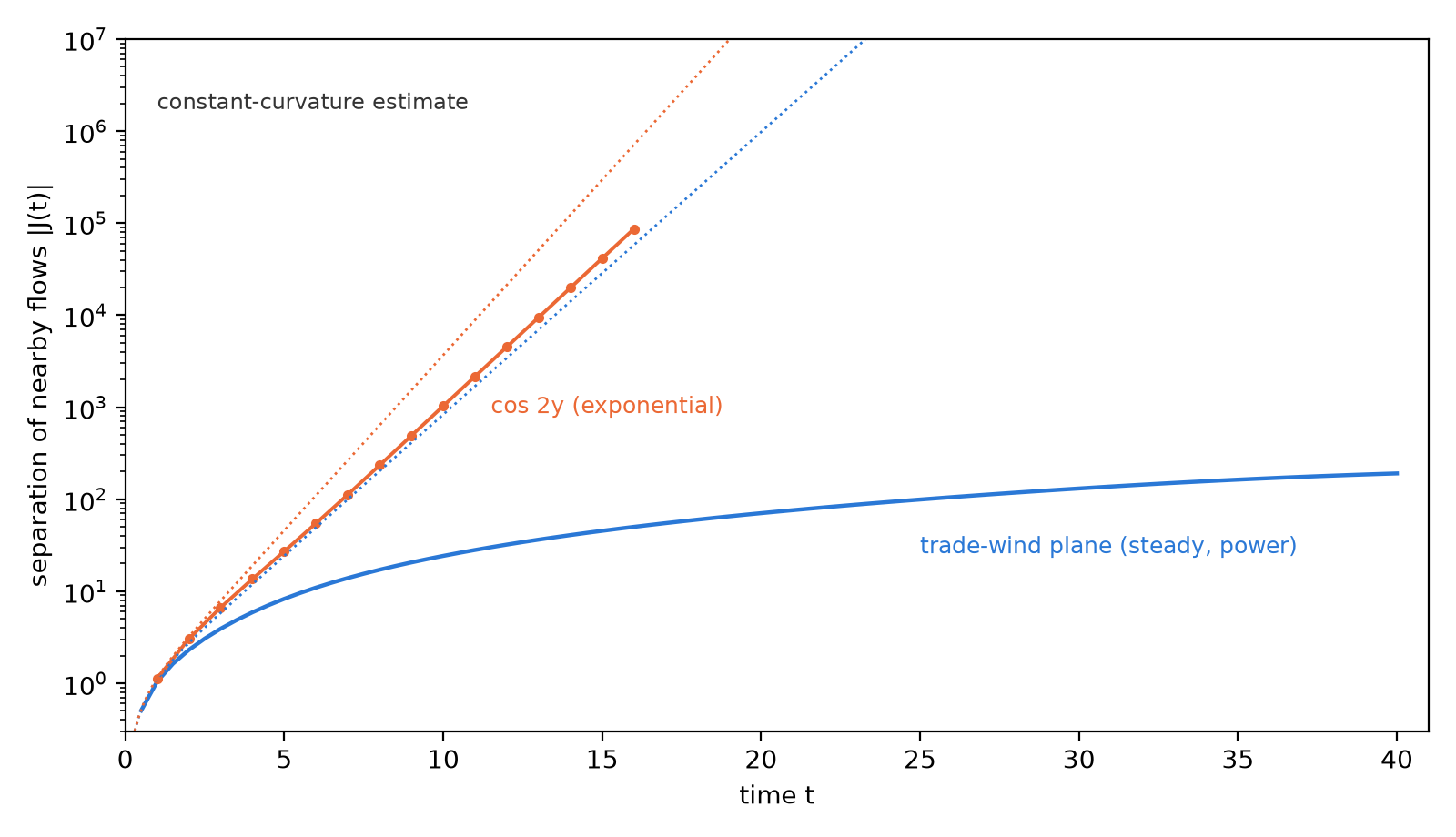
Third, and this is the core of the paper, negative curvature does not by itself make flows part exponentially. The plane of the trade wind (the shear flow cos y) and a shear flow perpendicular to it has curvature -1/2, and with constant curvature the separation would grow exponentially at rate 0.707107. But the two flows are exactly steady, and nearby flows parted only as powers of t from 1.1444 to 1.5515, reaching 190.6485 at t=40 (the exponential estimate is 1.3589e+12).
Fourth, as a control, the shear flow cos 2y parts exponentially. The rate of parting was 0.739423, matching the eigenvalue 0.738924436 of the linearized equations. The estimate from the curvature was 0.877207, of the same size as the 0.707107 of the trade wind, which does not grow.
To be candid, the clean form followed by the curvature of the trade wind against a single wave was found by fitting, and it has not been checked whether it is the same as the formula in the literature. No values for the atmosphere are used, and Arnold’s estimate for forecasting is not quoted.
Keywords: ideal fluid, Euler equations, geodesic, sectional curvature, trade wind, Jacobi field, predictability, linear stability.
Scope (what is not claimed)
No new theorem and no new law is claimed. That an ideal fluid moves along geodesics of the deformations that preserve area or volume, that their curvature is negative in most sections (Arnold, 1966), the analytic foundation (Ebin and Marsden, 1970), the discussion of the stability of flows and curvature (Misiołek, 1993) and the overall account (Arnold and Khesin, 1998) are all known. The curvature formula is not proved. It is computed with the Gauss equation for the curvature of a curved surface inside a flat space, and checked against how nearby flows part when the Euler equations are solved. No limit of weather forecasting is derived. No values for the atmosphere (the size of the Earth, wind speeds, the days in which errors double) are used, and Arnold’s estimate is not quoted. Turbulence and chaos are not entered. Only steady shear flows in a two-dimensional periodic box and their neighbourhood are treated. Viscosity and three dimensions are not treated. Flows on a sphere are also left out. The form of the curvature is not claimed to be new. The form followed by the curvature of the trade wind against a single wave was found by fitting, and it has not been checked against the formula in the literature. Relation to earlier papers: Paper 289 declared in its scope note that it would not speak of a single exponent, since the real atmosphere has different growth rates at different scales. This paper takes that seat of the scope note. It counts that the growth estimated from the geometry of the flow (the curvature) differs by direction (closer to 1 for smaller eddies) and is moreover separate from the actual growth. Paper 198 showed that a straight path need not be the shortest, and that nearby paths meet again at a conjugate point. Here the curvature is read off from the coefficient of the fourth power of time in the separation of the same nearby paths (a Jacobi field). What is added: the curvature formula matched against measured separations, the share of signs of the curvature counted for three ways of choosing, the curvature of the planes of the trade wind set out wave by wave, a steady flow with negative curvature that parts only as a power set beside a flow that parts exponentially, and a record of the error in measurement.
1. The Question and the Shape of the Answer
In an ideal fluid without viscosity, particles are carried by the flow. The list of where each particle starting at a given place has gone at time $t$ (the Lagrangian map) is a deformation that preserves the area of the box. The motion of the fluid follows, among the deformations that preserve area, the straightest path (a geodesic) when length is measured by the kinetic energy. This is what Arnold showed in 1966.
In a curved space, how nearby geodesics part is set by the curvature. With positive curvature nearby paths draw together; with negative curvature they part. Arnold showed that the curvature of this set is negative in most sections and argued from the parting of nearby flows that weather forecasting has a limit.
This paper counts the curvature in the two-dimensional periodic box $[0, 2\pi)^2$ and measures separately whether the curvature is negative and whether nearby flows actually part exponentially. The answer is that the sign of the curvature alone does not decide it; what separates the cases is whether the shape of the flow (its vorticity) is kept.
2. Measuring the Curvature in Two Ways
A flow is made from a stream function $\psi$ as $u = (\partial\psi/\partial y, -\partial\psi/\partial x)$. Lengths are measured by the average over the box, $\langle u, v\rangle$. The set of area-preserving deformations is a curved surface inside the set of all deformations (a flat space), so its curvature can be written with the Gauss equation:
$$\langle R(X,Y)Y, X\rangle = \langle Q\nabla_X X,\; Q\nabla_Y Y\rangle - \lvert Q\nabla_X Y\rvert^2,\qquad K(X,Y) = \frac{\langle R(X,Y)Y,X\rangle}{\lvert X\rvert^2\lvert Y\rvert^2 - \langle X,Y\rangle^2}$$where $\nabla_X Y = (X\cdot\nabla)Y$ and $Q$ projects a flow onto its gradient part.
Independently of this, the Euler equations were actually solved. With initial flows $X + \varepsilon Y$ and $X - \varepsilon Y$, the difference in where particles go, $J = (\varphi_+ - \varphi_-)/(2\varepsilon)$, is measured. The separation of nearby geodesics (a Jacobi field) grows as
$$\lvert J(t)\rvert^2 = t^2\lvert Y\rvert^2 - \tfrac{1}{3}\langle R(Y,X)X, Y\rangle\, t^4 + \cdots ,$$so the curvature can be read off from the coefficient of the fourth power of time.
| Pair | Curvature formula | From the separation | Relative difference |
|---|---|---|---|
| 1 | $-1.344103$ | $-1.344168$ | $4.79\times10^{-5}$ |
| 2 | $-1.603911$ | $-1.603902$ | $5.59\times10^{-6}$ |
| 3 | $-1.356819$ | $-1.356749$ | $5.20\times10^{-5}$ |
The two ways agreed within a relative difference of $5.20\times10^{-5}$. The flows are random combinations of waves of wavenumber at most 3; the grid is 48 points square and the particles 16 points square.
3. The Curvature Is Mostly Negative
| Choice | Pairs | Negative | Positive | Exactly 0 |
|---|---|---|---|---|
| Random flows (wavenumber at most 3) | 2000 | 2000 | 0 | 0 |
| Single waves (wavenumber at most 4) | 1128 | 1048 | 0 | 80 |
| Flows made of two waves | 4000 | 1 |
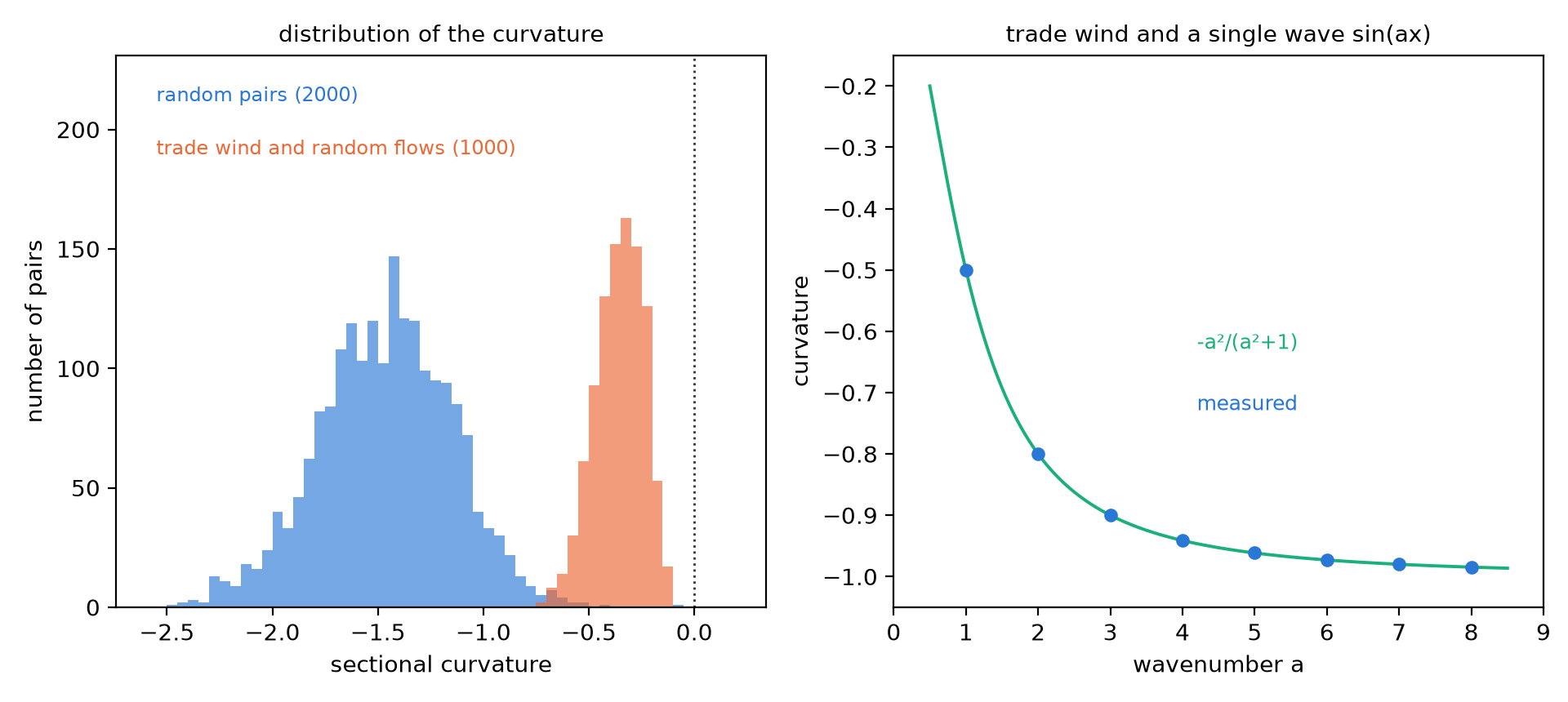
The pairs of random flows had minimum $-2.476692$, maximum $-0.061172$ and median $-1.449503$, all negative. Among single waves there was no positive plane either, and the minimum was $-8.000000$. Among 4000 pairs of flows made of two waves, one pair (a share of 0.0003) gave the positive curvature 0.661408. Positive planes exist, but they are rare, and depending on how one searches none may be seen at all.
4. The Planes of the Trade Wind
The trade wind is the shear flow $u = (\cos y, 0)$, blowing along $x$ with a strength that varies with $y$. It is the form of flow Arnold used in his argument on forecasting; here it is scaled to length 1. The curvature with 1000 random flows had maximum $-1.049\times10^{-1}$, minimum $-0.711855$ and median $-0.346827$, all negative. The plane with a shear flow depending only on $y$ was exactly 0.
The curvature of the plane with a single wave $\sin(ax + by)$ lined up as follows (the same values with $\cos$).
| $(a, b)$ | $(1,0)$ | $(1,1)$ | $(2,0)$ | $(2,1)$ | $(2,2)$ | $(3,0)$ | $(4,0)$ | $(6,0)$ | $(8,0)$ |
|---|---|---|---|---|---|---|---|---|---|
| Curvature | $-0.5$ | $-0.3$ | $-0.8$ | $-0.6$ | $-0.276923$ | $-0.9$ | $-0.941176$ | $-0.972973$ | $-0.984615$ |
These follow the form
$$K = -\frac{a^4}{2(a^2+b^2)}\left(\frac{1}{a^2+(b+1)^2} + \frac{1}{a^2+(b-1)^2}\right)$$for 110 waves within a difference of $1.33\times10^{-15}$. The form was found by fitting, and it has not been checked whether it is the same as the formula Arnold gave. For $b = 0$ it is $K = -a^2/(a^2+1)$, and the growth estimated from constant curvature, $\sqrt{-K} = a/\sqrt{a^2+1}$, is 0.707107 for $a = 1$, 0.894427 for 2, 0.970143 for 4 and 0.992278 for 8. The smaller the eddy, the larger the estimate, but it never exceeds 1.
5. Negative Curvature, but No Exponential Parting
The plane of the trade wind $X = (\cos y, 0)$ and the shear flow perpendicular to it, $Y = (0, -\cos x)$, has curvature exactly $-1/2$. With constant curvature, the separation of nearby paths would grow exponentially as $\sinh(\lambda t)/\lambda$ with $\lambda = \sqrt{-K} = 0.707107$.
But the stream function of $X + \varepsilon Y$ is $\sin y - \varepsilon c \sin x$; since the two waves have wavenumbers of the same size, the vorticity is proportional to the stream function and the flow is exactly steady. The largest value of the transport of vorticity $u\cdot\nabla\omega$ was $2.87\times10^{-12}$, the size of rounding, while for the unsteady control $\sin y + 0.3\sin 2x$ it was 1.800000. Because the flow is steady, only the particles need to be carried, and the parting of nearby flows can be measured to long times.
| Time $t$ | Measured $\lvert J(t)\rvert$ | Constant-curvature estimate |
|---|---|---|
| 1 | 1.0405 | $1.0854$ |
| 2 | 2.3001 | $2.7366$ |
| 5 | 8.2635 | $2.4243\times10^{1}$ |
| 10 | 24.2224 | $8.3255\times10^{2}$ |
| 20 | 70.5219 | $9.8025\times10^{5}$ |
| 40 | 190.6485 | $1.3589\times10^{12}$ |
The log-log slopes between neighbours were 1.1444, 1.3957, 1.5515, 1.5417 and 1.4348; the separation grew only as a power of $t$. At $t = 40$ the constant-curvature estimate exceeds the measured value by more than a factor of $10^{9}$. The curvature of this plane is negative, yet nearby flows do not part exponentially.
6. A Control: the Shear Flow cos 2y Parts Exponentially
To check that the measurement does not miss exponential growth, a flow that parts exponentially was measured. A small flow $\sin x + 0.3\cos(x + y)$ was added to the shear flow $u = (\cos 2y, 0)$ (scaled to length 1), the Euler equations were solved, and the parting of particles was measured.
| Flows | Curvature | Estimate from curvature | Actual growth |
|---|---|---|---|
| Trade wind $\cos y$ and $(0, -\cos x)$ | $-0.5$ | 0.707107 | power (slopes 1.1444 to 1.5515) |
| Shear flow $\cos 2y$ and a small flow | $-0.769492$ | 0.877207 | exponential (0.739423) |
For $\cos 2y$, $\lvert J\rvert$ grew at a nearly constant ratio: $1.3599\times10^{1}$ at $t = 4$, $2.3389\times10^{2}$ at 8, $4.5161\times10^{3}$ at 12 and $8.6750\times10^{4}$ at 16. The slope of $\log\lvert J\rvert$ from $t = 8$ to 16 is 0.739423.
This was checked another way, with the eigenvalues of the linearized Euler equations. Around $\cos 2y$, only perturbations with $x$ wavenumber 1 grow, at rate 0.738924436, matching the particle measurement ($x$ wavenumbers 2 and 3 give 0). Around the trade wind $\cos y$, $x$ wavenumbers 1, 2 and 3 all give 0, and no perturbation grows.
The estimate from the curvature was of the same size for the trade wind, which does not grow (0.707107), and for $\cos 2y$, which does (0.877207). What separated them was not the sign of the curvature but whether the shape of the flow (its vorticity) is kept. The trade wind, when nudged, only moves to another steady flow and keeps its shape; for $\cos 2y$ the perturbation grows and the shape breaks down.
7. Relation to Earlier Papers
Paper 289 declared in its scope note that the real atmosphere has different growth rates at different scales, with smaller eddies growing faster, and so did not speak of a single exponent. This paper takes that seat of the scope note and counted the growth estimated from the geometry of the flow. The estimate differs by direction, and for planes of the trade wind with a single wave it approaches 1 for smaller eddies. But the estimate is separate from the actual growth: planes with estimates of the same size grew only as a power in one case and exponentially in another.
Paper 198 showed that a straight path need not be the shortest, and that nearby paths meet again at a conjugate point. Here the curvature was read off from the coefficient of the fourth power of time in the separation of the same nearby paths (a Jacobi field).
One error in the measurement was corrected and is recorded here. For the check of steadiness, the largest transport of vorticity was set to be below $10^{-12}$ before measuring, and the check failed. The measured $2.87\times10^{-12}$ is the size of rounding in derivatives on the grid, and the check was changed to a comparison with an unsteady control.
Closing
Closing: the curvature of an ideal fluid is mostly negative, but that alone does not make nearby flows part exponentially. The curvature formula agreed with the separation found by solving the Euler equations within a relative difference of 5.20e-05. All 2000 random planes were negative, and a positive plane appeared only once among 4000 pairs made of two waves. The plane of the trade wind and a perpendicular shear flow has curvature -1/2, but the two flows are steady, and nearby flows parted only as powers of t from 1.1444 to 1.5515, reaching 190.6485 at t=40. The shear flow cos 2y parted exponentially at 0.739423, matching the eigenvalue 0.738924436. The estimate from the curvature was of the same size, 0.707107 for the plane that does not grow and 0.877207 for the one that does. To be candid, the form of the curvature of the trade wind against a single wave was found by fitting, and neither values for the atmosphere nor Arnold’s estimate are used. The separator is not the sign of the curvature but whether the shape of the flow is kept. If it is kept, flows part as a power; if it breaks, they part exponentially.
References
- Arnold, V. (1966). Sur la géométrie différentielle des groupes de Lie de dimension infinie et ses applications à l’hydrodynamique des fluides parfaits. Annales de l’Institut Fourier.
- Arnold, V. I., & Khesin, B. A. (1998). Topological Methods in Hydrodynamics. Springer.
- Ebin, D. G., & Marsden, J. (1970). Groups of Diffeomorphisms and the Motion of an Incompressible Fluid. Annals of Mathematics.
- Misiołek, G. (1993). Stability of Flows of Ideal Fluids and the Geometry of the Group of Diffeomorphisms. Indiana University Mathematics Journal.
- Yamagishi, Y. (2026). “Straight” Does Not Mean “Shortest”, and There Are Two Fences [Paper 198]. YOI: https://www.yamagishiyuuki.com/yoi/198; DOI: 10.5281/zenodo.22107954
- Yamagishi, Y. (2026). One Number Sets the Limit of Forecasting [Paper 289]. YOI: https://www.yamagishiyuuki.com/yoi/289; DOI: 10.5281/zenodo.22171367
Reference
Yamagishi, Y. (2026). The Curvature of an Ideal Fluid Is Mostly Negative, but That Alone Does Not Make Nearby Flows Part Exponentially [Paper 1079]. YOI: https://www.yamagishiyuuki.com/yoi/1079
ORCID: 0009-0006-8587-3450
PDF (English) · PDF (Japanese) · Date proof of the English PDF (OpenTimestamps .ots) · SHA256SUMS
The record page for this paper (in Japanese, with the PDFs in each language and the date proof): YOI 1079. This paper is a preprint and has not been peer reviewed.