Abstract
Paper 01 showed that in three dimensions the weight per shell is independent of the radius only for exponent 2, and Paper 08 read the same thing happening at exponent 3 in four dimensions. One step to the right of this diagonal, exponent = dimension - 1, an exponent equal to the dimension is the border where a summation stops converging (Paper 1094 on a two-dimensional map, Paper 1097 with three-dimensional dipoles). This paper counts what a sum over a lattice is made of on that border (the yellow diagonal of the map of inverse-square laws), from one to eight dimensions. No new theorem or law is claimed.
First, the sum splits into three parts. Summing, over the region obtained by enlarging a shape S by R, the weight of direction (the kernel) K divided by the d-th power of |n| at each lattice point n in d dimensions gives the integral of the kernel over directions times ln R, a remainder decided by the lattice alone, and a shape term. The shape term is the integral, weighted by the kernel, of the logarithm of the distance to the edge in each direction (Section 2).
Second, the face of the lattice remainder changes with the dimension. For the kernel 1, the remainder is 2γ = 1.154431 in one dimension (γ is Euler’s constant), π(2γ + 2ln2 + 3lnπ - 4lnΓ(1/4)) = 2.584982 from Kronecker’s limit formula in two, π²(2γ + (5/3)ln2 + lnπ - 12lnA) = 4.632326 in four (A is Glaisher’s constant), 16β′(3) + (π³/2)γ - πζ(3) = 5.677514 in six, and (π⁴/6)γ + 15ζ′(4) = 8.337340 in eight, where ln2 cancels exactly. In three, five and seven dimensions the values came only from the theta-function route (3.821924, 5.131696, 6.662093). The two routes differ by at most 9.5×10⁻³⁰, and agree with direct lattice sums to four digits or more, except in one dimension, which approaches as 1/R (Section 3).
Third, the shape enters as the geometric mean of the distance to the edge. For the kernel 1, summing over any shape is the same as summing over the ball whose radius is the geometric mean, over directions, of the distance to the edge (for large R). For a square this length is 2exp(-2G/π) = 1.116306 times the half side (G is Catalan’s constant), and for an ellipse it is the harmonic mean of the two radii. On the lattice, the difference between square and disc is 0.692372 at R = 3000 (formula 2π ln2 - 4G = 0.691310), and between an ellipse with radii 2 to 1 and the disc 1.807539 at R = 1000 (formula 1.807560). For the same volume the ball gives the largest sum (Jensen’s inequality) (Section 4).
Fourth, the shape does not know the lattice, and the lattice remainder does not know the shape. On a triangular lattice with the same area per point, the remainder changes to 2.518477 (2.584982 for the square lattice), but the difference between square and disc approaches the same formula, 0.691593 at R = 1000. In the remainder of the triangular lattice, Γ(1/3) appears in place of Γ(1/4) (Section 5).
Fifth, if the kernel averages to zero over directions, the logarithm disappears, and for dipoles the shape term becomes the depolarization factor. For the dipole kernel the lattice remainder also vanishes shell by shell, and the sum is only (full solid angle)×(1/d - D), with D the depolarization factor. For an ellipse in two dimensions this is π(a - b)/(a + b): for radii 2 to 1 the lattice sum is 1.047274 at R = 800 (formula π/3 = 1.047198). For seven spheroids in three dimensions the integral of the shape term and the formula differed by at most 4.8×10⁻⁸, and the 0, 4π/3 and -8π/3 of Paper 1097 come from this shape term alone (Section 6).
Sixth, the separator is whether the kernel averages to zero over directions, and whether the rotations of the lattice cancel the kernel shell by shell. The kernel cos4θ is not cancelled shell by shell on the square lattice and leaves the remainder Γ(1/4)⁸/(384π³) = 2.507655, while on the triangular lattice it is cancelled. For cos6θ it is the other way round: it leaves √3Γ(1/3)¹⁸/(2048π⁸) = 4.501541 on the triangular lattice. The two closed forms were found with an integer-relation tool (PSLQ) and agree with the theta-function values to more than 40 digits (they are not proved) (Section 7).
Keywords: lattice sum, Epstein zeta function, Kronecker limit formula, depolarization factor, geometric mean, uniqueness theorem, separator.
Scope (what is not claimed)
No new theorem or law is claimed. The Epstein zeta function and its continuation by theta functions, Kronecker’s limit formula, the formulas for the number of ways of writing a number as a sum of squares, the uniform field inside an ellipsoid and the depolarization factor, the Lorentz local field, and Jensen’s inequality are all standard. What this paper adds is lining them up on the yellow diagonal of the map of inverse-square laws (exponent = dimension), splitting the lattice sum into a logarithm, a lattice remainder and a shape term, and checking the numbers from one to eight dimensions with two lattices and four kernels. It does not show that three, five and seven dimensions have no closed form (it only says that the routes used here do not close). It does not connect the closing dimensions 1, 2, 4, 6, 8 with the 1, 2, 4, 8 of composition algebras. The formula splitting the sum into three parts is a continuum estimate checked against lattice numbers; how fast the error term goes to zero is not proved. The two closed forms found by PSLQ are not proved either. Lattices other than square, cubic and triangular, and applications to real materials, are not treated.
1. The question
With the ruler of Paper 01, when a density falls off as the $n$-th power of the distance, the weight of one shell of radius $R$ is proportional to $|S^{d-1}|R^{d-1}\cdot R^{-n}$ ($|S^{d-1}|$ is the full solid angle in $d$ dimensions, $4\pi$ in three). For $n=d-1$ every shell is the same and the sum grows in proportion to the radius ($n=2$ in three dimensions is Paper 01, $n=3$ in four dimensions is Paper 08, and the growth of the sum is Paper 496). For $n=d$ one shell contributes as $1/R$, and the sum keeps growing as $\ln R$. In one dimension this border is the harmonic series, and Paper 435 counted that the total of Zipf’s law is $\ln N+\gamma$ and is undetermined until $N$ is fixed. In two dimensions Paper 1094 counted the same border with market areas on a map, and in three dimensions Paper 1097 with a lattice sum of dipoles. In Paper 1097 the sum became 0, $4\pi/3$ or $-8\pi/3$ depending on the shape of the region summed over. Question: in any dimension, what is the sum on this border made of, and where do the shape and the lattice enter?
2. Splitting into three
To each point $n\neq0$ of the integer lattice $\mathbb{Z}^{d}$ attach a weight (kernel) $K(\hat n)$ that depends only on the direction $\hat n$. Describe a shape $S$, whose edge is crossed only once by each ray from the origin, by the distance $\rho_{S}(\Omega)$ to the edge in direction $\Omega$, and sum over the region $RS$ obtained by enlarging $S$ by $R$. Define the lattice remainder as the limit for cutting with balls,
$$F_{d}[K]=\lim_{R\to\infty}\left(\sum_{0<|n|\le R}\frac{K(\hat n)}{|n|^{d}}-\left(\int K\,d\Omega\right)\ln R\right).$$Replacing the part outside the ball of radius $r_{0}R$ ($r_{0}$ smaller than the minimum of $\rho_{S}$) by an integral with one point per unit volume leaves, in each direction $\Omega$, $\int_{r_{0}R}^{\rho_{S}R}r^{d-1}r^{-d} dr=\ln\rho_{S}-\ln r_{0}$. Together with the sum inside the ball this gives
$$\sum_{n\in RS,\ n\neq0}\frac{K(\hat n)}{|n|^{d}}=\left(\int K\,d\Omega\right)\ln R+F_{d}[K]+\int K(\Omega)\ln\rho_{S}(\Omega)\,d\Omega+o(1)$$(the term $o(1)$ goes to zero as $R\to\infty$; its speed is not proved, and is checked with lattice numbers). The first term is the logarithm due to the border, the second the remainder decided by the lattice alone, and the third the term decided by the shape alone.
In one dimension the directions are right and left, and summing from $-M$ to $N$ makes the shape term $\ln(N/R)+\ln(M/R)$.
| Kernel | Range | Lattice sum | Formula |
|---|---|---|---|
| $1/|n|$ (even) | $-1000$ to $2000$ | 15.663839 | $\ln(MN)+2\gamma=15.663089$ |
| $1/|n|$ (even) | $-10^{6}$ to $2\times10^{6}$ | 29.478600 | 29.478600 |
| $\mathrm{sign}(n)/|n|$ (odd) | $-1000$ to $2000$ | 0.692897 | $\ln(N/M)=0.693147$ |
| $\mathrm{sign}(n)/|n|$ (odd) | $-1000$ to $5000$ | 1.609038 | $\ln5=1.609438$ |
| $\mathrm{sign}(n)/|n|$ (odd) | $-10^{6}$ to $2\times10^{6}$ | 0.693147 | 0.693147 |
Observation 2.1 For the even kernel, the logarithm $2\ln R$, the remainder $2\gamma$ and the shape term $\ln(N/R)+\ln(M/R)$ add up to $\ln(MN)+2\gamma$. For the odd kernel the average over directions is zero, so both the logarithm and the remainder disappear and only the shape term $\ln N-\ln M$ is left. Paper 230 showed that subtracting the same divergence in three ways, $\ln L$, $\ln 2L$ and $\ln(L/2)$, leaves finite parts that differ by $\ln2$, and wrote in its scope note that it does not treat the removal of the divergence itself and shows only that the finite part left behind is not settled. This paper stands beside that seat: it chooses no prescription, and writes the difference between prescriptions (shapes of cutting) as one formula, the shape term. The odd-kernel sum 0.693147 for cutting left and right in the ratio 1 to 2 comes from the same mechanism as the $\ln2$ of Paper 230 (the ratio of the cuts of a logarithmically growing sum).
3. The lattice remainder: a face for each dimension
For the kernel 1, the remainder $F_{d}$ equals the constant term, after removing the pole at $s=d/2$, of the Epstein zeta function $Z_{d}(s)=\sum_{n\neq0}|n|^{-2s}$ (Epstein, 1903). The residue of the pole is half the full solid angle, $|S^{d-1}|/2$. It was computed along two routes.
Route 1 (theta function, any dimension): from $\theta(u)=\sum_{k\in\mathbb{Z}}e^{-\pi k^{2}u}$ and $\theta(1/u)=\sqrt u \theta(u)$,
$$\pi^{-s}\Gamma(s)Z_{d}(s)=\frac{1}{s-d/2}-\frac{1}{s}+\int_{1}^{\infty}\left(u^{s-1}+u^{d/2-s-1}\right)\left(\theta(u)^{d}-1\right)du .$$Route 2 (sums of squares, dimensions 1, 2, 4, 6, 8): in dimensions where the number $r_{d}(n)$ of ways of writing $n$ as a sum of $d$ squares is a divisor sum, $Z_{d}(s)=\sum r_{d}(n)n^{-s}$ is a product of the Riemann zeta $\zeta$ and Dirichlet’s beta $\beta$ (the sum whose sign follows the remainder mod 4); closed forms of such lattice sums are collected widely in Borwein et al., 2013.
$$Z_{1}=2\zeta(2s),\qquad Z_{2}=4\zeta(s)\beta(s),\qquad Z_{4}=8\left(1-4^{1-s}\right)\zeta(s)\zeta(s-1),$$ $$Z_{6}=16\zeta(s-2)\beta(s)-4\zeta(s)\beta(s-2),\qquad Z_{8}=16\left(1-2^{1-s}+4^{2-s}\right)\zeta(s)\zeta(s-3).$$| $d$ | Residue | Closed form | $F_{d}$ | Direct lattice sum |
|---|---|---|---|---|
| 1 | 1 | $2\gamma$ | 1.154431 | 1.155431 |
| 2 | $\pi$ | $\pi(2\gamma+2\ln2+3\ln\pi-4\ln\Gamma(1/4))$ | 2.584982 | 2.584938 |
| 3 | $2\pi$ | not closed on this route | 3.821924 | 3.821915 |
| 4 | $\pi^{2}$ | $\pi^{2}(2\gamma+(5/3)\ln2+\ln\pi-12\ln A)$ | 4.632326 | 4.632329 |
| 5 | 13.1595 | not closed on this route | 5.131696 | 5.131705 |
| 6 | 15.5031 | $16\beta'(3)+(\pi^{3}/2)\gamma-\pi\zeta(3)$ | 5.677514 | 5.677525 |
| 7 | 16.5367 | not closed on this route | 6.662093 | 6.662147 |
| 8 | 16.2348 | $(\pi^{4}/6)\gamma+15\zeta'(4)$ | 8.337340 | 8.337385 |
Observation 3.1 The two routes differ by at most $9.5\times10^{-30}$ (computed with 30 digits), and agree within $6.2\times10^{-15}$ with the numbers obtained by removing the pole in the formulas of route 2. The differences from direct lattice sums (up to $R^{2}=10^{6}$ for $d\le6$ and $R^{2}=2\times10^{5}$ in seven and eight dimensions) were $1.0\times10^{-3}$ in one dimension (approaching as $1/R$) and within $5.4\times10^{-5}$ otherwise.
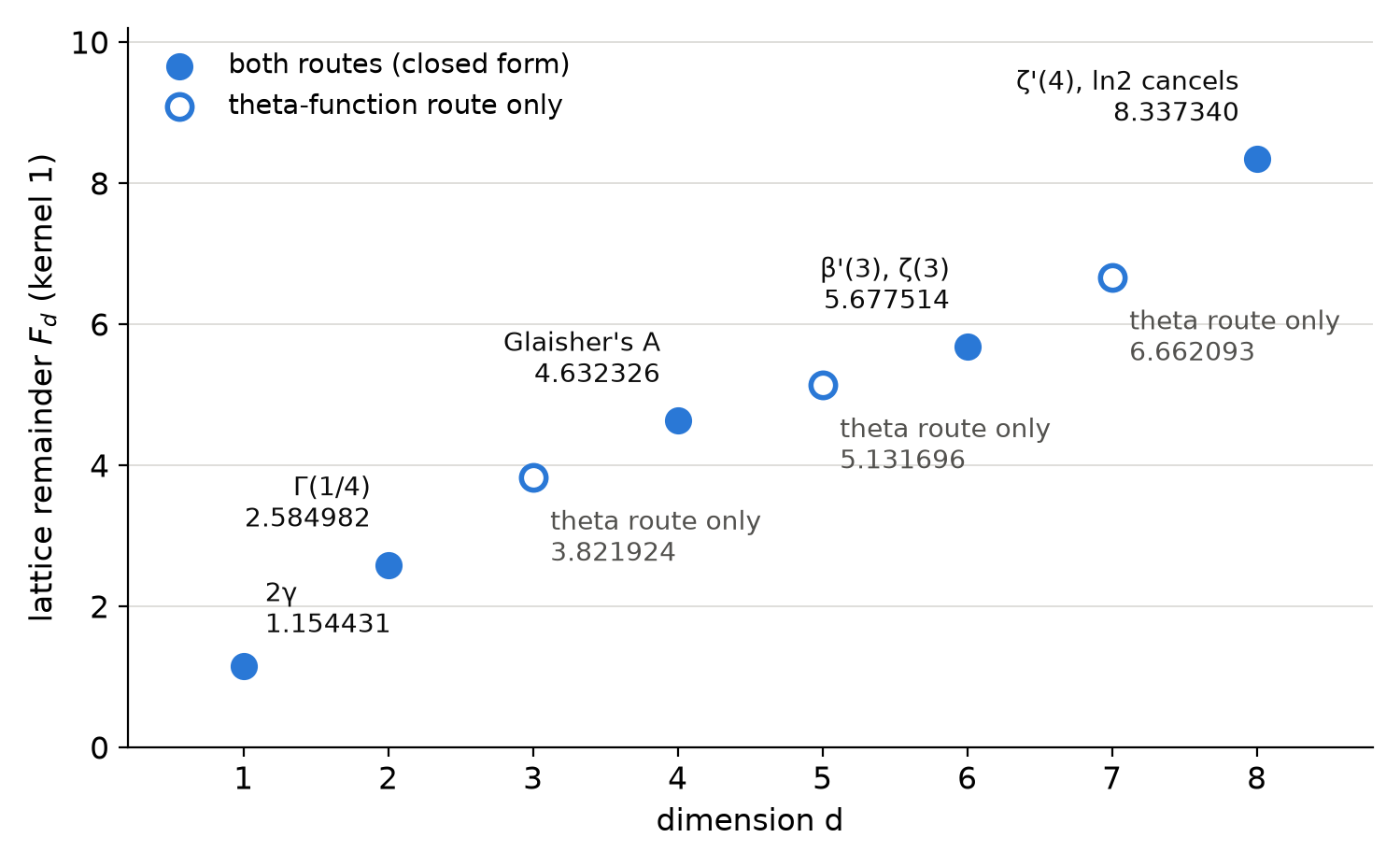
Observation 3.2 The face of the remainder changes with the dimension. One dimension has only Euler’s constant $\gamma=0.577216$. Two dimensions is Kronecker’s first limit formula $F_{2}=2\pi(\gamma-\ln2-\ln|\eta(i)|^{2})$, and $\Gamma(1/4)$ appears through Dedekind’s eta $\eta(i)=\Gamma(1/4)/(2\pi^{3/4})$. In four dimensions Glaisher’s constant $A=1.282427$ appears through $\zeta'(2)$. Six dimensions bring $\beta'(3)$ and $\zeta(3)$, and eight bring $\zeta'(4)$. In eight dimensions the $\ln2$ terms cancel exactly, since $2^{-3}\ln2-4^{-2}\ln4=0$. The formulas in two and six dimensions contain $\beta$, while those in four and eight are written with $\zeta$ alone.
Observation 3.3 In three, five and seven dimensions $r_{d}(n)$ has no divisor-sum formula, and route 2 does not close. The values come from the theta-function route. The value 3.821924 of the three dimensions we live in lies on the side that does not close on this route. Whether it closes along other routes was not checked.
Observation 3.4 The closing dimensions are 1, 2, 4, 6, 8, which differ from the 1, 2, 4, 8 of composition algebras (Paper 231) by the single 6. A similar sequence is not called the same root (Paper 300). What separated closing from not closing here is whether $r_{d}(n)$ can be written as a divisor sum.
4. The shape term: the geometric mean of the distance to the edge
For the kernel 1 the shape term can be written $\int\ln\rho_{S} d\Omega=|S^{d-1}|\ln\rho_{g}$, where $\rho_{g}$ is the geometric mean, over directions, of the distance to the edge. So summing over a shape $S$ is the same as summing over a ball of radius $\rho_{g}R$ (as $R\to\infty$).
Square (half side 1): $\int\ln\rho d\theta=-8\int_{0}^{\pi/4}\ln\cos\theta d\theta=2\pi\ln2-4G=$ 0.691310 ($G=0.915966$ is Catalan’s constant), and $\rho_{g}=2e^{-2G/\pi}=$ 1.116306.
Ellipse (radii $a$ and $b$): putting $A=1/a^{2}$ and $B=1/b^{2}$ into $\int_{0}^{2\pi}\ln(A\cos^{2}\theta+B\sin^{2}\theta) d\theta=4\pi\ln\frac{\sqrt A+\sqrt B}{2}$ gives $\int\ln\rho d\theta=2\pi\ln\frac{2ab}{a+b}$. The geometric mean of the distance to the edge of an ellipse is the harmonic mean $2ab/(a+b)$ of its two radii.
| Shape (square lattice) | $R$ | Difference of lattice sums (shape - disc) | Formula |
|---|---|---|---|
| Square | 300 | 0.702293 | 0.691310 |
| Square | 1000 | 0.694495 | 0.691310 |
| Square | 3000 | 0.692372 | 0.691310 |
| Ellipse (radii $2R$ and $R$) | 500 | 1.807527 | 1.807560 |
| Ellipse (radii $2R$ and $R$) | 1000 | 1.807539 | 1.807560 |
Observation 4.1 For square minus disc, the gap from the formula times $R$ is 3.295, 3.185, 3.187, nearly constant, so the difference approaches the formula as $1/R$. The ellipse formula agreed with numerical integration to nine digits (1.807560 for radii 2 and 1, 2.547612 for 3 and 1).
Cube (half side 1): mapping onto one face gives $\int\ln\rho d\Omega=6\int\!\!\int_{[-1,1]^{2}}\frac{\ln\sqrt{1+x^{2}+y^{2}}}{(1+x^{2}+y^{2})^{3/2}} dx dy=$ 2.416955. For the four-dimensional cube the same gives $8\int_{[-1,1]^{3}}\frac{\ln\sqrt{1+|y|^{2}}}{(1+|y|^{2})^{2}} d^{3}y=$ 5.099693.
| $R$ | Cube - ball | $R$ | 4D cube - ball |
|---|---|---|---|
| 60 | 2.524731 | 20 | 5.589745 |
| 100 | 2.480673 | 30 | 5.424159 |
| 150 | 2.458682 | 40 | 5.345824 |
| 200 | 2.448663 | 60 | 5.263607 |
| 300 | 2.437997 | 80 | 5.223013 |
| 400 | 2.432735 | ||
| Fit | 2.415853 to 2.417328 | Fit | 5.103686 |
| Formula | 2.416955 | Formula | 5.099693 |
Observation 4.2 In three dimensions, the gap from the formula times $R$ wanders between 6.259 and 6.467 while approaching. Fitting $c_{0}+c_{1}/R+c_{2}/R^{2}$ gave limits of 2.417328 with all six values of $R$ and 2.415853 with the largest four, bracketing the formula 2.416955 (differences $+0.000374$ and $-0.001102$). In four dimensions the fit gave 5.103686, a difference of 0.003993 from the formula.
| Shape (half side or radii 1 and 2) | Geometric-mean radius $\rho_{g}$ | Radius $r_{V}$ of the ball of equal volume | Ratio |
|---|---|---|---|
| Square | 1.116306 | 1.128379 | 0.989301 |
| Ellipse (radii 2 and 1) | 1.333333 | 1.414214 | 0.942809 |
| Cube | 1.212077 | 1.240701 | 0.976929 |
| Four-dimensional cube | 1.294796 | 1.341877 | 0.964915 |
Observation 4.3 (for the same volume the ball is largest): Since $\ln$ is concave, Jensen’s inequality gives
$$\frac{1}{|S^{d-1}|}\int\ln\rho\,d\Omega\le\frac{1}{d}\ln\left(\frac{1}{|S^{d-1}|}\int\rho^{d}\,d\Omega\right)=\ln r_{V},$$with equality only for the ball centred at the origin. For the same volume the sum over the ball is the largest, and every other shape gives strictly less. The square of area $\pi$ gave $\pi\ln\pi-4G=-0.067587$, the ellipse with radii 2 and 1/2 gave $-1.402052$, 3 and 1/3 gave $-3.209612$, the cube of volume $4\pi/3$ gave $-0.293317$, the elongated spheroid (radii 0.707107 and 2) gave $-1.561678$, and the flattened one (radii 1.414214 and 0.5) gave $-1.888329$. This is the intuition that taking the nearest points first gives the largest sum, written as a quantity.
Observation 4.4 Catalan’s constant $G$ appeared in Paper 627 in the number of domino tilings of a large board (the logarithm per square approaches $G/\pi$). Here it comes from the integral of $\ln\cos$ up to the corner angle $\pi/4$ of the square. The number is the same, but whether the root is the same was not checked (Paper 300).
5. The triangular lattice: the remainder changes, the shape does not
The same was done on a triangular lattice with area 1 per point (points $c(m+k/2, k\sqrt3/2)$ with $c^{2}=2/\sqrt3$). The remainder follows from Kronecker’s limit formula at $\tau=e^{i\pi/3}$ with $|\eta(e^{i\pi/3})|=3^{1/8}\Gamma(1/3)^{3/2}/(2\pi)=0.800579$:
$$F_{\triangle}=2\pi\left(\gamma+\frac{3}{2}\ln2-\frac{1}{2}\ln3+2\ln\pi-3\ln\Gamma(1/3)\right)=2.518477 .$$| Counted on the triangular lattice | $R$ | Lattice sum | Formula |
|---|---|---|---|
| Sum over the disc $- 2\pi\ln R$ | 1000 | 2.518480 | 2.518477 |
| Sum over the disc $- 2\pi\ln R$ | 2000 | 2.518486 | 2.518477 |
| Square - disc | 1000 | 0.691593 | 0.691310 |
| Square - disc | 2000 | 0.691895 | 0.691310 |
| Ellipse (radii $2R$ and $R$) - disc | 1000 | 1.807610 | 1.807560 |
| Dipole kernel over the ellipse ($2R$ and $R$) | 800 | 1.047173 | 1.047198 |
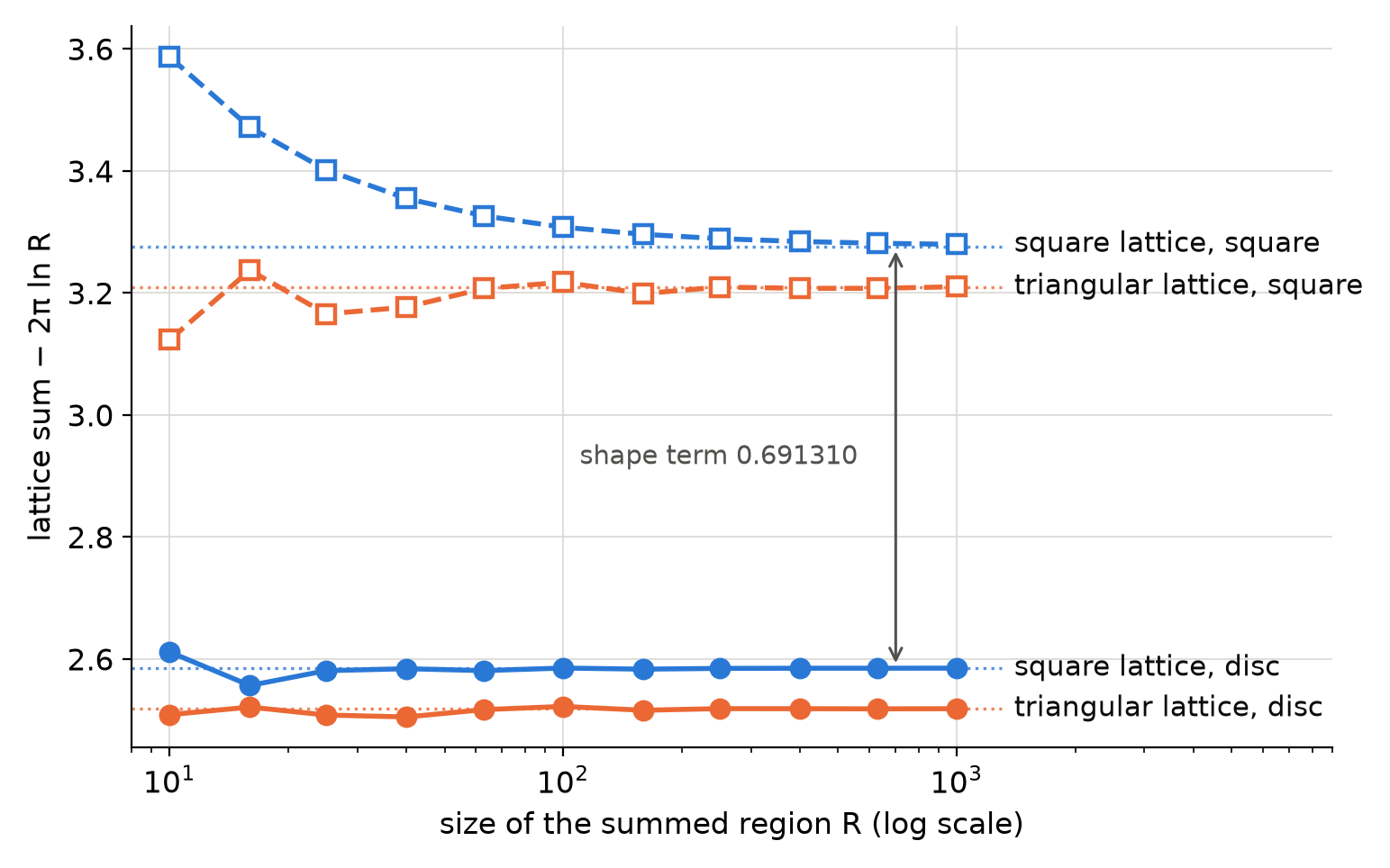
Observation 5.1 Changing the lattice moves the remainder from 2.584982 to 2.518477, by $-0.066504$, but the shape term approaches the same formula. The shape does not know the lattice, and the lattice remainder does not know the shape. The three terms do not mix. In two dimensions, $\Gamma(1/4)$ appears in the remainder of the square lattice and $\Gamma(1/3)$ in that of the triangular lattice.
6. Kernels that average to zero: for dipoles the shape term becomes the depolarization factor
If the kernel integrates to zero over directions, the logarithm of the first term disappears. For the dipole kernel $K=d\cos^{2}\theta-1$ ($\theta$ measured from one axis), swapping the coordinates of the lattice leaves the set of points unchanged, so each shell sums to zero and the remainder also vanishes (the sums over circular shells in two dimensions were 0 at radii 10 and 100, and $4.3\times10^{-19}$ at radius 299). The sum is the shape term alone.
The value of the shape term: the field inside a uniformly polarized ellipsoid is uniform and equals $-DP$ ($D$ is the depolarization factor; Osborn, 1945). The small ball around the origin gives $-P/d$ (the Lorentz local field), and integrating the rest of the region over $r$ in polar coordinates gives $\int(d\cos^{2}\theta-1)\ln\rho_{S} d\Omega/|S^{d-1}|$. Putting the two together,
$$\int(d\cos^{2}\theta-1)\ln\rho_{S}\,d\Omega=|S^{d-1}|\left(\frac{1}{d}-D\right),\qquad D=\frac{1}{d}-\frac{1}{|S^{d-1}|}\int(d\cos^{2}\theta-1)\ln\rho_{S}\,d\Omega .$$The depolarization factor is $1/d$ minus the average of the logarithm of the distance to the edge, weighted by the dipole kernel. This was checked numerically in two and three dimensions.
| Ellipse in 2D | Integral | $2\pi(1/2-D)$ | Lattice $R=400$ | Lattice $R=800$ |
|---|---|---|---|---|
| Radii 2 and 1 | 1.047198 | 1.047198 | 1.047500 | 1.047274 |
| Radii 3 and 1 | 1.570796 | 1.570796 | 1.571212 |
| $a$ | $c$ | $D$ | $\int(3\cos^{2}\theta-1)\ln\rho d\Omega$ | $4\pi(1/3-D)$ |
|---|---|---|---|---|
| 1 | 1 | 0.333333 | 0.000000 | 0.000000 |
| 1 | 2 | 0.173564 | 2.007721 | 2.007721 |
| 1 | 10 | 0.020286 | 3.933870 | 3.933870 |
| 1 | 30 | 0.003444 | 4.145509 | 4.145509 |
| 2 | 1 | 0.527200 | $-2.436204$ | $-2.436204$ |
| 10 | 1 | 0.860804 | $-6.628395$ | $-6.628395$ |
| 30 | 1 | 0.949778 | $-7.746475$ | $-7.746475$ |
Observation 6.1 For an elliptic cylinder in two dimensions $D=b/(a+b)$, so the shape term is $\pi(a-b)/(a+b)$: $\pi/3$ for radii 2 and 1, $\pi/2$ for 3 and 1. For seven spheroids in three dimensions (radii $a,a,c$), the integral and $4\pi(1/3-D)$ differed by at most $4.8\times10^{-8}$. The limits of the dipole sums that Paper 1097 counted on the lattice, 0 for the sphere, $4\pi/3=4.188790$ for a thin needle and $-8\pi/3=-8.377580$ for a thin plate, come from this shape term alone (the remainder is 0 on the cubic lattice).
7. The separator: the average of the kernel, and the rotations of the lattice
A kernel that averages to zero is not necessarily cancelled shell by shell. Consider the kernel $\cos k\theta$ in two dimensions. The square lattice, unchanged by a rotation of 90 degrees, cancels shell by shell the kernels with $k$ not a multiple of 4. The triangular lattice, unchanged by a rotation of 60 degrees, cancels shell by shell the kernels with $k$ not a multiple of 6.
| Disc radius $R$ | $\cos4\theta$, square | $\cos4\theta$, triangular | $\cos6\theta$, square | $\cos6\theta$, triangular |
|---|---|---|---|---|
| 250 | 2.507013 | 0.000000 | 0.000000 | 4.501501 |
| 500 | 2.507504 | 0.000000 | 0.000000 | 4.501371 |
| 1000 | 2.507566 | 0.000000 | 0.000000 | 4.501514 |
| 2000 | 2.507627 | 0.000000 | 0.000000 | 4.501540 |
Observation 7.1 The kernel $\cos4\theta$ is not cancelled shell by shell on the square lattice and leaves a remainder, while on the triangular lattice it gave 0 at every $R$. For $\cos6\theta$ it is the other way round. Both average to zero over directions, so neither has a logarithm. Computing with 45 digits along the theta-function route (with $P$ a harmonic polynomial of degree $k$, $Z_{P}(s)=\sum_{n\neq0}P(n)|n|^{-2s}$ obtained from $\int_{1}^{\infty}(t^{s-1}+t^{k-s})\Theta_{P}(t) dt$) gives 2.507655 for $\cos4\theta$ on the square lattice and 4.501541 for $\cos6\theta$ on the triangular lattice, and an integer-relation tool (PSLQ) found the following forms.
$$\sum_{n\in\mathbb{Z}^{2},\ n\neq0}\frac{\cos4\theta}{|n|^{2}}=\frac{\Gamma(1/4)^{8}}{384\pi^{3}}=\frac{\varpi^{4}}{6\pi},\qquad \sum_{n\in\Lambda_{\triangle},\ n\neq0}\frac{\cos6\theta}{|n|^{2}}=\frac{\sqrt3\,\Gamma(1/3)^{18}}{2048\pi^{8}}$$($\varpi=2.622058$ is the lemniscate constant and $\Lambda_{\triangle}$ the triangular lattice). The differences from the theta-function values were below $10^{-44}$ (no proof is given). The shape term enters by the same formula (square minus disc for $\cos4\theta$ is $-0.429204$ by the formula and $-0.429115$ on the square lattice at $R=1000$).
| Kernel | Average over directions | Shell by shell under rotations | Logarithm | Lattice remainder |
|---|---|---|---|---|
| 1 | full solid angle | not cancelled | yes | $F_{d}$ (a face per dimension) |
| Dipole | 0 | cancelled (square, cubic, triangular) | no | 0 |
| $\cos4\theta$ | 0 | square keeps it, triangular cancels it | no | square $\Gamma(1/4)^{8}/(384\pi^{3})$, triangular 0 |
| $\cos6\theta$ | 0 | square cancels it, triangular keeps it | no | square 0, triangular $\sqrt3 \Gamma(1/3)^{18}/(2048\pi^{8})$ |
Observation 7.2 There are two separators. Whether the kernel averages to zero decides whether there is a logarithm, and whether the rotations of the lattice cancel the kernel shell by shell decides whether there is a remainder. The shape term depends on neither and always enters. In two dimensions, the logarithm of $\Gamma$ appears in the remainder of a sum that grows logarithmically, and a power of $\Gamma$ in the remainder of a sum that does not grow.
8. What the checks showed
The difference between cube and ball in three dimensions was first extrapolated in the preliminary look from two radii, $R=60$ and 100, as $1/R$, and it disagreed with the formula in the third decimal place. Making the formula precise by mapping onto a face and extending $R$ to 400 showed that the gap from the formula times $R$ wanders between 6.259 and 6.467 and does not approach in a straight line (the cause of the wandering was not checked). So two sets of fits are given side by side, 2.415853 and 2.417328, which bracket the formula. Where the sums over circular shells were taken, a 0-divided-by-0 warning appeared once at the origin (the origin was already excluded from the sums, so no number changed). It was removed by replacing the denominator at the origin by 1. For the closed forms of $\cos4\theta$ and $\cos6\theta$, the value for $\cos4\theta$ on the square lattice was first matched to 40 digits by a guess from the lemniscate constant; PSLQ was then checked to find that form again, and only then used for $\cos6\theta$ on the triangular lattice.
Closing
Closing: on the yellow diagonal of the map of inverse-square laws (exponent = dimension), a sum over a lattice splits into three parts: the integral of the kernel over directions times ln R, a remainder decided by the lattice alone, and a term decided by the shape alone. The shape term is the mean logarithm of the distance to the edge; for the kernel 1 it makes summing over a shape the same as summing over the ball of the geometric-mean radius, and for the same volume the ball gives the largest sum. The lattice remainder changes its face with the dimension: 2γ in one dimension, the logarithm of Γ(1/4) in two, Glaisher’s constant in four, ln2 cancelling in eight, and values only along the theta-function route in three, five and seven. On the triangular lattice only the remainder changes; the shape term does not. For the dipole kernel only the shape term is left, and it is the depolarization factor, the origin of the 0, 4π/3 and -8π/3 of Paper 1097. The separator is whether the kernel averages to zero over directions, and whether the rotations of the lattice cancel the kernel shell by shell.
References
- Borwein, J. M., Glasser, M. L., McPhedran, R. C., Wan, J. G. & Zucker, I. J. (2013). Lattice Sums Then and Now. Cambridge University Press.
- Epstein, P. (1903). Zur Theorie allgemeiner Zetafunctionen. Mathematische Annalen.
- Osborn, J. A. (1945). Demagnetizing Factors of the General Ellipsoid. Physical Review.
- Yamagishi, Y. (2026). The Uniqueness Theorem of n = 2 for Spherically Symmetric Density Distributions [Paper 01]. YOI: https://www.yamagishiyuuki.com/yoi/1; DOI: 10.5281/zenodo.21403186
- Yamagishi, Y. (2026). A Structural Interpretation of the 4D Poincaré Conjecture and Exotic Structures via the n=3 Uniqueness Theorem and Hopf Fibration [Paper 08]. YOI: https://www.yamagishiyuuki.com/yoi/8; DOI: 10.5281/zenodo.21404419
- Yamagishi, Y. (2026). There Are Seven Minus Signs, and One of Them Undoes No Addition [Paper 230]. YOI: https://www.yamagishiyuuki.com/yoi/230; DOI: 10.5281/zenodo.22126779
- Yamagishi, Y. (2026). Every Doubling Costs the Product One Law [Paper 231]. YOI: https://www.yamagishiyuuki.com/yoi/231; DOI: 10.5281/zenodo.22126935
- Yamagishi, Y. (2026). The Three Hundredth Census: Whether Two Things Share a Root Is Decidable [Paper 300]. YOI: https://www.yamagishiyuuki.com/yoi/300; DOI: 10.5281/zenodo.22171914
- Yamagishi, Y. (2026). Constant at Every Rank, and the Total Is Still Undetermined [Paper 435]. YOI: https://www.yamagishiyuuki.com/yoi/435; DOI: 10.5281/zenodo.22709070
- Yamagishi, Y. (2026). The 4π Appears Twice, Cancels, and Then the Sum Diverges [Paper 496]. YOI: https://www.yamagishiyuuki.com/yoi/496; DOI: 10.5281/zenodo.22760174
- Yamagishi, Y. (2026). Whether an $8\times8$ Board Missing Two Squares Can Be Tiled by Dominoes Is Decided by Their Colours Alone [Paper 627]. YOI: https://www.yamagishiyuuki.com/yoi/627; DOI: 10.5281/zenodo.23014541
- Yamagishi, Y. (2026). The “Squared Distance” in Retail Gravity Models Is, on a Map, the Exponent at the Border Where the Total Number of Customers Stops Converging [Paper 1094]. YOI: https://www.yamagishiyuuki.com/yoi/1094
- Yamagishi, Y. (2026). A Lattice Sum of Dipole Fields Is Decided by the Shape of the Summation: 0 for a Sphere, 4π/3 for a Thin Needle, −8π/3 for a Thin Plate [Paper 1097]. YOI: https://www.yamagishiyuuki.com/yoi/1097
Reference
Yamagishi, Y. (2026). In a Lattice Sum Whose Exponent Equals the Dimension, Shape Enters as the Mean Logarithm of the Distance to the Edge [Paper 1098]. YOI: https://www.yamagishiyuuki.com/yoi/1098
ORCID: 0009-0006-8587-3450
PDF (English) · PDF (Japanese) · Date proof of the English PDF (OpenTimestamps .ots) · SHA256SUMS
The record page for this paper (in Japanese, with the PDFs in each language and the date proof): YOI 1098. This paper is a preprint and has not been peer reviewed.