Abstract
How much a closed curve bends is measured by its total curvature, the curvature added up once around. Fenchel (1929) showed that every closed curve in space bends at least 2π, and exactly 2π only when it is a flat convex curve. Fáry (1949) and Milnor (1950) showed that a knotted curve bends more than 4π. This paper counts what that 4π is. No new theorem or law is claimed.
First, the total curvature is π times the mean number of peaks and valleys of the height. Gathering the directions of the tangent gives one curve on the sphere, and its length is the total curvature. A great circle in a random direction meets this curve on average its length ÷ π times (Crofton’s formula on the sphere), and each meeting is a peak or a valley of the height seen from the direction perpendicular to that great circle. Counting with 100,000 directions, the trefoil has total curvature ÷ 4π = 1.418263 against π × mean ÷ 4π = 1.418400, and over eight curves in three dimensions the difference was below one part in ten thousand (Section 2).
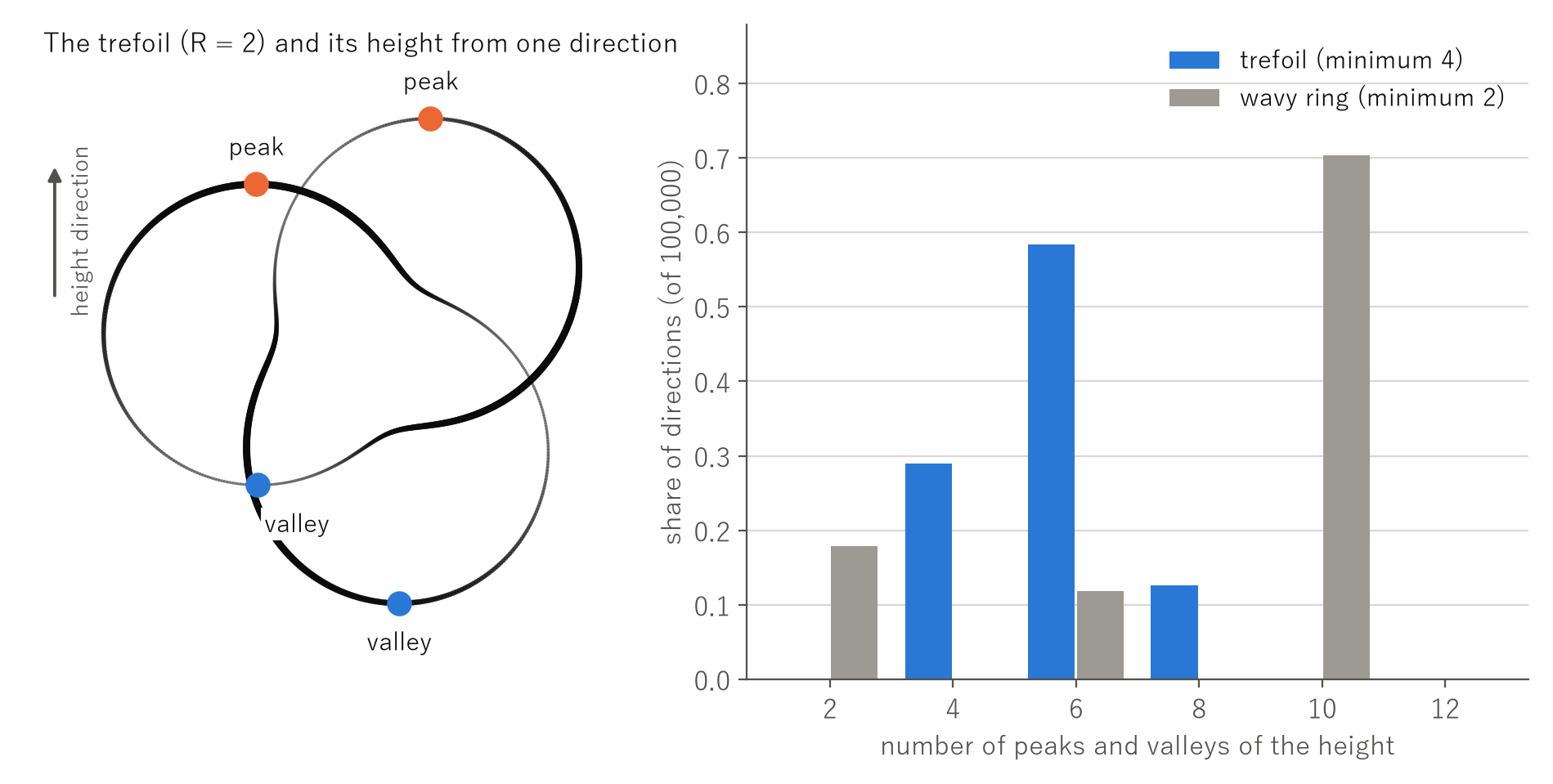
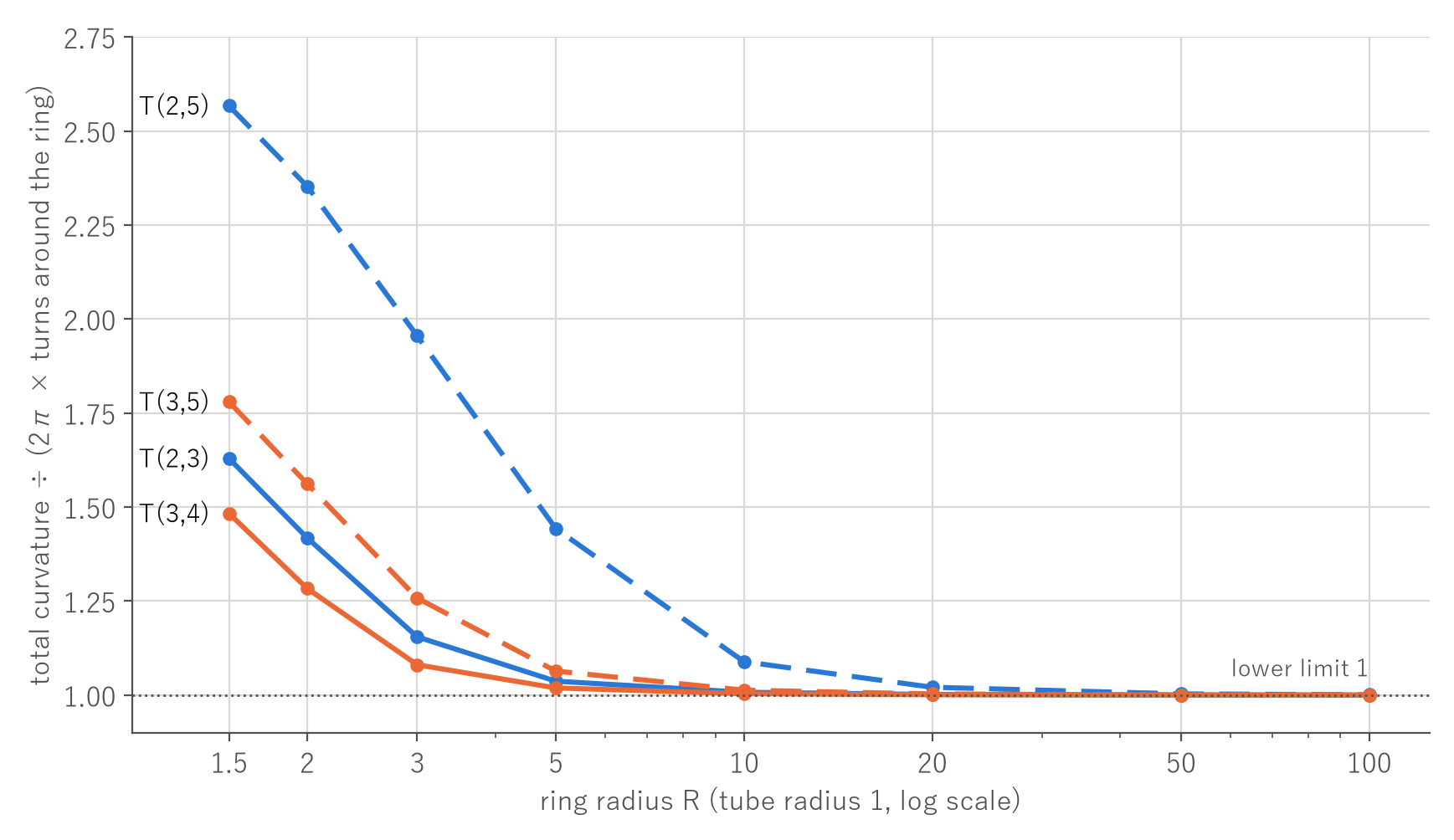
Second, a knot has at least four peaks and valleys from every direction. The minimum was 4 for the trefoil and 6 for the figure-eight knot. As the tube is made thinner relative to the ring, the total curvature approaches 2π × (the number of turns around the ring) from above; the trefoil at R = 50 is 1.000282 times 4π, and the curve drawn by the tangent approaches a curve going twice around the equator (Section 3).
Third, and this is the core of the paper. This 4π is not the area of the sphere but the length of two great circles. The π in total curvature = π × (mean number of peaks and valleys) stays π in two and in four dimensions (because the area of a sphere divided by 2π is the volume of the ball two dimensions lower; Paper 1083), while the solid angle changes as 2π, 4π, 2π². For a curve in four dimensions, total curvature ÷ π = 3.557777 against a mean of 3.553970 peaks and valleys (standard error 0.0034). It is none of the three 4π separated in Paper 60 (solid angle, topology, mass); it is a 4π of length (Section 4).
Fourth, the size of the total curvature is not a sign of a knot. An unknotted wavy ring bends 2.024555 times 4π, yet there is a direction with only two peaks and valleys. A flat limaçon (a curve with an inner loop) crosses itself, has four peaks and valleys from every direction and total curvature exactly 4π; lifting the crossing into space makes it an unknotted ring, and its total curvature falls to 0.984749 times 4π. The separator is whether, however the curve is placed, at least four peaks and valleys remain from every direction (Section 5).
Keywords: total curvature, knot, Fáry–Milnor theorem, Crofton formula, critical point, great circle, separator.
Scope (what is not claimed)
No new theorem or law is claimed. Fenchel’s theorem, the Fáry--Milnor theorem, Milnor’s formula for the total curvature, Crofton’s formula on the sphere, the relation between the area of a sphere and the volume of the ball two dimensions lower, and the fact that knots come undone in four dimensions (Paper 254) are all standard. What this paper adds is checking with numbers the formula that counts total curvature by peaks and valleys of the height, on eight curves in three dimensions and on curves in two and four dimensions, and showing, by moving the dimension, that the 4π of a knot is not the area of the sphere but the length of two great circles. It does not go into the classification of knots or the computation of bridge numbers (the minimum number of peaks and valleys is the value counted for the chosen placement and directions). It gives no method for deciding from the total curvature whether a curve is knotted. Curves whose curvature is not continuous (polygons) are not treated.
1. The question
Paper 1076 counted that a convex closed curve has at least four vertices because closing removes the first harmonic of its radius of curvature, and in its scope note it did not extend this to space curves or to higher dimensions. This paper sits in that seat (no earlier occupant: no published paper cites Paper 1076). How much a closed curve bends is measured by its total curvature $\int\kappa ds$, the curvature $\kappa$ added up once around. A circle bends $2\pi$. Fenchel (1929) showed that every closed curve in space bends at least $2\pi$, and exactly $2\pi$ only for a flat convex curve. Fáry (1949) and Milnor (1950) showed that a knotted curve bends more than $4\pi$. The question: what is this $4\pi$? Is it the same as the $4\pi$ of the solid angle that the corpus has met again and again? Paper 60 separated the $4\pi$ that appear in formulas into three: the solid angle (a fact), the $2\pi|\chi|$ of how a surface connects (a fact), and the choice of the unit of mass (a convention).
2. Counting total curvature by peaks and valleys of the height
Gathering the directions $T=\gamma'/|\gamma'|$ of the tangent of a curve $\gamma(t)$ gives a closed curve on the unit sphere (the tangent image). The tangent turns at the rate of the curvature, so the length of the tangent image equals the total curvature $\int\kappa ds$. The peaks and valleys (critical points) of the height $h_{u}(t)=u\cdot\gamma(t)$ seen from a direction $u$ are where $u\cdot\gamma'(t)=0$, that is, where the tangent lies on the great circle perpendicular to $u$. The number of peaks and valleys of the height is the number of times the tangent image meets that great circle.
A curve of length $L$ on the sphere meets a great circle in a random direction on average $L/\pi$ times (Crofton’s formula on the sphere; Santaló, 1976). Applying this to the tangent image, with $\overline{\mu}$ the mean number of critical points when $u$ is chosen uniformly,
$$\int\kappa\,ds=\pi\,\overline{\mu}$$(Milnor, 1950, wrote it as half the integral over the sphere of the number of maxima). Every curve is written as a sum of trigonometric functions; derivatives are taken by the fast Fourier transform and the total curvature by the periodic trapezoidal rule. The directions are 100,000 points spread almost uniformly over the sphere (a Fibonacci lattice). The torus knot $T(p,q)$ is $((R+\cos qt)\cos pt,(R+\cos qt)\sin pt,\sin qt)$ and the figure-eight knot is $((2+\cos2t)\cos3t,(2+\cos2t)\sin3t,\sin4t)$.
| Curve | Knotted | total curvature $\div4\pi$ | $\pi\overline{\mu}\div4\pi$ | min | max |
|---|---|---|---|---|---|
| circle | no | 0.500000 | 0.500000 | 2 | 2 |
| wavy ring $(\cos t,\sin t,0.6\sin5t)$ | no | 2.024555 | 2.024650 | 2 | 10 |
| lifted limaçon (Section 5) | no | 0.984749 | 0.984750 | 2 | 4 |
| trefoil $T(2,3)$, $R=2$ | yes | 1.418263 | 1.418400 | 4 | 8 |
| figure-eight knot | yes | 1.652586 | 1.652585 | 6 | 8 |
| $T(2,5)$, $R=2$ | yes | 2.353298 | 2.353355 | 8 | 12 |
| $T(2,5)$, $R=10$ | yes | 1.088901 | 1.088980 | 4 | 10 |
| $T(3,4)$, $R=2$ | yes | 1.925634 | 1.925655 | 6 | 10 |
Observation 2.1 For all eight curves, the total curvature and $\pi\overline{\mu}$ differ by less than one part in ten thousand (at most $9.69\times10^{-5}$). For the circle there are exactly two peaks and valleys from every direction, and the total curvature agrees with $2\pi$ within $10^{-10}$. The ellipse with radii 2 and 1 also gives $2\pi$; this is the equality case of Fenchel (flat and convex).
Observation 2.2 The height on a closed curve has a highest and a lowest point from every direction, so there are at least two peaks and valleys. By the formula the total curvature is at least $2\pi$; this is how Fenchel’s theorem is counted here.
3. A knot has at least four peaks and valleys from every direction
What Fáry and Milnor showed is that for a knotted curve the height has at least two peaks (maxima) from every direction, hence at least four peaks and valleys. By the formula the total curvature is at least $4\pi$, and in fact more than $4\pi$. In the table, the minimum is 4 for the trefoil and 6 for the figure-eight knot and $T(3,4)$.
Observation 3.1 The minimum depends on the placement. $T(2,5)$ has minimum 8 with the placement $R=2$, and 4 with $R=10$. Milnor showed that the lower limit of the total curvature, as the placement is changed to make it smaller, is $2\pi$ × (the least number of peaks over placements and directions). The minima in the table of this paper are values counted for the chosen placement and directions.
| Knot (divided by) | $R=1.5$ | 2 | 3 | 5 | 10 | 20 | 50 |
|---|---|---|---|---|---|---|---|
| $T(2,3)$ ($4\pi$) | 1.629347 | 1.418263 | 1.154925 | 1.037058 | 1.007584 | 1.001792 | 1.000282 |
| $T(2,5)$ ($4\pi$) | 2.566880 | 2.353298 | 1.955365 | 1.442780 | 1.088901 | 1.020916 | 1.003292 |
| $T(3,4)$ ($6\pi$) | 1.483185 | 1.283756 | 1.080741 | 1.019059 | 1.003777 | 1.000884 | 1.000139 |
| $T(3,5)$ ($6\pi$) | 1.779824 | 1.562336 | 1.258108 | 1.063864 | 1.013241 | 1.003142 | 1.000495 |
Observation 3.2 As the ring radius $R$ grows against the tube radius 1, the total curvature approaches $2\pi p$ ($p$ is the number of turns around the ring) from above. All four knots stayed above 1 for every $R$ and decreased with $R$. The trefoil at $R=50$ is 1.000282 times $4\pi$, and the largest distance of the tangent image from the equator (the largest $z$ component) is 0.030598. The tangent image approaches a curve going twice around the equator (a great circle).
4. This $4\pi$ is the length of two great circles
The $4\pi$ of a knot is the product of $\pi$ and the number 4 of peaks and valleys. In the language of the tangent image, it is the lower limit of the length of a curve that meets every great circle at least four times, which is the length of a great circle of length $2\pi$ traversed twice. It is not the $4\pi$ of the area of the sphere. This is checked by moving the dimension.
In $d$ dimensions the direction $u$ lies on the unit sphere $S^{d-1}$, and the peaks and valleys are where the tangent lies on the great sphere $S^{d-2}$ perpendicular to $u$. The coefficient of the formula is $|S^{d-1}|$ divided by the amount $2|B^{d-2}|$ swept when the great sphere turns by one radian. By the relation $|S^{d-1}|=2\pi|B^{d-2}|$ counted in Paper 1083 (the area of a sphere divided by $2\pi$ is the volume of the ball two dimensions lower; in three dimensions Archimedes’ hat-box theorem), this coefficient is $\pi$ in every dimension. The directions were 100,000 equally spaced points on the circle in two dimensions, and 200,000 normal random vectors scaled to length 1 (fixed seed) in four dimensions.
| Dimension | Curve | total curvature $\div\pi$ | mean peaks and valleys |
|---|---|---|---|
| 2 | ellipse (radii 2 and 1) | 2.000000 | 2.000000 |
| 2 | bean $r=1+0.6\cos2\theta$ | 3.615000 | 3.615040 |
| 2 | limaçon with inner loop $r=0.5+\cos\theta$ | 4.000000 | 4.000000 |
| 4 | $(\cos t,\sin t,0.4\cos2t,0.3\sin3t)$ | 3.557777 | 3.553970 |
| 4 | trefoil with a fourth coordinate $0.5\sin2t$ | 5.655111 | 5.659590 |
Observation 4.1 The coefficient of the formula stayed $\pi$ in two and in four dimensions (the two curves in four dimensions lie within 1.1 and 1.5 times their standard errors 0.0034 and 0.0029). The solid angle $|S^{d-1}|$ changes: $2\pi$ in two dimensions, $4\pi$ in three, $2\pi^{2}=$ 19.739209 in four. If the $4\pi$ of a knot were the solid angle, it would move with the dimension; it does not. In four dimensions knots come undone (Paper 254), so the $4\pi$ line has meaning only in three dimensions, while the form total curvature $=\pi\times$ (mean number of peaks and valleys) remains in every dimension.
| $d$ | swept amount $2|B^{d-2}|$ | Archimedes’ ratio $|S^{d-1}|/|B^{d-1}|$ |
|---|---|---|
| 2 | 2.000000000 | 3.141592654 |
| 3 | 4.000000000 | 4.000000000 |
| 4 | 6.283185307 | 4.712388980 |
| 5 | 8.377580410 | 5.333333333 |
| 6 | 9.869604401 | 5.890486225 |
Observation 4.2 Writing $\pi=4\pi\div4$ in three dimensions, $4\pi$ is the area of the sphere and 4 is the area swept when a great circle turns by one radian, $\int|\sin\phi| d\phi=$ 4.000000000. This 4 equals Archimedes’ 4 (area of the sphere ÷ the great disk; Paper 1093) only in three dimensions. In four dimensions the swept amount is $2\pi=$ 6.283185307 and Archimedes’ ratio is 4.712388980; they part. The same number appearing does not make them the same root (Paper 300).
Observation 4.3 The $4\pi$ of a knot is none of the three $4\pi$ of Paper 60 (solid angle, how a surface connects, the choice of the unit of mass); it is a length on the sphere, two great circles. It does not change when the dimension is moved, so its root is distinct from that of the solid angle.
5. The size of the total curvature is not a sign of a knot
The wavy ring $(\cos t,\sin t,0.6\sin5t)$ is unknotted, but its total curvature is 2.024555 times $4\pi$, larger than that of the knotted trefoil ($R=2$). Still, there is a direction with only two peaks and valleys (minimum 2).
The flat limaçon $r=0.5+\cos\theta$ passes through the origin at $\theta=2\pi/3$ and $4\pi/3$ and crosses itself there. It has four peaks and valleys from every direction in the plane, and its total curvature is exactly $4\pi$ (the two-dimensional table above). Paper 1076 counted that a limaçon closing after two turns has only two vertices. A curve of the same shape returns 2 for vertices and 4 for peaks and valleys of the height. Lifting the crossing into space by $0.2\sin\theta$ makes it an unknotted ring; its total curvature falls to 0.984749 times $4\pi$, and seen from straight above it has two peaks and valleys.
Observation 5.1 The separator is neither the size of the total curvature nor the minimum number of peaks and valleys in one placement; it is whether, however the curve is placed, at least four peaks and valleys remain from every direction. An unknotted ring can be brought to two by choosing the placement and the direction. A knot keeps at least four from every direction however it is placed (Fáry, 1949; Milnor, 1950).
6. Relation to earlier papers
Paper 316 showed that on a torus three counts (integrating the curvature, counting the zeros of a vector field, counting the passes of a function) return the same integer, and Paper 203 counted that the numbers of critical points move a great deal while only their alternating sum never moves. What this paper counts is the number of critical points of the height on a curve itself (not an alternating sum), averaged over directions. It moves with the shape and equals the total curvature divided by $\pi$. What does not move is the floor (2 for every closed curve, 4 for a knot). Paper 1073 showed that fixed points of maps keeping area and flux have the same floor as critical points of functions. The floor here is the 4 peaks and valleys of the height of a knot.
Paper 613 counted that the expected number of crossings of Buffon’s needle with parallel lines does not change when the needle is bent and depends only on its length. The formula here is the version of the same kind of fact on the sphere: the expected number of meetings of a curve on the sphere with great circles depends only on the length of the curve.
7. What the checks showed
In the preliminary survey I began to read that four peaks and valleys from every direction in the plane meant a knot. The flat limaçon broke that reading (it crosses itself, so it is not a knot). So I added the curve with the crossing lifted and confirmed that seen from straight above it has two peaks and valleys. $T(2,5)$ with $R=2$ had minimum 8 both in the preliminary survey (4,000 directions) and here (100,000). Why this placement does not reach 4 was not examined. The means in four dimensions were counted with random directions, so deviations of 1.1 and 1.5 standard errors remain.
Closing
Closing: the total curvature of a closed curve is the length of the curve the tangent draws on the sphere; it is π times the mean number of meetings with a great circle in a random direction, that is, π times the mean number of peaks and valleys of the height. Every closed curve has at least two peaks and valleys, so it bends at least 2π; a knot has at least four from every direction, so it bends more than 4π. This 4π is not the area of the sphere but the length of two great circles. Moving the dimension changes the solid angle as 2π, 4π, 2π², but the π of the formula does not change. The size of the total curvature is not a sign of a knot, and the separator is whether, however the curve is placed, at least four peaks and valleys remain from every direction.
References
- Fáry, I. (1949). Sur la courbure totale d’une courbe gauche faisant un nœud. Bulletin de la Société Mathématique de France.
- Fenchel, W. (1929). Über Krümmung und Windung geschlossener Raumkurven. Mathematische Annalen.
- Milnor, J. W. (1950). On the Total Curvature of Knots. Annals of Mathematics.
- Santaló, L. A. (1976). Integral Geometry and Geometric Probability. Addison-Wesley.
- Yamagishi, Y. (2026). $c$ as the Ball of Velocity Space [Paper 60]. YOI: https://www.yamagishiyuuki.com/yoi/60; DOI: 10.5281/zenodo.21598012
- Yamagishi, Y. (2026). The Counts of Critical Points Move a Great Deal, and Their Alternating Sum Never Moves at All [Paper 203]. YOI: https://www.yamagishiyuuki.com/yoi/203; DOI: 10.5281/zenodo.22109443
- Yamagishi, Y. (2026). That Knots Come Undone in Four Dimensions Is Not One Phenomenon [Paper 254]. YOI: https://www.yamagishiyuuki.com/yoi/254; DOI: 10.5281/zenodo.22162025
- Yamagishi, Y. (2026). The Three Hundredth Census: Whether Two Things Share a Root Is Decidable [Paper 300]. YOI: https://www.yamagishiyuuki.com/yoi/300; DOI: 10.5281/zenodo.22171914
- Yamagishi, Y. (2026). The Same Integer Comes Back from Three Different Counts [Paper 316]. YOI: https://www.yamagishiyuuki.com/yoi/316; DOI: 10.5281/zenodo.22208229
- Yamagishi, Y. (2026). The Expected Number of Crossings of Buffon’s Needle Does Not Change When the Needle Is Bent [Paper 613]. YOI: https://www.yamagishiyuuki.com/yoi/613; DOI: 10.5281/zenodo.23014478
- Yamagishi, Y. (2026). Fixed Points of Maps Keeping Area and Flux Have the Same Floor as Critical Points of Functions [Paper 1073]. YOI: https://www.yamagishiyuuki.com/yoi/1073
- Yamagishi, Y. (2026). A Convex Closed Curve Has at Least Four Vertices Because Closing Removes the First Harmonic of Its Radius of Curvature [Paper 1076]. YOI: https://www.yamagishiyuuki.com/yoi/1076
- Yamagishi, Y. (2026). Setting m = 4π Turns h/m into ħ/2, and Its 2 Has a Different Root from the 2 of the Uncertainty Bound [Paper 1083]. YOI: https://www.yamagishiyuuki.com/yoi/1083
- Yamagishi, Y. (2026). In Three Dimensions the Entropy of a Black Hole Is the Same Number as the Area of the Horizon’s Cross-Sectional Disk, and the Shadow Disk in the Photographs Is 27/4 Times Larger [Paper 1093]. YOI: https://www.yamagishiyuuki.com/yoi/1093
Reference
Yamagishi, Y. (2026). A Knot Bends More Than 4π, and That 4π Is the Length of Two Great Circles [Paper 1099]. YOI: https://www.yamagishiyuuki.com/yoi/1099
ORCID: 0009-0006-8587-3450
PDF (English) · PDF (Japanese) · Date proof of the English PDF (OpenTimestamps .ots) · SHA256SUMS
The record page for this paper (in Japanese, with the PDFs in each language and the date proof): YOI 1099. This paper is a preprint and has not been peer reviewed.