Abstract
Lit from random directions, a convex solid casts a shadow whose mean area is a quarter of its surface area (Cauchy, 1850). The mean length of a random line inside it (the chord) is 4V/S (V the volume, S the surface area). This paper counts, with one bundle of lines, what happens to these two when the solid is dented. It claims no new theorem and no new law.
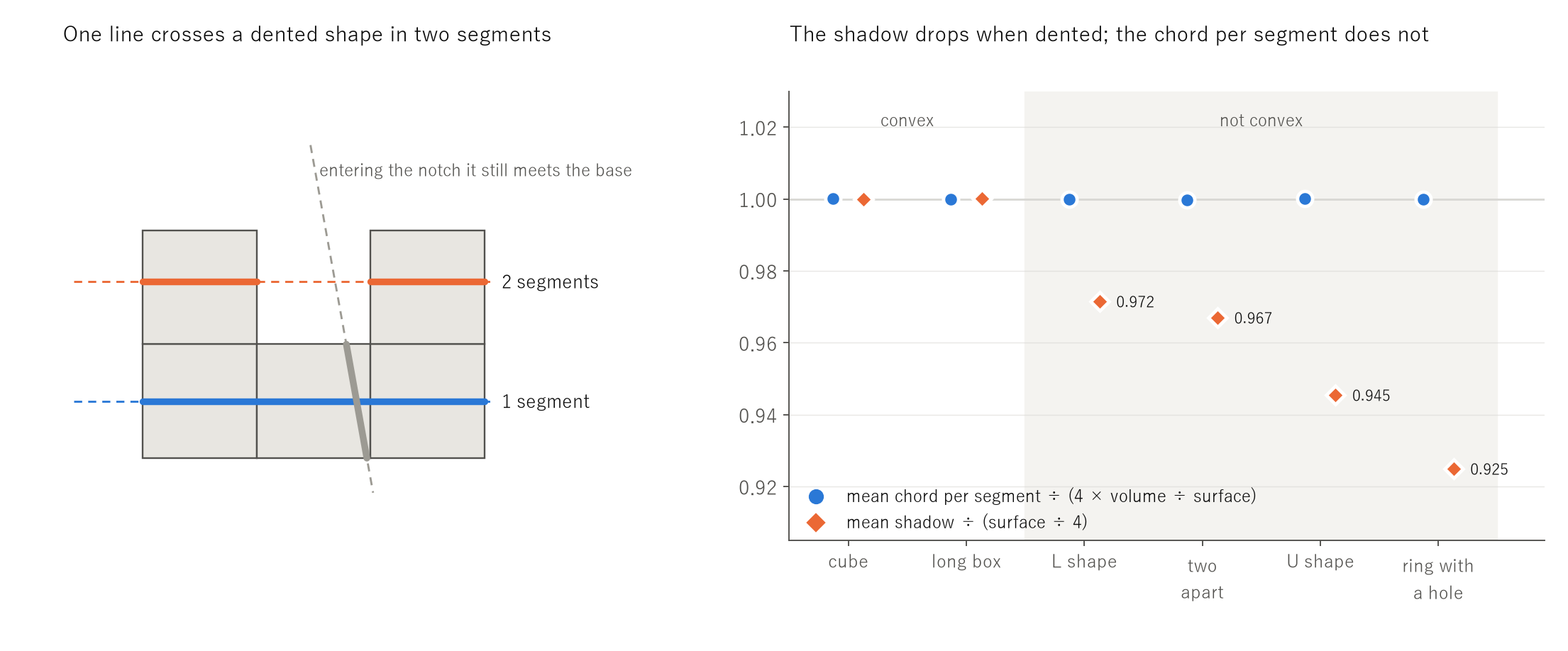
First, when dented, the mean shadow falls below a quarter of the surface. For four non-convex shapes made of unit cubes (L shape, two apart, U shape, ring with a hole), the mean shadow ÷ (surface ÷ 4) was 0.971535, 0.967007, 0.945467 and 0.924953. For the two convex boxes it is 0.999983 and 1.000167 (Section 3).
Second, and this is the core of the paper: the mean chord per entry stays 4V/S when dented. For all six shapes the mean chord per segment ÷ 4V/S stayed within 0.000215 of 1. The number of entries per line that hits is exactly the reciprocal of the shortfall of the shadow (1.029373, 1.034436, 1.057706, 1.081181), and their product stays within 0.000306 of 1. The shadow is counted per line and the chord per entry. For a convex body a line enters once, so the two counts agree; dented, they part (Section 3).
Third, in the plane the convex hull fixes the shadow of a connected shape; in space it does not. For the planar L shape and ring, the mean width ÷ (perimeter of the convex hull ÷ π) was 1.000004 and 1.000005. In space, even the connected L shape, U shape and ring give mean shadow ÷ (surface of the convex hull ÷ 4) of 0.943617, 0.945467 and 0.986617, below 1 (Section 4).
Fourth, the 4 of 4V/S is Archimedes’ ratio in every dimension. The coefficient of the mean chord equals the surface of the sphere divided by the area of its great disk from two to six dimensions (π in two, 4.712388980 in four). It equals the amount swept when a great circle turns by one radian (Paper 1099) only in three dimensions, where both are 4 (Section 5).
Fifth, the separator is whether one counts per line or per entry. Paper 277 used the 4V/S of the reverberation time in convex rooms and did not treat dented rooms. For a quantity counted per entry, the 4 remains in dented shapes too (Section 6).
Keywords: mean shadow, mean chord, Cauchy’s formula, convex hull, integral geometry, Archimedes’ ratio, separator.
Scope (what is not claimed)
No new theorem or law is claimed. That the mean shadow of a convex body is a quarter of its surface (Cauchy’s formula), that the mean chord of a convex body is 4V/S, and the general theory of integral geometry (Santaló, 1976) are standard. That the mean per entry stays 4V/S for dented shapes is taken as a known fact of the same family as the property that the mean path length of a diffusive random walk is fixed by the shape alone (Blanco and Fournier, 2003), and is not claimed as new. What this paper adds is counting the shadow and the chord with one bundle of lines, confirming by numbers that in dented shapes the shortfall of the shadow and the number of entries cancel exactly, and setting side by side the different roles of the convex hull in the plane and in space and the fact that the 4 is Archimedes’ ratio in every dimension. Cauchy’s formula is not proved. The shapes are limited to unit cubes and unit squares placed side by side; a smooth surface is used only for the self-check with the unit ball. The lines are chosen by Fibonacci points on the sphere and the disk; no random numbers are used. Acoustics (coupled rooms, absorption, bias in the directions of sound) is not entered. No general classification of non-convex shapes is attempted.
1. Question
Paper 277 confirmed that the 0.161 of the reverberation time contains the 4 of 4V/S and that this 4 is the ratio of solid angles $4\pi/\pi$, and in its scope note it did not prove Cauchy’s formula and, assuming a convex body, did not treat dented rooms or coupled rooms. This paper takes the seat of the dented shape (no earlier occupant: no earlier paper cites Paper 277). It does not take the seat of the exchange of sound between coupled rooms. Paper 613 counted that the expected number of crossings of a needle with parallel lines depends only on its length, and in its scope note it only mentioned the general theory of integral geometry. This paper places itself beside that seat.
Lit from a random direction $u$, the shadow of a convex solid $K$ (its projection on the plane perpendicular to $u$) has area $A(u)$ with mean
$$\langle A\rangle=\frac{S}{4}$$(Cauchy, 1850). The fraction of random lines hitting $K$ is proportional to $\langle A\rangle$, and the total length inside, summed over the lines that hit, is proportional to the volume $V$, so the mean length per line that hits (the mean chord) is $V/\langle A\rangle=4V/S$. Question: In a dented shape a line goes in and out several times. Which survives then, the $S/4$ of the shadow or the $4V/S$ of the chord?
2. Counting the shadow and the chord with one bundle of lines
A sphere was put around the shape, and 12 million lines were drawn with directions at 4000 nearly uniform points of the sphere (a Fibonacci lattice) and positions at 3000 nearly uniform points of the disk perpendicular to each direction. No random numbers were used. The fraction of lines that hit times the area of the disk is the mean shadow $\langle A\rangle$. The part of each line inside the shape was split into segments, one per entry and exit, and their lengths were measured (segments that touch were joined). As a self-check, the same bundle on the unit ball gives mean shadow ÷ π of 0.999867 and mean chord per segment ÷ (4/3) of 1.000132. There is more than one way to choose a random line. Paper 630 counted that the mean length of a random chord splits according to what is taken as uniform ($4/\pi$, $\pi/2$ and $4/3$ for a circle). The lines here take the direction and the position on the plane perpendicular to it as uniform, which gives mean chord $\pi/2$ for a circle (the same as the choice in Paper 630 that takes the distance from the centre as uniform).
| shape | $S$ | $V$ | $\langle A\rangle\div(S/4)$ | chord per segment $\div(4V/S)$ | segments per line |
|---|---|---|---|---|---|
| cube | 6 | 1 | 0.999983 | 1.000019 | 1.000000 |
| long box $1\times1\times4$ | 18 | 4 | 1.000167 | 0.999834 | 1.000000 |
| L shape (3 cubes) | 14 | 3 | 0.971535 | 0.999956 | 1.029373 |
| two cubes apart (gap 1) | 12 | 2 | 0.967007 | 0.999785 | 1.034436 |
| U shape (5 cubes) | 22 | 5 | 0.945467 | 1.000035 | 1.057706 |
| ring with a hole (8 cubes) | 32 | 8 | 0.924953 | 0.999970 | 1.081181 |
Observation 2.1 For the two convex boxes, the shadow matched a quarter of the surface and the chord matched 4V/S within 2 parts in 10,000. A line passes through once. The length per line that hits ÷ ($V/\langle A\rangle$) was within 1.000091 for all six shapes, and the volume check (recovering the volume from the total length) agreed to the same order.
3. Dented, the shadow shrinks and the chord per entry remains
Observation 3.1 When dented, the mean shadow falls below a quarter of the surface. For the four non-convex shapes the mean shadow ÷ (surface ÷ 4) was 0.971535 for the L shape, 0.967007 for the two apart, 0.945467 for the U shape and 0.924953 for the ring. Part of the surface lies in the shadow of another part.
Observation 3.2 This is the core of the paper. The mean chord per entry stays 4V/S when dented. For all six shapes the mean chord per segment ÷ 4V/S stayed within 0.000215 of 1. The numbers of segments per line that hits were 1.029373 for the L shape, 1.034436 for the two apart, 1.057706 for the U shape and 1.081181 for the ring; each equals the reciprocal of the shortfall of the shadow ($S/(4\langle A\rangle)$), and the product of the number of segments and the shadow ratio stayed within 0.000306 of 1 for all six.
Calculation 3.3: Setting the two counts side by side shows the cancellation. The length per line that hits is $V/\langle A\rangle$ whether convex or dented (the total length inside is fixed by the volume alone). The number of entries per line that hits is $S/(4\langle A\rangle)$ (entries are half the crossings of the surface, whose total is fixed by the surface area alone). The length per entry is their ratio,
$$\frac{V/\langle A\rangle}{S/(4\langle A\rangle)}=\frac{4V}{S},$$and the shadow $\langle A\rangle$ drops out. For a convex shape a line enters once, so counting per line and per entry are the same, and the shadow is fixed at $S/4$.
4. In the plane the convex hull fixes the shadow of a connected shape; in space it does not
In the plane the shadow becomes the mean width, perimeter ÷ π for a convex shape, and the mean chord is $\pi A/P$ ($A$ the area, $P$ the perimeter). Five shapes made of unit squares were counted with 6000 directions and 6000 positions.
| shape | $P$ | hull perimeter | width $\div(P/\pi)$ | width $\div$ (hull perimeter $/\pi$) | segments |
|---|---|---|---|---|---|
| square | 4 | 4.000000 | 1.000005 | 1.000005 | 1.000000 |
| rectangle $1\times3$ | 8 | 8.000000 | 1.000000 | 1.000000 | 1.000000 |
| L shape (3 squares) | 8 | 7.414214 | 0.926780 | 1.000004 | 1.079009 |
| two squares apart (gap 1) | 8 | 8.000000 | 0.896446 | 0.896446 | 1.115516 |
| ring with a hole (8 squares) | 16 | 12.000000 | 0.750004 | 1.000005 | 1.333335 |
Observation 4.1 In the plane, the mean width of a connected shape equals the perimeter of its convex hull ÷ π. It was 1.000004 for the L shape and 1.000005 for the ring. A line in the plane cannot meet the convex hull of a connected shape without meeting the shape: if the shape lies on one side of the line, so does its hull. The two squares apart fall to 0.896446, since lines pass through the gap. The mean chord per segment ÷ $\pi A/P$ was within 1 part in 10,000 of 1 for all five.
Observation 4.2 In space, the convex hull does not fix the shadow even of a connected shape. Mean shadow ÷ (surface of the convex hull ÷ 4) was 0.943617 for the L shape, 0.945467 for the U shape, 0.986617 for the ring and 0.828863 for the two apart. A line in space can cross the notch of the L shape from top to bottom, or go through the hole of the ring, meeting the hull but not the shape. The mean shadow of the L shape is 3.4004, smaller than a quarter of its surface, 3.5000, and smaller still than a quarter of the surface of its hull, 3.6036. For the U shape the surface of the hull happens to equal that of the shape, 22.
5. The 4 of 4V/S is Archimedes’ ratio in every dimension
In $d$ dimensions the mean shadow of a convex body is $\kappa_{d-1}/(d\kappa_d)$ times its surface, and the mean chord is $(d\kappa_d/\kappa_{d-1}) V/S$ ($\kappa_n$ the volume of the unit ball in $n$ dimensions). Since $d\kappa_d$ is the area $|S^{d-1}|$ of the unit sphere and $\kappa_{d-1}$ the volume of its great disk $|B^{d-1}|$, the coefficient of the mean chord is the surface of the sphere divided by its great disk, Archimedes’ ratio.
| $d$ | shadow $\div$ surface | coefficient of the mean chord (Archimedes’ ratio) | swept amount of Paper 1099, $2|B^{d-2}|$ |
|---|---|---|---|
| 2 | 0.318310 | 3.141592654 | 2.000000000 |
| 3 | 0.250000 | 4.000000000 | 4.000000000 |
| 4 | 0.212207 | 4.712388980 | 6.283185307 |
| 5 | 0.187500 | 5.333333333 | 8.377580410 |
| 6 | 0.169765 | 5.890486225 | 9.869604401 |
Observation 5.1 The 4 of 4V/S is Archimedes’ ratio in three dimensions. In the $4\pi/\pi$ of Paper 277, $4\pi$ is the area of the sphere and $\pi$ is the integral of $\cos$ over a hemisphere, which equals the area of the great disk (3.141593 with 2 million points on the sphere). So $4\pi/\pi$ is Archimedes’ ratio itself, and it moves to π in two dimensions and 4.712388980 in four.
Observation 5.2 It overlaps the 4 of Paper 1099 only in three dimensions. The 4 in the formula for the total curvature of a knot (the amount $2|B^{d-2}|$ swept when a great circle turns by one radian) becomes 6.283185307 in four dimensions and parts from the coefficient of the mean chord, 4.712388980. The same number appearing does not make them the same root (Paper 300). It shares the root of the three-dimensional Archimedes’ 4 counted in Paper 1093.
6. Relation to earlier papers and the separator
Observation 6.1 The separator is whether one counts per line or per entry. The shadow (the probability of being hit) is counted per line and shrinks with the overlap of entries when dented. The chord is counted per entry; the shadow enters both the numerator and the denominator and drops out, so it remains when dented. Convexity is the condition that makes the two counts agree.
Observation 6.2 The 4 of the reverberation in Paper 277 lies on the side counted per entry. Assuming a diffuse field (sound flying equally everywhere and in every direction), the path of sound from wall to wall inside a room is a chord per entry, and its mean stays 4V/S in a dented room as well. Whether that assumption holds in a dented room, coupled rooms and biased absorption are not treated here.
Observation 6.3 It is the spatial version of the planar count of Paper 613. Paper 613 counted that the expected number of crossings of a needle depends only on its length, not its shape. Here the expected number of crossings of the surface by a line depends only on the surface area, not the shape, and the expected length inside depends only on the volume.
7. What the checks showed
In the preliminary survey, the planar result (a connected shape is fixed by its convex hull) had not been checked in space. Computing the surface of the hull and comparing showed that in space even connected shapes fall below 1. That the surface of the hull of the U shape equals that of the shape, 22, is because the faces of the notch and the faces of the hull happen to balance; it does not hold for the other shapes. With 12 million lines, deviations of about 3 parts in 10,000 remain.
Closing
Closing: when dented, the mean shadow falls below a quarter of the surface, but the mean chord per entry stays 4V/S. For the four non-convex shapes the shadow ratio fell to between 0.924953 and 0.971535, while the chord ratio stayed within 0.000215 of 1. The number of entries per line that hits becomes exactly the reciprocal of the shortfall of the shadow, and the shadow drops out of numerator and denominator. In the plane the convex hull fixes the shadow of a connected shape; in space it does not. The 4 of 4V/S is, in every dimension, Archimedes’ ratio of the surface of the sphere to its great disk, and it overlaps the swept amount of Paper 1099 only in three dimensions. The separator is whether one counts per line or per entry.
References
- Blanco, S., & Fournier, R. (2003). An invariance property of diffusive random walks. Europhysics Letters.
- Cauchy, A.-L. (1850). Mémoire sur la rectification des courbes et la quadrature des surfaces courbes. Mémoires de l’Académie des Sciences.
- Santaló, L. A. (1976). Integral Geometry and Geometric Probability. Addison-Wesley.
- Yamagishi, Y. (2026). A Solid Angle Is Hidden inside the $0.161$ of the Reverberation Time [Paper 277]. YOI: https://www.yamagishiyuuki.com/yoi/277; DOI: 10.5281/zenodo.22170180
- Yamagishi, Y. (2026). The Three Hundredth Census: Whether Two Things Share a Root Is Decidable [Paper 300]. YOI: https://www.yamagishiyuuki.com/yoi/300; DOI: 10.5281/zenodo.22171914
- Yamagishi, Y. (2026). The Expected Number of Crossings of Buffon’s Needle Does Not Change When the Needle Is Bent [Paper 613]. YOI: https://www.yamagishiyuuki.com/yoi/613; DOI: 10.5281/zenodo.23014478
- Yamagishi, Y. (2026). The Chance That a Random Chord Is Long Is $1/3$, $1/2$ or $1/4$, Depending on What Is Taken as Uniform [Paper 630]. YOI: https://www.yamagishiyuuki.com/yoi/630; DOI: 10.5281/zenodo.23014554
- Yamagishi, Y. (2026). In Three Dimensions the Entropy of a Black Hole Is the Same Number as the Area of the Horizon’s Cross-Sectional Disk, and the Shadow Disk in the Photographs Is 27/4 Times Larger [Paper 1093]. YOI: https://www.yamagishiyuuki.com/yoi/1093
- Yamagishi, Y. (2026). A Knot Bends More Than 4π, and That 4π Is the Length of Two Great Circles [Paper 1099]. YOI: https://www.yamagishiyuuki.com/yoi/1099
Reference
Yamagishi, Y. (2026). A Dented Body Casts Less Than a Quarter of Its Surface as Shadow, but Its Mean Chord per Entry Stays 4V/S [Paper 1101]. YOI: https://www.yamagishiyuuki.com/yoi/1101
ORCID: 0009-0006-8587-3450
PDF (English) · PDF (Japanese) · Date proof of the English PDF (OpenTimestamps .ots) · SHA256SUMS
The record page for this paper (in Japanese, with the PDFs in each language and the date proof): YOI 1101. This paper is a preprint and has not been peer reviewed.