Abstract
Draw two rings of the same radius, facing each other, out of soapy water, and a film with a waist spans between them. Its cross-section is the catenary, the shape of a hanging chain. Yet as the rings are pulled apart the film breaks, while a chain hangs however long it is made. This paper counts what separates the two. It claims no new theorem and no new law.
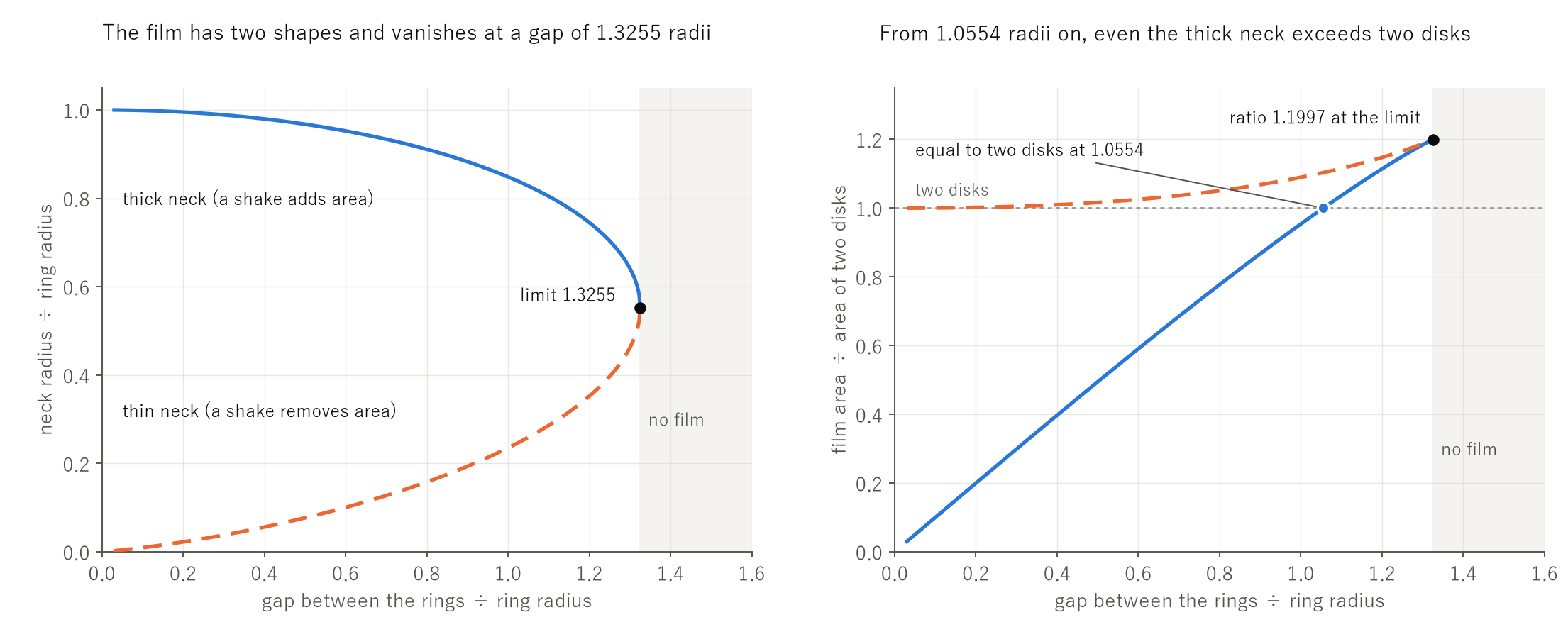
First, the film vanishes when the gap between the rings exceeds 1.325486839 times the radius. The limit is where the number t describing the waist satisfies tanh t = 1/t (t = 1.199678640), and there the waist is 0.552434125 times the radius. Below the limit the film has two shapes (a thick neck and a thin neck), which merge at the limit and vanish (Section 2).
Second, the thin neck collapses, and beyond 1.0554 radii even the thick neck has more area than two flat films. Shaken in a shape that vanishes at the ends, the thin neck loses area (collapses) and the thick neck gains (does not collapse). The area of the thick neck equals that of two disks at a gap of 1.055394794 radii (Goldschmidt), and at the limit it is 1.199678640 times the disks, which equals t (an identity) (Section 3).
Third, and this is the core of the paper: a chain always hangs because its length constraint gives the freedom to shift up and down. The shape of a chain is a catenary shifted up or down, and the amount of the shift is fixed by the length constraint. For ends 2 apart, every length from 2.05 to 100 had a shape. A film has no length constraint and cannot shift; revolving a shifted curve makes the mean curvature nonzero ($-0.247651$) (Section 4).
Fourth, the angle of 109.4712206 degrees at which films meet shares its root with the dihedral angle of the octahedron. Three films meet at 120 degrees (the angle of Paper 770 when a point is added to shorten a network), and where four edges of films meet the angle is arccos(−1/3) = 109.4712206 degrees, which, like the dihedral angle of the octahedron in the table of Paper 209, comes from the directions of the diagonals of a cube (Section 5).
Fifth, the separator is whether a length constraint gives the freedom to shift up and down. For the same catenary, the constrained chain always meets its three conditions (two ends and the length) with three numbers including the shift. The unconstrained film can meet the conditions at the rings only with the size of its waist, and fails once the gap opens (Section 4).
Keywords: soap film, catenoid, catenary, Goldschmidt solution, Plateau’s laws, length constraint, separator.
Scope (what is not claimed)
No new theorem or law is claimed. That the catenoid is a surface of revolution with zero mean curvature, that the film between two rings has an upper limit of the gap, the solution of two disks (Goldschmidt, 1831), that films meet at 120 degrees and about 109.47 degrees (Plateau, 1873), and that a chain of fixed length hangs as a catenary are all standard. What this paper adds is counting the limit, the two shapes, the area ratio and the collapse under a shake in one check, confirming that at the limit the area ratio equals t, and setting side by side, on the same formula, that what separates the film from the chain is whether there is a length constraint. The shake is tested with one shape vanishing at the ends only; stability is not proved. The film is taken as thin, uniform and weightless; how a film thins, the time until it bursts, and liquid bridges holding liquid inside are not treated. The rings have the same radius on the same axis; tilted rings and rings of different radii are not treated.
1. Question
Paper 588 showed that a soap film turns black not because the film is gone but because in a thin film the phase flips at only one surface, and in its scope note it did not treat why the film thins, setting aside the draining of the liquid, evaporation, flow driven by differences of surface tension, and the time of bursting. This paper places itself beside that seat. It counts the breaking of a film not by time but by the gap between two rings.
Two rings of radius $R$ face each other on one axis at a gap $h$. A film spanning them takes the shape of least area. Writing the cross-section of the surface revolved about the axis as $r(z)$, the shape is
$$r(z)=a\cosh\frac{z}{a}\qquad\left(|z|\le\frac{h}{2}\right),$$where $a$ is the radius of the waist (the middle). It is the same formula as the catenary of a hanging chain; Paper 327 showed that the catenary and the parabola differ by only 0.083 per cent and are still not the same curve. Setting $t=h/(2a)$, the condition $R=a\cosh t$ at the rings gives
$$\frac{h}{R}=\frac{2t}{\cosh t}.$$Question: For the same catenary, why does a hanging chain have a shape for every length, while the film between rings loses its shape as the gap opens?
2. The film has two shapes and vanishes at a gap of 1.3255 radii
Calculation 2.1: $2t/\cosh t$ first grows with $t$ and then falls, and is largest where $\tanh t=1/t$. That $t$ is 1.199678640; the upper limit of gap ÷ radius is 1.325486839, and there the waist ÷ radius is 0.552434125. For gap ÷ radius of 1, 1.2, 1.3, 1.32 and 1.3254 the film has two shapes; for 1.3256 and 1.4 it has none.
Observation 2.2 Below the limit, the same gap holds two films, a thick neck and a thin neck, which merge at the limit and vanish. For rings of radius 5 cm the film breaks at a gap of 6.627 cm.
3. The thin neck collapses, and beyond 1.0554 radii even the thick neck has more area than two disks
Calculation 3.1: The area of the film is $\pi a^{2}(\sinh 2t+2t)$ and that of two flat films spanning each ring (two disks) is $2\pi R^{2}$; their ratio is $(t+\sinh t\cosh t)/\cosh^{2}t$ (for the thick neck at gap ÷ radius 1, the formula gives 0.953624107 and the numerical integral 0.953624107).
| gap $\div$ radius | thick neck $a/R$ | area $\div$ two disks | thin neck $a/R$ | area $\div$ two disks |
|---|---|---|---|---|
| 0.5 | 0.967521 | 0.494671 | 0.076697 | 1.016229 |
| 0.8 | 0.910738 | 0.777280 | 0.157962 | 1.050630 |
| 1.0 | 0.848338 | 0.953624 | 0.235095 | 1.089520 |
| 1.2 | 0.745071 | 1.114028 | 0.351888 | 1.147175 |
| 1.3 | 0.641608 | 1.184078 | 0.461689 | 1.187140 |
Observation 3.2 The thin neck has more area than the thick neck at every gap. The area of the thick neck equals that of two disks at a gap of 1.055394794 radii (Goldschmidt), 5.277 cm for rings of radius 5 cm. At the limit the area ratio is 1.199678640, equal to the $t$ of the limit itself (when $\tanh t=1/t$, $1/\cosh^{2}t=1-1/t^{2}$ and the ratio collapses to $t$; the check gives a difference of 0).
Calculation 3.3: The cross-section was shaken as $r=a\cosh(z/a)+\varepsilon\cos(\pi z/h)$, a shape vanishing at both ends, and the second difference of the area ($\varepsilon=0.001$, $R=1$) was computed.
| gap $\div$ radius | thick neck | thin neck |
|---|---|---|
| 0.8 | 29.246552 | $-8.826458$ |
| 1.0 | 18.521973 | $-7.421269$ |
| 1.2 | 9.397500 | $-5.017472$ |
| 1.3 | 3.909831 | $-2.288774$ |
| 1.32 | 1.978282 | $-0.872502$ |
Observation 3.4 Under this shake the thin neck loses area and collapses, and the thick neck gains area and does not. The gain of the thick neck shrank as the limit came closer. Between 1.0554 and 1.3255 radii, the thick neck does not collapse under this shake, yet it has more area than two disks. To move from there to two disks, the film has to break once.
4. A chain always hangs because of its length constraint
Calculation 4.1: A chain of length $L$ with ends 2 apart at the same height takes the shape $y=a\cosh(x/a)+c$; $a$ is fixed by $2a\sinh(1/a)=L$, and the shift $c$ up or down by the height of the ends.
| length $L$ | $a$ | sag | shift $c$ |
|---|---|---|---|
| 2.05 | 2.591616 | 0.195335 | $-2.786951$ |
| 2.5 | 0.845505 | 0.663594 | $-1.509098$ |
| 4 | 0.459280 | 1.592777 | $-2.052057$ |
| 10 | 0.279467 | 4.728337 | $-5.007804$ |
| 100 | 0.154493 | 49.845746 | $-50.000239$ |
Observation 4.2 A chain longer than the gap between its ends has a shape for every length. For all five lengths the length equation was met within $10^{-9}$. When a chain makes the height of its weight as low as possible, the constraint that its length is fixed adds one number, $c$, which shifts the catenary up or down. With two numbers, $a$ and $c$, and two conditions, the height of the ends and the length, they can always be met.
Observation 4.3 A film has no length constraint and cannot shift. The surface revolved from the film’s cross-section $a\cosh(z/a)$ had the sum of its two curvatures (twice the mean curvature) equal to 0 at four points (within $10^{-12}$). But revolving $0.7\cosh(z/0.7)+0.2$, shifted by 0.2, gives the sum $-0.247651$ at $z=0.3$, and it is no longer the shape of least area. The film can meet the condition $R=a\cosh t$ at the rings only with the single number $a$, and fails once the gap opens.
Observation 4.4 This is the core of the paper. The separator is whether a length constraint gives the freedom to shift up and down. The formula of the shape is the same catenary; the only difference is whether a constraint is attached to what is made smallest. The constrained chain never loses its shape; the unconstrained film loses it at a gap of 1.3255 radii.
5. The angles at which films meet
Calculation 5.1: When three films meet along a line, three tensions balance at 120 degrees. Finding numerically the point of the triangle (0,0), (4,0), (1,3) that makes the total length of the paths shortest, the angles between the three directions were 119.999999, 119.999999 and 120.000002 degrees. Where four edges of films meet at a point, the angle is that between the directions from the centre of a regular tetrahedron to its vertices: cosine $-0.333333333$, angle 109.4712206 degrees ($\arccos(-1/3)$).
Observation 5.2 109.4712206 degrees shares its root with the dihedral angle of the octahedron. The dihedral angle of the octahedron in the table of Paper 209, 0.608173447969393 (in units of π), is 109.4712206 degrees when multiplied by π, and agrees with the angle where four edges meet within $10^{-12}$ degrees. Both come from the fact that the directions $(\pm1,\pm1,\pm1)$ of the diagonals of a cube have inner products $-1$ or $1$ and squared length 3. The 120 degrees where three films meet is the angle Paper 770 found when a point is added to shorten a network.
6. Relation to earlier papers
Observation 6.1 The way it breaks differs from the liquid column of Paper 309. Paper 309 showed that a liquid column breaks under waves longer than its circumference $2\pi R$ (the Rayleigh-Plateau instability). A column holds liquid inside and breaks as a disturbance of wavelength longer than its circumference grows. The film between rings holds no liquid, with equal pressure inside and out. The film breaks not because a disturbance grows but because, once the gap exceeds 1.3255 radii, the shape itself ceases to exist.
Observation 6.2 The length of chain counted in Paper 568 is a freedom the film lacks. Paper 568 counted, on the catenary, that the chain needed is not proportional to the depth. That very constraint of a fixed length gives the chain its shift up and down and makes the difference from the film. The same formula with a different constraint is a different thing (Paper 300).
7. What the checks showed
The limit agreed within $10^{-9}$ in two ways (the root of $\tanh t=1/t$, and the maximum of $2t/\cosh t$ on a grid of 400,000 points). That the area ratio equals $t$ at the limit was noticed numerically in the preliminary survey and confirmed in this check as an identity. The shake uses one shape only, so it does not prove that the thick neck never collapses.
Closing
Closing: a soap film between two rings breaks when the gap exceeds 1.325486839 times the radius. Below the limit there are two films, a thick neck and a thin neck; the thin one collapses when shaken, and beyond a gap of 1.055394794 radii even the thick one has more area than two disks. At the limit the area ratio equals t = 1.199678640. A chain of the same catenary hangs for every length, because its length constraint gives the freedom to shift up and down. The film has no such constraint and can meet the conditions at the rings only with the size of its waist. The separator is whether a length constraint gives the freedom to shift up and down. The angle of 109.4712206 degrees where four edges of films meet shares its root with the dihedral angle of the octahedron.
References
- Goldschmidt, C. W. B. (1831). Determinatio superficiei minimae rotatione curvae data duo puncta jungentis circa datum axem ortae. Göttingen.
- Plateau, J. (1873). Statique expérimentale et théorique des liquides soumis aux seules forces moléculaires. Gauthier-Villars.
- Yamagishi, Y. (2026). Equal Volume Is Not Enough to Cut and Reassemble [Paper 209]. YOI: https://www.yamagishiyuuki.com/yoi/209; DOI: 10.5281/zenodo.22111317
- Yamagishi, Y. (2026). The Three Hundredth Census: Whether Two Things Share a Root Is Decidable [Paper 300]. YOI: https://www.yamagishiyuuki.com/yoi/300; DOI: 10.5281/zenodo.22171914
- Yamagishi, Y. (2026). The Length That Divides Gravity from Surface Tension Is Nobody’s Size [Paper 309]. YOI: https://www.yamagishiyuuki.com/yoi/309; DOI: 10.5281/zenodo.22172337
- Yamagishi, Y. (2026). Two Curves Agree to Within $\mathbf{0.083}$ Per Cent and Are Not the Same Curve [Paper 327]. YOI: https://www.yamagishiyuuki.com/yoi/327; DOI: 10.5281/zenodo.22210286
- Yamagishi, Y. (2026). The Chain Needed Is Not Proportional to the Depth [Paper 568]. YOI: https://www.yamagishiyuuki.com/yoi/568; DOI: 10.5281/zenodo.23014280
- Yamagishi, Y. (2026). A Soap Film Turns Black Not Because the Film Is Gone [Paper 588]. YOI: https://www.yamagishiyuuki.com/yoi/588; DOI: 10.5281/zenodo.23014377
- Yamagishi, Y. (2026). Adding One Point Shortens the Total Length of a Network, and the 120-Degree Angle Decides Whether It Does [Paper 770]. YOI: https://www.yamagishiyuuki.com/yoi/770; DOI: 10.5281/zenodo.23015257
Reference
Yamagishi, Y. (2026). A Soap Film between Two Rings Breaks at a Gap of 1.3255 Radii, While a Chain of the Same Shape Always Hangs [Paper 1102]. YOI: https://www.yamagishiyuuki.com/yoi/1102
ORCID: 0009-0006-8587-3450
PDF (English) · PDF (Japanese) · Date proof of the English PDF (OpenTimestamps .ots) · SHA256SUMS
The record page for this paper (in Japanese, with the PDFs in each language and the date proof): YOI 1102. This paper is a preprint and has not been peer reviewed.