Abstract
On a closed four-dimensional space the total of the curvature is fixed by the Euler number χ alone. The Chern–Gauss–Bonnet formula reads ∫Q + ∫‖W‖² = 8π²χ, where Q is built from the scalar and trace-free Ricci curvature and W is the Weyl curvature. Moving the metric does not move the total; only the fraction f held by W moves. On the round S⁴, f = 0 and Q holds the whole 16π². The theorem of Chang, Gursky and Yang (2003) is short when written with f: if the Yamabe constant is positive and Q beats W (f < 1/2), the space is S⁴ or RP⁴.
This paper computes from scratch how that share is decided, on metrics made of stacked S³ shells. Regarding the ratio v of the Hopf fibre to its base as a function of the conformal time t, W⁺ and W⁻ are written by v alone and the size of the shell disappears from the formula. A conformal class on S⁴ becomes a single path v(t).
The total is decided by how the shells close. A point cap holds 8π², a surface cap holds 16π², and a neck holds nothing. The difference of W⁺ and W⁻ is an exact derivative, so f ≥ (1−v²)² + 2(dv/dt)² for every shell: the most squashed shell sets the floor under the share of W. The paths exactly on the floor are explicit and are two Pedersen self-dual Einstein balls placed back to back. If f < 1/2, every shell ratio lies between 0.5412 and 1.3066, yet beyond the wall the space is still the true S⁴, and f can exceed 1 with positive scalar curvature (neck ratio 0.5, length 6, f = 1.125). The wall has only one side. A point cap binds a stationary (Bach-flat) metric to the vanishing of W⁺ or of W⁻, so in the family the only stationary metrics on S⁴ are those conformal to the round one. Other stationary metrics open only on spaces with surface caps: the Page metric (f = 0.68155171), and a branch on which W vanishes at the central shell. The separator is whether a shell closes at a point or on a surface.
The floor formula agrees, with ratio at least 0.99996, with an eta invariant counted independently from Hitchin’s spectrum. The total reproduces every known value for the round S⁴, Fubini–Study, Eguchi–Hanson, Taub–NUT and Page.
Keywords: total curvature, Weyl curvature, Q-curvature, four-dimensional Poincaré conjecture, Hopf fibration, eta invariant, Yamabe constant, separator.
Scope (what is not claimed)
This paper does not solve the smooth four-dimensional Poincaré conjecture and does not show a way to solve it. Every space in the family is already known to be S⁴, CP² or the like; not a single exotic S⁴ enters. The Chern–Gauss–Bonnet and signature formulas, the theorems of Kuiper (1949), Aubin (1976), Gursky (1998, 1999), Chang–Gursky–Yang (2003) and APS (1975), the results of Hitchin (1974, 1997), and the metrics of Pedersen (1986) and Page (1978) are known and are only used here. What is added is the form of W in the ratio v on the family of S³ shells, the floor inequality with the explicit paths on it, the exact boundary of the Yamabe sign, the binding of stationary metrics by a point cap, the closed form of the share of Page, and the numbers of a second branch of stationary paths closing on two surfaces. These forms were not found in the literature searched, but that does not show they are unknown. The scope note of Paper 103 said that dimension three is solved, that the smooth four-dimensional Poincaré conjecture is open, and that the system keeps its hands off. This paper is placed beside it: hands stay off the problem, and the accounts around the problem are turned into numbers. As in the scope note of Paper 1003, nothing is added to the smooth four-dimensional conjecture. 16π² is not read as (4π)² (the discipline of Paper 48). The 16π² of the S³ of radius 2 (Paper 08 and Paper 45) moves with the unit, so it is not written as the same root as the total 16π². Nor is it written that a proof of the conjecture follows from the theorem of Paper 01.
1. The Number That Can Be Fixed First
The three-dimensional Poincaré conjecture was solved by the Ricci flow of Perelman (2002), and the topological four-dimensional case by Freedman (1982). What stays open is the smooth four-dimensional case: is a space homeomorphic to $S^4$ also diffeomorphic to $S^4$?
Dimension three had a number that could be fixed first. The theorem of Paper 01 says that the shell mass is independent of the radius only for the density $1/r^2$, and the total curvature of the shell $S^2$ closes to $4\pi$ for every metric (Paper 128). In dimension four the same question has its answer in a different place. The shell of a four-dimensional space is $S^3$, whose Euler number is 0, and no number closes on the total curvature of the shell. The space itself holds the number: on a closed four-dimensional space the integral of the curvature squared is fixed by the Euler number $\chi$.
Check on the round $S^4$. The density of curvature is $Q=6/r^4$ and the area is $8\pi^2r^4/3$, so in the product the radius disappears and $16\pi^2$ remains. For radii 0.5, 1 and 3, $Q$ is 96.000000, 6.000000 and 0.074074, the area is 1.644934, 26.318945 and 2131.834551, and every product is 16.0000000000 times $\pi^2$.
The density $1/r^4$ is one of the forms of the theorem of Paper 01 carried to other dimensions. Of the two roads separated in Paper 1092, take the one that keeps the shell mass constant in a five-dimensional space: the shell is $S^4$ and the density must be $1/r^4$. The $Q$ on $S^4$ has exactly that form. Curvature squared is length to the power $-4$, which cancels against the four-dimensional area.
The same continues on even spheres. The density of the unit sphere $S^{2k}$ is $(2k-1)!$, and the total for $k=1,2,3$ is $4\pi$, $16\pi^2$, $128\pi^3$ (12.56637061, 157.91367042, 3968.80341508). The cut is $(2\pi)^k\times 2^{k-1}(k-1)!\times\chi$. The value can also be written $(4\pi)^k(k-1)!$, but that is arithmetic, and as Paper 48 corrected, it is not read as a power of $4\pi$. Nothing here supports reading $16\pi^2$ as $(4\pi)^2$.
2. Sharing the Total
On a closed oriented four-dimensional space $(M,g)$, let $R$ be the scalar curvature, $\mathrm{Ric}_0$ the trace-free Ricci curvature and $W$ the Weyl curvature, and put
$$Q=\frac{R^2}{24}-\frac12|\mathrm{Ric}_0|^2$$(the $Q$-curvature without its $\Delta R$ term, which does not affect the integral). $\|W\|^2=\|W^+\|^2+\|W^-\|^2$ is the norm of $W$ as a map on 2-forms, one quarter of the four-index norm. The four-dimensional form of the formula of Chern (1944) and the signature formula are
$$\int_M Q\,dV+\int_M\|W\|^2\,dV=8\pi^2\chi,\qquad \int_M\bigl(\|W^+\|^2-\|W^-\|^2\bigr)\,dV=12\pi^2\tau,$$with $\tau$ the signature. Combining them gives a budget for each chirality of $W$:
$$\int_M Q\,dV+2\int_M\|W^\pm\|^2\,dV=4\pi^2(2\chi\pm3\tau).$$The right side is fixed by topology, and only the division on the left moves with the metric. So, on spaces with $\chi>0$, put the share of $W$ as
$$f=\frac{\int_M\|W\|^2\,dV}{8\pi^2\chi}.$$Since $\int\|W\|^2dV$ does not change under conformal changes, $f$ depends neither on scale nor on the conformal factor. What can be fixed first is the total; what moves is the share $f$.
| space | $\chi$ | $\tau$ | $f$ | floor $1-2/\chi$ | floor $3|\tau|/(2\chi)$ |
|---|---|---|---|---|---|
| round $S^4$ | 2 | 0 | 0 | 0 | 0 |
| $\mathbb{RP}^4$ | 1 | n/a | 0 | n/a | |
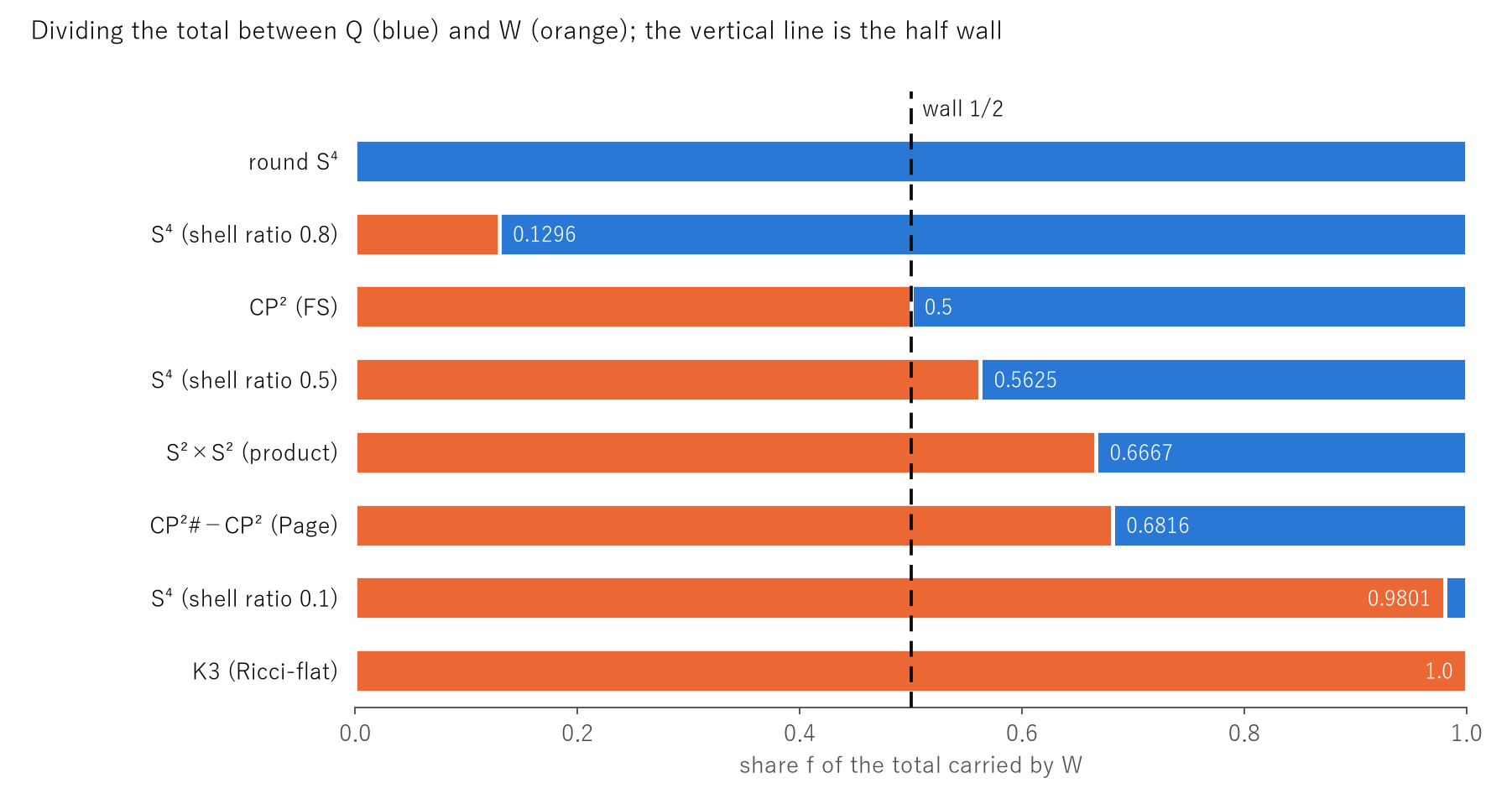
| $\mathbb{CP}^2$ (FS) | 3 | 1 | 0.500000 | 0.333333 | 0.500000 |
| $S^2\times S^2$ (product) | 4 | 0 | 0.666667 | 0.500000 | 0 |
| $\mathbb{CP}^2\#(-\mathbb{CP}^2)$ (Page) | 4 | 0 | 0.681552 | 0.500000 | 0 |
| K3 | 24 | $-16$ | 1.000000 | 0.916667 | 1.000000 |
$\mathbb{RP}^4$ is not orientable, so $\tau$ and $W^\pm$ are not considered there. If $x$ is the ratio of the two curvatures of $S^2\times S^2$, then $f=(2+x+1/x)/6$: the smallest is 0.666667 at $x=1$, then 0.750000 at $x=2$ and 1.041667 at $x=4$.
The two right columns are two floors under $f$. The right one follows at once from the signature formula: $\int\|W\|^2\geqq|\int(\|W^+\|^2-\|W^-\|^2)|=12\pi^2|\tau|$, so $f\geqq3|\tau|/(2\chi)$. The $W$ of $\mathbb{CP}^2$ has one chirality only, as does K3, and both sit exactly on this floor.
The left floor comes from a ceiling on $Q$. Let $Y$ be the Yamabe constant. When it is positive, the metric of constant scalar curvature in the conformal class (the Yamabe metric) gives $\int Q dV=Y^2/24-\frac12\int|\mathrm{Ric}_0|^2\leqq Y^2/24$, and by the inequality of Aubin (1976) $Y$ does not exceed its value on the round $S^4$. That value is $8\sqrt6 \pi=61.562392$, the four-dimensional entry of the table in Paper 23; squared and divided by 24 it is $16\pi^2$. If $Y=0$ then $\int Q dV\leqq0$, so $\int Q dV\leqq16\pi^2$ for $Y\geqq0$. This upper bound is in the form found in Gursky (1999), with equality only for metrics conformal to the round $S^4$.
So $16\pi^2$ is both the total of $S^4$ and the ceiling of $Q$ on every space whose Yamabe constant is not negative. Whatever $\chi$ has beyond 2 can only be taken on by $W$: $f\geqq1-2/\chi$. On $S^4$ with $\chi=2$ the $W$ forced by topology is 0.
A third floor comes from the theorem of Gursky (1998). If $Y>0$ and $b_+\neq0$, then $\int\|W^+\|^2\geqq\frac{4\pi^2}{3}(2\chi+3\tau)$, with equality only when the conformal class contains a Kähler–Einstein metric of positive Einstein constant (checked through the citation in LeBrun (2014)). FS on $\mathbb{CP}^2$ is exactly the equality. If neither $b_+$ nor $b_-$ is 0, using it for both orientations gives $f\geqq2/3$, and the product metric on $S^2\times S^2$ sits exactly on this floor. Under the shares of spaces with $Y>0$ stand the steps 0 of $S^4$, 1/2 of $\mathbb{CP}^2$ and 2/3 of $b_\pm\neq0$.
3. The Half Wall
Begin with the test of roundness. By Kuiper (1949), a closed simply connected space with $W=0$ is conformally $S^n$. So the smooth four-dimensional Poincaré conjecture is the same as this question: does every space homeomorphic to $S^4$ carry a metric with $W=0$?
Putting $\chi=2$, $\tau=0$ shortens it once more. The budgets of the two chiralities are equal, so $\int\|W^+\|^2=\int\|W^-\|^2=\frac12\int\|W\|^2$, and $W^+\equiv0$ brings $W^-\equiv0$ with it. The question becomes whether half of $W$ can be removed. By Taubes (1992), every closed four-dimensional space carries a metric with $W^+\equiv0$ after connected sum with enough copies of $-\mathbb{CP}^2$ (the orientation is a convention). By Wall (1964), simply connected spaces of the same homotopy type become diffeomorphic after connected sum with enough copies of $S^2\times S^2$. Both statements are about what happens after the addition. What remains is before the addition.
Theorem A′ of Chang, Gursky and Yang (2003) reads: a closed four-dimensional space with $Y>0$ and $\int\|W\|^2<\int Q$ is diffeomorphic to $S^4$ or $\mathbb{RP}^4$. If the Yamabe constant is positive and $Q$ beats $W$, only the sphere remains. This condition makes the total positive, so $\chi>0$, and it is the same as $f<1/2$. The proof combines the Ricci flow theorem of Margerin (1998) with a conformal deformation.
The wall value $1/2$ is decided by $\mathbb{CP}^2$: the Fubini–Study metric (FS) has $f=1/2$ and is the example of equality with $\chi>0$ (Theorem B of the same paper says that, apart from $S^4$ and $\mathbb{RP}^4$, equality happens only for FS and for spaces covered by $S^3\times S^1$). In the table above, the wall stands at the seat of the space that comes after $S^4$ and $\mathbb{RP}^4$. By contraposition, if an exotic $S^4$ exists, then $f>1/2$ for every metric on it with $Y>0$. The infimum for each space,
$$\mathfrak f(M)=\inf_{Y(g)>0}f(g),$$does not change under diffeomorphism (LeBrun (2023) treats $\inf\int|W_+|^2$, without the Yamabe condition, as a differential-topological invariant), and on spaces homeomorphic to $S^4$ one has $\mathfrak f\in\{0\}\cup[1/2,\infty]$. There is a gap between 0 and 1/2.
So far this is only known theorems rearranged in $f$, and it does not show what lies beyond the wall. So next comes a family in which both sides of the wall can be seen in formulas.
4. Stacking Shells
With left-invariant 1-forms $\sigma_1,\sigma_2,\sigma_3$ on $S^3$ ($d\sigma_1=-\sigma_2\wedge\sigma_3$ and so on, $\sigma_3=d\psi+\cos\theta d\phi$), consider
$$g=ds^2+a(s)^2(\sigma_1^2+\sigma_2^2)+b(s)^2\sigma_3^2.$$The direction of $\sigma_3$ is the Hopf fibre, $a$ is the size of the base and $b$ the thickness of the fibre. $a=b=r/2$ is flat $\mathbb{R}^4$, and $a=b$ is rotationally symmetric. With period $4\pi/p$ for $\psi$, one has $\int\sigma_1\sigma_2\sigma_3=16\pi^2/p$.
This $16\pi^2$ is a coefficient from the choice of $\sigma$, the area of the $S^3$ of radius 2 (the same value as in Paper 08 and Paper 45). It moves with the scale, so it sits in a different seat from the total $16\pi^2$.
The curvature comes from the Cartan structure equations (Appendix A). The densities of the total and of the signature, multiplied by the volume $a^2b$, are both exact $s$-derivatives. With $v=b/a$ and
$$T=2b'a'^2-2b'+\frac32v^2b'-v^3a',\qquad U=-(b'-a'v)^2+v^2-\frac{v^4}{2},$$one has
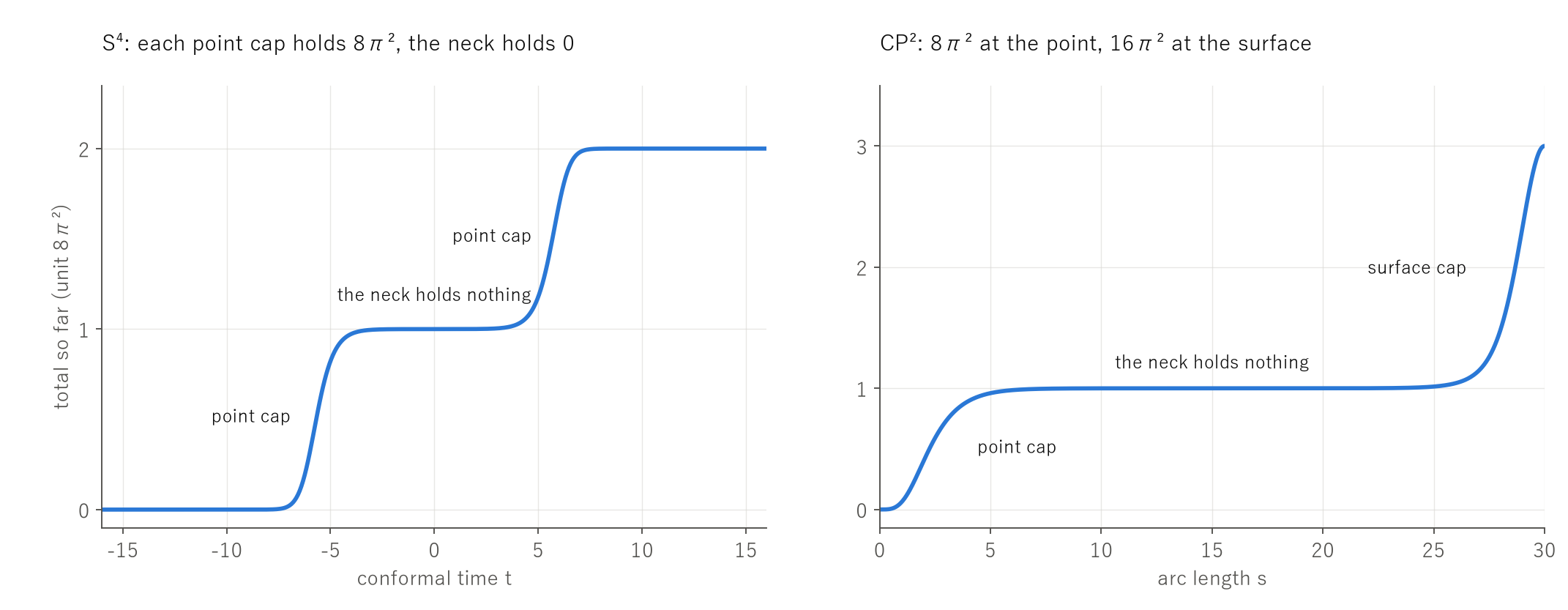
$$\int_M(Q+\|W\|^2)\,dV=\frac{16\pi^2}{p}\,[T],\qquad \int_M(\|W^+\|^2-\|W^-\|^2)\,dV=\frac{16\pi^2}{p}\,[U],$$where $[ ]$ means the value at the end minus the value at the start. The total does not depend on the inside of the shells; it is decided by how the two ends close.
There are two ways to close: the whole shell collapses to a point ($a'=b'=\pm\frac12$, $v=1$), or only the fibre collapses and the base $S^2$ remains ($a'=0$, $b'=\pm p/2$, $v=0$). These are the nut and the bolt of the physics literature. Below they are called a point cap and a surface cap.
| end | $T$ | $U$ | total | part of $\chi$ | part of $\tau$ |
|---|---|---|---|---|---|
| point (start) | $-1/2$ | $1/2$ | $8\pi^2$ | 1 | $-2/3$ |
| point (end) | $1/2$ | $1/2$ | $8\pi^2$ | 1 | $2/3$ |
| surface (start) | $-p$ | $-p^2/4$ | $16\pi^2$ | 2 | $p/3$ |
| surface (end) | $p$ | $-p^2/4$ | $16\pi^2$ | 2 | $-p/3$ |
The pair of ends decides the space.
| start | end | space | total | $\tau$ |
|---|---|---|---|---|
| point | point | $S^4$ | $16\pi^2$ | 0 |
| surface ($p=1$) | point | $\mathbb{CP}^2$ | $24\pi^2$ | 1 |
| surface ($p=1$) | surface ($p=1$) | $\mathbb{CP}^2\#(-\mathbb{CP}^2)$ | $32\pi^2$ | 0 |
| surface ($p=2$) | surface ($p=2$) | $S^2\times S^2$ | $32\pi^2$ | 0 |
The parts of $\tau$ come in thirds and add to integers over two ends, the same 3 as in the signature formula. The second Betti number $b_2$ equals the number of surface caps. Only $S^4$ has no surface.
As a check, metrics that are not round were integrated. Distorting $a$ and $b$ separately on $S^4$ gives $\int Q$ of −8.759318 times $8\pi^2$ and $\int\|W\|^2$ of 10.759318 times, and the sum stays 2.00000000 times. Distorting $\mathbb{CP}^2$ gives 1.207799 and 1.792201, a two-surface example with $p=1$ gives −0.160351 and 4.160351, and one with $p=2$ gives −0.714719 and 4.714719, with sums 3.00000000, 4.00000000 and 4.00000000. The signature also stays at −1.00000000 (in the orientation running from point to surface) and 0.
With rotational symmetry ($v\equiv1$) only $T=2a'^3-\frac32a'$ remains. As $a'$ moves from $\frac12$ to $-\frac12$, $T$ moves from $-\frac12$ to $\frac12$. On the neck $S^3\times\mathbb{R}$ with $a'=0$, $T=0$, and at unit radius $R=6$, $|\mathrm{Ric}|^2=12$, so $Q=(R^2-3|\mathrm{Ric}|^2)/6=0$. A neck holds no total. A connected sum lowers $\chi$ by 2 because one point cap is cut from each space, and the price is $8\pi^2+8\pi^2=16\pi^2$.
5. W Is Written by the Ratio v Alone
The total is decided at the ends, but the share is decided along the way. Here begins the centre of the computation. Define the conformal time $t$ by $dt=ds/a$ and rewrite the metric as
$$g=a^2\bigl(dt^2+\sigma_1^2+\sigma_2^2+v^2\sigma_3^2\bigr).$$The bracket is the conformal class and $a$ is the conformal factor. A conformal class on $S^4$ becomes a single path $v(t)$ with $v\to1$ as $t\to\pm\infty$. An $S^3$ with ratio $v\neq1$ is called a Berger sphere.
Write $t$-derivatives with dots and put
$$E=\ddot v+v^3-v,\qquad G=3v\dot v.$$The Cartan computation gives the eigenvalues of $W^\pm$ as $(\lambda_\pm,\lambda_\pm,-2\lambda_\pm)$ with
$$\lambda_\pm=\frac{E\mp G}{6a^2v},\qquad \|W^\pm\|^2=\frac{(E\mp G)^2}{6a^4v^2}$$(checked by symbolic computation). The volume is $a^4v dt \sigma_1\sigma_2\sigma_3$, so on integration $a$ disappears:
$$\int_M\|W^\pm\|^2\,dV=\frac{16\pi^2}{p}\,D_\pm,\qquad D_\pm=\int\frac{(E\mp G)^2}{6v}\,dt.$$$W$ is written by the ratio of the Hopf fibre to its base alone. If $E=G=0$ then $\dot v=0$ and $v^3=v$, so $v\equiv1$: $W$ vanishes only when every shell is round. On $S^4$, $f=D_++D_-$, and on $\mathbb{CP}^2$, $f=\frac23(D_++D_-)$.
This functional of the path,
$$\mathcal Y[v]=D_++D_-=\int\frac{E^2+G^2}{3v}\,dt,$$together with the procedure of the next section, cutting at a shell and pressing from both sides, is called here Yamagishi’s wrinkle-removing jig ($\mathcal Y$-Jig). It treats $W$ as the wrinkles of the metric, weighs them along the path, reads on which shell they remain, and lowers them. The letter $\mathcal Y$ is the author’s initial and is not the Yamabe constant $Y$.
The independence from the conformal factor was checked directly. For one path $v(t)$, multiplying by three factors (round, dumbbell, lopsided) and integrating the curvature directly gives, for all three, $\int\|W^+\|^2$ and $\int\|W^-\|^2$ of 0.6952335321 times $16\pi^2$, $\int Q$ of −0.3904670642 times, and the sum 1.0000000000 times, the same to ten digits.
Known metrics give known values.
| metric | path $v(t)$ | $p$ | $D_+$ and $D_-$ | integral |
|---|---|---|---|---|
| FS ($\mathbb{CP}^2$) | $\tanh(t/2)$ | 1 | 0.7500000000 and 0 | $12\pi^2$ |
| Eguchi–Hanson | $\tanh t$ | 2 | 1.5000000000 and 0 | $12\pi^2$ |
| Taub–NUT | $1/(1+e^t)$ | 1 | 0 and 0.5000000000 | $8\pi^2$ |
The $12\pi^2$ of $\mathbb{CP}^2$ is the value of the signature formula, the $12\pi^2$ of Eguchi and Hanson (1978) is $8\pi^2(2-\frac12)$, and the $8\pi^2$ of Taub–NUT (Hawking 1977) is $8\pi^2\chi$. When Ricci-flat, $Q=0$ and $W$ holds the whole total.
The equation $W^+=0$ looks like a nonlinear second-order equation, but it falls to a linear one. With $v=-\dot w/w$,
$$E-G=-\frac{\dddot w-\dot w}{w}.$$$W^+=0$ is the same as $\dddot w=\dot w$, whose solutions are exactly $w=Ce^{-t}+A+Be^t$. With $C=1$, $x=e^t$,
$$v=\frac{1-Bx^2}{1+Ax+Bx^2}.$$$A=B=0$ is the round metric, $B=0$ Taub–NUT, $A=0$ the Eguchi–Hanson form, $A=2$, $B=1$ FS, and $A=-2$, $B=1$ the complex hyperbolic plane ($a=\frac12\sinh s$, $b=\frac12\sinh s\cosh s$, checked $\mathrm{Ric}=-6g$). Below, a metric on which one of $W^+$ and $W^-$ vanishes is called self-dual whichever the orientation (by convention $W^-=0$ is self-dual and $W^+=0$ anti-self-dual). Such metrics enter this one family, and reversing $t$ gives the family with $W^-=0$.
For a small deviation $v=1+\varepsilon$ from round, $f\approx\frac13\int(\omega^2+1)(\omega^2+4)|\hat\varepsilon|^2d\omega/2\pi$ (for a Gaussian $\varepsilon$, 5.013259 against 5.013257), and the fourth-order operator splits as $(\partial_t-1)(\partial_t-2)(\partial_t+1)(\partial_t+2)$. The positive pair belongs to $W^+$ and the negative pair to $W^-$.
6. One Shell Sets the Floor
The difference of $D_+$ and $D_-$ is an exact derivative. Since $(E-G)^2-(E+G)^2=-4EG$, the difference of the integrands is $-2\dot vE$ and
$$\frac{(E-G)^2-(E+G)^2}{6v}=\frac{d}{dt}\Bigl(-\dot v^2+v^2-\frac{v^4}{2}\Bigr)=\dot U,$$the same $U$ as in Section 4 ($b'-a'v=\dot v$). This is the decomposition of $W$ by chirality, in the shape of the inequality of Bogomolny (1976).
Cut a path on $S^4$ in two at the shell of any time $t_0$. On the left part $D_+-D_-=U(t_0)-\frac12$, and on the right part $D_+-D_-=\frac12-U(t_0)$. Since $D_\pm\geqq0$, $D_++D_-$ is at least $|U(t_0)-\frac12|$ on each side. Since $\frac12-U=\frac12(1-v^2)^2+\dot v^2$, the following inequality results.
Floor of the shell. For a metric on $S^4$ made of stacked $S^3$ shells,
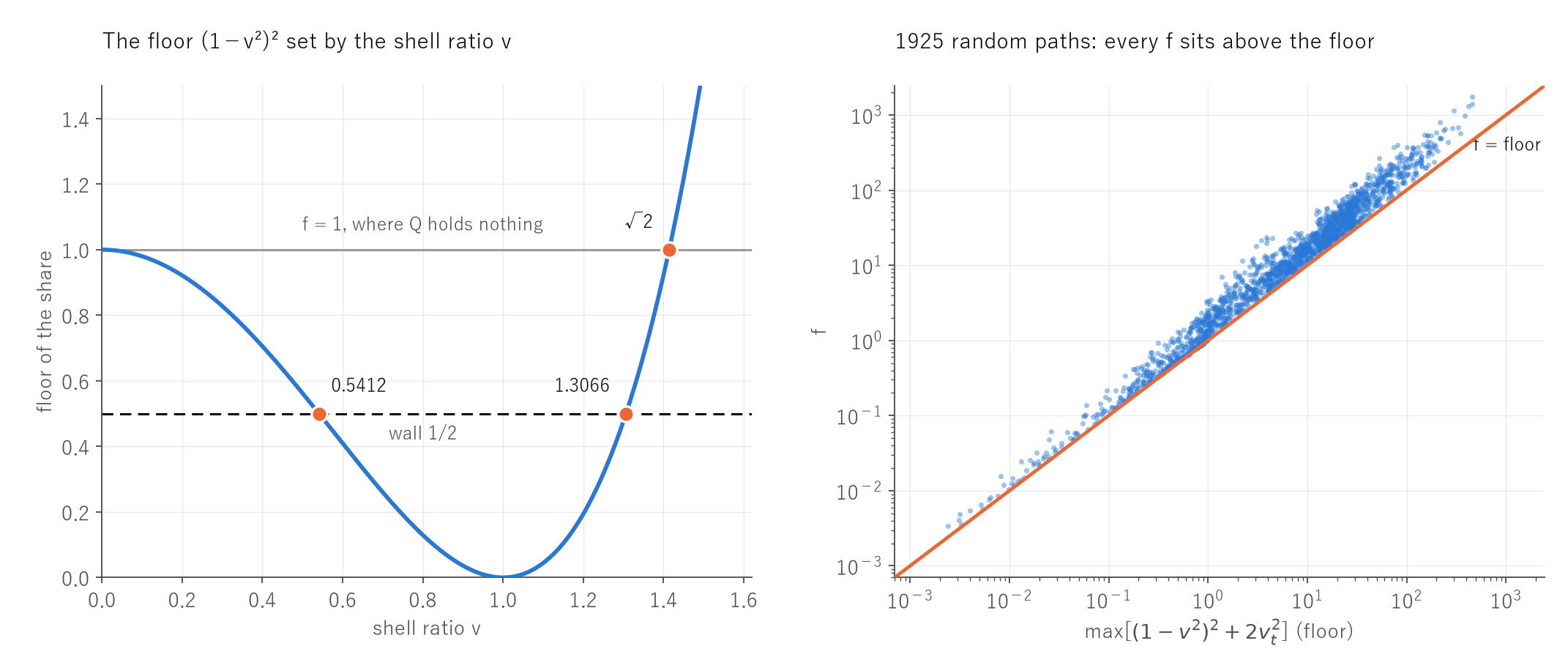
$$f\geqq\max_t\bigl[(1-v^2)^2+2\dot v^2\bigr].$$The most squashed shell sets the floor under the share of $W$. For 1925 random paths, $f$ divided by the right side has minimum 1.002144, median 1.6697 and maximum 6.34, and no path breaks the floor.
Translating the wall into shell ratios: if $f<1/2$, every shell ratio lies between 0.5411961 and 1.3065630, which are $\sqrt2\sin(\pi/8)$ and $\sqrt2\cos(\pi/8)$. If $f<1$, then $v<\sqrt2$ (1.4142136).
What the floor counts can be named by a well-known quantity. Cut at a shell with $\dot v=0$; the integral of the signature density on the left part is $-\frac23(1-v^2)^2$. By the theorem of APS (1975) this is the eta invariant of the shell (when the metric is a product near the boundary, the difference of the integral of the signature density and the eta of the shell is the integer signature). With a choice of orientation, the signature eta of the Berger sphere is $-\frac23(1-v^2)^2$.
This was checked by another road. Counting eta directly from the eigenvalues of the Dirac operator on the Berger sphere found by Hitchin (1974) gives −0.093750, −0.043350, −0.260416, −1.499992, −10.666323 for $v$ equal to 0.5, 0.7, 1.5, 2.0, 3.0, which match the values 0.093750, 0.043350, 0.260417, 1.500000, 10.666667 of $(1-v^2)^2/6$ in absolute value with ratio at least 0.99996 (this holds for $v<4$: at $v=4$ an eigenvalue crosses 0 and the Dirac eta jumps, while the signature eta does not). The ratio 4 of the absolute values to the signature eta comes from the ratio of the $\hat A$ and $L$ genera. The spectrum shares nothing with the curvature computation, so $(1-v^2)^2$ has come from two roads.
Hitchin (1997) showed that if a three-dimensional conformal structure appears at infinity of a self-dual Einstein metric on the four-ball, its eta is at most 0, and 0 only for the standard structure (checked through the citation in Maschler (2008)). The floor of the shell is this inequality used from both sides inside the family of $S^3$, without the Einstein condition. The term $\dot v^2$ comes from the second fundamental form of the shell.
Outside the family. The same shape remains without symmetry. If a shell $\Sigma$ in a homotopy sphere is an integral homology sphere with a product metric nearby, the signatures of both sides are 0 and the APS theorem gives $f\geqq\frac32|\eta(\Sigma)|$. Paper 109 listed the APS formula as a pillar joining the four-dimensional bulk and the three-dimensional boundary. Here that pillar has received a number. The shell $S^3$ has no number for the total, but it has a number for its shape, eta.
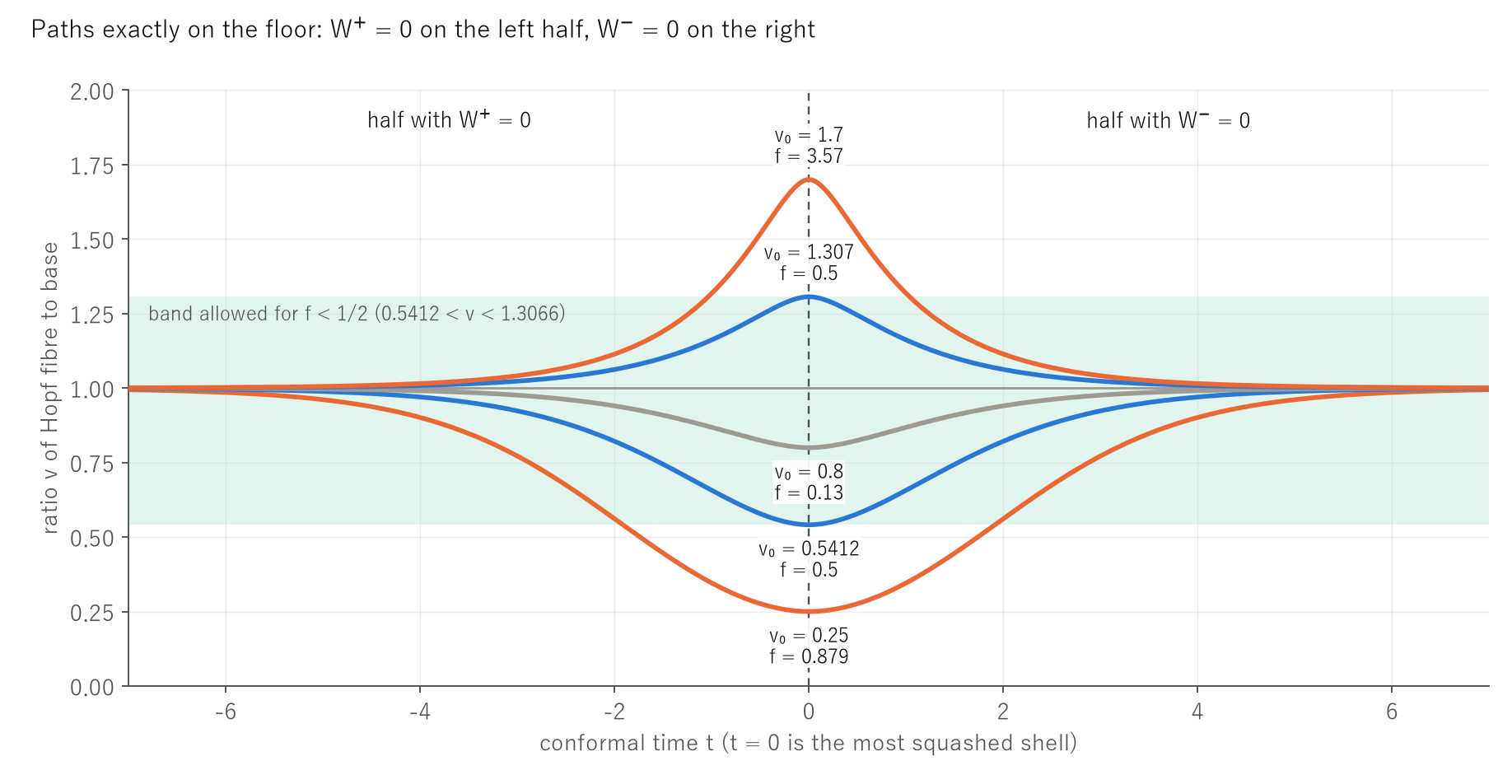
The floor is reached. Equality holds when $W^+\equiv0$ to the left of $t_0$ and $W^-\equiv0$ to the right. Equality also happens with $\dot v(t_0)\neq0$, and then $\ddot v$ jumps by $-6v\dot v$ at $t_0$ (at $v=0.5$, $\dot v=0.2$, $\ddot v$ jumps from 0.675000 to 0.075000 and the numerical $f$ is 0.642500, the same as the floor formula). On paths continuous up to $\ddot v$ one has $\dot v(t_0)=0$, and with the linear solution of Section 5 the path turning at $t=0$ is explicit. For $v_0>0$ put
$$A=\frac{2(1-v_0)}{v_0},\quad B=\frac{v_0-1}{v_0+1},\quad x=e^{-|t|},\quad v=\frac{1-Bx^2}{1+Ax+Bx^2};$$then $v(0)=v_0$, $\dot v(0)=0$ and $f=(1-v_0^2)^2$. It is continuous up to $\ddot v$, and the third derivative jumps at $t=0$ (smoothing raises $f$ by as little as one likes). Numerical integration for $v_0$ equal to 0.1, 0.25, 0.4, 0.5, 0.7, 0.9, 1.1, 2.0, 3.0 gives $f$ equal to 0.9801000000, 0.8789062500, 0.7056000000, 0.5625000000, 0.2601000000, 0.0361000000, 0.0441000000, 9.0000000000, 64.0000000000, agreeing with $(1-v_0^2)^2$ to ten digits, and $D_+$ on the left half is below $10^{-27}$.
Half of this path has a name. The metric of Pedersen (1986) is a complete self-dual Einstein metric on the four-ball whose conformal structure at infinity is a Berger sphere. Its form is
$$g=\frac{1}{(1-\rho^2)^2}\Bigl[\frac{4(1+m^2\rho^2)}{1+m^2\rho^4}d\rho^2+\rho^2(1+m^2\rho^2)(\sigma_1^2+\sigma_2^2)+\frac{\rho^2(1+m^2\rho^4)}{1+m^2\rho^2}\sigma_3^2\Bigr]$$(checked $\mathrm{Ric}=-3g$, $W^+=0$ at two points for $m^2=3$). Computing the ratio from it, it coincides with the left half of the floor path when $v_0^2=1/(1+m^2)$ (difference at most $5.55\times10^{-16}$). The turning shell $t=0$ is the infinity $\rho=1$. The second fundamental form of the shell vanishes there because infinity is umbilic.
The $S^4$ on the floor at a turning shell is the conformal class of two Pedersen balls placed back to back.
As $v_0$ moves, the half ball joins three famous metrics: $v_0=1$ is real hyperbolic space (the round ball), $v_0\to\infty$ the complex hyperbolic plane, and $v_0\to0$ Taub–NUT. At $v_0$ equal to 0.01, $f$ is 0.99980001, and the limiting $S^4$ as $v_0\to0$ is two Taub–NUT spaces, with $W$ holding the whole $16\pi^2$.
7. The Wall Has Only One Side
On the near side of the wall ($f<1/2$, $Y>0$) the theorem names $S^4$. How much $S^4$ with $Y>0$ is there beyond the wall? In the family this too has an exact answer.
The Yamabe sign of a conformal class is the sign of the lowest eigenvalue of the conformal Laplacian $-6\Delta+R$. The scalar curvature of the cylinder metric $dt^2+\sigma_1^2+\sigma_2^2+v^2\sigma_3^2$ is $\hat R=-2\ddot v/v+2-v^2/2$, and on symmetric functions the operator, transformed by $\sqrt v$, becomes the one-dimensional Schrödinger operator (the first eigenfunction is positive and simple, hence symmetric; the weight differs, so the eigenvalues differ, but the sign agrees, the two poles having zero capacity)
$$-6\partial_t^2+\mathcal V,\qquad \mathcal V=\frac{\ddot v}{v}-\frac32\Bigl(\frac{\dot v}{v}\Bigr)^2+2-\frac{v^2}{2}.$$On the half with $W^+=0$, put $\phi=v-\dot v/v$; then $\dot\phi=\phi^2-1$, $\mathcal V=3-\frac32\phi^2$, and a zero mode is explicit, $\psi=\exp(-\frac12\int\phi dt)$. Let $m$ be the logarithmic derivative at $t=0$ of the solution decaying as $t\to-\infty$; then the operator is positive exactly when $m>0$.
For $v_0\leqq1$, $|\phi|\leqq1$ gives $\mathcal V\geqq3/2$, which alone gives $Y>0$ (there is no eigenvalue, and the bottom of the spectrum is 3/2). As a formula, with $\cos\theta=v_0$, $m=-\frac12\cos\theta+\sin\theta/\theta$. For $v_0>1$, with $\coth c=v_0$, $m=-\frac12\coth c+1/(\sinh c \ln\coth(c/2))$, which vanishes at $\cosh c \ln\coth(c/2)=2$. The solution is $c$ equal to 0.29684195 and $v_*$ equal to 3.46716703, with $f_*$ equal to 121.467891. The floor paths have $Y>0$ while $v_0<v_*$. The lowest eigenvalue found by shooting, without a box, for $v_0$ equal to 2.0, 3.0, 3.4, $v_*$, 3.6, 4.0, is 1.207720, 0.472228, 0.072725, 0, −0.148545, −0.633367, agreeing with the boundary formula.
Metrics of positive scalar curvature can also be written down. Multiplying by $a=1/(2\cosh(t/2))$, at $v_0=0.5$ the minimum of the scalar curvature $R$ is 7.500000 at $t=0$, $\int Q$ is 0.43750000 times $16\pi^2$ and $\int\|W\|^2$ is 0.56250000 times. At $v_0=0.15$, $R$ is at least 6.135000 and the share of $W$ is 0.95550625. There are $S^4$ with $W$ larger than $Q$ while the scalar curvature is positive everywhere.
Inserting a Berger neck of length $L$ ($v=v_0$ constant) at the turning shell goes farther. On the neck $G=0$ and $E=v_0^3-v_0$, so $f$ grows by $v_0(1-v_0^2)^2/3$ per unit length (0.093750 at $v_0=0.5$, largest at $v_0=1/\sqrt5$ (0.447214) with 0.095406), and
$$f=(1-v_0^2)^2\Bigl(1+\frac{Lv_0}{3}\Bigr).$$At $v_0=0.5$, $L=6$, $f$ is 1.125000 and $\int Q$ is negative, −2.000000 times $\pi^2$, while $\mathcal V\geqq3/2$, so $Y>0$. With longer $L$, $f$ grows as far as one likes ($\ddot v$ jumps at the junctions of the neck, but smoothing hardly moves $f$ or the sign of $Y$). $Y>0$ does not stop $Q$ from becoming negative.
With $\hat R=2-v_0^2/2$ on the neck and $m>0$, one has $Y>0$ for every length when $v_0\leqq2$. For $2<v_0<v_*$ the condition is $L<L_{\max}=(2/k)\arctan(m/k)$ with $k^2=(v_0^2/2-2)/6$. At $v_0=2.5$, $L_{\max}=2.106326$, and the lowest eigenvalue is 0.133499 at $L=0.8L_{\max}$, 0 at $L_{\max}$ and −0.115011 at $1.2L_{\max}$.
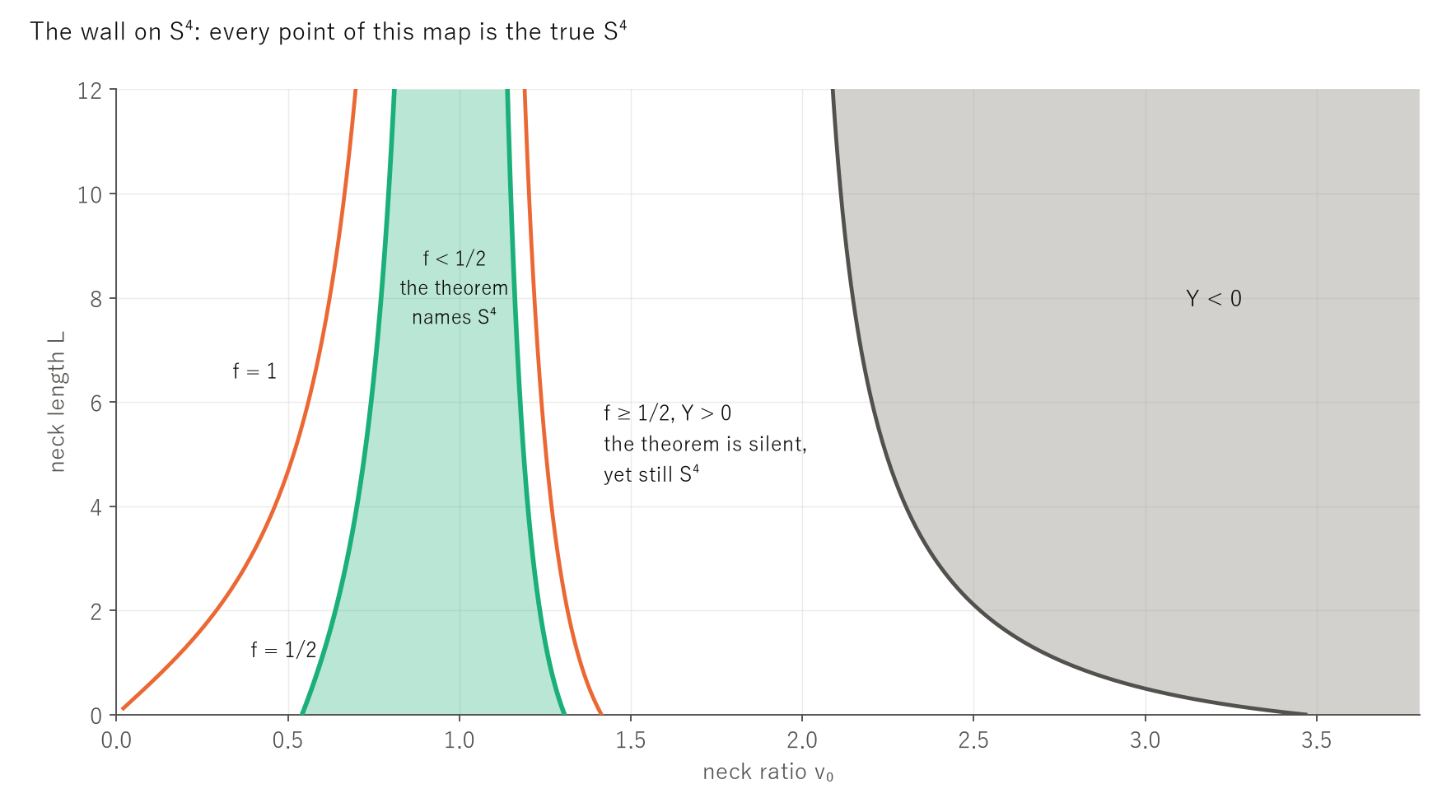
The whole map is the standard $S^4$. The half wall says that on the near side there is a sphere; it does not say that beyond it there is not. The wall has only one side. The size of $f$ for one metric does not tell whether the space is standard. If anything can tell, it is the infimum $\mathfrak f$ of Section 3.
8. Stationary Metrics and the Way Down
Lowering $f$, where does it stop? The critical points of $\int\|W\|^2$ are the Bach-flat metrics, and a metric stationary among symmetric metrics is stationary among all (Palais 1979). Since $D_+$ and $D_-$ differ by an exact derivative, the equations on the path come from either one. With $y=(E-G)/(3v)$ the Euler–Lagrange equations are
$$\ddot v-3v\dot v+v^3-v=3vy,\qquad \ddot y+3v\dot y+(3v^2-1)y-\frac32y^2=0$$(checked by symbolic computation). Linearizing near the point $(v,\dot v,y,\dot y)=(1,0,0,0)$, the exponents on the side of $v$ are $+1,+2$ and on the side of $y$ are $-1,-2$. The set $y\equiv0$ is invariant and contains the directions with exponents $+1,+2$, so the unstable manifold of this point is exactly $y\equiv0$.
The binding by a point cap. A Bach-flat path whose end $t\to-\infty$ is a point cap approaches this point, so $y\equiv0$, that is, $W^+\equiv0$ throughout. If the end $t\to+\infty$ is a point cap, then by reversal $W^-\equiv0$ throughout.
A path on $S^4$ has point caps at both ends, so both hold at once, $E=G=0$ and $v\equiv1$. In the family of $S^3$ shells, the only stationary metrics on $S^4$ are those conformal to the round one. On $\mathbb{CP}^2$, a smooth point cap forces $p=1$, so the slope at the surface is 1/2. The slope of a self-dual path at the surface is $|\dot v|=1/(1+A/(2\sqrt B))$, so $A=2\sqrt B$, which is FS. $A=0$ is Eguchi–Hanson with slope 1, and for $A<0$ the slope exceeds 1 and gives $p=3,4,\dots$, but in each case the point side is $\mathbb{R}^4/\mathbb{Z}_p$ (slope 1.500000 at $A=-2/3$, $B=1$, and 2.000000 at $A=-1$).
With surfaces at both ends there is no binding, and stationary metrics that are not self-dual open up here. By Liu and coauthors (2013), every biaxial Bach-flat metric is locally conformally Einstein.
Shifting $t$ does not change the functional of the path, so by the theorem of Noether (1918)
$$H=-\dot v\dot y+\frac32vy^2+(v-v^3)y$$is conserved. At a point cap $y\equiv0$ and $H=0$. At a surface $H=-\dot v\dot y$, and a smooth closure has $\dot y=0$, so again $H=0$. A solution that closes smoothly has $H\equiv0$ and is Bach-flat.
The metric of Page (1978) is an example. With $\Lambda=3$, $a^2=N^2-\rho^2$, $b^2=4N^2\mathcal D/(N^2-\rho^2)$, $ds^2=(N^2-\rho^2)d\rho^2/\mathcal D$, $\mathcal D=\rho^4+(1-6N^2)\rho^2+N^2-3N^4$ satisfies $\mathrm{Ric}=3g$. Placing surfaces at $\rho=\pm\nu N$ gives $N^2=(1+\nu^2)/(3+6\nu^2-\nu^4)$, and the surface condition is
$$p=\frac{4\nu(3+\nu^2)}{3+6\nu^2-\nu^4}.$$The right side increases from 0 to 2 on $0<\nu\leqq1$ (0.393477, 1.464789, 1.903969, 2.000000 at $\nu=0.1$, 0.5, 0.9, 1). On this Einstein branch only $p=1$ closes on surfaces, and $S^2\times S^2$ with $p=2$ is out of reach. $p=1$ becomes the quartic
$$\nu^4+4\nu^3-6\nu^2+12\nu-3=0$$with root $\nu=0.28170156$. The quartic is irreducible with Galois group $S_4$ of order 24 (solvable, so $\nu$ is written in radicals). The share is
$$f=1-\frac{4\nu(3-\nu^2)(1+\nu^2)^2}{(3+6\nu^2-\nu^4)^2}=0.68155171.$$Without the formula, shooting the ordinary differential equations with $\Lambda=3$ from the surface gives base size 0.535147712, $\int Q$ of 10.19034504 times $\pi^2$, $\int\|W\|^2$ of 21.80965419 times, sum 31.99999923 times, and $f$ equal to 0.68155169, matching the closed form. Along that path $|H|$ is at most $1.098\times10^{-7}$.
Another branch. A mirror-symmetric path has $\dot v=0$ at the central shell, so $H=y(\frac32vy+v-v^3)$, and $H=0$ gives $y=\frac23(v^2-1)$ or $y=0$. The former is the branch of Page ($v<1$; the central ratio of Page is 0.51689701), and the latter is a branch on which $W=0$ at the central shell. The latter reaches a surface for $v>1$, with $p$ rising from just above 2. Numerically, for $p=3$, 4, 5, 6 the central ratio is 1.09649243, 1.22081574, 1.33814385, 1.44743303 and $f$ is 0.91248097, 1.10480532, 1.30613722, 1.51140527 ($p=4,6$ are $S^2\times S^2$ and $p=3,5$ are $\mathbb{CP}^2\#(-\mathbb{CP}^2)$). At the ends $|\dot y|$ is at most $10^{-13}$, so the closure is smooth, and the scalar curvature $\hat R$ of the cylinder is positive (minimum 1.803443 at $p=3$), so $Y>0$. Each half is conformal to an Einstein metric of negative constant (checked at $p=3,4$), and the conformal factor diverges at the central shell, so these are Bach-flat metrics that are not conformally Einstein as a whole. This was found numerically and is not proved. $p=2$ is on neither branch. The values of $f$ are above the floor 2/3 of Gursky.
Descent. If the only stationary point on $S^4$ in the family is round, lowering $\mathcal Y$ should return to round. An $L^2(dt)$ gradient on the path was run implicitly (this is not the true Bach flow but a descent inside the family). Starting from $v_0=0.4$ with neck length 4 ($f$ is 1.081920 by formula and 1.080617 on the grid), $f$ fell at all 260 steps, reaching 0.82814668 at $\tau=0.7247$ and 0.00428831 at 2.8861, heading to 0. Along the way the floor rises for a while from 0.70664548 to 0.74398157 at $\tau=0.1788$, while the minimum of $v$ falls from 0.399222 to 0.370751. Even so, no step had $f$ below the floor. Starting from $v_0=1.5$, neck 1, it fell from 2.332855 to $2.017\times10^{-13}$ with 0 rising steps.
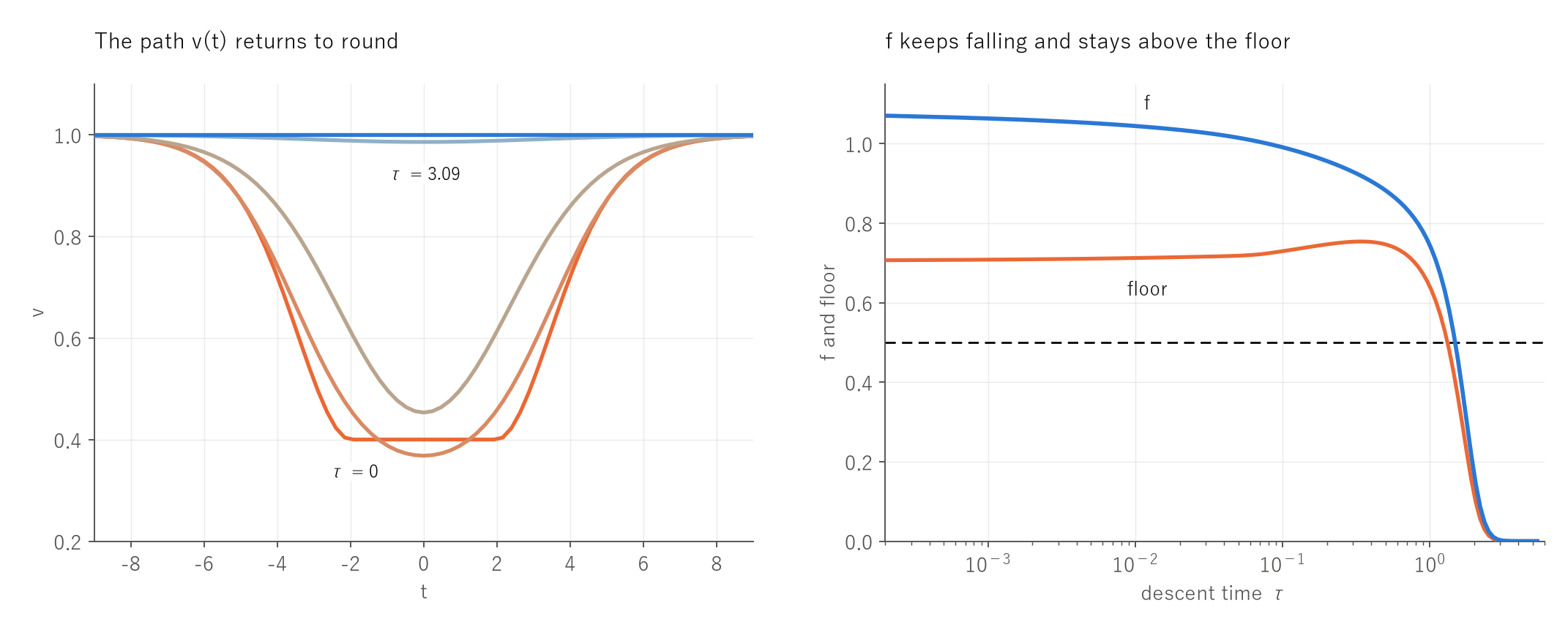
The Ricci flow need not lower $f$. Running the Ricci flow on $S^2\times S^2$ with squared radii $(2,1)$, the squared radii go to $(1.8,0.8)$, $(1.4,0.4)$, $(1.1,0.1)$ and $f$ rises from 0.750000 to 0.782407, 0.964286, 2.181818. On the other hand, running the three-dimensional Ricci flow on a Berger shell gives $\partial_\tau\ln v=(1-v^2)/a^2$, the ratio moves to 1, and with initial $a$ equal to 1 the floor of the shell falls by $\tau=0.45$ from 0.7056 to 0.2221 for $v_0=0.4$ and from 2.4336 to 0.1031 for $v_0=1.6$. The three-dimensional flow erases the floor of the shell, but the four-dimensional flow need not reduce the share.
9. What Numbers Cannot Separate
$(\chi,\tau)$ decides the total but not the space. $S^2\times S^2$ and $\mathbb{CP}^2\#(-\mathbb{CP}^2)$ are both $(4,0)$ with total $32\pi^2$. The floor of Gursky gives $\mathfrak f(S^2\times S^2)=2/3$, reached by the product metric. $\mathbb{CP}^2\#(-\mathbb{CP}^2)$ carries no Kähler–Einstein metric, so $f>2/3$ for every metric with $Y>0$, and the smallest known value is the 0.681552 of Page (LeBrun (2014) showed that the Page metric is minimal within a certain class of conformal classes). Whether the infimum exceeds 2/3 is not known. Spaces homeomorphic to $S^4$ also have the same total with $(\chi,\tau)=(2,0)$, so a difference, if any, lies on the side of the division and not on the side of the number. That is the view of this paper.
One reading is recorded. Many tools that distinguish smooth structures in dimension four (the theories of Donaldson and of Seiberg and Witten) take two-dimensional surfaces as their grip. In the family the second Betti number is the number of surfaces, and $S^4$ is (point, point) with no surface. Having no surface to grip and being hard for the tools to reach have the same shape. This is a reading, not a claim extended outside the family.
Meanwhile the exotic candidates have been disappearing by another road. Some Cappell–Shaneson spheres were shown standard by Akbulut (2010) and Gompf (2010). So far nothing joins the candidates turning out standard with the gap in $\mathfrak f$.
10. What Is Known and What Is Not
What is known is a statement inside this family.
- The total is decided by how the ends close: a point $8\pi^2$, a surface $16\pi^2$, a neck 0.
- $W$ is written by the ratio $v$ alone, and $W^+=0$ falls to a linear equation.
- For every shell $f\geqq(1-v^2)^2+2\dot v^2$, and the paths with equality at a turning shell are Pedersen balls back to back.
- If $f<1/2$, every shell ratio lies between 0.5412 and 1.3066, and beyond the wall there are as many $S^4$ with $Y>0$ as one likes.
- A point cap binds stationary metrics to self-duality, and the only stationary metrics on $S^4$ are conformal to the round one.
- Stationary paths closing on two surfaces have two branches: that of Page, and one on which $W$ vanishes at the central shell.
What is not known is also recorded.
- Whether an exotic $S^4$ exists.
- If it exists, whether it carries a metric with $Y>0$ (not checked). If not, $\mathfrak f=\infty$.
- The value of $\mathfrak f(\mathbb{CP}^2\#(-\mathbb{CP}^2))$: whether it is the value of Page, and whether it exceeds 2/3.
- Outside the family, how close the eta of the most squashed shell can come to $f$. Inside the family equality is reached; outside it is unknown.
- Whether the 2+2 of the disk and the 2×2 of the curvature share a root. The self-intersection $p$ of a surface does not appear in the total and enters the signature as $p/3$, but this alone does not make them the same root.
11. Appendix A: Curvature Formulas
In the orthonormal frame $e^0=ds$, $e^1=a\sigma_1$, $e^2=a\sigma_2$, $e^3=b\sigma_3$ the Cartan structure equations give
$$K_{01}=-\frac{a''}{a},\quad K_{03}=-\frac{b''}{b},\quad K_{12}=\frac{1-a'^2}{a^2}-\frac{3b^2}{4a^4},\quad K_{13}=-\frac{a'b'}{ab}+\frac{b^2}{4a^4},$$ $$R_{0312}=\frac{ab'-a'b}{a^3},\qquad R_{0123}=-\frac{ab'-a'b}{2a^3}.$$The Ricci curvature is diagonal,
$$\mathrm{Ric}_{00}=-\frac{b''}{b}-\frac{2a''}{a},\quad \mathrm{Ric}_{11}=\mathrm{Ric}_{22}=-\frac{a''}{a}-\frac{a'b'}{ab}+\frac{1-a'^2}{a^2}-\frac{b^2}{2a^4},\quad \mathrm{Ric}_{33}=-\frac{b''}{b}-\frac{2a'b'}{ab}+\frac{b^2}{2a^4}.$$In the basis $e^{01}\pm e^{23}$, $e^{02}\pm e^{31}$, $e^{03}\pm e^{12}$ of 2-forms the $\pm$ blocks of the curvature operator are diagonal with trace $R/4$; removing the trace gives the $\lambda_\pm$ of Section 5. The first Bianchi identity, the vanishing of torsion, and that the derivatives of $T$ and $U$ equal the densities were checked by symbolic computation. As Einstein checks, the Pedersen form gives $\mathrm{Ric}=-3g$, the complex hyperbolic plane $\mathrm{Ric}=-6g$ and the Page form $\mathrm{Ric}=3g$.
12. Appendix B: Numerical Procedure
Integrals along a path use Gauss–Legendre quadrature with subintervals near the ends. Direct integrals convert $t$-derivatives to $s$-derivatives by the chain rule and enter the curvature formulas. Lowest eigenvalues use shooting: the Riccati equation of the solution decaying at infinity is integrated up to the turning shell. To obtain eta from the eigenvalues of Hitchin ($\lambda/2+n/\lambda$ with multiplicity $2n$, and $\lambda/2\pm\lambda^{-1}\sqrt{4pq\lambda^2+(p-q)^2}$ with multiplicity $p+q$), $\sum\mathrm{sign}(\mu) \mathrm{erfc}(|\mu|\sqrt\tau)$ was computed at $\tau=10^{-3}$ and $5\times10^{-4}$ and extrapolated to $\tau\to0$. The form of these eigenvalues was not checked in the original paper of Hitchin; it was checked by reproducing $\pm(3/2+k)$ with multiplicity $(k+1)(k+2)$ on the round $S^3$ at $\lambda=1$ and by the appearance of 0 at $\lambda=4$.
Closing
The round sphere in dimension four is the place where Q holds the whole curvature total 16π². The total does not move, so distortion only moves an amount from Q to W, and that amount is measured by the ratio on the shells. One number, the ratio of the Hopf fibre to its base, writes all of W, and the most squashed shell sets the floor. As long as the shells close at points, the only place to stop is the round metric. The wall has only one side, and the size for one metric does not tell what the space is. What should be read is the infimum, and that number is so far known on very few spaces.
References
- Akbulut, S. (2010). Cappell-Shaneson homotopy spheres are standard. Annals of Mathematics.
- Atiyah, M. F., Patodi, V. K., and Singer, I. M. (1975). Spectral asymmetry and Riemannian geometry. I. Mathematical Proceedings of the Cambridge Philosophical Society.
- Aubin, T. (1976). Équations différentielles non linéaires et problème de Yamabe concernant la courbure scalaire. Journal de Mathématiques Pures et Appliquées.
- Bogomolny, E. B. (1976). The stability of classical solutions. Soviet Journal of Nuclear Physics.
- Chang, S.-Y. A., Gursky, M. J., and Yang, P. C. (2003). A conformally invariant sphere theorem in four dimensions. Publications Mathématiques de l’IHÉS.
- Chern, S.-S. (1944). A simple intrinsic proof of the Gauss-Bonnet formula for closed Riemannian manifolds. Annals of Mathematics.
- Eguchi, T., and Hanson, A. J. (1978). Asymptotically flat self-dual solutions to Euclidean gravity. Physics Letters B.
- Freedman, M. H. (1982). The topology of four-dimensional manifolds. Journal of Differential Geometry.
- Gompf, R. E. (2010). More Cappell-Shaneson spheres are standard. Algebraic and Geometric Topology.
- Gursky, M. J. (1998). The Weyl functional, de Rham cohomology, and Kähler-Einstein metrics. Annals of Mathematics.
- Gursky, M. J. (1999). The principal eigenvalue of a conformally invariant differential operator, with an application to semilinear elliptic PDE. Communications in Mathematical Physics.
- Hawking, S. W. (1977). Gravitational instantons. Physics Letters A.
- Hitchin, N. J. (1974). Harmonic spinors. Advances in Mathematics.
- Hitchin, N. J. (1997). Einstein metrics and the eta-invariant. Bollettino dell’Unione Matematica Italiana.
- Kuiper, N. H. (1949). On conformally-flat spaces in the large. Annals of Mathematics.
- LeBrun, C. (2014). Weyl curvature, Del Pezzo surfaces, and almost-Kähler geometry. Journal of Geometric Analysis.
- LeBrun, C. (2023). Curvature in the balance: the Weyl functional and scalar curvature of 4-manifolds. Pure and Applied Mathematics Quarterly.
- Liu, H.-S., Lü, H., Pope, C. N., and Vázquez-Poritz, J. F. (2013). Not conformally Einstein metrics in conformal gravity. Classical and Quantum Gravity.
- Margerin, C. (1998). A sharp characterization of the smooth 4-sphere in curvature terms. Communications in Analysis and Geometry.
- Maschler, G. (2008). The eta invariant in the doubly Kählerian conformally compact Einstein case. arXiv:0805.1646.
- Noether, E. (1918). Invariante Variationsprobleme. Nachrichten von der Gesellschaft der Wissenschaften zu Göttingen.
- Page, D. N. (1978). A compact rotating gravitational instanton. Physics Letters B.
- Palais, R. S. (1979). The principle of symmetric criticality. Communications in Mathematical Physics.
- Pedersen, H. (1986). Einstein metrics, spinning top motions and monopoles. Mathematische Annalen.
- Perelman, G. (2002). The entropy formula for the Ricci flow and its geometric applications. arXiv:math/0211159.
- Taubes, C. H. (1992). The existence of anti-self-dual conformal structures. Journal of Differential Geometry.
- Wall, C. T. C. (1964). On simply-connected 4-manifolds. Journal of the London Mathematical Society.
- Yamagishi, Y. (2026). The Uniqueness Theorem of $n=2$ for Spherically Symmetric Density Distributions [Paper 01]. YOI: https://www.yamagishiyuuki.com/yoi/1; DOI: 10.5281/zenodo.21403186
- Yamagishi, Y. (2026). A Structural Interpretation of the 4D Poincaré Conjecture and Exotic Structures [Paper 08]. YOI: https://www.yamagishiyuuki.com/yoi/8; DOI: 10.5281/zenodo.21404419
- Yamagishi, Y. (2026). Making the Curvature Constant Does Not Fix the Density [Paper 23]. YOI: https://www.yamagishiyuuki.com/yoi/23; DOI: 10.5281/zenodo.22090231
- Yamagishi, Y. (2026). An Area Is Not a Solid Angle [Paper 45]. YOI: https://www.yamagishiyuuki.com/yoi/45; DOI: 10.5281/zenodo.21602337
- Yamagishi, Y. (2026). The Pfaffian’s $2^n n!$ Is One Block [Paper 48]. YOI: https://www.yamagishiyuuki.com/yoi/48; DOI: 10.5281/zenodo.21602525
- Yamagishi, Y. (2026). Flowing Geometry to Canonical Form [Paper 103]. YOI: https://www.yamagishiyuuki.com/yoi/103; DOI: 10.5281/zenodo.21836801
- Yamagishi, Y. (2026). The Geometry of Dimensional Lift [Paper 109]. YOI: https://www.yamagishiyuuki.com/yoi/109; DOI: 10.5281/zenodo.21837375
- Yamagishi, Y. (2026). $4\pi=2\pi\chi$ Holds in Three Dimensions and Nowhere Else [Paper 128]. YOI: https://www.yamagishiyuuki.com/yoi/128; DOI: 10.5281/zenodo.22079576
- Yamagishi, Y. (2026). The Poincaré Conjecture Is a Different Question in Each Category, and Only Dimension Four Stays Open in Both PL and Smooth [Paper 1003]. YOI: https://www.yamagishiyuuki.com/yoi/1003; DOI: 10.5281/zenodo.22823587
- Yamagishi, Y. (2026). The “2” of the Inverse-Square Density Is Two 2s, and the 2 of the Shell Mass Meets the 2 of the Horizon Balance Only in Three Dimensions [Paper 1092]. YOI: https://www.yamagishiyuuki.com/yoi/1092
Reference
Yamagishi, Y. (2026). On the Four-Sphere, Q and W Share 16π², and the Most Squashed Shell Sets a Floor under the Share of W [Paper 1105]. YOI: https://www.yamagishiyuuki.com/yoi/1105
ORCID: 0009-0006-8587-3450
PDF (English) · PDF (Japanese) · Date proof of the English PDF (OpenTimestamps .ots) · SHA256SUMS
The record page for this paper (in Japanese, with the PDFs in each language and the date proof): YOI 1105. This paper is a preprint and has not been peer reviewed.