Abstract
Draw a circle of radius r on flat paper and its circumference is 2πr. On a curved surface, the ring of points at distance r from a centre, measured along the surface (a geodesic circle), has a circumference that departs from 2πr. This paper counts what that departure measures. It claims no new theorem and no new law.
First, a circle on a sphere falls short in circumference, and the shortfall divided by the cube of the radius gives the curvature. From a point of a sphere of radius 1, 8192 geodesics were shot to form the ring, and the circumference was measured in two ways, as a polygon and by Jacobi’s equation (difference at most 10⁻⁵). The quantity 3(2πr − C)/(πr³) was 0.992030409 at r = 0.4 and 0.999980000 at 0.02, approaching the curvature 1 of the sphere. The value from the shortfall of area also approaches 1, and the fraction by which the circumference falls short approaches twice the fraction for the area (1.999987) (Section 2).
Second, circles on the Earth fall short too. Taking the Earth as a sphere of radius 6371 km, a circle of radius 100 km falls 25.7993 m short of 2πr and one of 1000 km falls 25.767863 km short, so the measured ratio of circumference to diameter is 3.128708722. In celestial navigation, the circle of position joining the points where a star stands at the same altitude has a circumference of only 0.954930 of 2π times its radius at an altitude of 60 degrees, and 0.826993 at 30 degrees (Section 3).
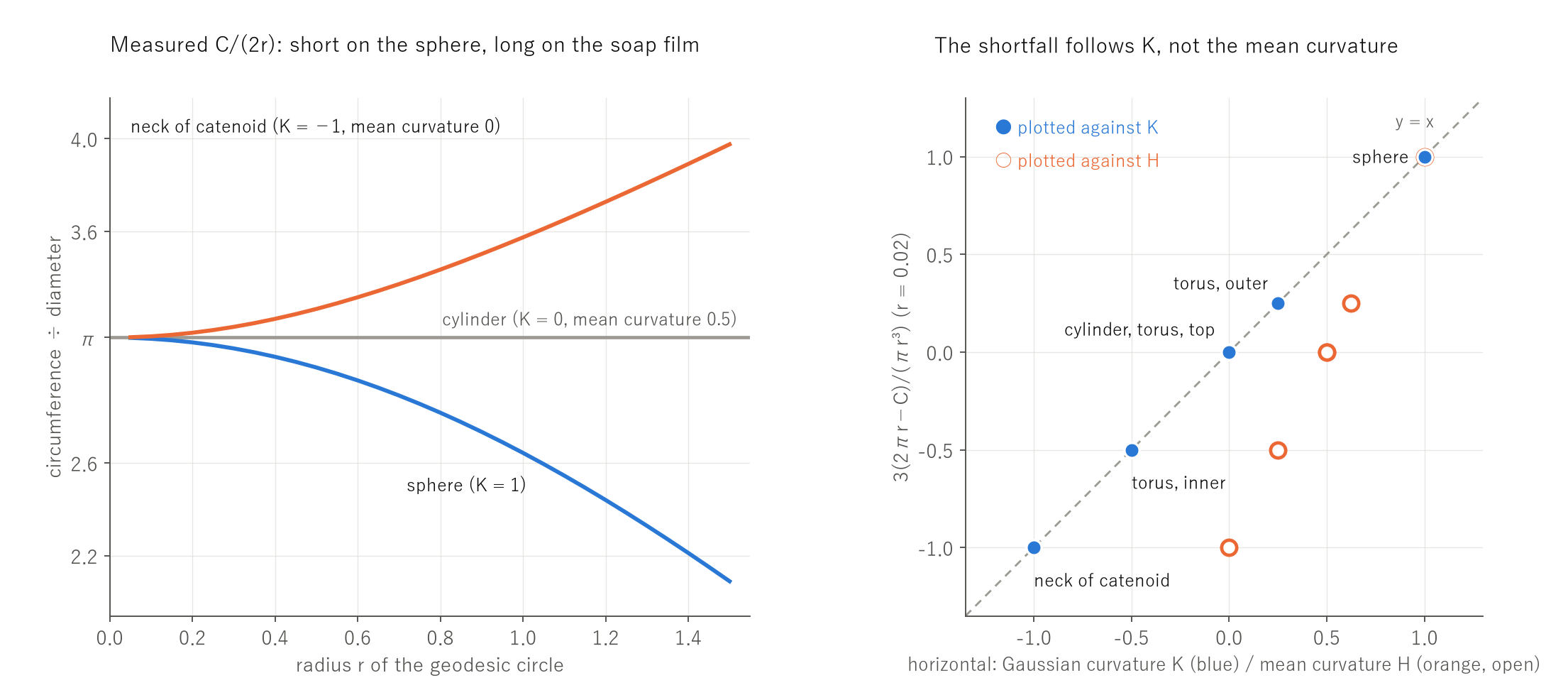
Third, and this is the core of the paper: the shortfall of circumference measures the curvature within the surface, not the curvature seen from outside. A cylinder of rolled paper looks curved from outside (mean curvature 0.500000), yet circles drawn on it were exactly 2πr up to radius 3 (difference at most 8.9×10⁻¹³). The soap film of Paper 1102 (a catenoid) has mean curvature 0, yet circles on its neck have too much circumference, and 3(2πr − C)/(πr³) approached −1 as −0.999900019. On a torus the value approached 0.25 on the outer equator, −0.5 on the inner equator and 0 on the top, each agreeing with the curvature within the surface (the Gaussian curvature) (Section 4).
Fourth, moving the dimension changes the coefficients of the shortfall. For a small ball on a d-dimensional sphere, the shortfall of surface area ÷ r² is (d − 1)/6 and the shortfall of volume ÷ r² is d(d − 1)/(6(d + 2)); their ratio falls from 2 in two dimensions to 1.666667 in three and 1.500000 in four. In a space of negative curvature there is an excess of the same size (Section 5).
To be candid, the Earth was taken as a sphere. The gravitational question of measuring the curvature of space by an excess in the radius of a ball is not entered.
Keywords: geodesic circle, circumference deficit, Gaussian curvature, mean curvature, Theorema Egregium, celestial navigation, dimension, separator.
Scope (what is not claimed)
No new theorem or law is claimed. That the curvature of a surface (the Gaussian curvature) is fixed by lengths within the surface alone (Gauss 1828), that the curvature follows from the shortfall of circumference and area of small circles (Bertrand, Diguet and Puiseux 1848), the circumference of circles on a sphere, and the surface area and volume of balls in spaces of constant curvature are all known. No theorem is proved. The limits are checked numerically only. The Earth is taken as a sphere. It is a model of radius 6371 km, without flattening. No corrections of celestial navigation. Refraction, dip and semi-diameter are not treated. No gravity. The view that measures the curvature of space by an excess in the radius of a ball is not entered. Relation to earlier papers: In its scope note Paper 807 approximated with a plane, took lines of position as straight, and left out the curvature of the Earth. This paper takes that seat (no earlier occupant). It puts the curvature of the Earth in and counts that the ring of points where a star stands at the same altitude falls short of 2π times its radius. In its scope note Paper 208 measured three dimensions only and moved the dimension only of flat space. This paper places itself beside that seat. It moves the dimension of a curved space and counts the coefficients of the shortfall of area and volume of small balls. The growth of volume at large radii is not entered. Paper 1102 showed that a soap film between two rings is a catenoid. Here that film, though not curved on average, is counted as giving circles too much circumference. Paper 1027 showed that the rim of a rotating disk is longer than π times its diameter and that the space of the disk is negatively curved. The reading of circumference used here is the same reading as for that disk. Paper 27 separated which manifold one means when saying that curvature was measured. Here the curvature of the same surface is measured by length rather than by angle. What is added: shooting geodesics to form rings, measuring their circumference in two ways and checking the limits; giving the shortfalls of circles on the Earth and of circles of position in celestial navigation; showing at six points of a cylinder, a catenoid, a torus and a sphere that the shortfall follows the Gaussian curvature and not the mean curvature; and moving the dimension of a curved space to give the coefficients and their ratio.
1. Question
Paper 807 counted the errors in fixing a position by celestial navigation, and in its scope note it approximated with a plane, took lines of position as straight, and left out the curvature of the Earth. This paper takes that seat. It counts how the ring of points where a star stands at the same altitude differs from a circle drawn on flat paper once the curvature of the Earth is put in.
From a point p of a curved surface, go along the shortest paths in the surface (geodesics) in every direction for a length $r$; the ring of points reached is called the geodesic circle of radius $r$. Write $C(r)$ for its circumference and $A(r)$ for the area it encloses. On a flat surface $C=2\pi r$ and $A=\pi r^{2}$. Question: When $C$ departs from $2\pi r$ on a curved surface, does the departure measure the curvature seen from outside, or the curvature within the surface?
2. A circle on a sphere falls short
Calculation 2.1: From a point at colatitude 0.9 of a sphere of radius 1, geodesics were shot in 8192 and 4096 directions with RK4 (800 steps). The circumference was measured in two ways. One is the length of the polygon through the end points placed in three dimensions, extrapolated from doubling the number of directions. The other solves Jacobi’s equation $J''+KJ=0$ ($J(0)=0$, $J'(0)=1$) along each geodesic and integrates over directions the spread $J$ obtained by shifting the direction. The area integrates $J$ along the path as well. The tool returned the circumference 3.141592653590 ($2\pi r$, $r=0.5$) and the area 0.785398163397 on a flat surface, and agreed within $10^{-9}$ with the closed form $2\pi\sin r$ for a circle of radius 0.7 on the sphere.
| $r$ | $C/(2r)$ | $3(2\pi r-C)/(\pi r^{3})$ polygon | Jacobi | $12(\pi r^{2}-A)/(\pi r^{4})$ | ratio of shortfalls |
|---|---|---|---|---|---|
| 0.4 | 3.058484508 | 0.992030409 | 0.992030409 | 0.994681878 | 1.994669 |
| 0.2 | 3.120690551 | 0.998001904 | 0.998001904 | 0.998667619 | 1.998667 |
| 0.1 | 3.136359283 | 0.999500119 | 0.999500119 | 0.999666726 | 1.999667 |
| 0.05 | 3.140283820 | 0.999875007 | 0.999875007 | 0.999916670 | 1.999917 |
| 0.02 | 3.141383218 | 0.999980000 | 0.999980000 | 0.999986667 | 1.999987 |
Observation 2.2 A circle on a sphere falls short in circumference, and the shortfall divided by the cube of the radius gives the curvature 1 of the sphere. The measured ratio $C/(2r)$ is smaller than π, the more so the larger $r$ is. The value from the shortfall of area also approaches 1, and the fraction $(2\pi r-C)/(2\pi r)$ by which the circumference falls short approached twice the fraction $(\pi r^{2}-A)/(\pi r^{2})$ for the area (1.999987).
3. Circles on the Earth, and circles of position
Calculation 3.1: Taking the Earth as a sphere of radius $R=6371$ km, the shortfall of circumference is $2\pi r-2\pi R\sin(r/R)$. A circle of radius 10 km falls 0.0258 m short, one of 100 km 25.7993 m and one of 1000 km 25.767863 km, and the measured ratio of circumference to diameter for 1000 km was 3.128708722. The small-circle approximation $\pi r^{3}/(3R^{2})$ gives 25.799626 km at 1000 km.
Calculation 3.2: The points where a star stands at the same altitude lie on a geodesic circle centred at the point beneath the star, with a radius on the ground equal to the angle (90 degrees minus the altitude) (the circle of position).
| altitude of star | radius (km) | circumference (km) | $2\pi\times$ radius (km) | ratio | shortfall (km) |
|---|---|---|---|---|---|
| 80 deg | 1111.9 | 6951.2 | 6986.6 | 0.994931 | 35.4 |
| 60 deg | 3335.8 | 20015.1 | 20959.7 | 0.954930 | 944.7 |
| 30 deg | 6671.7 | 34667.1 | 41919.5 | 0.826993 | 7252.4 |
Observation 3.3 Because of the curvature of the Earth, a circle of position is shorter than 2π times its radius. Treating the line of position as straight approximates a very small part of the circle; over the whole ring, the circle of a star at altitude 30 degrees has a circumference of only 0.826993 of 2π times its radius.
4. The circumference measures the curvature within the surface
Calculation 4.1: With the same tool, $3(2\pi r-C)/(\pi r^{3})$ was found at six points: a cylinder (radius 1), a catenoid (neck radius 1, the shape of the soap film of Paper 1102), the outer equator, inner equator and top of a torus (central circle of radius 3, tube of radius 1), and a sphere. $K$ is the Gaussian curvature (the product of the two principal curvatures) and $H$ the mean curvature (their average), both from the formulas of the surfaces.
| surface and point | $K$ | $H$ | $r=0.1$ | $r=0.05$ | $r=0.02$ |
|---|---|---|---|---|---|
| cylinder | 0 | 0.500000 | 0 | 0 | 0 |
| neck of catenoid | $-1$ | 0 | $-0.997511835$ | $-0.999375743$ | $-0.999900019$ |
| outer equator of torus | 0.25 | 0.625000 | 0.249828156 | 0.249957033 | 0.249993125 |
| inner equator of torus | $-0.5$ | 0.250000 | $-0.499562782$ | $-0.499890643$ | $-0.499982500$ |
| top of torus | 0 | 0.500000 | $-0.000083284$ | $-0.000020830$ | $-0.000003333$ |
| sphere | 1 | 1 | 0.999500119 | 0.999875007 | 0.999980000 |
Observation 4.2 A circle on a cylinder of rolled paper falls short not at all. The cylinder looks curved from outside (mean curvature 0.500000), yet the circumferences of circles of radius 0.5, 1.5 and 3.0 differed from $2\pi r$ by at most $8.9\times10^{-13}$ (up to the point where the ring would wrap round the cylinder onto itself). Rolling flat paper does not change lengths on the paper.
Observation 4.3 On a soap film whose mean curvature is zero, the circumference is instead too long. At the neck of the catenoid, a circle of radius 0.1 had a circumference 1.001662520 times $2\pi r$, and $3(2\pi r-C)/(\pi r^{3})$ approached $-1$. The two principal curvatures cancel, so their average is 0, but their product is $-1$.
Observation 4.4 This is the core of the paper. The separator is whether a curvature is fixed by lengths within the surface or seen from outside. At all six points, $3(2\pi r-C)/(\pi r^{3})$ approached the Gaussian curvature $K$ and did not line up with the mean curvature $H$: the cylinder and the top of the torus, both with $H=0.5$, approach 0, and the neck of the catenoid, with $H=0$, approaches $-1$. Circumference is measured by walking on the surface, so the part of the outer shape that changes when paper is merely rolled without stretching does not enter (Gauss’s Theorema Egregium). On the top of the torus $K=0$ but the curvature changes from place to place, so the value approached 0 in proportion to the square of $r$ (the three values of $r$ in the table).
5. Moving the dimension
Calculation 5.1: On the unit $d$-dimensional sphere, the surface area of a small ball of radius $r$ is proportional to $\sin^{d-1}r$. The fractions by which the surface area and the volume fall short were divided by $r^{2}$ and extrapolated from $r=0.02$ and $0.01$.
| dimension $d$ | shortfall of surface area $\div r^{2}$ | shortfall of volume $\div r^{2}$ | ratio |
|---|---|---|---|
| 2 | 0.166667 | 0.083333 | 2.000000 |
| 3 | 0.333333 | 0.200000 | 1.666667 |
| 4 | 0.500000 | 0.333333 | 1.500000 |
| 5 | 0.666667 | 0.476190 | 1.400000 |
Observation 5.2 The coefficient for surface area is $(d-1)/6$, that for volume is $d(d-1)/(6(d+2))$, and their ratio is $(d+2)/d$. That circumference and area fall short by a factor of 2 apart in two dimensions is because the dimension is 2; in three dimensions the ratio is 1.666667. In a three-dimensional space of curvature $-1$, the surface area of a ball exceeded $4\pi r^{2}$ with the same coefficient 0.333333. The surface area of the ball in velocity space in Paper 60 is larger than $4\pi r^{2}$ by this excess.
Observation 5.3 Paper 208 showed that curvature does the same work as dimension in the growth of volume, and in its scope note it measured three dimensions only and moved the dimension only of flat space. This paper places itself beside that seat. Here the dimension of a curved space is moved, and the coefficients for small balls are counted. Growth at large radii belongs to 208.
6. Relation to earlier papers
Observation 6.1 Paper 1027 showed that the rim of a rotating disk is longer than π times its diameter and that the space of the disk has curvature $-3\Omega^{2}/c^{2}$. Reading a negative curvature from a circumference that is too long is the same reading as for the neck of the catenoid here. The curvature of the disk is not measured again.
Observation 6.2 Paper 27 separated which manifold one means when saying that curvature was measured, and Paper 409 showed that there is no undistorted map and that the projection is not to blame. This paper measured the curvature of the same sphere by the shortfall of circumference rather than by the excess of angles. A map that draws distances from the centre correctly must stretch the circumference that falls short on the sphere out to $2\pi r$ on flat paper, and so it distorts.
7. What the checks showed
The two ways of measuring the circumference agreed within $10^{-5}$ at every point and radius. Going from 4096 to 8192 directions lengthened the polygon by $2.3\times10^{-7}$, and the extrapolation removed that amount. On the sphere the limiting value approached 1 monotonically as $r$ shrank, but at no $r$ did it equal 1 (the limits are checked numerically only).
Closing
Closing: the circumference of a circle drawn on a curved surface departs from 2πr, and the shortfall divided by the cube of the radius gives the curvature within the surface (the Gaussian curvature). A circle of radius 1000 km on the Earth falls 25.77 km short, and a circle of position of a star at altitude 30 degrees has only 0.826993 of 2π times its radius. A circle on a cylinder of rolled paper falls short not at all, and a circle on a soap film of zero mean curvature has too much circumference. What the circumference measures is not the curvature seen from outside but the curvature that can be measured by walking on the surface. Moving the dimension changes the coefficients, and the ratio 2 between the shortfalls of circumference and area becomes 5/3 in three dimensions.
References
- Bertrand, J. (1848). Démonstration d’un théorème de M. Gauss. Journal de Mathématiques Pures et Appliquées.
- Diguet (1848). Note de M. Diguet. Journal de Mathématiques Pures et Appliquées.
- Gauss, C. F. (1828). Disquisitiones generales circa superficies curvas. Commentationes Societatis Regiae Scientiarum Gottingensis Recentiores.
- Puiseux, V. (1848). Sur le même théorème. Journal de Mathématiques Pures et Appliquées.
- Yamagishi, Y. (2026). “We Measured the Curvature” — of Which Manifold? [Paper 27]. YOI: https://www.yamagishiyuuki.com/yoi/27; DOI: 10.5281/zenodo.22090333
- Yamagishi, Y. (2026). $c$ as the Ball of Velocity Space [Paper 60]. YOI: https://www.yamagishiyuuki.com/yoi/60; DOI: 10.5281/zenodo.21598012
- Yamagishi, Y. (2026). Curvature Does the Same Work as Dimension [Paper 208]. YOI: https://www.yamagishiyuuki.com/yoi/208; DOI: 10.5281/zenodo.22111071
- Yamagishi, Y. (2026). There Is No Undistorted Map, and the Projection Is Not to Blame [Paper 409]. YOI: https://www.yamagishiyuuki.com/yoi/409; DOI: 10.5281/zenodo.22699616
- Yamagishi, Y. (2026). A Celestial Fix Improves with a Right-Angle Crossing Against Random Error and with Surrounding Stars Against Common Bias [Paper 807]. YOI: https://www.yamagishiyuuki.com/yoi/807; DOI: 10.5281/zenodo.23015447
- Yamagishi, Y. (2026). The Spatial Curvature of a Rotating Disk Is −3Ω²/c², and Its Argument Differs from the −1/c² of Velocity Space [Paper 1027]. YOI: https://www.yamagishiyuuki.com/yoi/1027; DOI: 10.5281/zenodo.22860239
- Yamagishi, Y. (2026). A Soap Film between Two Rings Breaks at a Gap of 1.3255 Radii, While a Chain of the Same Shape Always Hangs [Paper 1102]. YOI: https://www.yamagishiyuuki.com/yoi/1102
Reference
Yamagishi, Y. (2026). A Circle of Radius 1000 km Drawn on the Earth Falls 25.77 km Short of 2πr, While a Circle on a Cylinder of Rolled Paper Falls Short Not at All [Paper 1104]. YOI: https://www.yamagishiyuuki.com/yoi/1104
ORCID: 0009-0006-8587-3450
PDF (English) · PDF (Japanese) · Date proof of the English PDF (OpenTimestamps .ots) · SHA256SUMS
The record page for this paper (in Japanese, with the PDFs in each language and the date proof): YOI 1104. This paper is a preprint and has not been peer reviewed.