Abstract
When a density thins out as the inverse n-th power of the distance from the center, the amount held by one shell of fixed thickness in d-dimensional space is proportional to the radius to the power d−1−n. The sum is finite at the center when n is smaller than d, finite outside when n is larger than d, and at n = d it grows logarithmically at both ends. How fast it grows as the cutoff is shrunk is set by the exponent d−n, the same count as the power counting by which quantum field theory finds the degree of divergence. This count has no place for an overall factor.
Changing the overall factor does not turn finite into infinite or back. In three dimensions the sum with n = 4 grew by a factor of 100.00990099 when the cutoff was cut to 1/100, whether the factor was 1, 4π or 1000. Putting 4π for m in E = γmc² keeps the ratio of the energies at 4π, while γ reaches 707.106958 at v = 0.999999. Putting m = 4π into the gravitational self-energy of a uniform ball, with the number of particles held fixed, multiplies the value by (4π)² and nothing more; shrinking the radius to 1/10 still multiplies it by 10, as with m = 1. Setting m = 4π removes not a single infinity.
Ten well-known infinities of physics are placed on a map of (d, n, the overflowing end). The field energies of a point charge and a point mass have d = 3, n = 4 and grow as 1/a toward the center; the mass of the singular isothermal sphere and the brightness of the night sky have n = 2 and grow as R outward; a planar vortex and a straight current sit on the border with logarithms at both ends; the zero-point energy of the vacuum grows as Λ⁴ outward in wavenumber, and the Higgs mass correction as Λ² outward in four-dimensional wavenumber.
An infinity that overflows at the center in position space overflows outside in wavenumber space. The exponent of a squared quantity moves to 2d minus itself, and on the map the point is reflected across the border n = d. For a charge smeared with width σ, numerical integrals in both spaces and the closed form 1/(2√π σ) agreed within a relative difference of 10⁻¹². Dimensional regularization moves d on the map to the finite side, takes the value there and continues it: the integral of 1/(k²+1) over d dimensions is −2π² at d = 3 and has poles at d = 2 and 4. The separator is whether a number is an overall factor or the exponent of the weight of one shell.
Keywords: infinity, degree of divergence, power counting, dimensional regularization, self-energy, overall factor, separator.
Scope (what is not claimed)
This paper claims no new theorem and no new law. The convergence of sums shell by shell, power counting and the degree of divergence in quantum field theory (Peskin and Schroeder 1995), the self-energy of a point charge and the classical electron radius (Jackson 1998), Olbers’s night sky, the singular isothermal sphere, the dependence of the Bose gas on the dimension, and dimensional regularization (Bollini and Giambiagi 1972; ’t Hooft and Veltman 1972) are all known. The theory of renormalization is not explained, and no way of removing an infinity is offered. Other meanings of “diverges” (ways of summing, convergence in another metric) are not treated (Paper 239). What is added is the separation of the overall factor from the exponent of the weight of one shell as a separator, the placing of ten infinities on one map, numerical checks that position and wavenumber reflect the exponent across the border, and a reading of dimensional regularization as a move on the map. The scope note of Paper 482 said that other settings share the same integrand, that numbers were given only for the general integral and the Bose gas, and that the others would only be named. This paper sits in that scope note and puts numbers into the other settings. The scope note of Paper 46 said that no finiteness of a divergence through a cutoff is claimed. This paper is placed beside it and shows that the choice of unit m = 4π likewise makes nothing finite.
1. Putting $4\pi$ for the Mass Leaves the Infinity in Place
Paper 02 showed that the mass inside a ball of density $1/r^2$ equals the full solid angle $4\pi$, and, extending the same integral to a general exponent $n$, wrote $m(n)=4\pi/(3-n)$. The $4\pi$ and the $3-n$ in this formula do different jobs. The $4\pi$ is the area of the unit sphere and multiplies every $n$ alike. As $n$ approaches 3 the formula grows without bound, but where this happens is decided by $3-n$, and the $4\pi$ has no part in it.
A question follows. Choosing the unit of mass so that $m=4\pi$, $E=mc^2$ becomes $E=4\pi c^2$. Physics has many places where a mass or an energy becomes infinite and causes trouble. With $m$ set to $4\pi$, does the trouble go away?
It does not. Check it on the most familiar case. The energy of a body moving at speed $v$ is $E=\gamma mc^2$ with $\gamma=1/\sqrt{1-v^2/c^2}$. With $c=1$, compare $m=1$ and $m=4\pi$.
| $v$ | $\gamma$ ($E$ for $m=1$) | $E$ for $m=4\pi$ | ratio |
|---|---|---|---|
| 0.9 | 2.294157339 | 28.82923137 | 12.5663706144 |
| 0.99 | 7.08881205 | 89.08063944 | 12.5663706144 |
| 0.9999 | 70.71244595 | 888.5988029 | 12.5663706144 |
| 0.999999 | 707.106958 | 8885.768098 | 12.5663706144 |
The ratio of the energies is $4\pi=12.5663706144$ at every speed, and $\gamma$ grows without bound as $v$ approaches 1. $\gamma$ is fixed by $v$ alone, and $m$ multiplies it from outside. Whatever is put for $m$, $E$ still grows without bound as $v\to1$. Paper 240 split “mass” into seven and counted that the resistance to a push along the motion is $\gamma^3m$. There too $m$ is a factor, and the infinity lies on the side of $\gamma$.
In quantum field theory, too, the mass multiplies an infinity as a factor. At one loop the correction to the electron mass grows as the logarithm of the upper wavenumber $\Lambda$, and its size is proportional to the electron mass itself (Peskin and Schroeder 1995). Renormalization is the procedure that absorbs this infinity into the definition of the observed mass. The infinity goes into the mass, but the value of the mass is not what removes it. With $m$ set to $4\pi$, the logarithmic growth as $\Lambda$ is raised is the same.
What, then, decides whether a quantity is finite or infinite? This paper shows that it is the exponent of the weight of one shell, by placing ten infinities on one map. Separating the overall factor from the exponent of the weight of one shell is the separator of this paper.
2. The Weight of One Shell
In $d$-dimensional space let the density thin out as the inverse $n$-th power of the distance from the center, $\rho(r)=r^{-n}$. The amount held by one shell between radius $r$ and $r+dr$ is $|S^{d-1}| r^{d-1-n} dr$, where $|S^{d-1}|$ is the area of the unit sphere, $4\pi$ in three dimensions and $2\pi$ in two. This is the overall factor; what decides finite or infinite is the remaining $r^{d-1-n}$. Summing from a cutoff length $a$ to a size $R$ gives
$$\int_a^R r^{d-1-n}\,dr=\frac{R^{d-n}-a^{d-n}}{d-n}\quad(n\neq d),\qquad \int_a^R\frac{dr}{r}=\ln\frac{R}{a}\quad(n=d).$$The sum stays finite as $a\to0$ when $n<d$, stays finite as $R\to\infty$ when $n>d$, and at $n=d$ grows logarithmically at both ends. The growth exponent is $d-n$, and power counting in quantum field theory (Peskin and Schroeder 1995), which counts the degree of divergence, counts this $d-n$ for a single integral. Paper 117 wrote that the 4 of the upper critical dimension comes from power counting of the coupling constant.
In three dimensions ($d=3$, $R=1$), the sums for $a$ made smaller by 1/100 at a time are:
| $n$ | $a=10^{-2}$ | $a=10^{-4}$ | $a=10^{-6}$ | growth |
|---|---|---|---|---|
| 0 | 0.333333 | 0.3333333333 | 0.3333333333 | finite (1/3) |
| 1 | 0.49995 | 0.499999995 | 0.5 | finite (1/2) |
| 2 | 0.99 | 0.9999 | 0.999999 | finite (1) |
| 3 | 4.605170186 | 9.210340372 | 13.81551056 | $\ln(1/a)$ |
| 4 | 99 | 9999 | 999999 | $1/a$ |
| 5 | 4999.5 | 49999999.5 | $5.0\times10^{11}$ | $1/(2a^2)$ |
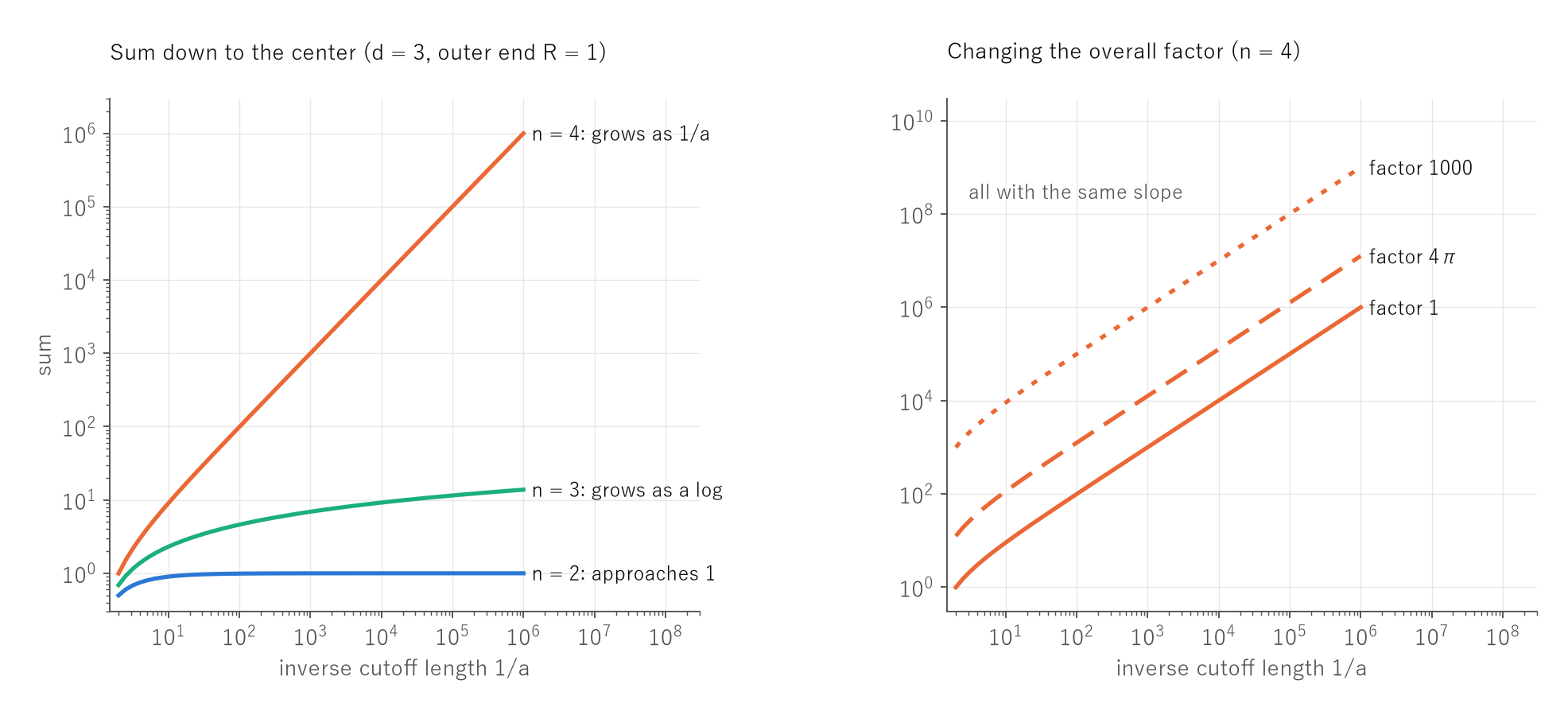
For $n=0,1,2$ the sum approaches $1/(3-n)$; for $n=3$ it grows by $\ln100=4.60517018599$ each time $a$ is cut to 1/100; for $n=4$ it grows a hundredfold each time, and for $n=5$ ten-thousandfold. The sums toward the outside (keeping $a=1$ and enlarging $R$ a hundredfold at a time) give the same numbers as this table when $n$ is replaced by $6-n$. For example the outside sums for $n=2$ are 99, 9999 and 999999, the same as the center sums for $n=4$. This is because replacing $r$ by $1/r$ turns the sum to the outside (exponent $n$) into the sum to the center (exponent $2d-n$), and the two agreed for every $d$ from 1 to 4 and every $n$ from 0 to $2d$. On the map, the center side and the outside side lie at positions reflected across the border $n=d$.
Paper 10 started from the fact that the three-dimensional shell weight $4\pi r^{2-n}$ grows without bound at the center or outside when $n\neq2$. The theorem of Paper 01 says that the mass per shell is independent of the radius only for $n=2$. In the language of the map this is $d-1-n=0$: each shell adds the same amount, so the sum grows outward in proportion to $R$. Of the two roads separated in Paper 1092, the one that keeps the shell mass constant takes this $n=d-1$ in $d$ dimensions.
3. An Overall Factor Does Not Exchange Finite and Infinite
Multiplying a sum by an overall factor multiplies the sum, but does not change by how much it grows as $a$ is shrunk. With $d=3$, $n=4$ and factors 1, $4\pi$ and 1000, shrinking $a$ from $10^{-4}$ to $10^{-6}$ takes the sum from 9999 to 999999, from 125651.139773 to 12566358.048, and from 9999000 to 999999000, and the ratio is 100.00990099 every time. On a log-log plot the lines for different factors only shift vertically, with the same slope (Figure 1). Setting the factor to 0 makes the sum 0, but that erases the quantity itself; it does not make an infinity finite.
Check it on a uniform ball as well. Paper 30 put $m=4\pi$ into the gravitational self-energy of a uniform ball (magnitude $3GM^2/5R$) and wrote that the constant appearing there comes from the choice of the unit of mass. With $G=1$, holding the number of particles at $N=1000$ and taking $M=Nm$, the field energy $(1/8\pi)\int g^2 d^3r$ was integrated numerically inside and outside the ball. For $m=1$, $R=1$ the inside is 100000, the outside 500000 and the total 600000, matching the closed form. For $m=4\pi$ the inside is 15791367.04, the outside 78956835.21 and the total 94748202.25, a ratio of $(4\pi)^2=157.913670417$. For either $m$, cutting $R$ to 1/10 multiplies the value by 10.0. The outside share is 0.83333333, that is, five sixths, at every $R$, and the density of the outside field is $1/r^4$. As the ball shrinks, this $n=4$ field reaches close to the center, and the value grows as $1/R$ as $R\to0$. This is the same infinity as point 2 on the map of Section 4, and no choice of $m$ changes it. If the density instead of the number of particles is held while shrinking, $M$ is proportional to $R^3$ and the value falls in proportion to $R^5$ (cutting $R$ to 1/10 divides it by a hundred thousand). What is held while shrinking is a convention decided outside the sum.
Paper 496 showed that in the brightness of the night sky the $4\pi$ appears twice and cancels, and the sum still diverges. The infinity remains when the factor disappears, and it remains when the factor becomes $4\pi$. Where the infinity sits and how fast it grows are decided by the $r^{d-1-n}$ outside the factor.
Paper 10 confirmed that dimensionful constants are choices of unit and cannot be tuned, and Paper 95 separated convention from fact. What is put for $m$ is a convention of units, and whether a sum is finite or infinite is a fact that does not depend on units. Changing units only multiplies the sum by a constant, so the convention cannot move the fact.
4. Ten Infinities on the Map
Well-known infinities of physics are listed by space (position or wavenumber), dimension $d$, exponent $n$, the overflowing end and the dependence on the cutoff (the table below and Figure 2). In wavenumber space the origin $k\to0$ corresponds to long distances and the outside $k\to\infty$ to short distances.
| infinity | space | $d$ | $n$ | overflowing end | growth |
|---|---|---|---|---|---|
| ① field energy of a point charge | position | 3 | 4 | center | $1/a$ |
| ② gravitational field energy of a point mass | position | 3 | 4 | center | $1/a$ |
| ③ mass of a ball of uniform density | position | 3 | 0 | outside | $R^3$ |
| ④ mass of a ball of density $1/r^2$ (singular isothermal sphere) | position | 3 | 2 | outside | $R$ |
| ⑤ brightness of uniformly placed stars (night sky) | position | 3 | 2 | outside | $R$ |
| ⑥ field energy of a planar vortex or a straight current | position | 2 | 2 | both ends | $\ln(R/a)$ |
| ⑦ uncondensed particles of a Bose gas (three dimensions) | wavenumber | 3 | 2 | none | finite |
| ⑧ uncondensed particles of a Bose gas (two dimensions) | wavenumber | 2 | 2 | origin | $\ln(1/k_0)$ |
| ⑨ zero-point energy of the vacuum | wavenumber | 3 | $-1$ | outside | $\Lambda^4$ |
| ⑩ Higgs mass correction (one loop) | wavenumber | 4 | 2 | outside | $\Lambda^2$ |
For ① and ②, the field strength is $1/r^2$ and the energy density is its square, $1/r^4$. In three dimensions $n=4>d$, so the sum overflows at the center, inversely proportional to the cutoff length $a$. Replacing the point charge by a charged shell of radius $a$, the field energy is $e^2/2a$, and the $a$ at which it equals $mc^2$ is half the classical electron radius $e^2/mc^2$ (Jackson 1998). The charged shell with $U_0=q^2/2R$, on which Paper 908 counted the 4/3 of the electromagnetic mass, is also ① stopped at the radius of the shell. Putting $4\pi$ for $m$ only changes the radius at which the two balance; the growth as $1/a$ when $a\to0$ is unchanged.
③ to ⑤ overflow outside. The mass of a uniform density ($n=0$) grows as $R^3$, and ④ and ⑤, with density $1/r^2$, add the same amount for each shell and grow in proportion to $R$. ④ is the density that Paper 910 counted as imposed by a flat rotation curve, and ⑤ is the Olbers night sky of Paper 496.
⑥ sits on the border. In two dimensions with $n=2$ the sum grows logarithmically both at the center and outside, reaching $\ln1000=6.90775527898$ at $R/a=1000$. Paper 1094 showed that on the two-dimensional map where people live, the squared distance of retail gravity models is exactly this border exponent, and Paper 1098 showed that in lattice sums whose exponent equals the dimension, the shape enters the remainder of the logarithm.
⑦ and ⑧ are on the side of the origin of wavenumber space (long distances). In an ideal Bose gas the density of uncondensed particles becomes $1/k^2$ near the origin. In three dimensions $n<d$, so it is finite at the origin (the outside end is cut exponentially); in two dimensions it lies exactly on the border and grows logarithmically. Paper 482 counted this border as the lower critical dimension 2.
⑨ and ⑩ overflow outside in wavenumber (short distances). For the zero-point energy of the vacuum, $\hbar\omega/2$ per wave with $\omega=ck$ grows in proportion to $k$, so the density exponent is $n=-1$, the weight of one shell is $k^3$, and the sum grows as $\Lambda^4/4$ (250000000000 at $\Lambda=1000$). The one-loop Higgs mass correction sums $1/k^2$ over four-dimensional wavenumber, so $n=2$, $d=4$, and it grows as $\Lambda^2/2$ (500000 at the same $\Lambda$). This quadratic growth is the one Paper 46 listed as standard physics.
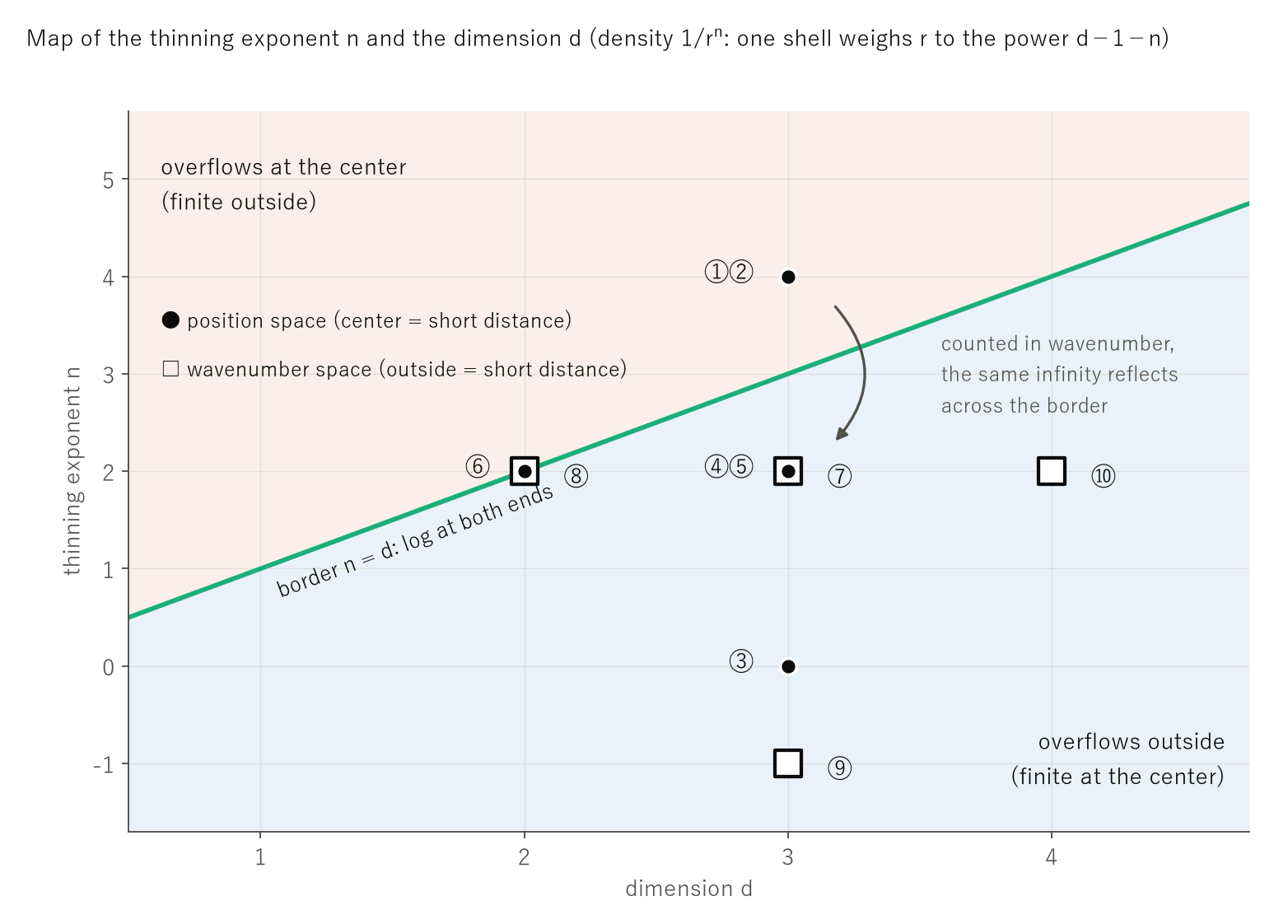
The coordinates of the ten points are $d$ and $n$ alone; the factor enters nowhere. Every point stays in the same place whatever factor is chosen. The $\gamma$ of Section 1 is not a sum over shells, so it is not on this map. Other meanings of the word “diverge”, such as series that converge under another way of summing or another distance, are left to Paper 239.
5. Center and Outside Exchange in Wavenumber
Counted in wavenumber space, the infinity ① overflows at the other end. A squared quantity (such as field energy) has the same value whether summed in position or over the wavenumbers of its Fourier transform. A field $f\propto r^{-q}$ in position is proportional to $k^{q-d}$ in wavenumber (as rescaling shows). The exponent of the squared density is $n=2q$ in position and $2d-2q$ in wavenumber, and the two add to $2d$. On the map, the point for the same quantity moves to the position reflected across the border $n=d$. It is the same reflection as replacing $r$ by $1/r$ in Section 2.
This was checked numerically. In three dimensions, computing $F(k)=(4\pi/k)\int_0^\infty r^{1-q}\sin(kr) dr$ as an oscillatory integral gives $F(2)/F(1)$ equal to 0.3535533906, 0.5 and 0.7071067812 for $q=1.5$, 2 and 2.5, matching $2^{q-3}$. In two dimensions, with $F(k)=2\pi\int_0^\infty r^{1-q}J_0(kr) dr$, $q=0.75$, 1 and 1.25 give 0.4204482076, 0.5 and 0.5946035575, matching $2^{q-2}$.
A point charge has $q=2$ and position exponent $n=4$, and $n=2$ in wavenumber. In three-dimensional wavenumber the weight of one shell is $k^0$, and summing up to $\Lambda$ grows in proportion to $\Lambda$. The $1/a$ at the center in position and the $\Lambda$ outside in wavenumber are one and the same infinity. When quantum field theory calls a short-distance divergence ultraviolet, that is the name it gets when counted outside in wavenumber; counted in position it overflows at the center. A long-distance (infrared) divergence lies outside in position and at the origin in wavenumber. The border $q=1.5$ ($n=3$) stays at $n=3$ in wavenumber, and a logarithm stays a logarithm.
The two spaces were compared on a unit charge smeared into a Gaussian of width $\sigma$. Integrating the squared field in position space gives 0.282094791774, 2.82094791774 and 28.2094791774 for $\sigma=1$, 0.1 and 0.01, and the integral in wavenumber space and the closed form $1/(2\sqrt\pi \sigma)$ gave the same values (relative difference within $10^{-12}$). The tenfold growth each time $\sigma$ is cut to 1/10 is the $1/a$ at the center seen in position and the $\Lambda$ outside seen in wavenumber. The weight on the wavenumber side stays constant at $1/\pi=0.318309886184$ for $k\ll1/\sigma$, and the Gaussian cuts it off where $k$ passes $1/\sigma$. Smearing is one way of putting in a cutoff, not a factor.
6. Moving the Dimension
Of the two coordinates of the map, $n$ is set by physics, but $d$ can be moved by the calculation. Dimensional regularization (Bollini and Giambiagi 1972; ’t Hooft and Veltman 1972) moves $d$ as a real number, takes the value on the side where the sum is finite, and continues it as a formula in $d$.
Summing $1/(k^2+1)$ over $d$-dimensional wavenumber gives
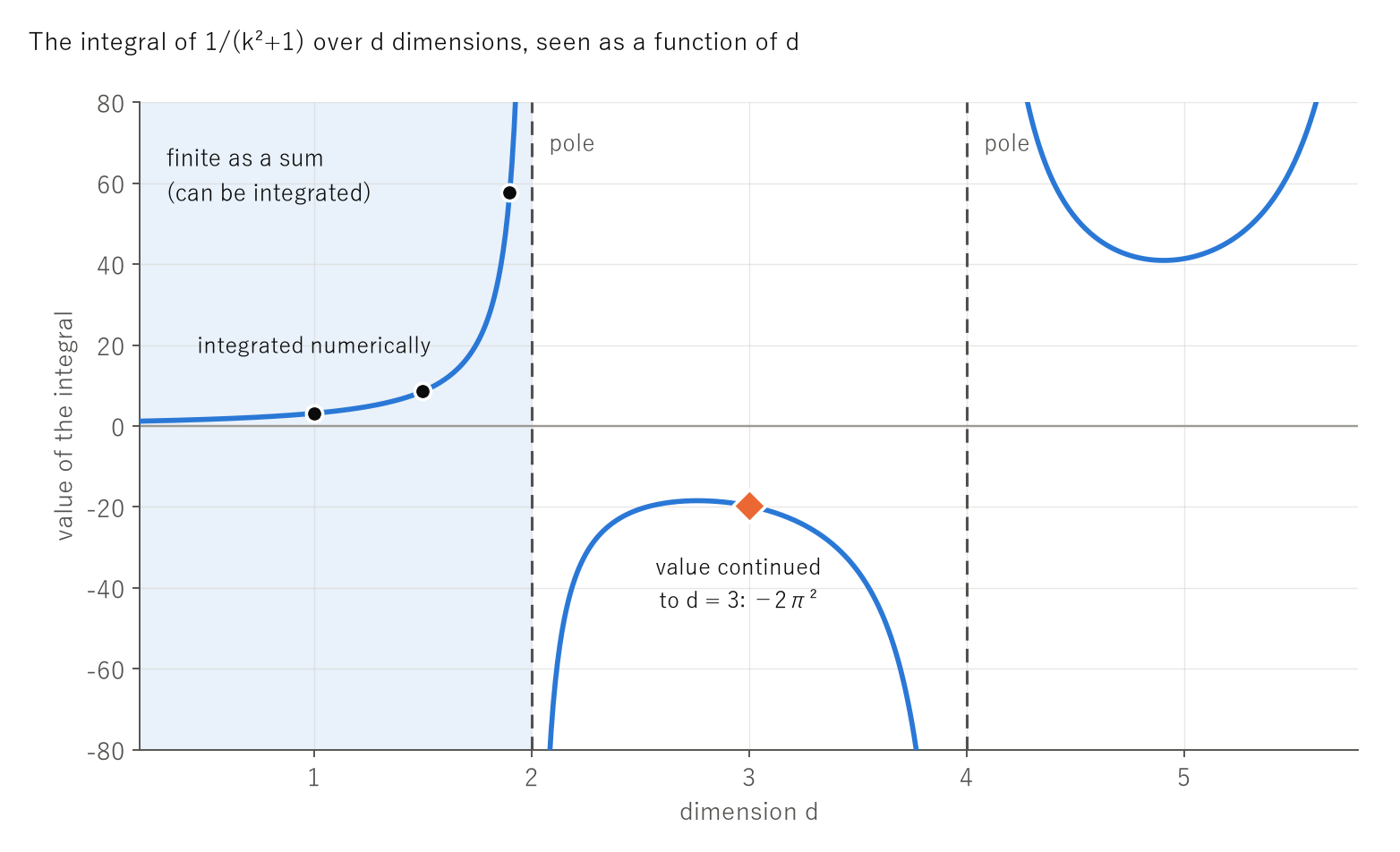
$$I(d)=\int\frac{d^dk}{k^2+1}=\pi^{d/2}\,\Gamma(1-d/2).$$At the outside end the weight of one shell is $k^{d-3}$ ($n=2$), so the sum is finite for $d<2$. Integrating numerically at $d=1$, 1.5 and 1.9 gives 3.14159265359, 8.55546225403 and 57.7643955891, matching the closed form. Continuing the formula gives $-20.5012871066$, $-19.7392088022$ and $-35.8370364871$ at $d=2.5$, 3 and 3.5, and the value at $d=3$ is $-2\pi^2$ (Figure 3).
$d=2$ and $d=4$ are poles: the value is 622.9448779 at $d=1.99$ and $-633.7646$ at $d=2.01$, changing sign ($-1966.873419$ at $d=3.99$ and 1981.124588 at 4.01). The places of the poles can be read off the map. Expanding $1/(k^2+1)$ for large $k$ gives $k^{-2}-k^{-4}+k^{-6}-\cdots$, whose terms have $n=2$, 4, 6. The dimensions at which the terms lie on the border $n=d$ are exactly the poles $d=2,4,6,\dots$ of $\Gamma(1-d/2)$.
The continued value $-2\pi^2$ is not a sum. In three dimensions the sum up to $\Lambda$ is $4\pi(\Lambda-\arctan\Lambda)$, which is 1237.0235121513, 125643.96819143 and 12566350.875163 at $\Lambda=10^2$, $10^4$ and $10^6$. Subtracting $4\pi\Lambda$ leaves $-19.6135492846$, $-19.7379521651$ and $-19.7391962358$, approaching $-2\pi^2+4\pi/\Lambda$. Here too $4\pi$ is a factor on the growing part, and what sets the growth is the exponent. The value of dimensional regularization is the number that remains under the convention of not counting the part that grows in proportion to $\Lambda$. The infinity was not removed; it was put on the side that is not counted. That the remaining number changes with what is left uncounted was shown by Paper 230, where subtracting the same divergence in three ways shifted the finite remainder by $\ln2$.
Moving the dimension to test a root is the same move as in Paper 58, which compared two factors of 2 as functions of $d$ and decided they had distinct roots because they meet only at $d=4$. On the map of this paper, moving $d$ moves a point sideways, and a pole stands where it crosses the border. Moving $m$ moves no point anywhere.
Closing
Putting 4π for m in E = mc² turns the formula into E = 4πc². Yet every infinity of physics lies outside m. The weight of one shell is the radius to the power d−1−n, and whether a sum overflows at the center, overflows outside, or becomes a logarithm on the border is decided only by comparing the thinning exponent n with the dimension d. A factor of 1, 4π or 1000 only scales the sum by the same proportion. The same infinity sits at the center when counted in position and outside when counted in wavenumber, and a calculation that moves the dimension carries the point sideways on the map. What reaches an infinity is the exponent, the dimension and the convention of where to cut off, not the value of the mass.
References
- ’t Hooft, G., and Veltman, M. (1972). Regularization and renormalization of gauge fields. Nuclear Physics B.
- Bollini, C. G., and Giambiagi, J. J. (1972). Dimensional renormalization: The number of dimensions as a regularizing parameter. Il Nuovo Cimento B.
- Jackson, J. D. (1998). Classical Electrodynamics (3rd ed.). Wiley.
- Peskin, M. E., and Schroeder, D. V. (1995). An Introduction to Quantum Field Theory. Addison-Wesley.
- Yamagishi, Y. (2026). The Uniqueness Theorem of $n = 2$ for Spherically Symmetric Density Distributions [Paper 01]. YOI: https://www.yamagishiyuuki.com/yoi/1; DOI: 10.5281/zenodo.21403186
- Yamagishi, Y. (2026). The $4\pi$ Mass Cancellation Theorem [Paper 02]. YOI: https://www.yamagishiyuuki.com/yoi/2; DOI: 10.5281/zenodo.21403931
- Yamagishi, Y. (2026). Only Dimensionless Numbers Can Be Fine-Tuned [Paper 10]. YOI: https://www.yamagishiyuuki.com/yoi/10; DOI: 10.5281/zenodo.21404556
- Yamagishi, Y. (2026). The Yamagishi Double-Torus Stellar Fortress Equation [Paper 30]. YOI: https://www.yamagishiyuuki.com/yoi/30; DOI: 10.5281/zenodo.21601732
- Yamagishi, Y. (2026). Of $16\pi^2$, Only $\Omega_3=2\pi^2$ Is Geometry [Paper 46]. YOI: https://www.yamagishiyuuki.com/yoi/46; DOI: 10.5281/zenodo.21602422
- Yamagishi, Y. (2026). The Agreement of the Factors $2$ Is a Case of Distinct Roots [Paper 58]. YOI: https://www.yamagishiyuuki.com/yoi/58; DOI: 10.5281/zenodo.21597747
- Yamagishi, Y. (2026). Convention and Fact [Paper 95]. YOI: https://www.yamagishiyuuki.com/yoi/95; DOI: 10.5281/zenodo.21758621
- Yamagishi, Y. (2026). Scale Invariance Fixes an Exponent — in Four Different Ways [Paper 117]. YOI: https://www.yamagishiyuuki.com/yoi/117; DOI: 10.5281/zenodo.22005515
- Yamagishi, Y. (2026). There Are Seven Minus Signs, and One of Them Undoes No Addition [Paper 230]. YOI: https://www.yamagishiyuuki.com/yoi/230; DOI: 10.5281/zenodo.22126779
- Yamagishi, Y. (2026). “Diverges” Is Four Things, and One of Them Converges in Another Metric [Paper 239]. YOI: https://www.yamagishiyuuki.com/yoi/239; DOI: 10.5281/zenodo.22129461
- Yamagishi, Y. (2026). “Mass” Is Seven Things, One of Which Goes Negative and One of Which Depends on the Direction of the Push [Paper 240]. YOI: https://www.yamagishiyuuki.com/yoi/240; DOI: 10.5281/zenodo.22129765
- Yamagishi, Y. (2026). The Same Words “Critical Dimension” Name Two Different Numbers, Above and Below [Paper 482]. YOI: https://www.yamagishiyuuki.com/yoi/482; DOI: 10.5281/zenodo.22759625
- Yamagishi, Y. (2026). The $4\pi$ Appears Twice, Cancels, and Then the Sum Diverges [Paper 496]. YOI: https://www.yamagishiyuuki.com/yoi/496; DOI: 10.5281/zenodo.22760174
- Yamagishi, Y. (2026). The 4/3 of the Electromagnetic Mass Comes Not from a Ball’s Volume but from Averaging over Field Directions [Paper 908]. YOI: https://www.yamagishiyuuki.com/yoi/908; DOI: 10.5281/zenodo.22804819
- Yamagishi, Y. (2026). A Flat Rotation Curve Fixes the Density There and Imposes Only the Enclosed Mass on the Inside [Paper 910]. YOI: https://www.yamagishiyuuki.com/yoi/910; DOI: 10.5281/zenodo.22804897
- Yamagishi, Y. (2026). The “2” of the Inverse-Square Density Is Two 2s, and the 2 of the Shell Mass Meets the 2 of the Horizon Balance Only in Three Dimensions [Paper 1092]. YOI: https://www.yamagishiyuuki.com/yoi/1092
- Yamagishi, Y. (2026). The “Squared Distance” in Retail Gravity Models Is, on a Map, the Exponent at the Border Where the Total Number of Customers Stops Converging [Paper 1094]. YOI: https://www.yamagishiyuuki.com/yoi/1094
- Yamagishi, Y. (2026). In a Lattice Sum Whose Exponent Equals the Dimension, Shape Enters as the Mean Logarithm of the Distance to the Edge [Paper 1098]. YOI: https://www.yamagishiyuuki.com/yoi/1098
Reference
Yamagishi, Y. (2026). A Physical Infinity Is Set by How Fast Things Thin Out against the Dimension, Not by the Mass [Paper 1106]. YOI: https://www.yamagishiyuuki.com/yoi/1106
ORCID: 0009-0006-8587-3450
PDF (English) · PDF (Japanese) · Date proof of the English PDF (OpenTimestamps .ots) · SHA256SUMS
The record page for this paper (in Japanese, with the PDFs in each language and the date proof): YOI 1106. This paper is a preprint and has not been peer reviewed.