Abstract
Does the way an electron cloud turns (its angular pattern ℓ) keep the electron from falling to the center? Rewrite the radial equation of quantum mechanics with x = ln r and with f, the function u = rψ divided by the square root of r. A potential that pulls inward in inverse proportion to the p-th power of the distance (strength g) then becomes, near the center, the product of g and e to the power (2−p)x, and the contest of exponents with the 1/r² of the kinetic term is in plain view (ħ²/2m = 1). If p is below 2 the potential grows weak near the center compared with the kinetic term and nothing falls; if p is above 2 the potential wins and the particle falls whatever its angular pattern. The angular pattern matters only at exactly p = 2, where falling becomes a contest of strength and the bound in three dimensions is g = (ℓ+½)². The yardstick is r²V near the center, and the boundary exponent is 2 because the kinetic term is of second order. With a small wall of radius r0 at the center made ever finer, the lowest energies of hydrogen (p = 1) for ℓ = 0, 1, 2 settled, at r0 = 10⁻⁶, at −0.999997, −0.250000 and −0.111111 (Rydberg). For p = 3, dividing r0 by 100 from 10⁻⁶ to 10⁻⁸ made the size of the lowest energy grow as r0 to the power −3.0183; step by step this power approached p, and the energy approached the depth of the potential at the wall. At p = 2, 0.1 below the bound there are no bound states, with the cutoff taken as this wall, even with r0 as fine as 10⁻¹⁶, and 0.1 above it their number grows as r0 is refined.
In classical mechanics the bound for falling under the same potential is the square of the angular momentum, L². Assigning to L² the eigenvalue ℓ(ℓ+1), the quantum bound (ℓ+½)² lies a quarter higher for every ℓ, and at strengths in between not a single quantum state of the same angular pattern falls. Under the semiclassical convention that assigns (ℓ+½)² to L², the two bounds coincide. What does not depend on the convention is that in three dimensions even an s state, with zero angular momentum, does not fall up to strength 1/4; this value becomes ((d−2)/2)² in d dimensions and 0 in two. Above the bound the bound states line up in a geometric sequence, with the energy ratio of neighbours e to the power 2π/ν (ν is the square root of the excess of g over (ℓ+½)²). Putting the value 1.006237825103 of Paper 1060 for ν gives, by the formula, the same ratio as in 1060, and the ratio obtained by solving the trench matched the formula’s 515.035001 to a relative difference of 6.59×10⁻⁶. In relativity, treating the nucleus as a point, the square of the Coulomb potential enters near the center as a 1/r² potential of strength (Zα)², and the upper end of the range in which the standard exponent near the center is real is Zα = ℓ+½ for the Klein–Gordon equation (Z = 68.518 for s) and Zα = j+½ for the Dirac equation (Z = 137.036 for j = ½). The separator is whether the exponent of the potential is below 2, exactly 2, or above 2.
Keywords: fall to the center, inverse-square potential, angular pattern, centrifugal barrier, discrete scale invariance, Klein-Gordon equation, Dirac equation, separator.
Scope (what is not claimed)
This paper claims no new theorem and no new law. The problem of a potential that takes the form −g/r² at the center has been discussed since Case (1950) (as cited by Camblong et al.). That its bound in D dimensions is (ℓ+D/2−1)², that it is a quarter for the s state in three dimensions, that weaker potentials hold no bound state regular at the origin, and that under a cutoff at the center the levels above the bound line up in a geometric sequence, are in Camblong, Epele, Fanchiotti and Garcia Canal (2000). They concluded that when the strength is renormalized together with the cutoff, only one bound state survives; this paper counts the tower before renormalization. That for the Dirac equation in a point Coulomb field the standard formula for the bound-state energy becomes complex once Zα exceeds j+½ is in Voronov, Gitman and Tyutin (2007). In a footnote they write that the equation for the radial components takes the nonrelativistic form with an effective potential that has an r to the power −2 singularity at the origin, associated with the fall to the center. They also write that the self-adjoint Hamiltonian is already not unique once Zα exceeds the square root of j(j+1), that compared with this nothing changes qualitatively in the mathematics at j+½, and that with a finite nucleus electron–positron pairs are created at Z of about 170, so that the problem is no longer one of a single particle. Replacing ℓ(ℓ+1) by (ℓ+½)² in the radial equation is known in semiclassical calculations as the Langer modification (Langer 1937). The quarter in three dimensions is the value at d = 3 of the best constant ((d−2)/2)² of the Hardy inequality. That nothing falls when p is below 2 and that a particle falls when p is above 2 are textbook facts. This paper enters neither the choice of self-adjoint extensions nor renormalization; it only places a wall of radius r0 at the center and lets r0 shrink, and its numbers of bound states are counted with the cutoff taken as this wall. We do not treat the computation of the critical Z with a finite nucleus, the screening by many electrons, or the effective pull among three bodies. Nor do we say that the shape of the electron cloud makes the atom stable: under the Coulomb potential even an s cloud that does not turn does not fall. What we add is the following: with numbers from hydrogen to p = 3 we showed that the angular pattern matters only at p = 2, and counted how, for p above 2, the power of the lowest energy approaches p; we confirmed that in three dimensions no bound state of the same angular pattern exists at strengths between ℓ(ℓ+1) and (ℓ+½)²; we tabulated the exponents of the relativistic Coulomb problem near the center and solved the Klein–Gordon 1s state numerically to match the formula; we matched the ratio above the bound, obtained by solving the trench, to the formula; and we tabulated the bounds against the dimension. The scope note of Paper 1096 said that the nucleus is held fixed and that screening in many-electron atoms, relativistic corrections and the size of the nucleus are left out. This paper is placed next to that scope note: of the relativistic corrections, it lines up, pattern by pattern, the upper end of the range of Z of a point nucleus in which the standard exponent near the center is real. It counts no weight per skin, and enters neither screening by many electrons nor the size of the nucleus. The scope note of Paper 1060 said that it does not derive the mechanism of binding, that why three bodies bind is not its subject, and that it looks only at the structure of the ratio. This paper is placed next to that scope note. Without entering three bodies, it counts, in the equation of two particles, how a 1/r² potential beyond the bound fixes only the ratio and not the position.
1. Does the Shape of the Cloud Hold Off the Fall?
Besides the perfectly round s shape, an electron cloud can take the dumbbell p shape and the d shape with a doughnut wrapped around its middle. The larger the angular pattern $\ell$, the farther the cloud keeps from the center and the more turning (angular momentum) it carries. The question this paper starts from is whether this shape keeps the electron from falling to the center and the atom from collapsing.
The answer depends on how steep the pull is. The Coulomb force that holds an electron in an atom falls as the inverse square of the distance, and its potential is $-1/r$. In that case even an s cloud, which does not turn, does not fall to the center. Since even the s cloud does not fall, the atom does not collapse even without the shape of the cloud. The angular pattern takes on the role of preventing the fall only when the attractive potential near the center goes exactly as $-1/r^2$ (a force falling as the inverse cube). And when the nucleus of a heavy atom is treated as a point in relativity, the square of the Coulomb potential acts near the center in exactly this form.
In this corpus “inverse square” has usually meant the force. The boundary counted in this paper is the exponent 2 of the potential. In terms of the force the exponent is 3, the inverse-cube force for which Paper 15 tabulated the fall to the center in classical mechanics.
2. In x = ln r the Contest Becomes a Single Term
Take units with $\hbar^2/2m=1$. The radial equation for a state with angular pattern $\ell$ is, for $u=r\psi$,
$$-u''+\Bigl[\frac{\ell(\ell+1)}{r^2}+V(r)\Bigr]u=Eu .$$Put $x=\ln r$ and write $u=r^{1/2}f$. Since $u''=r^{-3/2}(f_{xx}-f/4)$, the equation becomes
$$-f_{xx}+\Bigl[\bigl(\ell+\tfrac12\bigr)^2+r^2V\Bigr]f=E\,r^2f .$$A quarter has been added to $\ell(\ell+1)$, giving $(\ell+\frac12)^2$. This quarter comes from the kinetic term together with the volume measure $r^2$; in semiclassical calculations this replacement is known as the Langer modification (Langer 1937). For an attractive potential $V=-g/r^p$ we have $r^2V=-g e^{(2-p)x}$. Near the center ($x\to-\infty$) this term fades to 0 if $p<2$, stays at the constant $-g$ if $p=2$, and falls to minus infinity if $p>2$.
The yardstick for falling is the value of $r^2V$ near the center. Even if the potential is not a pure power, the discussion of $p=2$ here applies when the term acting most strongly near the center is $-g/r^2$. The boundary exponent is 2 because the kinetic term is of second order. When the strength sits exactly at the bound, the next strongest term decides; this paper does not count that case.
Seen in the coordinate $x$, $f$ is a wave moving over a floor whose height near the center is $(\ell+\frac12)^2-g e^{(2-p)x}$. For $p<2$ the floor near the center has the positive height $(\ell+\frac12)^2$, and the wave decays toward the center in the coordinate $x$. For $p>2$ the floor sinks without end, and the angular pattern’s $(\ell+\frac12)^2$, a constant height, must lose somewhere. Only at exactly $p=2$ is the floor at the constant height $(\ell+\frac12)^2-g$, and its sign decides. If positive, the wave decays toward the center; if negative, the floor becomes a flat trench running endlessly toward the center, and in it ever deeper states appear as the cutoff at the center is made finer. This is the fall to the center. The “fall” of this paper is the view taken when a cutoff is placed at the center and made ever finer.
In the computation a wall of radius $r_0$ was placed at the center, and $u=0$ was imposed at both $r_0$ and an outer radius $R$. On a grid in $x$ the equation becomes a tridiagonal matrix; because the weight $r^2$ is positive, the number of states below a given energy equals the number of negative pivots of the matrix with that energy subtracted (Sylvester’s law of inertia), and the eigenvalues were found by narrowing brackets with this count. The weight $r^2$ spans dozens of orders of magnitude, so the matrix is not diagonalized directly. As checks, the lowest states of hydrogen ($V=-2/r$ in Rydberg units, $r_0=10^{-6}$, $R=60$) for $\ell=0,1,2$ came out as $-0.999997$, $-0.250000$ and $-0.111111$ (the formula gives $-1$, $-1/4$, $-1/9$), and a free particle in the box from $r_0=10^{-6}$ to 1 gave 9.869616 (the formula gives 9.869624).
3. The Numbers of the Contest of Exponents
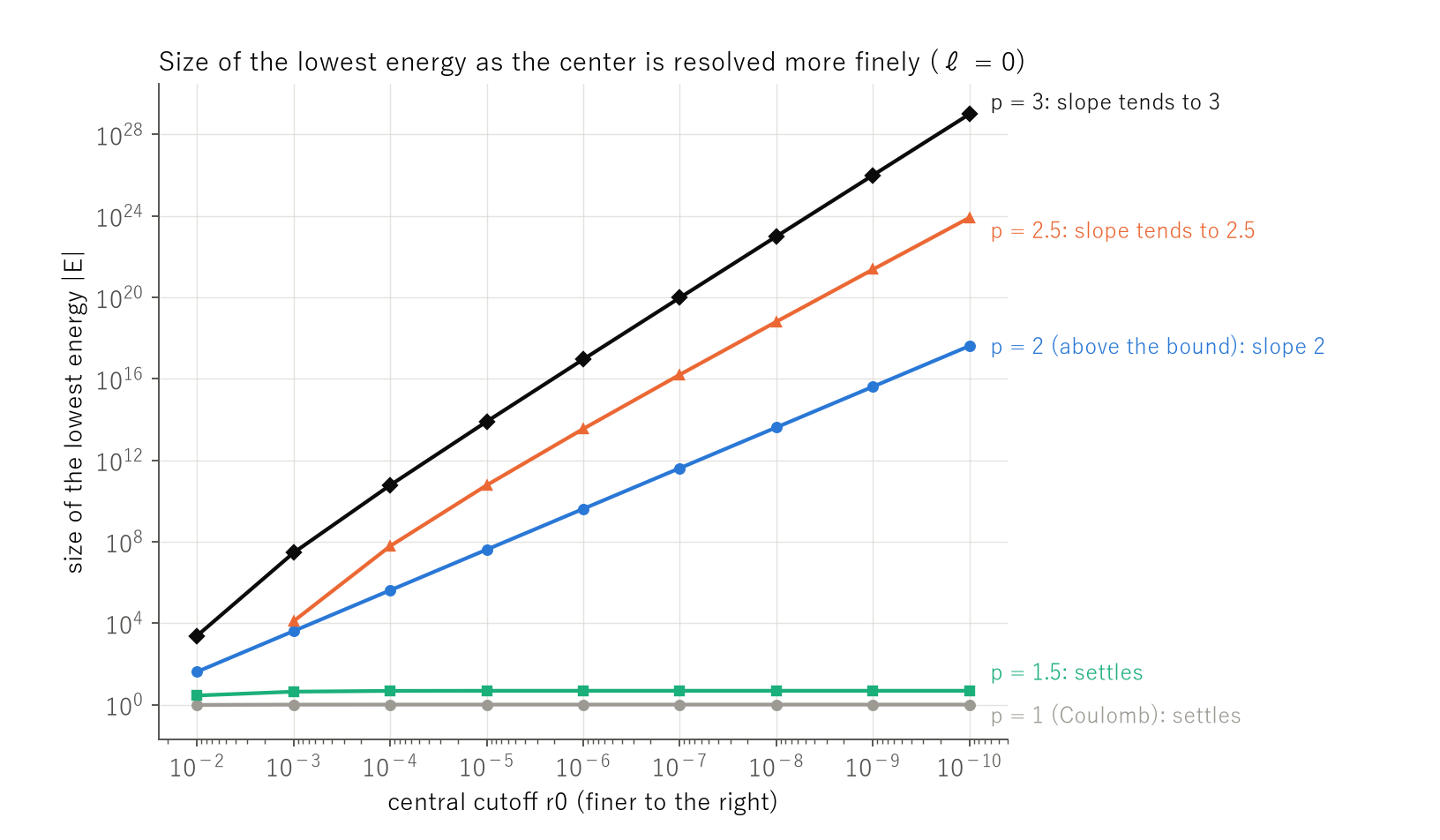
With $g=2$ for $p=1$ (Coulomb) and $p=1.5$, and $g=0.1$ for $p=2.5$ and $p=3$, we refined $r_0$ from $10^{-2}$ to $10^{-8}$ and listed the lowest energy ($R=400$).
| $p$ | $g$ | $\ell$ | $r_0=10^{-2}$ | $10^{-4}$ | $10^{-6}$ | $10^{-8}$ |
|---|---|---|---|---|---|---|
| 1 | 2 | 0 | $-0.964214$ | $-0.999602$ | $-0.999997$ | $-1$ |
| 1 | 2 | 2 | $-0.111111$ | $-0.111111$ | $-0.111111$ | $-0.111111$ |
| 1.5 | 2 | 0 | $-2.79885$ | $-4.71702$ | $-4.77739$ | $-4.77806$ |
| 1.5 | 2 | 2 | $-0.00315273$ | $-0.00315273$ | $-0.00315273$ | $-0.00315273$ |
| 2.5 | 0.1 | 0 | none | $-6.06447\times10^{7}$ | $-3.47026\times10^{13}$ | $-6.33791\times10^{18}$ |
| 2.5 | 0.1 | 2 | none | none | $-3.1372\times10^{13}$ | $-6.29103\times10^{18}$ |
| 3 | 0.1 | 0 | $-2388.68$ | $-5.92051\times10^{10}$ | $-8.99329\times10^{16}$ | $-9.78581\times10^{22}$ |
| 3 | 0.1 | 2 | none | $-5.87317\times10^{10}$ | $-8.99271\times10^{16}$ | $-9.78581\times10^{22}$ |
When $p$ is below 2, the lowest energy settles as $r_0$ is refined; between $r_0=10^{-6}$ and $10^{-8}$ it changed by at most $1.4\times10^{-4}$ of its value for every $\ell$. When $p$ is above 2, the lowest energy kept falling with $r_0$ even with a weak potential of strength 0.1. For $\ell=0$, the power at which the size of the energy grows with each division of $r_0$ by 100 was 3.6971, 3.0908 and 3.0183 for $p=3$, and 2.8788 and 2.6308 for $p=2.5$ (no state at $r_0=10^{-2}$), approaching $p$ from above. Dividing the size of the lowest energy by the depth of the potential at the wall, $g/r_0^p$, gives 0.0239, 0.5921, 0.8993 and 0.9786 for $p=3$, and 0.0606, 0.3470 and 0.6338 for $p=2.5$, approaching 1: the lowest state moves to the wall and sinks to the depth there. For $\ell=2$ the fall only starts at a smaller $r_0$; it does not stop. The angular pattern’s $(\ell+\frac12)^2$ is a wall of constant height, and a potential with $p>2$ always climbs over it near the center (Figure 1).
4. At Exactly 1/r² It Becomes a Contest of Strength
We placed the $p=2$ potential only inside $r<1$ (zero outside), set the strength $g$ 0.1 below and 0.1 above the bound $(\ell+\frac12)^2$, refined $r_0$ through $10^{-4}$, $10^{-8}$, $10^{-12}$ and $10^{-16}$, and counted the bound states ($R=1000$).
| $\ell$ | quantum bound $(\ell+\frac12)^2$ | $\ell(\ell+1)$ | count 0.1 below | count 0.1 above |
|---|---|---|---|---|
| 0 | 0.25 | 0 | 0, 0, 0, 0 | 1, 2, 2, 3 |
| 1 | 2.25 | 2 | 0, 0, 0, 0 | 0, 1, 2, 3 |
| 2 | 6.25 | 6 | 0, 0, 0, 0 | 0, 1, 2, 3 |
| 3 | 12.25 | 12 | 0, 0, 0, 0 | 0, 1, 2, 3 |
Below the bound, with the cutoff taken as the wall, no bound state formed however finely the center was resolved. Above it, the number grew as $r_0$ was refined, one at a time for $\ell=1$ to 3 and as 1, 2, 2, 3 for $\ell=0$. The depth of the trench, $g-(\ell+\frac12)^2=0.1$, does not depend on $\ell$, and the guide from the formula is 0.9271 more states for each division of $r_0$ by ten thousand ($\nu/\pi$ per unit of $\ln(1/r_0)$ with $\nu=\sqrt{0.1}$). Multiplying the lowest energy by $r_0^2$ gave the constant $-3.197\times10^{-9}$ for every $\ell$ once $r_0$ was $10^{-8}$ or smaller ($-2.561\times10^{-9}$ for $\ell=0$ at $r_0=10^{-4}$). It does not depend on $\ell$ because the trench is set by its depth 0.1 alone. The lowest state sits at a radius proportional to $r_0$, and its energy keeps falling as $1/r_0^2$. Raising the angular pattern $\ell$ by one raises the strength needed to fall to $(\ell+\frac12)^2$. It is here that the angular pattern takes on the role of preventing the fall.
The angular pattern, however, protects only the states that carry it. Whether the whole system is bounded below is decided by the lowest pattern alone, in three dimensions by the bound $1/4$ of s. For strengths between $1/4$ and $9/4$ the p states do not fall, but the s states do, so the system falls.
5. Even an s State That Does Not Turn Has a Wall of a Quarter in Three Dimensions
Consider the same potential in classical mechanics. For a particle with angular momentum $L$ the effective potential is $(L^2-g)/r^2$: the centrifugal term and the potential act with the same $1/r^2$. Paper 15 tabulated this case, as the classical case that Landau and Lifshitz’s Mechanics treats as the fall to the center, and wrote that the particle flies away if $L^2$ exceeds the strength of the pull, is neutral at every radius if they are equal, and falls to the center if it is smaller. Assigning to $L^2$ the quantum eigenvalue $\ell(\ell+1)$, the classical bound is $g=\ell(\ell+1)$. Under the semiclassical convention that assigns $(\ell+\frac12)^2$ to $L^2$, the classical bound coincides with the quantum one. Which to assign is a convention.
The quantum bound $(\ell+\frac12)^2$ lies exactly a quarter above $\ell(\ell+1)$ for every $\ell$. At the strengths in between, $g=\ell(\ell+1)+\frac18$ (0.125, 2.125, 6.125 and 12.125), there was not a single bound state of the same angular pattern even with $r_0=10^{-16}$. An eighth above the quantum bound (0.375, 2.375, 6.375 and 12.375) there were 4 each (Figure 2). Raising the strength in steps of 0.05, bound states first appeared at 0.30, 2.30, 6.30 and 12.30 (just above the bounds 0.25, 2.25, 6.25 and 12.25).
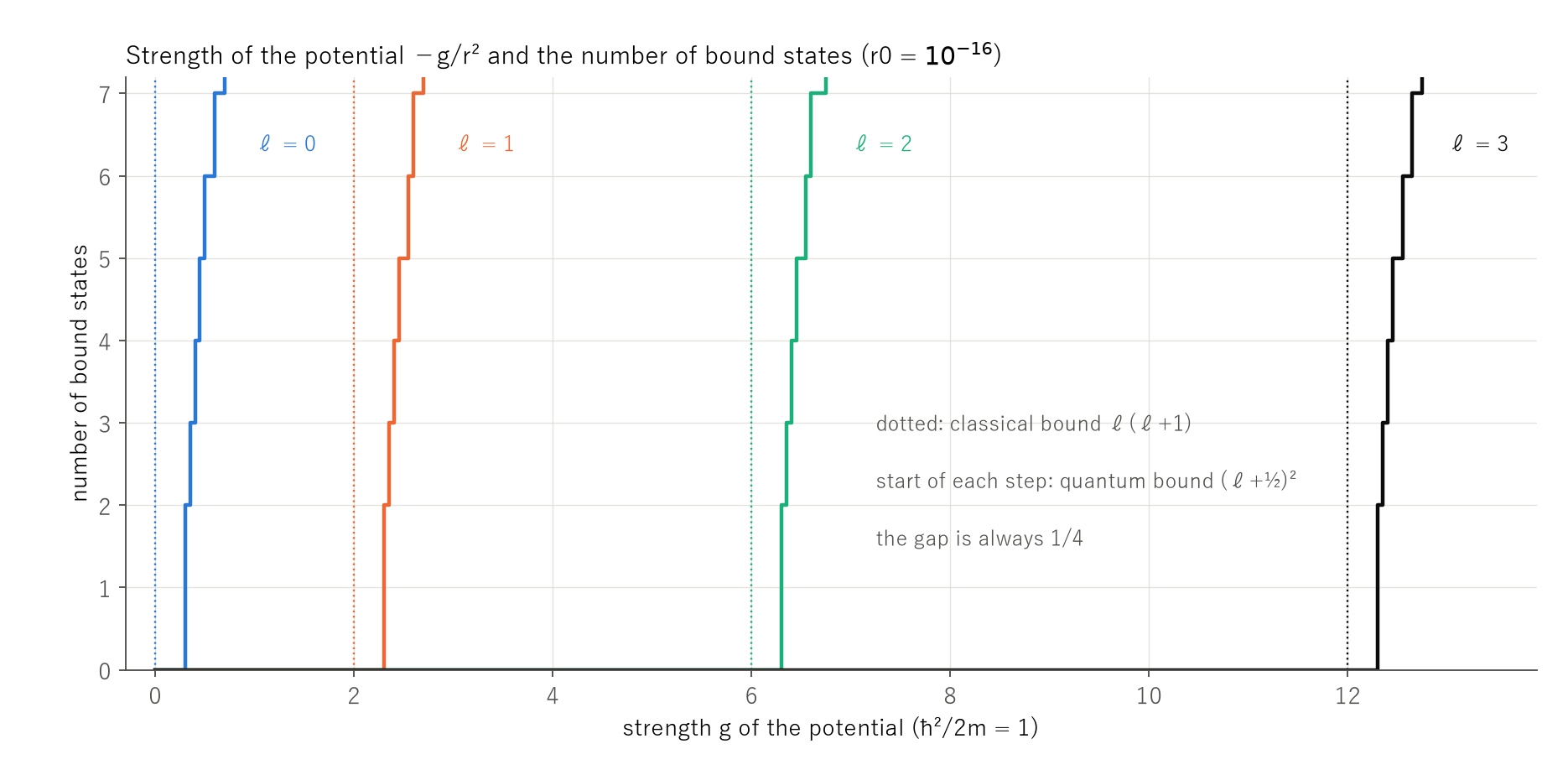
A classical particle that does not turn ($L=0$) falls to the center under any $-g/r^2$ potential, however weak. In three dimensions a quantum s state, with zero angular momentum, does not fall up to strength $1/4$; this does not depend on what is assigned to $L^2$. This quarter came out of the kinetic term together with the volume measure $r^2$ when we rewrote $u=r^{1/2}f$ in Section 2; in $d$ dimensions it becomes $((d-2)/2)^2$, and in two dimensions it is 0 (the table of Section 7). Confinement in a small space raises the kinetic energy in two dimensions as well, so this value does not come from confinement alone. The quarter in three dimensions is known as the value at $d=3$ of the best constant $((d-2)/2)^2$ of the Hardy inequality. Camblong et al. (2000) write that the bound $1/4$ in three dimensions agrees with experimental results for a wide range of polar molecules. The wall of the angular pattern stacks $\ell(\ell+1)$ on top of it.
6. Above the Bound Only the Ratio Is Fixed
Above the bound, write the strength as $g=(\ell+\frac12)^2+\nu^2$; the wave in the trench oscillates in $x$ with wavenumber $\nu$. One state forms for every advance of $\pi/\nu$ in $x$, so neighbouring states differ in size by the ratio $e^{\pi/\nu}$ and in energy by $e^{2\pi/\nu}$. The equation with only a $1/r^2$ potential keeps its form when all lengths are multiplied by any factor (dilation symmetry). The cutoff at the center breaks this symmetry, and what remains is a single factor. Camblong et al. (2000) wrote the formula for the zeros that fix the levels under a cutoff and, as its approximation when the strength is close to the bound, this geometric spacing. They then concluded that when the strength is renormalized toward the bound together with the cutoff, only one bound state survives. What this paper counts is the tower before renormalization.
With $\nu=1$ ($g=1.25$, $\ell=0$, $r_0=10^{-24}$, $R=10$), the six deepest states gave neighbour ratios 536.034871, 535.489170, 535.488153, 535.488151 and 535.488151. The relative difference from the formula’s $e^{2\pi}=535.491656$ is $6.54\times10^{-6}$; halving the grid step gave the ratio 535.490779 and the relative difference $1.64\times10^{-6}$, a reduction by a factor of 4.00, so the difference is a computing error that shrinks as the square of the step. For $\ell=2$ ($g=7.25$) the ratios were the same. The number of bound states was 4, 9, 13 and 17 at $r_0=10^{-6}$, $10^{-12}$, $10^{-18}$ and $10^{-24}$, growing by 0.3137 per unit of $\ln(1/r_0)$ (the formula gives $\nu/\pi=0.3183$).
Paper 1060 showed, by solving the formula of the literature, that in a system of three particles with only one scale factor the length ratio $e^{\pi/s}$ ($s=1.006237825103$) is 22.694382595 and the energy ratio 515.035001, and wrote that the formula does not decide where the sequence starts. Putting this $s$ for $\nu$ in our trench gives, by the formula, the length ratio $e^{\pi/s}=22.694382595$ and the energy ratio $e^{2\pi/s}=515.035001$, the same as in 1060; this agreement follows from the construction. What we checked by number is that the ratio obtained by solving the trench matches this formula: the neighbour energy ratios were 515.577611, 515.032668, 515.031612, 515.031610 and 515.031610, with relative difference $6.59\times10^{-6}$ from the formula, and 515.034153 with $1.65\times10^{-6}$ when the step was halved. Only $\nu$ decides the ratio, and the cutoff $r_0$ decides where the deepest state sits. The mechanism by which only the ratio is fixed and not the position is present in the $1/r^2$ potential between two particles as well.
The length ratio $e^\pi=23.140692633$ for $\nu=1$ is the same number as the ratio by which, in Paper 1046, the rings in the image of a black hole thin with every half turn. Here $\nu=1$ is a value chosen in this paper, whereas the ratio of 1046 comes from the angle of deflection following the logarithm of the closeness to the threshold with coefficient 1. As in the judgement of Paper 300, sharing a number alone does not make two things share a root.
7. Moving the Dimension
In $d$ dimensions, with $u=r^{(d-1)/2}\psi$ and $x=\ln r$, $(\ell+\frac12)^2$ is replaced by $(\ell+\frac{d-2}{2})^2$. We tabulated the bounds and counted bound states 0.1 below and 0.1 above each ($r_0=10^{-16}$). There were 0 below in every case (for $\ell=0$ in two dimensions the bound is 0, so nothing is counted below it) and 3 above (4 for $\ell=0$ in two dimensions).
| dimension $d$ | $\ell=0$ | $\ell=1$ | $\ell=2$ | $\ell=3$ |
|---|---|---|---|---|
| 2 | 0 | 1 | 4 | 9 |
| 3 | 0.25 | 2.25 | 6.25 | 12.25 |
| 4 | 1 | 4 | 9 | 16 |
| 5 | 2.25 | 6.25 | 12.25 | 20.25 |
For the s state in two dimensions the bound is 0, and any $-g/r^2$ potential, however weak, makes it fall. In four dimensions the bound is $(\ell+1)^2$. Proposition 5.2 of Paper 56 wrote that the attractive potential $-1/r^{d-2}$ has a bound ground state for $d\le3$ and cannot escape the fall to the center for $d\ge4$. In four dimensions this potential is $-k/r^2$, exactly $p=2$, and it falls only when $k$ exceeds $(\ell+1)^2$; when weaker it does not fall, but it also has no bound state. Either way there is no stable ground state, so the conclusion of the proposition (that three dimensions are required) is unchanged. Above four dimensions the exponent $d-2$ of this potential exceeds 2, so it falls, as Paper 56 says.
Paper 1106 showed that a physical infinity is set by a contest between the exponent of thinning and the dimension, with the boundary where the exponent equals the dimension. The boundary exponent for the fall to the center is 2 in every dimension. This 2 comes from the kinetic term being of second order, the same second order with which Paper 1107 counted the numbers that leave a skin. The dimension enters only on the side of the strength at the bound, $(\ell+\frac{d-2}{2})^2$. An equation with a first-order kinetic term is different: in the Dirac equation the Coulomb $-Z\alpha/r$ itself competes with $\kappa$ (next section).
8. The Relativistic Coulomb Problem Can Enter Above the Bound
Now consider how an ordinary Coulomb $-1/r$ brings in the $1/r^2$ form near the center. Treat the nucleus as a point and take units with $\hbar=c=m=1$, the nuclear charge $Z$ and the fine-structure constant $\alpha$ ($\alpha^{-1}=137.035999177$). In the Klein–Gordon equation the energy $E$ and the potential $-Z\alpha/r$ enter in the form $(E+Z\alpha/r)^2$, and the term $(Z\alpha)^2/r^2$ within it, the square of the Coulomb potential, acts as a $-g/r^2$ potential of strength $g=(Z\alpha)^2$. Putting $u\sim r^s$ near the center gives $s(s-1)=\ell(\ell+1)-(Z\alpha)^2$, so $s=\frac12\pm\sqrt{(\ell+\frac12)^2-(Z\alpha)^2}$ (confirmed with sympy). The roots stop being real at $Z\alpha=\ell+\frac12$, the same form as the bound $(\ell+\frac12)^2$ of the previous sections. The Dirac equation has a first-order kinetic term, and $-Z\alpha/r$ competes directly with $\kappa$. Putting the two components $G\sim a r^s$ and $F\sim b r^s$ makes the determinant $s^2-\kappa^2+(Z\alpha)^2$, so $s=\pm\sqrt{\kappa^2-(Z\alpha)^2}$ ($|\kappa|=j+\frac12$). The bound is a comparison of $(Z\alpha)^2$ with $(j+\frac12)^2$, of the same form.
| equation | exponent $s$ near the center | bound | $Z$ at the bound |
|---|---|---|---|
| Klein–Gordon | $\frac12\pm\sqrt{(\ell+\frac12)^2-(Z\alpha)^2}$ | $Z\alpha=\ell+\frac12$ | 68.518, 205.554, 342.590 ($\ell=0,1,2$) |
| Dirac | $\pm\sqrt{\kappa^2-(Z\alpha)^2}$ | $Z\alpha=|\kappa|=j+\frac12$ | 137.036, 274.072, 411.108 ($j=\frac12,\frac32,\frac52$) |
We solved the Klein–Gordon 1s state numerically with the same counting, with the exponent near the center built in, and compared it with the formula $E/m=[1+(Z\alpha)^2/(\frac12+\sqrt{\frac14-(Z\alpha)^2})^2]^{-1/2}$. For $Z\alpha=0.3$ the numerical value was 0.948683 and the formula 0.948683; for $Z\alpha=0.45$ the numerical value was 0.847324 and the formula 0.847316. Above the bound, at $Z\alpha=0.6$, with the energy fixed at $E=0.9$, the number of eigenvalues of the equation (the whole equation, including $-2EZ\alpha/r$) lying below $-1$, the lower end that $E^2-1$ can take for real $E$, grew as 1, 2, 3 and 4 at $r_0=10^{-4}$, $10^{-8}$, $10^{-12}$ and $10^{-16}$. This is not a count of bound states: an eigenvalue below $-1$ matches no real $E$, so it is not a bound state. What is counted is the trench of strength $(Z\alpha)^2-\frac14=0.11$ that remains in the equation with $E$ fixed, which near the center does not depend on the choice of $E$. It is a sign that, with the nucleus kept a point, the answer moves with where the cutoff is placed.
The standard formula for the 1s state of the Dirac equation with a point nucleus, $E/m=\sqrt{1-(Z\alpha)^2}$, gives 0.811906, 0.683730, 0.482888 and 0.022920 at $Z=80$, 100, 120 and 137, and stops being real beyond $Z=137.036$. Voronov et al. (2007) confirmed that this formula becomes complex when $Z\alpha$ exceeds $j+\frac12$, and wrote that the self-adjoint Hamiltonian is already not unique once $Z\alpha$ exceeds $\sqrt{j(j+1)}$ ($Z=118.677$ for $j=\frac12$), and that compared with this nothing changes qualitatively in the mathematics at $j+\frac12$. They also write that, once an extension is chosen, the levels between $-m$ and $m$ are discrete and accumulate at $E=m$. With a finite nucleus, the lowest level reaches $-mc^2$ at $Z$ of about 170 and electron–positron pairs are created, so that the problem is no longer one of a single particle (the introduction of the same paper). This paper enters neither the choice of extensions nor the size of the nucleus. What it says is that the upper end of the range of $Z$ in which the standard exponent near the center is real has the same form as the bound of the non-relativistic $-g/r^2$ potential and is set pattern by pattern ($\ell$ for Klein–Gordon, $j$ for Dirac). For the atom as a whole, the lowest pattern, $j=\frac12$, sets this upper end; higher $j$ only raise the upper end of their own pattern. Paper 1096 counted the weight per skin of the electron cloud without relativistic corrections. This paper counts no weight per skin; next to it, it lines up the exponents near the center of a point nucleus pattern by pattern.
9. The Separator
Paper 79 wrote that the potential $-1/r$ (an inverse-square force) carries a hidden symmetry one step larger than rotation. What the $p=2$ potential of this paper carries is dilation symmetry: its form does not change when all lengths are multiplied by any factor. In the former there is no danger of falling; in the latter it becomes a contest of strength. Though both are called “square”, what the inverse-square force (potential $-1/r$) carries is a symmetry larger than rotation, and what the inverse-square potential carries is the symmetry of dilating lengths.
The separator is whether the exponent of the potential near the center is below 2, exactly 2, or above 2. The yardstick is $r^2V$ near the center, and the boundary is 2 because the kinetic term is of second order. Below 2 the angular pattern plays no part in the fall; above 2 it cannot stop the fall. Only at exactly 2 does the outcome split on whether the strength exceeds $(\ell+\frac{d-2}{2})^2$, and the angular pattern and the dimension decide that bound. The relativistic Coulomb problem enters this bound through the term that is the square of the potential.
Closing
Under the ordinary Coulomb potential, the shape of the electron cloud is not what keeps the atom from collapsing: even an s cloud that does not turn does not fall, so the atom does not collapse even without the shape. Whether a particle falls to the center is decided by the contest between the exponent of the attractive potential near the center and the exponent 2 of the kinetic term. The angular pattern can hold off the fall only when the attractive potential near the center goes exactly as 1/r²; there the bound in three dimensions is (ℓ+½)², and even s, with zero angular momentum, has a wall of a quarter in three dimensions. Above the bound only the ratio is fixed. In relativity, treating the nucleus as a point, the square of the Coulomb potential brings in this form near the center and sets, pattern by pattern, the upper end of the range of Z in which the standard exponent near the center is real; for the atom as a whole the pattern j = ½ sets it.
References
- Camblong, H. E., Epele, L. N., Fanchiotti, H., and Garcia Canal, C. A. (2000). Renormalization of the inverse square potential. Physical Review Letters.
- Langer, R. E. (1937). On the connection formulas and the solutions of the wave equation. Physical Review.
- Voronov, B. L., Gitman, D. M., and Tyutin, I. V. (2007). Dirac Hamiltonian with superstrong Coulomb field. Theoretical and Mathematical Physics.
- Yamagishi, Y. (2026). A Convention Is a Number, Not a Function of the Configuration [Paper 15]. YOI: https://www.yamagishiyuuki.com/yoi/15; DOI: 10.5281/zenodo.21600352
- Yamagishi, Y. (2026). A Structural Study of the $4\pi$ Patch [Paper 56]. YOI: https://www.yamagishiyuuki.com/yoi/56; DOI: 10.5281/zenodo.21597500
- Yamagishi, Y. (2026). The Hidden Symmetry Unique to n=2 [Paper 79]. YOI: https://www.yamagishiyuuki.com/yoi/79; DOI: 10.5281/zenodo.21732820
- Yamagishi, Y. (2026). The Three Hundredth Census: Whether Two Things Share a Root Is Decidable [Paper 300]. YOI: https://www.yamagishiyuuki.com/yoi/300; DOI: 10.5281/zenodo.22171914
- Yamagishi, Y. (2026). The Edge of a Black Hole’s Shadow Is Not the Horizon but the Image of the Circle Where Light Can Orbit [Paper 1046]. YOI: https://www.yamagishiyuuki.com/yoi/1046; DOI: 10.5281/zenodo.22861257
- Yamagishi, Y. (2026). In a System with Only One Scale Factor, the Ratio Is Determined but the Position Is Not [Paper 1060]. YOI: https://www.yamagishiyuuki.com/yoi/1060; DOI: 10.5281/zenodo.22915151
- Yamagishi, Y. (2026). The Weight per Skin of the Electron Cloud Peaks Where Its Local Exponent Is Exactly 2, and for Circular States That Radius Is Bohr’s n² [Paper 1096]. YOI: https://www.yamagishiyuuki.com/yoi/1096
- Yamagishi, Y. (2026). A Physical Infinity Is Set by How Fast Things Thin Out against the Dimension, Not by the Mass [Paper 1106]. YOI: https://www.yamagishiyuuki.com/yoi/1106
- Yamagishi, Y. (2026). When the Field Equation Is of Second Order, the Interior Can Be Read from Outside a Closed Skin Only as One Number per Angular Pattern [Paper 1107]. YOI: https://www.yamagishiyuuki.com/yoi/1107
Reference
Yamagishi, Y. (2026). The Angular Pattern Can Hold Off the Fall to the Center Only When the Attractive Potential near the Center Goes Exactly as 1/r² [Paper 1108]. YOI: https://www.yamagishiyuuki.com/yoi/1108
ORCID: 0009-0006-8587-3450
PDF (English) · PDF (Japanese) · Date proof of the English PDF (OpenTimestamps .ots) · SHA256SUMS
The record page for this paper (in Japanese, with the PDFs in each language and the date proof): YOI 1108. This paper is a preprint and has not been peer reviewed.