PDF (a copy kept with this page, identical to the archived original): yamagishi_yoi1110_v1_en.pdf
Abstract
The four bonds of methane point to the vertices of a regular tetrahedron, at an angle arccos(−1/3) = 109.4712206 degrees. Water, at 104.4776 degrees, and ammonia, at 106.67 degrees, are narrower. This paper separates how much of an angle is fixed by something outside the force law and how much by unequal seats or parts, with one test: change the force law and see whether the angle moves. N equal directions summing to zero meet at cos θ = −1/(N−1); the matrix of their inner products has rank N−1, so at most N = 4 fit in three dimensions. Mixing one s room and n p rooms into n+1 equal rooms gives cos θ = −1/n, the same counting. Pushing points on a sphere apart with a power-law energy (inversely proportional to the s-th power of the distance, the force to the (s+1)-th) and moving s from 0.5 to 40, the shapes of 2, 3, 4, 6 and 12 points (two opposite points, an equilateral triangle, a regular tetrahedron, a regular octahedron and a regular icosahedron) do not move at all, and only 5 points change from a triangular bipyramid to a square pyramid at s = 15.048077 (agreeing with Schwartz’s S = 15.048... to the digits shown). 2, 3 and 4 points are fixed by counting equal directions, 6 and 12 points by a symmetric shape in which every point stands alike, and 5 points cannot be placed at equal angles in three dimensions, so two kinds of seats appear. Mixing points of unequal charge moves the angle off 109.4712206 degrees, and how far depends on both the charge ratio and s. For a balanced shape in which two pairs of like charges face each other in two perpendicular planes, however, any power law whose strength is the product of the charges, with any s and any charge, makes the product of the distances between like charges equal the square of the distance between unlike charges; s and the charge decide only the position on that curve. Matching the charge ratio to water’s 104.4776 degrees, the ratio moves with s from 1.245468 to 1.757134, while the angle between the other two points is 114.6236 degrees for every s, and with the same ratio one point and three points give angles from 106.7364 to 106.8303 degrees, 0.07 to 0.16 degrees above the 106.67 degrees of ammonia.
Reading the p weight λ² from the measured angles (NIST tables) through the orthogonality of two rooms gives 3.99998 for water (3.99946 to 4.00049 within the uncertainty), 3.486 for ammonia, 17.37 for phosphine and 27.16 for hydrogen sulfide, which do not line up on integers. Water’s 104.4776 degrees (uncertainty 0.0019 degrees) differs from arccos(−1/4) = 104.4775122 degrees by only 0.0000878 degrees, but arccos(−1/4) is the angle of five equal directions in four or more dimensions, while water has four rooms in three dimensions, the two bonding rooms weighted differently from the two non-bonding ones. The numbers agree, but the roots are not the same. Moving the dimension d, the centre angle of the regular simplex is arccos(−1/d). Paper 1102 put 109.4712206 degrees at the same root as the dihedral angle of the octahedron. Extending the octahedron as the rectified tetrahedron, the dihedral angle between adjacent faces of different kinds is arccos(−1/d) for every d, and the same root survives in every dimension (built and measured for d = 3 to 8, the difference is below 10⁻¹³). Extending it as a cross polytope, the dihedral angle is arccos(−(d−2)/d), and they coincide only at d = 3. The test of moving the dimension gives an answer only once the family to extend into is chosen. The separator is whether the angle moves when the force law is changed. If it does not move, something outside the force law (counting or symmetry) fixes the angle; if it moves, unequal seats or parts and the force law fix it.
Keywords: bond angle, hybrid orbital, regular tetrahedron, Thomson problem, universal optimality, dimension, separate roots, separator.
Scope (what is not claimed)
This paper claims no new theorem and no new law. Reading tetrahedral bonds by mixing s and p rooms is in Pauling (1931), and reading weights and angles from the orthogonality of mixed rooms is the standard treatment, represented by Coulson’s Valence (1952). Reading the shapes of molecules by the pushing of electron pairs is in Gillespie and Nyholm (1957). Pushing points apart on a sphere begins with Thomson (1904); that the shapes of 2, 3, 4, 6 and 12 points are minimal for every force law of a wide family (universally optimal), and that this fails for 5 points, is in Cohn and Kumar (2007); and that the shape of 5 points changes at s = 15.048... is in Schwartz (2016). Our 15.048077 retraces it by comparing the energies of the two shapes and agrees to the digits shown. The measured angles are taken from NIST’s CCCBDB (Release 22): water is the equilibrium value of Hoy and Bunker (1979), hydrogen sulfide is from Cook, De Lucia and Helminger (1975), and ammonia and phosphine are from Herzberg (1966); we have not checked whether the three other than water are equilibrium values. The relation that puts balanced two-and-two shapes on one curve for power laws came out of our calculation, but we have not checked for prior work and do not call it new. The pushing of points of unequal charge is a model; we do not say that electron pairs are point charges. We do not compute angles by quantum chemistry, and we do not treat the strength of bonds, the use of d rooms, real molecules with five or more parts, bent bonds whose rooms point away from the lines joining the nuclei (we take them to coincide), the split between the two non-bonding rooms (only their total is fixed; we split equally), the computation of the size of the deviation from energies, soap films in higher dimensions, the classification of families of polytopes in higher dimensions, or the change of the density of water with temperature. What we add is the following: we separated, with one test that moves the exponent s of the energy, whether something outside the force law or the force law fixes an angle; we counted that balanced two-and-two shapes lie on a curve that does not depend on the power law; we read weights from measured angles and judged that the overlap of water’s 104.4776 degrees with the angle of the four-dimensional regular simplex is not counting; and we built and measured, moving the dimension, that whether the dihedral angle of the octahedron equals the centre angle of the tetrahedron depends on whether the octahedron is extended as a rectified simplex or as a cross polytope. The scope note of Paper 1014 said that it does not treat other potentials, forces other than the Coulomb force, or the question of maximizing the smallest distance. This paper takes the part of that seat about forces other than the Coulomb force, and moves the exponent of the energy for small numbers of points. The scope note of Paper 836 said that it does not make claims about real molecules: the four points of the tetrahedron are a model, and neither bond lengths nor angles are real values. This paper takes that seat too, taking the angles of real molecules from tables and reading the weights of the mixed rooms.
1. Where Do the 109.47 Degrees Come From?
The four bonds of methane (CH$_4$) point from the carbon to the vertices of a regular tetrahedron, and any two of them meet at $\arccos(-1/3)=109.4712206$ degrees. The same number appears as the angle at which four borders of a soap film meet in Paper 1102 and as the dihedral angle of the regular octahedron in the table of Paper 209. Yet the angle of water (H$_2$O) is 104.4776 degrees and that of ammonia (NH$_3$) is 106.67 degrees; both are narrower (measured values in NIST’s CCCBDB).
Paper 1109 counted how atoms that are round on average attract through the product of fluctuations that have no fixed direction on average. This paper counts the other side, the angles of bonds that do have directions. How much of an angle is fixed by counting, and from where does another reason take over? This paper separates the two with one test. Change the force law and see whether the angle moves. An angle that does not move is an angle of counting; an angle that moves is fixed by the unequal parts and the force law.
2. Counting Equal Directions
Let unit directions $\mathbf u_1,\dots,\mathbf u_N$ have the same inner product $c$ between any two and sum to zero. From
$$\Bigl|\sum_{i=1}^N\mathbf u_i\Bigr|^2=N+N(N-1)\,c=0$$we get $c=-1/(N-1)$: 180, 120 and 109.4712206 degrees for $N=2$, 3 and 4. The matrix of inner products (the Gram matrix) has eigenvalues $1-c$, $N-1$ times, and $1+(N-1)c$ once, and the latter is 0 when the sum is zero. The matrix has rank $N-1$, so $N$ directions need $N-1$ dimensions, and at most $N=4$ fit in three dimensions. The equal angle of $N=5$, $\arccos(-1/4)=104.4775122$ degrees, needs four or more dimensions.
The same counting appears in the rooms of an atom. The s room is round and has no direction; a p room has one direction $\mathbf u$. Writing a room that mixes s and p as
$$h=\frac{s+\lambda\,p_{\mathbf u}}{\sqrt{1+\lambda^2}},$$the overlap of two rooms $h_i$ and $h_j$ is $(1+\lambda_i\lambda_j\cos\theta_{ij})/\sqrt{(1+\lambda_i^2)(1+\lambda_j^2)}$, and that they are separate rooms (orthogonal) is
$$1+\lambda_i\lambda_j\cos\theta_{ij}=0.$$Splitting one s and $n$ p into $n+1$ equal rooms, each room holds $1/(n+1)$ of s and $n/(n+1)$ of p, so $\lambda^2=n$ and $\cos\theta=-1/n$. This is exactly the counting of $n+1$ equal directions in $n$ dimensions. There are three p rooms, as many as the directions of space, so the 3 in the $-1/3$ of $n=3$ is the dimension of space. Building the four rooms along the alternate vertices of a cube, $(1,1,1)$, $(1,-1,-1)$, $(-1,1,-1)$ and $(-1,-1,1)$, the 4-by-4 matrix $HH^{\mathsf T}$ equals the identity with deviation 0, the directions sum to zero, and $\sum\mathbf u\mathbf u^{\mathsf T}$ is 1.333333333333 (4/3) times the identity.
3. Changing the Force Law
Place $N$ points on the unit sphere and minimize the energy
$$E_s=\sum_{i<j}|\mathbf x_i-\mathbf x_j|^{-s}.$$$s=1$ is the Coulomb force and gives Thomson’s problem (Thomson, 1904). $s$ is the exponent of the energy; the force is inversely proportional to the $(s+1)$-th power of the distance. We moved $s$ through 0.5, 1, 2, 6, 12, 15, 16, 20 and 40, minimized from 40 random starts for each $N$ (60 for $N=12$), and counted the angles of the lowest shape.
| $N$ | shape | angles (degrees) and number of pairs | $s$ from 0.5 to 40 |
|---|---|---|---|
| 2 | two opposite points | 180 (1) | does not move |
| 3 | equilateral triangle on a great circle | 120 (3) | does not move |
| 4 | regular tetrahedron | 109.471221 (6) | does not move |
| 6 | regular octahedron | 90 (12), 180 (3) | does not move |
| 12 | regular icosahedron | 63.434949 (30), 116.565051 (30), 180 (6) | does not move |
| 5 | triangular bipyramid ($s\le15$) | 90 (6), 120 (3), 180 (1) | changes |
| 5 | square pyramid ($s=20$) | 89.161333 (4), 96.948861 (4), 166.102278 (2) | at $s=15.048077$ |
For 2, 3, 4, 6 and 12 points, not one angle moved however far $s$ was moved. The energy for $N=12$ and $s=1$, 49.165253058, equals the value of Paper 1014, and the angle 63.434949 degrees is the smallest separation of the regular icosahedron found in Paper 315. Cohn and Kumar (2007) call a configuration that is minimal for every force law of a wide family universally optimal, and they write that on the sphere in three dimensions the regular simplices (2, 3 and 4 points), the regular octahedron (6 points) and the regular icosahedron (12 points) are so, that a full-dimensional regular polytope is universally optimal only when all its faces are simplices (triangles in three dimensions), and that this fails for 5 points. The regular tetrahedron, octahedron and icosahedron have triangular faces; the cube and the regular dodecahedron do not. Six and twelve points are not the counting of equal directions ($\cos\theta=-1/(N-1)$), but symmetric shapes in which every point stands alike, and they too do not depend on the force law.
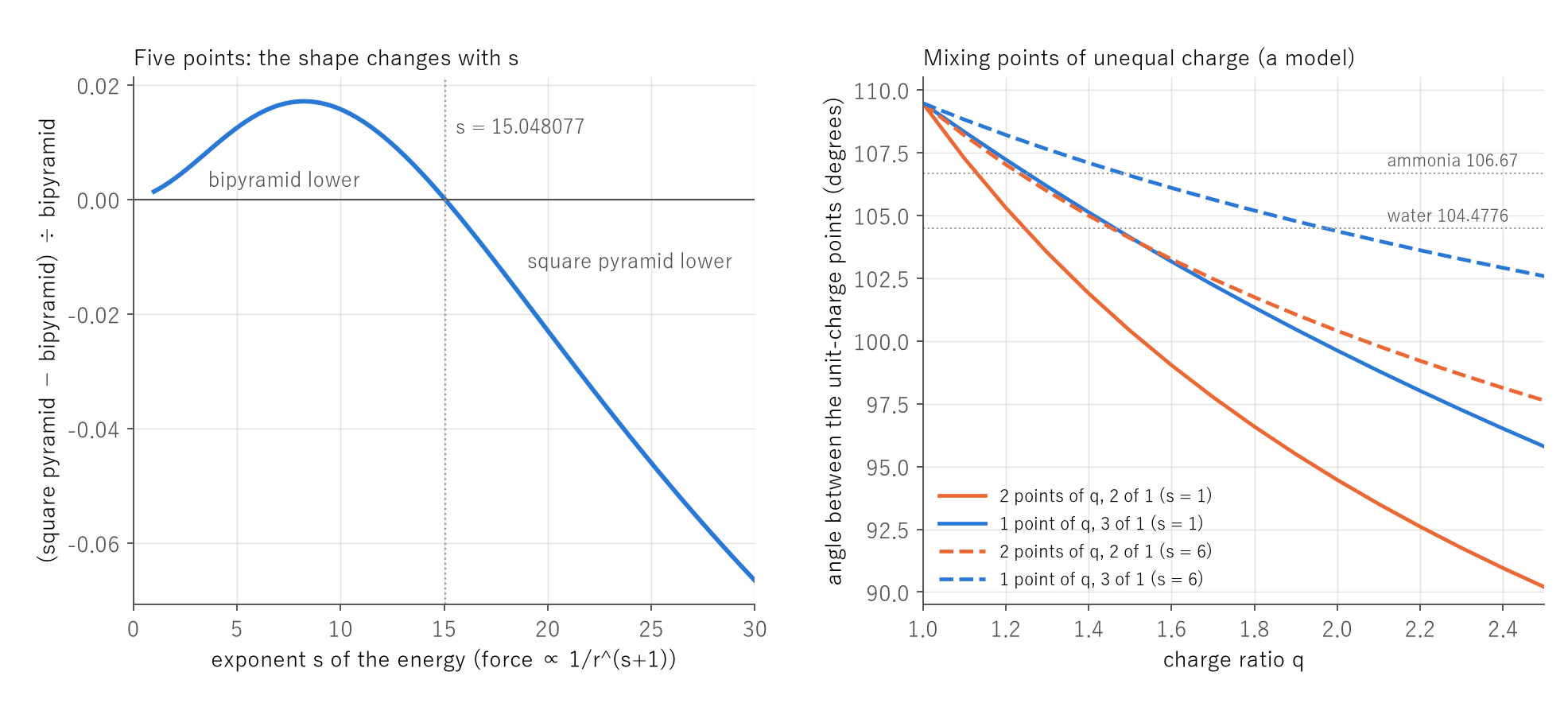
Only 5 points change shape. The energy of the triangular bipyramid (one point at each of the north and south poles, three on the equator) has the closed form $2^{-s}+6\cdot2^{-s/2}+3\cdot3^{-s/2}$, which at $s=1$ is 6.474691495, equal to the result of the minimization. The square pyramid (one point at the apex, four at the base) can be minimized over the height of the base alone. Comparing the two, the square pyramid becomes lower when $s$ exceeds 15.048077 (Figure 1, left). There its base points lie 97.995763 degrees from the apex. Schwartz (2016) proved with the help of a computer that, for positive $s$, the triangular bipyramid is the unique minimum exactly when $s$ lies in $(0,S)$ with $S=15.048\ldots$; our value retraces it and agrees to the digits shown. Of the 40 starts, all 40 went to the triangular bipyramid at $s=1$, and all 40 went to the square pyramid at $s=20$. Five points cannot be placed at equal angles in three dimensions ($N\le4$). So two kinds of seats appear (poles and equator, apex and base), and the force law decides which arrangement is lower.
4. When the Parts Are Unequal
In a molecule the four neighbours need not be the same. Around the oxygen of water there are two rooms that bond to hydrogen and two that do not. Gillespie and Nyholm (1957) read the shapes of molecules by the pushing of electron pairs, with non-bonding pairs pushing harder. We count that reading in a model of points. Of four points, $n_L$ carry charge $q$ and the rest carry 1; we minimize the energy $\sum q_iq_j|\mathbf x_i-\mathbf x_j|^{-s}$ and measure the angle (in degrees) between the points of charge 1.
| $q=1.1$ | 1.25 | 1.5 | 2 | 3 | |
|---|---|---|---|---|---|
| $s=1$, 2 points of $q$, 2 of 1 | 107.2804 | 104.3966 | 100.4087 | 94.4672 | 86.9442 |
| $s=1$, 1 point of $q$, 3 of 1 | 108.3311 | 106.6879 | 104.1275 | 99.6194 | 92.4988 |
| $s=6$, 2 points of $q$, 2 of 1 | 108.1893 | 106.4866 | 104.0930 | 100.4052 | 95.4085 |
| $s=6$, 1 point of $q$, 3 of 1 | 108.8188 | 107.9171 | 106.5819 | 104.3703 | 101.0763 |
With equal charges, $q=1$, the angle is 109.4712 degrees for $s=1$ and for 6 alike, and the force law has no effect. When $q$ exceeds 1 the angle narrows, and how far depends on both $q$ and $s$ (Figure 1, right). The force law enters the angle where the parts stop being equal.
Even so, one thing does not move. Take two points of charge $q$ and two of charge 1, the two pairs placed in two perpendicular planes and facing each other about a common axis (a shape in which all four distances between unlike charges are equal). With $\theta$ the angle between the points of charge 1, $\varphi$ that between the points of charge $q$, $d$ the distance between two points, and $g(r)=s r^{-s-2}$ the magnitude of the force divided by the distance, the balance of a point of charge 1 is $g(d_{BB})\cos(\theta/2)=q g(d_{BL})\cos(\varphi/2)$ and that of a point of charge $q$ is $q g(d_{LL})\cos(\varphi/2)=g(d_{BL})\cos(\theta/2)$. Multiplying the two removes the charge and gives $g(d_{BB}) g(d_{LL})=g(d_{BL})^2$, which for a power law is
$$d_{BB}\,d_{LL}=d_{BL}^{\,2}.$$What it uses is three things: that the shape is balanced, that the strength of the interaction is the product of the charges, and that every pair has the same power law; it depends neither on $s$ nor on $q$. In 16 cases, $s=1$, 2, 6 and 12 with $q=1.1$, 1.5, 2 and 3, the left side divided by the right side, minus 1, was at most $6.2\times10^{-9}$ (set by the precision of the minimization). The shapes that can balance in this symmetric form are fixed on one curve, and the charge and the force law decide where on it the shape stops.
The charge ratio that matches water’s 104.4776 degrees moves widely: 1.245468 for $s=1$, 1.285053 for 2, 1.325896 for 3, 1.456379 for 6 and 1.757134 for 12. Yet the angle between the points of charge $q$ is then 114.6236 degrees for every $s$, moving by $4.24\times10^{-8}$ degrees. Solving the curve above at $\theta=104.4776$ degrees also gives 114.6236 degrees. With the same ratio, one point of charge $q$ and three of charge 1 give an angle between the points of charge 1 of 106.7364 degrees for $s=1$, 106.7566 for 2, 106.7719 for 3, 106.8017 for 6 and 106.8303 for 12, from 0.07 to 0.16 degrees above the 106.67 degrees measured for ammonia. That one ratio puts the angles of two molecules close together is a fact about the model; we do not say that electron pairs are point charges.
5. Reading the Weights of the Mixed Rooms from Measured Angles
Used the other way, the orthogonality condition reads the weights of the rooms from measured angles. Taking the bonding rooms to point along the lines joining the nuclei and to be equal to each other, $\lambda^2=-1/\cos\theta$, and one bonding room holds $1/(1+\lambda^2)$ of s. There is 1 of s and 3 of p in all, so the non-bonding rooms hold the rest. The angles are taken from NIST’s CCCBDB: for water the equilibrium value of Hoy and Bunker (1979), 104.4776 degrees (uncertainty 0.0019 degrees); for ammonia, 106.67 degrees, and phosphine, 93.3 degrees, Herzberg (1966); for hydrogen sulfide, 92.11 degrees, Cook, De Lucia and Helminger (1975). We have not checked whether the three other than water are equilibrium values. The ranges of $\lambda^2$ take as the width of the angle the uncertainty for water and half of the last written digit for the other three.
| molecule | measured angle (degrees) | $\lambda^2$ (range over the angle’s width) | s of one bonding room | total s of the non-bonding rooms |
|---|---|---|---|---|
| water | 104.4776 | 3.99998 (3.99946 to 4.00049) | 0.2000 | 0.6000 |
| ammonia | 106.67 | 3.486 (3.48502 to 3.48705) | 0.2229 | 0.3313 |
| phosphine | 93.3 | 17.37 (17.11297 to 17.63893) | 0.0544 | 0.8367 |
| hydrogen sulfide | 92.11 | 27.16 (27.09636 to 27.22502) | 0.0355 | 0.9290 |
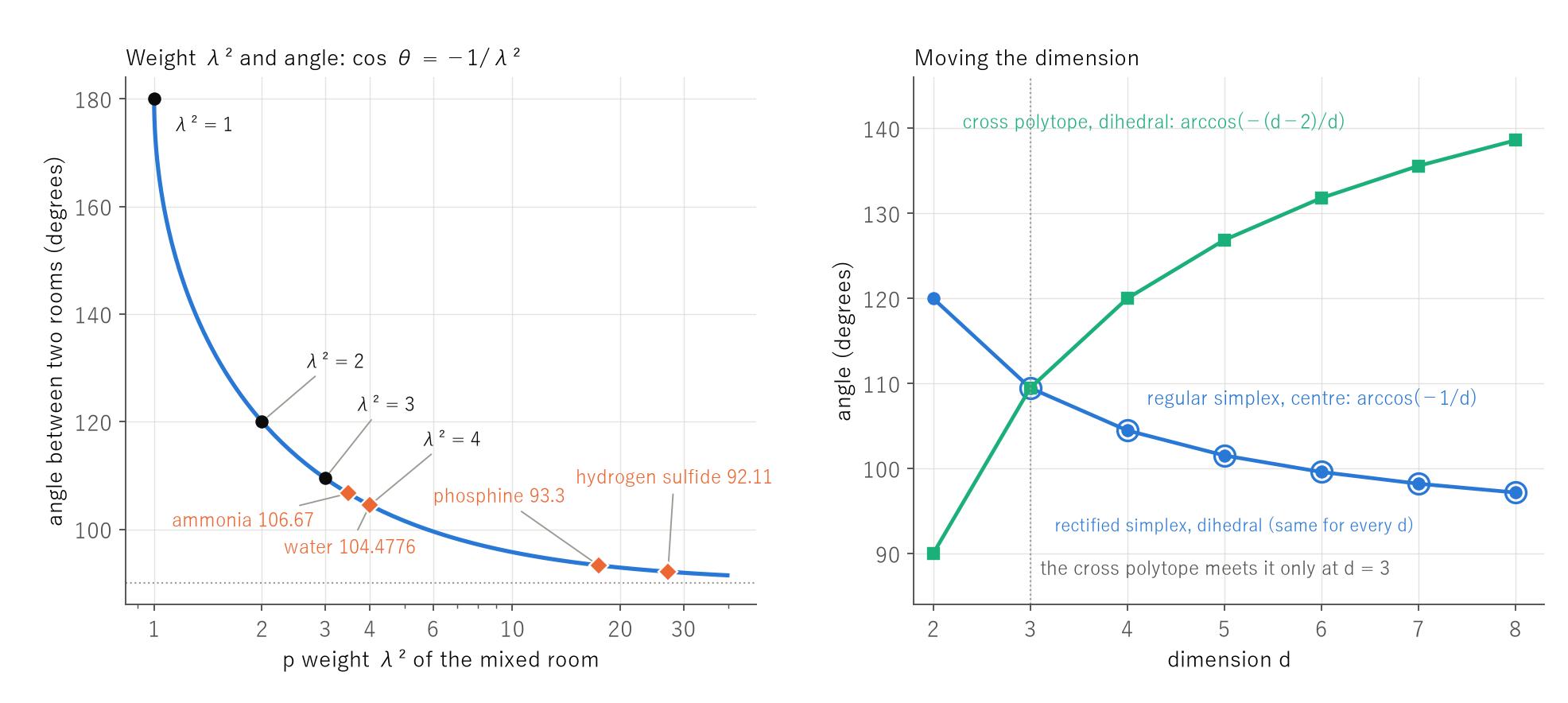
Building all four rooms to check, the 4-by-4 matrix lies within $3.5\times10^{-16}$ of the identity for every molecule. The weights do not line up on integers. The bonding rooms of ammonia have 3.486, more p than the 3 of sp$^3$. Hydrogen sulfide and phosphine have 27.16 and 17.37, and their bonding rooms hold only 0.0355 and 0.0544 of s. Pure p would give 90 degrees, and the two are close to it (Figure 2, left). The two non-bonding rooms of water hold 0.6000 of s together, but the split between them is not fixed. Split equally, each holds half of it ($\lambda^2=2.3333$), and the angle between them is 115.3768 degrees. In the charge model of the previous section the same two points meet at 114.6236 degrees, so the two models differ by 0.7532 degrees; the angle of non-bonding rooms cannot be measured, and neither is checked against measurement. The direction and size of the departure from integer weights are presumably set by the differences in energy between the rooms, but this paper does not compute it. The departure comes not from counting but from the difference between the rooms.
6. 104.4776 Degrees and 104.4775122 Degrees
Water’s 104.4776 degrees differs from $\arccos(-1/4)=104.4775122$ degrees by only 0.0000878 degrees, within the uncertainty of 0.0019 degrees. In weights, $\lambda^2=3.99998$ (3.99946 to 4.00049 within the uncertainty). $\arccos(-1/4)$ is the angle of five equal directions in four or more dimensions, the case $n=4$ of the counting formula $\cos\theta=-1/n$. Is the angle of water the counting of four dimensions?
Seen with the test of Paper 300 and the way Paper 58 asks the question (asking whether functions agree, not values), it is not. There are two reasons. The first is the number of parts. The $-1/4$ of counting is the angle when there are five equal directions and all ten pairs meet at 104.4775122 degrees. Water has four rooms in three dimensions; the two bonding rooms have weight 4.0000 and the two non-bonding rooms (split equally) 2.3333, and the angle between the non-bonding rooms is 115.3768 degrees. The $\lambda^2=4$ of water is not a number of rooms but the ratio of s and p inside one room, and there are only three p rooms. The second is the family. The weights of the hydrides of the same family, with four rooms around the central atom, 3.486 for ammonia, 17.37 for phosphine and 27.16 for hydrogen sulfide, do not line up on integers. Nothing on the side of counting explains why water alone lands on an integer. The numbers agree, but the roots are not the same.
7. Moving the Dimension
How does an angle of counting move when the dimension is moved? The angle between the directions from the centre to the vertices of the $d$-dimensional regular simplex ($d+1$ vertices) is $\arccos(-1/d)$, the same as the angle of rooms mixing one s and $d$ p. Paper 1102 put the angle at which four borders of a soap film meet, 109.4712206 degrees, at the same root as the dihedral angle of the octahedron. The octahedron does not have only one family of relatives in $d$ dimensions. It is the three-dimensional cross polytope (the convex hull of the points $\pm1$ on the coordinate axes), and it is also the shape joining the midpoints of the edges of a regular tetrahedron (the rectified simplex).
The face normals of the cross polytope are $(\pm1,\dots,\pm1)/\sqrt d$, neighbours differ in one sign, and their inner product is $(d-2)/d$, so the dihedral angle is $\arccos(-(d-2)/d)$. The rectified simplex has two kinds of faces: the face around an original vertex $k$ and the face opposite an original vertex $m$, with outward normals $\mathbf u_k$ and $-\mathbf u_m$ ($\mathbf u$ the directions from the centre of the simplex to its vertices). Two adjacent faces of different kinds have normals with inner product $-\mathbf u_k\cdot\mathbf u_m=1/d$, and the dihedral angle is $\arccos(-1/d)$. We built the directions for both families and measured, and they agree with the formulas. For the rectified simplex we also checked that the two faces share a face of dimension $d-2$, so they really are adjacent ($d=2$ has no opposite faces, so the table starts at $d=3$).
| dimension $d$ | centre angle of the simplex | dihedral of the rectified simplex | dihedral of the cross polytope |
|---|---|---|---|
| 2 | 120.0000000 | none | 90.0000000 |
| 3 | 109.4712206 | 109.4712206 | 109.4712206 |
| 4 | 104.4775122 | 104.4775122 | 120.0000000 |
| 5 | 101.5369590 | 101.5369590 | 126.8698976 |
| 6 | 99.5940682 | 99.5940682 | 131.8103149 |
| 7 | 98.2132107 | 98.2132107 | 135.5846914 |
| 8 | 97.1807558 | 97.1807558 | 138.5903779 |
In the family of rectified simplices, the dihedral angle between adjacent faces of different kinds equals the centre angle of the simplex in every dimension; the measured difference is below $10^{-13}$ for $d=3$ to 8. In the family of cross polytopes, they coincide only at $d=3$, where $1/d=(d-2)/d$ (Figure 2, right). The three-dimensional octahedron belongs to both families. So the same root of Paper 1102 survives in every dimension when read in the family of rectified simplices. The root is that the normals of adjacent faces of the octahedron are a direction $\mathbf u_k$ from the centre of the tetrahedron to a vertex and the reversed direction $-\mathbf u_m$ of another vertex; in three dimensions these are the cube diagonals $(\pm1,\pm1,\pm1)$ that 1102 names. Read in the family of cross polytopes, the same dihedral angle becomes a coincidence of three dimensions only. The test of moving the dimension gives an answer only once it is decided what is kept while moving (which family to extend into). Paper 315 showed that which dimension is special depends on the question. Here, too, 3 looks special only when the family of cross polytopes is chosen. The separator of Paper 1083 was whether something moves when the dimension is changed; the separator of this paper is the force-law version of that question, and both questions first decide what is moved and what is kept.
8. The Separator
The separator is whether the angle moves when the force law is changed. The angles of 2, 3, 4, 6 and 12 equal points do not move when the positive $s$ is moved from 0.5 to 40. What fixes those angles lies outside the force law: for 2, 3 and 4 points it is counting equal directions summing to zero ($\cos\theta=-1/(N-1)$, the same formula as for rooms mixing s and p), and for 6 and 12 points it is a symmetry in which every point stands alike. Five points, even with equal parts, cannot be placed at equal angles in three dimensions; two kinds of seats appear, the force law decides which is lower, and the two trade places at 15.048077. When the parts are unequal, the angle moves with the charge ratio and the force law; but the curve on which balanced two-and-two shapes lie does not depend on the power law, and only the position on the curve moves. The angles of real molecules can be read as the weights of mixed rooms, and those weights do not line up on integers. That water’s 104.4776 degrees overlaps an angle of counting in four dimensions is an agreement of values, not counting.
Closing
The 109.47 degrees of methane are fixed just by placing four equal directions in three dimensions so that they sum to zero, and they do not move when the force law is changed. Checked with points on a sphere, the shapes of 2, 3, 4, 6 and 12 points stay the same however far the exponent of the energy is moved, and only 5 points change shape, at s = 15.048077. The angles of water and ammonia are narrower because the four neighbours are not equal, and the departure is set by the unequal parts and the force law. Even so, the path that balanced two-and-two shapes can take does not depend on the power law. The weights of the rooms read from measured angles, 3.99998 for water, 3.486 for ammonia, 17.37 for phosphine and 27.16 for hydrogen sulfide, do not line up on integers, and that the angle of water overlaps the 104.4775122 degrees of the four-dimensional regular simplex to within 0.0000878 degrees is not counting. That the dihedral angle of the octahedron equals the centre angle of the tetrahedron survives in every dimension when the dimension is moved with the octahedron as the rectified tetrahedron, and becomes a matter of three dimensions only when it is moved as a cross polytope. The test of moving the dimension gives its answer only once it is decided what is kept while moving.
References
- Cohn, H., and Kumar, A. (2007). Universally optimal distribution of points on spheres. Journal of the American Mathematical Society.
- Cook, R. L., De Lucia, F. C., and Helminger, P. (1975). Molecular force field and structure of hydrogen sulfide: recent microwave results. Journal of Molecular Structure.
- Coulson, C. A. (1952). Valence. Oxford.
- Gillespie, R. J., and Nyholm, R. S. (1957). Inorganic stereochemistry. Quarterly Reviews, Chemical Society.
- Herzberg, G. (1966). Electronic Spectra and Electronic Structure of Polyatomic Molecules. Van Nostrand.
- Hoy, A. R., and Bunker, P. R. (1979). A precise solution of the rotation bending Schrödinger equation for a triatomic molecule with application to the water molecule. Journal of Molecular Spectroscopy.
- Johnson, R. D. III (ed.) (2022). NIST Computational Chemistry Comparison and Benchmark Database. NIST Standard Reference Database Number 101, Release 22.
- Pauling, L. (1931). The nature of the chemical bond. Application of results obtained from the quantum mechanics and from a theory of paramagnetic susceptibility to the structure of molecules. Journal of the American Chemical Society.
- Schwartz, R. E. (2016). The phase transition in 5 point energy minimization. arXiv:1610.03303.
- Thomson, J. J. (1904). On the Structure of the Atom. Philosophical Magazine.
- Yamagishi, Y. (2026). The Agreement of the Factors $2$ Is a Case of Distinct Roots [Paper 58]. YOI: https://www.yamagishiyuuki.com/yoi/58; DOI: 10.5281/zenodo.21597747
- Yamagishi, Y. (2026). Equal Volume Is Not Enough to Cut and Reassemble [Paper 209]. YOI: https://www.yamagishiyuuki.com/yoi/209; DOI: 10.5281/zenodo.22111317
- Yamagishi, Y. (2026). The Three Hundredth Census: Whether Two Things Share a Root Is Decidable [Paper 300]. YOI: https://www.yamagishiyuuki.com/yoi/300; DOI: 10.5281/zenodo.22171914
- Yamagishi, Y. (2026). Which Dimension Is Special Depends on the Question [Paper 315]. YOI: https://www.yamagishiyuuki.com/yoi/315; DOI: 10.5281/zenodo.22208139
- Yamagishi, Y. (2026). Two Mirror Images Return the Same Numbers However Many Distances You Measure [Paper 836]. YOI: https://www.yamagishiyuuki.com/yoi/836; DOI: 10.5281/zenodo.23015609
- Yamagishi, Y. (2026). The Optimal Arrangement in the Thomson Problem Is Unknown, but the Coordination Defects Always Sum to Twelve [Paper 1014]. YOI: https://www.yamagishiyuuki.com/yoi/1014; DOI: 10.5281/zenodo.22829288
- Yamagishi, Y. (2026). Setting $m=4\pi$ Turns $h/m$ into $\hbar/2$, and Its 2 Has a Different Root from the 2 of the Uncertainty Bound [Paper 1083]. YOI: https://www.yamagishiyuuki.com/yoi/1083
- Yamagishi, Y. (2026). A Soap Film between Two Rings Breaks at a Gap of 1.3255 Radii, While a Chain of the Same Shape Always Hangs [Paper 1102]. YOI: https://www.yamagishiyuuki.com/yoi/1102
- Yamagishi, Y. (2026). Atoms That Are Round on Average Still Attract, Their Fluctuating Lopsidedness Lining Up, in Inverse Proportion to the Sixth Power of the Distance [Paper 1109]. YOI: https://www.yamagishiyuuki.com/yoi/1109
Reference
Yamagishi, Y. (2026). Methane’s 109.47 Degrees Is an Angle of Counting That Does Not Move When the Force Law Is Changed, and Water’s Angle Departs from It as Far as Its Four Neighbours Are Unequal [Paper 1110]. YOI: https://www.yamagishiyuuki.com/yoi/1110
ORCID: 0009-0006-8587-3450
PDF (English) · PDF (Japanese) · Date proof of the English PDF (OpenTimestamps .ots) · SHA256SUMS
The record page for this paper (in Japanese, with the PDFs in each language and the date proof): YOI 1110. This paper is a preprint and has not been peer reviewed.