Abstract
Paper 02 showed that in a ball of density 1/r² the growth of volume r² cancels the density, so that the mass within radius 1 equals the full solid angle 4π. Paper 258 set out how this 4π disappears and 2π appears when the source is changed from a point to a line or a sheet. Staying in three-dimensional space, this paper lays unit masses at a spacing in a row or a sheet. It counts at what distance and how fast the point law gives way to the law of a line or a sheet, and checks whether the 2π of a line and the 2π of a sheet are the same thing. For each number k of directions perpendicular to the arrangement (3 for a point, 2 for a line, 1 for a sheet), the value left after the cancellation of Paper 02 is 4π, 2π and 2. Summing the outward component of the field of a point over the six faces of a cube of side 2 gives 12.566370614359, and summing the outward component of the field of a line over the four edges of a square of side 2 gives 6.283185307180, so 4π and 2π appear without spherical or polar coordinates. The coefficients of the far field are 4π divided by these, 1, 2 and 2π, and the exponents of distance are 2, 1 and 0.
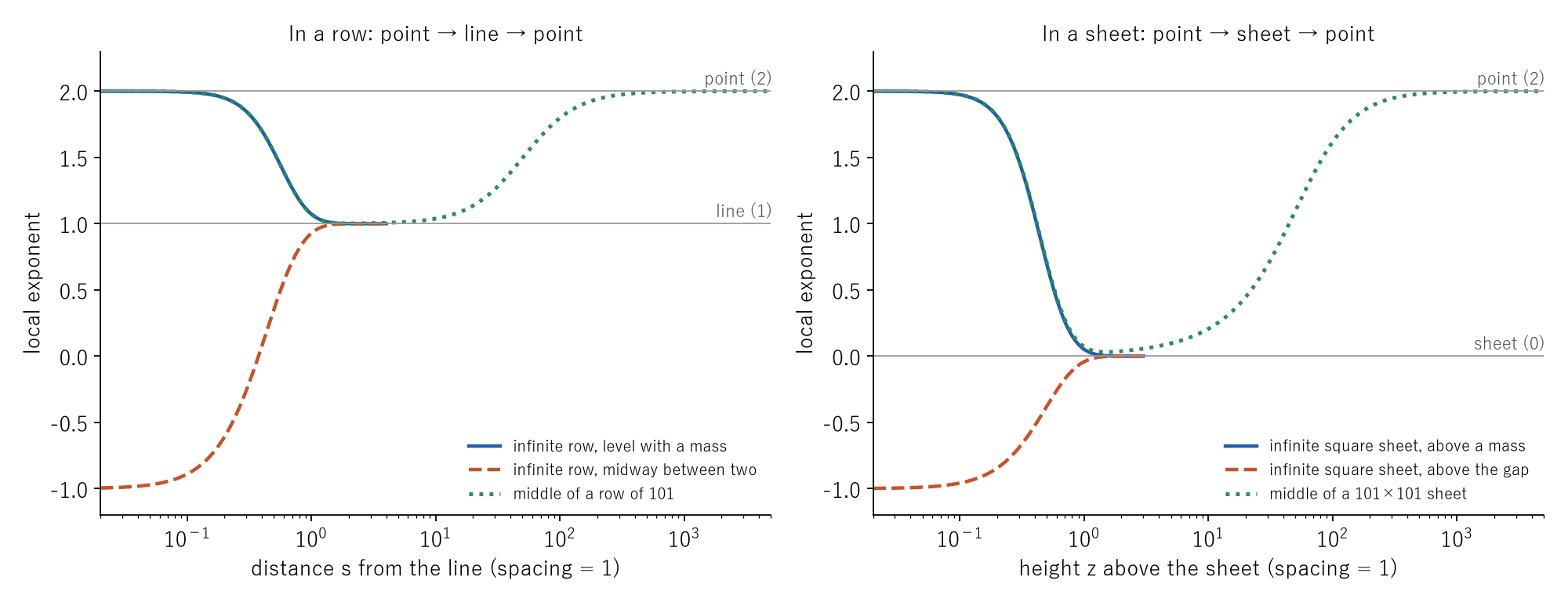
With unit masses in a row at unit spacing, level with a mass the near law 1/s² and the far law 2/s cross at s = 1/2 (both equal 4; the true field is 4.904664979). Far away the deviation from the far law shrinks by roughly a factor of e every 0.159155 of the spacing, that is every 1/(2π) (at s = 1 it falls by e to the power 5.851072 per unit distance, a little slower than 2π). Midway between two masses the pulls of the two neighbours point almost along the line, up and down, and cancel, so the field goes to 0 as 14ζ(3) times s. On a square lattice the near law 1/z² and the far law 2π cross at z = 0.398942, and the size of the first deviation from the point law is set by the lattice sum 4ζ(3/2)β(3/2) = 9.033621683. The field approaches 2π from above over a mass and from below over the gap between four masses, at the same rate. For a row of 101 masses the local exponent (the power of distance with which the field weakens around that distance) moves from 2 to near 1 (minimum 1.001938) and back to 2; for a 101×101 sheet it moves from 2 to near 0 (minimum 0.030649) and back to 2.
The 2π of a line is the circumference of the circle around the line, and the 2π of a sheet is 4π divided by the 2 of the sheet’s two sides. The two are the same number because, for a sphere of radius 1 in three dimensions, the area 4π is the circumference 2π of the equator times the diameter 2. In rationalized units, which count the strength of a source by the flux leaving it (SI for electricity), the fields of a point, a line and a sheet are q/(4πε0 r²), λ/(2πε0 s) and σ/(2ε0), and the sizes of the enclosing figures, 4π, 2π and 2, remain in the denominators. In unrationalized units, which put no 4π in the point law (Gaussian units for electricity, and gravity written with G), they are q/r², 2λ/s and 2πσ, and 4π divided by those sizes, 1, 2 and 2π, remains as the coefficients. Changing the units makes 2π and 2 trade places between the field formulas of the line and the sheet, and the two 2π never stand side by side in the field formulas of the same convention. The 2π of this paper has at least four addresses; the other two are the 2π of the period in the rate of approach to the far law, 2π/d (d the spacing for a row, and for a sheet the widest spacing between parallel rows of masses), and m(1) = 4π/(3−1) of Paper 02, and neither moves with the units. With the spacing set to 1 the sheet field 2πσ and the rate of approach look like the same 6.283185, but with spacing 2 they split into 1.570796 and 3.141593. The Bouguer slab 2πGρh used in gravity surveying is the 2π of a sheet, and gives 0.041936 mGal for density 1 g/cm³ and thickness 1 m. The separator is whether the 2π is the size of the figure enclosing the arrangement itself or 4π divided by that size.
Keywords: 4π, solid angle, Gauss law, inverse-square law, lattice sum, choice of unit, Bouguer slab, separator.
Scope (what is not claimed)
This paper claims no new theorem and no new law. The fields of mass spread on a line and on a sheet (2λ/s and 2πσ) and Gauss’s law, rationalized and unrationalized units, the formula that rewrites a periodic sum as a Fourier sum (the Poisson summation formula), the expression of the sum over a row by modified Bessel functions, the closed form 4ζ(3/2)β(3/2) of the square-lattice sum (Borwein et al., 2013), and the Bouguer correction used in gravity surveying (Hinze et al., 2005) are all standard. What this paper adds is to confirm with numbers, for masses laid at a spacing, where and how fast the point law gives way to the law of the arrangement, to count where a finite arrangement returns to a point, and to separate the addresses of the same 2π by what moves them. Only three-dimensional space is treated, and the dimension of space is never changed. We do not treat the practice of gravity surveying (terrain corrections, the roundness of the Earth, the choice of density), electricity in real materials, moving masses or general relativity. The closed form of the lattice sum and the formulas for the approach to the far law are confirmed with numbers and are not proved. The only arrangements counted are an infinite row, the square, triangular, rectangular and honeycomb lattices, a row of 101 masses, a 101×101 sheet and a disc. Paper 258 set out that the numbers appearing for a point, a line and a sheet source are 4π, 2π and 2π, with the fall-off becoming flatter one step at a time, and wrote in its scope note that a finite length returns toward 4π at the ends. This paper sits next to it. What Paper 258 placed at the limit of infinite length is counted here with masses laid at a spacing and with a finite row and sheet, and the 2π of a line and the 2π of a sheet, which Paper 258 set out both as solid angles, are separated here as different addresses. Paper 456 counted that doubling the distance lowers the sound of a point source twice as much as that of a line source (the exponents 2 and 1 here), and wrote that very close to a road each car looks like a point source while farther away the road becomes a line source; the row of this paper counts that changeover in the field of gravity (sound adds intensities, so the distance of the changeover is not the same). Paper 1088 counted that the field on one side of a charged sheet is 2πσ and the difference across it is 4πσ, that the 2 in the momentum given by a fast particle is the ratio of the surface areas of adjacent unit spheres (4π÷2π in three dimensions), and that the 4π of Bethe’s formula is twice the 2π of the circumference of a ring. The 2π = 4π÷2 of a sheet and the 2 = 4π÷2π of a line in this paper are counted in the same way as that three-dimensional case and are not claimed as new results. Paper 306 showed that where 4π sits moves with the convention of units, and wrote that it moved rather than vanished; with the same convention, this paper counts that the 2π of the field formulas moves between the line and the sheet. Paper 01 showed that in three dimensions 2 is the only density exponent for which the mass of a spherical shell does not depend on the radius, and Paper 02 showed that in m(n) = 4π/(3−n), n = 2 is the only exponent that makes the mass equal the solid angle itself; this paper asks the same questions for a line and a sheet. Paper 35 showed that the 4π of Poisson’s equation for gravity is a solid angle forced by Gauss’s law. Paper 1052 said that the exponent of a shell is one less than the dimension of space, the subtracted 1 coming from the surface of the shell being one lower than its interior; here space stays three-dimensional, the number k of directions perpendicular to the arrangement plays the role of the dimension of space in Paper 1052, and the exponent of the shell is k−1. Paper 1086 said that the π remaining in the period and the free-fall time when the formulas of gravity are written with mass is the angle of a revolution; among the 2π of this paper, two are angles of a revolution, the circumference of a line and the 2π of the period. Paper 1097 and Paper 1098 counted the boundary where the terms weaken as the distance to the power of the dimension and the shape of summation affects the sum; the near-side sums of this paper weaken as the cube of distance both in a row and on a sheet, and since 3 exceeds the dimension of the lattice they do not depend on the shape of summation. Following the judgement of Paper 300, the same number appearing does not make two things share a root; we separate them by what moves them.
1. What Does 4π Surround?
Paper 02 showed that when a ball of density $\rho(r)=1/r^2$ in three dimensions is built up to radius 1, the $r^2$ of the volume growth $4\pi r^2$ cancels the $1/r^2$ of the density, and the mass equals the full solid angle $4\pi$. Paper 35 showed that the $4\pi$ of Poisson’s equation for gravity, $\nabla^2\phi=4\pi G\rho$, is a solid angle forced by Gauss’s law. Both $4\pi$ are the size of a sphere around one point.
Paper 258 set out how this $4\pi$ disappears and $2\pi$ appears when the source is changed from a point to a line or a sheet, and wrote that a finite length returns toward $4\pi$ at the ends. This paper asks two questions from there. One is at what distance, and how fast, the point law gives way to the law of a line or a sheet when the mass is not gathered at a point but laid at a spacing. The other is whether the $2\pi$ of a line and the $2\pi$ of a sheet are the same thing. Staying in three-dimensional space and changing only the arrangement, we check both with numbers. The units are $G=1$, one mass $m=1$ and spacing 1 unless stated otherwise.
2. The Size of the Enclosing Figure: 4π, 2π, 2
Around a point the field can spread in three directions. Around masses laid in a row (a line) it can spread only in the two directions perpendicular to the line; around masses spread in a sheet, only in the one direction perpendicular to the sheet. Calling the number of directions $k$, it is 3 for a point, 2 for a line and 1 for a sheet. Space is three-dimensional in every case, and $k$ is set by the arrangement.
The cancellation of Paper 02 happens in the same form for every $k$. For a point it is $\int_{r<1}r^{-2} d^3x$; for a line, per unit length, $\int_{s<1}s^{-1} d^2x$ ($s$ is the distance from the line); for a sheet, per unit area, $\int_{|z|<1}dz$. The values are 12.5663706144, 6.28318530718 and 2.0. These are the surface areas of the unit sphere in the space spanned by the $k$ directions, $S_k=2\pi^{k/2}/\Gamma(k/2)$, with $S_3=4\pi$, $S_2=2\pi$ and $S_1=2$. The $S_k$ of this paper corresponds to $S_{k-1}$ in the notation of Paper 1088.
In spherical or polar coordinates this calculation looks like a restatement, so we also checked it another way. Summing the outward component of the field of a point, $\hat r/r^2$, over the six faces of a cube of side 2 gives 12.566370614359, whose difference from $4\pi$ is 0 in double precision. Summing the outward component of the field of a line, $\hat s/s$, over the four edges of a square of side 2 gives 6.283185307180, differing from $2\pi$ by $8.9\times10^{-16}$. The field of a sheet goes out only in the two directions of its two sides, which sum to $S_1=2$.
In units where gravity is written with $G$, the total field sent out by a mass $m$ is $4\pi Gm$ by Gauss’s law ($4\pi m$ with $G=1$). If the enclosing figure has size $S_k$, the coefficient of the far field is $4\pi\div S_k$.
| arrangement | directions to spread, $k$ | size of the enclosing figure, $S_k$ | far field | exponent $k-1$ |
|---|---|---|---|---|
| point | 3 | $4\pi$ (sphere) | $m/r^2$ | 2 |
| line (row) | 2 | $2\pi$ (circle) | $2\lambda/s$ | 1 |
| sheet | 1 | 2 (two sides) | $2\pi\sigma$ | 0 |
The 2 of the line’s $2\lambda/s$ is $4\pi\div2\pi$, and the $2\pi$ of the sheet’s $2\pi\sigma$ is $4\pi\div2$. This way of counting is the same as what Paper 1088 counted in three dimensions (the 2 in the momentum given by a fast particle, and the field $2\pi\sigma$ on one side of a charged sheet). The exponent of distance is $k-1$, decreasing by one from the 2 of a point.
Paper 01 showed that in three dimensions 2 is the only density exponent for which the mass of a spherical shell does not depend on the radius. Asking the same question for a line and a sheet, the exponent for which the shell mass $S_kr^{k-1}\rho(r)$ does not depend on the radius is $k-1$: 1 for a line ($\rho=1/s$) and 0 for a sheet (a density uniform across the thickness). At $r=0.5$, 1, 2 and 7 the shell mass stays $S_k$. Paper 1052 said that the exponent of a shell is one less than the dimension of space, the subtracted 1 coming from the surface of the shell being one lower than its interior. Here the dimension of space stays 3, the number $k$ of directions perpendicular to the arrangement plays the role of the dimension of space in Paper 1052, and since the shell (a circle around a line, the two points on either side of a sheet) is one lower within the space of directions, the exponent is $k-1$.
3. Laying Masses in a Row
Place unit masses at unit spacing on the $z$ axis. Let $s$ be the distance from the line and $z_0$ the height, and find the field $g$ perpendicular to the line at $z_0=0$ (level with a mass) and $z_0=1/2$ (midway between two masses). Rewriting the periodic sum as a Fourier sum (the Poisson summation formula) gives
$$g(s,z_0)=\frac{2}{s}\Bigl[1+2\sum_{q\ge1}(2\pi qs)\,K_1(2\pi qs)\cos(2\pi qz_0)\Bigr] ,$$with $K_1$ the modified Bessel function. Summing $\pm200000$ masses directly and adding the outside as a continuous line, the ratio to this formula differed by at most $5.6\times10^{-16}$, level with a mass and midway, at $s=0.1$, 0.5, 1 and 2.
| $s$ | level with a mass, $g$ | $g s^2$ | $g s/2$ | midway | midway $g s/2$ |
|---|---|---|---|---|---|
| 0.05 | 400.119818021 | 1.000299545 | 10.002995451 | 0.829533887 | 0.020738347 |
| 0.10 | 100.237337977 | 1.002373380 | 5.011866899 | 1.591033290 | 0.079551665 |
| 0.20 | 25.457092817 | 1.018283713 | 2.545709282 | 2.723671075 | 0.272367107 |
| 0.50 | 4.904664979 | 1.226166245 | 1.226166245 | 3.194814393 | 0.798703598 |
| 1.00 | 2.024869843 | 2.024869843 | 1.012434922 | 1.975257721 | 0.987628861 |
| 2.00 | 1.000031891 | 4.000127564 | 1.000031891 | 0.999968109 | 0.999968109 |
| 3.00 | 0.666666715 | 6.000000434 | 1.000000072 | 0.666666618 | 0.999999928 |
The near law $1/s^2$ and the far law $2/s$ cross at $s=1/2$, where both equal 4. The true field there is 4.904664979, 1.226166 times the value of either law. We call the power of distance with which the field weakens around a given distance the local exponent, $-d\ln g/d\ln s$. The local exponent reaches 1.5, halfway between 2 and 1, at $s=0.524839$, close to the crossing.
On the near side, the neighbouring masses strengthen the field slightly. $g s^2-1$ starts as $2\zeta(3)s^3$, from the sum $\sum_{j\ne0}s/(s^2+j^2)^{3/2}\approx2\zeta(3)s$ ($\zeta(3)=1.202056903$). $(g s^2-1)\div(2\zeta(3)s^3)$ is 0.987216064 at $s=0.1$ and 0.999870622 at $s=0.01$.
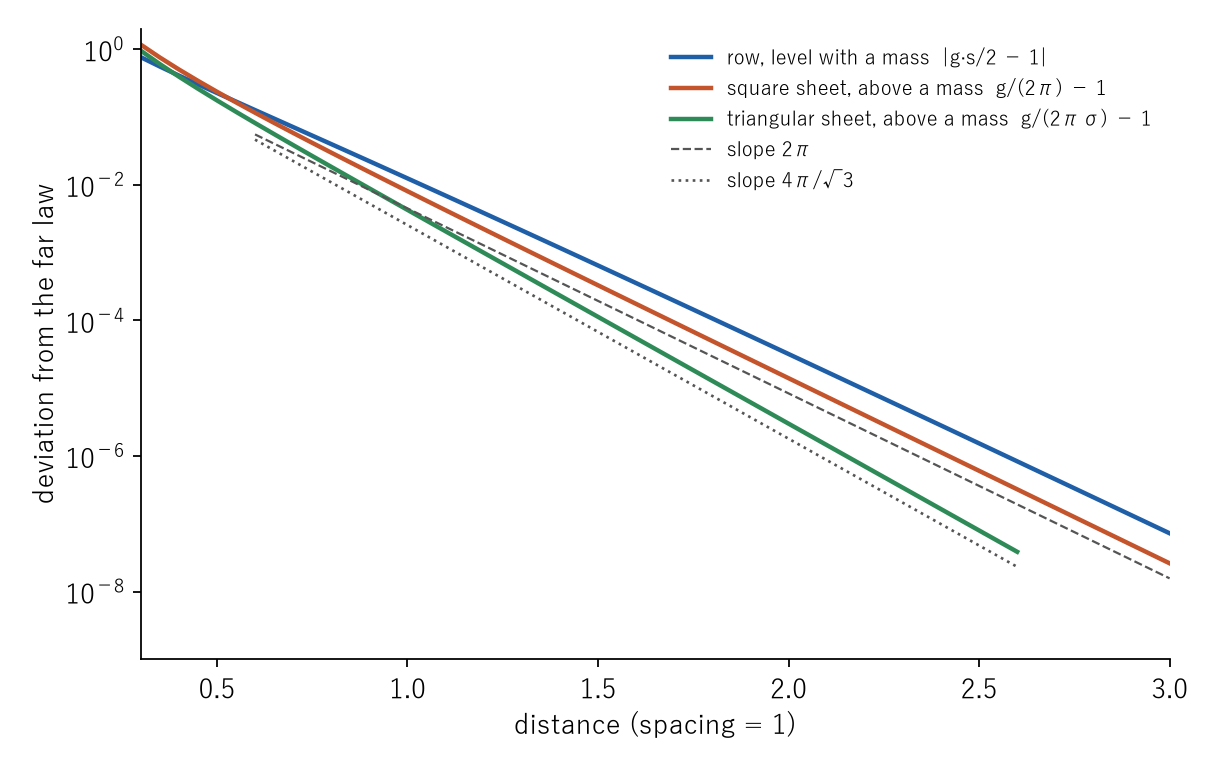
On the far side, $g s/2-1$ shrinks to $1.243492\times10^{-2}$ at $s=1$, $3.189103\times10^{-5}$ at $s=2$ and $7.226087\times10^{-8}$ at $s=3$. Its rate of shrinking (the power of $e$ by which the difference falls while the distance grows by 1, $-d\ln|g s/2-1|/ds$) is 5.851072 at $s=1$, 6.047059 at 2 and 6.122821 at 3, approaching $2\pi-1/(2s)$ from the form of $K_1$ (5.783185, 6.033185, 6.116519) and tending to $2\pi$ far away. Far away, the difference falls by roughly a factor of $e$ every $1/(2\pi)=0.159155$ of the spacing; nearer, a little more slowly.
Midway between two masses the near behaviour differs. The pulls of the two neighbours point almost along the line, up and down, and cancel. Perpendicular to the line the two pulls add, but since the pulls are nearly parallel to the line, that component is small and proportional to $s$. Summed over the whole row, $g\approx s\sum_j1/|j+1/2|^3=14\zeta(3) s$; $g/s$ is 16.819158 at $s=0.01$ and 16.828700 at $s=0.001$, approaching $14\zeta(3)=16.828797$. The local exponent is $-0.998854$ at $s=0.01$ and $-0.999989$ at $s=0.001$. The field peaks at 3.361465516 at $s=0.375363$, and far away it settles on the same $2/s$ as level with a mass ($g s/2$ is 0.999968109 at $s=2$, against 1.000031891 level with a mass). The far field forgets where along the row one stands.
4. Spreading Masses in a Sheet
Place unit masses on a square lattice of unit spacing, and find the field at height $z$ above a mass and above the centre of the gap between four masses. Rewriting the lattice sum as a Fourier sum gives
$$g=2\pi\Bigl[1+\sum_{\mathbf G\ne0}e^{-|\mathbf G|z}\cos(\mathbf G\cdot\boldsymbol\rho_0)\Bigr],\qquad \mathbf G=2\pi(i,j) ,$$with $\boldsymbol\rho_0$ the position of the observation point along the sheet and $i$, $j$ integers. Summing the lattice points inside a circle of radius 1500 directly and adding the outside as a continuous sheet, the ratio to this formula differed by at most $2.5\times10^{-9}$, above a mass and above the gap, at $z=0.2$, 0.5 and 1.
| $z$ | above a mass $\div2\pi$ | above the gap $\div2\pi$ | above a mass $\times z^2$ |
|---|---|---|---|
| 0.05 | 63.733713024 | 0.130737496 | 1.001126823 |
| 0.10 | 16.058066709 | 0.257355288 | 1.008958088 |
| 0.20 | 4.257105494 | 0.484475848 | 1.069927308 |
| 0.40 | 1.503526264 | 0.790777431 | 1.511509461 |
| 0.60 | 1.115645873 | 0.927599622 | 2.523531513 |
| 1.00 | 1.008043550 | 0.993091293 | 6.333724421 |
| 1.50 | 1.000329339 | 0.999683731 | 14.141822856 |
The near law $1/z^2$ and the far law $2\pi$ cross at $z=1/\sqrt{2\pi}=0.398942$. The true field above a mass there is 9.473538430, 1.507760 times $2\pi$. The local exponent reaches 1, halfway between 2 and 0, at $z=0.415122$.
On the near side above a mass, $(g z^2-1)\div z^3$ approaches the lattice sum $\sum_{(i,j)\ne0}(i^2+j^2)^{-3/2}$. This sum has the closed form $4\zeta(3/2)\beta(3/2)=9.033621683$ ($\beta$ is the Dirichlet beta function); at $z=0.01$ the ratio is 9.032858227. Summing the lattice points with $|i|,|j|\le3000$ directly and estimating the outside of that square as continuous, $4\sqrt2/R$ with $R=3000.5$, gives 9.033621683, agreeing with the closed form in every digit shown. The terms weaken as the cube of distance, and since 3 exceeds the lattice dimension 2, the sum does not depend on the shape of summation. The field along the sheet has terms weakening as the square of distance, the boundary case of Paper 1098, but above a mass and above the centre of the gap it vanishes by the symmetry of directions.
On the far side the field is $2\pi(1+4e^{-2\pi z}+\dots)$ above a mass and $2\pi(1-4e^{-2\pi z}+\dots)$ above the gap. The field approaches $2\pi$ from above over a mass and from below over the gap, at the same rate. At $z=1$ the differences divided by $2\pi$ are $+8.043550\times10^{-3}$ above a mass and $-6.908707\times10^{-3}$ above the gap, and the first term $4e^{-2\pi}$ is $7.469771\times10^{-3}$. The difference above a mass is 1.076813 times the first term because the next shells, $|\mathbf G|=2\pi\sqrt2$ and $4\pi$, still contribute; adding them gives $8.037097\times10^{-3}$. At $z=2$ the ratio to the first term alone has come down to 1.005492.
The rate of approach also depends on where one looks. Above the midpoint between two adjacent masses, the four terms of the first shell cancel in pairs, and at $z=1$ the difference divided by $2\pi$ is $-5.393696\times10^{-4}$ (the next two shells, $-4e^{-2\pi\sqrt2}+4e^{-4\pi}$, give $-5.394274\times10^{-4}$). What this paper calls the rate of approach is the value counted above a mass and above the gap between four masses.
Above the gap between four masses the four pulls cancel along the sheet near it, and the field goes to 0. The field grows with height and approaches $2\pi$ from below without a peak (divided by $2\pi$: 0.026282472 at $z=0.01$, 0.993091293 at 1, 0.999986127 at 2).
5. Finite Arrangements: Back to a Point
Paper 258 wrote that a finite length returns toward $4\pi$ at the ends. Here we count the effect of a finite length by moving away from the middle of the arrangement to distances beyond the size of the whole (we do not count near the ends). For 101 masses in a row, the local exponent level with the middle is 2 near the row, approaches 1 in between (the minimum found by a fine search is 1.001938 at $s=2.052$), and returns to 2 far away (1.003518 at $s=3$, 1.940070 at 200). The far law of a line, $2/s$, and the law that sees the whole as one point, $101/s^2$, cross at $s=50.5$, where the exponent is 1.500000. For a uniform rod of length $2a$, the local exponent level with the middle is $1+s^2/(s^2+a^2)$, exactly 3/2 at $s=a$; the row of 101 corresponds to a rod with $a=50.5$.
Above the middle of a 101×101 square sheet (mass 10201), the local exponent is 2 near the sheet, approaches 0 in between (the minimum found by a fine search is 0.030649 at $z=1.494$), and returns to 2 far away (0.056251 at $z=3$, 0.206036 at 10, 1.882397 at 200). The sheet law $2\pi$ and the point law $10201/z^2$ cross at $z=40.293170$, where the exponent is 0.913492. This height is $1/\sqrt2$ of the radius 56.9831 of the circle of equal area, the same form as the height where the sheet law and the point law cross for the disc of Section 8.
With two lengths in the arrangement (the spacing and the size of the whole), there are two replacements. Closer than the spacing one sees the $4\pi$ of a single point; farther than the spacing but closer than the size of the whole, the law of a line or a sheet; farther than the size of the whole, the $4\pi$ of a single point again (Figure 1).
6. The 2π of a Line and the 2π of a Sheet
The $2\pi$ of a line and the $2\pi$ of a sheet look like the same number. Paper 258 set them out both as solid angles halved from the $4\pi$ of a point. Following the judgement of Paper 300, this paper separates them by what moves them.
Look first at their origins. The $2\pi$ of a line is the size $S_2$ of the circle around the line itself, the angle of one revolution around the line. The $2\pi$ of a sheet is $4\pi$ divided by the $S_1=2$ of the sheet’s two sides, the solid angle (a hemisphere) that an infinite sheet subtends from a point on one side.
The two are the same number because $4\pi=2\times2\pi$ for a sphere in three dimensions: the area of a sphere of radius 1 equals the circumference $2\pi$ of its equator times its diameter 2. In the proof of Paper 02, $4\pi$ splits into $\int_0^\pi\sin\theta d\theta=2$ times $\int_0^{2\pi}d\varphi=2\pi$, and Paper 1088 read the $4\pi$ of Bethe’s formula as twice the $2\pi$ of the circumference of a ring. So $4\pi\div2$ equals the circumference $2\pi$ as a number, and $4\pi\div2\pi$ equals the 2 of the sheet’s two sides; this one identity is also why $2\pi$ and 2 trade places exactly when the units change. We still count them as separate addresses because moving the convention or the arrangement $k$ moves them separately, in opposite directions.
Moving the units. The convention that counts the strength of a source by the flux leaving it we call rationalized units. SI for electricity is of this kind: the fields of a point, a line and a sheet are $q/(4\pi\varepsilon_0r^2)$, $\lambda/(2\pi\varepsilon_0s)$ and $\sigma/(2\varepsilon_0)$, and what remains in the denominators is the size of the enclosing figure, $S_3=4\pi$, $S_2=2\pi$ and $S_1=2$. The convention that puts no $4\pi$ in the point law (the coefficient is 1 or $G$) we call unrationalized units. Gaussian units for electricity and gravity written with $G$ are of this kind: the fields are $q/r^2$, $2\lambda/s$ and $2\pi\sigma$, with coefficients $4\pi\div S_k$, that is 1, 2 and $2\pi$.
| arrangement | size of the enclosing figure, $S_k$ | rationalized units (SI) | unrationalized units (Gaussian) | units where the field formula keeps $2\pi$ |
|---|---|---|---|---|
| point | $4\pi$ | $q/(4\pi\varepsilon_0r^2)$ | $q/r^2$ | ($4\pi$ remains in rationalized units) |
| line | $2\pi$ | $\lambda/(2\pi\varepsilon_0s)$ | $2\lambda/s$ | rationalized units |
| sheet | 2 | $\sigma/(2\varepsilon_0)$ | $2\pi\sigma$ | unrationalized units |
In rationalized units the $2\pi$ stays in the field formula of the line, while that of the sheet keeps 2; in unrationalized units the $2\pi$ stays in the field formula of the sheet, while that of the line keeps 2. Changing the convention makes $2\pi$ and 2 trade places between the field formulas of the line and the sheet, and the two $2\pi$ never stand side by side in the field formulas of the same convention. They appear side by side only when the line is written in rationalized units and the sheet in unrationalized units. In this paper, when a $2\pi$ is said to vanish from a field formula, we mean that it cancels against the $4\pi$ of the convention inside that formula; the circumference and the hemisphere themselves remain. Outside field formulas the circumference stays in every convention: in Paper 1088 the $2\pi$ of the ring in Bethe’s formula appears, in the same Gaussian units, together with the one-side field $2\pi\sigma$. Paper 306 showed that where the $4\pi$ of a point sits moves with the convention of units, and wrote that it moved rather than vanished. Applied to the criterion of Paper 306 (what vanishes when the system of units changes is a convention; what remains is geometry), the place inside the field formula falls on the side of convention, and the sizes of the circumference and the hemisphere themselves on the side of geometry. For the line and the sheet, too, the convention moves where the $2\pi$ sits inside the field formulas.
Moving the arrangement. The $2\pi$ of a line is the value of $S_k$ at $k=2$; with $k=3$ it becomes $4\pi$ and with $k=1$ it becomes 2. The $2\pi$ of a sheet is the value of $4\pi\div S_k$ at $k=1$; with $k=2$ it becomes 2 and with $k=3$ it becomes 1. Moving $k$ moves the two in opposite directions. The Bouguer slab of gravity surveying (Section 8) is written in unrationalized units with $G$, so the $2\pi$ of a sheet is what one sees.
7. Two More 2π
The $2\pi$ that appear in this paper have at least four addresses. Besides (a) the circumference $S_2$ of a line and (b) the one-side coefficient $4\pi\div S_1$ of a sheet, there are (c) the $2\pi$ of the period in the rate of approach to the far law and (d) $n=1$ in $m(n)=4\pi/(3-n)$ of Paper 02.
(c) The $2\pi$ of the period. The far-side difference shrinks as $e^{-|\mathbf G|z}$. The reciprocal-lattice length $|\mathbf G|$ is the wavenumber of the arrangement seen as a wave, the angle the phase turns through per unit length; for a wave of period $d$ it is $2\pi/d$. Above a mass on a square lattice the smallest $|\mathbf G|$ is $2\pi$. On any lattice with one equal mass per unit cell (a Bravais lattice), the rate of approach above a mass is $2\pi/d$ (on the square lattice, also above the gap between four masses), where $d$ is the widest of the spacings between parallel rows along which the masses lie. This $2\pi$ is the angle that counts one period of the arrangement as one revolution of phase, and it vanishes when written with $|\mathbf G|$ instead of the period. It is built the same way as the $2\pi$ that remains in the period of an orbit in Paper 1086 (which vanishes when written with the angular velocity). Changing the units does not move the rate.
Moving the spacing. The sheet field is $2\pi\sigma=2\pi/A$ ($A$ the area of the unit cell), and the rate of approach is $2\pi/d$. On a square lattice of spacing 1 both look like 6.283185, but with spacing 2 they split into 1.570796 and 3.141593. On a Bravais lattice $A=L\times d$ ($L$ the distance between the two nearest masses), so their ratio is $1/L$. We confirmed this for the square ($A=1$), triangular ($A=0.866025$, both 7.255197) and 1×2 rectangular ($A=2$, both 3.141593) lattices. With $G$ and $m$ restored the ratio is $Gm/L$; the field is an acceleration and the rate is an inverse length. Only in units where $Gm/L=1$ (for example $G=m=L=1$) do the two look like the same number. On the honeycomb lattice, with two masses per unit cell (nearest-neighbour distance 1), the surface density is 0.769800, the sheet field 4.836798 and the smallest reciprocal-lattice length $4\pi/3=4.188790$, so the ratio is 1.154701 ($2/\sqrt3$), not $1/L$.
Moving the lattice shape. On a triangular lattice of unit spacing (surface density 1.154701), the far field is $2\pi\sigma=7.255197$ and the rate of approach is the shortest reciprocal-lattice length $4\pi/\sqrt3=7.255197$; the two move together from the 6.283185 of the square lattice. At $z=1$ above a mass the direct sum is 7.286125847 and the Fourier sum 7.286125882, a ratio difference of $-4.7\times10^{-9}$. The difference shrinks as $6e^{-(4\pi/\sqrt3)z}$: $4.262934\times10^{-3}$ at $z=1$ (first term $4.238957\times10^{-3}$) and $1.127124\times10^{-4}$ at 1.5 ($1.126712\times10^{-4}$). The near law and the far law cross at $1/\sqrt{2\pi\sigma}=0.371258$, lower than the 0.398942 of the square lattice. Writing the rate as $2\pi/d$, the $2\pi$ stays and $d$ moves; writing the field as $2\pi\sigma$, the $2\pi$ stays and $\sigma$ moves. The lattice shape does not separate (b) and (c). What separates them is the units ((b) vanishes from the field formula in rationalized units, (c) remains in both) and the dimension of the quantity multiplied (an acceleration and an inverse length) (Figure 2).
(d) $m(1)$ of Paper 02. $m(n)=4\pi/(3-n)$ is 5.026548, 6.283185 and 8.377580 at $n=0.5$, 1 and 1.5. Moving the density exponent moves only (d); the other three do not move. (b) and (d) are both half of $4\pi$, but the halves come from different places: (b) is the half from dividing by the two sides of the sheet, (d) the half from the radial integral $\int_0^1r dr=0.5$.
As angles of a revolution, (a) is one revolution of direction around the line and (c) one revolution of phase along the arrangement, and in the reading of Paper 1086 both are angles of a revolution. But changing the units makes only (a) vanish from the field formula. Moving the arrangement $k$ also separates them: (a) moves as $S_k$ through $4\pi$, $2\pi$ and 2, while (c) stays $2\pi/d$ for a row and a sheet alike. They do not share a root.
| address | origin | moved by | not moved by |
|---|---|---|---|
| (a) circumference of a line | size of the circle around the line, $S_2$ | arrangement $k$; units (in unrationalized units it cancels against $4\pi$ inside the field formula) | spacing, lattice shape, density exponent |
| (b) one-side coefficient of a sheet | $4\pi\div S_1$ (solid angle the sheet subtends from one side) | arrangement $k$; units (in rationalized units it cancels against $4\pi$ inside the field formula) | spacing, lattice shape (enter only through $\sigma$), density exponent |
| (c) $2\pi$ of the period | rate of approach $2\pi/d$ | writing with the period or with the reciprocal-lattice length (vanishes with $|\mathbf G|$) | units, arrangement $k$ ($2\pi/d$ for a row and a sheet alike), density exponent (spacing and lattice shape enter only through $d$) |
| (d) $m(1)$ of Paper 02 | $n=1$ in $4\pi/(3-n)$ | density exponent $n$ | units, spacing, lattice shape |
8. A Real Sheet: The Bouguer Slab
In gravity surveying, the gravity above a wide slab of thickness $h$ and density $\rho$ is taken as $2\pi G\rho h$ for the correction (the Bouguer correction; the standard procedure is set out in Hinze et al., 2005). This $2\pi$ is the sheet coefficient (b). With $G=6.67430\times10^{-11}$ m$^3$ kg$^{-1}$ s$^{-2}$ (CODATA 2022), density 1000 kg/m$^3$ and thickness 1 m give $4.193586\times10^{-7}$ m/s$^2$, that is 0.041936 mGal (milligal, 1 mGal $=10^{-5}$ m/s$^2$); density 2670 kg/m$^3$, a value often used for the average rock of the crust, gives 0.111969 mGal.
The slab can be taken as infinite only when the height is much smaller than its extent. On the axis of a disc of radius $a$, thin compared with the height $z$, the field is $2\pi G\rho h (1-z/\sqrt{z^2+a^2})$. The factor $2\pi(1-z/\sqrt{z^2+a^2})$ is the solid angle the disc subtends from that point, the solid angle that Paper 258 described as levelling off at $2\pi$ for a sheet source. Coming within 99 percent of $2\pi G\rho h$ needs $a\ge\sqrt{9999} z=99.995 z$: at 1 m above it a flat extent of radius about 100 m, and at 10 m one of about 1000 m. Far away the slab returns to a single point, $GM/z^2$ with $M=\pi a^2\rho h$. The sheet law and the point law become equal at $z=a/\sqrt2$ ($0.707107 a$), where the true field is $1-1/\sqrt3=0.422650$ of the sheet law. At $z/a=10$ the true field is 0.004963 of the sheet law and the point law 0.005000, so it has nearly returned to a point.
9. The Separator
The separator is whether the $2\pi$ is the size of the figure enclosing the arrangement itself or $4\pi$ divided by that size. The $2\pi$ of a line is the size of the enclosing circle itself and remains in the denominator of the field formula in rationalized units. The $2\pi$ of a sheet is $4\pi$ divided by the 2 of its two sides and remains in the coefficient of the field formula in unrationalized units. The two are the same number because $4\pi=2\times2\pi$ for a sphere in three dimensions; changing the units makes them trade places, and they never stand side by side in the field formulas of the same convention. The $2\pi$ of the period has nothing to do with an enclosing figure. It is the angle that counts one period of the arrangement as one revolution of phase, and it remains in both conventions. The $2\pi$ of $m(1)$ in Paper 02 moves when the density exponent moves. The point law gives way to the law of a line or a sheet where the distance becomes about the spacing: at half the spacing in a row and at 0.398942 of the spacing on a square lattice. Beyond that, far away, the difference shrinks by roughly a factor of $e$ every $1/(2\pi)$ of the spacing. A finite arrangement has another length, the size of the whole, and beyond it the $4\pi$ of a point returns.
Closing
4π is the size of a sphere around one point. Staying in three-dimensional space and laying the masses at a spacing, the 4π of a point gives way to the law of a line or a sheet where the distance becomes about the spacing. The point law and the law of the arrangement cross at half the spacing in a row and at 0.398942 of the spacing on a square lattice, and beyond that, far away, the difference shrinks by roughly a factor of e every 0.159155 of the spacing. If the arrangement is finite, the 4π of a point returns beyond the size of the whole. The 2π of a line and the 2π of a sheet look like the same number, but the 2π of a line is the circumference of the circle around the line, and the 2π of a sheet is 4π divided by the 2 of its two sides. They are the same number because 4π = 2 × 2π for a sphere in three dimensions. In rationalized units (SI for electricity) the 2π stays in the field formula of the line; in unrationalized units (Gaussian units, and gravity written with G) it stays in that of the sheet. Changing the convention makes the two trade places, and they never stand side by side in the field formulas of the same convention. The 2π in the rate of approach to the far law and the 2π of m(1) in Paper 02 remain in both conventions. The sheet field and the rate of approach look like the same number with the spacing set to 1 because their ratio is 1/L on any lattice with one mass per unit cell. The 2πGρh of the Bouguer slab in gravity surveying is the 2π of a sheet, 0.041936 mGal for 1 g/cm³ and 1 m, and far away it returns to the 4π of a point.
References
- Borwein, J. M., Glasser, M. L., McPhedran, R. C., Wan, J. G. & Zucker, I. J. (2013). Lattice Sums Then and Now. Cambridge University Press.
- Hinze, W. J., Aiken, C., Brozena, J., et al. (2005). New standards for reducing gravity data: The North American gravity database. Geophysics.
- National Institute of Standards and Technology (2024). CODATA Recommended Values of the Fundamental Physical Constants: 2022. NIST.
- Yamagishi, Y. (2026). The Uniqueness Theorem of $n = 2$ for Spherically Symmetric Density Distributions [Paper 01]. YOI: https://www.yamagishiyuuki.com/yoi/1; DOI: 10.5281/zenodo.21403186
- Yamagishi, Y. (2026). The $4\pi$ Mass Cancellation Theorem [Paper 02]. YOI: https://www.yamagishiyuuki.com/yoi/2; DOI: 10.5281/zenodo.21403931
- Yamagishi, Y. (2026). The Yamagishi Gravitational Constant Unpacking Theory [Paper 35]. YOI: https://www.yamagishiyuuki.com/yoi/35; DOI: 10.5281/zenodo.21430118
- Yamagishi, Y. (2026). $4\pi$ Appears Only When the Source Is a Point [Paper 258]. YOI: https://www.yamagishiyuuki.com/yoi/258; DOI: 10.5281/zenodo.22169011
- Yamagishi, Y. (2026). The Three Hundredth Census: Whether Two Things Share a Root Is Decidable [Paper 300]. YOI: https://www.yamagishiyuuki.com/yoi/300; DOI: 10.5281/zenodo.22171914
- Yamagishi, Y. (2026). How Many “Base” Units There Are Is a Promise [Paper 306]. YOI: https://www.yamagishiyuuki.com/yoi/306; DOI: 10.5281/zenodo.22172149
- Yamagishi, Y. (2026). Doubling the Distance Does Not Halve the Noise [Paper 456]. YOI: https://www.yamagishiyuuki.com/yoi/456; DOI: 10.5281/zenodo.22733038
- Yamagishi, Y. (2026). Two Kinds of Subtracting One: One Counts Holes, the Other Counts Dimensions [Paper 1052]. YOI: https://www.yamagishiyuuki.com/yoi/1052; DOI: 10.5281/zenodo.22903834
- Yamagishi, Y. (2026). The π in the Formulas of Gravity Appears with Density and Vanishes with Mass; What Remains Is the Angle of a Revolution [Paper 1086]. YOI: https://www.yamagishiyuuki.com/yoi/1086
- Yamagishi, Y. (2026). The Same 4π/m, but the 4π of the Plasma Frequency Is a Solid Angle and the 4π of Bethe’s Formula Is Twice the 2π of a Ring [Paper 1088]. YOI: https://www.yamagishiyuuki.com/yoi/1088
- Yamagishi, Y. (2026). A Lattice Sum of Dipole Fields Is Decided by the Shape of the Summation: 0 for a Sphere, 4π/3 for a Thin Needle, −8π/3 for a Thin Plate [Paper 1097]. YOI: https://www.yamagishiyuuki.com/yoi/1097
- Yamagishi, Y. (2026). In a Lattice Sum Whose Exponent Equals the Dimension, Shape Enters as the Mean Logarithm of the Distance to the Edge [Paper 1098]. YOI: https://www.yamagishiyuuki.com/yoi/1098
Reference
Yamagishi, Y. (2026). A Point’s 4π Gives Way to a Line’s or a Sheet’s Law at About the Spacing, and the Two 2π Trade Places with the Units [Paper 1112]. YOI: https://www.yamagishiyuuki.com/yoi/1112
ORCID: 0009-0006-8587-3450
PDF (English) · PDF (Japanese) · Date proof of the English PDF (OpenTimestamps .ots) · SHA256SUMS
The record page for this paper (in Japanese, with the PDFs in each language and the date proof): YOI 1112. This paper is a preprint and has not been peer reviewed.