Abstract
What this paper asks is how much of a prediction that does not exist gets manufactured when one of two data sources is shifted by an hour in summer — and the answer is that zero pairs become all twelve. No new mathematical theorem and no new law is claimed.
First, with correct timestamps there is no power to call the next hour. The twelve pairs give a median D of −0.0363 pips, and 0 of them reach a daily t of 2 in absolute value (Section 3).
Second, and this is the core of the paper: ★ shift only the summer by one hour and all twelve exceed 2. EURUSD → GBPUSD reaches 27.5623 and GBPUSD → EURUSD 28.5147 (Section 3).
Third, winter is unchanged. The winter difference (shifted − correct) has a maximum absolute value of 0.000000. ★ Only summer was touched, so this follows. A check, not a finding (Section 4).
Fourth, ★ the shifted summer value is the same-hour value itself. In all twelve pairs the absolute difference is 0.000000. What was taken for the next hour was the same hour (Section 5).
Fifth, ★ so the sign follows the contemporaneous correlation. USDJPY → XAUUSD gives −8.6852 and EURUSD → XAUUSD 9.3861 pips. The direction of the "prediction" is merely the direction of the same hour (Section 5).
Sixth, ★ year by year, 6 of the 12 pairs come out positive in all six years. With correct timestamps it is 0. "Profitable in six years out of six" is manufactured by the shift alone (Section 6).
Scope of this paper: no new mathematical theorem and no new law is claimed — daylight saving time, timestamp matching and contemporaneous correlation are all known. No real course, author, or vendor is the subject here, and none is named. No real data provider is the subject — the shift was introduced deliberately here, and no claim is made that any provider is shifted (Section 7). No trading is discussed — neither cost nor slippage is included, and everything is on mid prices (Section 7). No prediction is claimed to exist — the next hour is zero with correct timestamps, and this paper merely confirms it (Section 3). One form of shift is fixed — the European summer period only, by one hour (Section 7). The scope is intraday and few instruments — four instruments over six years on one-hour bars. Results documented at longer holding periods, such as monthly time-series momentum, are not contradicted. No prediction is claimed.
1. Notation and the question
When two data sources are matched, one of them has sometimes been in local time.
| What gets said | What does not get said |
|---|---|
| One of them predicts the other an hour ahead | Whether the two timestamps follow the same convention |
| It was profitable in every year | Whether summer and winter differ |
| The t is large, so it is solid | That a large t can be made by a shift |
Observation 1.1: ★ Local time in a region with daylight saving is one hour off from Coordinated Universal Time in summer only. In winter they agree.
Observation 1.2: ★ Ask for "the next hour" then, and in summer you get "the same hour". Contemporaneous correlation is strong, so something that is not a prediction looks like one.
Observation 1.3: The separator is how the timestamps are handled. The data, the quantity, the pairs and the period are all held fixed, and only whether the summer reference is moved back one bar is changed. That a choice of convention can manufacture an answer was measured in [F040], and the effect of the reference point in [F041].
Question: with a one-hour shift in summer only, how much of a prediction that does not exist gets manufactured?
2. State the quantities and the design first
Declared before the run and unchanged during it.
| Grid | 1-hour bars (mid price, completed bars only), timestamps in UTC |
| Leader | The sign of that hour's move |
| Follower | The next hour's move (pips) |
| Shift | During European summer time (last Sunday of March 01:00 UTC to last Sunday of October 01:00 UTC) only, the follower's reference is moved back one bar (making it the same hour) |
| Pairs | Twelve ordered pairs from four instruments |
| Quantities | D = the mean of (leader's sign × follower's move) in pips, daily t, count |
| Same hour | For comparison, the follower's same hour move is measured as well |
| Separator | How the timestamps are handled (correct, or shifted an hour in summer) |
| Instruments and period | USDJPY, EURUSD, GBPUSD, XAUUSD / 2019–2024 |
Observation 2.1: ★ The shift was introduced deliberately here. No claim is made that any provider is shifted. What is measured is what happens if one is.
Observation 2.2: Only timestamps common to the pair are used. For USDJPY → EURUSD that is 36,106 bars, of which the summer share is 0.5802.
Observation 2.3: ★ The leader's sign is the direction from open to close of that hour. The bar is complete, so looking at the next hour involves no look-ahead.
Observation 2.4: All twelve ordered pairs are measured. ★ Swapping leader and follower counts as a separate pair.
Predictions (written before measuring)
① With correct timestamps, the next-hour prediction is zero.
② Shifting only the summer makes the summer value strongly positive while winter is unchanged.
③ Pooling summer and winter, it still comes out positive.
④ The shifted summer value matches the same-hour value closely.
⑤ Year by year, most years come out positive.
3. Correct timestamps against a one-hour summer shift
The same data and the same quantity. Only the summer reference differs.
Calculation 3.1 The twelve ordered pairs
| Leader → Follower | Correct D | Correct t | Shifted D | Shifted t |
|---|---|---|---|---|
| USDJPY → EURUSD | −0.0073 | −0.2899 | −1.5362 | −17.8202 |
| USDJPY → GBPUSD | −0.0264 | −0.7194 | −1.8679 | −15.2583 |
| USDJPY → XAUUSD | −0.0054 | 1.3851 | −5.3203 | −11.7157 |
| EURUSD → USDJPY | 0.0324 | 1.5019 | −1.9923 | −14.6412 |
| EURUSD → GBPUSD | −0.1260 | −0.9503 | 3.5583 | 27.5623 |
| EURUSD → XAUUSD | −0.3250 | −1.6847 | 5.5340 | 13.6119 |
| GBPUSD → USDJPY | 0.0951 | 1.4962 | −1.6107 | −10.8203 |
| GBPUSD → EURUSD | −0.0463 | −0.1187 | 2.5690 | 28.5147 |
| GBPUSD → XAUUSD | −0.2287 | −1.2349 | 4.8788 | 11.2282 |
| XAUUSD → USDJPY | 0.0614 | 1.8093 | −2.0629 | −11.7241 |
| XAUUSD → EURUSD | −0.0785 | −1.5087 | 1.5967 | 16.9711 |
| XAUUSD → GBPUSD | −0.1207 | −1.5175 | 1.9406 | 13.5275 |
Observation 3.2: Prediction ① held. With correct timestamps the median D is −0.0363 pips and 0 of the 12 pairs reach a daily t of 2 in absolute value.
Observation 3.3: ★ This is the core of the paper. Shift only the summer and all twelve exceed 2. The largest is GBPUSD → EURUSD at 28.5147, followed by EURUSD → GBPUSD at 27.5623.
Observation 3.4: ★ Not one pair is an exception. From 0 of 12 to 12 of 12, by the shift alone.
Observation 3.5: The size of D changes by an order of magnitude too. With correct timestamps it runs from −0.3250 to 0.0951 pips; shifted, from −5.3203 to 5.5340.
Observation 3.6: ★ The median, however, is only 0.0303 pips. The signs split across pairs. Looking only at one pooled number, the anomaly is invisible.
4. Splitting summer from winter
Only summer was shifted. Winter was not touched.
Calculation 4.1 Median of the twelve pairs
| Summer, correct | Summer, shifted | Winter, correct | Winter, shifted | |
|---|---|---|---|---|
| Median of twelve pairs | −0.0109 | 0.0550 | −0.0957 | −0.0957 |
Observation 4.2: The winter difference (shifted − correct) has a maximum absolute value of 0.000000. ★ Winter was not touched, so this follows: a check, not a finding.
Observation 4.3: ★ The summer difference has a median of 0.0887 and a range of −8.7858 to 9.6806. The sign and the size differ completely by pair.
Observation 4.4: ★ So "summer and winter differ" makes it visible. USDJPY → XAUUSD gives −8.6852 in summer and −0.1612 in winter.
Observation 4.5: Conversely, report one pooled number and it stays invisible. ★ The median is 0.0303 pips against −0.0363 with correct timestamps: hardly different.
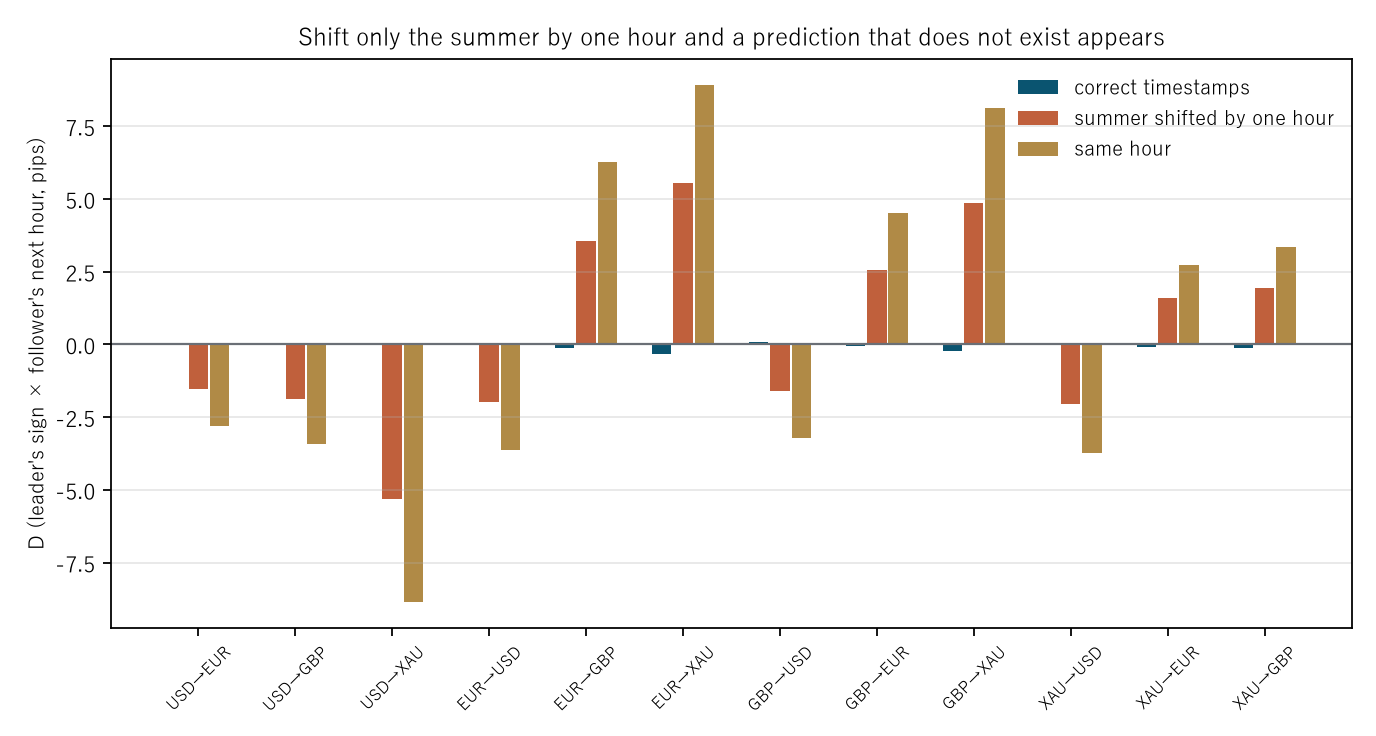
Figure 1: D (leader's sign × follower's next hour, pips) for the twelve ordered pairs. From the left: correct timestamps, summer shifted by one hour, and the same hour.
5. What the shifted value is a copy of
The shifted summer is placed beside the same-hour value.
Calculation 5.1 Summer values against same-hour values
| Leader → Follower | Summer, shifted | Same hour | Difference |
|---|---|---|---|
| USDJPY → EURUSD | −2.6183 | −2.6183 | 0.000000 |
| USDJPY → XAUUSD | −8.6852 | −8.6852 | 0.000000 |
| EURUSD → GBPUSD | 6.1925 | 6.1925 | 0.000000 |
| EURUSD → XAUUSD | 9.3861 | 9.3861 | 0.000000 |
| GBPUSD → XAUUSD | 8.3689 | 8.3689 | 0.000000 |
| XAUUSD → GBPUSD | 3.2700 | 3.2700 | 0.000000 |
Observation 5.2: ★ In all twelve pairs the absolute difference is 0.000000. The shifted summer is the same-hour value itself.
Observation 5.3: ★ What was taken for the next hour was the same hour. Prediction ④ held. It follows from the design, so this is a check.
Observation 5.4: ★ So the sign follows the contemporaneous correlation. USDJPY → XAUUSD gives −8.6852 and EURUSD → XAUUSD 9.3861 pips. The direction of the "prediction" is merely the direction of the same hour.
Observation 5.5: Over the whole period the same-hour D has a median of −0.0306 pips and a daily t of −0.5136. ★ Pooling summer and winter splits the signs and shrinks it, so the size shows only pair by pair.
6. Year by year
Can "profitable in N years out of N" be manufactured by the shift alone?
Calculation 6.1 Yearly medians and the number of positive pairs
| Year | Correct, median | Correct, positive pairs | Shifted, median | Shifted, positive pairs |
|---|---|---|---|---|
| 2019 | 0.0403 | 7 | 0.0536 | 6 |
| 2020 | −0.0866 | 2 | 0.3131 | 6 |
| 2021 | −0.0265 | 6 | 0.2519 | 6 |
| 2022 | −0.1977 | 5 | 0.1736 | 6 |
| 2023 | −0.0388 | 3 | 0.1360 | 6 |
| 2024 | 0.0162 | 6 | 0.0033 | 6 |
Observation 6.2: ★ Pairs positive in all six years number 6 of 12 when shifted and 0 of 12 when correct. Prediction ⑤ held.
Observation 6.3: ★ "Profitable in six years out of six" is manufactured by the shift alone — and for half the pairs.
Observation 6.4: Of the 72 year-pair combinations, 29 are positive with correct timestamps and 36 when shifted. ★ The overall share barely differs. What does the work is the consistency: the same pairs stay positive.
Observation 6.5: The shifted version has exactly 6 positive pairs in every one of the six years. ★ The yearly median moves from 0.0033 to 0.3131, yet which pairs are positive does not move at all.
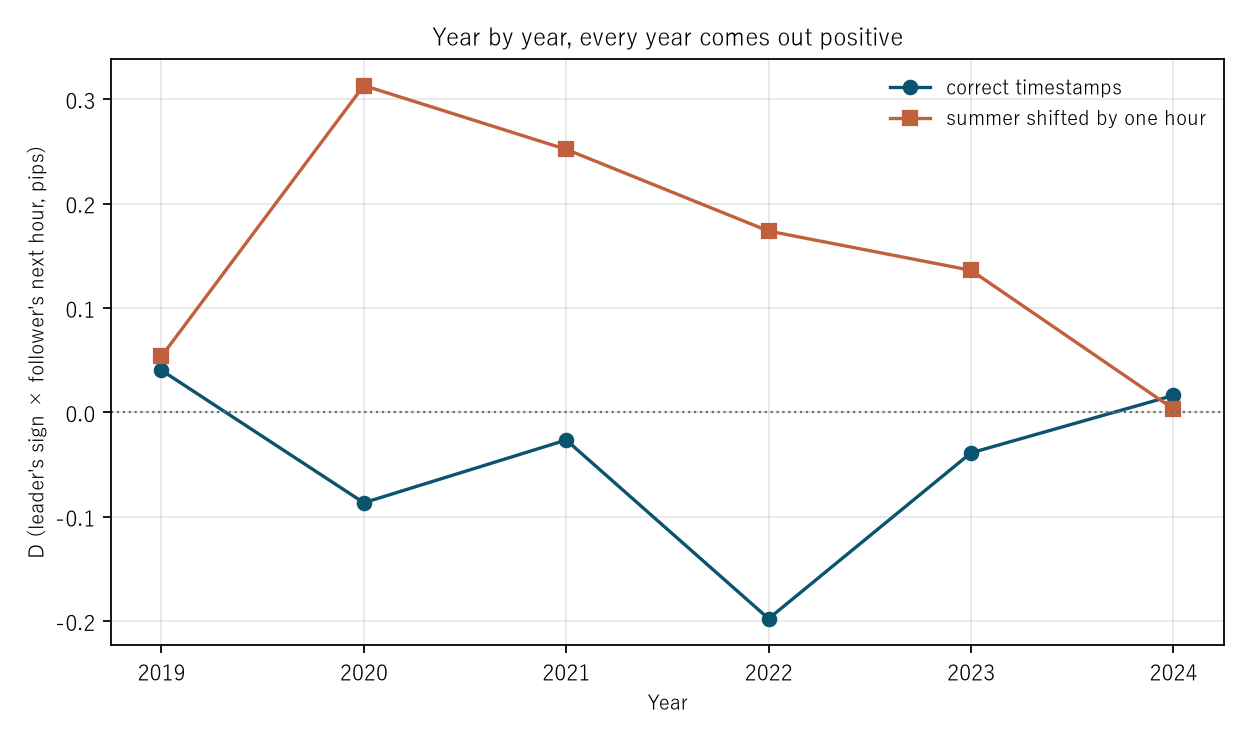
Figure 2: year on the horizontal axis and the median D across the twelve pairs (pips) on the vertical. Circles are correct timestamps and squares are the summer shifted by one hour. The dotted line is 0.
7. Limitations
- The shift was introduced deliberately here. No claim is made that any provider is shifted.
- One form of shift is fixed: the European summer period only, by one hour.
- One quantity is fixed: the leader's sign × the follower's next hour, and nothing else.
- One grid is fixed. On one-hour bars the shift is exactly one bar. On another bar size it would act differently.
- No trading is discussed. Neither cost nor slippage is included, and everything is on mid prices.
- Contemporaneous correlation itself is not the subject. Neither its size nor its mechanism is measured.
- That the next hour is zero with correct timestamps is merely confirmed here. That is already known.
- Four instruments, six years, one-hour bars. Nothing is claimed about other markets or other periods.
Conclusion
When two data sources are matched, one of them has sometimes been in local time. In a region with daylight saving, that means one hour off in summer only.
With correct timestamps there is no power to call the next hour. The twelve pairs give a median D of −0.0363 pips, and 0 of them reach a daily t of 2 in absolute value.
★ Shift only the summer by one hour and all twelve exceed 2. The largest is 28.5147 and the next 27.5623. From 0 of 12 to 12 of 12, by the shift alone, with not one exception.
★ And the shifted summer value is the same-hour value itself. In all twelve pairs the absolute difference is 0.000000. What was taken for the next hour was the same hour.
★ So the direction of the "prediction" is merely the direction of the same hour. USDJPY → XAUUSD gives −8.6852 and EURUSD → XAUUSD 9.3861 pips: the sign follows the contemporaneous correlation.
★ Year by year, 6 of the 12 pairs come out positive in all six years. With correct timestamps it is 0. "Profitable in six years out of six" is manufactured by the shift alone, and for half the pairs.
There is a place where it shows and a place where it does not. ★ Split summer from winter and USDJPY → XAUUSD reads −8.6852 against −0.1612 pips at a glance. But the median across the twelve pairs is 0.0303 pips against −0.0363 with correct timestamps. Look only at one pooled number and the anomaly disappears.
So when two sources are matched, the first thing to do is to lay summer and winter side by side. ★ And a large t is not evidence of solidity. A shift can make one.
Data and reproduction
| Data | Foreign exchange from Dukascopy-derived ticks (from 2019 onward, matching to the millisecond, bid and ask, has been verified). Gold from Dukascopy |
| Period | 2019–2024 (six years) |
| Instruments | USDJPY, EURUSD, GBPUSD, XAUUSD (twelve ordered pairs) |
| Bars | 1-hour, mid price, completed bars only, timestamps in UTC. Bars with no ticks are not created |
| Alignment | Only timestamps common to the pair (36,106 bars for USDJPY → EURUSD, summer share 0.5802) |
| Leader | The sign from open to close of that hour |
| Follower | The next hour's move (pips) |
| Shift | During European summer time (last Sunday of March 01:00 UTC to last Sunday of October 01:00 UTC) only, the follower's reference is moved back one bar |
| Quantities | D = the mean of (leader's sign × follower's move), daily t, count |
| Verification | 検算/F042.py (--zu also writes the figures). Every number in the text comes from 検算/F042_output.txt |
| Figures | 図/F042_zu1, 図/F042_zu2 (png, svg, English versions) |
| Substrate check | _ツール/audit_bars.py (bar look-ahead, daylight saving, day boundary). The record is _土台の検査.txt |
References
- Yamagishi, Y. (2026). A Renko Turning Point Is Not a Turning Point Until the Brick Completes [F040]. Zenodo. 10.5281/zenodo.22894529
- Yamagishi, Y. (2026). The Bias in a Minute-Rounded Record Belongs to Whether the Recorder Reacted [F041]. Zenodo. 10.5281/zenodo.22894667
Reference
Yamagishi, Y. (2026). A One-Hour Timestamp Shift Manufactures a Prediction That Does Not Exist [F042]. Zenodo.
DOI: 10.5281/zenodo.22894848
YOI: https://www.yamagishiyuuki.com/yoi/F042
ORCID: 0009-0006-8587-3450
PDF (English) · PDF (Japanese) · Date proof of the English PDF (OpenTimestamps .ots) · SHA256SUMS
The record page for this paper (in Japanese, with the PDFs in each language and the date proof): YOI F042. This paper is a preprint and has not been peer reviewed.