Abstract
I counted the premises notifying distance selling under the Pharmaceuticals and Medical Devices Act (selling non-prescription medicines to customers not present at the shop — internet and telephone sales), together with the violations found by pharmaceutical inspection, from the Report on Public Health Administration (FY2024, MHLW, Pharmaceutical Affairs Tables 4-1 and 2).
11,910 premises carry out distance selling — 12.8% of the 92,738 pharmacies (63,203) and shop-based retailers (29,535) combined, or 9.6 per 100,000 residents.
Prefectures differ 7.6-fold. First is Niigata at 27.9%, then Gifu 23.5% and Toyama 23.3%. Tokyo, at 6.5%, is third from the bottom, ahead only of Okinawa 4.6% and Yamaguchi 3.7%. Distance selling is not a metropolitan phenomenon.
Of 193,543 premises inspected, violations were found at 9,537 (4.9%). Violations numbered 16,374, of which the largest category is "other" at 7,723 (47.2%), followed by violations concerning the designated manager (2,560) and deficient sales arrangements (1,817). Violations relating to distance selling number only 98 (0.60%).
Sanctions numbered 2,633, or 27.6% of premises with violations. Of these, licence revocations and suspensions came to 6 (0.063%), and there were no prosecutions.
1. Introduction
I013 showed that there are 697,897 authorisations under the Act, of which pharmacies are 9.1%. The adjacent table records what inspection found.
It also carries a column for premises carrying out distance selling — those that have notified their intent to sell medicines to customers not present at the shop. Internet sales fall here.
How many shops sell medicines online? And what does pharmaceutical inspection actually find?
2. Data
| Distance selling, violations, sanctions | MHLW, Report on Public Health Administration, FY2024, Pharmaceutical Affairs Table 4-1: authorised premises, premises inspected, premises with violations, premises carrying out distance selling, and counts of violations, sanctions and prosecutions, by prefecture |
| Pharmacies and shop-based retail | Same report, Table 2 (as used in I013) |
| Economic Census | 2021 Economic Census, subcategory 603 (for the Kushiro reference) |
| Population and age 65+ | MIC, Basic Resident Register population, 1 January 2026 |
All 47 prefectures are present and their sums match the national row (697,897 authorisations; 193,543 inspected; 9,537 with violations; 11,910 with distance selling).
Taking "pharmacies plus shop-based retail" as the denominator for distance selling is this paper's judgement; the table gives no such ratio. Only pharmacies and shop-based retailers may notify distance selling, so those two were used.
The Report has no municipal breakdown (prefectures, designated cities and core cities only).
3. Results
3-1 11,910 shops sell medicines remotely
| Premises with distance selling | 11,910 |
| Pharmacies + shop-based retail | 92,738 |
| Share | 12.8% |
| Against all 697,897 authorisations | 1.71% |
| Per 100,000 residents | 9.6 |
Seven of every eight shops selling medicines sell only to those who come in.
3-2 Tokyo third from bottom, Niigata first
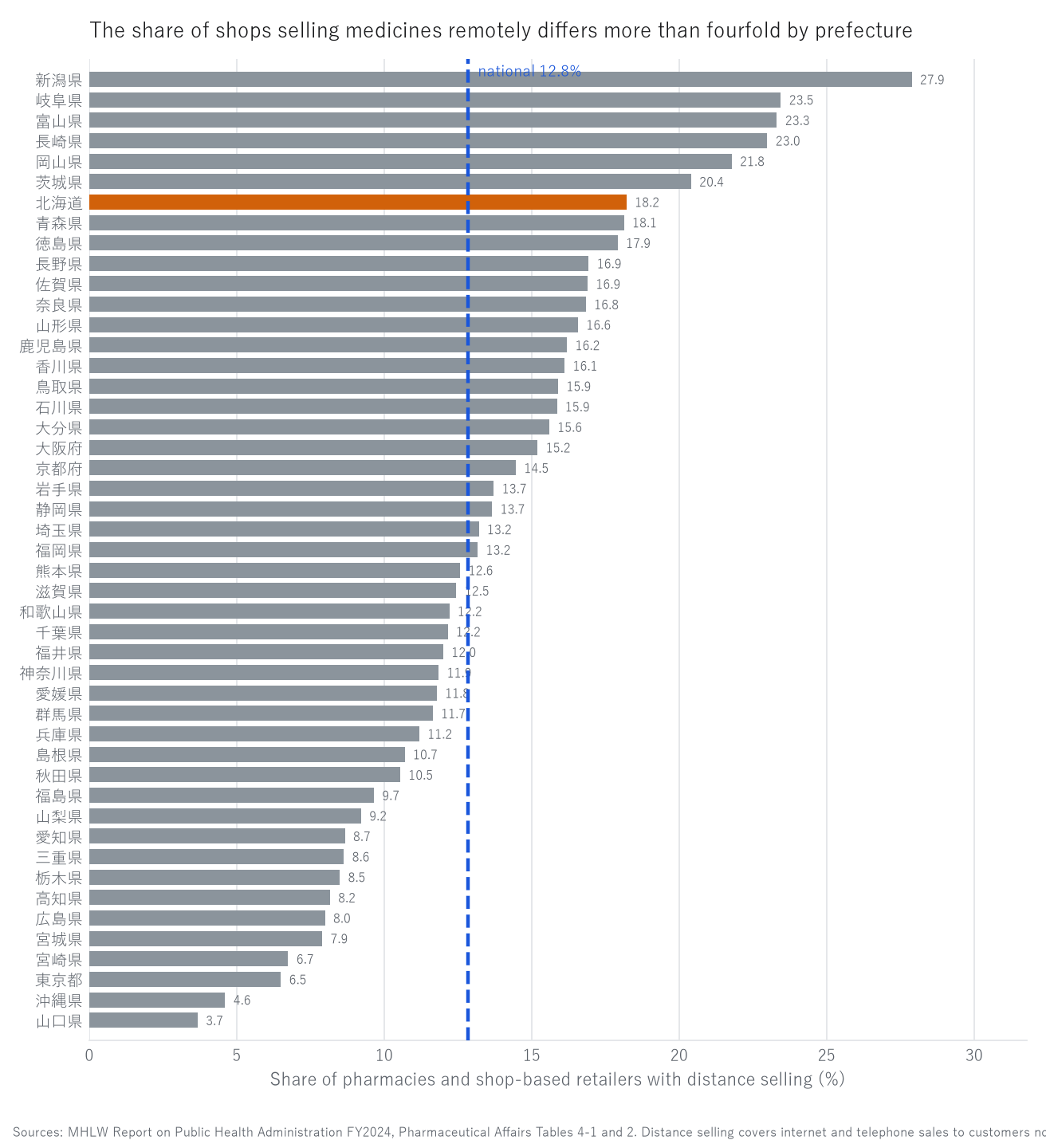
Figure 1. Share of pharmacies and shop-based retailers carrying out distance selling (47 prefectures, end of FY2024).
Grey bars are prefectures, orange is Hokkaido, and the dashed blue line marks the national 12.8%.
| Highest | Lowest | ||
|---|---|---|---|
| Niigata | 27.9% | Tokyo | 6.5% |
| Gifu | 23.5% | Okinawa | 4.6% |
| Toyama | 23.3% | Yamaguchi | 3.7% |
A 7.6-fold spread; the median is 13.2%.
Tokyo is third from the bottom. The correlation with log population is r = −0.107: there is no tendency for more populous prefectures to have more distance selling. The correlation with ageing is also weak at r = +0.257.
Distance selling depends not on where the buyers are but on where the shop is. Niigata, Gifu and Toyama at the top are none of them metropolitan.
3-3 Violations are found at 4.9% of inspected premises
| Premises inspected (during the year) | 193,543 |
| Premises with violations | 9,537 |
| Against premises inspected | 4.9% |
| Against all authorisations | 1.37% |
3-4 Inside the violations — half are "other"
Violations number 16,374 across twenty categories.
| Category | Count | Share |
|---|---|---|
| Other | 7,723 | 47.2% |
| Concerning the designated manager | 2,560 | 15.6% |
| Deficient sales arrangements | 1,817 | 11.1% |
| Deficient premises or equipment | 1,183 | 7.2% |
| Deficient compliance systems | 820 | 5.0% |
| Storage and display of poisons | 619 | 3.8% |
| Advertising unapproved medicines | 354 | 2.2% |
| False or exaggerated advertising | 233 | 1.4% |
| Operating without authorisation | 209 | 1.3% |
| Mislabelled products | 168 | 1.0% |
| Unapproved products | 157 | 1.0% |
| Defective products | 156 | 1.0% |
"Other" accounts for 47.2%, and its contents cannot be told from this table.
Excluding it, the largest of the remaining 8,651 is violations concerning the designated manager, 2,560 (29.6%) — the managing pharmacist or equivalent a shop must appoint. The commonest problem is the placement of people.
Violations relating to distance selling number 98, or 0.60% of all violations. Online selling is not what inspection mostly finds.
3-5 Sanctions are rare
| Sanction | Count during the year |
|---|---|
| Licence revocation or business suspension | 6 |
| Improvement orders and similar | 17 |
| Other | 2,610 |
| Total | 2,633 |
Against 9,537 premises with violations, sanctions number 2,633, or 27.6%.
Of these, revocations and suspensions come to 6 — 0.063% of premises with violations. Prosecutions during the year: none.
Most sanctions (2,610, or 99.1%) are "other", whose contents this table does not give. Guidance and verbal warnings presumably fall here, but that is not verified.
3-6 The more a prefecture inspects, the lower its violation rate
| Violations found per premises inspected (national 4.9%) | Highest | Lowest |
|---|---|---|
| Aomori 42.3% / Fukushima 25.1% / Akita 22.8% | Mie 0.2% / Iwate 0.2% / Wakayama 0.1% |
A 623.6-fold spread. This more plausibly reflects differences in how inspection is conducted and how violations are recorded than differences in compliance.
The correlation bears that out. Between the inspection rate (authorisations inspected, as seen in I013) and the violation-finding rate, r = −0.407. The more a prefecture inspects, the fewer violations it finds per inspection.
Some prefectures go wide and shallow, others narrow and deep. This paper does not observe what inspections consist of, so that is an explanation, not a test.
3-7 Hokkaido and the Kushiro Subprefecture
Hokkaido has 647 premises carrying out distance selling, 18.2% of its 3,551 pharmacies and shop-based retailers, 7th of 47 and well above the national 12.8%.
It inspected 3,612 premises and found violations at 408, 11.3% (12th) — more than twice the national 4.9%.
For the Kushiro Subprefecture only Economic Census subcategory 603 is available (not the same thing as a pharmacy).
| Municipality | Population | 603 establishments |
|---|---|---|
| Kushiro City | 151,566 | 110 |
| Kushiro Town | 18,021 | 12 |
| Akkeshi | 7,976 | 5 |
| Hamanaka | 5,172 | 2 |
| Shibecha | 6,698 | 5 |
| Teshikaga | 6,327 | 7 |
| Tsurui | 2,368 | 0 |
| Shiranuka | 6,840 | 5 |
4. Discussion
4-1 Online selling is still one shop in eight
Of 92,738 pharmacies and shop-based retailers, 11,910 — 12.8% — sell beyond the shop.
That is smaller than "medicines can now be bought online" suggests. Seven in eight sell only to those who walk in.
For a small pharmacy or shop-based retailer, the fact is that the shops that have not notified vastly outnumber those that have. The regime exists; one shop in eight uses it.
4-2 Not more in the cities
Distance selling runs from 27.9% in Niigata to 6.5% in Tokyo, and correlates with population at r = −0.107, essentially not at all.
I012 found specified buildings per head unrelated to population size (r = +0.013). The same holds here: "more because it is a city" does not describe the data.
A plausible reading is that a shop people can walk into has less need to sell beyond it. People pass a Tokyo pharmacy; a Niigata pharmacy cannot count on that. This paper does not test it.
4-3 What inspection finds is people and systems
Excluding "other", the largest violation is the designated manager (2,560, 29.6%), then sales arrangements 1,817, premises and equipment 1,183, compliance systems 820.
All four concern people and systems, not the medicines themselves. Defective products 156, unapproved products 157 and mislabelled products 168 each account for 1.0%.
What inspection actually finds is that a required person is not in place, records are incomplete, or the premises do not meet the standard.
Distance selling accounts for 98 violations, 0.60%. Online selling is not where oversight concentrates.
4-4 Sanctions are almost never issued
Against 9,537 premises with violations, revocations and suspensions came to six — 0.063%. Prosecutions: none.
Most violations evidently end in guidance. The regime works by correcting rather than punishing, so far as can be read. But with 2,610 "other" sanctions unexplained, nothing firm can be said.
I012 found a 99.65% appointment rate for supervising engineers of specified buildings. The effectiveness of regulation cannot be measured by the count of sanctions.
4-5 The violation rate reflects the administration, not the businesses
Violation-finding rates are 42.3% in Aomori and 0.1% in Wakayama, a 623.6-fold difference.
This cannot be read as "Aomori's pharmacies are 623 times sloppier than Wakayama's." As I013 showed, inspection rates themselves differ 22.1-fold, from 91.6% in Nagano to 4.1% in Nara. And prefectures that inspect more find proportionally fewer violations (r = −0.407).
The same column of the same statistic can reflect administrative practice rather than the behaviour of businesses. The same point arose with the itinerant selling of I011 (21.0% in Miyazaki).
When speaking about a region from official statistics, one must first establish whose behaviour the figure counts.
5. Limitations
- The Report covers FY2024, the Census 1 June 2021, population 1 January 2026: the dates differ
- Taking "pharmacies plus shop-based retail" as the denominator is this paper's judgement; the table gives no such ratio
- Violations are a count of violations, not of premises; one premises may yield several
- "Other" accounts for 47.2% of violations and its contents cannot be told from this table
- "Other" accounts for 2,610 sanctions (99.1%), and its contents are likewise unknown
- Inspection density differs 22.1-fold by prefecture (I013), so violation-finding rates cannot be compared across prefectures
- Differences in how inspections are conducted or recorded are not examined here
- Economic Census subcategory 603 is not the same thing as a pharmacy
- The Report has no municipal breakdown; Kushiro figures are from the Census only
- Revenue, volumes handled and the scale of online sales are not examined
6. Reproduction
- From e-Stat, obtain the Report on Public Health Administration, FY2024, Pharmaceutical Affairs Table 4-1 (CSV)
- Confirm that the 47 prefecture rows sum to the national row (697,897; 193,543; 9,537; 11,910)
- From Table 2 of the same report, take pharmacies (column 5) and shop-based retail (column 19) and add them for the denominator (92,738)
- Sum the twenty violation categories (columns 5 to 27) and compute the share of "other" (column 27)
- Sum the sanction counts (columns 28, 29 and 32) and compute the share against premises with violations
- Sum Basic Resident Register population and population aged 65+ by prefecture
All values are the output of a single script (kensan_203). No intermediate value was transcribed by hand.
Scope of this paper
No new theory is claimed. This paper reads the number of notifications for distance selling under the Pharmaceuticals and Medical Devices Act, together with the violations and sanctions recorded by pharmaceutical inspection. It continues I013. It shows that distance selling covers 12.8% of pharmacies and shop-based retailers, that it is unrelated to population size, that violations concentrate on people and systems, and that sanctions are almost never issued. The contents of the "other" categories and the cause of the differences between prefectures are not established.
References and data sources
- MHLW, Report on Public Health Administration, FY2024, Pharmaceutical Affairs Tables 4-1 and 2.
- Statistics Bureau of Japan and METI, 2021 Economic Census for Business Activity.
- MIC, Population Based on the Basic Resident Register, 1 January 2026.
- Y. Yamagishi, "140 Towns and Villages Have No Pharmacy" (I007). Zenodo. https://doi.org/10.5281/zenodo.22876130
- Y. Yamagishi, "865,122 Notified Food Businesses" (I011). Zenodo. https://doi.org/10.5281/zenodo.22876599
- Y. Yamagishi, "17,842 Registered Businesses Maintain 48,608 Specified Buildings" (I012). Zenodo. https://doi.org/10.5281/zenodo.22877101
- Y. Yamagishi, "Pharmacies Are 9.1% of 697,897 Pharmaceutical-Related Businesses" (I013). Zenodo. https://doi.org/10.5281/zenodo.22877276
Version history
| Version | Date | Change |
|---|---|---|
| 1 | 2026-09-21 | First release |
How to cite
Yamagishi, Y. (2026). 11,910 Shops Sell Medicines Remotely (12.8%) — Tokyo Ranks Third from Bottom, Niigata First [I014]. Zenodo. https://doi.org/10.5281/zenodo.22877337
(This DOI is the concept DOI; it always resolves to the latest version. Cite this one.)
© 2026 Yuuki YAMAGISHI
This work is licensed under a Creative Commons Attribution 4.0 International License (CC BY 4.0).
You may copy, adapt, redistribute and use it commercially, provided you give appropriate credit.
creativecommons.org/licenses/by/4.0
All figures and values in this paper were computed from official statistics. Rights in the underlying data remain with the publishing agencies.
Reference
Yamagishi, Y. (2026). 11,910 Shops Sell Medicines Remotely (12.8%) [I014]. Zenodo.
DOI: 10.5281/zenodo.22877337
YOI: https://www.yamagishiyuuki.com/yoi/I014
ORCID: 0009-0006-8587-3450
PDF (English) · PDF (Japanese) · Date proof of the English PDF (OpenTimestamps .ots) · SHA256SUMS
The record page for this paper (in Japanese, with the PDFs in each language and the date proof): YOI I014. This paper is a preprint and has not been peer reviewed.