Abstract
This paper asks how much the number of papers on the same disease found in PubMed changes with the choice of words, and what that difference depends on. The answer is that the name matters greatly when it is put in quotes (when PubMed does not map the words), and that without quotes the two names give nearly the same counts. No new mathematical theorem and no new law are claimed.
First, searching PubMed for pancreatic cancer, pancreatic cancer without quotes gives 167,715 records and in quotes 67,997, a factor of 2.47. The everyday wording pancreas cancer gives 148,792 without quotes and 2,011 in quotes (73.99 times), and cancer of the pancreas gives 148,792 and 1,090 (136.51 times) (Section 4).
Second, this is the core of the paper. For seven organs, comparing the everyday word (stomach, kidney, liver, lung, breast, bowel, pancreas) with the medical word (gastric, renal, hepatic, pulmonary, mammary, colorectal, pancreatic), the ratio of the two counts without quotes stays within 0.786–1.239. In quotes, for six organs other than the kidney, the larger is 11.42–209.19 times the smaller. Which one is larger differs by organ: the medical word is larger for the pancreas, stomach and colorectum, and the everyday word for the liver, lung and breast. Only for the kidney are both small, with a ratio of 1.06 (Section 5).
Third, this difference is explained by PubMed's Automatic Term Mapping. Words without quotes are linked, through a translation table, to the medical index term (MeSH), and for six of the seven organs the two names were mapped to the same index term. Quotes and field tags stop the mapping. This paper saved every translation returned by PubMed and checked it (Sections 5 and 6).
Fourth, mapping both widens and misfires. Bowel cancer was mapped to tumours of the whole intestine (intestinal neoplasms), and pancreatic adenocarcinoma to an expression that includes pancreatitis. The abbreviation PDAC was mapped to a supplementary concept of a disease that is not of the pancreas. Tumor and tumour gave the same 157,215 records, and the one-letter misspelling pancratic cancer gave 10 (Section 6).
Fifth, splitting pancreatic cancer records into the index term and the phrase in the title or abstract, the two searches miss opposite ends of time. The share of records with "pancreatic cancer" in the title or abstract but without the index term rose from 0.125–0.206 in 1990–2010 to 0.399–0.411 in 2021–2024. Among records with the index term, the share with this phrase in the title or abstract rose from 0.031 in 1975 to 0.579 in 2024 (18.5 times). The index term misses recent years, and the phrase misses early years (Section 7).
Sixth, the unquoted search contains the index-term search entirely (167,715 − 104,584 = 63,131 matches exactly). Of the 104,584 records with the index term, 104,583 are MEDLINE records: the index term is assigned in MEDLINE indexing. Of the 21,464 records with the phrase but without the index term, 0.649 lie outside MEDLINE (Section 7).
Scope of this paper (scope note): No new mathematical theorem and no new law are claimed. PubMed's Automatic Term Mapping, phrase searching with quotes, and MeSH indexing are known mechanisms described in the NLM user guide. This paper only measures them with counts for each way of naming a disease and with the translations PubMed returned. This paper is a structural interpretation of the shape of numbers in public aggregate data; it is not medical advice, not a diagnosis, and not a treatment recommendation. The author is not a physician. Decisions about individual health should be discussed with a physician or a medical institution. This is a preprint that has not been peer reviewed. No way of searching is recommended: depending on the purpose, a search that gathers widely and a search that narrows are both correct. This paper only shows what each search counts. The quality or value of papers is not discussed: counts are numbers, not the merits of papers. No paper, author or journal is named. No cause is stated: why a wording became customary for an organ, and why records without the index term increased, are not entered into. Variant spellings in Japanese are not counted: PubMed mainly handles English bibliographic records. On the data: Courtesy of the U.S. National Library of Medicine. The counts are as retrieved on 25 September 2026 and do not reflect the most current or accurate data available from NLM. NLM does not endorse this paper. Relation to earlier work: M004 showed that more than half of the growth of PubMed came from records outside MEDLINE. "The miss by the index term" in Section 7 of this paper lies next to it. What is added is: setting the two names for the same organ side by side with and without quotes, and narrowing where the difference acts to one place; saving the translations returned by PubMed and showing examples that widen and that misfire; and measuring by year of publication that the misses of the index term and of the phrase fall at opposite ends of time.
1. Notation and question
When searching PubMed for a disease, the same disease can be written in many ways. This paper uses the following (terms of the PubMed User Guide).
- Without quotes: the words are entered as they are, as in
pancreatic cancer. PubMed matches them against the translation table (Subject Translation Table) and searches with the medical index term (MeSH), synonyms, British and American spellings, and singular and plural forms added. This is called Automatic Term Mapping - In quotes: the phrase is enclosed in double quotes, as in
"pancreatic cancer". It does not go through Automatic Term Mapping, and the phrase itself is searched - Field tags:
[tiab]is title and abstract,[ti]is title,[mh]is MeSH including narrower terms,[mh:noexp]is MeSH without narrower terms, and[majr]is MeSH assigned as a major topic - Everyday word and medical word: the form naming the organ with a noun (stomach cancer) and the adjective form used in medicine (gastric cancer)
Question: How much does the number of papers on the same disease change with the choice of words, and what does it depend on?
Observation 1.1: "The papers on that disease" gives different numbers depending on whether it means ① papers with those words in the title or abstract, ② papers with the index term, or ③ papers picked up by PubMed's mapping. One phrase points to separate sets.
2. Preliminary survey and design
Stated honestly: the design of this paper was decided after seeing counts in preliminary queries. It is not claimed that predictions were written before measuring. The numbers of the paper are computed not from the preliminary survey but from data taken again and saved.
| Content | |
|---|---|
| Retrieval | Counts and translations from PubMed E-utilities esearch (376 queries, 25 September 2026, 22:42–22:48) |
| A | 23 ways of writing pancreatic cancer (no quotes, quotes, field tags, abbreviation, misspelling) |
| B | 7 organs × 5 forms (everyday word and medical word × with and without quotes, MeSH) |
| C | Year of publication 1975–2025 × 6 forms for pancreatic cancer (MeSH, phrase in title/abstract, no quotes, MeSH only, phrase only, everyday phrase) |
| D | Overlap and difference of MeSH and the phrase in title/abstract for pancreatic cancer, the MEDLINE filter, and wordings written instead of the phrase |
3. The data and their checks
Calculation 3.1 The responses retrieved (search expression, URL, count, translation, warnings, time of retrieval) were saved as JSON as they were and fixed with SHA-256. The check computes only from the saved JSON and does not query PubMed (counts change daily).
| What was checked | Result |
|---|---|
| Number of search expressions | A 23, B 35, C 306, D 12, all as declared |
| Warning "quoted phrase not found in phrase index" (quotes ignored) | 0 |
| Queries with a warning | 1 ("pancreas cancer"[tiab] AND 1977[dp]: count 0) |
| MeSH = overlap + MeSH only | 104,584 = 44,365 + 60,219 (exact) |
| Phrase in title/abstract = overlap + phrase only | 65,829 = 44,365 + 21,464 (exact) |
| No quotes − MeSH = "no quotes NOT MeSH" | 167,715 − 104,584 = 63,131 (exact) |
| Overlap by year computed two ways (MeSH − MeSH only = phrase − phrase only) | agrees in all 51 years |
Observation 3.2: At first I checked that "the sum of the yearly counts does not exceed the count over all years", and this failed. The sum over 1975–2025 is 105,561 for MeSH (all years 104,584, difference +977) and 68,399 for the phrase in title/abstract (all years 65,829, difference +2,570). PubMed's publication date [dp] is defined to include both print and electronic dates, so some records may be counted in two years. How many were counted twice was not counted. This paper therefore does not add yearly counts together and uses only yearly shares.
4. Measurement: counts for each way of writing the same pancreatic cancer
Calculation 4.1 Counts for each way of writing pancreatic cancer (all years, excerpt)
| Search expression | Count | Relative to pancreatic cancer without quotes |
|---|---|---|
| pancreatic cancer | 167,715 | 1.0000 |
| pancreatic tumor | 157,215 | 0.9374 |
| pancreas cancer | 148,792 | 0.8872 |
| pancreatic carcinoma | 141,625 | 0.8444 |
| pancreatic neoplasms[mh] | 104,584 | 0.6236 |
| "pancreatic cancer" | 67,997 | 0.4054 |
| pancreatic cancer[tiab] | 65,829 | 0.3925 |
| pancreatic cancer[ti] | 40,048 | 0.2388 |
| "pancreatic ductal adenocarcinoma" | 21,074 | 0.1257 |
| "pancreatic adenocarcinoma" | 11,227 | 0.0669 |
| "pancreatic carcinoma" | 7,638 | 0.0455 |
| "pancreas cancer" | 2,011 | 0.0120 |
| "cancer of the pancreas" | 1,090 | 0.0065 |
| pancratic cancer (misspelling) | 10 | 0.000060 |
Calculation 4.2 Without quotes ÷ in quotes, for the same wording
| Wording | Without quotes | In quotes | Ratio |
|---|---|---|---|
| pancreatic cancer | 167,715 | 67,997 | 2.47 |
| pancreas cancer | 148,792 | 2,011 | 73.99 |
| cancer of the pancreas | 148,792 | 1,090 | 136.51 |
| pancreatic carcinoma | 141,625 | 7,638 | 18.54 |
| pancreatic adenocarcinoma | 63,863 | 11,227 | 5.69 |
| pancreatic ductal adenocarcinoma | 28,574 | 21,074 | 1.36 |
Observation 4.3: For all six wordings, the count without quotes is larger than in quotes. The gap ranges from 1.36 to 136.51 times depending on the wording. The more a wording is used in papers, the smaller the gap; the less it is used, the larger the gap.
Observation 4.4: A MeSH search is not one thing either. Including narrower terms gives 104,584, without them 101,426, and only as a major topic 90,019. Title and abstract give 65,829, and title only 40,048.
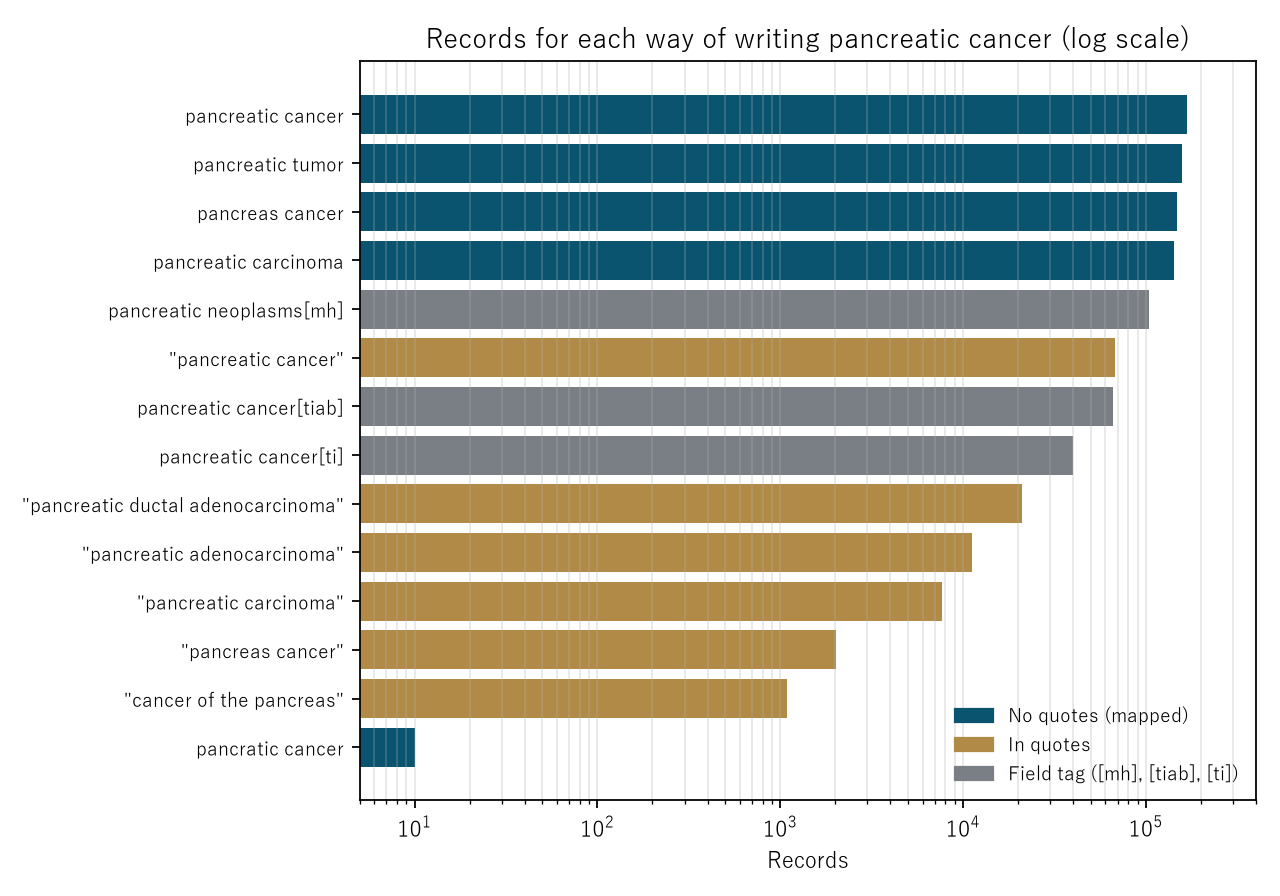
Figure 3: Log scale on the horizontal axis. Navy is without quotes (mapped), gold is in quotes, grey is a field tag. Every unquoted wording comes to over a hundred thousand records, while quoted wordings scatter from about a thousand to tens of thousands.
5. The core: the name matters when it is put in quotes
Calculation 5.1 The everyday word and the medical word for seven organs (all years)
| Organ | Everyday word / medical word | Without quotes (everyday, medical) | Ratio (everyday ÷ medical) | In quotes (everyday, medical) | Larger ÷ smaller | MeSH |
|---|---|---|---|---|---|---|
| Pancreas | pancreas cancer / pancreatic cancer | 148,792, 167,715 | 0.887 | 2,011, 67,997 | 33.81 (medical) | 104,584 |
| Stomach | stomach cancer / gastric cancer | 151,255, 192,337 | 0.786 | 8,677, 99,070 | 11.42 (medical) | 123,565 |
| Kidney | kidney cancer / renal cancer | 170,482, 181,884 | 0.937 | 9,716, 9,200 | 1.06 (everyday) | 92,914 |
| Liver | liver cancer / hepatic cancer | 380,368, 323,929 | 1.174 | 45,592, 1,802 | 25.30 (everyday) | 217,562 |
| Lung | lung cancer / pulmonary cancer | 510,523, 442,595 | 1.153 | 261,281, 1,249 | 209.19 (everyday) | 312,439 |
| Breast | breast cancer / mammary cancer | 592,266, 478,134 | 1.239 | 422,912, 3,604 | 117.35 (everyday) | 387,753 |
| Colorectum | bowel cancer / colorectal cancer | 347,712, 352,618 | 0.986 | 3,039, 172,432 | 56.74 (medical) | 269,782 |
Observation 5.2: Without quotes, the ratio of the counts of the two names stays within 0.786 (stomach) to 1.239 (breast). In quotes, for six organs other than the kidney, the larger is 11.42 times (stomach) to 209.19 times (lung) the smaller. The gap in quotes is larger than the gap without quotes for six organs; the only exception is the kidney.
Observation 5.3: Which name is larger differs by organ. The medical word is larger for the pancreas, stomach and colorectum, and the everyday word for the liver, lung and breast. So it cannot be said that "searching with the medical word finds more". What is larger in quotes is the wording that has been customary in papers for that organ.
Observation 5.4: Only for the kidney are both the everyday word (9,716) and the medical word (9,200) small in quotes, with a ratio of 1.06. Another wording may be customary, but this paper did not check it.
Observation 5.5: The separator is whether PubMed maps the words or not. Words without quotes go through the translation table and are linked to MeSH. For six of the seven organs, the everyday word and the medical word were mapped to the same index term (pancreas and pancreatic both to pancreatic neoplasms; stomach and gastric both to stomach neoplasms). Quotes stop the mapping, so the customs of wording appear in the counts as they are.
Observation 5.6: Only for the colorectum were the two names mapped to different index terms (bowel cancer to tumours of the whole intestine, intestinal neoplasms; colorectal cancer to colorectal neoplasms). The unquoted ratio of 0.986 is a value that happened to come close for counts of separate sets, and it does not mean the same as the ratios of the other six organs.
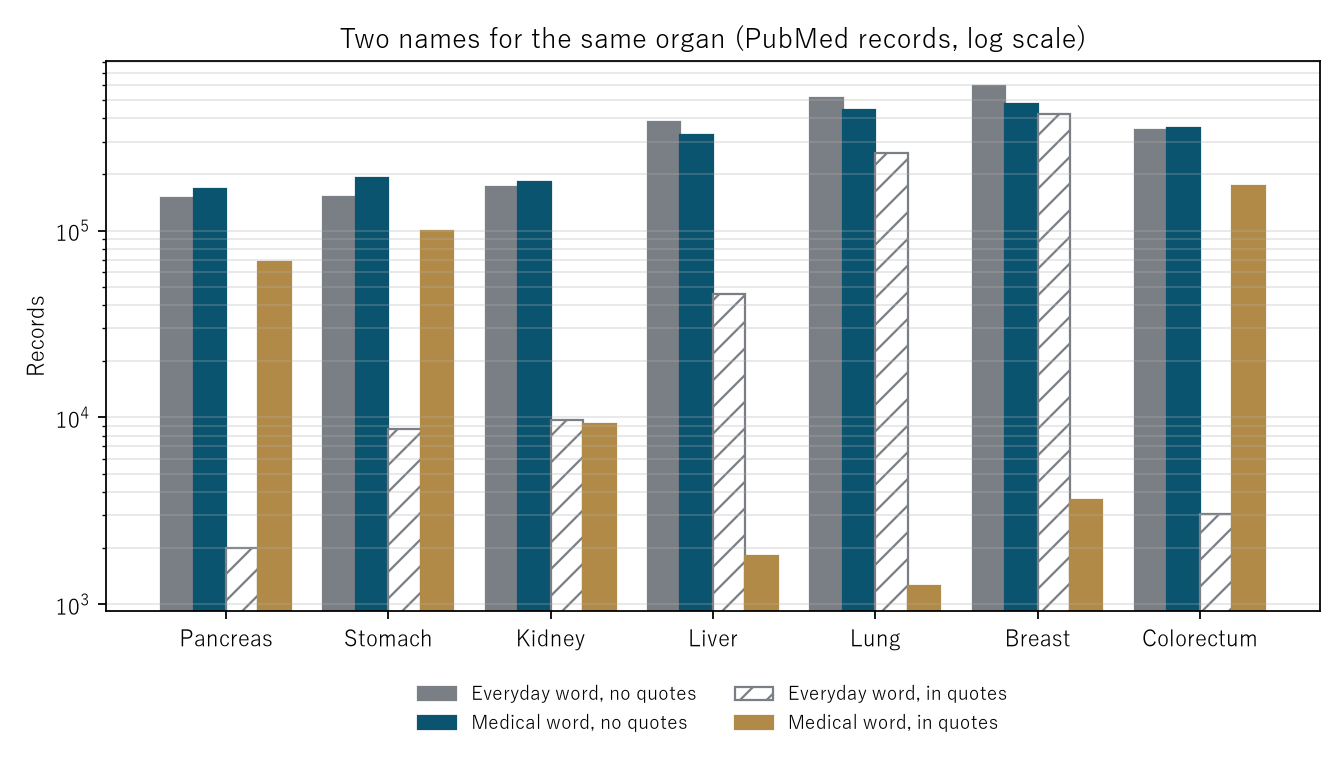
Figure 1: Log scale. The filled grey (everyday word) and navy (medical word) bars are without quotes, and their heights match for every organ. The hatched (everyday word) and gold (medical word) bars are in quotes, and for each organ one of them sinks far down.
6. Mapping both widens and misfires
The translations returned by PubMed are read as they are.
Calculation 6.1 Translations (excerpt)
| Words entered | Count | PubMed's translation (key parts) |
|---|---|---|
| pancreatic cancer | 167,715 | "pancreatic neoplasms"[MeSH Terms] OR …… OR "pancreatic cancer"[All Fields] |
| bowel cancer | 347,712 | "intestinal neoplasms"[MeSH Terms] OR … (tumours of the whole intestine) |
| pancreatic adenocarcinoma | 63,863 | ("pancreas"[MeSH Terms] OR … OR "pancreatitis"[MeSH Terms] OR …) AND ("adenocarcinoma"[MeSH Terms] OR …) |
| PDAC | 17,048 | "anophthalmia with pulmonary hypoplasia"[Supplementary Concept] OR … OR "pdac"[All Fields] |
| pancreatic tumor, pancreatic tumour | 157,215, 157,215 | "pancreatic tumour"[All Fields] OR "pancreatic neoplasms"[MeSH Terms] OR … (both British and American spellings) |
| pancratic cancer | 10 | "pancratic"[All Fields] AND (… "cancer"[All Fields] …) |
Observation 6.2: Mapping widens. Bowel cancer was linked to the index term for tumours of the whole intestine, becoming a search that includes tumours of other parts of the intestine as well as the colorectum. Pancreatic adenocarcinoma mapped pancreatic not only to the pancreas but also to pancreatitis.
Observation 6.3: Mapping misfires. The abbreviation PDAC was mapped to the supplementary concept of a disease not of the pancreas (a condition with anophthalmia and pulmonary hypoplasia). As the PubMed user guide says, the translation table contains supplementary concepts, and when an abbreviation matches the heading of another concept, it is linked to that concept too.
Observation 6.4: Mapping absorbs differences of spelling but not misspellings. Tumor and tumour gave the same 157,215 records. The one-letter misspelling pancratic cancer gave 10 records, 0.000060 of pancreatic cancer without quotes.
7. The two misses fall at opposite ends of time
Calculation 7.1 Overlap of pancreatic cancer records (all years)
| Count | Share | |
|---|---|---|
| MeSH (pancreatic neoplasms[mh]) | 104,584 | |
| of which "pancreatic cancer" is in the title or abstract | 44,365 | 0.424 |
| of which it is not | 60,219 | 0.576 |
| Phrase in title/abstract ("pancreatic cancer"[tiab]) | 65,829 | |
| of which without MeSH | 21,464 | 0.326 |
| of those, MEDLINE records / outside MEDLINE | 7,544 / 13,920 | 0.351 / 0.649 |
| MEDLINE records among MeSH records | 104,583 | 0.99999 |
| Records in the unquoted search matched by neither MeSH nor the phrase | 41,667 | 0.248 of all unquoted |
Observation 7.2: More than half (0.576) of the records with the index term do not have the phrase "pancreatic cancer" in the title or abstract. Counting wordings in the title or abstract of those records gives "pancreatic tumo*" 4,721, "pancreatic adenocarcinoma" 3,877, "pancreatic carcinoma" 3,445, "pancreatic neoplasm*" 2,239 and the plural "pancreatic cancers" 553; adding the five without removing overlaps gives only 14,835 (0.246). How the remaining records are worded was not counted.
Calculation 7.3 Two shares by year of publication (excerpt)
| Year of publication | MeSH | Phrase in title/abstract | Phrase but no MeSH | Among MeSH, with phrase | No quotes ÷ MeSH |
|---|---|---|---|---|---|
| 1975 | 512 | 17 | 0.059 | 0.031 | 1.109 |
| 1990 | 982 | 257 | 0.125 | 0.229 | 1.218 |
| 2000 | 1,328 | 500 | 0.152 | 0.319 | 1.288 |
| 2008 | 2,402 | 1,332 | 0.194 | 0.447 | 1.333 |
| 2010 | 2,792 | 1,583 | 0.191 | 0.459 | 1.352 |
| 2015 | 4,027 | 2,833 | 0.274 | 0.511 | 1.531 |
| 2020 | 5,039 | 4,410 | 0.371 | 0.550 | 1.899 |
| 2021 | 5,100 | 4,830 | 0.411 | 0.558 | 2.028 |
| 2024 | 4,764 | 4,680 | 0.410 | 0.579 | 2.170 |
| 2025 | 4,691 | 5,198 | 0.447 | 0.613 | 2.449 |
Observation 7.4: The index term misses recent years. The share of records with the phrase in the title or abstract but without MeSH was 0.125–0.206 in every year of 1990–2010, and is 0.399–0.411 in every year of 2021–2024. In 2025 it is 0.447 and may include records whose indexing is still in progress. Since records with MeSH are almost all MEDLINE records, records outside MEDLINE (more than half of the growth seen in M004) do not enter an index-term search.
Observation 7.5: The phrase misses early years. Among records with the index term, the share with "pancreatic cancer" in the title or abstract is at most 0.101 in every year of 1975–1980 and at least 0.511 in every year of 2014–2025. From 0.031 in 1975 to 0.579 in 2024 it grew 18.5 times. It is the wording that has changed with time.
Observation 7.6: The everyday phrase "pancreas cancer"[tiab] totals 1,933 over the yearly counts of 1975–2025, 0.0283 of the 68,399 for "pancreatic cancer"[tiab] in the same years (the yearly sums may include records counted twice).
Observation 7.7: The unquoted search was 1.109 times MeSH in 1975 and 2.170 times in 2024. It contains MeSH entirely and also picks up recent records without the index term and records where the words appear separately.
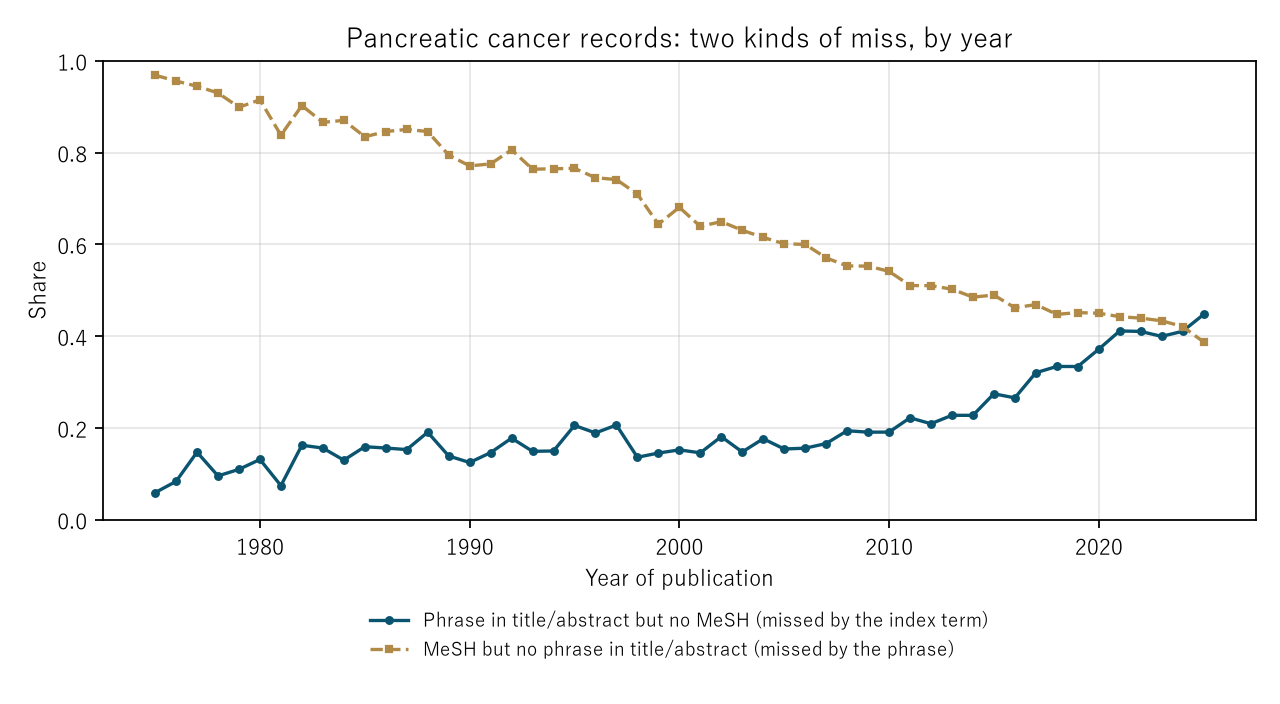
Figure 2: Navy is the share "phrase in the title or abstract but no MeSH", rising from around 2010. The gold dashed line is the share "MeSH but no phrase in the title or abstract", falling since 1975. The two lines move in opposite directions.
8. Limitations
- The counts are as of retrieval and change daily. The numbers are those of 25 September 2026 and do not reflect the most current data of NLM.
- Only PubMed. Japanese bibliographic databases and general web search engines are not covered. Variant spellings in Japanese (すい臓がん, 膵臓がん, 膵癌 and so on) were not counted.
- Only counts were counted. Whether the papers found match what the searcher wants to know was not measured.
- The pairs of everyday and medical words are seven pairs chosen for this paper. For the kidney both names are small, and another customary wording was not checked.
- Yearly counts may include records counted in two years. Yearly sums were not used; only shares were.
- No cause is stated. Why customs of wording differ by organ, and why records without the index term increased, lie outside this way of counting.
- No way of searching is recommended. Whether to gather widely or to narrow depends on the purpose.
Conclusion
Searching for the same organ with two names, without quotes the ratio of the counts stayed within 0.786–1.239, and in quotes the larger was 11.42–209.19 times the smaller (6 of 7 organs). For some organs the medical word is larger (pancreas, stomach, colorectum), and for others the everyday word (liver, lung, breast). For pancreatic cancer, the everyday wording pancreas cancer sinks 73.99 times, from 148,792 records without quotes to 2,011 in quotes.
What separates them is one thing: whether PubMed maps the words or not.
Mapping both widens (bowel cancer to the whole intestine, pancreatic to pancreatitis) and misfires (PDAC to another disease). And the index-term search and the phrase search miss opposite ends of time: the index term misses recent years, the phrase misses early ones. "The number of papers" on the same disease cannot be stated without saying which set was counted.
Data and reproduction
| Data | Counts and translations from PubMed (U.S. National Library of Medicine) E-utilities (esearch). Retrieved on 25 September 2026, 22:42–22:48. Courtesy of the U.S. National Library of Medicine |
| Terms of use | NLM Terms and Conditions (free of charge, source stated, no suggestion of NLM endorsement, stated that the data are not the most current) |
| Scope | 23 ways of writing pancreatic cancer, 7 organs × 5 forms, years of publication 1975–2025, 12 overlaps. Counts only (no individual paper, author or journal is counted) |
| Check | 検算/M005.py (--zu also writes the figures). Every number in the text is taken from 検算/M005_output.txt |
| Raw data | data/pubmed_m005_20260925.json (search expression, URL, count, translation, warnings, time of retrieval), the retrieval tool data/fetch_pubmed.py, and data/SOURCES.md (terms of use, SHA-256, original text on how search works). The check verifies SHA-256 every time it runs |
| Figures | 図/M005_zu1, 図/M005_zu2, 図/M005_zu3 (png, svg, English versions) |
References
- U.S. National Library of Medicine. PubMed (E-utilities, esearch). Courtesy of the U.S. National Library of Medicine (retrieved 25 September 2026). https://eutils.ncbi.nlm.nih.gov/entrez/eutils/
- U.S. National Library of Medicine. PubMed User Guide (accessed 25 September 2026). https://pubmed.ncbi.nlm.nih.gov/help/
- Yamagishi, Y. (2026). "Medical Papers Double About Every 15 Years" Has a Different Answer Depending on What Is Counted [M004]. Zenodo. https://doi.org/10.5281/zenodo.22963542
Reference
Yamagishi, Y. (2026). Which Name You Use for a Disease Matters Only When You Put It in Quotes [M005]. Zenodo.
DOI: 10.5281/zenodo.22963601
YOI: https://www.yamagishiyuuki.com/yoi/M005
ORCID: 0009-0006-8587-3450
PDF (English) · PDF (Japanese) · Date proof of the English PDF (OpenTimestamps .ots) · SHA256SUMS
The record page for this paper (in Japanese, with the PDFs in each language and the date proof): YOI M005. This paper is a preprint and has not been peer reviewed.