Abstract
Draw a planet’s velocity arrows, taken at every moment, from one common point, and the tips of the arrows trace a circle (Hamilton 1847). This paper counts what the circle tells about the orbit, and what makes the curve a circle. It claims no new theorem and no new law.
First, the tip of the velocity arrow traces a circle, and its centre lies at the eccentricity vector turned through a right angle. Solving orbits of eccentricity 0.0167, 0.5 and 0.9 numerically and fitting a circle to the tips of the velocities, the deviation from a circle was at most 3.4×10⁻¹² of the radius. The radius is GM/h (h is the angular momentum per unit mass), the offset of the centre from the point of zero velocity is e times that, and the centre agreed within 2.75×10⁻¹¹ with the eccentricity vector (the Laplace-Runge-Lenz vector) turned through a right angle and divided by h. In a model of the Earth with a semi-major axis of 1 astronomical unit and eccentricity 0.0167, the radius is 29.7888 km/s and the offset 0.4975 km/s (Section 2).
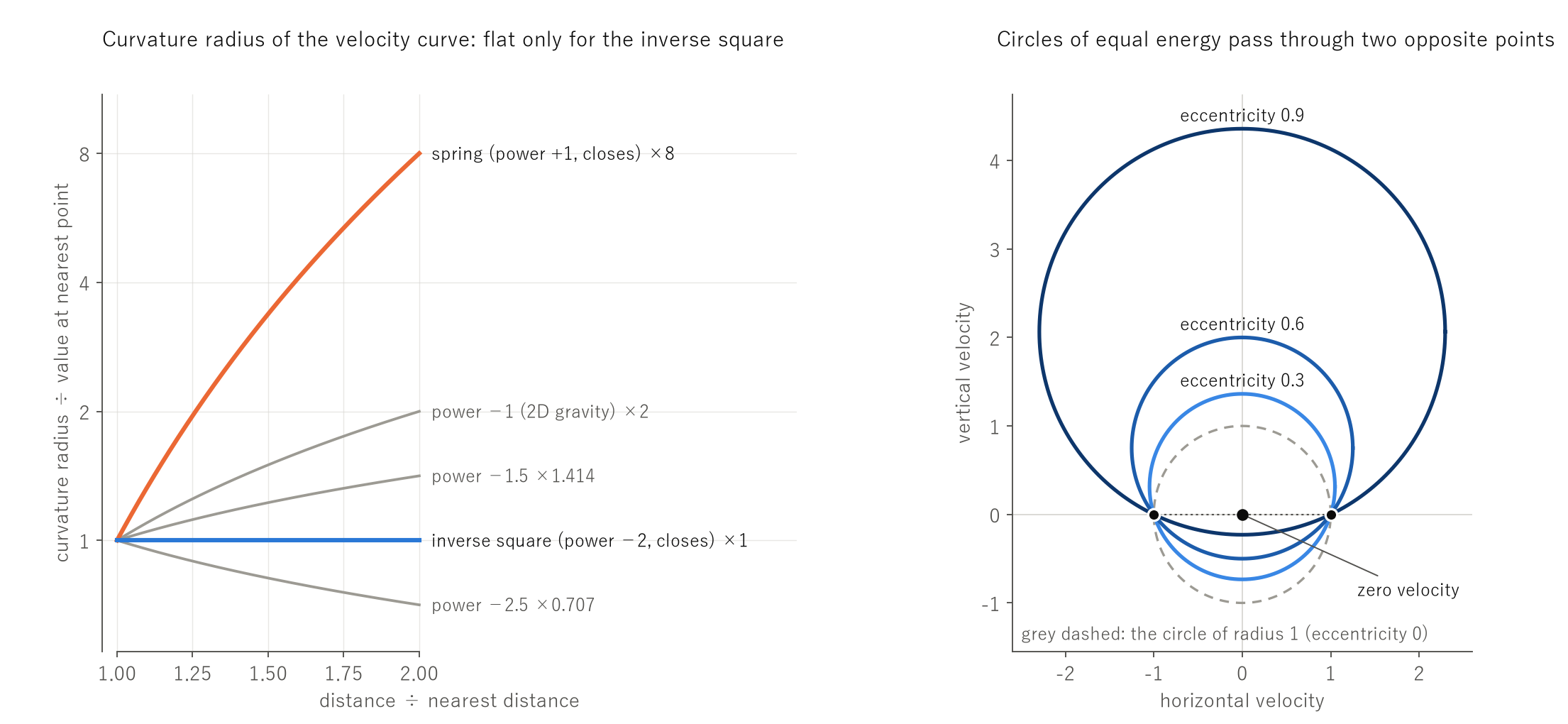
Second, and this is the core of the paper: the radius of curvature of the velocity curve is the force times the squared distance divided by h, so only the inverse-square force makes it a circle. Varying the power of the force on an orbit with nearest point 1 and farthest point 2, the maximum ÷ minimum of the radius of curvature was 8.000000 for a spring (power +1), 2.000000 for gravity in two dimensions (power −1), 1.414214 for powers −1.5 and −2.5, and 1.000000 for the inverse square. The angle from the nearest to the farthest point ÷ π was 0.500000, 0.700231, 0.811505, 1.000000 and 1.426363: the orbit closes for two forces, the spring and the inverse square (Bertrand’s theorem), but the velocity curve is a circle for one only, the inverse square (Section 3).
Third, the energy is half the power of the point of zero velocity with respect to the velocity circle. The formula 2E = c² − R² (c the distance to the centre, R the radius) is in Milnor (1983). With the point of zero velocity inside the circle the orbit is an ellipse, on it a parabola, outside it a hyperbola; over six orbits the difference was at most 2.7×10⁻¹³. By the theorem on the power of a point, two velocities on an orbit pointing in opposite directions always have speeds whose product is GM/a (a the semi-major axis). Checked without fitting a circle, from the orbit data in 12 directions, the deviation was at most 5.8×10⁻⁸ (Section 4).
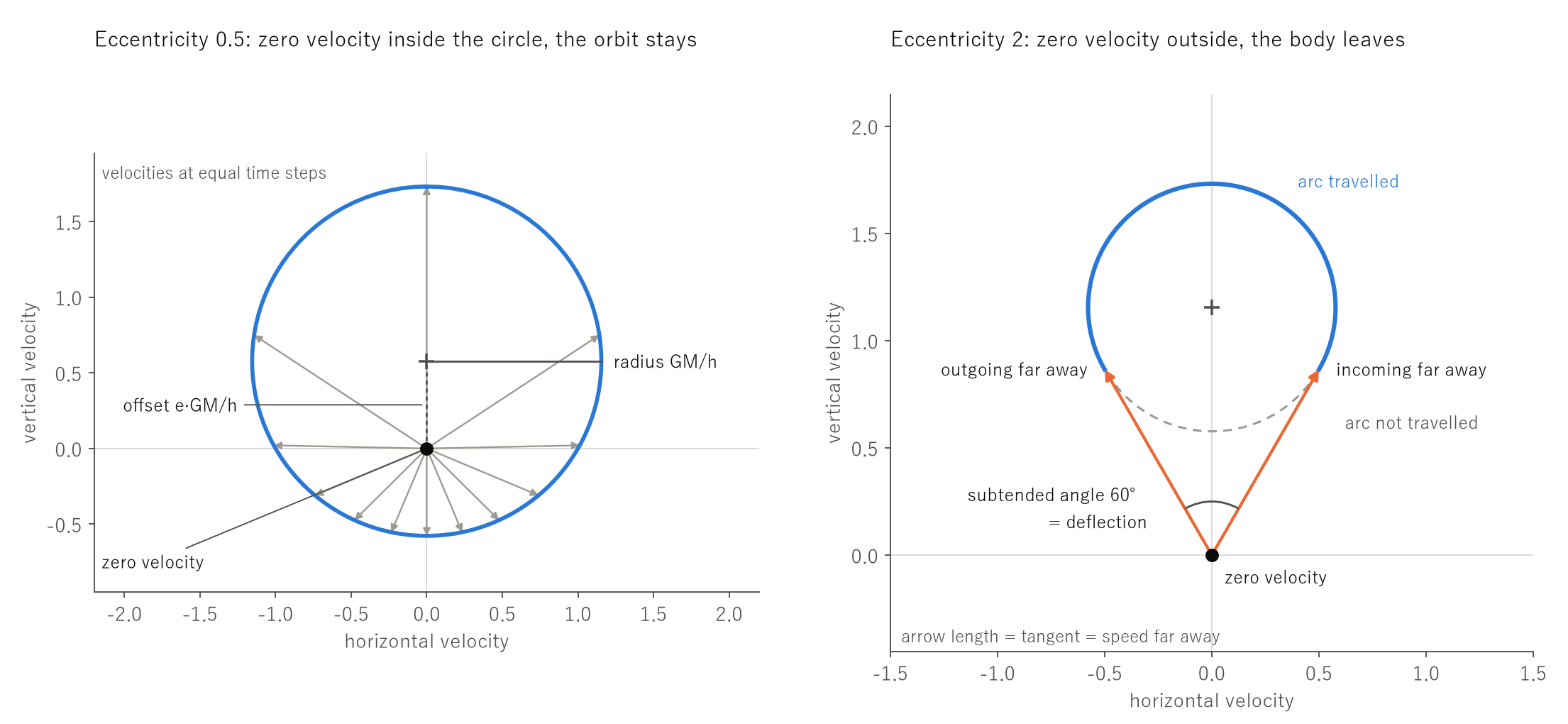
Fourth, on an orbit that leaves, the speed far away is the length of the tangent from the point of zero velocity to the circle, and the angle of deflection is the angle the circle subtends from that point. For eccentricities 1.414214, 2 and 3 the deflections are 90.000000, 60.000000 and 38.942441 degrees, agreeing within 10⁻¹¹ degrees with the angle integrated out to a distance of 10⁸ and with Rutherford’s formula. The orbit turns through a right angle when the tangent is as long as the radius of the circle (Section 5).
Fifth, velocity circles of equal energy are the images in the plane of great circles of a sphere when the energy is negative, and of straight lines of the hyperbolic plane when it is positive. Lifting five circles of energy −1/2 to a sphere of radius 1, the plane holding the points passed within 3.4×10⁻¹² of the centre of the sphere, and the angle along the great circle agreed with the eccentric anomaly within 3.2×10⁻¹¹. A circle with its radius shrunk by 1 per cent misses the centre by 0.012562. This family of circles is the same family as the light paths of Maxwell’s fish-eye in Paper 1045 (Fock 1935, Milnor 1983) (Section 6).
To be candid, what is treated here is motion in a plane. The sphere in three-dimensional momentum space and quantum matters (the hydrogen atom) are not entered.
Keywords: velocity circle, hodograph, inverse-square force, eccentricity vector, power of a point, Rutherford scattering, stereographic projection, separator.
Scope (what is not claimed)
No new theorem or law is claimed. That the tip of a planet’s velocity arrow traces a circle (Hamilton 1847), that its centre is fixed by the eccentricity vector, that the energy is 2E = c² − R² and the orbit is an ellipse, a parabola or a hyperbola as the point of zero velocity lies inside, on or outside the circle, that velocity circles of equal energy are the straight lines of a geometry of curvature −2E (Milnor 1983), that bound orbits can be read on a sphere in momentum space (Fock 1935), the angle of Coulomb scattering (Rutherford 1911), that two central forces close their orbits (Bertrand 1873), and the construction of an ellipse from the circle (Feynman’s lecture, Goodstein and Goodstein 1996) are all known. Only the plane is treated. The sphere in three-dimensional momentum space and the group of rotations in four dimensions are not entered. No quantum matters. The degeneracy of the hydrogen atom is not touched. No perturbations. The pull of planets on one another and the shift of perihelion by general relativity are not included. The power of a point is a name for a reading. The formula is in Milnor, and applying the theorem on the power of a point is not called a new theorem. Numerical integration is not written as proof. The table that varies the power gives the numbers of one orbit, with nearest point 1 and farthest point 2. The Earth’s numbers are a model. A semi-major axis of 1 astronomical unit and eccentricity 0.0167 were set. Relation to earlier papers: In its scope note Paper 1036 brought in no dynamics and said nothing sits at the focus; it wrote that the polar equation of the same form as a Kepler orbit appears in the slice of the light sphere because both are ellipses with a focus at the origin, not because of force. This paper takes that seat (no earlier occupant). It puts the centre of force at the focus, sets things moving, and counts that it is the velocity curve, not the shape of the ellipse, that speaks of the force. In its scope note Paper 1045 wrote that it does not return from Maxwell’s fish-eye to gravity. This paper places itself beside that seat. It counts that the same family of circles as the fish-eye’s light paths appears as the velocity curves of bodies moving under gravity. Gravitational lenses are not entered. Paper 79 wrote that the inverse-square force has an extra conserved quantity (the Laplace-Runge-Lenz vector), which gives bound orbits a hidden symmetry. Here that quantity is counted as visible as the centre of the velocity circle. Paper 1072 showed that squaring the ellipse of a spring gives the ellipse of Kepler. Here the two are counted as parting in their velocity curves. Paper 1090 showed that Ignatowski’s κ is minus the curvature of velocity space. Here the sign of the energy divides three geometries in the same way, but moving the force breaks only this side, so the two are not said to share a root (Paper 300). What is added: checking on numerical orbits that the centre of the velocity circle is the eccentricity vector turned through a right angle, and that a construction gives the positions on the orbit; checking with five powers that the radius of curvature of the velocity curve is the force times the squared distance, separating the two forces that close orbits from the one that makes a circle; checking from orbit data that two velocities in opposite directions have speeds whose product is GM/a; checking by integration out to large distances that the angle of deflection is the angle the circle subtends; and lifting circles of equal energy to the sphere and counting that the angle along the great circle is the eccentric anomaly.
1. Question
Paper 1036 showed that slicing a light sphere by another frame’s simultaneity gives an ellipse with the emission point at a focus, and in its scope note it brought in no dynamics and said nothing sits at the focus: the polar equation of the same form as a Kepler orbit appears because both are ellipses with a focus at the origin, not because of force. This paper takes that seat. It counts where the force shows itself when a centre of force is put at the focus and a body is set moving.
Let a body moving about the Sun have position $\mathbf{r}$ and velocity $\mathbf{v}$, and let the force per unit mass be central, $\mathbf{F}=f(r) \hat{\mathbf{r}}$. The angular momentum per unit mass $h=|\mathbf{r}\times\mathbf{v}|$ is constant. Draw the velocity arrows, taken at every moment, from one common point (the origin of the velocity diagram, that is, the point of zero velocity); the curve traced by their tips is called here the velocity curve (Hamilton 1847 named it the hodograph). Question: For ellipses of the same shape, where does the force enter? What can the velocity curve tell about the orbit?
2. The tip of the velocity arrow traces a circle
Calculation 2.1: With $GM=1$ and semi-major axis 1, orbits of eccentricity $e=0.0167$, 0.5 and 0.9 were solved numerically through one turn from the nearest point (DOP853, relative tolerance $10^{-12}$). A circle was fitted to the tips of the velocities at each moment.
| eccentricity $e$ | radius of circle | $GM/h$ | offset of centre | $e GM/h$ | deviation $\div$ radius |
|---|---|---|---|---|---|
| 0.0167 | 1.000139474174 | 1.000139474174 | 0.016702329219 | 0.016702329219 | $1.6\times10^{-13}$ |
| 0.5 | 1.154700538379 | 1.154700538379 | 0.577350269190 | 0.577350269190 | $3.4\times10^{-12}$ |
| 0.9 | 2.294157338705 | 2.294157338706 | 2.064741604836 | 2.064741604835 | $2.1\times10^{-12}$ |
Observation 2.2 The tip of the velocity arrow traces a circle whose radius is $GM/h$, with its centre offset from the point of zero velocity by $e$ times that. On the three orbits the deviation from a circle was at most $3.4\times10^{-12}$ of the radius. Since offset $\div$ radius is the eccentricity itself, on orbits with $e<1$ the point of zero velocity lies inside the circle.
Observation 2.3 The centre of the circle is the eccentricity vector turned through a right angle and divided by $h$. The eccentricity vector $\mathbf{A}=\mathbf{v}\times\mathbf{h}/GM-\hat{\mathbf{r}}$ (with $\mathbf{h}=\mathbf{r}\times\mathbf{v}$) points the same way as the conserved quantity that Paper 79 set out as the Laplace-Runge-Lenz vector; its length is $e$ and it points to the nearest point. Turned through a right angle and divided by $h$, it agreed with the fitted centre within $2.75\times10^{-11}$ on the three orbits. The extra conserved quantity of Paper 79 is seen in the velocity diagram as the centre of the circle.
Calculation 2.4: Turn the velocity circle through −90 degrees, and take the point X where the perpendicular bisector of the segment joining the point of zero velocity O to a point P of the circle meets the segment joining the turned centre C to P (the construction of Feynman’s lecture, Goodstein and Goodstein 1996). X lay on an ellipse with foci O and C and major axis equal to the radius of the circle (the sum of the distances to the two foci differed from the radius by at most $8.3\times10^{-12}$). Moreover, the position of X seen from C agreed within $1.14\times10^{-11}$ with the position on the orbit at the same moment, multiplied by $R/(2a)$ ($R$ the radius of the circle, $a$ the semi-major axis).
Observation 2.5 The velocity circle alone gives the shape of the orbit and the position at each moment.
Calculation 2.6: In a model of the Earth with a semi-major axis of 1 astronomical unit, eccentricity 0.0167, and the Sun’s $GM=1.32712440018\times10^{20}$ m³/s², the radius of the velocity circle is 29.7888 km/s and the offset of its centre 0.4975 km/s; the greatest speed is 30.2863 km/s (perihelion) and the least 29.2914 km/s (aphelion). The radius of the circle is the mean of the greatest and least speeds, and the offset is half their difference.
3. Only the inverse-square force makes a circle
Calculation 3.1: The velocity curve runs in the direction of the acceleration $\mathbf{a}=\mathbf{F}$, which for a central force lies along the line of the position. The radius of curvature of the velocity curve is $\rho=|\mathbf{a}|^{3}/|\mathbf{a}\times\dot{\mathbf{a}}|$, and for the force $-r^{n} \hat{\mathbf{r}}$ one has $\mathbf{a}\times\dot{\mathbf{a}}=r^{2n-2} \mathbf{r}\times\mathbf{v}$, so that
$$\rho=\frac{|\mathbf{F}|\,r^{2}}{h}=\frac{r^{n+2}}{h}.$$Only for the power $n=-2$ (the inverse square) is $\rho$ independent of the distance.
Calculation 3.2: Orbits with nearest point 1 and farthest point 2 were solved numerically for powers $n=+1$ (spring), $-1$ (gravity in two dimensions), $-1.5$, $-2$ (gravity in three dimensions) and $-2.5$. The radius of the circle through each three successive velocity points (a radius of curvature that does not use the formula) agreed with the formula within $1.3\times10^{-7}$. The angle from the nearest to the farthest point was also found by quadrature, apart from integrating the orbit, and agreed within $1.1\times10^{-12}$.
| power $n$ | force | angle nearest to farthest $\div\pi$ | max $\div$ min of curvature radius | circle-fit deviation $\div$ radius |
|---|---|---|---|---|
| $+1$ | spring | 0.500000 | 8.000000 | $4.4\times10^{-2}$ |
| $-1$ | gravity in 2D | 0.700231 | 2.000000 | $8.7\times10^{-2}$ |
| $-1.5$ | 0.811505 | 1.414214 | $7.7\times10^{-2}$ | |
| $-2$ | gravity in 3D (inverse square) | 1.000000 | 1.000000 | $6.4\times10^{-12}$ |
| $-2.5$ | 1.426363 | 1.414214 | $4.0\times10^{-1}$ |
Observation 3.3 Orbits close for two forces, the spring and the inverse square, but the velocity curve is a circle for one only, the inverse square. The orbit closes when the angle from the nearest to the farthest point is half of π (spring) or π (inverse square) (Bertrand’s theorem, Papers 79 and 1072). The velocity curve of the spring is an ellipse centred at the origin, and on this orbit its radius of curvature varies by a factor of 8. Closing and having a circular velocity curve are different conditions.
Observation 3.4 Moving the dimension, only gravity in three dimensions gives a circular velocity curve. Gravity in D dimensions falls off as the (D−1)th power of the distance (Paper 1002). The 2 of the inverse square is the exponent at which the flow through each shell is constant in three dimensions (Paper 01). For gravity in two dimensions (power −1) the radius of curvature is proportional to the distance and varies by a factor of 2; for gravity in four dimensions (power −3) the effective potential $(h^{2}-1)/(2r^{2})$ is monotonic and there is no orbit with a nearest and a farthest point at all (zero valleys over 59 values of the angular momentum).
Observation 3.5 This is the core of the paper. The separator is whether the force times the squared distance stays constant along the orbit. The slice of the light sphere in Paper 1036 is also an ellipse with a focus at the origin. The shape of an ellipse does not tell what sits at the focus. When a centre of force is put at the focus and a body moves, what speaks of the force is the velocity curve.
4. The energy is half the power of the point of zero velocity
Calculation 4.1: With nearest point 1, orbits of eccentricity 0, 0.5, 0.9, 1, 1.5 and 3 were solved numerically (for 1 and above, for a time of 30 on each side of the nearest point), and a circle was fitted to the velocity curve. With $c$ the distance to the centre and $R$ the radius, $(c^{2}-R^{2})/2$ was compared with the energy $E$.
| eccentricity | $E$ | $(c^{2}-R^{2})/2$ | $c\div R$ | point of zero velocity | orbit |
|---|---|---|---|---|---|
| 0 | $-0.5$ | $-0.5$ | 0 | inside | circle |
| 0.5 | $-0.25$ | $-0.25$ | 0.5 | inside | ellipse |
| 0.9 | $-0.05$ | $-0.05$ | 0.9 | inside | ellipse |
| 1 | 0 | 0 | 1 | on | parabola |
| 1.5 | $+0.25$ | $+0.25$ | 1.5 | outside | hyperbola |
| 3 | $+1$ | $+1$ | 3 | outside | hyperbola |
Observation 4.2 The energy is half the power of the point of zero velocity with respect to the velocity circle. Over the six orbits the difference was at most $2.7\times10^{-13}$. The power of a point is the squared distance from the point to the centre of a circle minus the squared radius: negative inside the circle, zero on it, positive outside. So with the point of zero velocity inside the circle the orbit is an ellipse and keeps going round; on it, a parabola; outside it, a hyperbola that leaves. The formula $2E=c^{2}-R^{2}$ is in Milnor (1983).
Observation 4.3 Two velocities on an orbit pointing in opposite directions always have speeds whose product is $GM/a$. A line through the point of zero velocity meets the velocity circle at two points. By the theorem on the power of a point, the product of the distances to the two points equals the size of the power, $-2E=GM/a$. Without fitting a circle, multiplying the speeds at the two moments when the velocity points in opposite directions, from the data of orbits with eccentricity 0.3, 0.6 and 0.9 in 12 directions, every product was within $5.8\times10^{-8}$ of 1 ($GM/a$). That the speeds at the nearest and farthest points multiply to $GM/a$ is one case of this.
5. The speed and the deflection of an orbit that leaves
Calculation 5.1: With nearest point 1, orbits of eccentricity 1.414214 ($\sqrt{2}$), 2 and 3 were solved numerically from the nearest point forwards and backwards out to a distance of $10^{8}$. The angle between the incoming and outgoing velocities (the deflection) was compared with the angle $2\arcsin(R/c)$ that the velocity circle subtends from the point of zero velocity, and with Rutherford’s formula $2\arctan(GM/(b v_{\infty}^{2}))$ ($b$ the impact parameter).
| eccentricity | tangent length | speed far away $v_{\infty}$ | subtended angle (deg) | difference from integration (deg) | radius $\div$ tangent |
|---|---|---|---|---|---|
| 1.414214 | 0.643594252906 | 0.643594252906 | 90.000000 | $6.8\times10^{-12}$ | 1.000000000 |
| 2 | 1.000000000000 | 1.000000000000 | 60.000000 | $8.8\times10^{-13}$ | 0.577350269 |
| 3 | 1.414213562373 | 1.414213562373 | 38.942441 | $8.9\times10^{-14}$ | 0.353553391 |
Observation 5.2 The speed far away is the length of the tangent from the point of zero velocity to the velocity circle, and the deflection is the angle the circle subtends from that point. The square of the tangent length is the power, $c^{2}-R^{2}=2E=v_{\infty}^{2}$, and the two points of tangency give the directions of the incoming and outgoing velocities. The point of zero velocity, the centre of the circle and a point of tangency form a right triangle, and radius $\div$ tangent is the tangent of half the deflection. Since the radius is $GM/h=GM/(b v_{\infty})$, this is Rutherford’s formula. The orbit turns through a right angle when the tangent is as long as the radius (eccentricity $\sqrt{2}$).
Observation 5.3 Paper 1088 treated the angle of Coulomb scattering (Rutherford 1911) as a known result and counted that the 4π in the formula for stopping a particle is twice the 2π of a ring. Here that angle is counted as the angle subtended by the velocity circle.
6. Velocity circles of equal energy
Calculation 6.1: The velocity circles of orbits with energy $E=-1/2$ (semi-major axis 1) and eccentricity 0, 0.3, 0.6, 0.9 and 0.99 were lifted to a sphere of radius $p_{0}=\sqrt{-2E}=1$ by the inverse of stereographic projection from the north pole onto the equatorial plane. A plane was fitted to the lifted points, and its distance from the centre of the sphere was examined.
| eccentricity | power | centre of sphere to plane | angle on great circle minus eccentric anomaly |
|---|---|---|---|
| 0 | $-1.000000000000$ | $1.6\times10^{-13}$ | (no nearest point) |
| 0.3 | $-0.999999999998$ | $7.5\times10^{-13}$ | $2.3\times10^{-11}$ |
| 0.6 | $-0.999999999998$ | $6.5\times10^{-13}$ | $1.3\times10^{-11}$ |
| 0.9 | $-0.999999999996$ | $8.7\times10^{-13}$ | $3.7\times10^{-12}$ |
| 0.99 | $-0.999999999952$ | $3.4\times10^{-12}$ | $3.2\times10^{-11}$ |
Observation 6.2 Velocity circles of equal energy are great circles of a sphere carried to the plane. For all five circles the plane of the lifted points passed within $3.4\times10^{-12}$ of the centre of the sphere (a great circle). For a circle with its radius shrunk by 1 per cent (power $-0.968906$), the plane missed the centre by 0.012562. The angle along the great circle, measured from the image of the nearest point, agreed with the eccentric anomaly within $3.2\times10^{-11}$. In the plane every circle meets the circle of radius 1 at two opposite points (the sum of the two points has size at most $5.0\times10^{-12}$). This is the image of a great circle meeting the equator at two opposite points.
Observation 6.3 This family of circles is the same family as the light paths of Maxwell’s fish-eye in Paper 1045. Paper 1045 showed that the index of the fish-eye is the scale factor of the stereographic projection of the sphere and that its light paths are the circles that image great circles, and in its scope note it did not return to gravity. This paper places itself beside that seat. The same family of circles appears as the velocity curves, at equal energy, of bodies moving under gravity.
Calculation 6.4: The velocity circle for $E=0$ (a parabola, nearest point 1) has its centre at a distance from the point of zero velocity that differs from its radius by $2.0\times10^{-13}$: it passes through the point of zero velocity. Inverted in the circle of radius 1, its points fell on a straight line (deviation from the line $\div$ spread $2.9\times10^{-13}$). The velocity circles for $E=+1/2$ (eccentricity 1.5, 2 and 3) have power $+1$ and meet the circle of radius $v_{\infty}=1$ at right angles (cosine of the angle of meeting at most $6.2\times10^{-14}$), and the arc actually travelled lies outside that circle (least speed 1.002464287 out to a distance of 405).
Observation 6.5 Velocity circles of equal energy are great circles of a sphere when the energy is negative, straight lines after inversion when it is zero, and straight lines of the hyperbolic plane (circles meeting the circle of radius $v_{\infty}$ at right angles) when it is positive. Milnor (1983) showed that putting the metric $2|d\mathbf{v}|/(|\mathbf{v}|^{2}-2E)$ on the velocity diagram gives a geometry of constant curvature $-2E$ whose straight lines are the velocity circles. Finding the curvature by finite differences at four points each, it was $+1$, 0 and $-1$ for $E=-1/2$, 0 and $+1/2$ (difference at most $4.8\times10^{-6}$). Reading bound orbits on a sphere in momentum space is Fock’s view (1935), and what is counted here is its planar case (Paper 79).
7. Relation to earlier papers
Observation 7.1 The order matches the three branches of Paper 1090, but the two are not said to share a root. Paper 1090 counted that Ignatowski’s κ is minus the curvature of velocity space, with a hyperbolic geometry for positive κ, the Galilean (flat) one for zero, and a spherical one for negative κ. Here the sign of the energy divides the geometry of the velocity diagram into three in the same way, with $2E$ in the seat of κ. But moving the force away from the inverse square breaks both the circles and the geometry on this side, while the velocity space of relativity does not depend on any force. Since what must be moved to make them different things is not the same, they are not said to share a root (Paper 300).
Observation 7.2 Numbers in a table of Paper 1036 equal numbers of the velocity circles here, but their roots differ. In the rows β = 0.5 and 0.9 of a table of Paper 1036, 1.154700538379 and 0.577350269190, and 2.294157338706 and 2.064741604835, agree with $GM/h$ and $e GM/h$ in the table of Section 2 here (a semi-major axis of 1 corresponds to $E=-1/2$). Both have the forms $1/\sqrt{1-x^{2}}$ and $x/\sqrt{1-x^{2}}$; there $x$ is the speed $\div$ the speed of light, here it is the eccentricity. Here too, moving the force breaks only this side, so they are not said to share a root (Paper 300).
Observation 7.3 Paper 1072 showed that squaring the ellipse of a spring gives the ellipse of Kepler, and that the shape is carried over while time must be measured anew. Seen through the velocity curve, the spring gives an ellipse centred at the origin (its radius of curvature varying by a factor of 8) and Kepler gives a circle: the two part.
8. What the checks showed
The velocity circle was not drawn from a formula but checked by fitting a circle to the velocities of numerical orbits. The fitting tool returned a circle of known centre and radius within $10^{-12}$, and returned a deviation of 0.048697 for an ellipse with radii 1 and 1.1 (it does not call a non-circle a circle). The tool that lifts to the sphere returned distance 0 from the centre for the equator (the circle of radius 1) and 0.600000 for the circle of radius 2. The table that varies the power gives the numbers of one orbit and does not show that every orbit behaves the same (the formula for the radius of curvature holds on every orbit).
Closing
Closing: the tip of a planet’s velocity arrow traces a circle. Its radius of curvature is the force times the squared distance divided by the angular momentum, so only the inverse-square force makes a circle, and even a spring, whose orbits close, does not. The shape of an ellipse does not tell what sits at its focus; what speaks of the force is the velocity curve. With the point of zero velocity inside the circle the planet keeps going round, on it the orbit is a parabola, and outside it the body leaves. The energy is half the power of that point, the speed far away of a body that leaves is the tangent length, and the deflection is the angle the circle subtends. Circles of equal energy are images of great circles of a sphere when the energy is negative and of straight lines of the hyperbolic plane when it is positive.
References
- Bertrand, J. (1873). Théorème relatif au mouvement d’un point attiré vers un centre fixe. Comptes Rendus de l’Académie des Sciences.
- Fock, V. (1935). Zur Theorie des Wasserstoffatoms. Zeitschrift für Physik.
- Goodstein, D. L. and Goodstein, J. R. (1996). Feynman’s Lost Lecture: The Motion of Planets Around the Sun. W. W. Norton.
- Hamilton, W. R. (1847). The Hodograph, or a new Method of expressing in symbolical Language the Newtonian Law of Attraction. Proceedings of the Royal Irish Academy.
- Milnor, J. (1983). On the Geometry of the Kepler Problem. The American Mathematical Monthly.
- Rutherford, E. (1911). The Scattering of α and β Particles by Matter and the Structure of the Atom. Philosophical Magazine.
- Yamagishi, Y. (2026). The Uniqueness Theorem of $n = 2$ for Spherically Symmetric Density Distributions [Paper 01]. YOI: https://www.yamagishiyuuki.com/yoi/1; DOI: 10.5281/zenodo.21403186
- Yamagishi, Y. (2026). The Hidden Symmetry Unique to n=2 [Paper 79]. YOI: https://www.yamagishiyuuki.com/yoi/79; DOI: 10.5281/zenodo.21732820
- Yamagishi, Y. (2026). The Three Hundredth Census: Whether Two Things Share a Root Is Decidable [Paper 300]. YOI: https://www.yamagishiyuuki.com/yoi/300; DOI: 10.5281/zenodo.22171914
- Yamagishi, Y. (2026). The Three-Body Moment of Inertia Is a Parabola Only in Four Dimensions, Where the Spinning Triangle Has Zero Energy [Paper 1002]. YOI: https://www.yamagishiyuuki.com/yoi/1002; DOI: 10.5281/zenodo.22823542
- Yamagishi, Y. (2026). Slicing a Light Sphere by Another Frame’s Simultaneity Gives an Ellipse of Eccentricity β with the Emission Point at a Focus [Paper 1036]. YOI: https://www.yamagishiyuuki.com/yoi/1036; DOI: 10.5281/zenodo.22860709
- Yamagishi, Y. (2026). Light Travels in Circles in Maxwell’s Fish-Eye Because the Index Is the Scale Factor of a Map of the Sphere [Paper 1045]. YOI: https://www.yamagishiyuuki.com/yoi/1045; DOI: 10.5281/zenodo.22861142
- Yamagishi, Y. (2026). Squaring the Ellipse of a Spring Gives the Ellipse of Kepler [Paper 1072]. YOI: https://www.yamagishiyuuki.com/yoi/1072
- Yamagishi, Y. (2026). The Same 4π/m, but the 4π of the Plasma Frequency Is a Solid Angle and the 4π of Bethe’s Formula Is Twice the 2π of a Ring [Paper 1088]. YOI: https://www.yamagishiyuuki.com/yoi/1088
- Yamagishi, Y. (2026). Ignatowski’s κ Is Minus the Curvature of Velocity Space [Paper 1090]. YOI: https://www.yamagishiyuuki.com/yoi/1090
Reference
Yamagishi, Y. (2026). A Planet’s Velocity Arrow Traces a Circle, and the Planet Stays If the Point of Zero Velocity Lies Inside It and Leaves If It Lies Outside [Paper 1103]. YOI: https://www.yamagishiyuuki.com/yoi/1103
ORCID: 0009-0006-8587-3450
PDF (English) · PDF (Japanese) · Date proof of the English PDF (OpenTimestamps .ots) · SHA256SUMS
The record page for this paper (in Japanese, with the PDFs in each language and the date proof): YOI 1103. This paper is a preprint and has not been peer reviewed.