Abstract
What this paper asks is what changes when there is a level ahead of the take-profit — and the answer is: not the win rate but the time-outs. No new mathematical theorem and no new law is claimed.
First, the declared design produced nothing. With a deadline of 24 bars (one day) there are almost no time-outs (0.0002 at R=10), and the layers move the win rate by only +0.48 points at R=20. There was no room for the mechanism to appear (Section 3).
Second, ★ so a six-bar deadline was added after the fact (and is labelled as such). At R=20 with a six-bar deadline the unconditional win rate is 0.3059 when a level is close ahead and 0.4057 when it is far — a move of 9.97 points (Section 3).
Third, and this is the core. ★ That move is in the time-outs. They go from 0.3774 to 0.1058, a move of 27.17 points, while the win rate among decided trades goes only from 0.4906 to 0.4661, a move of 2.46 points (Section 4).
Fourth, ★ the win rate among decided trades stays near 0.5 in every layer. The gaps run from −0.0094 to −0.0339, and most of that is explained by resolving ambiguous bars adverse-first (Section 4).
Fifth, prediction ③ failed. M = (buy + sell) / 2 does move across the layers, by −0.6838 to −1.1076 pips end to end (Section 5).
Sixth, prediction ④ failed too, and the way it failed changes the answer. On the synthetic random walk the layers move the win rate by only +0.08 points and M by +0.0815 pips. ★ The layers are picking up a property of the market, not geometry. But that does not mean "the level blocked it": the distance to the level ahead is also a proxy for small movement (Sections 6 and 7).
Scope of this paper: No new mathematical theorem and no new law is claimed — optional stopping, the triple-barrier method, swing levels and random walks are all known. No real course or its proponent is discussed — no real teaching material, author, or vendor is the subject here, and none is named. Trading is not discussed — no costs are included, so the figures here are not trading performance (Section 7). The six-bar deadline was added afterwards — the declared deadline left no room for the mechanism, so this is after the fact (Sections 2 and 3). The mechanism is not separated — the distance to the level ahead is also a proxy for small movement, and this paper does not separate "blocked" from "quiet" (Sections 6 and 7). Levels are used only once confirmed — a swing high over three bars either side is not known to be one until three bars later, and this paper waits those three bars (Section 2). Ambiguous bars are resolved adverse-first — as F025 showed, that convention pushes the decided win rate below 0.5 (Section 4). The scope is intraday and few instruments — four instruments, six years, one-hour bars. Monthly time-series momentum (dozens of markets, one to twelve month holds) is documented in the academic literature and is not contradicted here. The overlap is not removed — entries are taken on every bar, so the observations overlap, and no t value is reported (Section 7). No forecast is claimed.
1. Notation and the question
It is often said that "there is resistance ahead of the target, so price is less likely to get there".
| What gets said | What does not |
|---|---|
| It is less likely to reach the level ahead | Where the trades that did not reach it went |
| So the win rate falls | Whether the win rate among decided trades falls too |
| The level is doing something | Whether a series with no edge gives the same shape |
Observation 1.1: ★ "Less likely to get there" has two destinations: the opposite barrier, or neither (a time-out). The first lowers the win rate; the second merely leaves the trade undecided.
Observation 1.2: ★ With symmetric barriers and no costs, the win rate among decided trades is 0.5. Optional stopping says so. If a level moved that, the theorem would be broken.
Observation 1.3: The separator is the distance to the level ahead. The entries, the barriers, the deadline and the instruments are held fixed, and the layers are cut on distance ÷ barrier.
Observation 1.4: ★ And a level must be used only once confirmed. A swing high over three bars either side is not known to be one until three bars later. Stepping over that is look-ahead.
Question: with a level ahead, which moves — the unconditional win rate, the win rate among decided trades, or the time-outs?
2. State the quantity and the design first
Predictions (written before running)
① The closer the level ahead, the lower the unconditional win rate.
② But what falls is the part that did not resolve. The win rate among decided trades does not move.
③ So M = (buy + sell) / 2 does not move.
④ ★ A synthetic random walk with zero directional information gives the same shape. A level is geometry, not a market property.
Design (declared before running and not changed during it)
| Item | Decision |
|---|---|
| Entry | Close of a one-hour bar, on every bar. Both the buy and the sell |
| Level | A bar's high above the 3 bars either side (a swing high). ★ Known only 3 bars later |
| Only the most recent 20 confirmed swing highs are looked at | |
| Barriers | Take-profit = stop-loss = R pips. R is 10 and 20 |
| Deadline | 24 bars (one day) |
| Layers | Distance to the level ahead ÷ R in <0.25, 0.25-0.5, 0.5-1, 1-2, 2-4, >4 |
| Ambiguous bars | Resolved adverse-first (declared as F025 requires) |
| Costs | Not included |
| Baseline | Synthetic random walk down to within-bar movement (3 series) |
| Instruments | USDJPY, EURUSD, GBPUSD, XAUUSD |
| Period | 2019–2024 |
Added afterwards (this is after the fact, so it is written as such)
With the declared deadline of 24 bars there were almost no time-outs, so "blocked and does not get there" had no room to appear. A six-bar deadline was therefore added. The tables label it "(added afterwards)".
Observation 2.1: ★ A swing high is usable only once confirmed. A swing at bar i is usable from i + 3 onward, and not before. Stepping over that is the hardest kind of look-ahead to spot.
Observation 2.2: The sell is produced by running a buy on bars turned upside down. That makes the conventions identical on both sides.
Observation 2.3: A layer is a distance to a level, but it is also a proxy for small movement. A nearby swing high means a stretch with small swings. This paper does not separate the two.
The confirmed swing highs number 3,611, 3,512, 3,497 and 3,422, which is 9.88%, 9.61%, 9.57% and 9.81% of the bars.
3. Is the unconditional win rate lower when a level is close ahead?
Calculation 3.1 Layers under the declared deadline (24 bars)
| R | Layer | Count | Unconditional win | Decided win | Time-out | M |
|---|---|---|---|---|---|---|
| 10 | <0.25 | 12,428 | 0.4700 | 0.4701 | 0.0002 | −0.5989 |
| 10 | 1-2 | 13,870 | 0.4544 | 0.4545 | 0.0001 | −0.9097 |
| 10 | >4 | 9,732 | 0.4342 | 0.4343 | 0.0000 | −1.3141 |
| 20 | <0.25 | 21,647 | 0.4631 | 0.4964 | 0.0263 | −0.1353 |
| 20 | 1-2 | 11,433 | 0.4749 | 0.4828 | 0.0138 | −0.6749 |
| 20 | >4 | 3,102 | 0.4680 | 0.4690 | 0.0000 | −1.2429 |
Calculation 3.2 Layers under the added deadline (6 bars)
| R | Layer | Count | Unconditional win | Decided win | Time-out | M |
|---|---|---|---|---|---|---|
| 10 | <0.25 | 12,428 | 0.4111 | 0.4677 | 0.0966 | −0.5969 |
| 10 | >4 | 9,732 | 0.4244 | 0.4333 | 0.0203 | −1.3049 |
| 20 | <0.25 | 21,647 | 0.3059 | 0.4906 | 0.3774 | −0.2324 |
| 20 | 0.25-0.5 | 12,756 | 0.3279 | 0.4919 | 0.3455 | −0.2449 |
| 20 | 0.5-1 | 13,870 | 0.3338 | 0.4828 | 0.3087 | −0.5051 |
| 20 | 1-2 | 11,433 | 0.3611 | 0.4815 | 0.2497 | −0.5131 |
| 20 | 2-4 | 6,630 | 0.3900 | 0.4785 | 0.1912 | −0.5373 |
| 20 | >4 | 3,102 | 0.4057 | 0.4661 | 0.1058 | −0.9162 |
Observation 3.3: The declared design produced nothing. Under the 24-bar deadline the layers move the win rate by −3.57 points at R=10 and +0.48 points at R=20. ★ At R=20 even the sign is the opposite of the prediction.
Observation 3.4: ★ The reason is the absence of time-outs. At 24 bars and R=10 they are 0.0002, so "blocked and does not get there" has no room to appear.
Observation 3.5: ★ At six bars it appears. At R=20 the unconditional win rate is 0.3059 with a level close ahead and 0.4057 with it far, a difference of 9.97 points. As prediction ① said, closer means lower.
Observation 3.6: And it is monotone across all six layers: 0.3059 → 0.3279 → 0.3338 → 0.3611 → 0.3900 → 0.4057, without a single reversal.
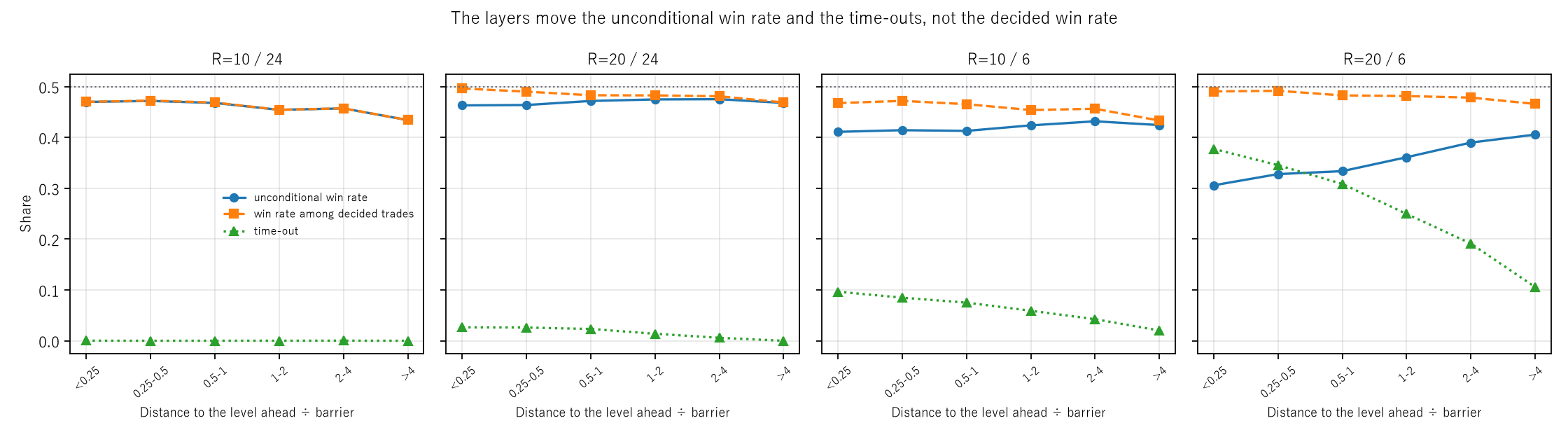
Figure 1: horizontal is "distance to the level ahead ÷ barrier", vertical is the share. The four panels are the barrier and deadline pairs; the dotted line is 0.5.
4. Did the decided win rate fall, or the part that did not resolve?
Calculation 4.1 End-to-end movement across the layers (points)
| R | Deadline | Unconditional win | Decided win | Time-out |
|---|---|---|---|---|
| 10 | 24 | −3.57 | −3.58 | −0.02 |
| 20 | 24 | +0.48 | −2.74 | −2.63 |
| 10 | 6 | +1.33 | −3.44 | −7.63 |
| 20 | 6 | +9.97 | −2.46 | −27.17 |
Calculation 4.2 Is the decided win rate near 0.5? (six-bar deadline)
| R | Layer | Unconditional win | Decided win | Time-out | Decided − 0.5 |
|---|---|---|---|---|---|
| 20 | <0.25 | 0.3059 | 0.4906 | 0.3774 | −0.0094 |
| 20 | 0.25-0.5 | 0.3279 | 0.4919 | 0.3455 | −0.0081 |
| 20 | 0.5-1 | 0.3338 | 0.4828 | 0.3087 | −0.0172 |
| 20 | 1-2 | 0.3611 | 0.4815 | 0.2497 | −0.0185 |
| 20 | 2-4 | 0.3900 | 0.4785 | 0.1912 | −0.0215 |
| 20 | >4 | 0.4057 | 0.4661 | 0.1058 | −0.0339 |
Observation 4.3: ★ This is the core. At R=20 with a six-bar deadline the unconditional win rate moves 9.97 points. But the time-outs move 27.17 points and the win rate among decided trades moves only 2.46.
Observation 4.4: ★ Prediction ② held. What fell is the part that did not resolve. A level ahead changes not "which side wins" but "whether it is decided at all".
Observation 4.5: The win rate among decided trades stays near 0.5 in every layer, with gaps of −0.0094 to −0.0339. ★ Optional stopping is not broken.
Observation 4.6: ★ And even those small gaps are mostly explained by resolving ambiguous bars adverse-first. As F025 showed, that convention puts a loss on both sides and so pushes the decided win rate below 0.5.
Observation 4.7: Across everything the time-outs run from 0.0000 to 0.4897. ★ Where the deadline is set decides what this paper can see.
5. Does the expected-value side move?
Calculation 5.1 M by layer, against the synthetic random walk (pips)
| R | Deadline | Layer | M | Random-walk M | Difference |
|---|---|---|---|---|---|
| 10 | 24 | <0.25 | −0.5989 | −0.4147 | −0.1842 |
| 10 | 24 | >4 | −1.3141 | −0.4267 | −0.8874 |
| 20 | 24 | <0.25 | −0.1353 | −0.1159 | −0.0193 |
| 20 | 24 | >4 | −1.2429 | −0.0701 | −1.1728 |
| 20 | 6 | <0.25 | −0.2324 | −0.1115 | −0.1208 |
| 20 | 6 | 0.5-1 | −0.5051 | −0.0159 | −0.4892 |
| 20 | 6 | >4 | −0.9162 | −0.0301 | −0.8861 |
Observation 5.2: Prediction ③ failed. M moves across the layers: end to end it is −0.7152 (R=10, 24 bars), −1.1076 (R=20, 24 bars), −0.7080 (R=10, 6 bars) and −0.6838 pips (R=20, 6 bars).
Observation 5.3: ★ But it does not move on the random walk. The same end-to-end figures there are −0.0120, +0.0458, −0.0120 and +0.0815 pips — a tenth of the measurement or less.
Observation 5.4: ★ What moves M is the share of ambiguous bars. As F026 showed, M under symmetric barriers equals −(ambiguous share × barrier) exactly. Layers with a distant level are stretches with larger movement, which have more ambiguous bars.
Observation 5.5: So the movement in M is not directional information. It is the growth in the number of cases where the order inside a bar is unknown.
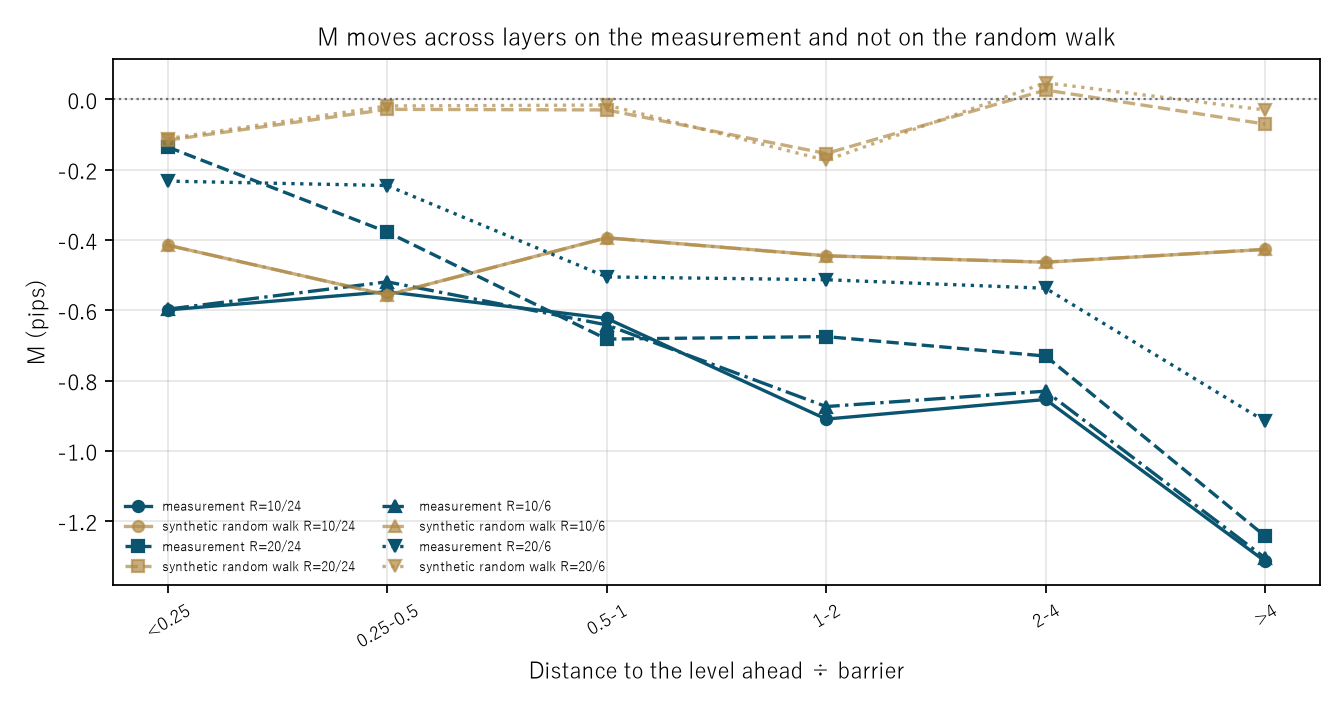
Figure 2: horizontal is "distance to the level ahead ÷ barrier", vertical is M. The dark lines are the measurement, the pale ones the synthetic random walk.
6. Baseline — do the same thing on a series with zero directional information
Calculation 6.1 Unconditional win rate by layer (measurement and random walk)
| R | Deadline | Correlation | Measurement, end to end | Random walk, end to end |
|---|---|---|---|---|
| 10 | 24 | −0.2592 | 0.4700 → 0.4342 (−3.57) | 0.4793 → 0.4787 (−0.06) |
| 20 | 24 | +0.1849 | 0.4631 → 0.4680 (+0.48) | 0.4967 → 0.4982 (+0.15) |
| 10 | 6 | −0.0581 | 0.4111 → 0.4244 (+1.33) | 0.4793 → 0.4787 (−0.06) |
| 20 | 6 | +0.2047 | 0.3059 → 0.4057 (+9.97) | 0.4655 → 0.4664 (+0.08) |
Observation 6.2: Prediction ④ failed. The synthetic random walk shows no layer effect: end to end it is −0.06, +0.15, −0.06 and +0.08 points — essentially zero against the measurement's +9.97.
Observation 6.3: ★ The way it failed changes the answer. The synthetic series has swing highs too (geometry guarantees that). That the layers still separate nothing there means the layers are picking up a property of the market, not geometry.
Observation 6.4: ★ The layer-by-layer correlations are low as well: −0.2592, +0.1849, −0.0581 and +0.2047. The measurement's shape does not resemble the random walk's.
Observation 6.5: ★ But "the level blocked it" cannot be concluded. What the synthetic series lacks is not swing highs but volatility clustering. A nearby swing high also means a stretch with small movement.
Observation 6.6: ★ So what this paper shows goes as far as: the layers move the time-outs. Whether the mechanism is "stopped by the level" or "it was quiet" is not separated. Separating them needs a measurement that varies only the presence of a level within the same level of quiet.
7. Limitations
- ★ The declared deadline produced nothing, and a six-bar deadline was added afterwards. That is after the fact. This paper says so plainly.
- ★ The mechanism is not separated. The distance to the level ahead is also a proxy for small movement. "Blocked" and "quiet" are not distinguished.
- Predictions ③ and ④ failed. M moves across layers, and the random walk shows no layer effect.
- One definition of a level is fixed: a swing high over 3 bars either side, the most recent 20. Other definitions give other figures.
- Ambiguous bars are resolved adverse-first. As F025 showed, that convention pushes the decided win rate below 0.5.
- No costs are included. The figures here are therefore not trading performance.
- The overlap is not removed. Entries are taken on every bar, so the observations overlap. No t value is reported and significance is not discussed.
- Four instruments over six years. Nothing is said about other markets or other periods.
Conclusion
Under the declared deadline of 24 bars, the layers moved the win rate by only +0.48 points at R=20. ★ The time-outs were 0.0002, so the mechanism had no room to appear. A six-bar deadline was therefore added afterwards, and is labelled as such.
At six bars and R=20, the unconditional win rate is 0.3059 with a level close ahead and 0.4057 with it far, a move of 9.97 points, monotone across all six layers. As prediction ① said, closer means lower.
★ But that move is in the time-outs. They go from 0.3774 to 0.1058, a move of 27.17 points, while the win rate among decided trades goes only from 0.4906 to 0.4661, a move of 2.46 points. Even those small gaps (−0.0094 to −0.0339) are mostly explained by resolving ambiguous bars adverse-first.
A level ahead changes not "which side wins" but "whether it is decided at all".
Predictions ③ and ④ failed. M moves across the layers (−0.6838 to −1.1076 pips end to end) while the random walk shows no layer effect (+0.08 points, +0.0815 pips). ★ The synthetic series has swing highs too, and the layers still separate nothing there, so what the layers pick up is a property of the market, not geometry.
★ Even so, "the level blocked it" cannot be concluded. What the synthetic series lacks is not swing highs but volatility clustering, and a nearby swing high also means a stretch with small movement. What this paper shows goes as far as: the layers move the time-outs. Separating the two mechanisms needs a measurement that varies only the presence of a level within the same level of quiet.
Data and reproduction
| Data | FX is Dukascopy-derived tick data (from 2019 onward, confirmed identical down to the millisecond, bid and ask). Gold is Dukascopy |
| Period | 2019–2024 (six years) |
| Instruments | USDJPY, EURUSD, GBPUSD, XAUUSD |
| Bars | One-hour bars, mid prices, completed bars only. No bar is made where there are no ticks |
| Levels | A bar's high above the 3 bars either side; known only 3 bars later; the most recent 20 only |
| Barriers | Take-profit = stop-loss = 10 and 20 pips. Deadline 24 bars (declared) and 6 bars (added afterwards) |
| Convention | Ambiguous bars resolved adverse-first |
| Costs | Not included |
| Verification | 検算/F028.py (--zu also writes the figures). Every figure in the text comes from 検算/F028_output.txt |
| Figures | 図/F028_zu1, 図/F028_zu2 (png, svg, English versions) |
| Random seeds | Fixed. Re-running gives the same values |
| Foundation check | _ツール/audit_bars.py (bar look-ahead, daylight saving, day boundaries). The record is _土台の検査.txt |
References
- Yamagishi, Y. (2026). How You Treat a Bar That Touches Both Barriers Is What Makes the Win Rate and the Expected Value [F025]. Zenodo. 10.5281/zenodo.22892549
- Yamagishi, Y. (2026). A Stopping Rule Changes the Shape of the Profit and Loss, Not the Direction [F026]. Zenodo. 10.5281/zenodo.22892604
Reference
Yamagishi, Y. (2026). The Distance to the Level Ahead Moves the Time-Outs, Not the Win Rate [F028]. Zenodo.
DOI: 10.5281/zenodo.22892891
YOI: https://www.yamagishiyuuki.com/yoi/F028
ORCID: 0009-0006-8587-3450
PDF (English) · PDF (Japanese) · Date proof of the English PDF (OpenTimestamps .ots) · SHA256SUMS
The record page for this paper (in Japanese, with the PDFs in each language and the date proof): YOI F028. This paper is a preprint and has not been peer reviewed.