Abstract
What this paper asks is what agrees and what does not when one and the same rule is run on five clocks. No new mathematical theorem and no new law is claimed.
First, and this is the core of the paper: ★★ only two things agreed. The direction D lies between -0.0540 and +0.2789 pips and stays below a cost of 0.7123 to 0.7304 pips on all five, and that cost differs by only 1.0254 times (Sections 3 and 4).
Second, ★★ what does not agree differs by a great deal. The count differs by 57.4639 times, the duration of a bar by 62.5735 times, and the move per bar by 11.3276 times (Section 4).
Third, ★ what was held constant is what agrees. The hourly bars' spread of duration is 1.00 and the tick bars' spread of move is 14.92, each the smallest of the five (Section 5).
Fourth, ★★ prediction ④ failed. Tick bars, cut by the event count, give 14.92, below the 15.01 of range bars, cut by the absolute move. The single phrase "the move" was pointing at two quantities: the path length and the net displacement (Section 6).
Fifth, ★ only the minute bars passed a daily t of 2 (-2.9864). The size, though, is -0.0540 pips, far below the cost of 0.7129 pips (Section 3).
Sixth, ★ the same shape appears on a synthetic random walk. D runs from -0.1598 to +0.0222 pips and the daily t in absolute value reaches only 0.1044 (Section 7).
Scope of this paper: no new mathematical theorem and no new law is claimed — time change and subordinated processes are classical subjects. No real course, author, or vendor is the subject here, and none is named. One rule is fixed — enter on the direction of the previous bar and close 24 bars later (Section 7). No exit is discussed — the measurement runs to a fixed horizon, and neither performance nor profit and loss is measured. Two of the five are identical by definition — tick bars and volume bars, as measured in [F053] (Section 5). [F019] does the same thing on four clocks — what this paper adds is the fifth and a single table of what agrees and what does not (Section 1). The scope is intraday and few instruments — four instruments over six years. Results documented at longer holding periods, such as monthly time-series momentum, are not contradicted. No prediction is claimed.
1. Notation and the question
This series has measured "a bar type is a clock" many times over. There are bars cut by the clock, bars cut by the event count, and bars cut by the absolute move. ★ So what agrees and what does not when one and the same rule is run on all five?
| What cuts the bar | What is held constant per bar |
|---|---|
| The clock | Elapsed time |
| The event count | Elapsed ticks |
| The absolute move | Elapsed path length |
Observation 1.1: ★ The sentence of the rule does not change by a single character across the five. It reads: enter long if the previous bar rose, short if it fell, and close 24 bars later. What changes is only the meaning of "a bar".
Observation 1.2: ★ So if the answer changed, it was changed not by the rule but by the meaning of a bar.
Observation 1.3: [F019] does the same thing on four clocks. ★ What this paper adds is the fifth (volume bars) and a single table of what agrees and what does not. The overlap is large, so it is stated here first.
Observation 1.4: Which ruler each bar type holds constant was measured in [F054]. ★ This paper takes that as given and looks at running the same rule instead.
Question: what agrees and what does not when one rule is run on five clocks?
2. State the quantities and the design first
Declared before the run and unchanged during it.
| Clock | What cuts the bar |
|---|---|
| T, minute bars | The clock |
| H, hourly bars | The clock |
| K, tick bars | The event count |
| V, volume bars | The event count |
| R, range bars | The absolute move |
| Rule | Enter on the direction of the previous bar (the sign of close minus open) and close 24 bars later |
| D | The mean of direction × the move over the next 24 bars, in pips |
| t | Clustered by day |
| Cost | The median spread inside that bar, in pips |
| Spread of a quantity | The ninetieth percentile ÷ the tenth percentile (1.00 if perfectly constant) |
| Baseline | Synthetic random walk down to the tick (3 draws, times and spreads left as measured) |
| Separator | What cuts the bar (the clock, the event count, the absolute move) |
| Instruments and period | USDJPY, EURUSD, GBPUSD, XAUUSD / 2019–2024 |
Observation 2.1: ★ The step sizes are set so that the counts match the hourly bars. N is 5,120, 4,534, 4,780 and 9,046 ticks, and S is 511.6875, 340.5750, 488.2750 and 1749.0050 pips.
Observation 2.2: ★ The counts were matched so that a difference in count would not simply come from a coarser or finer step. Even so the counts do not agree; the reason appears in Section 4.
Predictions (written before measuring)
① ★★ The direction comes out at zero on all five alike.
② ★ The cost per bar agrees.
③ ★★ The count and the duration of a bar do not agree.
④ ★ The spread of the move per bar is smallest for the bars cut by the absolute move.
⑤ ★ Volume bars agree with tick bars.
⑥ On a synthetic random walk too, what agrees agrees and what does not does not.
3. One rule run on five clocks
Calculation 3.1 Five clocks (median of the four instruments)
| Clock | What cuts the bar | Count | D (pips) | Daily t | Cost (pips) |
|---|---|---|---|---|---|
| T, minute bars | The clock | 2,084,015 | -0.0540 | -2.9864 | 0.7129 |
| H, hourly bars | The clock | 36,266 | +0.2789 | +0.1188 | 0.7199 |
| K, tick bars | The event count | 36,322 | -0.0355 | +0.2277 | 0.7123 |
| V, volume bars | The event count | 36,322 | -0.0355 | +0.2277 | 0.7123 |
| R, range bars | The absolute move | 37,825 | +0.2164 | +0.2450 | 0.7304 |
Observation 3.2: Prediction ① held. ★★ D lies between -0.0540 and +0.2789 pips and stays below a cost of 0.7123 to 0.7304 pips on all five.
Observation 3.3: Prediction ② held. ★ The cost runs from 0.7123 to 0.7304 pips, a maximum over minimum of 1.0254. Change the clock and what is paid does not change.
Observation 3.4: ★ Only the minute bars passed a daily t of 2 (-2.9864). The size, though, is -0.0540 pips, far below the cost of 0.7129 pips. ★ With a count of 2,084,015, even a small size makes t stand up.
Observation 3.5: ★ That t stands up and that the size suffices are two different things. A shape this series has met many times appears here too.
Observation 3.6: ★ Tick bars and volume bars give the same value on all four columns: count, D, t and cost. They are the same thing by definition, so this is a check rather than a finding.
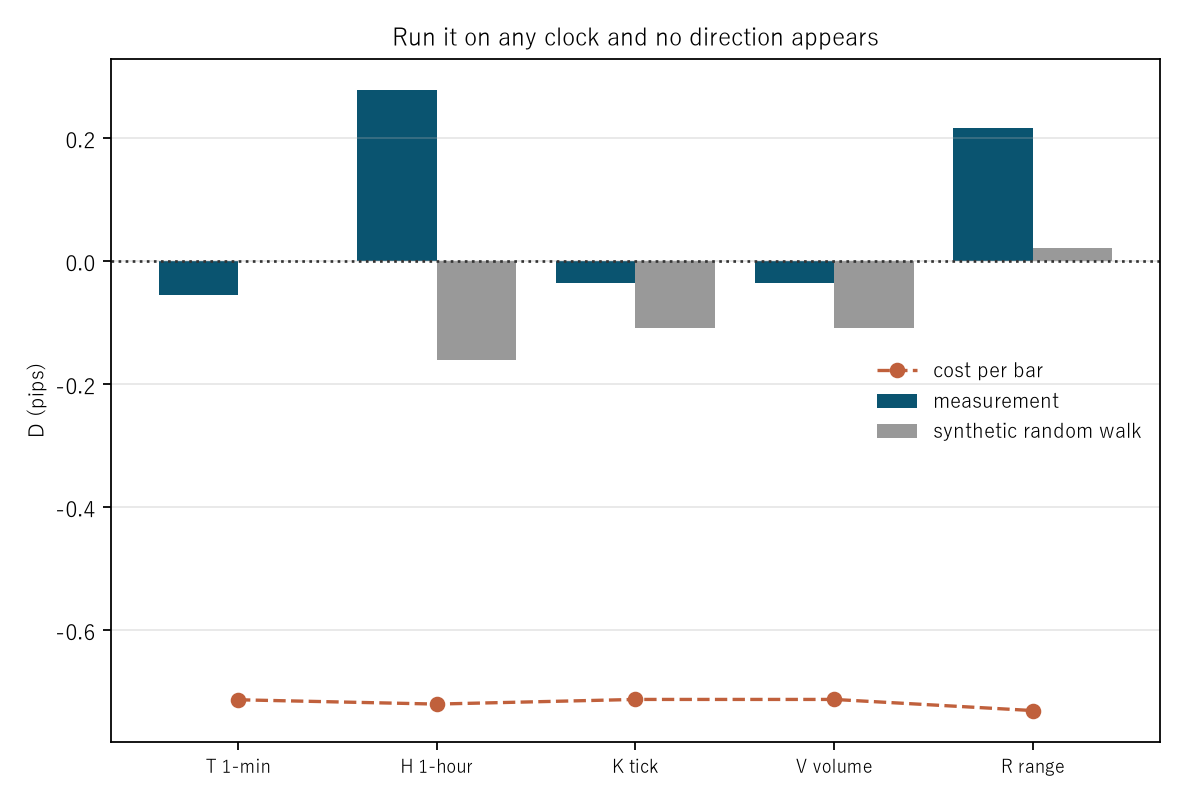
Figure 1: clock on the horizontal axis and D in pips on the vertical. Measurement and synthetic random walk are shown side by side, with the cost per bar overlaid as a dashed line.
4. What agrees and what does not
Calculation 4.1 Seven quantities (median of the four instruments, maximum ÷ minimum)
| Quantity | Minimum | Maximum | Max ÷ min | Agrees? |
|---|---|---|---|---|
| Direction D | -0.0540 | 0.2789 | — | No |
| Cost per bar | 0.7123 | 0.7304 | 1.0254 | Yes |
| Count | 36266.5000 | 2084015.5000 | 57.4639 | No |
| Duration of a bar (seconds) | 57.5168 | 3599.0229 | 62.5735 | No |
| Move per bar (pips) | 0.7250 | 8.2125 | 11.3276 | No |
| Spread of the move | 14.9171 | 32.2500 | 2.1620 | No |
| Spread of the duration | 1.0018 | 9.1525 | 9.1362 | No |
Observation 4.2: Prediction ③ held. ★★ The count differs by 57.4639 times and the duration of a bar by 62.5735 times.
Observation 4.3: The row for D is placed under "No". The sign crosses zero, so no ratio is defined, and the values themselves do not agree. ★ What agrees is that all five stay below the cost, not the value of D. The two have to be written separately.
Observation 4.4: ★ The table splits in two. A cost at 1.0254 times, and a group at 57.4639, 62.5735 and 11.3276 times.
Observation 4.5: ★ A minute bar's median move is 0.7250 pips, almost the same as the cost per bar of 0.7129 pips. On minute bars the whole move of a bar is swallowed by the cost.
Observation 4.6: ★ The counts differ by 57.4639 times despite being matched, because only the minute bars have their step fixed by declaration. N and S are set against the hourly bars, and the minute bars are not.
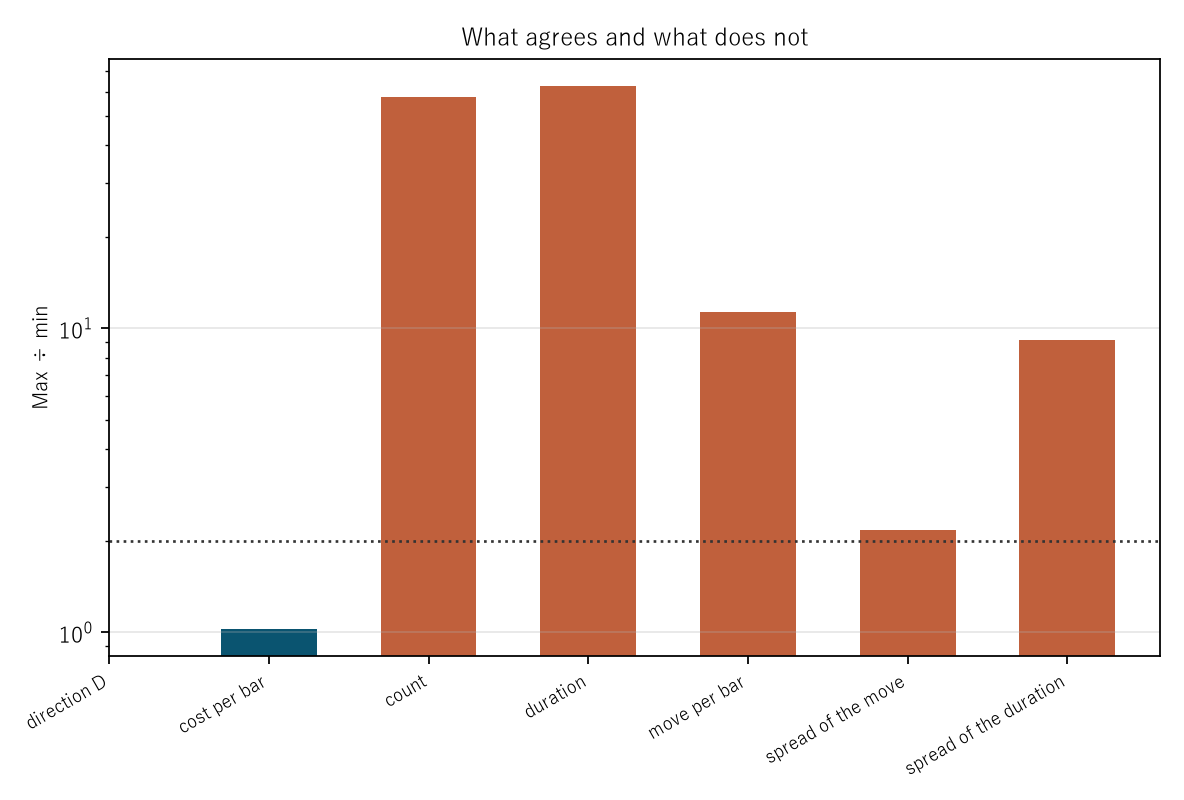
Figure 2: quantity on the horizontal axis and maximum ÷ minimum on the vertical (logarithmic). A dashed line is drawn at 2 times.
5. What was held constant agrees, and what was not spreads out
Calculation 5.1 Inside a bar (median of the four instruments)
| Clock | Duration of a bar (seconds) | Spread | Move per bar (pips) | Spread |
|---|---|---|---|---|
| T, minute bars | 57.5 | 1.31 | 0.7250 | 32.25 |
| H, hourly bars | 3599.0 | 1.00 | 5.7750 | 20.63 |
| K, tick bars | 2838.9 | 5.58 | 7.9250 | 14.92 |
| V, volume bars | 2838.9 | 5.58 | 7.9250 | 14.92 |
| R, range bars | 2603.6 | 9.15 | 8.2125 | 15.01 |
Observation 5.2: ★ Bars cut by the clock agree on time. The hourly bars' spread of duration is 1.00, the top tenth and the bottom tenth taking the same value.
Observation 5.3: ★ Bars cut by the event count or the move spread out in time. Tick bars give 5.58 and range bars 9.15.
Observation 5.4: ★ Conversely, bars cut by the clock spread out in move. Minute bars give 32.25 and hourly bars 20.63.
Observation 5.5: Prediction ⑤ held. ★ The edges of tick bars and volume bars match at 1.0000. Volume in foreign exchange is the tick count, so the two are the same rule; that was measured in [F053].
Observation 5.6: ★ A minute bar's median duration is 57.5 seconds, not 60. No bar is created for a slot with no ticks, as measured in [F049].
6. Prediction ④ failed — "the move" was pointing at two quantities
Calculation 6.1 The spread of the move, smallest first (median of the four instruments)
| Clock | What is held constant | Spread of the move |
|---|---|---|
| K, tick bars | The event count | 14.92 |
| V, volume bars | The event count | 14.92 |
| R, range bars | The absolute move | 15.01 |
| H, hourly bars | Time | 20.63 |
| T, minute bars | Time | 32.25 |
Observation 6.2: ★★ Prediction ④ failed. Tick bars, cut by the event count, give 14.92, below the 15.01 of range bars, cut by the absolute move.
Observation 6.3: ★★ The reason is that a range bar holds the path length constant, not the net move per bar. Wander up and down inside the bar and the path grows while the net move does not.
Observation 6.4: ★★ So the single phrase "the move" was pointing at two different quantities: the path length, which a round trip increases, and the net displacement, which a round trip cancels. I wrote the prediction without separating them.
Observation 6.5: ★ The same slip of wording appears in [F053]. There too the spread of the move per bar did not fall all the way.
Observation 6.6: ★ The gap between 14.92 and 15.01 is, however, hardly anything. What "failed" means here is not that range bars lost, but that no gap opened.
Observation 6.7: ★ The ordering itself does carry meaning. The three cut by the event count or the move cluster at 14.92, 14.92 and 15.01, while the two cut by the clock sit apart at 20.63 and 32.25.
7. The baseline and limitations
Calculation 7.1 Replacing only the price movement (median of the four instruments)
| Clock | Measured D | Random walk's D | Measured daily t in absolute value | Random walk's daily t in absolute value | Measured cost |
|---|---|---|---|---|---|
| T, minute bars | -0.0540 | +0.0005 | 2.9864 | 0.0256 | 0.7129 |
| H, hourly bars | +0.2789 | -0.1598 | 0.1188 | 0.0517 | 0.7199 |
| K, tick bars | -0.0355 | -0.1088 | 0.2277 | 0.1044 | 0.7123 |
| V, volume bars | -0.0355 | -0.1088 | 0.2277 | 0.1044 | 0.7123 |
| R, range bars | +0.2164 | +0.0222 | 0.2450 | 0.0791 | 0.7304 |
Observation 7.2: Prediction ⑥ held. ★ The random walk's D runs from -0.1598 to +0.0222 pips, the same band as the measured -0.0540 to +0.2789.
Observation 7.3: ★ The random walk's daily t reaches only 0.1044 in absolute value. Only the minute bars' measured 2.9864 stands apart from the random walk.
Observation 7.4: ★ That 2.9864 too has a size of -0.0540 pips, far below the cost of 0.7129 pips. Being distinguishable from a random walk and being worth trading are two different things.
Observation 7.5: ★ What this baseline is zero about was measured in [F033].
Limitations
- One rule is fixed. Enter on the direction of the previous bar and close 24 bars later.
- No exit is discussed. The measurement runs to a fixed horizon.
- One step size is fixed: N and S.
- Two of the five are identical by definition: tick bars and volume bars, as measured in [F053].
- Only the minute bars have their step fixed by declaration, so their count does not match the other four.
- [F019] does the same thing on four clocks. What this paper adds is the fifth and a single table.
- Four instruments, six years. Nothing is claimed about other markets or other periods.
Conclusion
One and the same rule was run on five clocks. Neither the sentence for entering nor the sentence for closing changed by a character. What changed was only the meaning of "a bar".
★★ Only two things agreed. The direction D lies between -0.0540 and +0.2789 pips and stays below a cost of 0.7123 to 0.7304 pips on all five, and that cost differs by only 1.0254 times.
★★ What does not agree differs by a great deal. The count differs by 57.4639 times, the duration of a bar by 62.5735 times, and the move per bar by 11.3276 times.
★ What was held constant is what agrees. The hourly bars' spread of duration is 1.00 and the tick bars' spread of move is 14.92, each the smallest of the five.
★ Only the minute bars passed a daily t of 2 (-2.9864). But the size is -0.0540 pips, on a bar whose median move of 0.7250 pips is swallowed whole by a cost of 0.7129 pips. That t stands up and that the size suffices are two different things.
★★ And prediction ④ failed. Tick bars give 14.92, below the 15.01 of range bars. The single phrase "the move" was pointing at two quantities: the path length, which a round trip increases, and the net displacement, which a round trip cancels. The same slip appears in [F053].
★ The same shape appears on a synthetic random walk (D from -0.1598 to +0.0222).
So choosing a clock is not choosing an answer. ★ Choose a clock and the count and the meaning of a bar change. What comes out does not. What is needed when saying "on this bar type it shows" is not the name of the bar type, but one line putting the size measured on it beside the cost.
Data and reproduction
| Data | Foreign exchange from Dukascopy-derived ticks (from 2019 onward, matching to the millisecond, bid and ask, has been verified). Gold from Dukascopy |
| Period | 2019–2024 (six years) |
| Instruments | USDJPY, EURUSD, GBPUSD, XAUUSD |
| T, minute bars | Every minute |
| H, hourly bars | Every hour |
| K, tick bars | Every N ticks. N = total ticks ÷ the number of hourly bars |
| V, volume bars | Every time volume sums to N (volume = the tick count) |
| R, range bars | Every time the path length sums to S. S is K's median per bar |
| Rule | Enter on the direction of the previous bar (the sign of close minus open) and close 24 bars later |
| D | The mean of direction × the move over the next 24 bars, in pips |
| t | Clustered by day |
| Cost | The median spread inside that bar, in pips |
| Spread of a quantity | The ninetieth percentile ÷ the tenth percentile |
| Baseline | Synthetic random walk down to the tick (3 draws). The times and spreads are left as measured |
| Verification | 検算/F055.py (--zu also writes the figures). Every number in the text comes from 検算/F055_output.txt |
| Figures | 図/F055_zu1, 図/F055_zu2 (png, svg, English versions) |
| Random seeds | Fixed. Re-running gives the same values |
| Substrate check | _ツール/audit_bars.py (bar look-ahead, daylight saving, day boundary). The record is _土台の検査.txt |
References
- Yamagishi, Y. (2026). Running One Rule on Four Clocks [F019]. Zenodo. 10.5281/zenodo.22891953
- Yamagishi, Y. (2026). A Synthetic Random Walk Has No Volatility Clustering [F033]. Zenodo. 10.5281/zenodo.22893674
- Yamagishi, Y. (2026). Create Bars for the Empty Slots and the Values Stay Put While the Counts Move [F049]. Zenodo. 10.5281/zenodo.22897116
- Yamagishi, Y. (2026). A Volume Bar in Foreign Exchange Is Identically a Tick Bar [F053]. Zenodo. 10.5281/zenodo.22898174
- Yamagishi, Y. (2026). Bar Types Are Separated by Which of Three Rulers They Hold Constant [F054]. Zenodo. 10.5281/zenodo.22898240
Reference
Yamagishi, Y. (2026). Run One Rule on Five Clocks and Only the Direction and the Cost Agree [F055]. Zenodo.
DOI: 10.5281/zenodo.22898302
YOI: https://www.yamagishiyuuki.com/yoi/F055
ORCID: 0009-0006-8587-3450
PDF (English) · PDF (Japanese) · Date proof of the English PDF (OpenTimestamps .ots) · SHA256SUMS
The record page for this paper (in Japanese, with the PDFs in each language and the date proof): YOI F055. This paper is a preprint and has not been peer reviewed.