Abstract
What this paper asks is how to decide which clock a given bar type is. No new mathematical theorem and no new law is claimed.
First, and this is the core of the paper: ★★ for all five bar types the declared ruler gave the smallest coefficient of variation (5 out of 5). Bars cut by the clock give 0.0092 on time, bars cut by ticks give 0.0000 on ticks, and bars cut on the path give 0.0011 on the path (Section 3).
Second, ★★ rank correlation, however, cannot classify them. All five bar types correlate at 1.0000 with all three rulers, a range of 0.0000 (Section 4).
Third, ★ so what classifies is not correlation but constancy (the coefficient of variation). Correlation only asks whether they rise together, not whether they rise by the same amount per bar (Section 4).
Fourth, ★ double the step and the count halves exactly. All five run between 0.5000 and 0.5056 (Section 5).
Fifth, ★★ "a clock advances even when nobody moves" does not hold in the implementation. The median duration of a minute bar is 57.5 seconds, not 60, and the coefficient of variation of its duration is 0.1687 (Section 6).
Sixth, ★ the classification is the same on a synthetic random walk. The smallest coefficient runs from 0.0000 to 0.1687, as measured. The classification is a property of how bars are made, not of the market (Section 7).
Scope of this paper: no new mathematical theorem and no new law is claimed — time change and subordinated processes are classical subjects. No real course, author, or vendor is the subject here, and none is named. No trading is discussed — neither performance nor profit and loss is measured. Five bar types are fixed — renko and absolute-grid bars are not included (Section 7). Two of the five are identical by definition — tick bars and volume bars, as measured in [F053] (Section 7). It relies on the convention of not creating a bar for a slot with no ticks — that this convention moves the answer was measured in [F049] (Section 6). The scope is intraday and few instruments — four instruments over six years. Results documented at longer holding periods, such as monthly time-series momentum, are not contradicted. No prediction is claimed.
1. Notation and the question
This series has measured "a bar type is a clock" many times over. ★ So how is it decided which clock a given bar type is?
There are three rulers.
| Ruler | What it measures |
|---|---|
| Time | Seconds elapsed |
| Event count | Ticks elapsed |
| Absolute move | Path length elapsed |
Observation 1.1: ★ Making a bar means holding one of these three constant per bar.
Observation 1.2: ★ So measuring the spread of the increment per bar on all three shows which one was held. There is no need to decide by the name.
Observation 1.3: That a renko chart is a different clock was measured in [F017]. ★ What this paper adds is the instrument for deciding which clock a bar type is.
Question: what has to be measured to settle which clock a bar type is?
2. State the quantities and the design first
Declared before the run and unchanged during it.
| Bar type | Held constant |
|---|---|
| T, minute bars | Time |
| H, hourly bars | Time |
| K, tick bars | Event count |
| V, volume bars | Event count |
| R, range bars | Absolute move |
| Rulers | Time (seconds) / tick count / path length (pips) |
| Constancy | The coefficient of variation of the increment per bar (standard deviation ÷ mean) |
| Correlation | The rank correlation between the bar index and the accumulated ruler |
| Doubling | The ratio of counts when the step is doubled |
| Baseline | Synthetic random walk down to the tick (3 draws, times left as measured) |
| Separator | Which ruler was held constant |
| Instruments and period | USDJPY, EURUSD, GBPUSD, XAUUSD / 2019–2024 |
Observation 2.1: ★ Fixing the deciding quantity in advance is the point. Measuring first and then saying "this one was constant" would be after the fact.
Observation 2.2: N is 5,120, 4,534, 4,780 and 9,046 ticks; S is 511.6875, 340.5750, 488.2750 and 1749.0050 pips. ★ They are set so that the counts match the hourly bars.
Observation 2.3: ★ Tick bars and volume bars are identical by definition in foreign exchange. That was measured in [F053], and here it serves as a check that the same thing lands in the same place.
Predictions (written before measuring)
① ★★ Each bar type is constant on exactly one of the three.
② ★ It is not constant on the other two.
③ ★ Doubling the step halves the count exactly.
④ ★★ "A clock advances even when nobody moves" does not hold in the implementation.
⑤ The classification is the same on a synthetic random walk.
⑥ ★ The three rulers are strongly correlated, so rank correlation cannot classify them.
3. Which ruler is held constant
The coefficient of variation of the increment per bar. For the ruler that was held, it is near 0.
Calculation 3.1 Five bar types × three rulers (median of the four instruments)
| Bar type | Held constant | CV on time | CV on ticks | CV on path |
|---|---|---|---|---|
| T, minute bars | Time | 0.1687 | 0.8680 | 1.2722 |
| H, hourly bars | Time | 0.0092 | 0.6895 | 0.9273 |
| K, tick bars | Event count | 3.2569 | 0.0000 | 0.2900 |
| V, volume bars | Event count | 3.2569 | 0.0000 | 0.2900 |
| R, range bars | Absolute move | 3.3240 | 0.2358 | 0.0011 |
Observation 3.2: ★★ This is the core of the paper. Predictions ① and ② held: for all five bar types the declared ruler is the smallest (5 out of 5).
Observation 3.3: ★ The table is diagonal. Bars cut by the clock give 0.0092 on time, bars cut by ticks 0.0000 on ticks, and bars cut on the path 0.0011 on the path.
Observation 3.4: ★ The gap to the next smallest is clear too. Hourly bars give 0.0092 against a next of 0.6895, a factor of 75.31; range bars give 0.0011 against 0.2358, a factor of 212.20.
Observation 3.5: ★ Tick bars and volume bars give identical values on all three rulers. They are the same thing by definition, so this is a check rather than a finding.
Observation 3.6: The 0.0000 of the tick bars is exactly zero by definition, not a rounding. So "the factor to the next smallest" is not meaningful there.
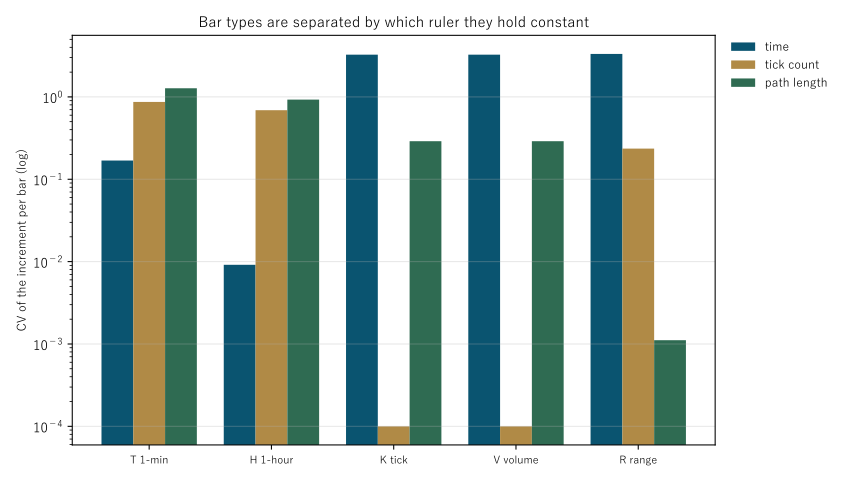
Figure 1: bar type on the horizontal axis and the coefficient of variation of the increment per bar on the vertical (logarithmic). The three rulers are shown side by side.
4. Rank correlation cannot classify them
Calculation 4.1 Rank correlation between the bar index and the accumulated ruler (median of the four instruments)
| Bar type | With time | With ticks | With path | Max − min |
|---|---|---|---|---|
| T, minute bars | 1.0000 | 1.0000 | 1.0000 | 0.0000 |
| H, hourly bars | 1.0000 | 1.0000 | 1.0000 | 0.0000 |
| K, tick bars | 1.0000 | 1.0000 | 1.0000 | 0.0000 |
| V, volume bars | 1.0000 | 1.0000 | 1.0000 | 0.0000 |
| R, range bars | 1.0000 | 1.0000 | 1.0000 | 0.0000 |
Observation 4.2: Prediction ⑥ held. ★★ All five bar types correlate at 1.0000 with all three rulers, a range of 0.0000.
Observation 4.3: ★★ The reason is simple: all three rulers increase monotonically, so each necessarily correlates at 1.0000 with the bar index.
Observation 4.4: ★★ So correlation cannot classify them. Correlation only asks whether they rise together, not whether they rise by the same amount per bar.
Observation 4.5: ★ What classifies is constancy. Section 3's table spreads from 0.0000 to 3.3240, in contrast with the 0.0000 of the correlations.
5. Double the step and the count halves
Calculation 5.1 The ratio of counts (median of the four instruments)
| Bar type | Ratio of counts when the step is doubled |
|---|---|
| T, minute bars | 0.5013 |
| H, hourly bars | 0.5056 |
| K, tick bars | 0.5000 |
| V, volume bars | 0.5000 |
| R, range bars | 0.5000 |
Observation 5.2: Prediction ③ held. ★ The ratio runs from 0.5000 to 0.5056, with a median of 0.5000.
Observation 5.3: ★ Tick, volume and range bars give exactly 0.5000. Doubling the accumulated quantity halves the count by definition.
Observation 5.4: ★ Only the clock-cut bars exceed a half slightly, at 0.5013 and 0.5056. A plausible reading is the slots left empty, since no bar is created for a slot with no ticks, but the mechanism is not measured here.
6. "A clock advances even when nobody moves" does not hold in the implementation
Calculation 6.1 Inside the clock-cut bars (median of the four instruments)
| Bar type | Median duration (seconds) | CV on time |
|---|---|---|
| T, minute bars | 57.5 | 0.1687 |
| H, hourly bars | 3599.0 | 0.0092 |
Observation 6.2: ★★ Prediction ④ held. Even for bars cut by the clock, the coefficient of variation of the duration is not 0.
Observation 6.3: ★★ A minute bar's median duration is 57.5 seconds, not 60. No bar is created for a slot with no ticks, so the time when nobody moves is skipped.
Observation 6.4: ★ Hourly bars give 3599.0 seconds with a coefficient of 0.0092, far closer to 0 than the minute bars. The longer the bar, the smaller the share of skipped slots.
Observation 6.5: ★ So the reasoning that "coordinate time is a scale pasted on from outside and advances even when nobody moves" does not hold in the implementation. That this convention moves the answer was measured in [F049].
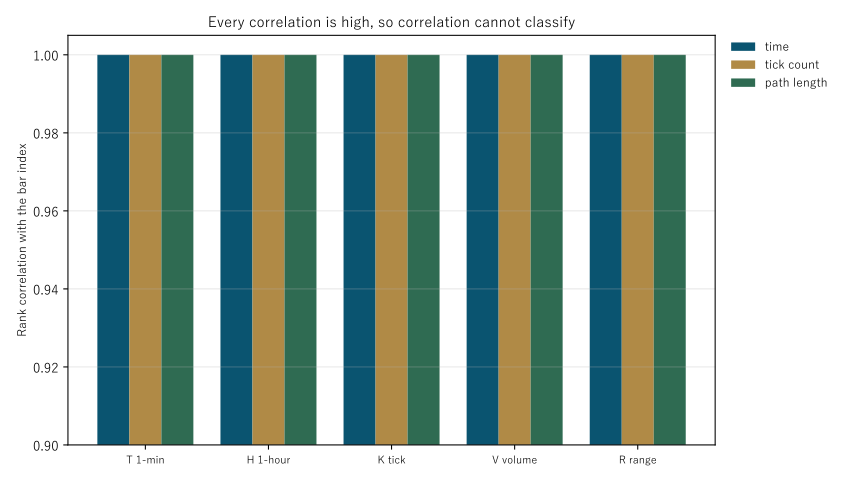
Figure 2: bar type on the horizontal axis and the rank correlation with the bar index on the vertical. The three rulers are shown side by side, with the vertical axis expanded near 1.
7. The baseline and limitations
Calculation 7.1 Replacing only the price movement (median of the four instruments)
| Bar type | Measured smallest CV | Random walk's smallest CV | Measured range of correlation | Random walk's range |
|---|---|---|---|---|
| T, minute bars | 0.1687 | 0.1687 | 0.0000 | 0.0000 |
| H, hourly bars | 0.0092 | 0.0092 | 0.0000 | 0.0000 |
| K, tick bars | 0.0000 | 0.0000 | 0.0000 | 0.0000 |
| V, volume bars | 0.0000 | 0.0000 | 0.0000 | 0.0000 |
| R, range bars | 0.0011 | 0.0002 | 0.0000 | 0.0000 |
Observation 7.2: Prediction ⑤ held. ★ On the random walk the smallest coefficient runs from 0.0000 to 0.1687, as measured.
Observation 7.3: ★★ So the classification is a property of how bars are made, not of the market. Replace the price movement with a random walk and which bar is which clock does not change.
Observation 7.4: ★ The 0.1687 and 0.0092 of the clock-cut bars agree exactly between the measurement and the random walk. The times and the sequence of ticks are left as measured, so this too is a check.
Observation 7.5: ★ What this baseline is zero about was measured in [F033].
Limitations
- Five bar types are fixed. Renko and absolute-grid bars are not included.
- Two of the five are identical by definition: tick bars and volume bars, as measured in [F053].
- One step size is fixed: N and S.
- Three rulers are fixed. Another ruler could give another classification.
- It relies on the convention of not creating a bar for a slot with no ticks.
- Why the clock-cut bars exceed a half slightly is not measured.
- Four instruments, six years. Nothing is claimed about other markets or other periods.
Conclusion
Making a bar means holding something constant per bar. So how is it settled what a given bar type held?
★★ Measuring the coefficient of variation of the increment per bar on three rulers settles it. For all five bar types the declared ruler was the smallest (5 out of 5). Bars cut by the clock give 0.0092 on time, bars cut by ticks 0.0000 on ticks, bars cut on the path 0.0011 on the path.
★ The table is diagonal. The gap to the next smallest is a factor of 75.31 for hourly bars and 212.20 for range bars.
★★ Rank correlation, however, cannot classify them. All five correlate at 1.0000 with all three rulers, a range of 0.0000. All three rulers increase monotonically, so each necessarily correlates at 1.0000 with the bar index.
★★ So correlation is not the instrument. It only asks whether they rise together, not whether they rise by the same amount per bar.
★ Doubling the step halves the count exactly (0.5000 to 0.5056). Doubling the accumulated quantity does that by definition.
★★ And "a clock advances even when nobody moves" does not hold in the implementation. A minute bar's median duration is 57.5 seconds, not 60, with a coefficient of 0.1687. No bar is created for a slot with no ticks, so the time when nobody moves is skipped.
★ The classification is unchanged on a synthetic random walk (smallest coefficient 0.0000 to 0.1687). It is a property of how bars are made, not of the market.
So what should be written when discussing a bar type is neither its name nor a correlation. ★ It is the coefficient of variation of the increment per bar, on all three rulers. That settles which clock it is in one line.
Data and reproduction
| Data | Foreign exchange from Dukascopy-derived ticks (from 2019 onward, matching to the millisecond, bid and ask, has been verified). Gold from Dukascopy |
| Period | 2019–2024 (six years) |
| Instruments | USDJPY, EURUSD, GBPUSD, XAUUSD |
| T, minute bars | Every minute |
| H, hourly bars | Every hour |
| K, tick bars | Every N ticks. N = total ticks ÷ the number of hourly bars |
| V, volume bars | Every time volume sums to N (volume = the tick count) |
| R, range bars | Every time the path length sums to S. S is K's median per bar |
| Rulers | Time (seconds) / tick count / path length (pips) |
| Constancy | The coefficient of variation of the increment per bar (standard deviation ÷ mean) |
| Correlation | The rank correlation between the bar index and the accumulated ruler |
| Doubling | The ratio of counts when the step is doubled |
| Baseline | Synthetic random walk down to the tick (3 draws). The times are left as measured |
| Verification | 検算/F054.py (--zu also writes the figures). Every number in the text comes from 検算/F054_output.txt |
| Figures | 図/F054_zu1, 図/F054_zu2 (png, svg, English versions) |
| Random seeds | Fixed. Re-running gives the same values |
| Substrate check | _ツール/audit_bars.py (bar look-ahead, daylight saving, day boundary). The record is _土台の検査.txt |
References
- Yamagishi, Y. (2026). A Renko Chart Is a Different Clock [F017]. Zenodo. 10.5281/zenodo.22891823
- Yamagishi, Y. (2026). A Synthetic Random Walk Has No Volatility Clustering [F033]. Zenodo. 10.5281/zenodo.22893674
- Yamagishi, Y. (2026). Create Bars for the Empty Slots and the Values Stay Put While the Counts Move [F049]. Zenodo. 10.5281/zenodo.22897116
- Yamagishi, Y. (2026). A Volume Bar in Foreign Exchange Is Identically a Tick Bar [F053]. Zenodo. 10.5281/zenodo.22898174
Reference
Yamagishi, Y. (2026). Bar Types Are Separated by Which of Three Rulers They Hold Constant [F054]. Zenodo.
DOI: 10.5281/zenodo.22898240
YOI: https://www.yamagishiyuuki.com/yoi/F054
ORCID: 0009-0006-8587-3450
PDF (English) · PDF (Japanese) · Date proof of the English PDF (OpenTimestamps .ots) · SHA256SUMS
The record page for this paper (in Japanese, with the PDFs in each language and the date proof): YOI F054. This paper is a preprint and has not been peer reviewed.