Abstract
I counted pharmacies in the Report on Public Health Administration (end of FY2024, MHLW, Pharmaceutical Affairs Table 1) and read them against population and the Economic Census.
There are 63,203 pharmacies nationwide, 51.1 per 100,000 residents. The more aged the prefecture, the more there are (r = +0.522), running from 65.1 in Saga to 38.9 in Okinawa, a 1.67-fold spread.
140 towns and villages have no pharmacy at all — 15.1% of the country's 926 towns and villages. The largest count is Hokkaido's 26 (18.6% of the national total). By share of its own towns and villages, however, Tokyo leads at 53.8% (7 of 13). Eleven prefectures have none.
94.4% of pharmacies are not managed by their owner. Only 3,544 pharmacies — 5.6% — are managed by the person who opened them. By prefecture the share runs from 20.4% in Wakayama to 1.8% in Kumamoto, an 11.5-fold spread.
There are 301,401 registered sellers of non-prescription medicines — 4.8 per pharmacy, or 243.5 per 100,000 residents. The qualification permits selling class-2 and class-3 medicines without being a pharmacist, and holders work outside pharmacies as well.
Hokkaido has 46.9 pharmacies per 100,000 residents, 40th of 47 prefectures, and only 3.2% owner-managed, 42nd.
1. Introduction
R003 counted the trades of which a town has only one, and I003 showed that whether a subcategory is "absent" depends on which statistic is used. Both counted presence and absence from the Economic Census.
Pharmacies admit a different kind of count. The Ministry of Health, Labour and Welfare directly publishes the number of towns and villages with no pharmacy at all. It is an absence counted by the administration, not inferred from a census.
The same table carries something else absent from other trades' statistics: whether the owner manages the premises in person.
Where are there no pharmacies? And whose are the pharmacies?
2. Data
| Pharmacies | MHLW, Report on Public Health Administration, FY2024, Pharmaceutical Affairs Table 1: pharmacies, towns and villages without a pharmacy, and registered sellers, by prefecture (end of FY2024) |
| Economic Census (reference) | 2021 Economic Census, subcategory 603 pharmaceutical and cosmetic retailing (1 June 2021) |
| Population, age 65+, count of towns and villages | MIC, Basic Resident Register population, 1 January 2026 |
All 47 prefectures are present and their sums match the national row (63,203 pharmacies; 140 towns and villages without one; 301,401 registered sellers; 3,544 owner-managed). This table contains no re-tabulated rows for designated or core cities.
The total number of towns and villages was obtained by counting, among the 1,892 municipalities of the Basic Resident Register (unit A of R001), those whose names end in machi/chō or mura/son: 926.
Subcategory 603 is not the same thing as a pharmacy. It includes drugstores and cosmetics retailers. It appears here for reference only and is not used for matching.
3. Results
3-1 63,203 pharmacies, 51.1 per 100,000 residents
| Premises | Share | |
|---|---|---|
| Pharmacies (total) | 63,203 | |
| of which health-support pharmacies | 3,183 | 5.0% |
| of which community-liaison pharmacies | 4,202 | 6.6% |
| of which specialist-liaison pharmacies | 206 | 0.33% |
Per 100,000 residents the national figure is 51.1, with a median of 53.0.
| Per 100,000 residents | Highest | Lowest |
|---|---|---|
| Pharmacies | Saga 65.1 / Yamagata 61.4 / Kochi 61.1 | Saitama 43.9 / Chiba 42.5 / Okinawa 38.9 |
The spread is 1.67-fold. Against the lodgings of I006 (25.6-fold in premises per resident), pharmacies are spread at almost the same density everywhere.
The more aged the prefecture, the more there are (r = +0.522). That is consistent with demand for medicines rising with age, though prescription volumes are not examined here.
3-2 140 towns and villages have no pharmacy
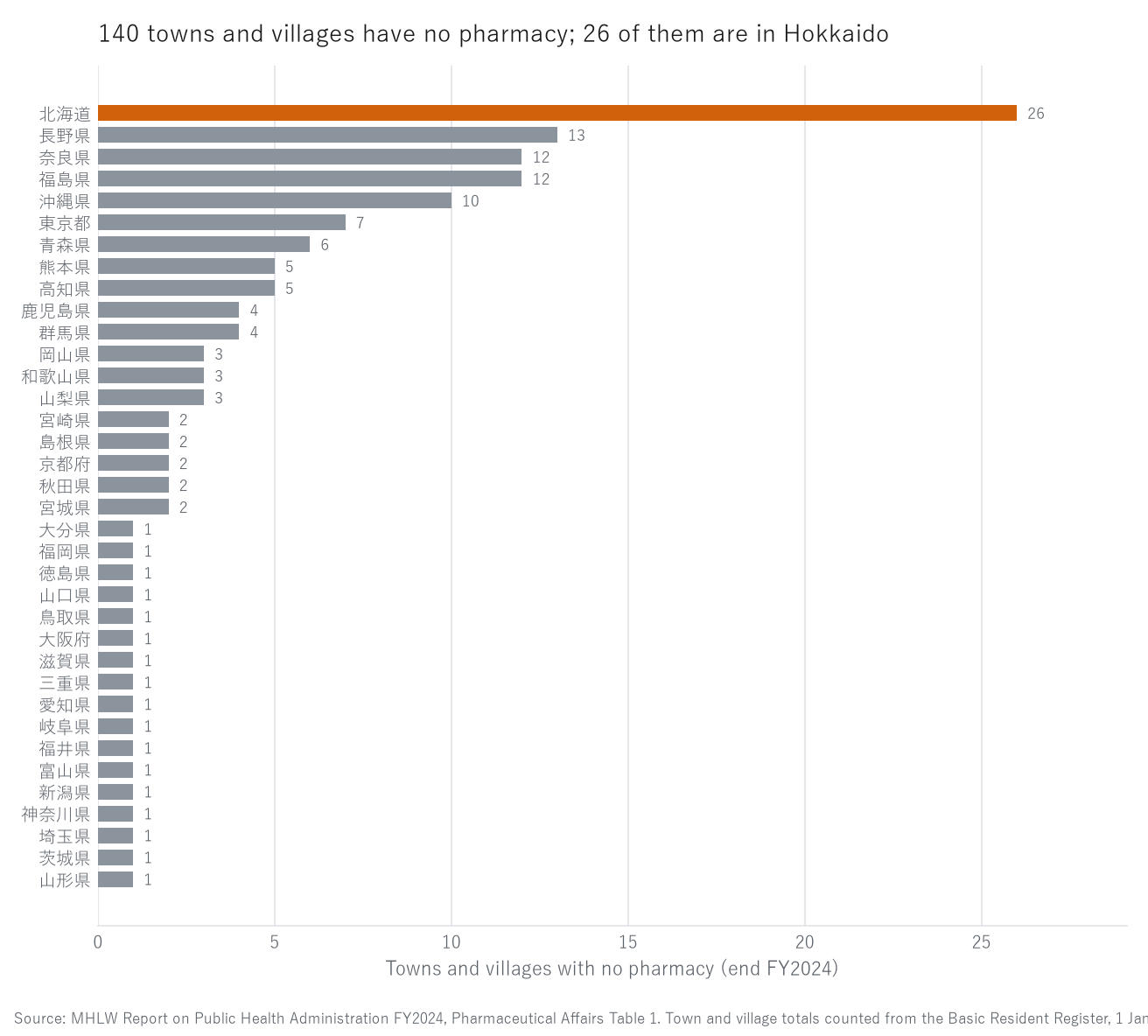
Figure 1. Towns and villages with no pharmacy (end of FY2024; the 36 prefectures with at least one).
Grey bars are prefectures, orange is Hokkaido.
140 nationwide — 15.1% of the country's 926 towns and villages.
| Largest count | Without a pharmacy | Towns and villages | Share |
|---|---|---|---|
| Hokkaido | 26 | 144 | 18.1% |
| Nagano | 13 | 58 | 22.4% |
| Nara | 12 | 27 | 44.4% |
| Fukushima | 12 | 46 | 26.1% |
| Okinawa | 10 | 30 | 33.3% |
| Tokyo | 7 | 13 | 53.8% |
Hokkaido accounts for 18.6% of the national total. By share of a prefecture's own towns and villages, the order changes.
| Highest share | Without a pharmacy | Towns and villages | Share |
|---|---|---|---|
| Tokyo | 7 | 13 | 53.8% |
| Nara | 12 | 27 | 44.4% |
| Okinawa | 10 | 30 | 33.3% |
In Tokyo, more than half the towns and villages have no pharmacy. Tokyo has only 13, most of them islands or mountain settlements in the western part of the prefecture. "Tokyo has many pharmacies" and "half of Tokyo's towns and villages have none" hold at the same time.
Eleven prefectures have no such town or village at all.
3-3 Only 5.6% of pharmacies are managed by their owner
| Premises | Share | |
|---|---|---|
| Managed by the owner | 3,544 | 5.6% |
| Not managed by the owner | 59,659 | 94.4% |
The Pharmaceuticals and Medical Devices Act requires the opener of a pharmacy to manage it personally where that person is a pharmacist, and otherwise to appoint a managing pharmacist. The distinction roughly separates pharmacies that are a pharmacist's own shop from those that are not.
94.4% are not managed by their owner, and the variation between prefectures is wide.
| Highest | Owner-managed | Pharmacies | Share |
|---|---|---|---|
| Wakayama | 99 | 486 | 20.4% |
| Okinawa | 89 | 577 | 15.4% |
| Yamanashi | 61 | 476 | 12.8% |
| Lowest | Owner-managed | Pharmacies | Share |
|---|---|---|---|
| Miyazaki | 15 | 588 | 2.6% |
| Miyagi | 28 | 1,219 | 2.3% |
| Kumamoto | 16 | 900 | 1.8% |
The median is 4.7% and the spread 11.5-fold. There is almost no correlation with ageing (r = −0.102).
In I004, barbershops and beauty salons averaged 1.80 and 2.12 workers per shop — small and everywhere. Pharmacies are everywhere, but they are not small individual shops.
3-4 301,401 registered sellers
| Registered sellers | 301,401 |
| Per pharmacy | 4.8 |
| Per 100,000 residents | 243.5 |
A registered seller may sell class-2 and class-3 medicines without being a pharmacist, and works in drugstores, convenience stores and supermarkets as well as in pharmacies. "4.8 per pharmacy" is therefore not a count of pharmacy staff but a ratio of qualification holders to pharmacies.
| Per 100,000 residents | Highest | Lowest |
|---|---|---|
| Registered sellers | Fukui 429 / Ishikawa 407 / Toyama 405 | Saitama 193 / Chiba 192 / Kanagawa 171 |
Fukui and Kanagawa differ 2.5-fold. The correlation with pharmacies per 100,000 residents is r = +0.361: a prefecture with many pharmacies does not necessarily have many registered sellers.
3-5 Hokkaido and the Kushiro Subprefecture
Hokkaido has 2,342 pharmacies, 46.9 per 100,000 residents, 40th of 47 — on the low side.
Twenty-six of its 144 towns and villages (18.1%) have no pharmacy, 18.6% of the national 140.
Only 3.2% are owner-managed, 42nd of 47, below the national 5.6%. Hokkaido's pharmacies are less often a pharmacist's own shop than the country's.
For the Kushiro Subprefecture only Economic Census subcategory 603 is available, the Report having no municipal breakdown. 603 is not the same thing as a pharmacy.
| Municipality | Population | 603 establishments | Per 100,000 |
|---|---|---|---|
| Kushiro City | 151,566 | 110 | 72.6 |
| Kushiro Town | 18,021 | 12 | 66.6 |
| Akkeshi | 7,976 | 5 | 62.7 |
| Hamanaka | 5,172 | 2 | 38.7 |
| Shibecha | 6,698 | 5 | 74.6 |
| Teshikaga | 6,327 | 7 | 110.6 |
| Tsurui | 2,368 | 0 | 0.0 |
| Shiranuka | 6,840 | 5 | 73.1 |
Tsurui has none — no pharmacy, no drugstore, no cosmetics shop. Nationwide, 104 municipalities have zero in 603.
In I006, Tsurui had 25.34 lodging establishments per 10,000 residents, far above the national median of 3.56. The same village has lodgings and no place to buy medicine.
4. Discussion
4-1 An absence counted by the administration
The absences in R001–R003 were derived from a zero establishment count in the Economic Census. I003 showed that such absences depend on the statistic chosen.
The 140 towns and villages are neither. They are a figure the ministry counted and published directly. Nothing is inferred.
Such direct tabulation of absence is rare in the statistics of other trades. Counting what is not there is harder than counting what is.
4-2 "Many" and "none" hold at the same time
Tokyo is near the top nationally in the total number of pharmacies, yet 53.8% of its towns and villages have none.
This is not a contradiction. The prefecture as a unit erases the variation inside it — the same shape as I006, where a national "lodgings are increasing 2.74-fold" concealed decline in nine prefectures.
"That prefecture has many pharmacies" does not mean "every town in it has one."
4-3 Whose are the pharmacies?
Only 5.6% are managed by the person who opened them. The remaining 94.4% were opened by a corporation with a salaried managing pharmacist appointed.
The figure shows that a licensed trade is not the same as an individual's shop. The barbershops and beauty salons of I004 averaged 1.80 and 2.12 workers per shop, almost all run by one or two people. Pharmacies, equally licensed, are not.
This paper does not observe directly whether openers are corporations or individuals, chains or independents. "Managed by the owner" is a coarse substitute for that.
4-4 The sellers are not only pharmacists
The 301,401 registered sellers are 4.8 times the 63,203 pharmacies. The number of pharmacists is not treated here, but the work of selling medicine extends well beyond the pharmacy.
What accounts for the 2.5-fold difference between Fukui (429) and Kanagawa (171) is not established here.
5. Limitations
- The Report is as of end-FY2024, the Census as of 1 June 2021, population as of 1 January 2026: the dates differ
- Towns and villages without a pharmacy counts only towns and villages. Cities, including wards with no pharmacy, are excluded
- The Report has no municipal breakdown; which towns and villages lack a pharmacy cannot be read from it
- The total of 926 towns and villages was counted from municipality names in the Basic Resident Register and need not match the ministry's own scope
- Registered sellers is a count of qualification holders, not of pharmacy staff
- "Managed by the owner" does not directly indicate corporate or individual ownership, chain or independent
- Subcategory 603 includes drugstores and cosmetics retailers and is not the same thing as a pharmacy
- The size of pharmacies (prescriptions dispensed, staff, revenue) is not examined
- The number of pharmacists is not treated
6. Reproduction
- From e-Stat, obtain the Report on Public Health Administration, FY2024, Pharmaceutical Affairs Table 1 (CSV)
- Confirm that the 47 prefecture rows sum to the national row (63,203 pharmacies; 140 without; 301,401 registered sellers; 3,544 owner-managed)
- From the Basic Resident Register, count municipalities whose names end in machi/chō or mura/son by prefecture (926 nationally)
- Compute pharmacies per 100,000 residents, the share of towns and villages without one, and the share managed by the owner
- For reference, take subcategory 603 by municipality from the Economic Census (stating that it is not the same thing as a pharmacy)
All values are the output of a single script (kensan_195). No intermediate value was transcribed by hand.
Scope of this paper
No new theory is claimed. This paper reads two things the administration counts directly — towns and villages with no pharmacy, and whether the owner manages the premises — against population. It continues R003 (the trades of which a town has only one) and I003 (absence that depends on the statistic). Subcategory 603 is not the same thing as a pharmacy, so no matching is performed.
References and data sources
- MHLW, Report on Public Health Administration, FY2024, Pharmaceutical Affairs Table 1.
- Statistics Bureau of Japan and METI, 2021 Economic Census for Business Activity.
- MIC, Population Based on the Basic Resident Register, 1 January 2026.
- Y. Yamagishi, "The Only One in Town" (R003). Zenodo. https://doi.org/10.5281/zenodo.22872474
- Y. Yamagishi, "The Same Clinics Counted by Two Official Statistics" (I003). Zenodo. https://doi.org/10.5281/zenodo.22875614
- Y. Yamagishi, "Barbershops and Beauty Salons: Two People per Shop" (I004). Zenodo. https://doi.org/10.5281/zenodo.22875820
- Y. Yamagishi, "The Number of Inns Differs 13.7-Fold Between Statistics" (I006). Zenodo. https://doi.org/10.5281/zenodo.22876047
Version history
| Version | Date | Change |
|---|---|---|
| 1 | 2026-09-21 | First release |
How to cite
Yamagishi, Y. (2026). 140 Towns and Villages Have No Pharmacy — and 94.4% of Pharmacies Are Not Managed by Their Owner [I007]. Zenodo. https://doi.org/10.5281/zenodo.22876130
(This DOI is the concept DOI; it always resolves to the latest version. Cite this one.)
© 2026 Yuuki YAMAGISHI
This work is licensed under a Creative Commons Attribution 4.0 International License (CC BY 4.0).
You may copy, adapt, redistribute and use it commercially, provided you give appropriate credit.
creativecommons.org/licenses/by/4.0
All figures and values in this paper were computed from official statistics. Rights in the underlying data remain with the publishing agencies.
Reference
Yamagishi, Y. (2026). 140 Towns and Villages Have No Pharmacy [I007]. Zenodo.
DOI: 10.5281/zenodo.22876130
YOI: https://www.yamagishiyuuki.com/yoi/I007
ORCID: 0009-0006-8587-3450
PDF (English) · PDF (Japanese) · Date proof of the English PDF (OpenTimestamps .ots) · SHA256SUMS
The record page for this paper (in Japanese, with the PDFs in each language and the date proof): YOI I007. This paper is a preprint and has not been peer reviewed.