Abstract
I counted dry-cleaning premises in the Report on Public Health Administration (end of FY2024, MHLW, Environmental Health Table 11) and read them against population and the Economic Census.
Of 67,551 registered cleaning premises, 48,172 (71.3%) are drop-off shops — premises that take in laundry and pass it to another site, washing nothing themselves. Only 19,379 actually wash.
There are 32,525 employed cleaning technicians. Divided across all premises that is 0.48 per premises, below one; divided across the washing premises alone it is 1.68. The Cleaning Business Act requires a licensed technician at premises that wash, not at drop-off shops.
790 technician licences were granted during the year — 2.43% of the 32,525 currently employed.
Premises-free agents (home delivery and similar) number 2,304, just 3.4% of cleaning premises; half of them (50.3%) handle designated laundry.
The share that are drop-off shops runs from 55.7% in Tochigi to 86.5% in Okinawa. Cleaning premises per 100,000 residents run from 106.5 in Ehime to 35.2 in Kanagawa, a 3.02-fold spread, and the more premises a prefecture has per head, the greater the share that are drop-off shops (r = +0.487).
Hokkaido has 2,429 premises (73.6% drop-off; 642 that wash). In the Kushiro Subprefecture, Tsurui has none at all.
1. Introduction
I004 showed that barbershops and beauty salons average 1.80 and 2.12 workers — small shops. I007 showed that 94.4% of pharmacies are not their owner's shop. Both asked, in numbers, what a shop in that trade actually is.
Dry cleaning carries a distinction the other trades' statistics lack: among premises registered as "cleaning premises," those that wash and those that only take in laundry are counted separately.
How many cleaners are there? And of those, how many wash?
2. Data
| Cleaning | MHLW, Report on Public Health Administration, FY2024, Environmental Health Table 11: technician licences granted and revoked, cleaning premises, employed technicians, use confirmations, premises-free agents (premises and persons as of end FY2024; licences and confirmations are counts during the year) |
| Economic Census | 2021 Economic Census, subcategory 781 laundry services (1 June 2021) |
| Population and age 65+ | MIC, Basic Resident Register population, 1 January 2026 |
All 47 prefectures are present and their sums match the national row (67,551 premises; 48,172 drop-off shops; 32,525 technicians; 2,304 premises-free agents).
The Report has no municipal breakdown (prefectures, designated cities and core cities only). The unit here is therefore the prefecture, with Economic Census municipal values summed by prefecture.
Drop-off shops are a re-tabulation of premises. "Premises that wash" was obtained by subtracting drop-off shops from total premises.
3. Results
3-1 Seven in ten are drop-off shops
| Premises | Share | |
|---|---|---|
| Cleaning premises | 67,551 | |
| of which drop-off shops (re-tabulated) | 48,172 | 71.3% |
| → premises that wash | 19,379 | 28.7% |
| of which handle designated laundry (re-tabulated) | 3,510 | 5.2% |
A drop-off shop takes in laundry and passes it to another site. The signage is the same; seven in ten do not wash.
Set against the Economic Census, the ratio points two ways.
| Count | Ratio to cleaning premises | |
|---|---|---|
| Cleaning premises (end FY2024) | 67,551 | |
| Economic Census laundry services 781 (2021) | 42,842 | 1.58× |
| Premises that wash | 19,379 | 0.45× |
The answer to "how many cleaners are there" moves between 0.45 and 1.58 times, the same shape as the eating places of I005 (0.54 to 2.91). Subcategory 781 also includes linen supply and towel rental, so the comparison is coarse.
3-2 1.68 technicians per washing premises
| Persons | |
|---|---|
| Employed cleaning technicians | 32,525 |
| Per premises, all (67,551) | 0.48 |
| Per washing premises (19,379) | 1.68 |
Across all premises the figure falls below one. That is not an arithmetic oddity: drop-off shops are not required to have a technician. The Cleaning Business Act requires one at premises that wash.
Taking washing premises alone gives 1.68 — close to the 1.80 of barbershops and 2.12 of beauty salons in I004. The place where the washing happens is about as small as a barbershop.
3-3 790 licences granted in the year
| Count during the year | |
|---|---|
| Technician licences granted | 790 |
| Licences revoked | 3 |
| Use confirmations | 858 |
The 790 granted are 2.43% of the 32,525 technicians employed.
If one person worked for forty years, holding the total steady would require about 813 entrants a year; 790 is slightly below that. This is a crude assumption: neither actual tenure nor whether licensees begin working is examined here.
3-4 Premises-free agents number 2,304
| Premises-free agents | 2,304 |
| of which handle designated laundry | 1,158 (50.3%) |
| Employed technicians | 128 |
| Against 67,551 cleaning premises | 3.4% |
Home-delivery cleaning attracts attention, but by registration count it is 3.4% of cleaning premises.
3-5 By prefecture
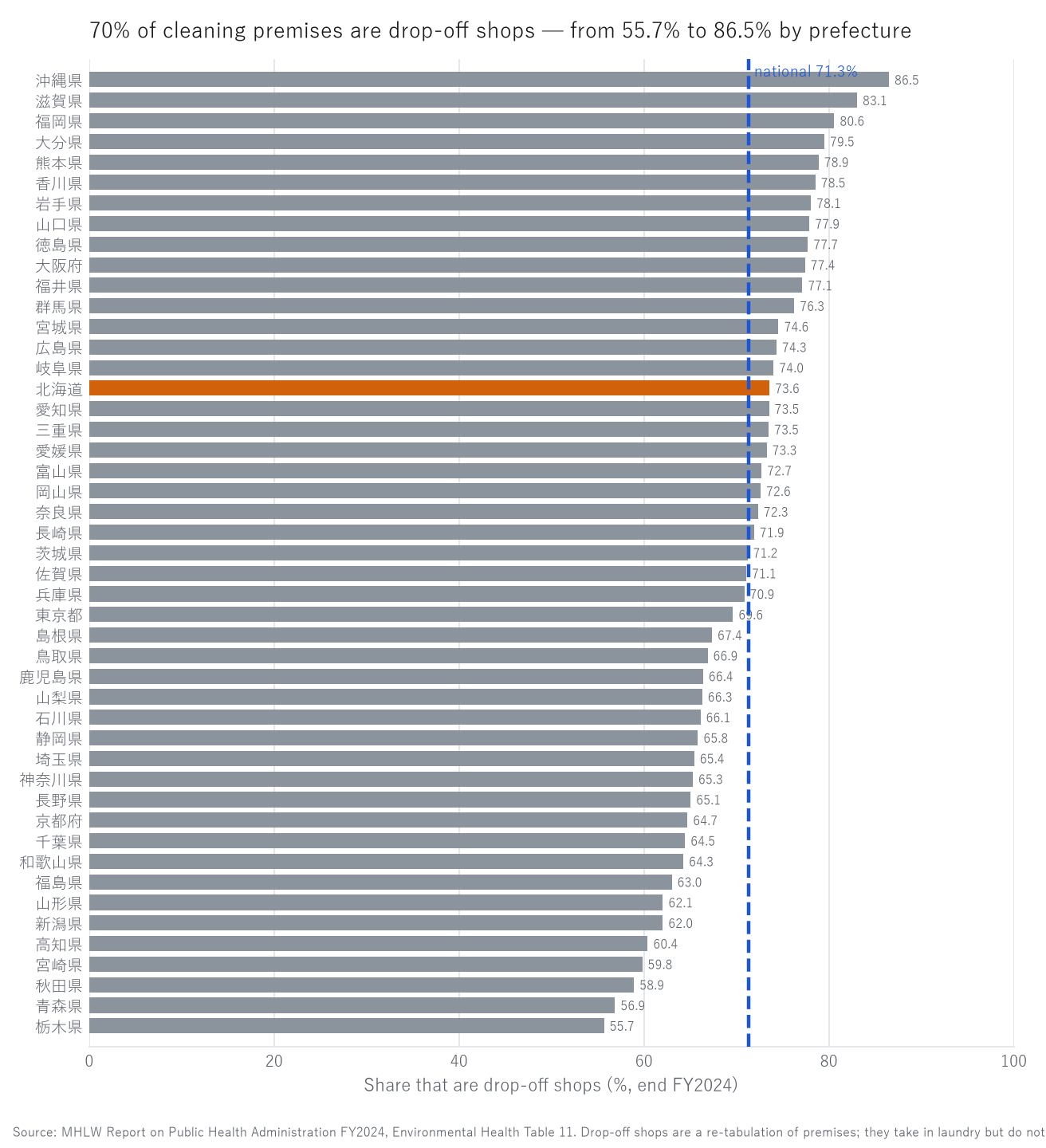
Figure 1. Share of cleaning premises that are drop-off shops (47 prefectures, end of FY2024).
Grey bars are prefectures, orange is Hokkaido, and the dashed blue line marks the national 71.3%.
| Share that are drop-off shops | Highest | Lowest |
|---|---|---|
| Okinawa 86.5% / Shiga 83.1% / Fukuoka 80.6% | Akita 58.9% / Aomori 56.9% / Tochigi 55.7% |
The median is 71.2%, almost exactly the national 71.3%. Every prefecture exceeds half.
| Per 100,000 residents | Highest | Lowest |
|---|---|---|
| Cleaning premises (national 54.6) | Ehime 106.5 / Fukui 101.2 / Iwate 95.5 | Saitama 39.2 / Chiba 37.5 / Kanagawa 35.2 |
| Premises that wash | Ehime 28.5 / Yamanashi 27.3 / Fukui 23.1 | Miyagi 11.2 / Shiga 10.3 / Okinawa 10.2 |
Cleaning premises show a 3.02-fold spread between highest and lowest.
The more premises a prefecture has per head, the greater the share that are drop-off shops (r = +0.487 between premises per 100,000 residents and the drop-off share). Ehime has the most premises in the country at 106.5 per 100,000, but only 28.5 of them wash.
Population size, by contrast, has almost no relationship with the drop-off share (r = +0.055 against log population). It is not a matter of cities having more drop-off shops. The correlation with ageing is weak at r = −0.327.
3-6 Hokkaido and the Kushiro Subprefecture
Hokkaido has 2,429 cleaning premises, of which 1,787 (73.6%) are drop-off shops. Only 642 wash.
It employs 1,305 technicians, 2.03 per washing premises, above the national 1.68. It has 131 premises-free agents.
Per 100,000 residents it has 48.6 premises, 36th of 47, and ranks 16th on the drop-off share.
For the Kushiro Subprefecture only Economic Census subcategory 781 is available, the Report having no municipal breakdown.
| Municipality | Population | 781 establishments | Per 100,000 |
|---|---|---|---|
| Kushiro City | 151,566 | 55 | 36.3 |
| Kushiro Town | 18,021 | 9 | 49.9 |
| Akkeshi | 7,976 | 2 | 25.1 |
| Hamanaka | 5,172 | 2 | 38.7 |
| Shibecha | 6,698 | 5 | 74.6 |
| Teshikaga | 6,327 | 3 | 47.4 |
| Tsurui | 2,368 | 0 | 0.0 |
| Shiranuka | 6,840 | 4 | 58.5 |
The national median across 1,889 municipalities is 32.6. Shibecha (74.6) and Shiranuka (58.5) stand high, Akkeshi (25.1) low.
Tsurui has none. In I007 it also had no place to buy medicine (subcategory 603). Nationwide, 192 municipalities have zero in 781.
4. Discussion
4-1 The same sign, different contents
"Cleaner" covers two things, and seven in ten are premises that only take laundry in. Those with washing equipment and a licensed technician number 19,379, under a third of the total.
This distinction barely exists in other trades' statistics. Barbershops, beauty salons and eating places are not counted separately according to whether the work happens on site. Dry cleaning is split only because the law requires a technician where washing occurs.
When counting "how many there are in this town," what is being counted differs from trade to trade. That is another angle on the limitation of R001–R003, which counted presence and absence using Economic Census establishments alone.
4-2 More shops means less washing
Premises per head and the drop-off share correlate moderately (r = +0.487). Ehime leads the country at 106.5 premises per 100,000 residents but has only 28.5 that wash.
A drop-off shop needs no equipment, so it is easy to add. A large number of shops does not mean a thick trade — the same direction as I006, where prefectures with more lodgings had smaller ones.
Why the share runs from 55.7% to 86.5% between prefectures is not explained here.
4-3 How many enter
The 790 licences granted are 2.43% of the technicians employed, slightly below the 813 implied by assuming a forty-year working life.
That alone does not support saying technicians will decline. Neither tenure nor whether licensees begin working is observed. What can be said is the figure itself: 790 a year.
4-4 Home delivery is still 3.4%
The 2,304 premises-free agents are 3.4% of the 67,551 cleaning premises. By registration count, the growth of home-delivery cleaning is still small.
How much each agent handles is not known here. Counts and scale are different things.
5. Limitations
- The Report is as of end-FY2024, the Census as of 1 June 2021, population as of 1 January 2026: the dates differ
- The Report counts premises notified under the Cleaning Business Act; the Census counts establishments
- Drop-off shops are a re-tabulation of premises. "Premises that wash" was obtained by subtraction
- Economic Census subcategory 781 includes linen supply and towel rental and is not the same thing as a cleaning premises
- Employed technicians are licence holders working at the premises, without distinguishing full-time from part-time
- Licences granted are a count during the year and do not show whether the holder began working; "a forty-year working life" is only an assumption
- The Report has no municipal breakdown; Kushiro figures are from the Census only
- Revenue, volume of laundry and size of premises are not examined
- This paper does not judge which statistic is correct
6. Reproduction
- From e-Stat, obtain the Report on Public Health Administration, FY2024, Environmental Health Table 11 (CSV). It contains re-tabulated rows for designated and core cities; use only the prefecture rows
- Confirm that the 47 prefecture rows sum to the national row (67,551 premises; 48,172 drop-off shops; 32,525 technicians; 2,304 premises-free agents)
- Subtract drop-off shops from premises to obtain premises that wash (19,379 nationally)
- From e-Stat, obtain establishments by industrial subcategory and municipality (2021 Economic Census) and sum 781 by prefecture
- Sum Basic Resident Register population and population aged 65+ by prefecture
- Compute the drop-off share, technicians per washing premises, and premises per 100,000 residents
All values are the output of a single script (kensan_196). No intermediate value was transcribed by hand.
Scope of this paper
No new theory is claimed. This paper counts, within the single category "cleaning premises," how many wash and how many only take laundry in. Like I004 (barbershops and beauty salons), I005 (eating places) and I007 (pharmacies), it reads what a shop in a trade actually is from the categories of official statistics. Subcategory 781 includes linen supply and similar services, so the comparison with it is kept to a reference. It does not judge which statistic is correct.
References and data sources
- MHLW, Report on Public Health Administration, FY2024, Environmental Health Table 11.
- Statistics Bureau of Japan and METI, 2021 Economic Census for Business Activity.
- MIC, Population Based on the Basic Resident Register, 1 January 2026.
- Y. Yamagishi, "Barbershops and Beauty Salons: Two People per Shop" (I004). Zenodo. https://doi.org/10.5281/zenodo.22875820
- Y. Yamagishi, "Food-Service Licences Are 2.9 Times the Establishments" (I005). Zenodo. https://doi.org/10.5281/zenodo.22875863
- Y. Yamagishi, "The Number of Inns Differs 13.7-Fold Between Statistics" (I006). Zenodo. https://doi.org/10.5281/zenodo.22876047
- Y. Yamagishi, "140 Towns and Villages Have No Pharmacy" (I007). Zenodo. https://doi.org/10.5281/zenodo.22876130
Version history
| Version | Date | Change |
|---|---|---|
| 1 | 2026-09-21 | First release |
How to cite
Yamagishi, Y. (2026). Seven in Ten Cleaning Premises Do Not Wash: 48,172 of 67,551 Are Drop-Off Shops [I008]. Zenodo. https://doi.org/10.5281/zenodo.22876239
(This DOI is the concept DOI; it always resolves to the latest version. Cite this one.)
© 2026 Yuuki YAMAGISHI
This work is licensed under a Creative Commons Attribution 4.0 International License (CC BY 4.0).
You may copy, adapt, redistribute and use it commercially, provided you give appropriate credit.
creativecommons.org/licenses/by/4.0
All figures and values in this paper were computed from official statistics. Rights in the underlying data remain with the publishing agencies.
Reference
Yamagishi, Y. (2026). Seven in Ten Cleaning Premises Do Not Wash: 48,172 of 67,551 Are Drop-Off Shops [I008]. Zenodo.
DOI: 10.5281/zenodo.22876239
YOI: https://www.yamagishiyuuki.com/yoi/I008
ORCID: 0009-0006-8587-3450
PDF (English) · PDF (Japanese) · Date proof of the English PDF (OpenTimestamps .ots) · SHA256SUMS
The record page for this paper (in Japanese, with the PDFs in each language and the date proof): YOI I008. This paper is a preprint and has not been peer reviewed.