Abstract
I counted public bathhouses in the Report on Public Health Administration (end of FY2024, MHLW, Environmental Health Table 9) and read them against population and the Economic Census.
There are 23,668 public bathhouses, but only 2,730 — 11.5% — are "general public baths," the neighbourhood sento. The rest are 2,031 saunas, 3,369 sports facilities, 1,759 health centres, 1,429 private-room baths and 12,350 others.
888 licences were granted during the year against 903 closures — a ratio of 0.98. The opposite of the lodgings of I006 (2.74), and the only trade in this series where the ratio falls below one. In 19 of 47 prefectures closures outnumber new licences.
Economic Census subcategory 784 (bathhouse services) counts 2,288 establishments. Against all 23,668 bathhouses that is a 10.34-fold gap, but against the 2,730 neighbourhood baths alone it is 1.19 — almost a match. The Census category appears in practice to capture the neighbourhood baths.
Neighbourhood baths per 100,000 residents average 2.21 nationally, median 1.18, ranging from 22.37 in Aomori to 0.00 in Yamagata. One prefecture has no general public bath at all.
Hokkaido has 1,208 public bathhouses (188 neighbourhood baths, 15.6%), with 48 licences granted against 75 closures (0.64).
1. Introduction
I006 counted lodgings and I008 dry cleaning from inside the categories of official statistics. In both, different things turned out to share one name.
Public bathhouses are the same. And this table carries what I006 also had: openings and closures during the year.
How many neighbourhood baths are there? Are they increasing or closing?
2. Data
| Public bathhouses | MHLW, Report on Public Health Administration, FY2024, Environmental Health Table 9: public bathhouses by public and private operation, with licences, closures and sanctions (premises as of end FY2024; licences and closures are counts during the year) |
| Economic Census | 2021 Economic Census, subcategory 784 bathhouse services (1 June 2021) |
| Population and age 65+ | MIC, Basic Resident Register population, 1 January 2026 |
All 47 prefectures are present and their sums match the national row (23,668 premises; 888 licences; 903 closures). The breakdown also reconciles: 3,361 publicly operated plus 20,307 privately operated equals 23,668.
The Report has no municipal breakdown (prefectures, designated cities and core cities only). The unit here is therefore the prefecture, with Economic Census municipal values summed by prefecture.
"General public bath" is the category subject to the Price Control Ordinance, under which each prefecture sets a ceiling on the bathing fee. It corresponds to the neighbourhood sento.
3. Results
3-1 Only 11.5% of "public bathhouses" are neighbourhood baths
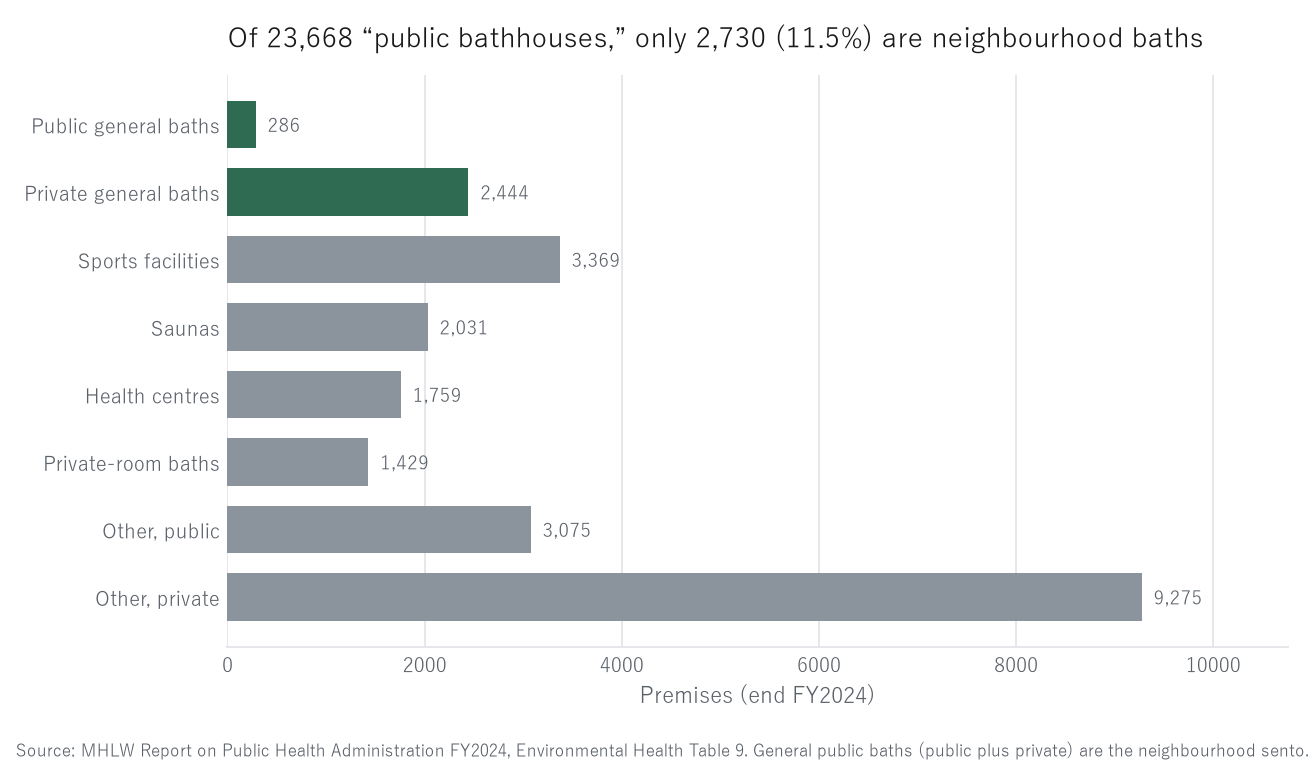
Figure 1. Composition of public bathhouses (end of FY2024, 23,668 nationally).
Green is general public baths (the neighbourhood sento); grey is everything else.
| Premises | Share of total | |
|---|---|---|
| Publicly operated | 3,361 | 14.2% |
| of which general public baths | 286 | 1.2% |
| of which other | 3,075 | 13.0% |
| Privately operated | 20,307 | 85.8% |
| of which general public baths | 2,444 | 10.3% |
| of which private-room baths | 1,429 | 6.0% |
| of which health centres | 1,759 | 7.4% |
| of which saunas | 2,031 | 8.6% |
| of which sports facilities | 3,369 | 14.2% |
| of which other | 9,275 | 39.2% |
| Total | 23,668 |
General public baths — 286 public plus 2,444 private — number 2,730, just 11.5% of the total.
"There are 23,668 public bathhouses" and "there are 2,730 neighbourhood baths" are both true, from the same table. The choice of word alone changes the figure 8.67-fold.
3-2 888 openings, 903 closures — the only ratio below one in this series
| Count during the year | |
|---|---|
| Licences granted | 888 |
| Businesses closed | 903 |
| Ratio | 0.98 |
The lodgings of I006 stood at 2.74. Public bathhouses fall below one.
| Increasing | Ratio |
|---|---|
| Nagasaki | 10.33 |
| Shiga | 5.50 |
| Fukui | 5.00 |
| (median) | 1.03 |
| Declining | Ratio |
|---|---|
| Nara | 0.40 |
| Toyama | 0.38 |
| Ehime | 0.22 |
In 19 of 47 prefectures, closures exceed new licences. The median of 1.03 points slightly the other way from the national 0.98, because the prefectures with the larger counts are the ones declining.
Note, however, that these counts cover all public bathhouses, not neighbourhood baths alone. If neighbourhood baths are closing while saunas open, this single figure cannot separate the two.
3-3 The Census category captures the neighbourhood baths
| Count | Ratio | |
|---|---|---|
| Public bathhouses (Public Health Report, end FY2024) | 23,668 | 10.34× |
| of which general public baths | 2,730 | 1.19× |
| Economic Census bathhouse services 784 (2021) | 2,288 |
The total differs 10.34-fold, but the neighbourhood baths differ only 1.19-fold.
Subcategory 784 combines 7841 general public baths and 7842 other public baths. That the total nonetheless differs tenfold suggests that baths attached to saunas, sports facilities and hotels are classified under the principal activity of the establishment they belong to — the same shape of explanation as the general clinics of I003, and not tested here.
This is the mirror image of I006, where simple lodgings differed 13.75-fold because many were not captured as establishments at all. Here the premises are captured; they sit under a different classification.
3-4 By prefecture
| Neighbourhood baths per 100,000 residents (national 2.21, median 1.18) | Highest | Lowest |
|---|---|---|
| Aomori 22.37 / Kagoshima 15.70 / Oita 11.45 | Okinawa 0.07 / Ibaraki 0.04 / Yamagata 0.00 |
One prefecture has no general public bath at all: Yamagata. It has 228 public bathhouses, but both the public and the private general-bath counts are reported as zero. Excluding zero, the highest and lowest differ 633.3-fold.
| Share of bathhouses that are neighbourhood baths (national 11.5%) | Highest | Lowest |
|---|---|---|
| Aomori 55.5% / Osaka 43.8% / Kagoshima 34.6% | Okinawa 0.3% / Ibaraki 0.2% / Yamagata 0.0% |
| Share publicly operated (national 14.2%) | Highest | Lowest |
|---|---|---|
| Nara 34.1% / Fukushima 27.5% / Niigata 26.3% | Shizuoka 7.1% / Okinawa 3.8% / Toyama 2.4% |
| Public bathhouses per 100,000 residents, all (national 19.1) | Highest | Lowest |
|---|---|---|
| Nagano 58.9 / Oita 52.0 / Kagoshima 45.4 | Osaka 9.2 / Aichi 8.6 / Saitama 8.1 |
Osaka is third from the bottom on the total (9.2) yet second from the top on the neighbourhood-bath share (43.8%). It has few, but what it has are neighbourhood baths. Nagano, conversely, leads the country on the total (58.9), presumably because of bathing facilities in hot-spring areas.
The correlation with ageing is weak (r = +0.214 with neighbourhood baths per 100,000 residents), and population size has almost no relationship with the neighbourhood-bath share (r = +0.156).
3-5 Hokkaido and the Kushiro Subprefecture
Hokkaido has 1,208 public bathhouses, of which 188 (15.6%) are neighbourhood baths and 242 (20.0%) are publicly operated.
Per 100,000 residents it has 24.2 in total (24th of 47) and 3.76 neighbourhood baths (8th), above the national 2.21.
Forty-eight licences were granted against 75 closures (0.64), below the national 0.98.
For the Kushiro Subprefecture only Economic Census subcategory 784 is available, the Report having no municipal breakdown.
| Municipality | Population | 784 establishments | Per 100,000 |
|---|---|---|---|
| Kushiro City | 151,566 | 12 | 7.9 |
| Kushiro Town | 18,021 | 0 | 0.0 |
| Akkeshi | 7,976 | 1 | 12.5 |
| Hamanaka | 5,172 | 1 | 19.3 |
| Shibecha | 6,698 | 1 | 14.9 |
| Teshikaga | 6,327 | 1 | 15.8 |
| Tsurui | 2,368 | 0 | 0.0 |
| Shiranuka | 6,840 | 0 | 0.0 |
1,239 municipalities have zero in 784 — two-thirds of the 1,889. The national median is 0.0: bathhouse services are a trade most towns do not have.
Within the subprefecture, Kushiro Town, Tsurui and Shiranuka have none — a stage before the "only one in town" of R003.
4. Discussion
4-1 The name and the contents
"There are 23,668 public bathhouses" is correct. "There are only 2,730 neighbourhood baths" is correct. Both come from the same column of the same table.
This is the shape of I008's dry cleaning, where only three in ten premises wash. An administrative category does not express the substance of a trade in a single number. Which category is taken changes the figure 8.67-fold.
The split comes from the law: general public baths have their bathing fee capped under the Price Control Ordinance and are treated differently from other bathhouses. The statistical category traces the regulatory one.
4-2 The one trade where closures win
Openings and closures were available in only two papers of this series: I006 (lodgings) and this one. Lodgings stood at 2.74 and were increasing; public bathhouses stand at 0.98 and are declining.
Closures exceed new licences in 19 of 47 prefectures. Hokkaido stands at 0.64.
These counts cover all public bathhouses. If neighbourhood baths are closing while saunas open, the figure cannot show it. This paper cannot say that neighbourhood baths are declining. What it can say is that across public bathhouses as a whole, closures exceeded new licences.
4-3 When two statistics do agree
Since I003 this series has assembled cases where official counts disagree: general clinics +26.8%, beauty salons +72.2%, food-service licences 2.91×, simple lodgings 13.75×.
Public bathhouses differ 10.34-fold on the total, but only 1.19-fold on the neighbourhood baths. What sits inside the Census's "bathhouse services" appears in practice to be the neighbourhood baths.
When statistics disagree, the categories being compared differ. Choose the matching category and they match. Which category that is, however, cannot be known until the numbers are examined.
4-4 A trade most towns do not have
Of 1,889 municipalities, 1,239 have zero in 784, and the median is zero.
R002 found that many of the 433 subcategories appear from a population of 155. Bathhouse services are the opposite: a trade that does not appear even where there are people. Three of the eight municipalities in the Kushiro Subprefecture have none.
5. Limitations
- The Report is as of end-FY2024, the Census as of 1 June 2021, population as of 1 January 2026: the dates differ
- The Report counts premises licensed under the Public Bathhouse Act; the Census counts establishments
- "General public bath" is the category subject to the Price Control Ordinance and corresponds to the neighbourhood sento, but its application rests with each local authority
- Licences and closures cover all public bathhouses; the change in neighbourhood baths alone cannot be derived
- Licences and closures are counts during the year and may include rebuilding or succession of the same premises
- That baths attached to sports or lodging facilities fall outside 784 is a hypothesis and is not verified
- The Report has no municipal breakdown; Kushiro figures are from the Census only
- Bathing fees, visitor numbers and the size of premises are not examined
- This paper does not judge which statistic is correct
6. Reproduction
- From e-Stat, obtain the Report on Public Health Administration, FY2024, Environmental Health Table 9 (CSV). It contains re-tabulated rows for designated and core cities; use only the prefecture rows
- Confirm that the 47 prefecture rows sum to the national row and that public plus private equals the total (23,668 premises; 888 licences; 903 closures)
- Add public and private general public baths to obtain the neighbourhood baths (2,730 nationally)
- From e-Stat, obtain establishments by industrial subcategory and municipality (2021 Economic Census) and sum 784 by prefecture
- Sum Basic Resident Register population and population aged 65+ by prefecture
- Compute the neighbourhood-bath share, premises per 100,000 residents, and licences divided by closures
All values are the output of a single script (kensan_197). No intermediate value was transcribed by hand.
Scope of this paper
No new theory is claimed. This paper counts what share of the category "public bathhouse" is made up of general public baths, and sets that beside the counts of openings and closures. Like I006 (lodgings) and I008 (dry cleaning), it looks inside the categories of official statistics. It is the only paper in this series where closures exceeded openings. The explanation offered for the agreement and disagreement with Census subcategory 784 is kept as a hypothesis. It does not judge which statistic is correct.
References and data sources
- MHLW, Report on Public Health Administration, FY2024, Environmental Health Table 9.
- Statistics Bureau of Japan and METI, 2021 Economic Census for Business Activity.
- MIC, Population Based on the Basic Resident Register, 1 January 2026.
- Y. Yamagishi, "At What Population Does a Trade Appear?" (R002). Zenodo. https://doi.org/10.5281/zenodo.22872356
- Y. Yamagishi, "The Same Clinics Counted by Two Official Statistics" (I003). Zenodo. https://doi.org/10.5281/zenodo.22875614
- Y. Yamagishi, "The Number of Inns Differs 13.7-Fold Between Statistics" (I006). Zenodo. https://doi.org/10.5281/zenodo.22876047
- Y. Yamagishi, "Seven in Ten Cleaning Premises Do Not Wash" (I008). Zenodo. https://doi.org/10.5281/zenodo.22876239
Version history
| Version | Date | Change |
|---|---|---|
| 1 | 2026-09-21 | First release |
How to cite
Yamagishi, Y. (2026). Of 23,668 "Public Bathhouses," 2,730 Are Neighbourhood Baths — and This Alone Is the Trade Where Closures Outnumber Openings [I009]. Zenodo. https://doi.org/10.5281/zenodo.22876425
(This DOI is the concept DOI; it always resolves to the latest version. Cite this one.)
© 2026 Yuuki YAMAGISHI
This work is licensed under a Creative Commons Attribution 4.0 International License (CC BY 4.0).
You may copy, adapt, redistribute and use it commercially, provided you give appropriate credit.
creativecommons.org/licenses/by/4.0
All figures and values in this paper were computed from official statistics. Rights in the underlying data remain with the publishing agencies.
Reference
Yamagishi, Y. (2026). Of 23,668 "Public Bathhouses," 2,730 Are Neighbourhood Baths [I009]. Zenodo.
DOI: 10.5281/zenodo.22876425
YOI: https://www.yamagishiyuuki.com/yoi/I009
ORCID: 0009-0006-8587-3450
PDF (English) · PDF (Japanese) · Date proof of the English PDF (OpenTimestamps .ots) · SHA256SUMS
The record page for this paper (in Japanese, with the PDFs in each language and the date proof): YOI I009. This paper is a preprint and has not been peer reviewed.