Abstract
From Table 13 of the Report on Public Health Administration (FY2024) I counted environmental health and food sanitation staff by job title and by whether they serve full time, and set that against the facility counts built up in earlier papers.
There are 27,227 staff. But this is not a headcount — it is a cumulative count. Under note 1 of Table 13, someone serving concurrently is counted once for each duty held.
Full-time staff number 2,349 (8.6%); concurrent staff 24,878 (91.4%).
| Job title | Staff | of whom full time |
|---|---|---|
| Food sanitation inspector | 8,558 | 1,372 (16.0%) |
| Environmental health inspector | 6,710 | 465 (6.9%) |
| Household goods sanitation inspector | 3,986 | |
| Poultry inspector | 2,805 | |
| Slaughterhouse inspector | 2,689 | |
| Rabies prevention officer | 2,479 |
Eleven prefectures have no full-time staff at all. The median full-time share is 4.9%; even Tokyo is at 38.9%.
Dividing 2,769,361 food businesses (all licensed plus notified) by 8,558 food sanitation inspectors gives 324 per inspector; by the 1,372 full-time inspectors, 2,018.
Staff per 100,000 population run from 48.4 in Shimane to 11.2 in Saitama, a spread of 4.31. The correlation with population in logs is r = −0.694: the less populous the prefecture, the more staff per head.
1. Introduction
From I006 onward, what I have counted is the watched side: 52,946 hotels and inns, 23,668 public bathhouses, 67,551 laundry premises, 2,769,361 food businesses, 63,203 pharmacies, 107,995 barbershops, 277,752 beauty salons, 876,042 cemeteries.
So how many are there on the watching side?
2. Data
| Staff | MHLW, Report on Public Health Administration, FY2024, Table 13 (Food Sanitation). As at end of FY2024. Six job titles × full-time / concurrent |
| Food businesses | Same source, Tables 4-1 and 6-1 (counted in I011) |
| Barbershops and beauty salons | Same source, Table 10 (counted in I015) |
| Population | MIC, Basic Resident Register, 1 January 2026 |
All 47 prefectures are present, and the total reconciles exactly with the national row (27,227, difference zero).
Note 1 of Table 13: the "total" for concurrent staff is a cumulative count of those holding the duties of environmental health inspector, food sanitation inspector, slaughterhouse inspector, poultry inspector, rabies prevention officer and household goods sanitation inspector.
That is, someone holding three titles counts as three. 27,227 is not a number of people.
3. Results
3-1 27,227 is a cumulative count
| Job title | Staff | Share |
|---|---|---|
| Food sanitation inspector | 8,558 | 31.4% |
| Environmental health inspector | 6,710 | 24.6% |
| Household goods sanitation inspector | 3,986 | 14.6% |
| Poultry inspector | 2,805 | 10.3% |
| Slaughterhouse inspector | 2,689 | 9.9% |
| Rabies prevention officer | 2,479 | 9.1% |
| Total | 27,227 |
The six titles sum to exactly 27,227. That they sum exactly means people serving concurrently are counted once per title.
The only clear headcount is the full-time figure.
3-2 8.6% serve full time
| Staff | Share | |
|---|---|---|
| Full time | 2,349 | 8.6% |
| Concurrent | 24,878 | 91.4% |
| All | Full time | Full-time share | |
|---|---|---|---|
| Food sanitation inspectors | 8,558 | 1,372 | 16.0% |
| Environmental health inspectors | 6,710 | 465 | 6.9% |
Nine tenths of this work is done alongside other duties.
| Full-time share (prefectures) | |
|---|---|
| High | Tokyo 38.9% / Fukuoka 23.0% / Miyagi 20.0% |
| Low | Ehime 0.0% / Saga 0.0% / Miyazaki 0.0% |
| Prefectures at 0% | 11 of 47 |
| Median | 4.9% |
Eleven prefectures have not a single full-time environmental health or food sanitation officer.
3-3 Facilities per person
| Food businesses | Facilities per person |
|---|---|
| Licensed + notified 2,769,361 ÷ 8,558 inspectors | 324 |
| Licensed + notified 2,769,361 ÷ 1,372 full time | 2,018 |
| Notified only 865,122 ÷ 8,558 | 101 |
| Notified only 865,122 ÷ 1,372 full time | 631 |
| Barbershops + beauty salons 385,747 | Facilities per person |
|---|---|
| ÷ 6,710 environmental health inspectors | 57 |
| ÷ 465 full time | 830 |
Environmental health inspectors do not cover only barbering and beauty. Hotels, public bathhouses, laundries, entertainment venues and specified buildings are also theirs, so the real load is considerably higher.
3-4 The less populous the prefecture, the more staff per head
| Per 100,000 population | |
|---|---|
| National | staff 22.0 (food sanitation 6.9 / environmental health 5.4) |
| High | Shimane 48.4 / Miyazaki 46.0 / Kochi 41.0 |
| Low | Tokyo 15.0 / Fukuoka 13.6 / Saitama 11.2 |
| Top ÷ bottom | 4.31, median 26.3 |
| Correlation with population (log) | r = −0.694 |
The less populous the prefecture, the more staff per head.
3-5 The load differs threefold
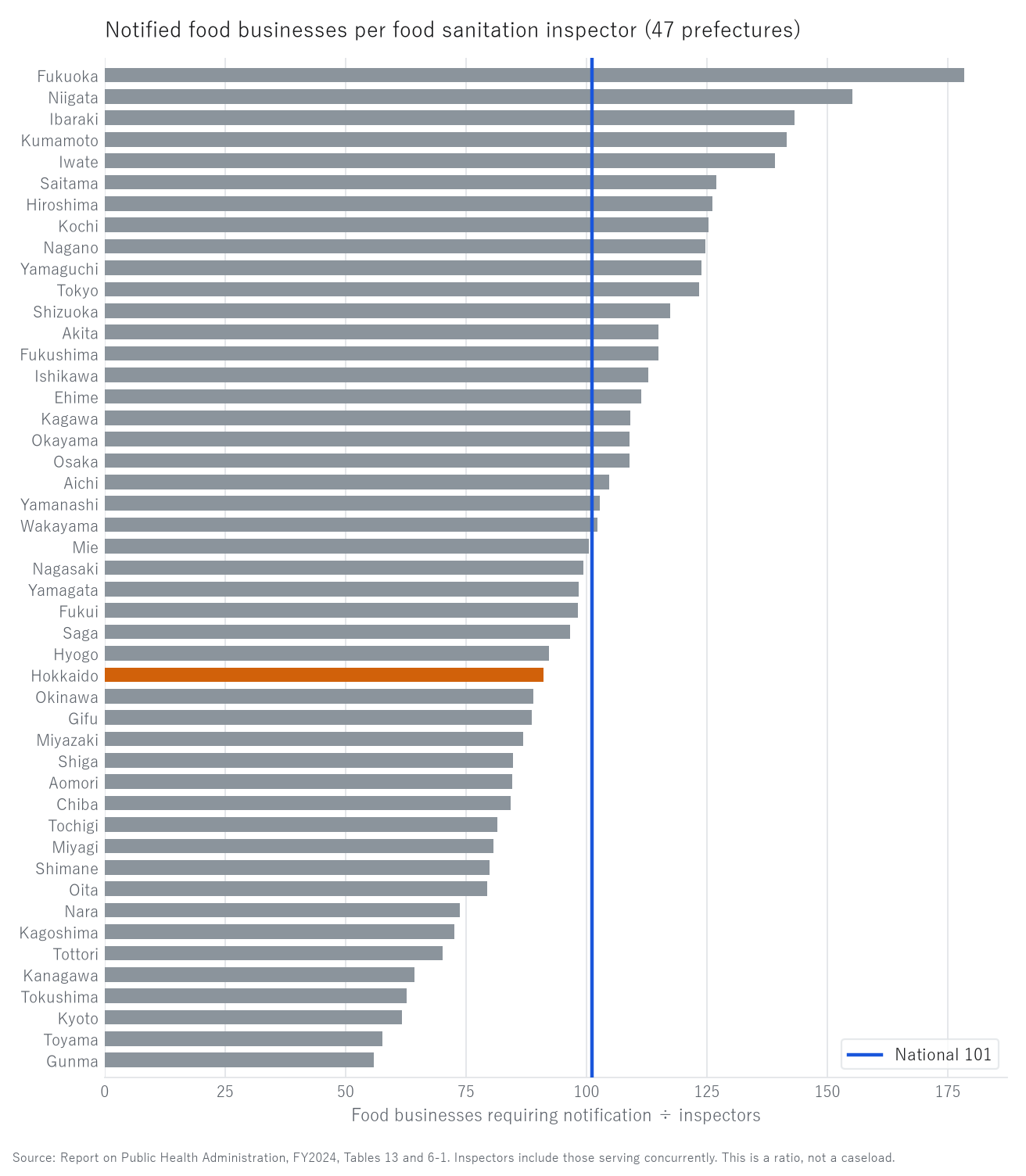
Figure 1. Notified food businesses per food sanitation inspector, 47 prefectures (FY2024).
Grey is prefectures, orange is Hokkaido, the blue vertical line is the national 101.
| Notified food businesses per food sanitation inspector | |
|---|---|
| High | Fukuoka 178 / Niigata 155 / Ibaraki 143 |
| Low | Kyoto 62 / Toyama 58 / Gunma 56 |
| National | 101, median 99 |
| Top ÷ bottom | 3.20 |
| Correlation with population (log) | r = +0.210 |
| Barbershops + beauty salons per environmental health inspector | |
|---|---|
| High | Niigata 115 / Fukuoka 101 / Yamanashi 101 |
| Low | Fukui 37 / Toyama 36 / Shimane 29 |
| National | 57, median 55 |
| Top ÷ bottom | 3.94 |
3-6 Hokkaido
| Staff | 1,369 (full time 199, 14.5%) |
| Food sanitation inspectors | 378 (103 full time) |
| Environmental health inspectors | 326 (46 full time) |
| Slaughterhouse inspectors | 243 (9.0% of the national 2,689) |
| Poultry inspectors | 199 (7.1% of the national 2,805) |
| Per 100,000 population | staff 27.4 (20th of 47; national 22.0) |
| Per food sanitation inspector | 91 notified food businesses (29th of 47; national 101) |
| Per environmental health inspector | 52 barbershops and beauty salons (27th of 47; national 57) |
Hokkaido's full-time share of 14.5% is above the national 8.6%. Its 243 slaughterhouse inspectors are 9.0% of the national total, more than twice its 4.0% share of population.
4. Discussion
4-1 Do not write "27,227 people"
Under note 1, concurrent staff are counted once for each duty held. 27,227 is therefore a cumulative count, not a headcount.
This is the single most important thing about reading this table. To write "Japan's hygiene administration has 27,227 staff" would be wrong. The real number of people is smaller.
By how much, this table cannot say. The only figure that is clear is the 2,349 full-time staff.
Just as I015's 381 premises registered as both barbershop and beauty salon were not double counted, the Report on Public Health Administration states its counting rules in the notes. Whether the reader reads them is another matter.
4-2 That nine tenths serve concurrently
Against 2,349 full-time staff there are 24,878 concurrent. Nine tenths of this work is done alongside other duties.
Eleven prefectures have none at all full time. The median is 4.9% and even Tokyo is 38.9%.
Concurrent service is not in itself a failing. In a small authority it is natural for one person to hold several duties. Staff per 100,000 are highest in Shimane (48.4) and Miyazaki (46.0), and the correlation with population in logs is −0.694: the less populous the prefecture, the better staffed per head.
What can be said is that this scarcely exists as a full-time occupation.
4-3 What 2,018 means
2,769,361 food businesses divided by 1,372 full-time food sanitation inspectors is 2,018 each. Divided by all 8,558, it is still 324.
This is a ratio, not a caseload. How staff are distributed across public health centres, and how often inspections happen, this table does not say. Inspection frequency differs by type of facility.
Even so, the order of magnitude is worth holding on to. I014 found on-site inspection rates for medicines retail running from 91.6% in Nagano to 4.1% in Nara, a spread of 22.1. I016 found milk sampling at 2,593 samples against 3,569,411 kilolitres processed — one per 1,377 kilolitres.
"Being regulated" and "being looked at" are different things. Counting the regulator's side shows how large that gap is.
4-4 What this means for small businesses
I015 found barbershops running on 1.80 people and beauty salons on 2.12. X001 found a median of 14.77 across the 526 subcategories.
There are 385,747 such small premises nationwide, watched by 6,710 environmental health inspectors (465 full time) — 57 each, or 830 each for the full-time staff.
The procedures at opening certainly happen. I015 counted 12,433 use confirmations for beauty salons in a year: a check made whenever premises open or move.
After opening, visits must necessarily be infrequent. That I015 found zero closure orders nationwide, and I014 found 6 revocations or suspensions among 2,633 dispositions (0.063%), is consistent with these staffing levels.
But whether few dispositions follow from few staff or from few problems, these numbers cannot decide.
4-5 Hokkaido and slaughterhouse inspectors
Hokkaido has 243 slaughterhouse inspectors (9.0% of the national total) and 199 poultry inspectors (7.1%), against 4.0% of the population — roughly double the weight.
I016 found Hokkaido processing 17.1% of the nation's milk, 4.23 times its population share. Where there is livestock, the staff who inspect it are placed.
This runs on a different logic from 4-2's "the less populous the prefecture, the more staff per head." Slaughterhouse inspectors are placed by where the slaughterhouses are, not by population — the same shape as milk volume not being set by population.
The Kushiro Subprefecture has 100 livestock farming establishments and 27 in livestock food manufacturing (I016). Around them sit the staff who inspect.
5. Limitations
- The total of 27,227 is a cumulative count, not a headcount. Concurrent staff are counted once per duty held (Table 13, note 1)
- "Concurrent" staff hold other duties as well; how much of their time this work takes is unknown
- Facilities per person is a ratio, not a caseload. Distribution across public health centres and inspection frequency are not in this table
- Environmental health inspectors do not cover only barbering and beauty. Hotels, public bathhouses, laundries, entertainment venues and specified buildings are also theirs
- Staff of designated and core cities are included in their prefecture's row (the regrouped rows are not used)
- More or fewer staff does not translate directly into either the volume or the quality of the work
- Whether few dispositions follow from few staff cannot be decided from these numbers
- A correlation indicates the strength of a relationship, not the direction of causation
6. How to reproduce
- Download Table 13 (Food Sanitation, environmental health and food sanitation staff) of the FY2024 Report on Public Health Administration from e-Stat (CP932)
- Take the national row and the 47 rows from Hokkaido to Okinawa (nothing below "designated cities (regrouped)")
- Take the six job titles across the total, full-time and concurrent blocks
- Read note 1. The concurrent total is cumulative across duties, not a headcount
- Divide by the food business counts of Tables 4-1 and 6-1 and the barbershop and beauty salon counts of Table 10
- Compute per-100,000 figures and correlate against population in logs
Every figure in this paper is output by a single script (kensan_209). No intermediate value was copied by hand.
Scope of this paper
No new theory is claimed. Table 13 of the Report on Public Health Administration is counted by job title and by full-time status, and divided by the facility counts of earlier papers. It shows that the total of 27,227 is cumulative, that 2,349 (8.6%) serve full time and eleven prefectures have none, that 2,769,361 food businesses face 8,558 food sanitation inspectors (1,372 of them full time), and that the less populous the prefecture the more staff per head (r = −0.694). Facilities per person is a ratio, not a caseload. Correlations are reported; the direction of causation is not.
References and data sources
- Ministry of Health, Labour and Welfare, Report on Public Health Administration, FY2024, Tables 13, 4-1 and 6-1 (Food Sanitation) and Table 10 (Environmental Health)
- Ministry of Internal Affairs and Communications and Ministry of Economy, Trade and Industry, Economic Census 2021, Tables 9-1A and 9-1B
- Ministry of Internal Affairs and Communications, Basic Resident Register population, 1 January 2026
- Yuuki Yamagishi, "865,122 Food Businesses Require Notification" (I011)
- Yuuki Yamagishi, "11,910 Shops Sell Medicines Online (12.8%)" (I014)
- Yuuki Yamagishi, "107,995 Barbershops and 277,752 Beauty Salons" (I015). Zenodo. https://doi.org/10.5281/zenodo.22878037
- Yuuki Yamagishi, "Milk Processed Differs 20,444-fold Top to Bottom" (I016). Zenodo. https://doi.org/10.5281/zenodo.22879076
- Yuuki Yamagishi, "How Many People Does a Trade Run On?" (X001)
Version history
| Version | Date | Contents |
|---|---|---|
| 1 | 2026-09-22 | First release |
How to cite
Yamagishi, Y. (2026). 27,227 on the Watching Side, of Whom 2,349 Are Full-Time — Against 2,769,361 Food Businesses [I018]. Zenodo. https://doi.org/10.5281/zenodo.22879207
(This DOI is the concept DOI; it always resolves to the latest version. Cite this one.)
© 2026 Yuuki YAMAGISHI
This work is licensed under a Creative Commons Attribution 4.0 International License (CC BY 4.0).
You may copy, adapt, redistribute and use it commercially, provided you give appropriate credit.
creativecommons.org/licenses/by/4.0
All figures and values in this paper were computed from official statistics. Rights in the underlying data remain with the publishing agencies.
Reference
Yamagishi, Y. (2026). 27,227 on the Watching Side, of Whom 2,349 Are Full-Time [I018]. Zenodo.
DOI: 10.5281/zenodo.22879207
YOI: https://www.yamagishiyuuki.com/yoi/I018
ORCID: 0009-0006-8587-3450
PDF (English) · PDF (Japanese) · Date proof of the English PDF (OpenTimestamps .ots) · SHA256SUMS
The record page for this paper (in Japanese, with the PDFs in each language and the date proof): YOI I018. This paper is a preprint and has not been peer reviewed.