Abstract
From Table 7 of the Report on Public Health Administration (FY2024) I counted entertainment venues by type together with licences, closures and sanctions, and matched them against the cinema, entertainment-venue and sports-facility categories of the Economic Census (2021).
There are 4,826 permanent entertainment venues: 1,468 cinemas (30.4%), 2,971 "other" (61.6%) and 387 sports venues (8.0%).
The direction of the discrepancy against the Economic Census reverses within the same table.
| Public Health Administration | Economic Census | Ratio | |
|---|---|---|---|
| Cinemas | 1,468 premises | 575 establishments | 2.55 |
| Other | 2,971 premises | 4,241 establishments | 0.70 |
| Sports venues | 387 premises | 19,344 establishments | 0.02 |
Of 19,344 sports facility establishments, only 387 (2.0%) hold an entertainment-venue licence. The Entertainment Venues Act covers premises that show or play something to the public, not places where people exercise.
The Economic Census finds cinemas in only 339 of 1,889 municipalities. 82.1% of municipalities have none.
Licence revocations: zero. Suspensions: zero. Against 4,826 permanent venues, sanctions numbered nil.
Licences for temporary venues numbered 202 in the year, 2.49 times the 81 issued to permanent ones.
In the Kushiro Subprefecture the only cinema is in Kushiro Town; Kushiro City has none.
1. Introduction
Like I015's barbershops and beauty salons and I017's cemeteries and crematoria, entertainment venues are a licensed environmental health trade.
But they differ in character from the rest. Barbering is present in 1,862 municipalities and beauty in 1,857. Cinemas are in 339.
How many entertainment venues does Japan have, and where are the cinemas?
2. Data
| Venues, licences, closures, sanctions | MHLW, Report on Public Health Administration, FY2024, Table 7 (Environmental Health). Premises as at end of FY2024; licences, closures and sanctions during the year |
| Establishments and workers | MIC and METI, Economic Census 2021, 801 Motion picture theatres / 802 Entertainment venues (n.e.c.) and troupes / 804 Sports facilities |
| Population | MIC, Basic Resident Register, 1 January 2026 |
All 47 prefectures are present, and all three counts reconcile exactly with the national row (cinemas 1,468, sports venues 387, other 2,971; all differences zero).
Under the Entertainment Venues Act, a "venue" is a facility that shows or plays film, theatre, music, sport, variety or exhibition to the public. Facilities for exercising (gyms and the like) are not covered.
3. Results
3-1 4,826 permanent venues
| Type | Premises | Share of permanent |
|---|---|---|
| Other | 2,971 | 61.6% |
| Cinemas | 1,468 | 30.4% |
| Sports venues | 387 | 8.0% |
| Together | 4,826 |
"Other" mixes theatre, music, variety and exhibition. This table cannot separate them.
3-2 The discrepancy reverses by type
| Public Health Administration (end FY2024) | Economic Census (1 June 2021) | Ratio | |
|---|---|---|---|
| Cinemas | 1,468 premises | 575 establishments (20,053 workers, 34.87 each) | 2.55 |
| Other | 2,971 premises | 4,241 establishments (39,996 workers, 9.43 each) | 0.70 |
| Sports venues | 387 premises | 19,344 establishments (306,208 workers, 15.83 each) | 0.02 |
Cinemas are 2.55 times more numerous in the health register; sports venues are 2.0% of the census count.
The sports gap is a matter of definition. The Act covers premises that show something to spectators, so gyms and tennis courts fall outside it. Of 19,344 establishments, 387 (2.0%) are venues that admit an audience.
Why cinemas run 2.55 times higher, this table cannot say. One establishment holding several venue licences (several buildings, several auditoria) is conceivable but unverifiable here.
Category 801 runs on 34.87 workers per establishment, nearly three times the all-industry 11.80 (X001). Among entertainment venues it is a large trade.
3-3 Zero sanctions
| During the year | Count |
|---|---|
| Licences (permanent) | 81 |
| Licences (temporary) | 202 |
| Closures | 73 |
| Licence revocations | 0 |
| Suspensions | 0 |
Against 4,826 permanent venues, sanctions numbered nil.
| Permanent licences 81 ÷ closures 73 | 1.11 |
| Licences + temporary 283 ÷ closures 73 | 3.88 |
| Permanent licences 81 ÷ permanent venues 4,826 | 1.68% |
Turnover is 1.68% a year. Openings and closures are both few.
Temporary venue licences numbered 202, 2.49 times the 81 permanent ones. Festivals, events and temporary stages fall here. Seven in ten entertainment-venue licences issued in a year are temporary.
3-4 Per million population
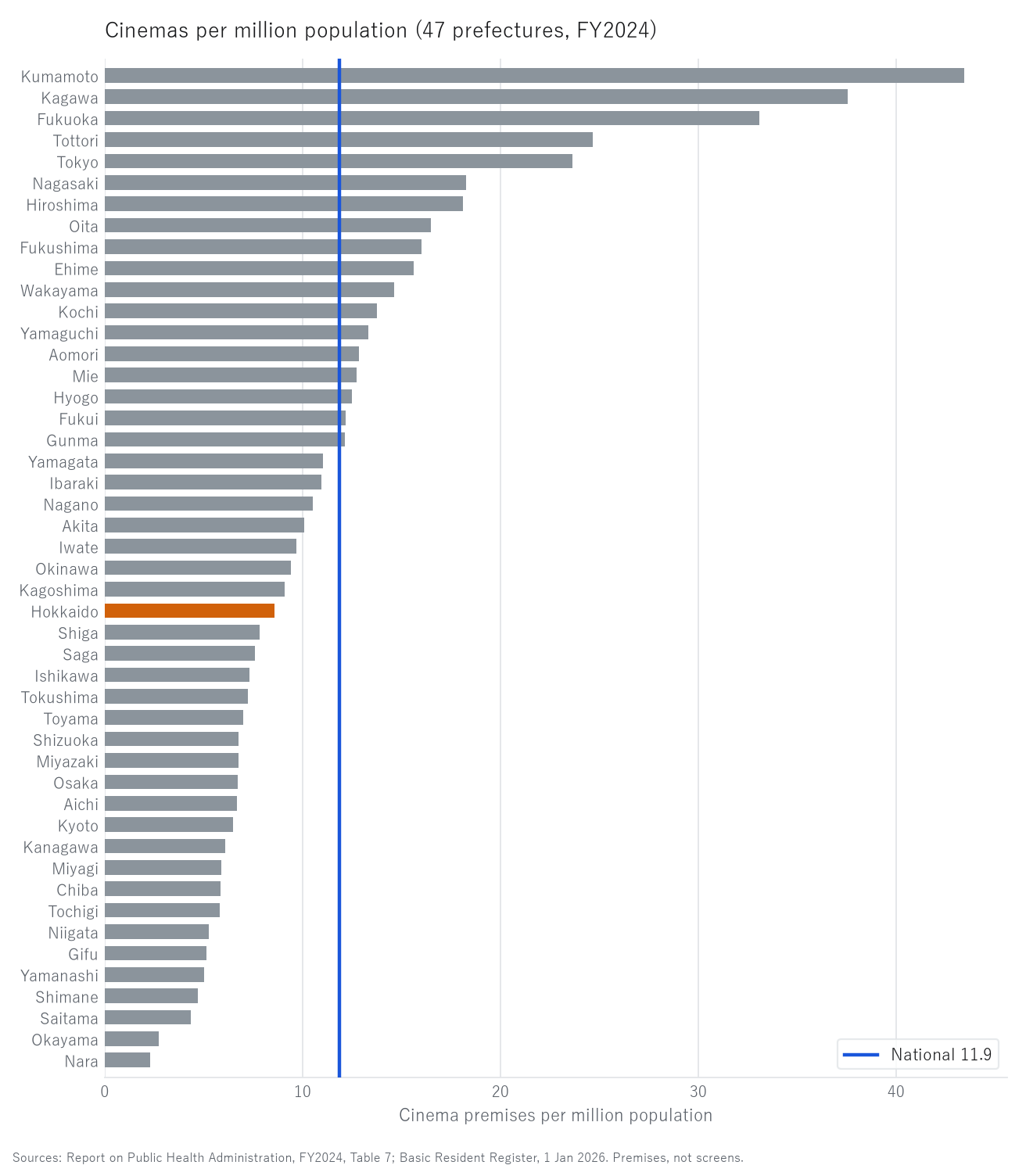
Figure 1. Cinema premises per million population, 47 prefectures (FY2024).
Grey is prefectures, orange is Hokkaido, the blue vertical line is the national 11.9.
| National | High | Low | Top ÷ bottom | Median | |
|---|---|---|---|---|---|
| Cinemas | 11.9 | Kumamoto 43.5 (74) / Kagawa 37.6 (35) / Fukuoka 33.1 (168) | Saitama 4.3 (32) / Okayama 2.7 (5) / Nara 2.3 (3) | 18.73 | 9.4 |
| All permanent venues | 39.0 | Aomori 72.0 / Shimane 69.4 / Tokyo 68.8 | Kanagawa 21.9 / Saitama 19.0 / Gifu 12.9 | 5.57 | 39.2 |
| Correlation (47 prefectures) | r |
|---|---|
| Cinemas per million × population (log) | −0.045 |
| All permanent × population (log) | −0.373 |
Cinemas per head are entirely unrelated to population (r = −0.045). The gap between Kumamoto's 43.5 and Nara's 2.3 is not explained by population.
3-5 82.1% of municipalities have no cinema
| Prefectures with no cinema | 0 |
| Prefectures with fewer than 10 | 12 of 47 |
| Municipalities with a cinema establishment | 339 of 1,889 (17.9%) |
| Municipalities with none | 82.1% |
At prefecture level they are everywhere; at municipal level, eight in ten have none.
Against I015's 1,862 barbering and 1,857 beauty municipalities, this is an order of magnitude apart.
3-6 Hokkaido and the Kushiro Subprefecture
| Hokkaido | |
|---|---|
| Cinemas | 43 |
| Sports venues | 22 |
| Other | 100 |
| Permanent, together | 165 |
| Per million population | cinemas 8.6 (26th of 47; national 11.9) / permanent 33.0 (34th; national 39.0) |
| During the year | 2 permanent licences / 6 temporary / 4 closures |
Kushiro Subprefecture (Economic Census 2021):
| Municipality | 801 Cinemas | 802 Venues and troupes | 804 Sports facilities |
|---|---|---|---|
| Kushiro City | 0 | 3 | 37 |
| Kushiro Town | 1 | 0 | 4 |
| Akkeshi | 0 | 0 | 3 |
| Hamanaka | 0 | 0 | 4 |
| Shibecha | 0 | 0 | 1 |
| Teshikaga | 0 | 1 | 2 |
| Tsurui | 0 | 0 | 2 |
| Shiranuka | 0 | 0 | 9 |
| Total | 1 | 62 |
The only cinema in the subprefecture is in Kushiro Town. Kushiro City, population 151,566, has none.
4. Discussion
4-1 The discrepancy reverses within one table
In the comparisons since I006, the health register has usually held more: simple lodgings 13.75-fold, beauty salons 1.710, department stores 29.6.
In Table 7 the direction splits within a single table: cinemas 2.55, sports venues 0.02.
The sports figure is definitional. The Act covers premises that show or play to the public. A gym or tennis court, where the customer exercises, falls outside. Of 19,344 establishments, 387 (2.0%) admit an audience.
This matches I012's "the regime is narrower than the classification" type (922 specified buildings against 27,977 establishments, 0.64).
The cinema figure of 2.55 cannot be explained from here. One establishment holding several venue licences — I011's department stores at 29.6, and I013 — is the shape it resembles, but the table does not say.
4-2 Zero sanctions
Against 4,826 permanent venues, neither revocations nor suspensions occurred.
I015 found the same for barbershops and beauty salons: zero closure orders against 385,747 premises. In the licensed environmental health trades, the administration almost never acts through sanctions.
As I018 showed, there are 6,710 environmental health inspectors (465 full time). 4,826 entertainment venues are a small part of their remit.
"Zero sanctions" does not mean "zero problems." Neither can be decided from this table.
4-3 Temporary venues outnumber permanent 2.49 to 1
Against 81 permanent licences there were 202 temporary. Seven in ten entertainment-venue licences issued in a year are temporary.
No other environmental health trade has this shape. Barbershops and inns have no temporary category.
Entertainment is a trade that works without holding a place. A licence is issued for each festival, event or temporary stage, and lapses when it ends.
On the permanent side, turnover is 1.68% a year (81 ÷ 4,826). The permanent stock does not move; only the temporary layer turns over each year.
4-4 "Every prefecture has one; eight in ten municipalities do not"
No prefecture is without a cinema. Yet in the Economic Census only 339 of 1,889 municipalities (17.9%) have one.
That gap is the shape of the trade.
X001 found that the smaller a trade is per establishment, the more municipalities it is present in (r = −0.417). Category 801 runs on 34.87 workers per establishment, nearly three times the all-industry 11.80. It is a large trade, so at municipal level it is rare.
By R005's calculation, the median municipal population ratio in 2050 is 0.664 (−33.6%) across 1,876 municipalities. What is already absent from eight in ten will move further in that direction. But cinemas per head did not correlate with population (r = −0.045), so no simple projection follows.
4-5 That Kushiro City has no cinema
The only cinema in the subprefecture is in Kushiro Town (population 18,021); Kushiro City (151,566) has none.
This is the position as of the 2021 Economic Census. Establishments are counted where they sit, so a facility just outside a city boundary is credited to the neighbouring town. It does not mean residents of Kushiro City cannot see a film.
It is the same shape as X002's finding that commercial land in Kushiro Town (56,500 yen/m²) is dearer than in Kushiro City (35,140): the facilities have moved outside the city line.
Administrative boundaries and the area people actually use do not coincide. Counting by municipality makes some things "absent" because of where a line falls. R001's use of two units — 1,892 municipalities and 1,741 — was a response to the same problem.
5. Limitations
- The health register is as at end of FY2024, the Economic Census at 1 June 2021 — three years and ten months apart
- The Act's "venue" is a facility that shows or plays to the public; facilities for exercising are excluded, so the scope differs from the census category "sports facilities"
- Premises are counted; screens, seats and capacity are not
- "Other" mixes theatre, music, variety and exhibition. This table cannot separate them
- Temporary venues are licences issued during the year, not premises at year end
- Why cinemas run 2.55 times higher cannot be verified from this table
- The health register has no municipal table. The Kushiro Subprefecture is shown from the Economic Census
- The Economic Census counts by the location of the establishment; a facility just outside a boundary is credited to the neighbouring municipality
- A correlation indicates the strength of a relationship, not the direction of causation
6. How to reproduce
- Download Table 7 (Environmental Health, entertainment venues) of the FY2024 Report on Public Health Administration from e-Stat (CP932)
- Take the national row and the 47 rows from Hokkaido to Okinawa (nothing below "designated cities (regrouped)")
- Sum cinemas, sports venues and other for the permanent total
- Match each type against Economic Census subcategories 801, 802 and 804
- Compute per-million figures and correlate against population in logs
- Divide the number of municipalities with a cinema establishment by 1,889
Every figure in this paper is output by a single script (kensan_210). No intermediate value was copied by hand.
Scope of this paper
No new theory is claimed. Table 7 of the Report on Public Health Administration is counted and matched against the census categories for cinemas, entertainment venues and sports facilities. It shows 4,826 permanent venues of which 1,468 are cinemas, a discrepancy that reverses between cinemas (2.55) and sports venues (0.02), zero sanctions, temporary licences at 2.49 times permanent ones, and cinemas absent from 82.1% of municipalities. Why cinemas run higher cannot be verified. Correlations are reported; the direction of causation is not.
References and data sources
- Ministry of Health, Labour and Welfare, Report on Public Health Administration, FY2024, Table 7 (Environmental Health)
- Ministry of Internal Affairs and Communications and Ministry of Economy, Trade and Industry, Economic Census 2021, Tables 9-1A and 9-1B
- Ministry of Internal Affairs and Communications, Basic Resident Register population, 1 January 2026
- Yuuki Yamagishi, "865,122 Food Businesses Require Notification" (I011)
- Yuuki Yamagishi, "48,608 Specified Buildings Are Managed by 17,842 Registered Offices" (I012)
- Yuuki Yamagishi, "107,995 Barbershops and 277,752 Beauty Salons" (I015). Zenodo. https://doi.org/10.5281/zenodo.22878037
- Yuuki Yamagishi, "27,227 on the Watching Side, of Whom 2,349 Are Full-Time" (I018). Zenodo. https://doi.org/10.5281/zenodo.22879207
- Yuuki Yamagishi, "How Many People Does a Trade Run On?" (X001)
- Yuuki Yamagishi, "Wages 1.20-fold, Prices 1.08-fold, Income 1.85-fold, Land 87.4-fold" (X002). Zenodo. https://doi.org/10.5281/zenodo.22877924
- Yuuki Yamagishi, "How Many Trades Will Leave a Town by 2050?" (R005). Zenodo. https://doi.org/10.5281/zenodo.22877595
Version history
| Version | Date | Contents |
|---|---|---|
| 1 | 2026-09-22 | First release |
How to cite
Yamagishi, Y. (2026). 1,468 Cinema Premises, and None at All in 82.1% of Municipalities — Zero Sanctions [I019]. Zenodo. https://doi.org/10.5281/zenodo.22879269
(This DOI is the concept DOI; it always resolves to the latest version. Cite this one.)
© 2026 Yuuki YAMAGISHI
This work is licensed under a Creative Commons Attribution 4.0 International License (CC BY 4.0).
You may copy, adapt, redistribute and use it commercially, provided you give appropriate credit.
creativecommons.org/licenses/by/4.0
All figures and values in this paper were computed from official statistics. Rights in the underlying data remain with the publishing agencies.
Reference
Yamagishi, Y. (2026). 1,468 Cinema Premises, and None at All in 82.1% of Municipalities [I019]. Zenodo.
DOI: 10.5281/zenodo.22879269
YOI: https://www.yamagishiyuuki.com/yoi/I019
ORCID: 0009-0006-8587-3450
PDF (English) · PDF (Japanese) · Date proof of the English PDF (OpenTimestamps .ots) · SHA256SUMS
The record page for this paper (in Japanese, with the PDFs in each language and the date proof): YOI I019. This paper is a preprint and has not been peer reviewed.