Abstract
This paper asks whether which site is "the most common cancer" changes with how sites are grouped and whether carcinoma in situ is included. It counts the National Cancer Registry's 2023 cases in four ways — grouped sites (colorectum, uterus), split sites (colon, rectum, cervix uteri, corpus uteri), ICD-10 three characters, and four characters — and sets beside them the counts including carcinoma in situ (Table 1-B) and deaths in the same year (Vital Statistics Table 5.24). It claims no new mathematical theorem and no new law.
First, the sums across tables agree: colorectum = colon + rectum, the four-character rows sum to their three-character row (all 69 three-character codes), and all sites in Table 1-B minus all sites in Table 1-A = the in situ total 121,173 (Section 3).
Second, this is the core of the paper. For both sexes the top site by cases is colorectum when grouped (154,039), lung when colon and rectum are split (123,989), lung at ICD three characters (C34, 123,903), and prostate at ICD four characters (C61, 102,094). Prostate has no four-character rows, while lung, breast, stomach, and colon split into 6 to 10 four-character rows (Section 4).
Third, including carcinoma in situ changes men's top site from prostate (102,094) to colorectum (112,375), and the top split site for both sexes from lung to colon (133,721). The number added by in situ differs greatly by site, from 3,204 for lung to 31,285 for colon (Section 5).
Fourth, women's top site by cases is breast in every way of grouping (at ICD four characters, the upper-outer quadrant of the breast, 43,647). What changes with grouping is second place and below (Section 4).
Fifth, the same happens with deaths. Women's top site by deaths is colorectum when grouped (25,195) and lung when colon and rectum are split (22,854). For men and both sexes, lung is top either way (Section 6).
Sixth, what separates them is how sites are grouped and what is included. "The most common cancer" is not a property of a site alone but a property of the site multiplied by the way of counting.
Scope note: This paper claims no new mathematical theorem and no new law — case and death counts are published by the National Cancer Registry and Vital Statistics; the paper only recounts them with different ways of grouping. This paper is a structural interpretation of the shape of numbers in published aggregate data, and is not medical advice, diagnosis, or a treatment recommendation. The author is not a physician. For decisions about individual health, consult a physician or medical institution. It is a preprint that has not been peer reviewed. It does not decide which way of grouping is right — grouping is chosen by what one wants to know. It does not discuss whether carcinoma in situ should be included. It does not read the weight of each site (how treatable or how deadly) from the ranking. It is not one person's likelihood and does not compare regions. About the data: the National Cancer Registry and Vital Statistics on e-Stat are used under the Public Data License (Version 2.0); this paper's ranks, ratios, and differences were produced by processing them. What the paper adds: counting that, from the same year's cases, the top site changes among colorectum, lung, prostate, and colon with four ways of grouping and with the inclusion of in situ, showing that only women's top site by cases does not change in any way of grouping, and setting beside this that women's top site by deaths also changes with grouping.
1. Notation and question
- Grouped sites: the site rows of Table 1-A counting colorectum (colon and rectum) and uterus as one each, without their breakdowns (21 sites).
- Split sites: using colon, rectum, cervix uteri, and corpus uteri instead of colorectum and uterus (23 sites).
- ICD three characters: the three-character rows C00–C96 of Table a1 (87 rows).
- ICD four characters: the four-character rows of Table a6 plus three-character rows that have no four-character rows (450 rows).
- With in situ: the 10 sites that have rows in Table 1-B replaced by the 1-B counts, with other sites kept at Table 1-A.
Question: is "the most common cancer" the same however sites are grouped? Does it change when carcinoma in situ is included? What about deaths?
Observation 1.1: M024 laid out cancer deaths by site. This paper lays out the same death table (Table 5.24) and the National Cancer Registry's incidence tables with different ways of grouping sites.
2. Survey and design
Stated honestly: the design was set after seeing the tables.
| Content | |
|---|---|
| Cases | National Cancer Registry 2023, Table 1-A (malignant neoplasms), Table 1-B (including carcinoma in situ), Table a1 (ICD three characters), Table a6 (ICD four characters) |
| Deaths | Vital Statistics Table 5.24, 2023 column (simple classification of causes of death; same year as incidence) |
| Ways of grouping | Grouped sites, split sites, ICD three characters, ICD four characters, and two ways with in situ |
| Expectation and what was measured | Before the survey the expectation was that the top site would change only when colorectum was split for both sexes. Measured, prostate became top at ICD four characters, colorectum became top for men too when in situ was included, and women's top site by deaths also changed |
3. Data and checks
Calculation 3.1 The 5 retrieved files were fixed by SHA-256, and the following was checked.
- Table 1-A has 26 rows, Table 1-B 11, Table a1 122, and Table a6 637.
- In Table 1-A, colorectum = colon + rectum (both sexes, men, women), and uterus = cervix uteri + corpus uteri + uterus, part unspecified (C55 in Table a1, 336 cases).
- The three-character rows of Table a1 sum, for both sexes, to the malignant total = all sites in Table 1-A (993,469). By sex the sums are 3 short for men and 2 short for women, matching C51 vulva "both sexes − women" (3) and C62 testis "both sexes − men" (2) (the table gives no reason).
- The three-character rows of Table a6 = those of Table a1. The four-character rows (432) sum to their three-character row (all 69 three-character codes that have them). Three-character rows without four-character rows: 18.
- All sites in Table 1-B minus all sites in Table 1-A = the carcinoma in situ (D00-D09) total in Table a1, 121,173 (both sexes, men, women).
- In Table 5.24 for 2023, colorectum (repeated entry) = colon + rectum (both sexes, men, women).
4. The top site by way of grouping
Calculation 4.1 Top and second sites by cases, by way of grouping (2023)
| Way of grouping, sex | Top | Cases | Second | Cases | Top ÷ second |
|---|---|---|---|---|---|
| Grouped sites (Table 1-A), both sexes | Colorectum | 154,039 | Lung | 123,989 | 1.242 |
| Grouped sites (Table 1-A), men | Prostate | 102,094 | Colorectum | 85,208 | 1.198 |
| Grouped sites (Table 1-A), women | Breast | 102,592 | Colorectum | 68,830 | 1.491 |
| Split sites (Table 1-A), both sexes | Lung | 123,989 | Stomach | 104,864 | 1.182 |
| Split sites (Table 1-A), men | Prostate | 102,094 | Lung | 81,381 | 1.255 |
| Split sites (Table 1-A), women | Breast | 102,592 | Colon | 49,441 | 2.075 |
| ICD 3 characters (Table a1), both sexes | C34 Bronchus and lung | 123,903 | C16 Stomach | 104,864 | 1.182 |
| ICD 3 characters (Table a1), men | C61 Prostate | 102,094 | C34 Bronchus and lung | 81,327 | 1.255 |
| ICD 3 characters (Table a1), women | C50 Breast | 102,592 | C18 Colon | 49,441 | 2.075 |
| ICD 4 characters (Table a6), both sexes | C61 Prostate | 102,094 | C341 Lung, upper lobe | 58,043 | 1.759 |
| ICD 4 characters (Table a6), men | C61 Prostate | 102,094 | C341 Lung, upper lobe | 38,415 | 2.658 |
| ICD 4 characters (Table a6), women | C504 Breast, upper-outer quadrant | 43,647 | C502 Breast, upper-inner quadrant | 24,252 | 1.800 |
| Grouped sites with in situ (Table 1-B), both sexes | Colorectum | 197,066 | Lung | 127,193 | 1.549 |
| Grouped sites with in situ (Table 1-B), men | Colorectum | 112,375 | Prostate | 102,094 | 1.101 |
| Grouped sites with in situ (Table 1-B), women | Breast | 115,720 | Colorectum | 84,689 | 1.366 |
| Split sites with in situ (Table 1-B), both sexes | Colon | 133,721 | Lung | 127,193 | 1.051 |
| Split sites with in situ (Table 1-B), men | Prostate | 102,094 | Lung | 82,664 | 1.235 |
| Split sites with in situ (Table 1-B), women | Breast | 115,720 | Colon | 61,177 | 1.892 |
Four-character site names are shortened from those in Table a6.
Observation 4.2: For both sexes the top site is colorectum with grouped sites, lung with split sites, lung at ICD three characters, and prostate at ICD four characters. Colorectum has 154,039 cases, but split into colon (102,436) and rectum (51,603), neither reaches lung (123,989). At ICD four characters, lung splits into the upper lobe (58,043), lower lobe (45,286), and so on, and prostate (102,094), which has no four-character rows, becomes top.
Observation 4.3: Women's top site is breast in every way of grouping. At ICD four characters the upper-outer quadrant of the breast (43,647) is top and second is also a breast quadrant, the upper-inner (24,252). Men's top site is colorectum only when in situ is included with grouped sites, and prostate in all other ways. The top site differs by name from "grouped sites" in 5 of the 15 combinations of the other 5 ways × 3 sexes.
Calculation 4.4 Top 5 sites for both sexes, by way of grouping
| Way of grouping | Top 5 sites (cases) |
|---|---|
| Grouped sites (Table 1-A) | Colorectum 154,039; Lung 123,989; Stomach 104,864; Breast 103,424; Prostate 102,094 |
| Split sites (Table 1-A) | Lung 123,989; Stomach 104,864; Breast 103,424; Colon 102,436; Prostate 102,094 |
| ICD 3 characters (Table a1) | C34 Bronchus and lung 123,903; C16 Stomach 104,864; C50 Breast 103,424; C18 Colon 102,436; C61 Prostate 102,094 |
| ICD 4 characters (Table a6) | C61 Prostate 102,094; C341 Lung, upper lobe 58,043; C162 Stomach, body 50,931; C343 Lung, lower lobe 45,286; C504 Breast, upper-outer quadrant 43,768 |
| Grouped sites with in situ (Table 1-B) | Colorectum 197,066; Lung 127,193; Breast 116,619; Stomach 104,864; Prostate 102,094 |
| Split sites with in situ (Table 1-B) | Colon 133,721; Lung 127,193; Breast 116,619; Stomach 104,864; Prostate 102,094 |
Observation 4.5: Prostate (C61) has no four-character rows in Table a6. Lung (C34) splits into 6, breast (C50) into 9, stomach (C16) into 9, and colon (C18) into 10 four-character rows. The finer the split, the higher the sites that cannot be split rise.
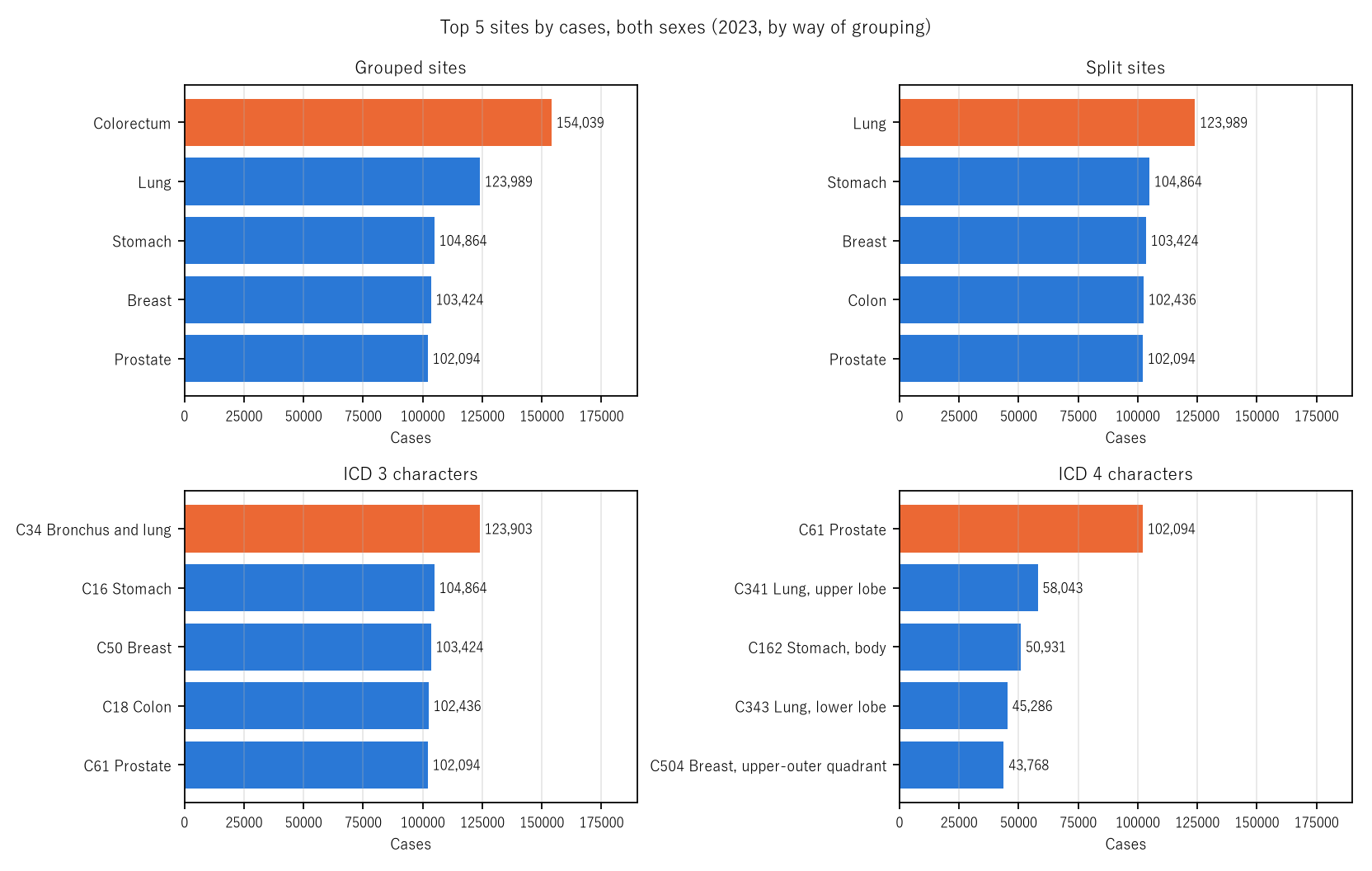
Figure 1: Top 5 sites by cases for both sexes (2023). From top left: grouped sites, split sites, ICD three characters, ICD four characters. Orange marks the top site.
5. Core — including carcinoma in situ
Calculation 5.1 Cases added by including carcinoma in situ (Table 1-B − Table 1-A, 2023)
| Site | Added, both sexes | Table 1-A → Table 1-B | Ratio | Men | Women |
|---|---|---|---|---|---|
| Esophagus | +2,639 | 25,889 → 28,528 | 1.102 | +1,999 | +640 |
| Colorectum | +43,027 | 154,039 → 197,066 | 1.279 | +27,167 | +15,859 |
| Colon | +31,285 | 102,436 → 133,721 | 1.305 | +19,549 | +11,736 |
| Rectum | +11,742 | 51,603 → 63,345 | 1.228 | +7,618 | +4,123 |
| Lung | +3,204 | 123,989 → 127,193 | 1.026 | +1,283 | +1,921 |
| Skin | +7,087 | 27,353 → 34,440 | 1.259 | +3,055 | +4,032 |
| Breast | +13,195 | 103,424 → 116,619 | 1.128 | +67 | +13,128 |
| Uterus | +23,128 | 30,738 → 53,866 | 1.752 | +0 | +23,127 |
| Cervix uteri | +23,128 | 10,457 → 33,585 | 3.212 | +0 | +23,127 |
| Bladder | +21,538 | 23,970 → 45,508 | 1.899 | +17,477 | +4,061 |
The in situ cases that Table 1-B adds to sites total 113,818 for both sexes, 51,048 for men, and 62,768 for women. The rest of the in situ totals (121,173, 55,706, 65,466) — 7,355, 4,658, and 2,698 — are not assigned to sites by Table 1-B.
Observation 5.2: Including carcinoma in situ, men's colorectum goes from 85,208 to 112,375, passing prostate (102,094) to become top. For both sexes with split sites, colon goes from 102,436 to 133,721, passing lung (123,989 → 127,193) to become top. The number added differs greatly by site, from 3,204 for lung (1.026 times) to 31,285 for colon (1.305 times), and cervix uteri becomes 3.212 times.
Observation 5.3: Even if all in situ cases not assigned to sites by Table 1-B are added to a site other than the top one, the top site does not change for any sex or either way of grouping (for men with grouped sites the largest after adding is 106,752, short of colorectum's 112,375).
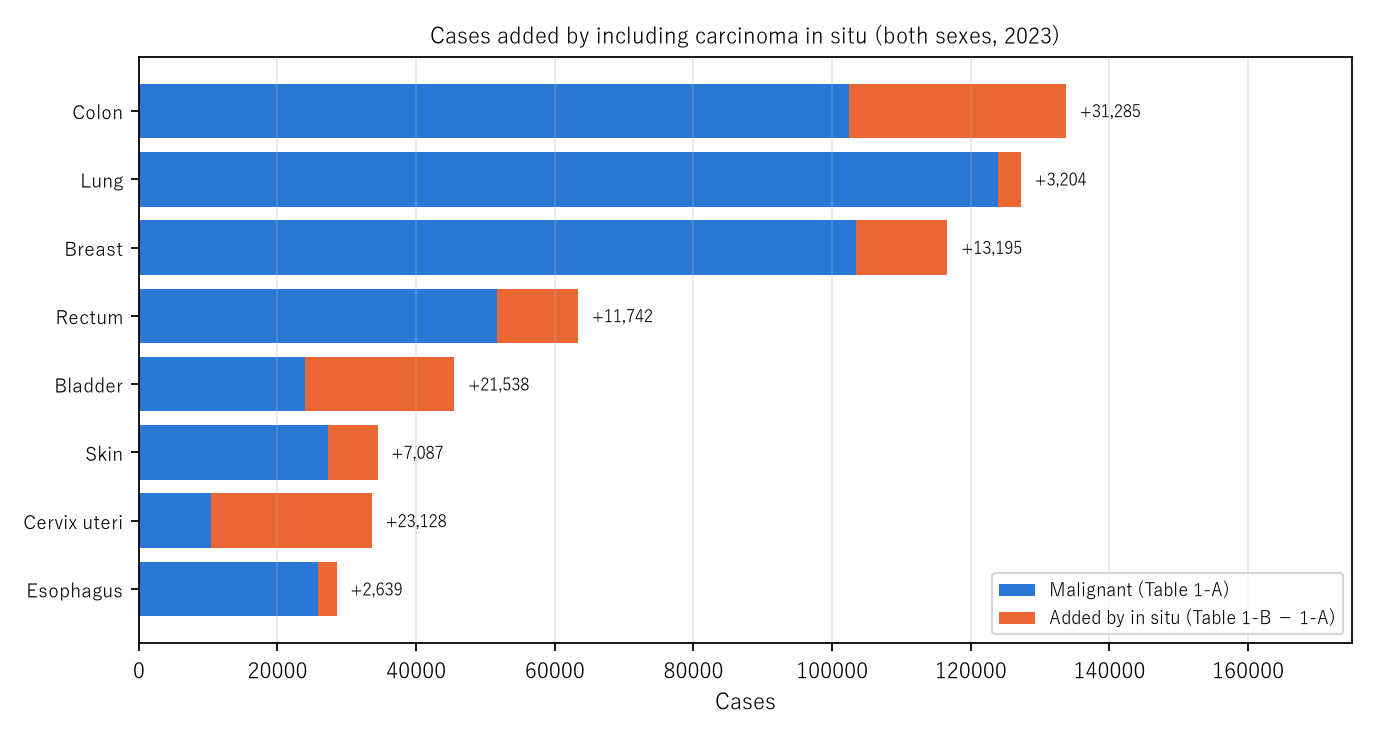
Figure 2: Cases added by including carcinoma in situ (both sexes, 2023). Blue: malignant (Table 1-A); orange: added by in situ (Table 1-B − Table 1-A).
6. It changes for deaths too
Calculation 6.1 Top 4 sites by deaths (Vital Statistics Table 5.24, 2023)
| Way of grouping, sex | Top 4 sites (deaths) |
|---|---|
| Grouped, both sexes | Trachea, bronchus, and lung 75,762; Colorectum 53,131; Pancreas 40,175; Stomach 38,771 |
| Grouped, men | Trachea, bronchus, and lung 52,908; Colorectum 27,936; Stomach 25,325; Pancreas 19,859 |
| Grouped, women | Colorectum 25,195; Trachea, bronchus, and lung 22,854; Pancreas 20,316; Breast 15,629 |
| Split, both sexes | Trachea, bronchus, and lung 75,762; Pancreas 40,175; Stomach 38,771; Colon 37,394 |
| Split, men | Trachea, bronchus, and lung 52,908; Stomach 25,325; Pancreas 19,859; Colon 18,146 |
| Split, women | Trachea, bronchus, and lung 22,854; Pancreas 20,316; Colon 19,248; Breast 15,629 |
Observation 6.2: Women's top site by deaths is colorectum when grouped (25,195) and lung when colon and rectum are split (22,854). When split, second is pancreas (20,316) and third is colon (19,248). Grouped colorectum is 1.102 times lung. For men and both sexes, lung is top either way.
7. Limitations
- It does not decide which way of grouping is right. Grouping is chosen by what one wants to know.
- It does not discuss whether carcinoma in situ should be included. Table 1-B adds in situ for only 10 sites.
- It does not read the weight of a site from the ranking. Being common is different from being hard to treat or likely to cause death.
- The site classification for deaths (simple classification of causes of death) is not the same as the sites in the incidence tables.
- It is not one person's likelihood. It does not compare regions.
Conclusion
From the same 2023 cases, "the most common cancer" for both sexes was colorectum when grouped, lung when colon and rectum were split, prostate at ICD four characters, and colon when split with carcinoma in situ included. For men too, including in situ with grouped sites changed the top site from prostate to colorectum, and women's top site by deaths was colorectum when grouped and lung when split. The only top site that did not change in any way was breast, women's top site by cases.
One thing separates them — how sites are grouped and what is included.
When hearing that "the most common cancer is X," check together how sites were grouped and whether carcinoma in situ was included.
Data and reproduction
| Data | National Cancer Registry 2023, Tables 1-A, 1-B, a1, and a6; Vital Statistics 2024, Volume 1, Table 5.24 (2023 column) (e-Stat, retrieved 25–26 September 2026) |
| Terms of use | e-Stat follows the Public Data License (Version 2.0). This paper's ranks, ratios, and differences were produced by processing these and are not figures produced by the government |
| Scope | Japan, 2023 |
| Verification | 検算/M031.py (--zu also writes the figures). Every number in the text is taken from 検算/M031_output.txt |
| Raw data | The 5 retrieved files and SOURCES.md (URLs, retrieval dates, SHA-256, terms of use, definitions and calculation) in data/ |
| Figures | 図/M031_zu1, 図/M031_zu2 (png, svg, English versions) |
References
- Ministry of Health, Labour and Welfare. National Cancer Registry: Cancer Incidence 2023, Tables 1-A, 1-B, a1, and a6 (in Japanese). e-Stat (accessed 26 September 2026). https://www.e-stat.go.jp/
- Ministry of Health, Labour and Welfare. Vital Statistics 2024 (final data), Volume 1, Table 5.24 (in Japanese). e-Stat (accessed 26 September 2026). https://www.e-stat.go.jp/
- Yamagishi, Y. (2026). Cancer Deaths Rose While the Age-Adjusted Rate Fell — the Push from the Age Composition Ranges from 1.433 Times for Breast to 2.918 Times for Prostate [M024]. Zenodo. https://doi.org/10.5281/zenodo.22968432
Reference
Yamagishi, Y. (2026). Which Cancer Is "Most Common" Changes with How Sites Are Grouped [M031]. Zenodo.
DOI: 10.5281/zenodo.22972431
YOI: https://www.yamagishiyuuki.com/yoi/M031
ORCID: 0009-0006-8587-3450
PDF (English) · PDF (Japanese) · Date proof of the English PDF (OpenTimestamps .ots) · SHA256SUMS
The record page for this paper (in Japanese, with the PDFs in each language and the date proof): YOI M031. This paper is a preprint and has not been peer reviewed.