Abstract
This paper asks how far the rise of heart failure among heart disease deaths, and the rise of its share, can be explained by the age composition (population aging). Using national values from the Vital Statistics special report tables of age-standardized death rates by prefecture (six editions, 1995–2020), it sets side by side crude and age-standardized death rates for heart disease, acute myocardial infarction, arrhythmia and conduction disorders, and heart failure, and computes heart failure's share in three ways. It claims no new mathematical theorem and no new law.
First, the special report's national age-standardized death rates agree with Vital Statistics Table 5.28 in all 48 cells (6 years × 4 causes × 2 sexes) (Section 3).
Second, from 1995 to 2020, men's crude death rate from heart failure rose from 27.3 to 56.5, 2.070-fold, but its age-standardized death rate fell from 81.8 to 69, 0.844 times. For women, the crude rate rose 2.571-fold and the age-standardized rate fell to 0.798 times. Heart failure deaths rose because of the push from the age composition (2.454 for men, 3.223 for women) (Section 4).
Third, this is the core of the paper. Heart failure's share of heart disease rose even when aligned by age-standardized rates. For men, the share of deaths went from 0.239 to 0.341, and the age-aligned share from 0.265 to 0.363; the rises, +0.103 and +0.098 (0.951), are almost the same. The rise in the share is hardly explained by the age composition (Section 5).
Fourth, the share rose because acute myocardial infarction's age-standardized death rate fell to 0.279 times (0.204 for women), much faster than heart failure's (0.844 times). The ratio of the age-aligned share, 1.368, equals heart failure's ratio 0.844 ÷ heart disease's ratio 0.616 (Section 6).
Fifth, within the age groups 80–84 and 90–94, heart failure's share also rose for both sexes (for men aged 90–94, from 0.329 to 0.487). At ages 60–64 it hardly moved, from 0.192 to 0.180 for men (Section 5).
Sixth, what separates them is a question about numbers, or a question about shares. "Heart failure deaths rose" is explained by the age composition; "heart failure's share rose" is not. The same "heart failure increased" points to two separate questions.
Scope note: This paper claims no new mathematical theorem and no new law — crude and age-standardized death rates are published in the Vital Statistics special report; the paper only compares them and takes ratios. This paper is a structural interpretation of the shape of numbers in published aggregate data, and is not medical advice, diagnosis, or a treatment recommendation. The author is not a physician. For decisions about individual health, consult a physician or medical institution. It is a preprint that has not been peer reviewed. It does not go into why acute myocardial infarction death rates fell fast (treatment, prevention, diagnosis, and so on). How heart failure deaths are written changed in 1995 (M035) — this paper compares from 1995, after the change. It does not separate the possibility that writing practice kept changing after that. Aortic aneurysm and dissection are not covered — there is no age-specific table for them in this series. Prefecture rows are not used, and regions are not compared. It is not one person's likelihood. About the data: the Vital Statistics special report and Vital Statistics on e-Stat are used under the Public Data License (Version 2.0); this paper's ratios, shares, and pushes were produced by processing them. What the paper adds: checking separately with age-standardized rates the rise in the "number" and the "share" of heart failure, and showing that the former is explained by the age composition and the latter is not, and separating, through an identity, that the rise in the share comes from the fast fall of acute myocardial infarction.
1. Notation and question
- Crude death rate: the "total" column of age-specific death rates in each table (per 100,000). Age-standardized death rate: the age-standardized death rate in each table (2015 model population).
- Push from the age composition: the ratio of crude death rates ÷ the ratio of age-standardized death rates (the same idea as M024).
- Heart failure's share: (1) the ratio of crude rates (heart failure ÷ heart disease) = the share of deaths; (2) the ratio of age-standardized rates (the share with the age composition aligned to the 2015 model population); (3) the ratio within an age group.
- Six years: 1995, 2000, …, 2020.
Question: how far can the rise in heart failure deaths, and the rise in heart failure's share of heart disease, each be explained by the age composition?
Observation 1.1: M024 split the rise in cancer deaths and the fall in age-standardized rates by the push from the age composition. M035 showed that the 1994–1995 step in heart disease deaths was a fall in heart failure. This paper separates the number and the share of heart failure over the 25 years after that step.
2. Survey and design
Stated honestly: the design was set after seeing the tables.
| Content | |
|---|---|
| Death rates | Vital Statistics special report, age-standardized death rates by prefecture (2015 model population), Table 22 (heart disease), Table 25 (acute myocardial infarction), Table 26 (arrhythmia and conduction disorders), Table 27 (heart failure); "national" rows of six editions, 1995–2020 |
| Check | Vital Statistics 2024, Volume 1, Table 5.28 age-standardized death rates |
| Yardsticks | Ratios of crude and age-standardized death rates, push from the age composition, heart failure's share (three ways) |
| Expectation and what was measured | Before the survey the expectation was that the rise in heart failure's share was also due to the age composition. Aligned by age, the share rose by almost the same amount, and the expectation failed. The inventory planned to cover aortic aneurysm and dissection too, but this series has no age-specific table for them, so they were not covered |
3. Data and checks
Calculation 3.1 The 25 retrieved files were fixed by SHA-256, and the following was checked.
- The titles of the 24 tables (6 years × 4 causes) match the causes read.
- The special report's national age-standardized death rate = the age-standardized death rate in Table 5.28 (48 cells).
- In every age group from 40, acute myocardial infarction + arrhythmia and conduction disorders + heart failure ≤ heart disease (up to rounding of 0.15).
4. Heart failure deaths rose because of the age composition
Calculation 4.1 Crude and age-standardized death rates, 1995 to 2020 (per 100,000)
| Cause, sex | Crude rate 1995 → 2020 | Ratio | Age-standardized rate 1995 → 2020 | Ratio | Push from the age composition |
|---|---|---|---|---|---|
| Heart disease, men | 114.4 → 165.5 | 1.447× | 308.4 → 190.1 | 0.616× | 2.347 |
| Heart disease, women | 109.6 → 167.7 | 1.530× | 206.9 → 109.2 | 0.528× | 2.899 |
| Acute myocardial infarction, men | 46.6 → 29.9 | 0.642× | 116.4 → 32.5 | 0.279× | 2.298 |
| Acute myocardial infarction, women | 38.1 → 19.9 | 0.522× | 68.6 → 14 | 0.204× | 2.559 |
| Arrhythmia and conduction disorders, men | 10.6 → 25.9 | 2.443× | 29.4 → 29.5 | 1.003× | 2.435 |
| Arrhythmia and conduction disorders, women | 10.1 → 24.4 | 2.416× | 19.1 → 16.1 | 0.843× | 2.866 |
| Heart failure, men | 27.3 → 56.5 | 2.070× | 81.8 → 69 | 0.844× | 2.454 |
| Heart failure, women | 30.8 → 79.2 | 2.571× | 61.3 → 48.9 | 0.798× | 3.223 |
Observation 4.2: Heart failure's crude death rate rose for both sexes (2.070-fold for men, 2.571-fold for women), while its age-standardized rate fell (0.844 and 0.798 times). Heart failure deaths rose because of the push from the age composition (2.454 for men, 3.223 for women). Arrhythmia and conduction disorders take the same shape: men's age-standardized rate hardly moved (1.003 times) while the crude rate rose 2.443-fold.
Observation 4.3: For acute myocardial infarction, both crude and age-standardized death rates fell. Men's age-standardized rate fell from 116.4 to 32.5, 0.279 times, and women's to 0.204 times, falling by more than the push from the age composition (2.298 for men).
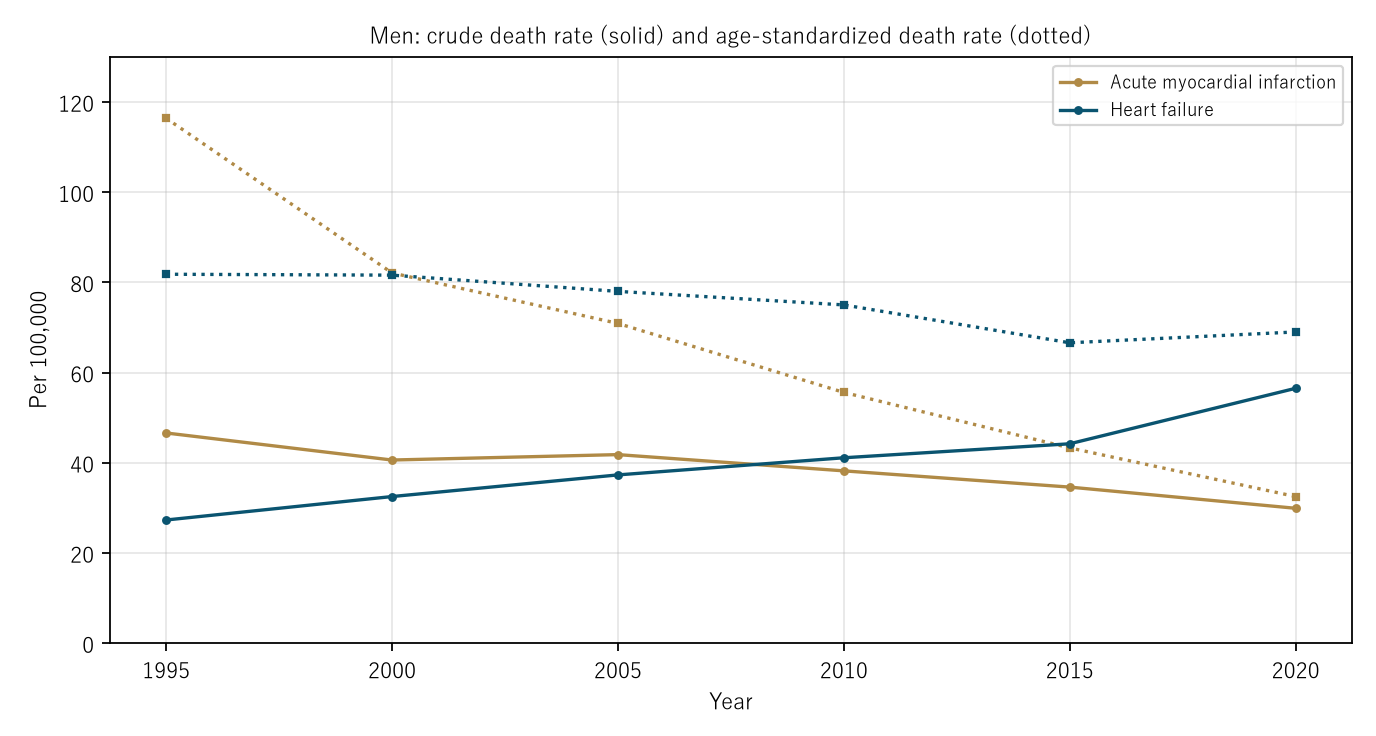
Figure 1: Men's crude death rates (solid) and age-standardized death rates (dotted). Gold: acute myocardial infarction; navy: heart failure. Heart failure's solid line rises and its dotted line falls. Both lines fall for acute myocardial infarction.
5. Core — heart failure's share rose even with ages aligned
Calculation 5.1 Heart failure's share of heart disease (three ways)
| Sex, year | Ratio of crude rates | Ratio of age-standardized rates | Within 60–64 | Within 70–74 | Within 80–84 | Within 90–94 |
|---|---|---|---|---|---|---|
| Men, 1995 | 0.239 | 0.265 | 0.192 | 0.204 | 0.250 | 0.329 |
| Men, 2000 | 0.277 | 0.316 | 0.213 | 0.228 | 0.299 | 0.409 |
| Men, 2005 | 0.274 | 0.313 | 0.191 | 0.219 | 0.295 | 0.412 |
| Men, 2010 | 0.285 | 0.328 | 0.171 | 0.213 | 0.304 | 0.449 |
| Men, 2015 | 0.293 | 0.327 | 0.154 | 0.212 | 0.306 | 0.445 |
| Men, 2020 | 0.341 | 0.363 | 0.180 | 0.235 | 0.341 | 0.487 |
| Women, 1995 | 0.281 | 0.296 | 0.237 | 0.230 | 0.267 | 0.349 |
| Women, 2000 | 0.355 | 0.368 | 0.255 | 0.257 | 0.327 | 0.443 |
| Women, 2005 | 0.375 | 0.378 | 0.245 | 0.254 | 0.328 | 0.459 |
| Women, 2010 | 0.413 | 0.408 | 0.232 | 0.262 | 0.340 | 0.495 |
| Women, 2015 | 0.432 | 0.418 | 0.245 | 0.267 | 0.347 | 0.506 |
| Women, 2020 | 0.472 | 0.448 | 0.243 | 0.269 | 0.381 | 0.532 |
Observation 5.2: For men, the share of deaths (ratio of crude rates) rose from 0.239 to 0.341, by +0.103, and the age-aligned share from 0.265 to 0.363, by +0.098. The ratio of the rises is 0.951, so almost none of the rise in the share is explained by the age composition. For women, +0.191 and +0.152 (0.792): the age-composition part is somewhat larger, but the age-aligned share also clearly rose.
Observation 5.3: Within the age groups 80–84 and 90–94, heart failure's share rose for both sexes (for men aged 90–94, from 0.329 to 0.487). At 60–64 it hardly moved: from 0.192 to 0.180 for men and from 0.237 to 0.243 for women. The rise in the share takes place within the older age groups.
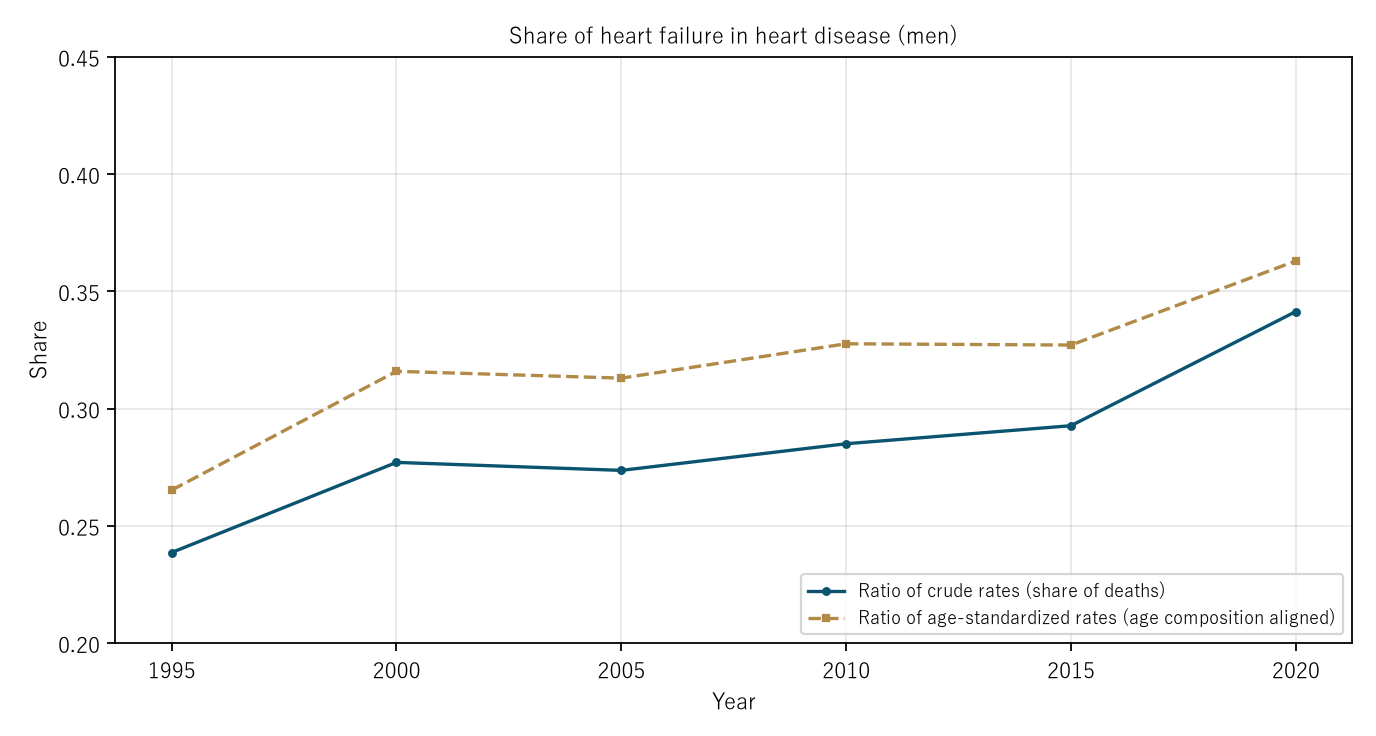
Figure 2: Heart failure's share of heart disease (men). Navy: ratio of crude rates (share of deaths); gold: ratio of age-standardized rates (age composition aligned). The two rise almost in parallel.
6. The rise in the share comes from the fast fall of acute myocardial infarction
Calculation 6.1 Splitting the ratio of the age-aligned share (1995 to 2020)
| Sex | Ratio of the aligned share | Heart failure's ratio | Heart disease's ratio | Acute myocardial infarction's ratio |
|---|---|---|---|---|
| Men | 1.368 | 0.844 | 0.616 | 0.279 |
| Women | 1.511 | 0.798 | 0.528 | 0.204 |
Observation 6.2: The ratio of the age-aligned share equals the ratio of heart failure's age-standardized rate ÷ the ratio of heart disease's age-standardized rate (for men, 1.368 = 0.844 ÷ 0.616). Heart failure's rate fell, but the rate of heart disease as a whole fell more. What pulled heart disease down was the fast fall of acute myocardial infarction, to 0.279 times (0.204 for women). In terms of age-aligned rates, heart failure's share rose not because heart failure increased but because the others fell faster.
7. Limitations
- It does not go into why acute myocardial infarction death rates fell fast.
- Practices for writing causes of death can keep changing after the 1995 change (M035). This paper does not separate such changes from changes in disease.
- Aortic aneurysm and dissection are not covered.
- Age-standardized rates use the 2015 model population; another standard population would give different values.
- Prefecture rows are not used, and regions are not compared. It is not one person's likelihood.
Conclusion
From 1995 to 2020, men's crude death rate from heart failure rose 2.070-fold, but its age-standardized rate fell to 0.844 times. Heart failure deaths rose because of the age composition. On the other hand, heart failure's share of heart disease rose from 0.265 to 0.363 even with ages aligned, and that rise came from acute myocardial infarction's age-standardized death rate falling fast, to 0.279 times.
One thing separates them — a question about numbers, or a question about shares.
When hearing that "heart failure is increasing," check together whether it is about the number of deaths or the share within heart disease, and what happens when ages are aligned.
Data and reproduction
| Data | Vital Statistics special report, age-standardized death rates by prefecture (2015 model population), Tables 22, 25, 26, and 27 (six editions, 1995–2020), and Vital Statistics 2024 (final data), Volume 1, Table 5.28 (e-Stat, retrieved 26 September 2026) |
| Terms of use | e-Stat follows the Public Data License (Version 2.0). This paper's ratios, shares, and pushes were produced by processing these and are not figures produced by the government |
| Scope | Japan (national), 1995–2020 (every 5 years) |
| Verification | 検算/M038.py (--zu also writes the figures). Every number in the text is taken from 検算/M038_output.txt |
| Raw data | The 25 retrieved files and SOURCES.md (URLs, retrieval dates, SHA-256, terms of use, definitions and calculation) in data/ |
| Figures | 図/M038_zu1, 図/M038_zu2 (png, svg, English versions) |
References
- Ministry of Health, Labour and Welfare. Vital Statistics special report: Age-standardized death rates by prefecture (2015 model population), 1995–2020, Tables 22, 25, 26, and 27 (in Japanese). e-Stat (accessed 26 September 2026). https://www.e-stat.go.jp/
- Ministry of Health, Labour and Welfare. Vital Statistics 2024 (final data), Volume 1, Table 5.28 (in Japanese). e-Stat (accessed 26 September 2026). https://www.e-stat.go.jp/
- Yamagishi, Y. (2026). Cancer Deaths Rose While the Age-Adjusted Rate Fell — the Push from the Age Composition Ranges from 1.433 Times for Breast to 2.918 Times for Prostate [M024]. Zenodo. https://doi.org/10.5281/zenodo.22968432
- Yamagishi, Y. (2026). Heart Disease Deaths Fell by More Than a Tenth in Each of Two Years, 1994 and 1995 — The Years of an Instruction on the Death Certificate; Only Heart Failure Fell (0.377-Fold from 1990 to 1995), While Acute Myocardial Infarction Rose 1.645-Fold [M035]. Zenodo. https://doi.org/10.5281/zenodo.22973433
Reference
Yamagishi, Y. (2026). Heart Failure Deaths Rose Because of the Age Composition, While Its Share of Heart Disease Rose Because Acute Myocardial Infarction Fell Faster [M038]. Zenodo.
DOI: 10.5281/zenodo.22974029
YOI: https://www.yamagishiyuuki.com/yoi/M038
ORCID: 0009-0006-8587-3450
PDF (English) · PDF (Japanese) · Date proof of the English PDF (OpenTimestamps .ots) · SHA256SUMS
The record page for this paper (in Japanese, with the PDFs in each language and the date proof): YOI M038. This paper is a preprint and has not been peer reviewed.