Abstract
Using the Ministry of Health, Labour and Welfare's Statistics of Medical Care Activities in Public Health Insurance (claims reviewed in August 2025), Pharmacy Table 8 — drug points split by middle drug class and age group — and the population on 1 July 2025, this paper looked at "which age each kind of drug belongs to." No new mathematical theorem and no new law are claimed.
First, the tables are consistent. For every middle class, the 19 age groups and general plus late-elderly care sum to the total within rounding (5 points), and the 19 population groups sum to the total (Section 3).
Second, this is the core of the paper. Dividing the 14 middle classes with 400 million points or more (0.802 of the total) by population, the per-person peak is at 75 or older for 12 classes, and only dermatological drugs (0–4) and allergy drugs (10–14) peak below age 20. No middle class peaks per person at 20–74. The peak ÷ 20–24 ranges from 96.6 for urogenital and anal drugs to 3.0 for dermatological and allergy drugs (Section 4).
Third, in totals without dividing by population, 10 of the 14 middle classes peak at 75–79. The peak age differs between per person and total for 10 classes. Hormones peak per person at 75–79, but their total peaks at 50–54 — 50–54 is the most populous five-year group (9,794 thousand), and hormones per person are nearly the same at 50–54 (31.3 points) and 75–79 (35.3 points). Dermatological drugs peak per person at 0–4 and in total at 75–79 (Section 5).
Fourth, the points-weighted mean age ranges from 42.5 years for allergy drugs to 76.1 years for urogenital and anal drugs. The largest gap between neighbors is 9.2 years, between allergy and dermatological drugs; the others are 3.8 years or less, so from dermatological drugs on they line up in one run (Section 4).
Fifth, total points per person (one month) are 127.8 at 20–24 against 804.1 at 90+ (Section 3).
Sixth, what separates them is whether one divides by population (per person) or not (total). "What age is this drug for" makes most drugs into drugs of people in their 80s per person, into drugs of people aged 75–79 in total, and for some, like hormones, the total peak moves to the most populous ages.
Scope note: This paper claims no new mathematical theorem and no new law — drug points and population are in public tables, and this paper only divided them by population by age and lined up peak ages and mean ages. This paper is a structural interpretation of the shape of numbers in public aggregate data; it is not medical advice, not a diagnosis, and not a treatment recommendation. The author is not a physician. Decisions about individual health should be discussed with a physician or a medical institution. This is a preprint that has not been peer reviewed. It does not judge whether drug prices are high or low, good or bad, nor drug efficacy or safety, nor prescribing. No product or manufacturer names are used; the unit of aggregation is the middle drug class. The middle classes of central nervous system drugs, drugs against pathogens (antibiotics, chemotherapeutics, biological products, and so on), and narcotics are not shown. Points are the drug points on pharmacy statements; drugs given inside medical institutions are not included. It is a cross-section of one month (claims reviewed in August 2025); seasonal and yearly movement is not examined. These are points, not people. Prefectures and pharmacies are not compared. About the data: the Statistics of Medical Care Activities in Public Health Insurance (Ministry of Health, Labour and Welfare) and the Population Estimates (Statistics Bureau) were taken from e-Stat and used under the Government of Japan Standard Terms of Use (Version 2.0); the ratios and mean ages in this paper were processed from them. What this paper adds: lining up the same drug points by age with two yardsticks, per person and total, and showing that per-person peaks gather almost entirely at 75 or older, total peaks gather at 75–79, and for hormones and dermatological drugs the two peak ages lie far apart, and showing that the points-weighted mean age runs continuously across kinds of drugs.
1. Notation and question
- Drug points: the drug points on pharmacy statements (1 point = 10 yen), for one month (claims reviewed in August 2025).
- Per person: an age group's drug points ÷ its population on 1 July 2025 (one month, points). Per-person peak: the age group with the largest value per person.
- Total peak: the age group with the largest points themselves.
- Points-weighted mean age: the average of age-group midpoints (92.5 for 90+) weighted by points.
Question: Does each kind of drug belong to "the young, the middle-aged, or the old"? Does the answer change with whether one divides by population?
Observation 1.1: M075 measured the years it takes per-capita national medical expenditure to double with age. M078 looked at how the number of drug types on one statement spreads with age. This paper compares the age shape across kinds of drugs.
2. Preview and design
Honestly stated: the design was decided after looking at the tables.
| Content | |
|---|---|
| Tables | Statistics of Medical Care Activities in Public Health Insurance, 2025, drug use: Pharmacy Table 8 (claims reviewed in August 2025); Population Estimates, population on the 1st of each month, Table 1 (as of 1 July 2025, final) |
| Noticed in the preview | The stock planned NDB Open Data prescription drugs, but the file already aggregated by drug class covered only some classes, and the full table was by product, mixing units (tablets, grams, milliliters) that cannot be summed. Table 8 aggregated points by middle drug class |
| Comparison | For the 14 middle classes with 400 million points or more: per-person peak, total peak, and points-weighted mean age. The population date was matched to the first day of the care month (July) behind the review month |
3. Data and checks
Calculation 3.1 The 2 retrieved files were fixed by SHA-256, and the following were checked.
- Table 8's total row and the 14 shown middle classes: the 19 age groups sum to the total, and general + late-elderly care = total. It first failed because I set the rounding width to 1 point — every row deviates within ±4 points, so it was checked with a width of 5 points. The total is 51,033,135,130 points.
- The 14 shown middle classes sum to 40,951,543,468 points (0.802 of the total). The middle classes with 400 million points or more that are not shown are four: central nervous system drugs, antibiotics, chemotherapeutics, and biological products.
- Population Estimates: the table has three categories — total population, Japanese population, and foreign population. I first read it without restricting the category and overwrote the total population with the foreign-population rows (noticed when the total came out as 3,748 thousand). Reading only the total population, it was 123,367 thousand on 1 July 2025, and the 19 groups differ from the total by 1 thousand.
- Total points per person (one month): 127.8 at 20–24 and 804.1 at 90+.
4. The core — per-person peaks lie almost entirely at 75 or older
Calculation 4.1 Age profiles of the 14 middle classes (in order of points-weighted mean age)
| Middle class | Share of total | Per-person peak | Peak ÷ 20–24 | Total peak | Mean age |
|---|---|---|---|---|---|
| Allergy | 0.043 | 10–14 | 3.0 | 10–14 | 42.5 |
| Dermatological | 0.031 | 0–4 | 3.0 | 75–79 | 51.7 |
| Hormones | 0.061 | 75–79 | 3.5 | 50–54 | 55.4 |
| Respiratory | 0.035 | 80–84 | 5.7 | 75–79 | 57.8 |
| Kampo preparations | 0.032 | 85–89 | 5.4 | 75–79 | 61.5 |
| Other metabolic | 0.185 | 75–79 | 9.5 | 75–79 | 63.9 |
| Sensory organ | 0.022 | 80–84 | 15.0 | 75–79 | 65.0 |
| Antineoplastic | 0.112 | 75–79 | 38.4 | 75–79 | 68.6 |
| Digestive | 0.067 | 90+ | 17.1 | 75–79 | 68.8 |
| Vitamins | 0.008 | 85–89 | 14.7 | 75–79 | 70.2 |
| Cardiovascular | 0.116 | 85–89 | 32.6 | 75–79 | 70.6 |
| Nutrients and tonics | 0.012 | 90+ | 27.8 | 90+ | 71.1 |
| Blood and body fluid | 0.062 | 85–89 | 44.2 | 75–79 | 72.4 |
| Urogenital and anal | 0.018 | 85–89 | 96.6 | 80–84 | 76.1 |
Observation 4.2: The per-person peak is at 75 or older for 12 of the 14 middle classes; only dermatological drugs (0–4) and allergy drugs (10–14) peak below 20, and no middle class peaks at 20–74. The peak ÷ 20–24 ranges from 96.6 for urogenital and anal drugs, 44.2 for blood and body fluid drugs, and 38.4 for antineoplastics, down to 3.5 for hormones and 3.0 for dermatological and allergy drugs.
Observation 4.3: The points-weighted mean age ranges from 42.5 years for allergy drugs to 76.1 years for urogenital and anal drugs. The largest gap between neighboring mean ages is 9.2 years, between allergy and dermatological drugs; the others are 3.8 years or less. Allergy drugs stand alone, and from dermatological drugs on the classes line up in one run without a clear break.
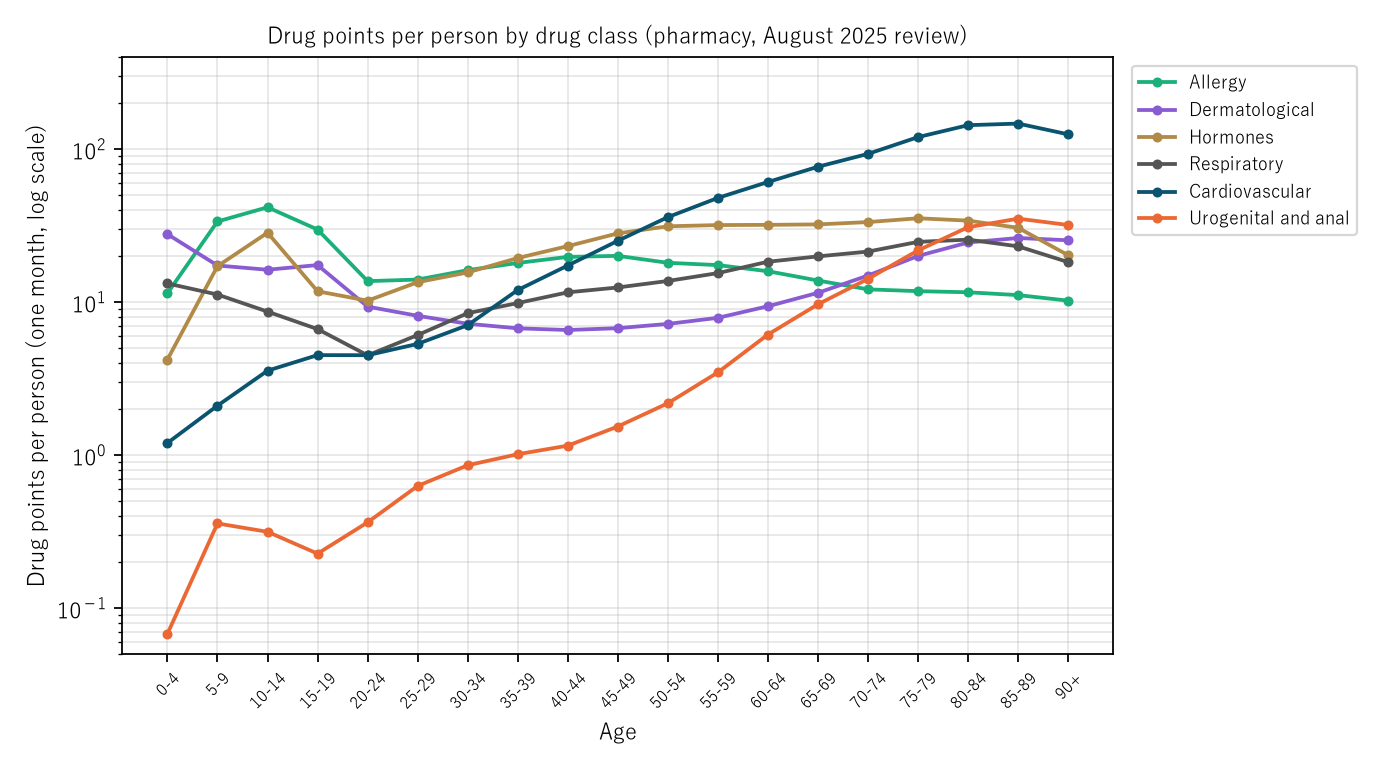
Figure 1: Drug points per person (one month, log scale) for 6 middle classes. Green is allergy drugs, purple dermatological, gold hormones, gray respiratory, navy cardiovascular, and orange urogenital and anal.
5. In totals, the peak age moves
Observation 5.1: In totals without dividing by population, 10 of the 14 middle classes peak at 75–79. The exceptions are allergy drugs (10–14), hormones (50–54), nutrients and tonics (90+), and urogenital and anal drugs (80–84). The per-person and total peak ages differ for 10 middle classes.
Observation 5.2: Hormones peak per person at 75–79 and in total at 50–54. 50–54 is the most populous five-year group (9,794 thousand; 75–79 has 8,240 thousand), and hormones per person are close at 50–54 (31.3 points) and 75–79 (35.3 points). For hormones, per-person values at 50–54 and 75–79 are close, and the total peak falls at the more populous 50–54.
Observation 5.3: Dermatological drugs peak per person at 0–4 (27.8 points) and in total at 75–79 (20.0 points per person at 75–79). The population at 0–4 is 3,828 thousand, so even with the highest per-person value it does not become the total peak.
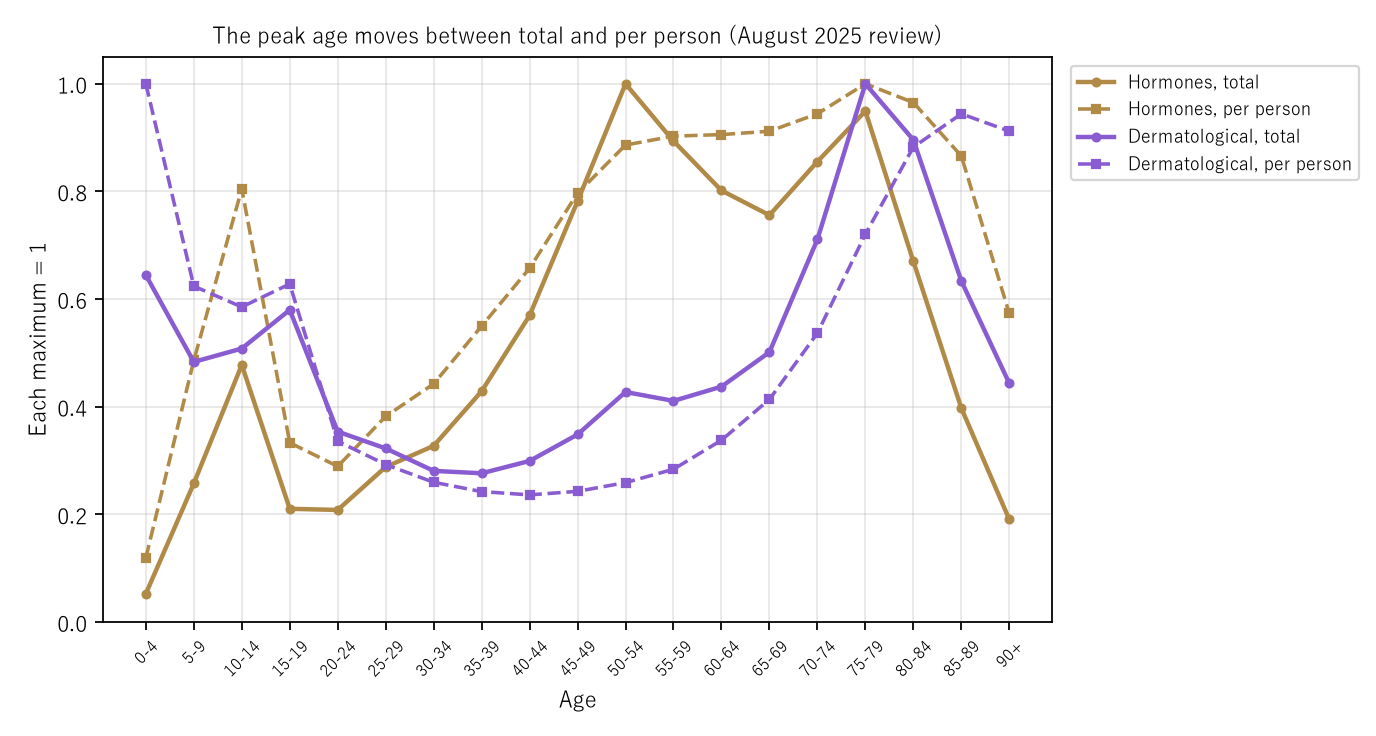
Figure 2: Hormones (gold) and dermatological drugs (purple), total (solid) and per person (dashed), each scaled to its maximum = 1.
6. Limitations
- Points are the drug points on pharmacy statements, neither numbers of people nor numbers of prescriptions. Drugs given inside medical institutions are not included.
- It is a cross-section of one month (claims reviewed in August 2025); seasonal and yearly movement is not examined. Population is as of 1 July 2025, roughly matched to the care month of the review month but not identical.
- Only 14 middle classes are shown, and differences among the small classes within them are not examined. The points-weighted mean age is a rough guide computed from age-group midpoints.
- The paper does not judge drug prices, efficacy, or prescribing. Prefectures and pharmacies are not compared. It is not an outlook for any one person.
Conclusion
Dividing pharmacy drug points by the population on 1 July 2025, 12 of 14 middle drug classes peaked per person at 75 or older, and only dermatological drugs (0–4) and allergy drugs (10–14) peaked in childhood. In totals without dividing by population, 10 middle classes peaked at 75–79, and the peak for hormones moved from 75–79 per person to 50–54 in total. The points-weighted mean age ran from 42.5 to 76.1 years.
One thing separates them — dividing by population or not.
When you hear "which age is this drug for," check together whether it is said per person or in total.
Data and reproduction
| Data | Statistics of Medical Care Activities in Public Health Insurance, 2025, drug use: Pharmacy Table 8 (Ministry of Health, Labour and Welfare, e-Stat); Population Estimates, population on the 1st of each month, Table 1 (as of 1 July 2025, final; Statistics Bureau, e-Stat) (retrieved 26 September 2026) |
| Terms of use | e-Stat follows the Government of Japan Standard Terms of Use (Version 2.0). The ratios and mean ages in this paper were processed from them and are not numbers produced by the government |
| Coverage | Japan, claims reviewed in August 2025, pharmacy dispensing |
| Verification | 検算/M079.py (--zu also draws the figures). Every number in the text is taken from 検算/M079_output.txt |
| Raw data | data/ holds the retrieved files and SOURCES.md (URLs, retrieval date, SHA-256, terms of use, definitions and how the calculations were set up) |
| Figures | 図/M079_zu1, 図/M079_zu2 (png, svg, English versions) |
References
- Ministry of Health, Labour and Welfare. Statistics of Medical Care Activities in Public Health Insurance, 2025, drug use: Pharmacy Table 8 (in Japanese). e-Stat (accessed 26 September 2026). https://www.e-stat.go.jp/
- Statistics Bureau. Population Estimates, population on the 1st of each month, Table 1: population by age (5-year groups) and sex (July 2025, final) (in Japanese). e-Stat (accessed 26 September 2026). https://www.e-stat.go.jp/
- Yamagishi, Y. (2026). Per-Capita National Medical Expenditure Doubles Every 16.52 Years at Ages 40–84, More Than Twice as Long as Death Rates (Men 6.99, Women 7.60 Years) — From FY2000 to FY2023 the Total Rose 1.596-Fold, the Age Composition Alone Would Have Raised It 1.337-Fold, and Per-Capita Growth Was 1.738-Fold at Ages 0–14 Against 1.051-Fold at 70–74 [M075]. Zenodo. https://doi.org/10.5281/zenodo.22978553
- Yamagishi, Y. (2026). Drug Types per Pharmacy Oral-Drug Statement Rise from 2.66 at Ages 20–24 to 5.49 at 90+ (2.064-Fold), but the Share with 10 or More Types Rises from 0.0064 to 0.1339 (20.97-Fold) — 0.628 of Statements with 10 or More Types Are at 75+, and In-Clinic Dispensing Shows the Same Shape, 1.869-Fold in the Mean Against 15.12-Fold for 10 or More [M078]. Zenodo. https://doi.org/10.5281/zenodo.22978769
Reference
Yamagishi, Y. (2026). Dividing Pharmacy Drug Points by Population, 12 of 14 Middle Drug Classes Peak per Person at 75 or Older, and Only Dermatological Drugs (Ages 0–4) and Allergy Drugs (10–14) Peak in Childhood [M079]. Zenodo.
DOI: 10.5281/zenodo.22978821
YOI: https://www.yamagishiyuuki.com/yoi/M079
ORCID: 0009-0006-8587-3450
PDF (English) · PDF (Japanese) · Date proof of the English PDF (OpenTimestamps .ots) · SHA256SUMS
The record page for this paper (in Japanese, with the PDFs in each language and the date proof): YOI M079. This paper is a preprint and has not been peer reviewed.