Abstract
For 1,889 Japanese municipalities, I measured, for each industrial subcategory, the population at which establishments of that subcategory begin to appear.
Ordering municipalities by population and sliding a window of 101 municipalities, I define the 50% threshold population as the population at which the share of municipalities having at least one establishment first exceeds 50%.
Of the 433 subcategories examined, a threshold was obtained for 390. Barbers, beauty salons, confectionery and bakery shops and medical clinics are present in more than half of municipalities even at the smallest population (155).
Motor vehicle repair appears at 970, dental clinics at 1,033, cram schools at 3,107, judicial scriveners at 5,238, and certified tax accountants at 11,775.
In the eight municipalities of the Kushiro Subprefecture, of the subcategories whose threshold their population exceeds, between 64.2% and 89.0% are actually present.
The resulting table of 433 subcategories applies to any municipality and is provided in full as an appendix.
1. Introduction
An earlier report (R001) showed that the number of industrial subcategories present in a municipality is almost fully determined by the common logarithm of population (R² = 0.925).
What remains is which subcategories.
At what population does each trade appear?
Because this concerns order rather than count, each subcategory must be given a single number.
2. Data
| Establishments | Statistics Bureau of Japan and METI, 2021 Economic Census for Business Activity (1 June 2021). 526 subcategories × municipality |
| Population | Ministry of Internal Affairs and Communications, Basic Resident Register population, 1 January 2026 |
Municipalities number 1,889 after excluding aggregate rows (unit A of R001).
Of the 526 subcategories, 93 are "establishments engaged in administrative or ancillary economic activities", and these were excluded.
They denote head-office functions rather than operating shops or plants. This leaves 433 subcategories.
3. Defining the threshold — the naive definition fails
I first defined the threshold as the smallest population T such that, among municipalities with population ≥ T, more than half have the subcategory.
Under that definition every familiar trade collapses onto the smallest population (155). Taken over the whole country, barbers, cram schools and tax accountants are all already present in more than half of municipalities.
The definition was therefore changed so that municipalities are compared with others of similar size.
Order municipalities by population and slide a window of 101 municipalities; within the window, measure the share having at least one establishment of the subcategory.
The 50% threshold population is the population at which that share first exceeds 50%.
A value was obtained for 390 of the 433 subcategories. The remaining 43 never reach half of any window.
4. Results
4-1 A ladder of familiar trades
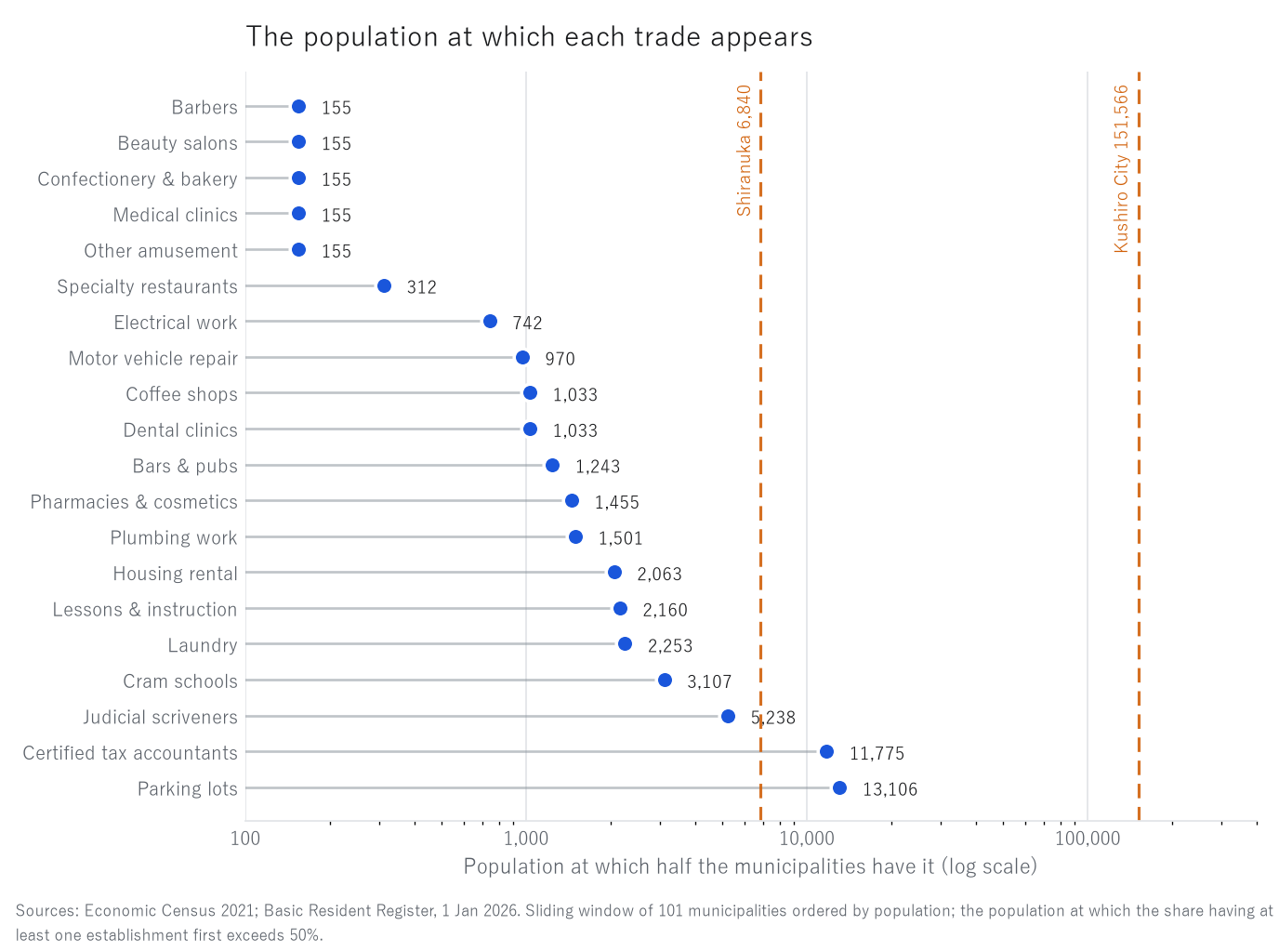
Figure 1. The population at which each trade appears (twenty familiar subcategories).
Dots are the 50% threshold population. The orange dashed lines mark Shiranuka (6,840) and Kushiro City (151,566). The horizontal axis is on a common-logarithmic scale.
| Threshold | Subcategory |
|---|---|
| 155 | Barbers; beauty salons; confectionery and bakery; medical clinics; other amusement |
| 312 | Specialty restaurants |
| 742 | Electrical work |
| 970 | Motor vehicle repair |
| 1,033 | Coffee shops; dental clinics |
| 1,243 | Bars and pubs |
| 1,455 | Pharmacies and cosmetics |
| 1,501 | Plumbing work |
| 2,063 | Housing rental |
| 2,160 | Lessons and instruction |
| 2,253 | Laundry |
| 3,107 | Cram schools |
| 5,238 | Judicial scriveners and land surveyors |
| 11,775 | Certified public accountants and tax accountants |
| 13,106 | Parking lots |
Barbers, beauty salons and medical clinics are present in municipalities of 155 residents.
Tax accountants appear only at 76 times that population.
4-2 Present in small towns / only in large ones
Subcategories crossing 50% at 155 include municipal agencies (present in 1,888 municipalities), post offices (1,887), primary schools (1,883), civil engineering work (1,879), fuel retailing (1,877), other food and beverage retailing (1,876), welfare and care for the elderly (1,865) and lower secondary schools (1,864).
At the other end, manufacturing dominates: boilers and prime movers (652,241), animal and vegetable oils and fats (479,587), industrial transport vehicles (470,718), silk reeling and spinning (441,947).
Administration and everyday necessities reach the smallest towns; the manufacture of materials and components concentrates in large ones.
4-3 Applied to the Kushiro Subprefecture
Of the subcategories whose threshold a municipality's population exceeds, how many are actually present?
| Municipality | Population | Thresholds exceeded | Present | Share |
|---|---|---|---|---|
| Kushiro City | 151,566 | 320 | 273 | 85.3% |
| Kushiro Town | 18,021 | 177 | 142 | 80.2% |
| Akkeshi | 7,976 | 118 | 105 | 89.0% |
| Hamanaka | 5,172 | 96 | 74 | 77.1% |
| Shibecha | 6,698 | 114 | 93 | 81.6% |
| Teshikaga | 6,327 | 112 | 97 | 86.6% |
| Tsurui | 2,368 | 67 | 43 | 64.2% |
| Shiranuka | 6,840 | 115 | 95 | 82.6% |
Shiranuka (6,840), for example, exceeds the threshold for cram schools (3,107), yet no cram school establishment is recorded there.
Subcategories that are absent despite the threshold being exceeded are what to examine next for that municipality.
5. Discussion
5-1 Order, not count
R001 explained the number of subcategories by population. This paper goes inside that number and assigns each subcategory a single population at which it appears.
Together they answer both "how many kinds should there be" and "which ones should there be" for a municipality of a given size.
5-2 A benchmark, not a condition
The 50% threshold population is a position in a cross-section of similarly sized municipalities. It does not mean that a trade is viable at that population.
Road and rail connections, the size of neighbouring municipalities, and industrial history all differ at the same population.
5-3 The definition determines the result
As Section 3 shows, the first definition collapsed every familiar trade onto 155. The population over which "more than half" is measured determined the entire result.
The reference population must be fixed and stated before counting.
6. Limitations
- Establishments are as of 1 June 2021 and population as of 1 January 2026: a five-year gap
- The window width (101 municipalities) trades smoothness against resolution; other widths shift the values somewhat
- "Present" means at least one establishment of that subcategory is recorded. Suppressed and non-responding cells follow the source tables
- Industrial subcategories are an administrative classification and do not map one-to-one onto trades as practised
- The 93 head-office subcategories are excluded
- Nothing is claimed about the 43 subcategories for which no threshold was obtained
7. Reproduction
- Obtain establishments by industrial subcategory and municipality (2021 Economic Census) from e-Stat
- Obtain Basic Resident Register population by municipality as of 1 January 2026
- Exclude aggregate rows and join on the municipality code
- Exclude the head-office subcategories
- Order by population and find, with a sliding window of 101 municipalities, where the share present first exceeds 50%
All values are the output of a single script (kensan_185). No intermediate value was transcribed by hand.
Appendix: table of 433 subcategories
The threshold population, the number of municipalities where present, the median population of municipalities with and without it, and the national establishment count are tabulated for all 433 subcategories (kensan_185_分類ごとの人口の目安.csv).
References and data sources
- Statistics Bureau of Japan and METI, 2021 Economic Census for Business Activity, establishments by industrial subcategory and municipality.
- Ministry of Internal Affairs and Communications, Population Based on the Basic Resident Register, 1 January 2026.
- Y. Yamagishi, "Population and the Number of Industrial Subcategories Present in Japanese Municipalities" (R001). Zenodo. https://doi.org/10.5281/zenodo.22872218
Items 1 and 2 are published on e-Stat and on the ministries' websites.
Version history
| Version | Date | Change |
|---|---|---|
| 1 | 2026-09-21 | First release |
How to cite
Yamagishi, Y. (2026). At What Population Does a Trade Appear? The 50% Threshold Population for 433 Industrial Subcategories [R002]. Zenodo. https://doi.org/10.5281/zenodo.22872356
(This DOI is the concept DOI; it always resolves to the latest version. Cite this one.)
© 2026 Yuuki YAMAGISHI
This work is licensed under a Creative Commons Attribution 4.0 International License (CC BY 4.0).
You may copy, adapt, redistribute and use it commercially, provided you give appropriate credit.
creativecommons.org/licenses/by/4.0
All figures and values in this paper were computed from official statistics. Rights in the underlying data remain with the publishing agencies.
Reference
Yamagishi, Y. (2026). At What Population Does a Trade Appear? The 50% Threshold Population for 433 Industrial Subcategories [R002]. Zenodo.
DOI: 10.5281/zenodo.22872356
YOI: https://www.yamagishiyuuki.com/yoi/R002
ORCID: 0009-0006-8587-3450
PDF (English) · PDF (Japanese) · Date proof of the English PDF (OpenTimestamps .ots) · SHA256SUMS
The record page for this paper (in Japanese, with the PDFs in each language and the date proof): YOI R002. This paper is a preprint and has not been peer reviewed.