Abstract
For 1,889 Japanese municipalities, I counted how many of 433 industrial subcategories have exactly one establishment recorded in the municipality.
That number is almost independent of the size of the municipality. The median is 46 in municipalities under 5,000 residents and 41 in those above 300,000.
The correlation with population is r = +0.056, essentially none.
The share of present subcategories that have only one establishment, by contrast, rises sharply as population falls: a median of 56.8% under 5,000 residents and 11.6% above 300,000, with a correlation of r = −0.937.
By subcategory, those most often reduced to a single establishment are public bodies — public health centres (450 of the 491 municipalities where present, 91.6%), judicial agencies (87.3%), welfare offices (85.3%) — together with converted paper manufacturing (70.3%) and cinemas (67.3%).
Least often: municipal agencies (0.1%), civil engineering work (0.9%), other food and beverage retailing (1.2%), beauty salons (2.3%).
In the Kushiro Subprefecture the share is 59.2% in Tsurui and 15.5% in Kushiro City.
"Only one" means that if that one establishment goes, the subcategory disappears from the municipality. In small municipalities, more than half of the trades present are in that state.
1. Introduction
R001 addressed the number of industrial subcategories present in a municipality; R002 addressed at which population each subcategory appears.
This paper steps from whether a trade is present to how many of it there are.
How many subcategories have only one establishment in the municipality?
If there is only one, then when that one goes, the subcategory leaves the municipality.
2. Data and scope
| Establishments | Statistics Bureau of Japan and METI, 2021 Economic Census for Business Activity (1 June 2021). Establishment counts are used |
| Population | Ministry of Internal Affairs and Communications, Basic Resident Register population, 1 January 2026 |
Municipalities number 1,889 after excluding aggregate rows. Of the 526 subcategories, the 93 head-office subcategories were excluded, leaving 433 (as in R002).
3. Results
3-1 The count is flat; the share is not
| Population band | Municipalities | Subcategories present | With only one | Share |
|---|---|---|---|---|
| under 5,000 | 307 | 83 | 46 | 56.8% |
| 5,000–10,000 | 243 | 131 | 58 | 44.6% |
| 10,000–30,000 | 448 | 182 | 62 | 34.0% |
| 30,000–100,000 | 498 | 250 | 59 | 23.7% |
| 100,000–300,000 | 328 | 304 | 50 | 16.6% |
| 300,000 and over | 65 | 348 | 41 | 11.6% |
All figures are medians.
- Correlation of population with the number of single-establishment subcategories: r = +0.056
- Correlation of population with the share: r = −0.937
Across a more than sixtyfold difference in population, the count barely moves (46 versus 41).
What changes is the denominator — the number of subcategories present (83 versus 348).
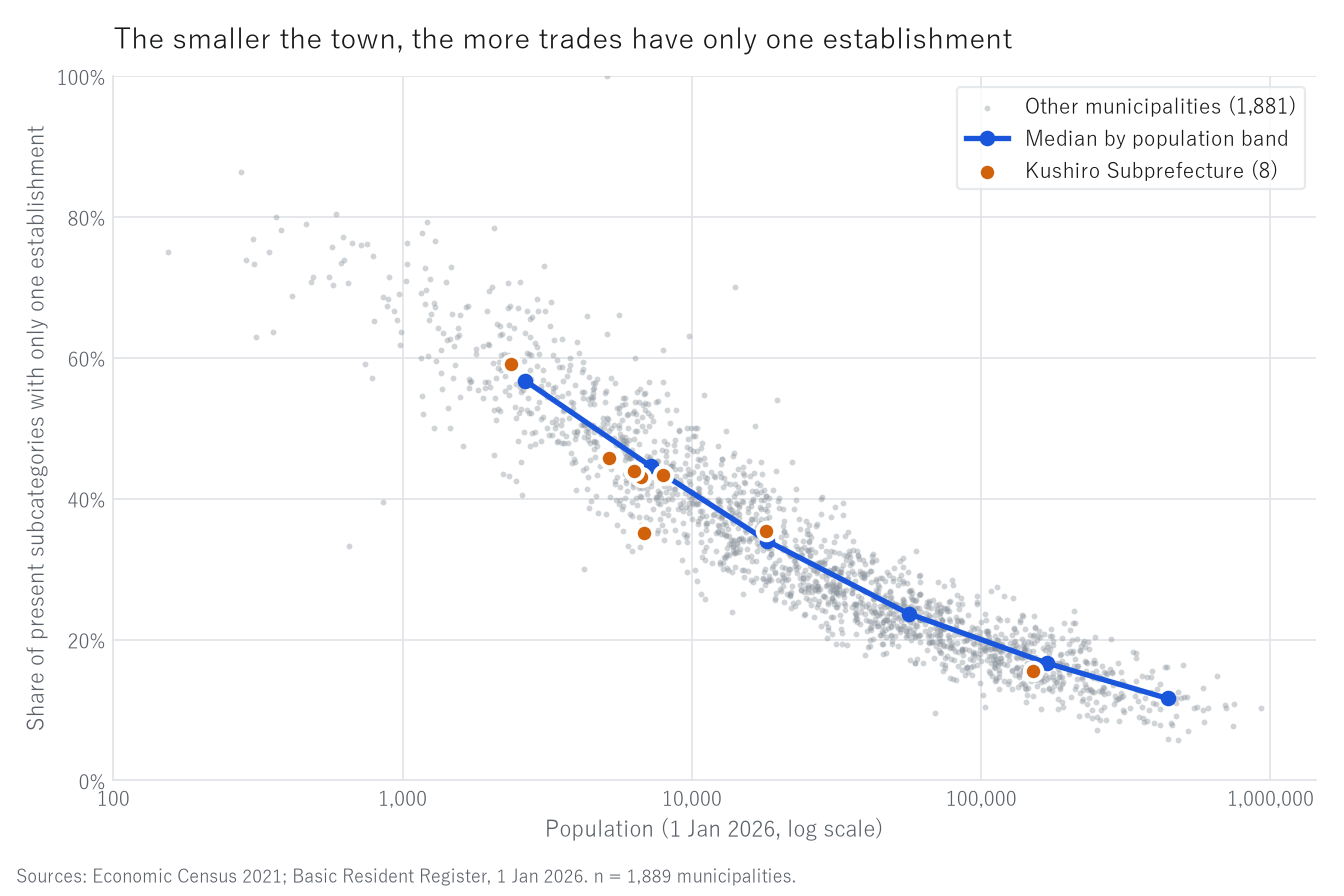
Figure 1. Population and the share of subcategories with a single establishment (1,889 municipalities).
Grey points are the other municipalities, the blue line is the median by population band, and the orange points are the eight municipalities of the Kushiro Subprefecture.
3-2 Which subcategories are reduced to one
Among the 355 subcategories present in at least 300 municipalities, the share of those municipalities where only one establishment exists.
| Share | Subcategory | Present in | Only one |
|---|---|---|---|
| 91.6% | Public health centres | 491 | 450 |
| 87.3% | Judicial agencies | 434 | 379 |
| 85.3% | Welfare offices | 510 | 435 |
| 70.3% | Converted paper manufacturing | 357 | 251 |
| 69.0% | Other rubber products | 390 | 269 |
| 67.7% | Cable broadcasting | 498 | 337 |
| 67.3% | Cinemas | 339 | 228 |
| 66.9% | Inland water aquaculture | 435 | 291 |
| Share | Subcategory | Present in | Only one |
|---|---|---|---|
| 4.7% | Specialty restaurants | 1,821 | 85 |
| 3.0% | Barbers | 1,862 | 55 |
| 2.3% | Beauty salons | 1,857 | 42 |
| 2.3% | Welfare and care for the elderly | 1,865 | 42 |
| 1.2% | Other food and beverage retailing | 1,876 | 22 |
| 0.9% | Civil engineering work | 1,879 | 17 |
| 0.1% | Municipal agencies | 1,888 | 1 |
At the top are things of which one per municipality suffices (health centres, judicial agencies, welfare offices) and things that require large facilities and few of them (converted paper, rubber, cinemas).
At the bottom are things that scale with the number of people (barbers, beauty salons, food, elderly care).
3-3 The Kushiro Subprefecture
| Municipality | Population | Present | Only one | Share |
|---|---|---|---|---|
| Kushiro City | 151,566 | 310 | 48 | 15.5% |
| Kushiro Town | 18,021 | 178 | 63 | 35.4% |
| Akkeshi | 7,976 | 159 | 69 | 43.4% |
| Hamanaka | 5,172 | 105 | 48 | 45.7% |
| Shibecha | 6,698 | 130 | 56 | 43.1% |
| Teshikaga | 6,327 | 139 | 61 | 43.9% |
| Tsurui | 2,368 | 71 | 42 | 59.2% |
| Shiranuka | 6,840 | 131 | 46 | 35.1% |
In Tsurui, 42 of the 71 subcategories present (59.2%) have a single establishment; in Kushiro City, 48 of 310 (15.5%).
The counts, 42 and 48, are nearly the same.
4. Discussion
4-1 The count is constant; the denominator moves
As population grows, new subcategories appear (R002) and existing ones gain further establishments.
The result is that every municipality, of whatever size, carries some 40 to 60 subcategories with a single establishment, while only the share falls.
The abundance of "only one" in small municipalities is not a local peculiarity; it follows from the small denominator.
4-2 When the one goes, the subcategory goes
"Only one" describes a state in which the closure or relocation of a single establishment removes the subcategory from the municipality.
In municipalities under 5,000 residents, more than half of the trades present (median 56.8%) are in that state.
This paper does not call that good or bad. But when considering business succession or the maintenance of local trades,
counting only presence and absence, without looking at how many, hides this state entirely.
4-3 What can and cannot be said
Having only one establishment does not by itself mean that the trade will not continue. Continuation depends on the owner's age, successors and profitability, none of which is examined here.
Nor can cases where suppression or non-response makes a subcategory appear to have one establishment be distinguished.
5. Limitations
- Establishments are as of 1 June 2021 and population as of 1 January 2026: a five-year gap
- "Only one" means exactly one establishment is recorded. Cases arising from suppression or non-response cannot be distinguished here
- Industrial subcategories are an administrative classification and do not map one-to-one onto trades as practised
- The 93 head-office subcategories are excluded
- Section 3-2 is restricted to the 355 subcategories present in at least 300 municipalities; nothing is claimed about the rest
6. Reproduction
- Obtain establishments by industrial subcategory and municipality (2021 Economic Census) from e-Stat
- Obtain Basic Resident Register population by municipality as of 1 January 2026
- Exclude aggregate rows and the head-office subcategories
- For each municipality, count the subcategories with exactly one establishment
- Divide by the number of subcategories with at least one
All values are the output of a single script (kensan_186). No intermediate value was transcribed by hand.
References and data sources
- Statistics Bureau of Japan and METI, 2021 Economic Census for Business Activity.
- Ministry of Internal Affairs and Communications, Population Based on the Basic Resident Register, 1 January 2026.
- Y. Yamagishi, "Population and the Number of Industrial Subcategories Present in Japanese Municipalities" (R001). Zenodo. https://doi.org/10.5281/zenodo.22872218
- Y. Yamagishi, "At What Population Does a Trade Appear?" (R002). Zenodo. https://doi.org/10.5281/zenodo.22872356
Items 1 and 2 are published on e-Stat and on the ministries' websites.
Version history
| Version | Date | Change |
|---|---|---|
| 1 | 2026-09-21 | First release |
How to cite
Yamagishi, Y. (2026). The Only One in Town: The Number of Industrial Subcategories with a Single Establishment Is Almost Independent of Municipality Size [R003]. Zenodo. https://doi.org/10.5281/zenodo.22872474
(This DOI is the concept DOI; it always resolves to the latest version. Cite this one.)
© 2026 Yuuki YAMAGISHI
This work is licensed under a Creative Commons Attribution 4.0 International License (CC BY 4.0).
You may copy, adapt, redistribute and use it commercially, provided you give appropriate credit.
creativecommons.org/licenses/by/4.0
All figures and values in this paper were computed from official statistics. Rights in the underlying data remain with the publishing agencies.
Reference
Yamagishi, Y. (2026). The Only One in Town: The Number of Industrial Subcategories with a Single Establishment Is Almost Independent of Municipality Size [R003]. Zenodo.
DOI: 10.5281/zenodo.22872474
YOI: https://www.yamagishiyuuki.com/yoi/R003
ORCID: 0009-0006-8587-3450
PDF (English) · PDF (Japanese) · Date proof of the English PDF (OpenTimestamps .ots) · SHA256SUMS
The record page for this paper (in Japanese, with the PDFs in each language and the date proof): YOI R003. This paper is a preprint and has not been peer reviewed.