Suppose you step on a scale and it reads 60 kg. What is that 60 kg made of?
"Atoms" is one answer. Then where does the mass of an atom come from? The explanation you often hear is that "the Higgs particle gives things their mass." I checked this with numbers.
The result was the opposite of what I expected. The mass given by the Higgs is only about 1% of your body weight. The remaining 99% or so comes from somewhere else: from the most famous equation in the world, E=mc².
Weighing a proton by its parts
Almost all of your body's mass sits in the protons and neutrons at the centers of atoms. A proton is a cluster of three particles called quarks: two up quarks and one down quark.
The mass of each quark is listed in the 2024 edition of the PDG (Particle Data Group), which collects the values for elementary particles. The up quark is 2.16 MeV and the down quark is 4.70 MeV (MeV is the unit used for the masses of elementary particles). Adding the three gives:
2.16 + 2.16 + 4.70 = 9.02 MeV
But the proton itself weighs 938.27209 MeV, which is 104.0 times the sum of its parts. The masses of the parts account for only 0.96% of the proton's mass.
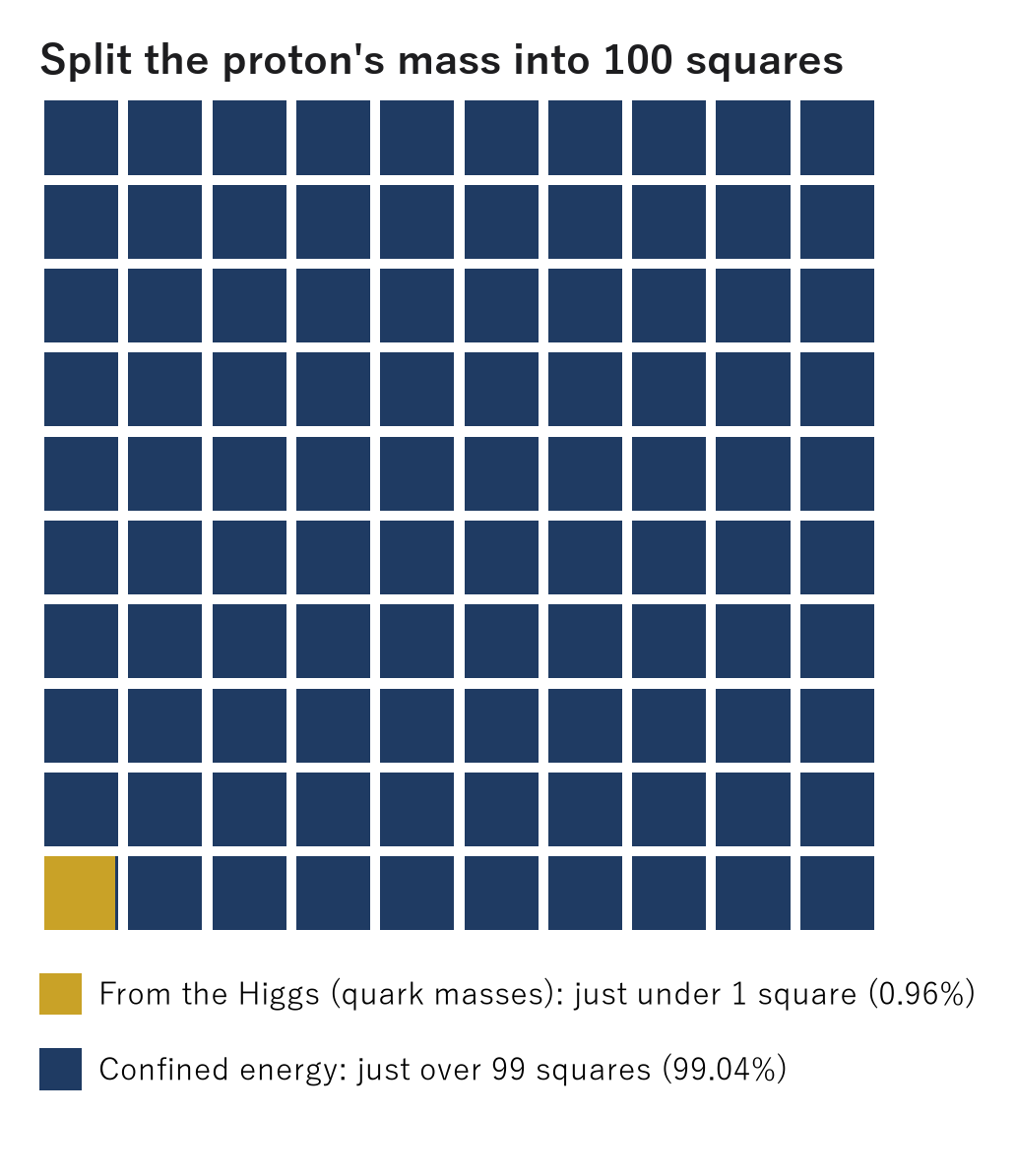
The quark masses come from the Higgs field. So "the Higgs gives things their mass" describes only 0.96% of a proton.
The other 99% is confined energy
Where, then, do the remaining 929.25 MeV come from?
Quarks are confined inside the proton by the strong force. Inside, the quarks move about violently, and the force field that binds them together (the gluon field) also holds a large amount of energy. Seen from outside, this energy is measured as mass.
This is where E=mc² comes in. The equation is usually read as "mass can be turned into energy." But it can also be read the other way: energy E confined inside an object at rest appears from outside as a mass m = E ÷ c². The 99% of the proton's mass belongs to this second reading.
In other words, most of the proton's mass is not "the mass of the parts" but "the energy of the parts moving and being bound together inside."
The electron is the exact opposite
Even inside the same atom, the electron is the other way round. An electron does not split into parts, and its mass of 0.511 MeV comes entirely from the Higgs field.
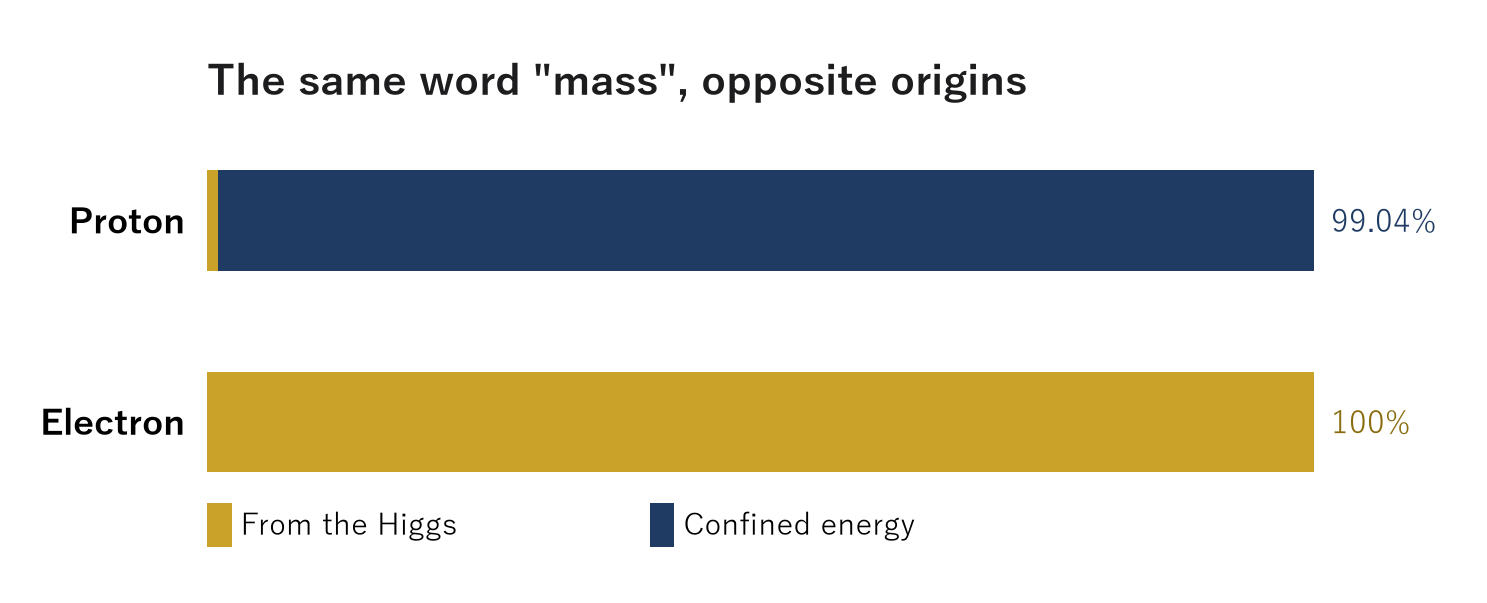
The share from the Higgs for the proton (0.96%) and for the electron (100%) differ by a factor of 104.0. The single word "mass" holds two things with different origins. In my papers I call such things, called by the same name but coming from different sources, distinct roots.
Converted to a 60 kg body
By mass, the body is 65% oxygen, 18.5% carbon, 9.5% hydrogen and 2.6% nitrogen, with calcium, phosphorus and others making up the rest (typical values that differ slightly from source to source). I counted the protons, neutrons and electrons in each kind of atom and added up the mass that comes from the Higgs.
- Quark masses (from the Higgs): 1.092% of body weight
- Electron masses (from the Higgs): 0.030% of body weight
- Together 1.122%. The remaining 98.88% is confined energy.
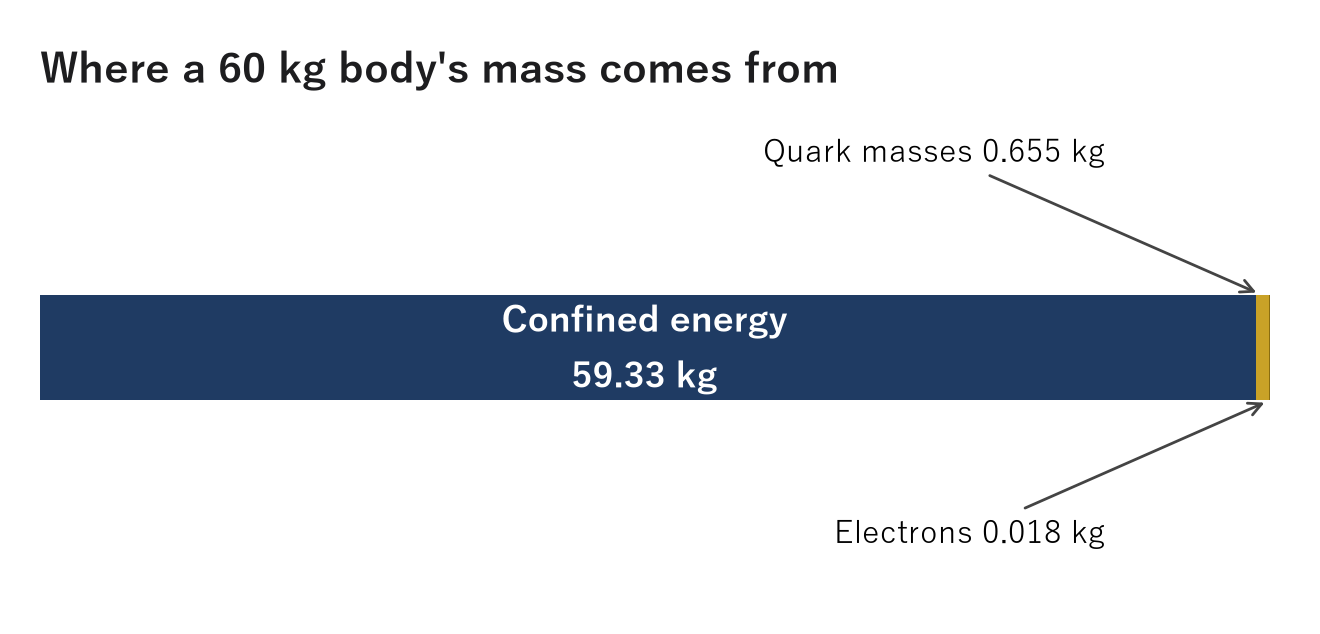
For a 60 kg body, the mass given by the Higgs is about 0.67 kg. The other 59.33 kg is energy confined inside protons and neutrons, showing up as mass through E=mc². The "99%" in the title is this 98.88%, rounded.
If the Higgs field's value were 0
Let me try a thought experiment. If the value of the Higgs field (its vacuum expectation value) were set to 0, the quark masses and the electron mass would all become 0.
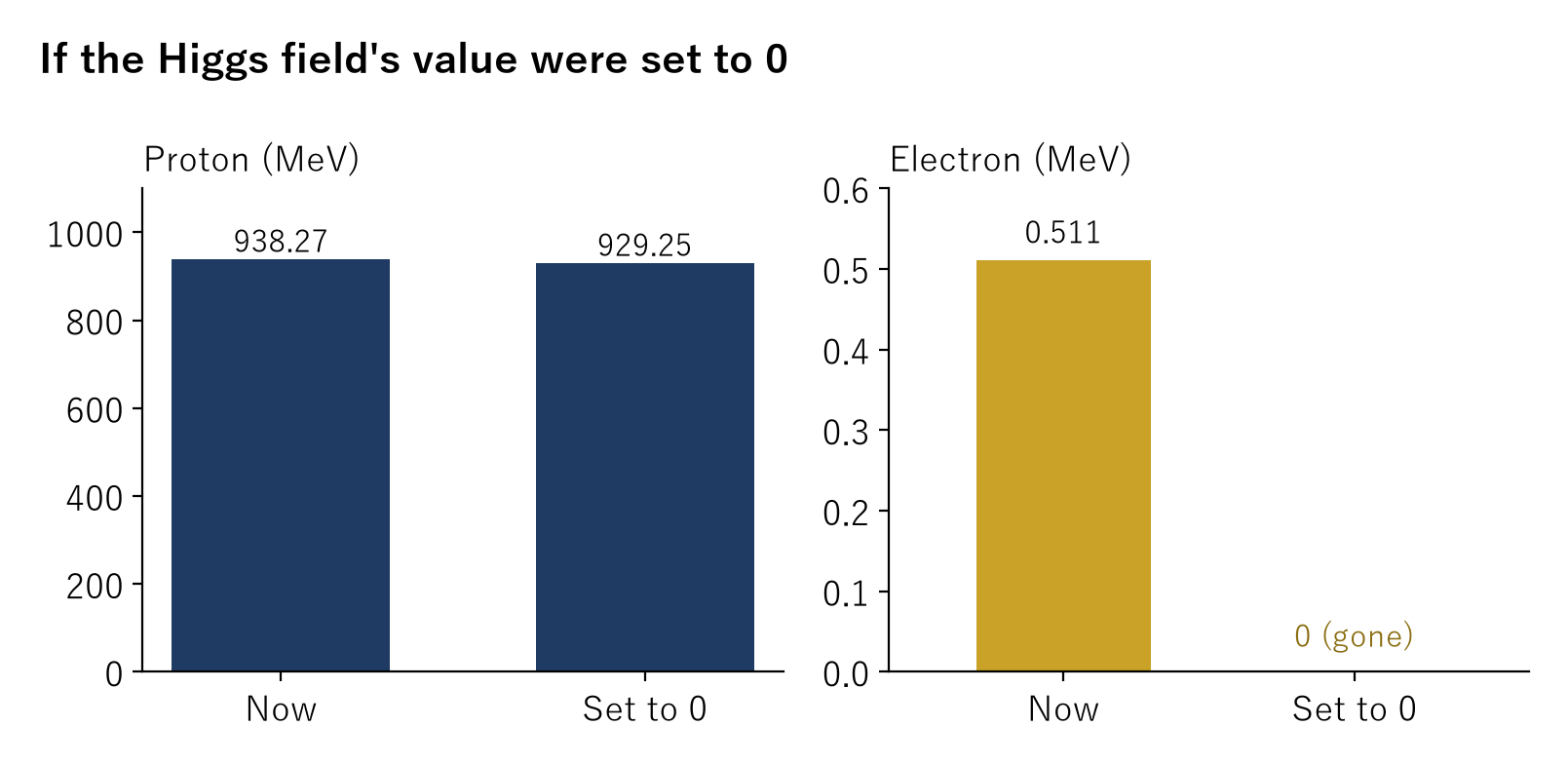
The proton's mass hardly changes. The electron, however, loses its mass. A massless electron cannot stay around a nucleus, and atoms can no longer keep their shape. Almost all of the body's weight would remain, but the body's form would not.
I should add a caution. This "set it to 0" calculation simply subtracts the quark masses. In a world where the Higgs field really were 0, other things would change too, and I have not calculated all of them.
Where simple addition goes wrong
Adding up the parts does not always work. A neutron is made of one up quark and two down quarks. The only difference between a neutron and a proton is that one up quark has been replaced by a down quark.
The difference in quark masses is 4.70 - 2.16 = 2.54 MeV. Yet the mass difference between the neutron and the proton is only 1.29333 MeV. Compared with the actual difference, the prediction from addition is 196%: it overshoots. The proton carries a positive electric charge, so it is made heavier by the energy of that charge, which narrows the difference. It is an example of why you cannot look only at the parts when you ask what mass is made of.
Summary
- Of the proton's mass, the quark masses (from the Higgs) are 0.96%. The remaining 99.04% is confined energy.
- The electron's mass is 100% from the Higgs. The same word "mass", but opposite origins.
- For body weight, the share from the Higgs is 1.122%. The other 98.88% is "energy showing up as mass", E=mc² read the other way round.
E=mc² is not only an equation of nuclear power. It is also the equation of your own weight, right now, standing on the scale.
Where the numbers come from, and the scope of this article
The masses of the quarks, the proton, the neutron and the electron are the values of PDG 2024 (S. Navas et al., Particle Data Group, Phys. Rev. D 110, 030001, 2024). The masses of the light quarks depend on how they are defined (the MS-bar scheme at 2 GeV), and the percentages in this article are numbers within that definition. For the elements of the body I used typical values, which differ slightly from source to source. Atomic masses are approximated from the mass number of the most common isotope.
This article does not claim any new law. It uses only published values, addition and division. It is based on two of my papers, both preprints that have not been peer reviewed (the pages are in Japanese, with the paper PDFs in Japanese and English):
- Paper 286: 99.04% of the Proton's Mass Is Not the Higgs (counted with the PDG 2022 values; recounting with the 2024 edition still gives 0.96%)
- Paper 240: “Mass” Is Seven Things, One of Which Goes Negative and One of Which Depends on the Direction of the Push
E=mc² can also be read as a shape. Put 4π in for m, and 4πc² appears, the same form as the surface area of a sphere. I wrote about that reading in a small book, A Single Skin and What It Holds.