Abstract
What this paper asks is whether a "volume bar" and a "tick bar" in foreign exchange are the same thing. No new mathematical theorem and no new law is claimed.
First, ★★ they are identically the same. The bar edges match at 1.0000 for all four instruments, and the counts are 2,183,483, 2,184,429, 2,183,491 and 2,090,836 on both sides (Section 3).
Second, ★ they are not the same because the numbers came out close; they are the same because the definitions are. Volume in foreign exchange is the tick count, so "N of volume accumulated" and "N ticks arrived" are the same sentence (Section 3).
Third, and this is the core of the paper: ★★ change what is accumulated to the move and it becomes a different thing at once. The match drops to 0.0135, a factor of 74.2 (Section 4).
Fourth, ★ the separator is what was accumulated, not how large the step is. Even with the counts matched, the edges hardly coincide (Section 4).
Fifth, ★★ one thing I put badly, though: what a range bar holds constant is the path length, not the move per bar. The spread of the move per bar is 15.36, barely below the tick bars' 16.85 (Section 5).
Sixth, ★ the match is 1.0000 on a synthetic random walk too. It is an identity, so agreement here is a check, not a finding (Section 6).
Scope of this paper: no new mathematical theorem and no new law is claimed — that foreign exchange has no central exchange and that a tick is a quote update are both known. No real course, author, or vendor is the subject here, and none is named. No particular data feed is discussed — the tick count depends on the feed (Section 7). No trading is discussed — neither performance nor profit and loss is measured. Prediction ④ was put badly — the path length and the move per bar are different quantities (Section 5). One step size is fixed (Section 7). The scope is intraday and few instruments — four instruments over six years. Results documented at longer holding periods, such as monthly time-series momentum, are not contradicted. No prediction is claimed.
1. Notation and the question
Foreign exchange has no central exchange, so nobody knows how many lots changed hands. The "volume" shown by trading software is the number of ticks inside that bar.
| What gets said | What does not get said |
|---|---|
| I use volume bars | What volume in foreign exchange counts |
| Volume bars and tick bars are similar | Similar, or the same? |
| Bars cut on the move are in the same family | That what is accumulated differs |
Observation 1.1: ★ If so, are a "volume bar" and a "tick bar" not the same thing?
Observation 1.2: ★ Numbers coming out close is not enough to call them the same root. They are separated by what has to change for the answer to change.
Observation 1.3: That volume in foreign exchange is not a restatement of the move was measured in [F043]. ★ What this paper asks is what a bar cut on that volume is the same as.
Question: are volume bars and tick bars the same, and what has to change to make them different?
2. State the quantities and the design first
Declared before the run and unchanged during it.
| A, tick bars | Every N ticks. N = total ticks ÷ the number of minute bars |
| B, volume bars | Every time volume sums to N (★ volume = the tick count) |
| C, range bars | Every time the path length sums to S. S is matched to A's median per bar |
| Match | The share of bars whose closing tick index appears in both sets |
| Measured | Duration per bar (seconds), move per bar (pips), ticks per bar |
| Spread | 90th percentile ÷ 10th percentile |
| Baseline | Synthetic random walk down to the tick (3 draws, times left as measured) |
| Separator | What was accumulated (the tick count, or the absolute move) |
| Instruments and period | USDJPY, EURUSD, GBPUSD, XAUUSD / 2019–2024 |
Observation 2.1: ★ Comparing at the edges is the point. Similar counts are not enough; what matters is whether they cut at the same tick.
Observation 2.2: N is 86, 76, 80 and 151 ticks; S is 8.4000, 5.5750, 8.0000 and 28.7475 pips.
Observation 2.3: ★ S is matched to the path length per bar, not to the net move per bar. Matched to the net move, the path is so much longer that the counts come out an order apart.
Predictions (written before measuring)
① ★★ They are identically the same. Every bar edge should coincide.
② ★ But change "volume" to the absolute move and it becomes a different thing at once.
③ ★ The match is set by what was accumulated, not by how large the step is.
④ A bar that accumulates the absolute move has a uniform move per bar by definition.
⑤ ★ The duration per bar is more spread out when accumulating the move.
⑥ A synthetic random walk satisfies ① identically as well.
3. A volume bar is identically a tick bar
Calculation 3.1 Matching edges
| Instrument | A's count | B's count | Share of matching edges |
|---|---|---|---|
| USDJPY | 2,183,483 | 2,183,483 | 1.0000 |
| EURUSD | 2,184,429 | 2,184,429 | 1.0000 |
| GBPUSD | 2,183,491 | 2,183,491 | 1.0000 |
| XAUUSD | 2,090,836 | 2,090,836 | 1.0000 |
Observation 3.2: Prediction ① held. ★★ The match is 1.0000 for all four instruments.
Observation 3.3: ★ That is a check, not a finding. Volume in foreign exchange is the tick count, so "N of volume accumulated" and "N ticks arrived" are the same sentence.
Observation 3.4: ★★ So there is nothing to gain by putting the two side by side. One rule has been given two names.
Observation 3.5: ★ That bars cut by tick count are a different clock from bars cut by the clock was measured in [F018]. What this paper adds is that "cutting by ticks" also goes by the name of a volume bar.
4. Change what is accumulated and it becomes a different thing at once
Calculation 4.1 Matching across the three bar types
| Instrument | A against B | A against C | Ratio |
|---|---|---|---|
| USDJPY | 1.0000 | 0.0140 | 0.0140 |
| EURUSD | 1.0000 | 0.0139 | 0.0139 |
| GBPUSD | 1.0000 | 0.0131 | 0.0131 |
| XAUUSD | 1.0000 | 0.0074 | 0.0074 |
Observation 4.2: Prediction ② held. ★★ A against C has a median of 0.0135, a factor of 74.2 below the 1.0000 of A against B.
Observation 4.3: ★★ This is the separator: change what is accumulated and the answer changes; change the step size and it does not. C's counts are 2,393,506, 2,309,241, 2,331,643 and 2,285,825, matched to A's order of magnitude.
Observation 4.4: ★ So even with the counts matched, the edges hardly coincide. Two sets of bars of much the same number, cutting in entirely different places.
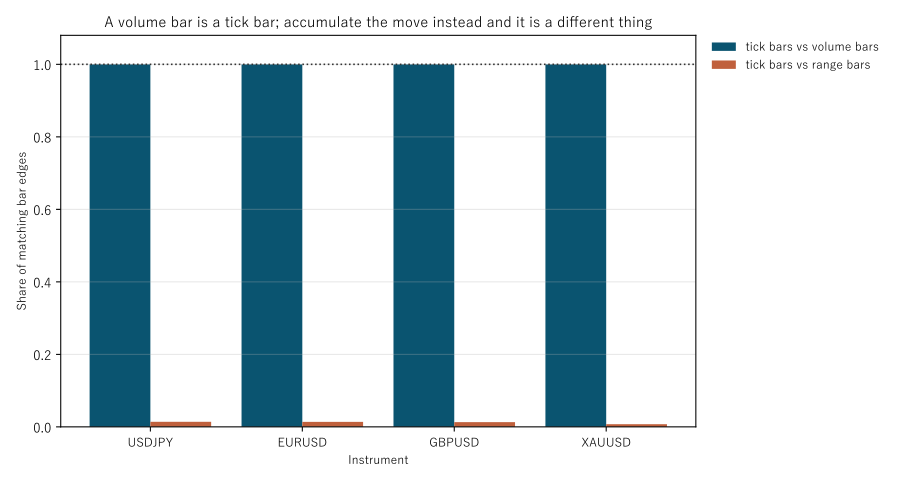
Figure 1: instrument on the horizontal axis and the share of matching edges on the vertical. Left is tick against volume bars, right tick against range bars, with a dotted line at 1.
5. ★ But "accumulating the move" does not make the move uniform either
Calculation 5.1 What is uniform and what is spread out (median of the four instruments)
| Bar type | Duration (s) | Spread | Move per bar (pips) | Spread | Ticks per bar | Spread |
|---|---|---|---|---|---|---|
| Tick bars | 42.3 | 7.04 | 0.9750 | 16.85 | 83 | 1.00 |
| Volume bars | 42.3 | 7.04 | 0.9750 | 16.85 | 83 | 1.00 |
| Range bars | 37.1 | 12.28 | 1.0500 | 15.36 | 76 | 2.25 |
Observation 5.2: Prediction ⑤ held. The spread of the duration is 7.04 for tick bars against 12.28 for range bars.
Observation 5.3: ★★ But prediction ④ was put badly. The spread of the move per bar only falls from 16.85 to 15.36. It is hardly uniform at all.
Observation 5.4: ★★ The reason is that a range bar holds the path length constant, not the net move per bar. Wander up and down inside the bar and the path grows while the net move does not.
Observation 5.5: ★ So the single phrase "the absolute move" was pointing at two different quantities: the path length (which a round trip increases) and the net displacement (which a round trip cancels).
Observation 5.6: ★ What was held constant does come out at 1.00. Tick bars and volume bars have a tick-count spread of 1.00, and range bars are uniform in the quantity they hold constant. The 15.36 in the table is the other quantity, the one that is not held.
6. On a synthetic random walk the match is 1.0000 as well
Calculation 6.1 Replacing only the price movement
| Instrument | Measured A−B | Random walk A−B | Measured A−C | Random walk A−C |
|---|---|---|---|---|
| USDJPY | 1.0000 | 1.0000 | 0.0140 | 0.0124 |
| EURUSD | 1.0000 | 1.0000 | 0.0139 | 0.0132 |
| GBPUSD | 1.0000 | 1.0000 | 0.0131 | 0.0124 |
| XAUUSD | 1.0000 | 1.0000 | 0.0074 | 0.0066 |
Observation 6.2: Prediction ⑥ held. ★ The random walk's A against B is 1.0000 too.
Observation 6.3: ★★ It is an identity, so of course it is. Agreement here is a check, not a finding.
Observation 6.4: ★ A against C comes out at a median of 0.0124 on the random walk, close to the measured 0.0135. Whether you accumulate the move or the count is a difference of definition, not of market.
Observation 6.5: ★ What this baseline is zero about was measured in [F033].
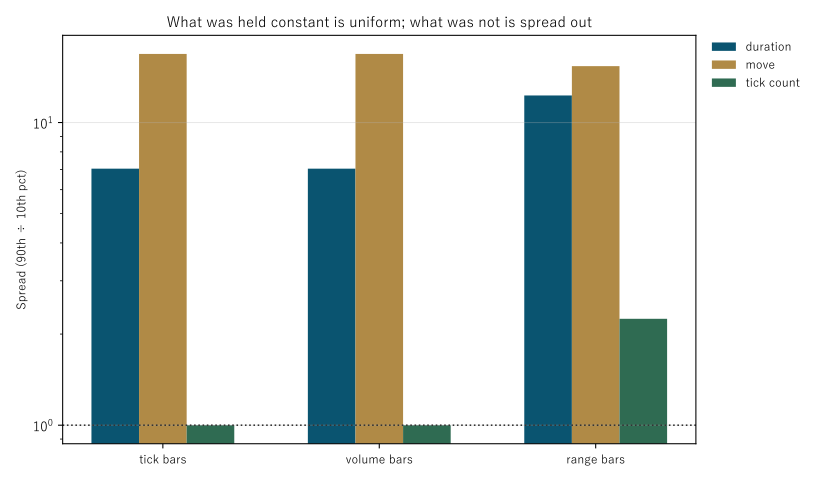
Figure 2: bar type on the horizontal axis and the spread (90th ÷ 10th percentile, logarithmic) on the vertical. Duration, move and tick count side by side, with a dotted line at 1.
7. Limitations
- Prediction ④ was put badly. I wrote that a bar accumulating the absolute move has a uniform move per bar; what it holds constant is the path length, not the net displacement.
- No particular data feed is discussed. The tick count depends on the feed, and one was used here.
- One step size is fixed: N and S.
- Three bar types are fixed. Renko and bars cut by the clock are not included.
- No trading is discussed. Neither performance nor profit and loss is measured.
- The match is measured as the set of closing tick indices. Another way of measuring gives another number.
- Four instruments, six years. Nothing is claimed about other markets or other periods.
Conclusion
Foreign exchange has no central exchange, so the "volume" shown by trading software is the number of ticks inside a bar.
★★ Which makes a "volume bar" and a "tick bar" identically the same thing. The match is 1.0000 for all four instruments, with every bar count the same.
★ That is a check, not a finding. "N of volume accumulated" and "N ticks arrived" are the same sentence. So there is nothing to gain by putting the two side by side; one rule has been given two names.
★★ Change what is accumulated to the move, though, and it becomes a different thing at once. The match drops to 0.0135, a factor of 74.2. Even with the counts matched to the same order, the edges hardly coincide.
★ So the separator is what was accumulated, not how large the step is.
★★ And one thing I put badly. I wrote that a bar accumulating the absolute move has a uniform move per bar; the spread only falls from 16.85 to 15.36. What it holds constant is the path length, not the net displacement. Wander up and down inside the bar and the path grows while the displacement does not.
★ So the single phrase "the absolute move" was pointing at two different quantities: one a round trip increases, one a round trip cancels.
★ On the random walk the match is 1.0000 too, and A against C comes out at 0.0124 against the measured 0.0135. Both are properties of the definitions, not of the market.
So what is needed when comparing bar types is not the name. ★ It is writing down what is held constant per bar. And when writing "the move", writing whether that means the path length or the net displacement.
Data and reproduction
| Data | Foreign exchange from Dukascopy-derived ticks (from 2019 onward, matching to the millisecond, bid and ask, has been verified). Gold from Dukascopy |
| Period | 2019–2024 (six years) |
| Instruments | USDJPY, EURUSD, GBPUSD, XAUUSD |
| A, tick bars | Every N ticks. N = total ticks ÷ the number of minute bars, per instrument and year |
| B, volume bars | Every time volume sums to N. Volume is 1 per tick |
| C, range bars | Every time the path length (the accumulated |change in mid|) sums to S. S is A's median per bar |
| Match | The share of bars whose closing tick index appears in both sets |
| Measured | Duration per bar (seconds), move per bar (pips), ticks per bar |
| Spread | 90th percentile ÷ 10th percentile |
| Baseline | Synthetic random walk down to the tick (3 draws). The times are left as measured |
| Verification | 検算/F053.py (--zu also writes the figures). Every number in the text comes from 検算/F053_output.txt |
| Figures | 図/F053_zu1, 図/F053_zu2 (png, svg, English versions) |
| Random seeds | Fixed. Re-running gives the same values |
| Substrate check | _ツール/audit_bars.py (bar look-ahead, daylight saving, day boundary). The record is _土台の検査.txt |
References
- Yamagishi, Y. (2026). Bars Cut by Tick Count Are a Different Clock from Bars Cut by the Clock [F018]. Zenodo. 10.5281/zenodo.22891916
- Yamagishi, Y. (2026). A Synthetic Random Walk Has No Volatility Clustering [F033]. Zenodo. 10.5281/zenodo.22893674
- Yamagishi, Y. (2026). The "Volume" in Foreign Exchange Is Not a Restatement of the Move [F043]. Zenodo. 10.5281/zenodo.22894928
Reference
Yamagishi, Y. (2026). A Volume Bar in Foreign Exchange Is Identically a Tick Bar [F053]. Zenodo.
DOI: 10.5281/zenodo.22898174
YOI: https://www.yamagishiyuuki.com/yoi/F053
ORCID: 0009-0006-8587-3450
PDF (English) · PDF (Japanese) · Date proof of the English PDF (OpenTimestamps .ots) · SHA256SUMS
The record page for this paper (in Japanese, with the PDFs in each language and the date proof): YOI F053. This paper is a preprint and has not been peer reviewed.