In the previous article, “Fill the Dumbbell and Doughnut Clouds and They Turn Round Again”, I checked that an atom whose shell is exactly half full or full has a round cloud and sends not a single number out. Noble gases such as neon and argon are exactly such atoms. Seen from outside, they carry nothing.
Yet noble gases turn liquid when cooled. Why do atoms that send nothing out attract each other? The answer was not in the “average” but in the “moment”.
The calculations in this article were made for this page or come from papers that I published myself as preprints; they have not been peer reviewed.
Key points
- An atom with a full shell is round on average, and the numbers it sends out are 0. Yet the cloud at each moment is lopsided toward somewhere. For hydrogen, the average lopsidedness is 0, but the average of its square is not.
- Place two atoms side by side, and their momentary lopsidedness lines up just a little: the same way along the joining line, opposite ways at right angles to it. That slight alignment lowers the energy and becomes an attraction.
- The attraction falls as the inverse sixth power of the distance. The 6 is the square of the fact that a dipole field weakens as the cube of the distance.
- Retracing it with the same tool as Mitroy and Bromley, the coefficient of the attraction between two hydrogen atoms came out as 6.4990267054 (agreeing to 13 digits). London’s simple formula gives 1.17 times that.
- The attraction is very weak because the average lopsidedness is 0 and only the product of two fluctuations remains.
- Average and moment
- Two side by side
- Hydrogen’s coefficient
- Zero point or heat
- 6 is twice 3
- Why so weak
- Shape and sticking
- Questions
- References
Round on average, lopsided at each moment
The 1s cloud of hydrogen is round, and the average position of the electron coincides with the nucleus. The average lopsidedness is 0. The average of its square, however, is not 0: in units of the Bohr radius squared it is exactly 1 (a third of the mean square spread of the cloud, 3). In the quantum world the position of the electron is not fixed, but a measurement finds it lopsided toward somewhere. In a picture, the electron is lopsided toward somewhere at each moment.
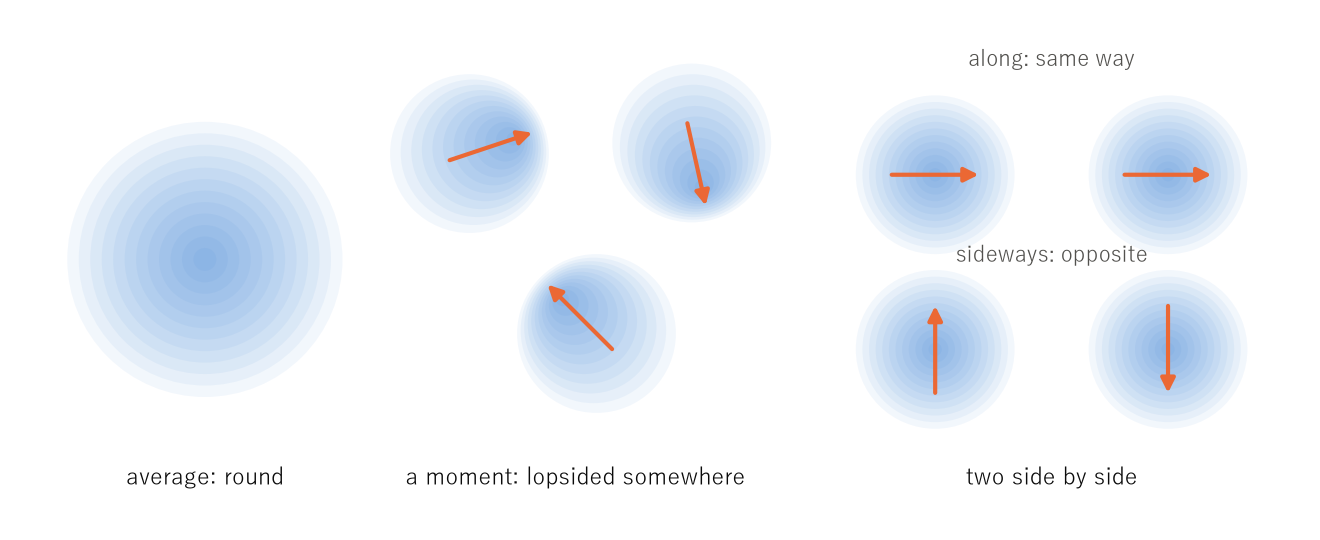
The numbers read from outside are averages of this lopsidedness. The lopsidedness that disappears on averaging is where the attraction comes from.
Two side by side: the lopsidedness lines up
Let us check with the simplest model. Bind a charge by a spring to each of two centers. The charges usually sit at the centers, but in the quantum world they cannot come fully to rest and always shake a little (the zero-point motion). The lopsidedness of the two charges is coupled by the force between dipoles. The strength of the coupling is κ = α/R³, with α the polarizability (how easily a charge is displaced) and R the distance. This model is known as a solvable model that shows this attraction between atoms (London’s dispersion force).
The slider changes the distance R between the two centers. The buttons jump to set distances.
- Coupling κ = α/R³
- Zero-point shift |ΔE| (ħω0 = 1)
- ΔE ÷ (−3κ²/4)
- Same way along the line
- Opposite ways at right angles
Where κ = 0.1 (distance 2.15), the share of measurements that find both lopsided the same way along the joining line is 53.22%, and the moments when they are lopsided opposite ways at right angles to it make 51.60%. Both differ only a little from 50%. Even so, this difference lowers the energy by 0.007572 of the size of the zero-point motion, ħω0. That is the attraction.
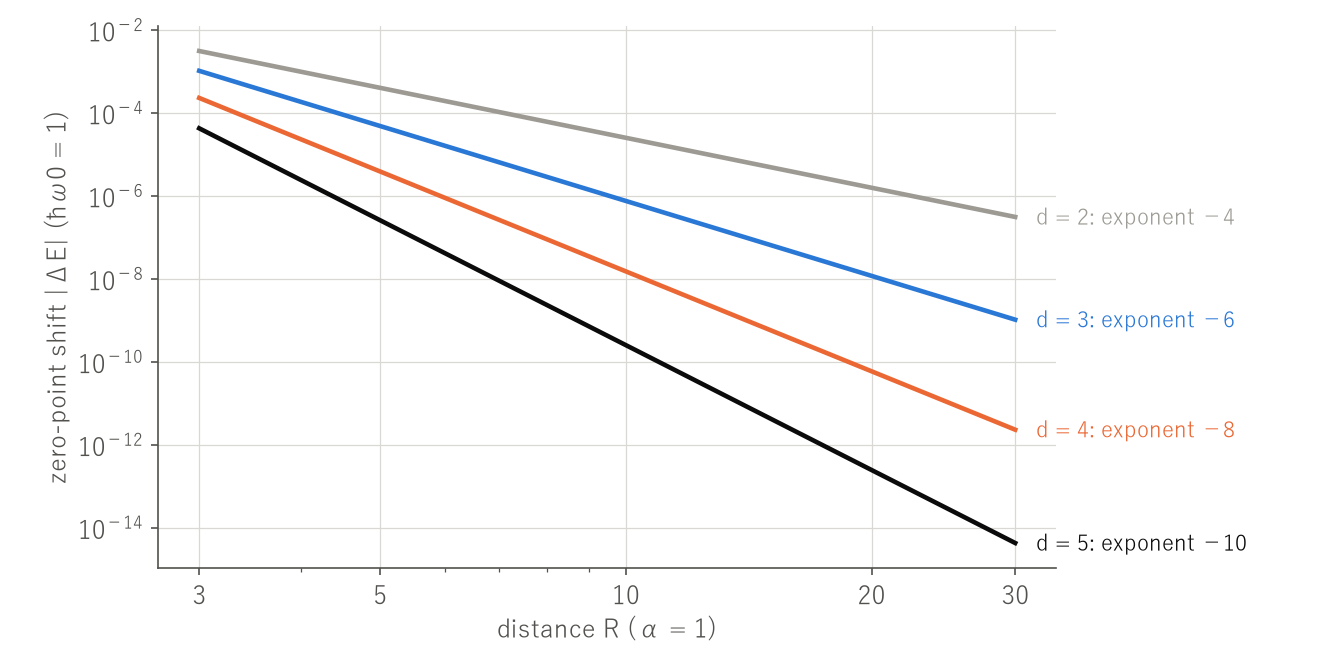
Move the distance out to 10, and the shift agrees with the formula (3/4)α²/R⁶ to within a factor of 1.000001. The attraction falls as the inverse sixth power of the distance. If the springs were classical and the charges stood still, there would be neither lopsidedness nor attraction. At zero temperature, this attraction comes only from the quantum zero-point motion (Paper 1109).
Hydrogen’s coefficient and London’s single line
For real hydrogen I counted the coefficient C6 of the attraction. At large distances the energy of the attraction is −C6/R⁶. C6 is obtained by extending the degree to which the electron is displaced by light (the polarizability) to imaginary frequencies, squaring it and adding it up. I counted the p rooms the electron can enter, bound rooms and the continuum together, with a tool called Laguerre polynomials.
This tool has the same form as the one Mitroy and Bromley (2005) used for the same calculation, and my calculation retraces theirs. The result was 6.4990267054, agreeing with the value in their table to 13 digits.
London’s simple formula (1930) keeps the ease of displacement (the polarizability) at its true value 9/2 and gathers only the energy to which the electron rises into a single line at the ionization energy (1/2). For hydrogen this gives 7.59375, 1.17 times the real value. It comes out large because most of the true ease of displacement comes from lines below the ionization energy. The line to the 2p room alone (an energy difference of 3/8) accounts for 0.66 of it.
The slider changes the energy E of the single line into which the energies the electron rises to are gathered.
- C6 of the single line
- Real C6
- Ratio
To match the real coefficient with a single line, E must be placed at 0.4279, 0.86 times the ionization energy, lower because the 2p line is strong. London’s formula gets the form of the attraction (the sixth power of the distance) right and estimates its size roughly.
Zero-point fluctuation or thermal fluctuation
The shaking has one more source: temperature. Warm the spring model, and shaking due to heat is added.
The slider changes the temperature kT (the scale goes up by factors of 10). The buttons jump to set temperatures. The thermal addition is the strength minus the zero-point part 3/4.
- Temperature kT
- Strength −ΔF/κ²
- Zero-point part
- Thermal addition
- Larger part
At low temperature the strength of the attraction approaches 3/4 from the zero-point fluctuation, and at high temperature 3kT from the thermal fluctuation. The two approximate formulas cross at kT = ħω0/4. There, however, the thermal addition is only 0.1592 of the whole; the thermal addition equals the zero-point part at kT = 0.4902ħω0. The thermal attraction comes not from the energy but from the entropy (the number of arrangements). With either fluctuation the attraction falls in the same way, as the inverse sixth power of the distance. What differs is the coefficient.
The ħω0 of the shaking of an atom’s electrons is of the size called a hartree (27.2 eV). Room-temperature kT is only 0.000950 of it. At short distances where delay does not matter, the attraction between atoms is decided almost entirely by the zero-point fluctuation.
6 is twice 3
In three dimensions a dipole field weakens as the cube of the distance. The attraction is the square of that coupling, so it goes as the sixth power. I solved the same model while changing the dimension d of space. The dipole field weakens as the d-th power, so the attraction weakens as the 2d-th power, with coefficient d(d−1)/8 (0.25, 0.75, 1.5 and 2.5 for d = 2, 3, 4 and 5).
Why is it so weak?
Chemical bonds are sorted by name into ionic bonds, covalent bonds, metallic bonds, hydrogen bonds and the van der Waals force. Earlier I counted that only the van der Waals force is weaker than the heat at room temperature (Paper 278). At that time I did not go into why it is weak.
What this page answers is the weakness of the dispersion force, the part of the van der Waals force that comes from fluctuation. In the numbers of this page, the weakness comes in two steps. The average lopsidedness of one atom is 0, so there is no first-step attraction. What remains is the second step, the product of two fluctuations, which acts through the square of the small ratio α/R³. Even real hydrogen at 6 Bohr radii has κ = 0.0208. Even with κ = 0.1, the shift is only 0.007572 of ħω0.
The shape of the cloud and sticking
The dumbbell and doughnut shapes of the cloud decide the directions in which an atom reaches out its hands. Whether atoms stick at all, however, is not decided by the shape alone. Even round atoms stick weakly through fluctuation. Nor was the shape of the cloud the reason the electron does not fall into the center (Paper 1108). The shape decides the direction; the source of the sticking force also lies outside the shape.
Questions
Can the lopsidedness be seen?
No. The average is round. That the lopsidedness lines up is a statement about shares: the share of measurements that find the two lopsided the same way is 53.22%, just a little more than 50%.
Is London’s formula wrong?
It is not wrong. Its form, the sixth power of the distance, is right; it estimates the size roughly with a single line. For hydrogen it gives 1.17 times the real value.
Does it stay a sixth power even very far away?
No. Far away, the delay before light arrives matters, and the attraction falls as the inverse seventh power (Casimir and Polder, 1948). This page treats only short distances where the delay does not matter.
Papers and references
All the papers are published under CC BY 4.0.
- Paper 1109, “Atoms That Are Round on Average Still Attract, Their Fluctuating Lopsidedness Lining Up, in Inverse Proportion to the Sixth Power of the Distance”: the source of the calculations on this page.
- Paper 1107, “When the Field Equation Is of Second Order, the Interior Can Be Read from Outside a Closed Skin Only as One Number per Angular Pattern”: the numbers that can be read from outside.
- Paper 1108, “The Angular Pattern Can Hold Off the Fall to the Center Only When the Attractive Potential near the Center Goes Exactly as 1/r²”: the shape of the cloud and the fall.
- Paper 278, “The Classes of Chemical Bond Are a Continuum of Strength Cut by a Temperature”: the strength of bonds and temperature.
- London, F. (1930). Zur Theorie und Systematik der Molekularkräfte. Zeitschrift für Physik.
- Casimir, H. B. G., and Polder, D. (1948). The influence of retardation on the London-van der Waals forces. Physical Review.
- Mitroy, J., and Bromley, M. W. J. (2005). The higher-order Cn dispersion coefficients for hydrogen. Physical Review A.