Books on chemistry and physics are full of pictures of electron clouds. The p cloud is an upright dumbbell; the d clouds are four-leaf clovers, or a dumbbell wearing a doughnut. Are atoms really this bumpy? Can the shape be seen from outside? And does the doughnut shape keep the electron from falling into the center?
In the previous article, “Rearrange the Inside of a Box and the Gravity Outside Does Not Change at All”, I checked that from outside a closed skin only one number per angular pattern can be read. This time I count those numbers for electron clouds. Put electrons into a shell one at a time, and the numbers that leave go up and down; but at exactly half full and at full they all become 0, and the cloud turns round again.
The calculations in this article were made for this page or come from papers that I published myself as preprints; they have not been peer reviewed.
Key points
- The shape of an electron cloud shows up in the electric field outside as “numbers per angular pattern”. The patterns a shell can produce are fixed: a p cloud gives only pattern 2, d gives patterns 2 and 4, and f gives only patterns 2, 4 and 6.
- Put electrons into a shell one at a time, and the count of numbers that leave goes up and down, returning to 0 at exactly half full (one per room) and at full. The cloud becomes round, and its shape cannot be read from outside.
- It turns round because, when all the rooms of a shell are added, the density is (2ℓ + 1)/4π in every direction. The 4π in the denominator is the size of all directions.
- Stack the room counts 1, 3, 5, 7 and you get a square. That number n² equals the number of patterns that can be drawn on a sphere in four dimensions, and the 2n² seats of a hydrogen shell come from it.
- The doughnut shape of the cloud is not why the electron of hydrogen does not fall into the center. The shape of the cloud decides the fall only when the attractive potential near the center goes exactly as 1/r² (a force falling as the inverse cube of the distance).
- Pictures of clouds
- One at a time
- Why it turns round
- Measuring the stretch
- Rooms make a square
- Shape and the fall
- Questions
- References
Cloud pictures draw the density in each direction
A picture of an electron cloud shows in which directions the electron is likely to be found. Seen from the origin, take the density in each direction as a length and mark a point at that distance; this gives surfaces like those in Figure 1. The spread with distance from the center (the weight per skin counted in Paper 1096) is not in these pictures.
The rooms (orbitals) that electrons enter are sorted by the angular fineness ℓ. ℓ = 0 is s, 1 is p, 2 is d, 3 is f, and there are 2ℓ + 1 rooms with the same ℓ. Figure 1 adds the clouds of the p and d rooms one at a time.
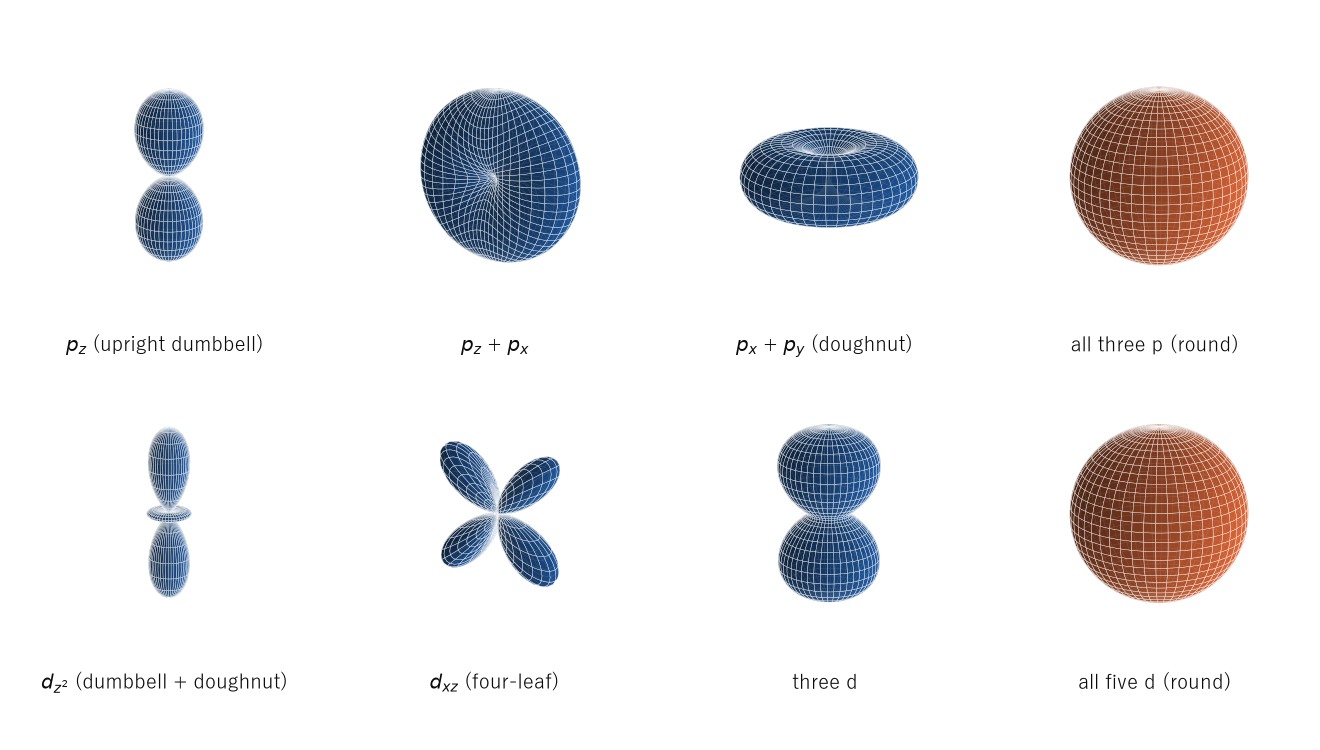
pz alone is an upright dumbbell; px plus py is a flat doughnut. Add all three, and the bumps disappear into a sphere. The same holds for the five d.
Put electrons in one at a time and count the numbers that leave
How do the bumps of a cloud show up in the electric field outside? I use the same tool as in the previous article. Split the density of the cloud by direction into patterns: pattern 0 is the total charge, pattern 1 the lopsidedness, pattern 2 an elliptical stretch (the quadrupole), and patterns 4 and 6 are finer. A pattern ℓ′ has 2ℓ′ + 1 numbers for its different orientations, and each one can be read from outside the skin.
The electrons of one shell all have the same spread with distance from the center. So the numbers that leave are set by the density in each direction alone. Here I count how many of the numbers of pattern 1 and up are not 0, and call them “the numbers that leave”.
There are two ways to choose the rooms: rooms with fixed directions, such as px, py, pz (real orbitals), and the rooms m = +1, 0, −1 that circle around the z axis (rotating orbitals). A cloud of rotating orbitals does not change when it is turned about the z axis (a doughnut or a dumbbell).
The buttons choose the shell and the kind of rooms; the slider puts electrons in one at a time. The other slider turns the cloud about the z axis.
- Electrons put in / full
- Numbers that leave (not 0)
- Cloud
Put one electron into the p shell with real orbitals, and 1 number leaves; with two, 3. With the third there is exactly one per room, the shell is half full, and the count returns to 0. From the fourth on the same sequence repeats, and at 6, full, it is 0 again. In a row: 0, 1, 3, 0, 1, 3, 0.
The d shell gives 0, 2, 6, 2, 4, 0, 2, 6, 2, 4, 0, with 0 at 5 and at 10. The f shell reaches 0 at 7 and at 14 (Figure 2). With rotating orbitals the sequence changes (for the p shell, 0, 1, 1, 0, 1, 1, 0), but it still returns to 0 at half full and at full.
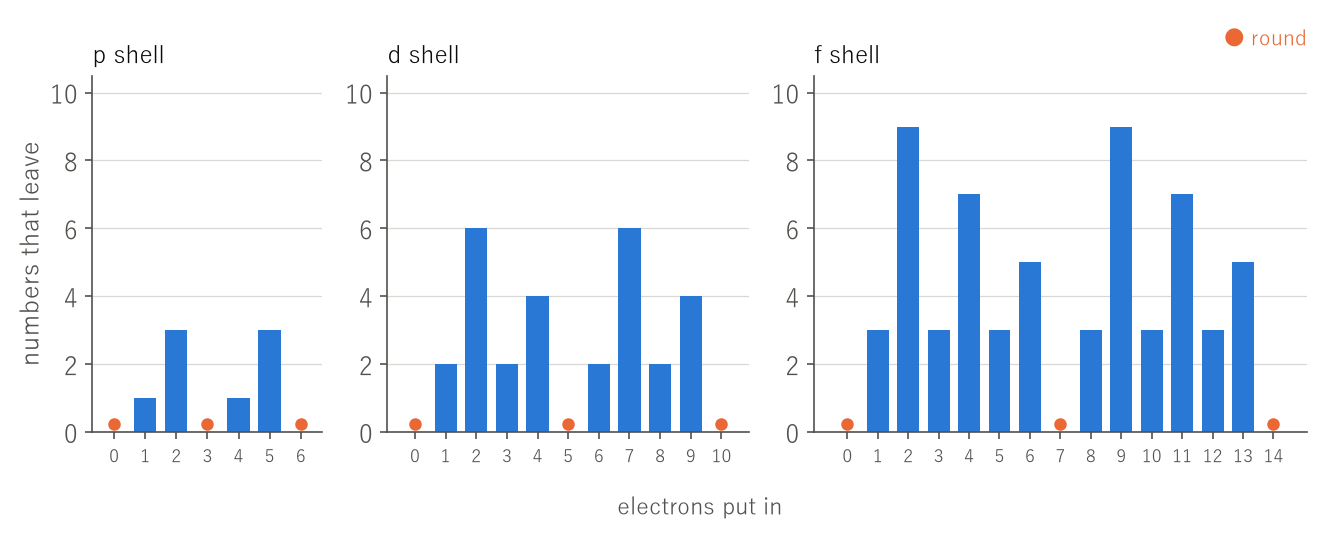
Only even patterns from 2 up to 2ℓ leave. A p cloud can give only numbers of pattern 2; d gives patterns 2 and 4; f gives patterns 2, 4 and 6. Odd patterns such as 1 and 3 are 0 for every cloud, because the density of a cloud is always the same in opposite directions.
Why it turns round at half full and at full
The reason lies in adding rooms. Add the clouds of all the rooms with the same ℓ, and the density is exactly (2ℓ + 1)/4π in every direction; the bumps vanish. This follows from an addition property of spherical harmonics (the addition theorem), and in atomic physics it is called Unsöld’s theorem.
One slider chooses ℓ; the other increases the number of rooms added.
- Density with all rooms added, (2ℓ + 1)/4π
- Bumpiness (highest − lowest)
Adding the rooms of ℓ = 2 one at a time, the bumpiness shrinks through 0.398, 0.298, 0.298, 0.149 and becomes 0 at the fifth. The density is then 0.397887, which is (2 × 2 + 1)/4π.
In a half-full shell there is one electron per room, so the density of the cloud is exactly this sum. In a full shell there are two per room, so it is twice the sum. Either way the density is the same in every direction. Changing the rooms from real orbitals to rotating orbitals does not change the sum of all of them.
The 4π in the denominator is the size of all directions (the full solid angle). Add the density (2ℓ + 1)/4π over all directions, and the number of rooms, 2ℓ + 1, comes back. It has the same form as the density 1/(4π) of the film in the previous article, when the point at the center was moved onto the skin.
In real atoms too, in the lowest state of neon (6 electrons in 2p) or of nitrogen (3 in 2p), the total orbital angular momentum of the electrons is 0, and the cloud is round.
Measuring the vertical stretch with the hydrogen cloud
How large are the numbers that leave? I measure them with the 2p cloud of hydrogen. I computed the quadrupole Qzz = ⟨3z² − r²⟩, which measures the stretch along the vertical (the z direction), in units of the Bohr radius squared (leaving out the sign of the electron’s charge).
| Cloud | Qzz |
|---|---|
| Upright dumbbell (pz) | +24 |
| Lying dumbbell (px) | −12 |
| Doughnut (m = +1) | −12 |
| Two doughnuts (m = +1 and −1) | −24 |
| All three (pz, px, py) | 0 |
The upright dumbbell gives +24, the flat doughnut −12. One upright dumbbell plus two doughnuts gives +24 − 24, exactly 0. The mean of the squared radius ⟨r²⟩ of the 2p cloud is 30, and the 24 of the upright dumbbell is four fifths of it.
Stacking the rooms makes a square
There are 2ℓ + 1 rooms of ℓ: 1 for s, 3 for p, 5 for d, 7 for f. A room holds up to two electrons (spin up and spin down), so there are 2, 6, 10, 14 seats, the widths of the s, p, d and f blocks of the periodic table (Paper 112).
Stack the room counts from the smallest: 1, 1 + 3 = 4, 1 + 3 + 5 = 9, 16, 25, all square numbers n². In the hydrogen atom, shell n has rooms from ℓ = 0 to n − 1, all with the same energy. The seats number 2n²: 2, 8, 18, 32, 50.
The slider chooses the shell number n.
- Rooms (n²)
- Seats (2n²)
The rows of the periodic table have lengths 2, 8, 8, 18, 18, 32, 32. The numbers 2n² appear, but apart from 2 each appears twice: in atoms with many electrons the energies of s, p, d and f split even for the same n, and the filling order differs from hydrogen. Nuclei also have numbers at which a filled shell settles down (magic numbers). In nuclei, however, counting rooms gives only the first three (2, 8, 20); from the fourth on, a second mechanism, the spin–orbit coupling, is needed (Paper 293).
The square numbers n² have another face. I counted the patterns that can be drawn on a sphere, changing the dimension of space.
| Degree ℓ | 0 | 1 | 2 | 3 | 4 | 5 | 6 |
|---|---|---|---|---|---|---|---|
| Circle (2D) | 1 | 2 | 2 | 2 | 2 | 2 | 2 |
| Sphere in 3D | 1 | 3 | 5 | 7 | 9 | 11 | 13 |
| Sphere in 4D | 1 | 4 | 9 | 16 | 25 | 36 | 49 |
On the sphere in four dimensions there are (ℓ + 1)² patterns of degree ℓ, exactly the square numbers. In 1935 Fock showed that if the momentum space of the bound electron of hydrogen is mapped onto a sphere in four dimensions, states of the same energy become patterns of the same degree on that sphere. The n² rooms of shell n share one energy because of this symmetry of rotations in four dimensions, larger than the rotations of three-dimensional space (Paper 79). For orbits in a plane, the same mapping turns the velocity circles of equal energy into great circles of a sphere, as seen in “A Planet’s Velocity Arrow Traces a Circle”.
Does the doughnut of the cloud keep the electron from falling into the center?
Looking at a doughnut-shaped cloud, it can seem that the electron circles around the hole in the middle and so does not fall into the center. But in hydrogen, even in the round s cloud, the electron does not fall into the center.
It does not fall because the more tightly the electron is confined, the more violently it moves, and that energy grows as the inverse square of the distance. The pull of the nucleus deepens only as the inverse of the distance, so near the center the confinement always wins. Even without a shape, the electron does not fall.
The shape of the cloud (ℓ) decides between falling and not falling only when the attractive potential near the center goes exactly as 1/r² (a force falling as the inverse cube of the distance). Only then do the pull and the confinement deepen at the same rate, so that it comes down to comparing strengths. In three dimensions, with the strength of the pull g (in units with ħ²/2m = 1), the fall begins at g = (ℓ + ½)²: 0.25 for s, 2.25 for p, 6.25 for d. Each is exactly 1/4 above the bounds 0, 2, 6 obtained from the rotation wall ℓ(ℓ + 1)/r² alone. Even an s state, which does not turn, does not fall in three dimensions until the strength reaches 0.25. This 1/4 is the value in three dimensions; in two dimensions it is 0 (Paper 1108). The angular pattern, however, protects only the states that carry it.
A potential of exactly the 1/r² form also appears in relativistic atoms. Treating the nucleus as a point, the square of the Coulomb potential produces a part of the form 1/r², and the standard formula for the energy of the innermost electron no longer has a real answer beyond an atomic number of about 137. It is also known that the mathematics does not break down there (Voronov et al., 2007). Real nuclei have a size, and the question moves to an atomic number of about 170.
Questions
Do electron clouds really have the shapes of dumbbells and doughnuts?
A cloud picture shows in which directions the electron of one room (orbital) is likely to be found. Rooms with the same ℓ have the same energy, so there is more than one way to choose them. Written with real orbitals you get dumbbells; with rotating orbitals, doughnuts. But when the shell is half full or full, the sum of all the clouds is round either way.
If the shape cannot be read from outside, can the arrangement of the electrons inside not be known?
It cannot be read from the numbers per pattern of the electric field outside. Other measurements, such as examining the colors of light (the spectrum), can read it.
Does “a sphere in four dimensions” mean that atoms are four-dimensional?
No. Atoms are in three-dimensional space. The sphere in four dimensions is a sphere for calculation, onto which the momentum space of the electron is mapped. It is a convenient way to count rooms of the same energy.
Papers and references
All the papers are published under CC BY 4.0.
- Paper 1107, “When the Field Equation Is of Second Order, the Interior Can Be Read from Outside a Closed Skin Only as One Number per Angular Pattern”: the numbers that can be read from outside.
- Paper 1108, “The Angular Pattern Can Hold Off the Fall to the Center Only When the Attractive Potential near the Center Goes Exactly as 1/r²”: the bound of the fall.
- Paper 1096, “The Weight per Skin of the Electron Cloud Peaks Where Its Local Exponent Is Exactly 2, and for Circular States That Radius Is Bohr’s n²”: the spread of the cloud with distance from the center.
- Paper 79, “The Hidden Symmetry Unique to n=2”: the extra conserved quantity of the inverse-square force and the symmetry of rotations in four dimensions.
- Paper 112, “The Allotted Region and the Freedom Within”: the numbers of seats of s, p, d and f.
- Paper 293, “The Magic Numbers Come from Two Mechanisms”: the magic numbers of nuclei.
- Fock, V. (1935). Zur Theorie des Wasserstoffatoms. Zeitschrift für Physik.
- Voronov, B. L., Gitman, D. M., and Tyutin, I. V. (2007). Dirac Hamiltonian with superstrong Coulomb field. Theoretical and Mathematical Physics.