On 13 March 1964 the physicist Feynman gave a lecture to first-year students at the California Institute of Technology, explaining why the planets move in ellipses using nothing more than high-school plane geometry. The lecture was forgotten for a long time; only the recording and a few pages of notes survived. Later David and Judith Goodstein worked it out again and published it as a book in 1996.
The key to that lecture is the velocity circle. Draw a planet’s velocity arrows, taken at every moment, from one common point, and the tips of the arrows trace a circle (Hamilton 1847). In Paper 1103 I counted what this circle tells about the orbit, and what makes the curve a circle.
This article summarizes papers that I published myself as preprints; they have not been peer reviewed. The product of the Earth’s speeds was calculated for this article.
Key points
- Draw a planet’s velocity arrows from one point, and their tips line up on a circle. For the Earth, it is a circle of radius 29.7888 km/s whose centre is 0.4975 km/s away from the point of zero velocity.
- If the point of zero velocity lies inside the circle, the orbit is an ellipse and the planet keeps going round. If it lies outside, the orbit is a hyperbola and the body leaves.
- The angle through which a departing body is turned is the angle the circle subtends from the point of zero velocity. The speed far away is the length of the tangent from that point to the circle.
- Two velocities on an orbit pointing in opposite directions always give the same number when their speeds are multiplied. For the Earth, the speeds at perihelion and aphelion multiply to 887.13 km²/s².
- The velocity curve is a circle only when the force falls off as the inverse square of the distance. Even the force of a spring, whose orbits close, does not make it a circle.
Gathering the velocity arrows at one point
At each point of its orbit, a planet moves with its own direction and speed. Draw that velocity as an arrow, and gather the tails of all the arrows at one point. The tips then line up on a neat circle. Hamilton named this curve the hodograph.
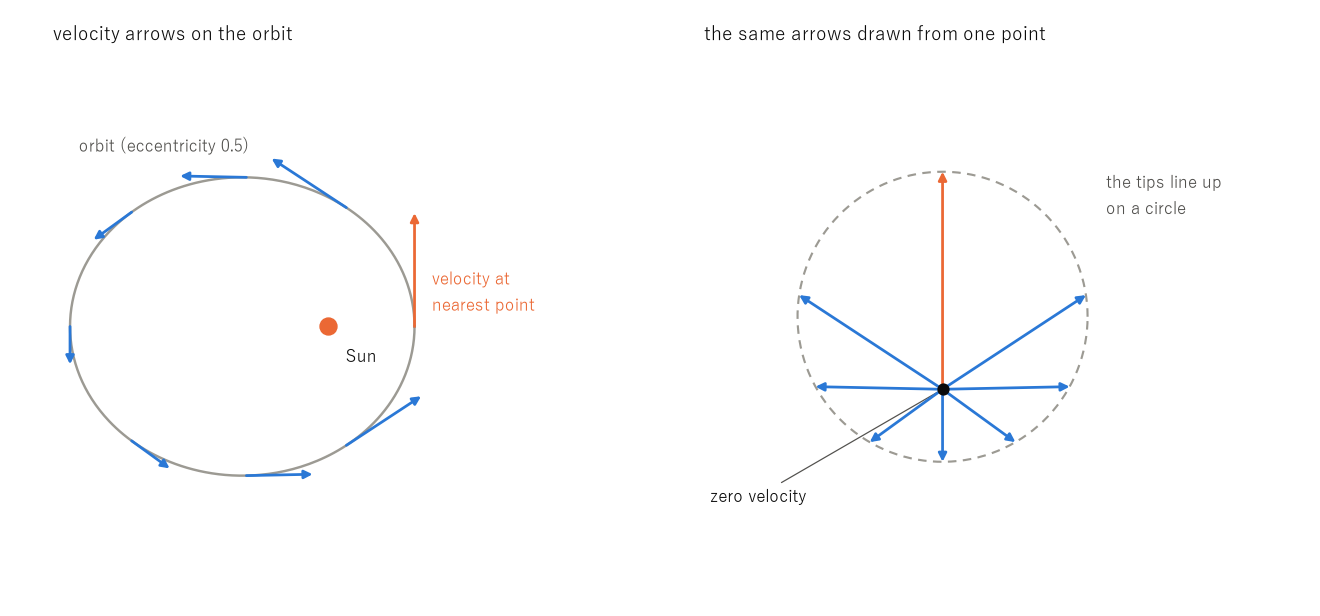
I solved three orbits, of eccentricity 0.0167, 0.5 and 0.9, numerically and fitted a circle to the tips of the velocities. The deviation from a circle was at most 3.4×10⁻¹² of the radius. The radius of the circle is GM/h (h the angular momentum), and the offset of its centre is the eccentricity times that.
For the Earth, in a model with a semi-major axis of 1 astronomical unit and eccentricity 0.0167, the circle has radius 29.7888 km/s and its centre is offset by 0.4975 km/s. The greatest speed, at perihelion, is 30.2863 km/s, and the least, at aphelion, 29.2914 km/s. The radius of the circle is their mean, and the offset is half their difference.
The centre of the circle has another meaning. A body moving under an inverse-square force has one more arrow that points along the long axis of its orbit and never changes (the eccentricity vector). The centre of the circle sat at that arrow turned through a right angle (agreement within 2.75×10⁻¹¹).
The circle alone draws the orbit
The construction in Feynman’s lecture draws the orbit itself out of this circle. Turn the circle through a right angle and draw the perpendicular bisectors of the segments joining the point of zero velocity to points of the circle; the shape these lines wrap around is an ellipse. In my calculation, too, the constructed points agreed within 1.14×10⁻¹¹ with the positions on the orbit at the same moment, scaled down. The velocity circle alone gives the shape of the orbit and the position at each moment.
Inside or outside the circle: staying or leaving
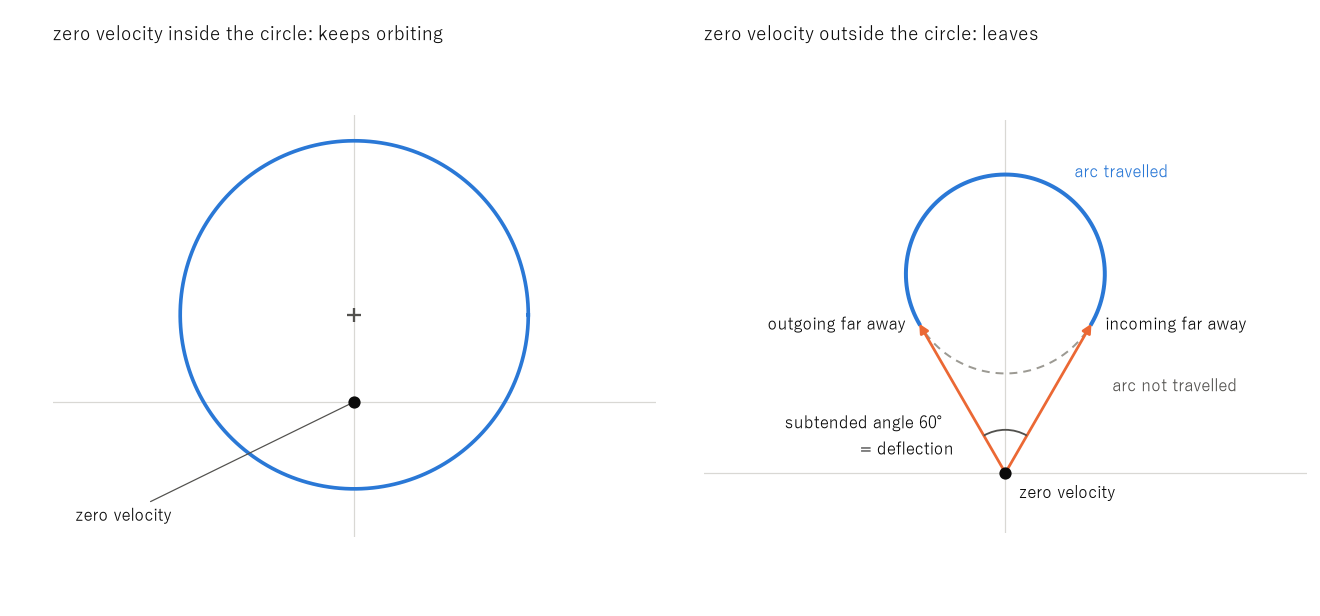
Whether the point of zero velocity lies inside or outside the velocity circle decides the fate. Inside, the orbit is an ellipse and the planet keeps going round. Exactly on the circle, it is a parabola. Outside, it is a hyperbola, and the body never returns.
In numbers, the energy is half the power of the point of zero velocity with respect to the circle (the squared distance to the centre minus the squared radius). Inside the circle the power is negative; outside it is positive. Milnor wrote this formula in 1983, and I checked it on six orbits (difference at most 2.7×10⁻¹³).
Multiply the speeds in opposite directions, and you always get the same
The theorem on the power of a point, taught at school, does its work here. A line through a point inside a circle meets the circle at two points, and the product of the distances to them is the same whatever the direction of the line. In terms of the velocity circle, two velocities on an orbit pointing in opposite directions always have speeds whose product is the same. Its value is GM/a (a the semi-major axis).
In the model of the Earth, the speed at perihelion, 30.2863 km/s, times the speed at aphelion, 29.2914 km/s, is 887.13 km²/s², which agrees with GM/a, 887.13 km²/s². Not only perihelion and aphelion: any pair in opposite directions gives the same. I checked this in 12 directions from the orbit data without fitting a circle, and the deviation was at most 5.8×10⁻⁸.
The angle through which a departing body is turned
A body that passes near the Sun and leaves has its direction turned. The angle of turning was the angle the velocity circle subtends from the point of zero velocity, and the speed far away was the length of the tangent from that point to the circle. On an orbit of eccentricity 2 the body turns through 60 degrees, and at 3 through 38.942441 degrees, agreeing within 10⁻¹¹ degrees with the angle from integrating numerically out to great distances.
The point of zero velocity, the centre of the circle and a point of tangency form a right triangle. This is exactly Rutherford’s formula (1911) for the angle through which an alpha particle is turned by a nucleus. The body turns through a right angle when the tangent is as long as the radius of the circle (eccentricity √2).
Only the inverse-square force makes a circle
So what makes the curve a circle? Working out how sharply the velocity curve bends (its radius of curvature) gives “force × squared distance ÷ angular momentum”. For a force that falls off as the inverse square of the distance, this does not depend on the distance, so the curve is a circle.
I varied how the strength of the force depends on distance (its power) and compared orbits whose nearest point is at 1 and farthest at 2. The greatest radius of curvature divided by the smallest was 8.000000 for a spring (power +1), 2.000000 for power −1, 1.414214 for powers −1.5 and −2.5, and 1.000000 only for the inverse square.
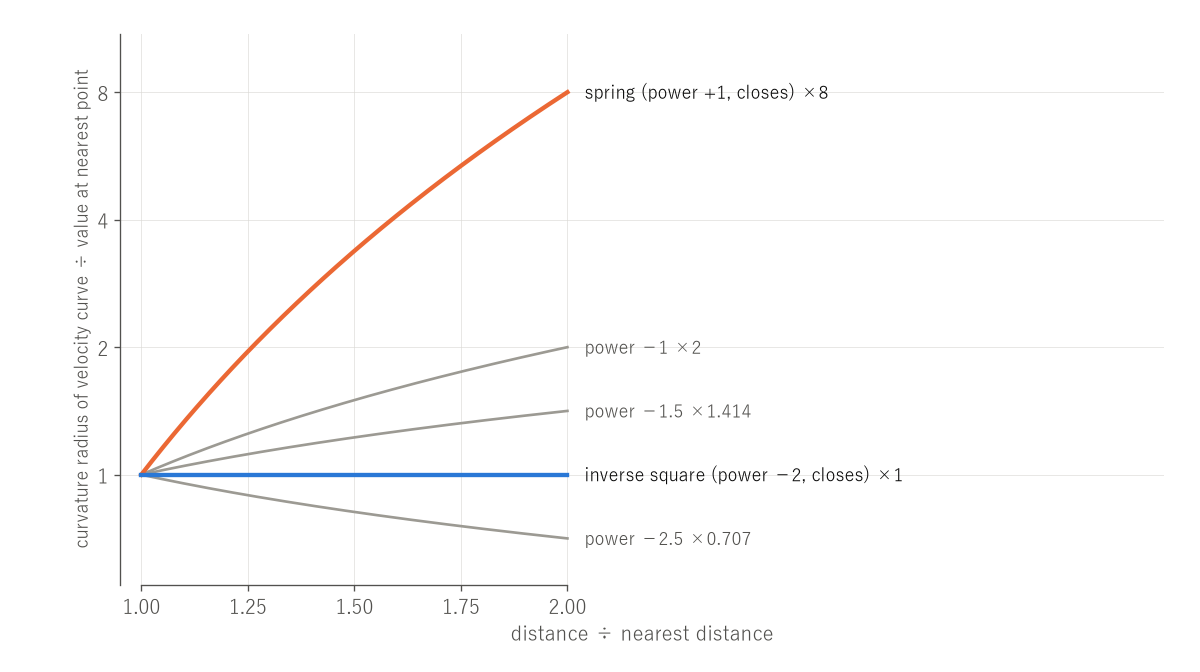
The spring is the interesting one. Under the force of a spring, too, orbits close; the only forces whose orbits always close are the inverse square and the spring (Bertrand’s theorem). Yet the velocity curve is a circle for only one of them, the inverse square. Closing and having a circular velocity curve are different conditions.
What this story does not say
- It claims no new theorem. The velocity circle (Hamilton 1847), its relation to the energy (Milnor 1983) and Rutherford’s formula (1911) are all known results; Paper 1103 goes as far as checking them numerically and reading them side by side.
- It treats the plane motion of one sun and one planet. The pull of the planets on one another and the shift of perihelion by general relativity are not included.
- The Earth’s numbers are those of a model with a semi-major axis of 1 astronomical unit and eccentricity 0.0167.
Frequently asked questions
For the Earth, the point of zero velocity is almost at the centre of the circle, isn’t it?
Yes. The Earth’s orbit is nearly a circle, so the offset, 0.4975 km/s, is very small compared with the radius, 29.7888 km/s. The more elongated the orbit, like a comet’s, the closer the point of zero velocity comes to the edge of the circle.
Do the circles of orbits with the same energy have anything in common?
They do. Carry the velocity circles of orbits with the same energy back onto the surface of a sphere, and each becomes a great circle (a circle through the centre of the sphere) (Fock 1935). In my calculation, the plane of the carried points passed within 3.4×10⁻¹² of the centre of the sphere. This family of circles is the same family as the light paths in Maxwell’s fish-eye lens, where light travels in circles (Paper 1045).
What shape is the velocity curve of a spring?
An ellipse centred at the origin. The orbit itself is also an ellipse centred at the origin, and the velocity curve is an ellipse of the same shape and orientation, differing only in size. It is not a circle.
The original papers
- Paper 1103 “A Planet’s Velocity Arrow Traces a Circle, and the Planet Stays If the Point of Zero Velocity Lies Inside It and Leaves If It Lies Outside”
- Paper 79 “The Hidden Symmetry Unique to n=2”
- Paper 1072 “Squaring the Ellipse of a Spring Gives the Ellipse of Kepler”
- Paper 1045 “Light Travels in Circles in Maxwell’s Fish-Eye Because the Index Is the Scale Factor of a Map of the Sphere”
All the papers are published under CC BY 4.0.