Set the mass to m = 4π, and E = mc² becomes 4πc², the same form as the surface area of a sphere of radius c. Integrate it over c from 0 to c and (4/3)πc³ comes back, the volume of that sphere (Paper 12). If energy has the form of “the amount on a skin”, what happens if we stop gathering it into one unit, the joule, and count it instead in types: point, line, skin and flesh? This page is an imaginary world of physics built from that question.
The types are called yuuki (symbol yk). The equations and numbers are those of present-day physics; only the names of the units and the way types are assigned change. No new law of physics is claimed. Every number and type on the page can be checked with the Python code printed in full at the end.
The calculations in this article were made for this page or come from papers that I published myself as preprints; they have not been peer reviewed.
Key points
- The starting table of types has four rows: 0 yk is mass (point), 1 yk is tension (line), 2 yk is the old joule (skin), and 3 yk is the quantity of volume restoration (flesh).
- Checking the dimensions, the three steps all turned out different. The rows 0, 2 and 3 yk sit on the speed ladder, which multiplies by c once per step; only the 1 yk row, tension, sits on the length ladder, which holds the exponent of time at −2.
- Edition 1 takes the speed ladder as the standard and makes 1 yk the momentum (kg·m/s). Tension stays, in the seat of “1 yk / s”. Both sides of E² = (mc²)² + (pc)² are then 2 yk.
- Of the 1,125 papers that have a Japanese manuscript, 881 do not change by a single word. In 201 only the name of energy becomes 2 yk, and in 43 the numbers in J, eV or W are rewritten.
- There are two roads to 3 yk with the same type and coefficients that differ by a factor of 2 (stacking the skin gives mc³/3, integrating over speed gives mc³/6). A type sees only dimensions, so telling the roots of coefficients apart remains a job outside the types.
- On the quantum side, E = hν, p = h/λ and hν = mc² also have matching types. Planck’s constant h reads both as “2 yk · s” and as “1 yk · m”, and joins the side of time to the side of space.
- Starting point
- The table
- One row off
- Four types
- 1 kg
- How the papers change
- Two roads
- Planck quantities
- The quantum side
- Ways to refute
- Questions
- References
Starting point: reading E = mc² as a skin
Paper 01 showed that for a ball of density r⁻ⁿ, the mass added by each shell is independent of the radius only for n = 2 (the uniqueness theorem). Paper 02 showed that the mass inside radius 1 is then exactly the full solid angle, 4π. Setting this 4π as the mass is where Yamagishi’s mathematical physics starts.
Put m = 4π into E = mc² and it becomes 4πc², the same form as the skin of a sphere of radius c. Paper 12 read this as “the equation of a skin” and integrated over c to bring back the flesh, (4/3)πc³. Lined up from the start, mass is a point; multiplied once by c it is the line of the radius, twice a skin, three times flesh.
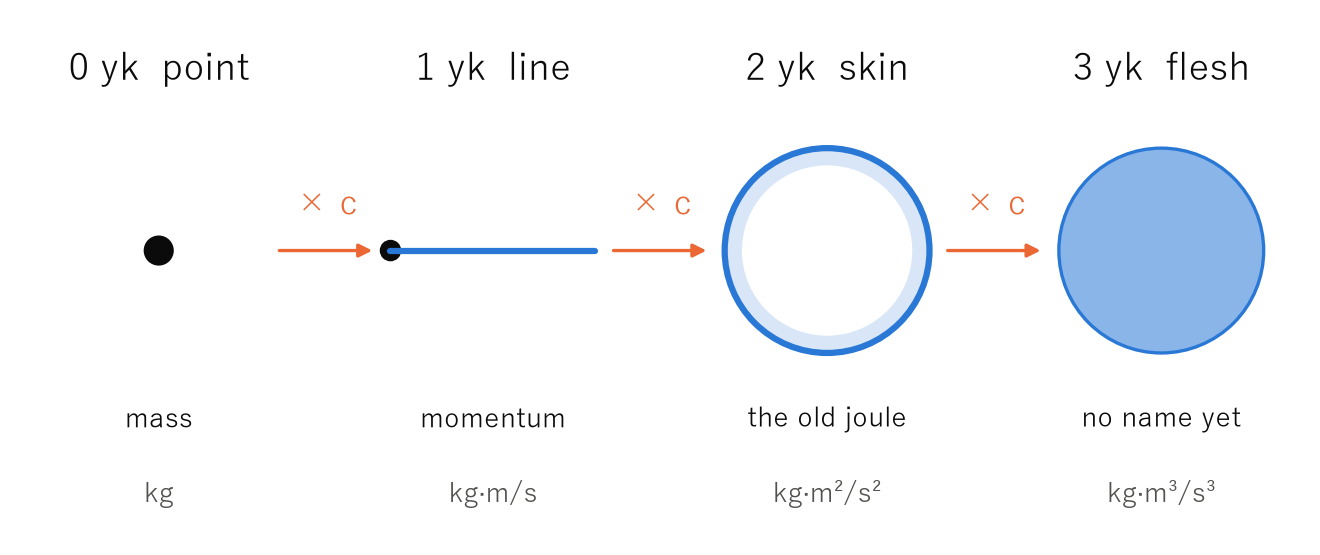
The table of types and three brakes
The starting point was the following table, written in the style of types in a programming language.
| Type | Name | Dimension | Shape |
|---|---|---|---|
| 0 yk | Mass | kg | point |
| 1 yk | Tension | kg·m/s² | line |
| 2 yk | SurfaceEnergy (energy of the skin, the old joule) | kg·m²/s² | skin |
| 3 yk | VolumeEnergy (quantity of volume restoration) | kg·m³/s³ | flesh |
In building this world, three of Yamagishi’s six brakes were applied.
- Do not summon higher dimensions or unknown particles at will. There are only four types, from 0 yk to 3 yk.
- Do not take a single step outside what the equations say. A type fixes dimensions only; no coefficients or meanings are added.
- Always attach a Python check and present things in a form that can be refuted. For each check, the page says which part falls if it fails.
Checked against the dimensions, one row is off
If the table were one ladder, it would climb from 0 yk to 3 yk in steps of equal width. So the dimension of each row was placed on a map of the exponent of length and the exponent of time. The exponent of mass is 1 in every row.
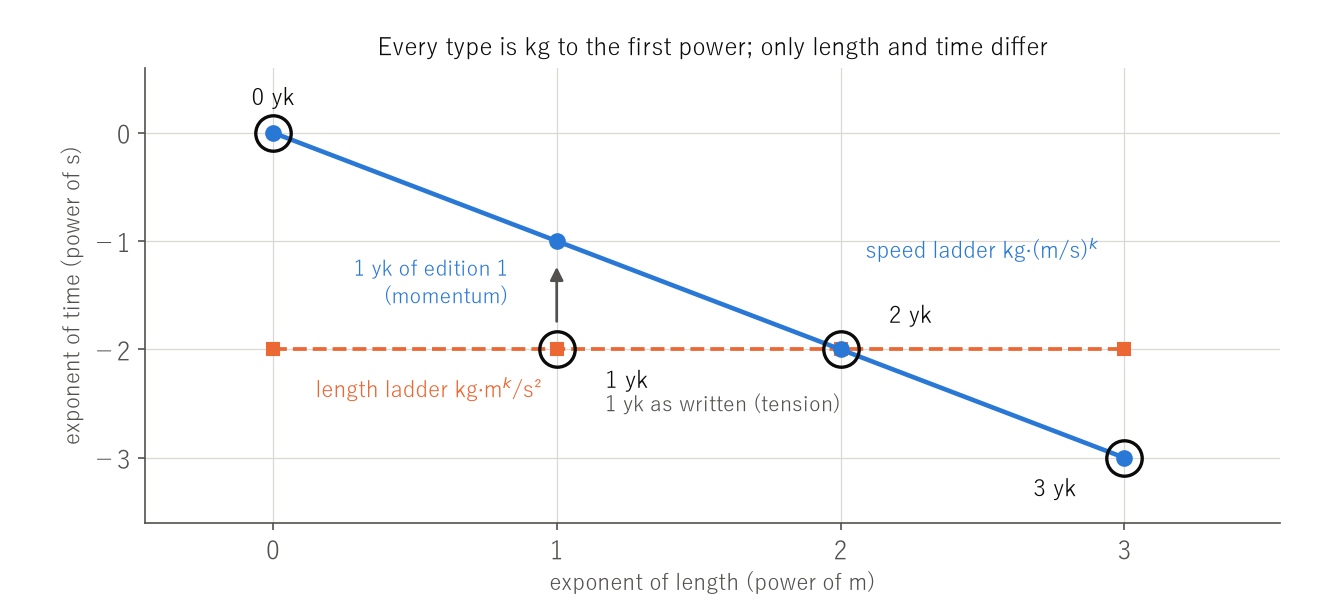
The steps are ×m/s² from 0 to 1, ×m from 1 to 2, and ×m/s from 2 to 3: all three differ. The three rows 0, 2 and 3 yk sit on the speed ladder kg·(m/s)ᵏ, which multiplies the mass by c k times. Only the 1 yk row, tension, sits on the length ladder kg·mᵏ/s², which holds the exponent of time at −2 and adds length.
The length ladder is a consistent ladder too. But if it is made the standard, step 0 becomes kg/s² (N/m, the dimension of surface tension), and mass drops out of the table. The point we started from no longer sits on the ladder.
The four types of edition 1
Edition 1 takes the speed ladder as the standard. What decides it lies on the side of the equations.
- The two starting equations climb the speed ladder. E = mc² multiplies the mass by c twice, and (4/3)πc³ integrates that once over c.
- The two sides of E² = (mc²)² + (pc)², which Paper 12 calls the Yamagishi overclock Pythagorean equation, match when the momentum p is 1 yk; then pc is 2 yk. In the table as written, momentum has no type.
- The statement of Paper 913, that kinetic energy is exactly half the product of momentum and speed, reads as a relation between the neighbouring steps 1 yk and 2 yk.
| Type | Dimension | Shape | Present name | Divided or multiplied by a second |
|---|---|---|---|---|
| 0 yk | kg | point | mass | 0 yk / s is a flow of mass (kg/s) |
| 1 yk | kg·m/s | line | momentum | 1 yk / s is force or tension (N); c⁴/G has this type too |
| 2 yk | kg·m²/s² | skin | energy (the old joule) | 2 yk / s is power (W); 2 yk · s is action (the dimension of ħ) |
| 3 yk | kg·m³/s³ | flesh | no name of its own (W·m in SI) | – |
Tension has not been thrown away. Tension is the rate at which momentum changes per second (F = dp/dt), so it takes the seat of “1 yk / s”. All three steps are ×m/s: multiplying by c once, or integrating over c once, is one step up. There are no types above 3 yk in this world (the first brake).
One kilogram in the four types
Count 1 kg in the four types, with SI numbers as they are.
| Type | Value |
|---|---|
| 0 yk | 1 kg |
| 1 yk | m·c = 2.997924580×10⁸ kg·m/s |
| 2 yk | m·c² = 8.98755178737×10¹⁶ kg·m²/s² (the old joule) |
| 3 yk | stacking the skin, m·c³/3 = 8.981334×10²⁴; integrating over speed, m·c³/6 = 4.490667×10²⁴ (kg·m³/s³) |
Why 3 yk has two values is checked below, in “Two roads to 3 yk”.
How the papers change
In the 1,125 papers that have a Japanese manuscript, I counted whether the word “energy”, mc², or the units J, eV and W appear. This is a rough count by matching text (the “joule” inside the Japanese word for “module” was left out).
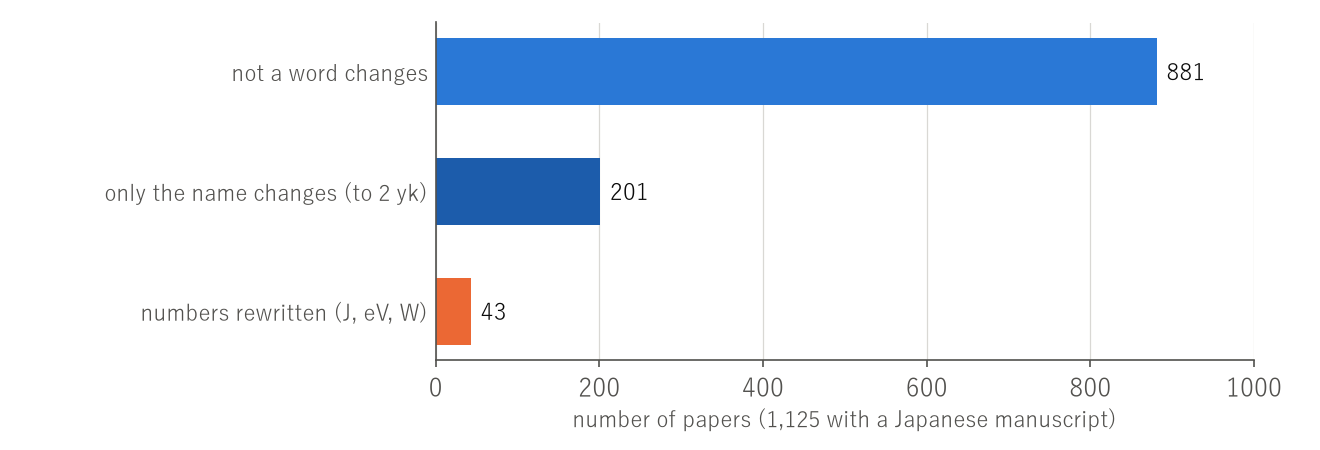
There are 132 papers in which four-dimensional or higher-dimensional space is mentioned (they overlap with the three groups). Where dimensions are varied as mathematics, nothing stops in this world either.
Not a word changes: Papers 01 and 02
The theorem of Paper 01 (the mass added per shell is independent of the radius only for n = 2) and the m = 4π of Paper 02 are both about a distribution of 0 yk and close entirely within 0 yk. Changing the types of energy does not move the starting point. This world stands on Papers 01 and 02.
Only the name changes
- Paper 1113: the gravitational energy of a 1/r² ball, −GM²/R, is 2 yk. A mass defect is 2 yk divided by c², which returns to 0 yk.
- Paper 1115: the kT/2 shared out to each cell of the light sphere and their total 4πc² are both 2 yk. The number of cells has no dimension.
- Paper 912: in the temperature coefficient kT = (4π/3)v², kT is 2 yk.
Neither the form of the equations nor the numbers change. The only change is that the single name “energy” becomes the name of a type, 2 yk.
Meaning is added
The (4/3)πc³ of Paper 12 is 2 yk integrated once over c, so it is 3 yk. In present-day physics kg·m³/s³ has no name of its own and can only be written W·m. In this world, the volume restoration equation turns from “a rereading” into “one step of a type”.
In Paper 18 and Paper 913, the origin of the ½ becomes visible on the ladder. Integrate the m of 0 yk once over speed and you get mv (1 yk); once more and you get ½mv² (2 yk). Every term of the expansion in Paper 18, E = 4πc² + 2πv² + (3/2)πv⁴/c² + …, is 2 yk, lined up in powers of v/c.
Stopped by a brake
Paper 12 extends the same reading to four dimensions and writes ∫₀ᶜ 2π²r³ dr = (π²/2)c⁴. As an integral it is correct. But its dimension, kg·m⁴/s⁴, has no type in this world. The check stops and says “no type”. Whether to add a fourth type is decided by people, not by the equations. Of the 132 papers that mention four or more dimensions, the only place read and confirmed to extend the energy ladder to a fourth step is this one in Paper 12.
Two roads to 3 yk: the root of a coefficient stays outside the types
There are two ways to reach 3 yk. One is the form of Paper 12: stack the skin of E = mc² from radius 0 to c. What is stacked is m r², so the result is mc³/3. The other is the form of Papers 18 and 913: integrate m over speed three times. It goes m, mv, ½mv², and the third time gives mc³/6.
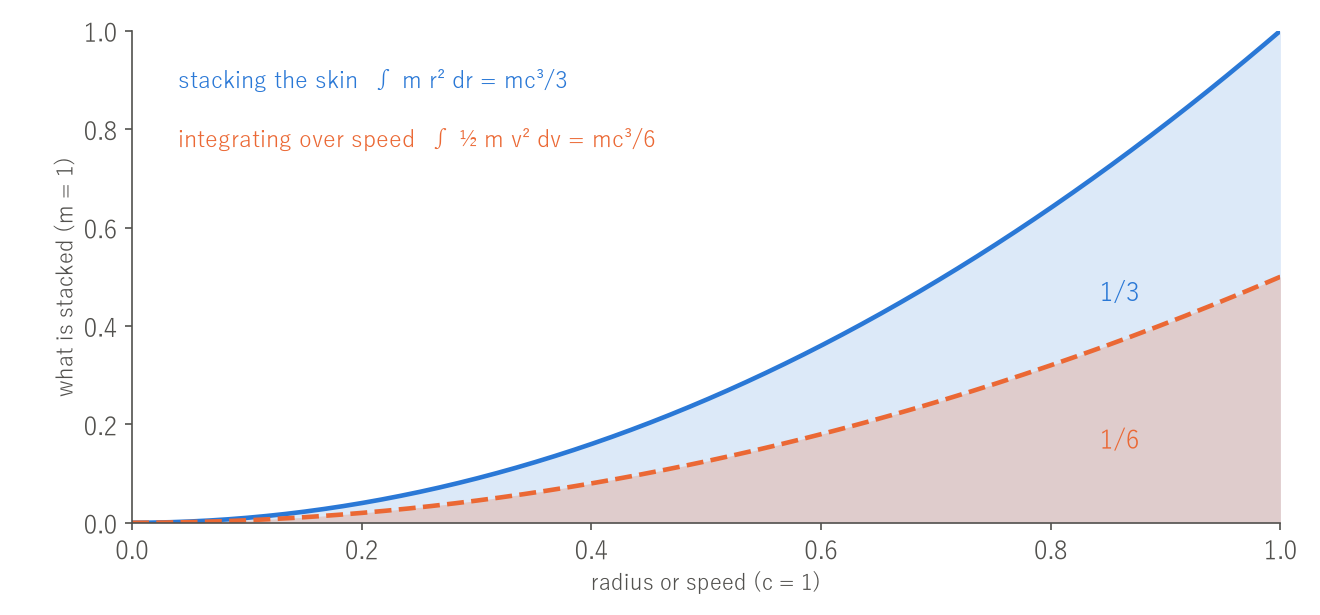
The two have the same type, and their coefficients differ by a factor of 2. A type sees only dimensions, so on the level of types the two cannot be told apart. The same thing happens at 2 yk: mc² and ½mv² are both 2 yk, and whether there is a ½ lies outside the types (Paper 913).
Saying what must be moved to turn one thing into another is the job of the separator. Here the separator is the root of the coefficient: 1/3 comes from “stacking the skin of a sphere”, 1/6 from “integrating over speed” (dividing by the count each time). Dividing energy into four types still leaves the work of telling the roots of coefficients apart outside the types. Which coefficient nature chooses, the equations do not yet say, so this world does not supply an answer.
Planck quantities climb by one c at a time
Here is the setting of Paper 44, passed through the types. Put G = 4π and ħ = 1/(4π). Their product ħG is then exactly 1. Every Planck quantity is built from ħ, G and c, so once ħ and G cancel, only c and 4π are left.
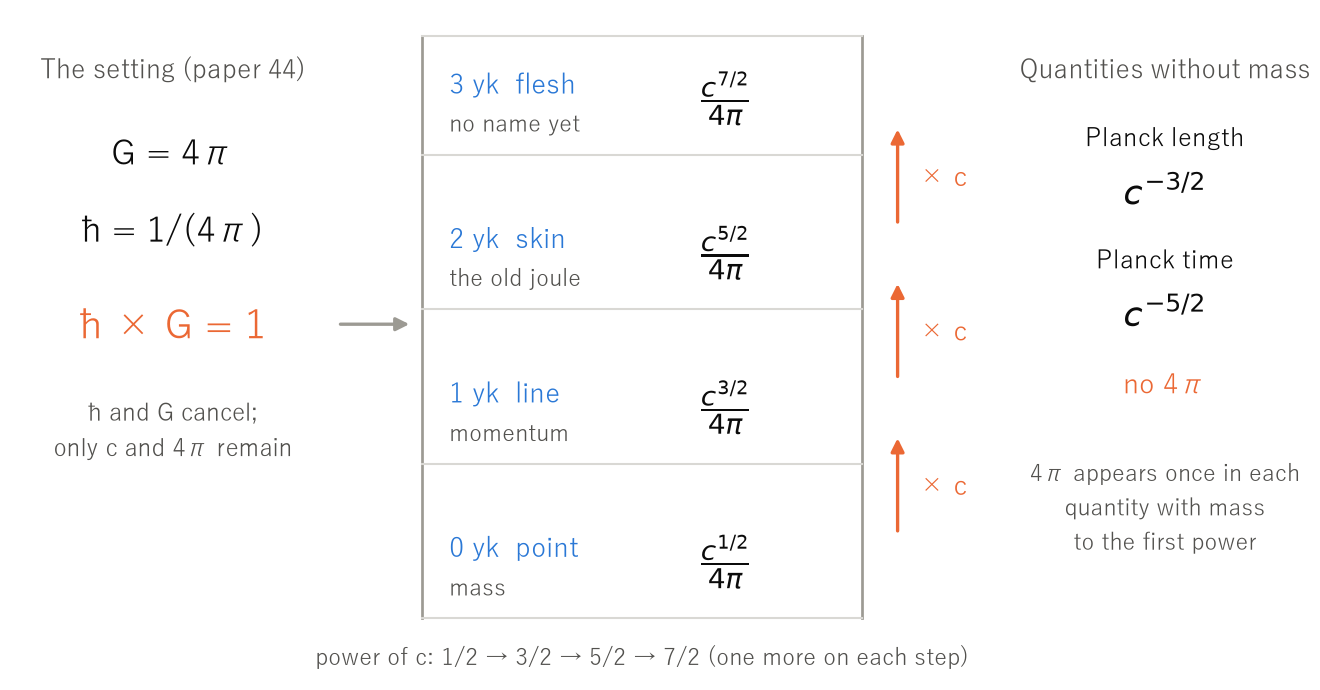
The Planck mass √(ħc/G) becomes √c/(4π). This is 0 yk, the point. Going up one step of the types means multiplying by a speed once. For the Planck quantities that speed is c, so each step multiplies by exactly one c.
| Type | Planck quantity | After the setting | Power of c |
|---|---|---|---|
| 0 yk (point) | mass | √c/(4π) | 1/2 |
| 1 yk (line) | momentum | c^(3/2)/(4π) | 3/2 |
| 2 yk (skin) | energy | c^(5/2)/(4π) | 5/2 |
| 3 yk (flesh) | kg·m³/s³ | c^(7/2)/(4π) | 7/2 |
The power of c goes 1/2, 3/2, 5/2, 7/2, one more each time. All four are divided by 4π once, because every type carries mass to the first power. Quantities without mass make this clear. The Planck length is c^(−3/2) and the Planck time is c^(−5/2), and neither carries 4π. In the language of the types, the statement of Paper 44, “the power of 4π is the mass dimension”, reads: a type with mass to the first power carries 4π once.
With the real G and ħ (the SI values), each step still multiplies by c once. Figure 6 draws those four values on a common logarithm.
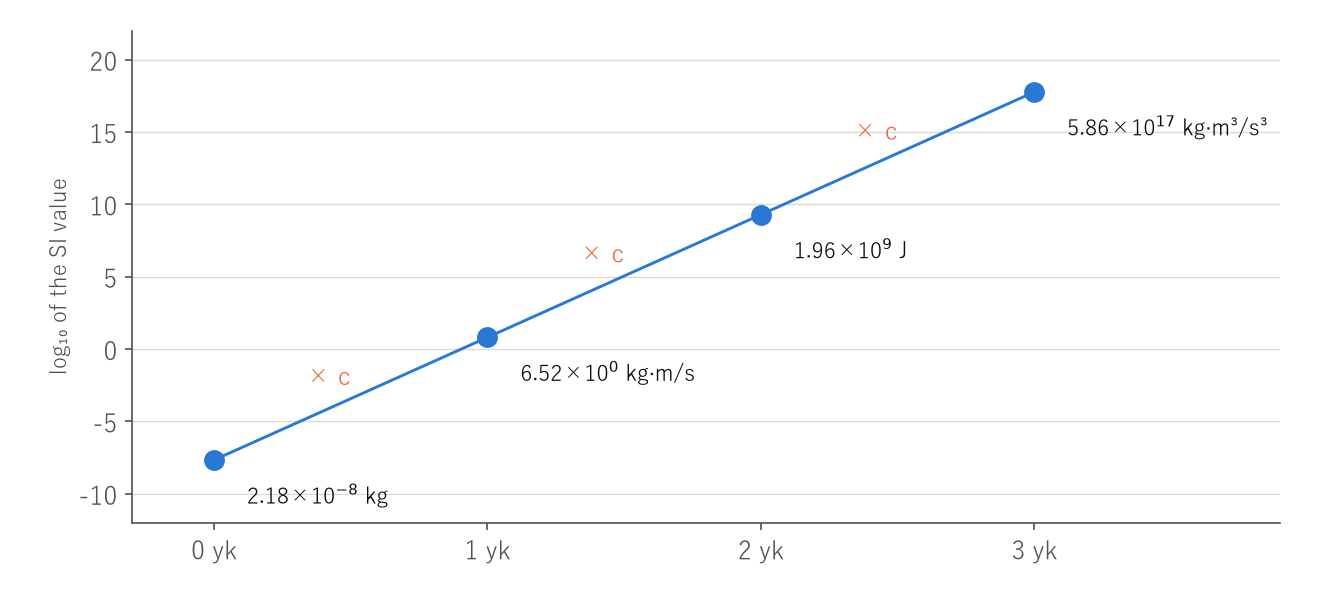
In SI, 0 yk is the Planck mass, 2.176434×10⁻⁸ kg, and 2 yk is the Planck energy, 1.956082×10⁹ J. Between them, 1 yk is 6.524786 kg·m/s, and above them 3 yk is 5.864185×10¹⁷ kg·m³/s³.
The quantum side: E = hν and p = h/λ stand on the same steps
So far the equations put through the types were those of relativity. Now put the quantum ones through the same types. Planck’s constant h has the dimension J·s (kg·m²/s), which in this world is “2 yk · s”. A frequency ν is 1/s, and a wavelength λ is m.
| Equation | Type of the left side | Type of the right side |
|---|---|---|
| E = hν | 2 yk | (2 yk · s) × (1/s) = 2 yk |
| p = h/λ | 1 yk | (1 yk · m) ÷ m = 1 yk |
| hν = mc² | 2 yk | 2 yk |
| E = pc (light) | 2 yk | 1 yk × speed = 2 yk |
h can be read in two ways. kg·m²/s is “2 yk multiplied by a second”, and at the same time “1 yk multiplied by a length”. E = hν uses the reading on the side of time: the second is cancelled by the frequency. p = h/λ uses the reading on the side of space: the length is cancelled by the wavelength. One constant joins the side of time to the side of space.
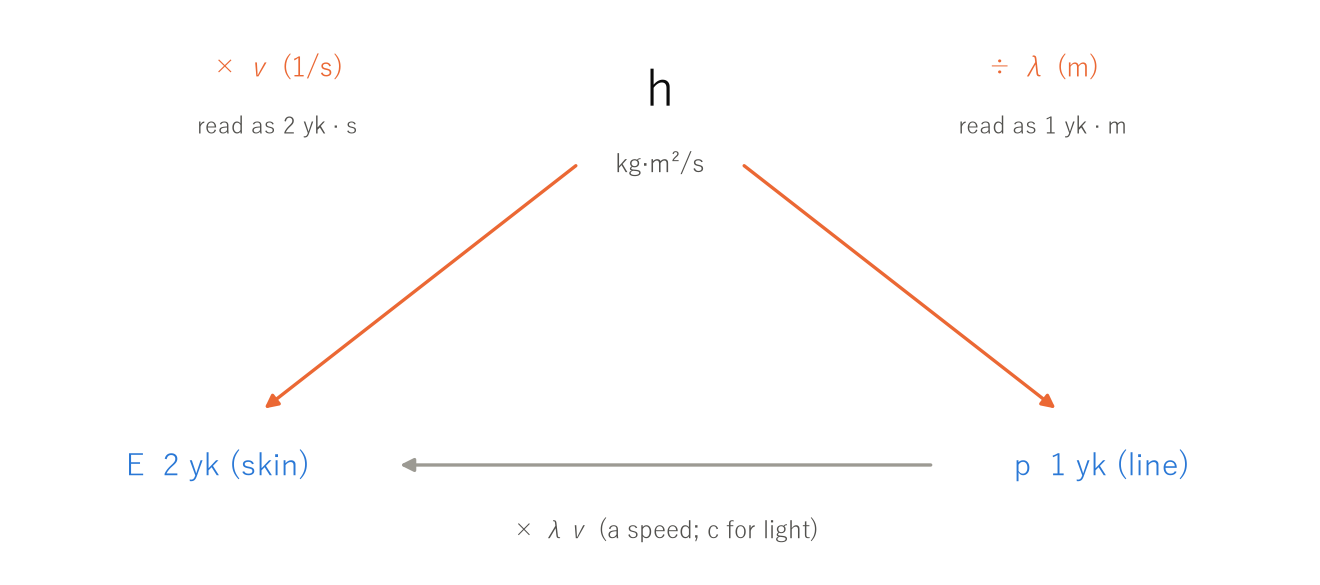
The ratio of E to p is λν, which is a speed. One step from 1 yk to 2 yk is multiplying once by a speed, and for light that speed is c. For green light of 500 nm, ν = 5.99584916×10¹⁴ /s, E = hν = 3.972892×10⁻¹⁹ J and p = h/λ = 1.32521403×10⁻²⁷ kg·m/s, and E ÷ p agrees with c to a difference smaller than 10⁻¹².
Both sides of hν = mc² are 2 yk as well. A photon, however, has no rest mass. The m in this equation is the mass carried by the photon’s energy (4.420438×10⁻³⁶ kg for green light), the same thing as the weight E/c² that light crossing a box carries in Paper 911.
In the table as written (1 yk = tension), the right side of p = h/λ, kg·m/s, gets no type. The de Broglie relation becomes a fourth reason why edition 1 took the speed ladder as the standard. The other way round, writing E = h/λ by mistake would set 2 yk equal to 1 yk, and the check stops.
Types do not see 2π either. hν and ħω are the same number, and h and ħ (= h/(2π)) have the same type. Which side the 2π goes to stays outside the types, like the 1/3 and 1/6 of the two roads to 3 yk. Every correct equation of physics has matching dimensions. That is also why it passes through types that only rename the units. What the type check confirms is that the dimensions match; it is not a proof that the equation itself is right. Even so, it still stops slips of the pen and shows which quantity sits on which step.
Ways to refute, and the full check
The numbers and types of this world are checked in Python. A dimension is counted as the triple of exponents (mass, length, time), and the exponents are kept as fractions. The equations are integrated and expanded in series with sympy. Here is which part of the page falls if each check fails.
| Section of the check | What falls if it fails |
|---|---|
| 1. The table and the two ladders | “One row is off” and the choice of edition 1 |
| 2. Volume restoration in Paper 12 | Paper 12 under “Meaning is added”, and “Stopped by a brake” |
| 3. Two roads to 3 yk | “Two roads to 3 yk” |
| 4. The two sides of the Pythagorean equation | The second reason for edition 1 |
| 5. Kinetic energy and momentum | The origin of the ½ |
| 6. Types divided by a second | The seats of tension and power |
| 7. Planck quantities | “Planck quantities climb by one c at a time” |
| 8. Mass defect | Paper 1113 under “Only the name changes” |
| 9. One kilogram | The table for 1 kg |
| 10. Adding different types | The type check itself (if it did not stop, the types would be decoration) |
| 11. The quantum side | The section “The quantum side” |
The other way to refute lies in the papers themselves. If a place is found where an equation adds things of different types, that paper needs rewriting in this world. Pass the terms of the equation to same_type_sum in the check to find out.
The full check (runs with Python 3 and sympy)
# A world without joules: the check (a thought experiment)
# Yuuki Yamagishi, 2026-11-18. Runs with Python 3 and sympy. Published under CC BY 4.0.
#
# The rules of this world:
#   Energy is not one unit (the joule). It is counted in four types: point, line, skin and flesh.
#   The types are called n yuuki, written [n yk].
# Three of Yamagishi's six brakes are used here:
#   1. Do not summon higher dimensions or unknown particles (only 0 to 3 yk exist).
#   2. Do not step outside what the equations say (a type fixes dimensions only).
#   3. Always attach a check that can fail (each assert below guards one claim of the page).
# A dimension is the triple of exponents (mass M, length L, time T): kg = (1,0,0), m = (0,1,0), s = (0,0,1).

import math
import sys
from fractions import Fraction as Fr
import sympy as sp

if hasattr(sys.stdout, "reconfigure"):
    sys.stdout.reconfigure(encoding="utf-8")


def D(M=0, L=0, T=0):
    return (Fr(M), Fr(L), Fr(T))


def mul(*xs):
    r = D()
    for x in xs:
        r = tuple(a + b for a, b in zip(r, x))
    return r


def inv(x):
    return tuple(-a for a in x)


def pw(x, k):
    return tuple(a * Fr(k) for a in x)


KG, METER, SEC = D(1, 0, 0), D(0, 1, 0), D(0, 0, 1)
SPEED = mul(METER, inv(SEC))
NONE = D()


def show(x):
    names = (("kg", x[0]), ("m", x[1]), ("s", x[2]))
    up = [n + ("" if e == 1 else "^" + str(e)) for n, e in names if e > 0]
    dn = [n + ("" if e == -1 else "^" + str(-e)) for n, e in names if e < 0]
    s = "*".join(up) if up else "1"
    return s + ("/" + "*".join(dn) if dn else "")


# The starting table, as written
USER = [
    (0, "Mass (point)", D(1, 0, 0)),
    (1, "Tension (line)", D(1, 1, -2)),
    (2, "SurfaceEnergy (skin, the old joule)", D(1, 2, -2)),
    (3, "VolumeEnergy (flesh, volume restoration)", D(1, 3, -3)),
]


def ladder_speed(k):    # kg*(m/s)^k : multiply the mass by c, k times (integrate over c, k times)
    return mul(KG, pw(SPEED, k))


def ladder_length(k):   # kg*m^k/s^2 : keep the time exponent at -2 and add only length
    return mul(KG, pw(METER, k), pw(SEC, -2))


# The types of edition 1 (the speed ladder is the standard)
YK = {k: ladder_speed(k) for k in range(4)}
YK_NAME = {0: "0 yk (point)", 1: "1 yk (line)", 2: "2 yk (skin)", 3: "3 yk (flesh)"}


class BrakeError(Exception):
    pass


def yk_of(x):
    for k, v in YK.items():
        if v == x:
            return YK_NAME[k]
    for k, v in YK.items():
        if mul(v, pw(SEC, -1)) == x:
            return YK_NAME[k] + " / s"
        if mul(v, SEC) == x:
            return YK_NAME[k] + " * s"
    if x == NONE:
        return "no dimension"
    raise BrakeError("no type: " + show(x) + " (this world has 0 to 3 yk only)")


def same_type_sum(terms):
    ds = [t[1] for t in terms]
    if any(d != ds[0] for d in ds):
        raise TypeError("added things of different types: " + ", ".join(n + " = " + show(d) for n, d in terms))
    return ds[0]


LOG = []


def out(s=""):
    LOG.append(s)
    print(s)


def ok(cond, label):
    assert cond, label
    out("  OK  " + label)


def main(wrong=False):
    out("A world without joules: the check")
    out("sympy " + sp.__version__)
    out()

    out("1. The starting table against the two ladders")
    for k, name, d in USER:
        out("  %d yk  %-42s %-12s speed ladder: %-4s length ladder: %s"
            % (k, name, show(d), "on" if d == ladder_speed(k) else "-", "on" if d == ladder_length(k) else "-"))
    steps = [mul(USER[i + 1][2], inv(USER[i][2])) for i in range(3)]
    out("  steps: " + ", ".join("%d->%d is x %s" % (i, i + 1, show(s)) for i, s in enumerate(steps)))
    ok(len(set(steps)) == 3, "as written, the three steps all differ (not one ladder)")
    ok(USER[1][2] != ladder_speed(1) and USER[1][2] == ladder_length(1), "only the 1 yk row (Tension) leaves the speed ladder and sits on the length ladder")
    ok(all(USER[k][2] == ladder_speed(k) for k in (0, 2, 3)), "0, 2 and 3 yk sit on the speed ladder")
    ok(ladder_length(0) == D(1, 0, -2), "step 0 of the length ladder is kg/s^2 (N/m, surface tension), not mass")
    ok(all(d != mul(KG, SPEED) for _, _, d in USER), "as written, momentum kg*m/s gets no yk type")
    ok(all(YK[k + 1] == mul(YK[k], SPEED) for k in range(3)), "edition 1: every step is x m/s (multiply by c once, integrate over c once)")
    out()

    out("2. Paper 12: E = mc^2 = 4 pi c^2, then integrate over c")
    c, r, v, m = sp.symbols("c r v m", positive=True)
    V = sp.integrate(4 * sp.pi * r**2, (r, 0, c))
    ok(sp.simplify(V - sp.Rational(4, 3) * sp.pi * c**3) == 0, "integral of 4 pi r^2 from 0 to c = (4/3) pi c^3")
    ok(yk_of(mul(KG, pw(SPEED, 2))) == YK_NAME[2], "the type of mc^2 is 2 yk (skin)")
    ok(yk_of(mul(YK[2], SPEED)) == YK_NAME[3], "2 yk integrated over c is 3 yk (flesh); in SI, kg*m^3/s^3 = W*m")
    try:
        yk_of(mul(YK[3], SPEED))
        ok(False, "a fourth step was read")
    except BrakeError as e:
        out("  BRAKE  the four-dimensional step (pi^2/2) c^4 of paper 12: " + str(e))
    V4 = sp.integrate(2 * sp.pi**2 * r**3, (r, 0, c))
    ok(sp.simplify(V4 - sp.pi**2 * c**4 / 2) == 0, "as a number, integral of 2 pi^2 r^3 = (pi^2/2) c^4; it has no type here")
    out()

    out("3. Two roads to 3 yk: the same type, coefficients differ by 2")
    skin = sp.integrate(m * r**2, (r, 0, c))
    k1 = sp.integrate(m, (v, 0, v))
    k2 = sp.integrate(k1, (v, 0, v))
    k3 = sp.integrate(k2, (v, 0, c))
    out("  stacking the skin of mc^2 over c: " + str(sp.simplify(skin)))
    out("  integrating over speed three times (m, mv, mv^2/2, ...): " + str(sp.simplify(k3)))
    ok(sp.simplify(skin / k3) == 2, "same type 3 yk, coefficients 1/3 and 1/6")
    ok(sp.simplify(k2 - m * v**2 / 2) == 0, "integrating twice over speed gives (1/2) m v^2 (papers 18 and 913)")
    out()

    out("4. E^2 = (mc^2)^2 + (pc)^2: both sides of the triangle")
    t = same_type_sum([("(mc^2)^2", pw(mul(KG, pw(SPEED, 2)), 2)), ("(pc)^2", pw(mul(YK[1], SPEED), 2))])
    ok(t == pw(YK[2], 2), "with p = 1 yk, pc = 2 yk and both sides are (2 yk)^2")
    out()

    out("5. Papers 18 and 913: kinetic energy = momentum x speed / 2")
    gamma = 1 / sp.sqrt(1 - v**2 / c**2)
    ser = sp.series(4 * sp.pi * c**2 * gamma, v, 0, 6).removeO()
    want = 4 * sp.pi * c**2 + 2 * sp.pi * v**2 + sp.Rational(3, 2) * sp.pi * v**4 / c**2
    ok(sp.simplify(sp.expand(ser) - want) == 0, "with m = 4 pi: E = 4 pi c^2 + 2 pi v^2 + (3/2) pi v^4/c^2 + ... (paper 18)")
    Ek, p = 2 * sp.pi * v**2, 4 * sp.pi * v
    ok(sp.simplify(Ek / (p * v)) == sp.Rational(1, 2), "E_k / (p v) = 1/2 (paper 913): 2 yk / (1 yk x speed) has no dimension")
    out()

    out("6. Force and power are types divided by a second")
    G_dim = D(-1, 3, -2)
    ok(yk_of(D(1, 1, -2)) == YK_NAME[1] + " / s", "force (tension) kg*m/s^2 = 1 yk / s (F = dp/dt)")
    ok(yk_of(mul(pw(SPEED, 4), inv(G_dim))) == YK_NAME[1] + " / s", "c^4/G is 1 yk / s")
    ok(yk_of(mul(pw(SPEED, 5), inv(G_dim))) == YK_NAME[2] + " / s", "c^5/G (power, W) is 2 yk / s")
    ok(yk_of(D(1, 2, -1)) == YK_NAME[2] + " * s", "action J*s (the dimension of hbar) is 2 yk * s")
    out()

    out("7. Planck quantities: 0 to 3 yk climb by one c each (paper 44: G = 4 pi, hbar = 1/(4 pi))")
    hbar_p, G_p = 1 / (4 * sp.pi), 4 * sp.pi
    out("  hbar * G = " + str(sp.simplify(hbar_p * G_p)))
    ok(sp.simplify(hbar_p * G_p - 1) == 0, "hbar * G = 1: the two constants cancel, so only c and 4 pi are left")
    mP = sp.sqrt(hbar_p * c / G_p)
    for k in range(4):
        out("  " + YK_NAME[k] + " = " + str(sp.simplify(mP * c**k)))
    ok(sp.simplify(mP - sp.sqrt(c) / (4 * sp.pi)) == 0, "m_P = sqrt(c)/(4 pi): all four types have mass dimension 1, so all are c^N/(4 pi)")
    ok(all(sp.simplify(mP * c**k - c**sp.Rational(2 * k + 1, 2) / (4 * sp.pi)) == 0 for k in range(4)),
       "the power of c goes 1/2, 3/2, 5/2, 7/2: one more c on each step")
    lP, tP = sp.sqrt(hbar_p * G_p / c**3), sp.sqrt(hbar_p * G_p / c**5)
    out("  Planck length = " + str(sp.simplify(lP)) + ", Planck time = " + str(sp.simplify(tP)))
    ok(sp.simplify(lP - c**sp.Rational(-3, 2)) == 0 and sp.simplify(tP - c**sp.Rational(-5, 2)) == 0,
       "length and time carry no mass, so they carry no 4 pi: l_P = c^(-3/2), t_P = c^(-5/2)")
    hbar, Gs, cs = 1.054571817e-34, 6.67430e-11, 299792458.0
    out("  constants (CODATA 2022): hbar = %.9e, G = %.5e, c = %.0f" % (hbar, Gs, cs))
    mPs = (hbar * cs / Gs) ** 0.5
    out("  SI: 0 yk %.6e kg, 1 yk %.6e kg*m/s, 2 yk %.6e J, 3 yk %.6e kg*m^3/s^3" % (mPs, mPs * cs, mPs * cs**2, mPs * cs**3))
    out("  log10: %.3f, %.3f, %.3f, %.3f; one step = log10(c) = %.3f"
        % tuple([math.log10(mPs * cs**k) for k in range(4)] + [math.log10(cs)]))
    ok(abs(mPs - 2.176434e-8) / 2.176434e-8 < 1e-6, "Planck mass 2.176434e-8 kg")
    out()

    out("8. Paper 1113: -alpha(n) G M^2 / R is 2 yk; divided by c^2 it returns to 0 yk")
    n = sp.symbols("n")
    alpha = (3 - n) / (5 - 2 * n)
    ok(alpha.subs(n, 2) == 1 and alpha.subs(n, 0) == sp.Rational(3, 5), "alpha(2) = 1, alpha(0) = 3/5")
    ok(yk_of(mul(G_dim, pw(KG, 2), inv(METER))) == YK_NAME[2], "the type of G M^2 / R is 2 yk")
    ok(yk_of(mul(YK[2], pw(SPEED, -2))) == YK_NAME[0], "2 yk / c^2 = 0 yk (a mass defect returns to the point type)")
    out()

    out("9. One kilogram in the four types (SI numbers)")
    out("  0 yk: 1 kg")
    out("  1 yk: m c = %.9e kg*m/s" % cs)
    out("  2 yk: m c^2 = %.11e (the old joule)" % (cs**2))
    out("  3 yk: stacking the skin m c^3/3 = %.6e, integrating over speed m c^3/6 = %.6e (kg*m^3/s^3)" % (cs**3 / 3, cs**3 / 6))
    ok(abs(cs**2 - 8.98755178737e16) < 1e5, "m c^2 = 8.98755178737e16 (the SI value of paper 1115)")
    out()

    out("10. The door to refutation: adding different types stops")
    try:
        same_type_sum([("4 pi c^2 (2 yk)", YK[2]), ("(4/3) pi c^3 (3 yk)", YK[3])])
        ok(False, "different types were added")
    except TypeError as e:
        out("  OK  stopped: " + str(e))
    if wrong:
        same_type_sum([("4 pi c^2 (2 yk)", YK[2]), ("(4/3) pi c^3 (3 yk)", YK[3])])
    out()

    out("11. The quantum side: E = h nu, p = h / lambda, h nu = m c^2 (added 2026-11-18)")
    H_DIM = D(1, 2, -1)          # Planck's constant h: J*s = kg*m^2/s
    NU = pw(SEC, -1)             # frequency nu: 1/s
    ok(yk_of(H_DIM) == YK_NAME[2] + " * s", "h (J*s) is 2 yk * s")
    ok(mul(YK[1], METER) == H_DIM, "h is also 1 yk * m (momentum x length): one dimension, two readings")
    ok(yk_of(mul(H_DIM, NU)) == YK_NAME[2], "E = h nu: (2 yk * s) x (1/s) = 2 yk")
    ok(yk_of(mul(H_DIM, inv(METER))) == YK_NAME[1], "p = h / lambda: (1 yk * m) / m = 1 yk")
    t = same_type_sum([("h nu", mul(H_DIM, NU)), ("m c^2", mul(KG, pw(SPEED, 2)))])
    ok(t == YK[2], "h nu = m c^2: both sides are 2 yk")
    ok(mul(METER, NU) == SPEED and mul(YK[1], mul(METER, NU)) == YK[2],
       "E / p = lambda nu is a speed: one step from 1 yk to 2 yk (for light the speed is c)")
    ok(all(d != mul(H_DIM, inv(METER)) for _, _, d in USER), "as written (1 yk = tension), p = h / lambda gets no yk type")
    try:
        same_type_sum([("E", YK[2]), ("h / lambda", mul(H_DIM, inv(METER)))])
        ok(False, "E = h / lambda passed")
    except TypeError as e:
        out("  OK  stopped (a slip that the types catch): E = h / lambda. " + str(e))
    h_si = 6.62607015e-34        # exact in the SI since 2019
    lam = 500e-9                 # green light, 500 nm
    nu = cs / lam
    E_l, p_l = h_si * nu, h_si / lam
    out("  h = %.8e J*s (exact in the SI)" % h_si)
    out("  green light, lambda = 500 nm: nu = %.8e /s, E = h nu = %.6e J, p = h / lambda = %.8e kg*m/s" % (nu, E_l, p_l))
    ok(abs(E_l / p_l - cs) / cs < 1e-12, "E / p = c for light (relative difference below 1e-12)")
    out("  mass equivalent E / c^2 = %.6e kg (0 yk). A photon has no rest mass; this is the mass its energy carries (paper 911)" % (E_l / cs**2))
    ok(abs(h_si / (2 * math.pi) * (2 * math.pi * nu) - E_l) / E_l < 1e-15,
       "h nu = hbar omega: h and hbar have the same type; the 2 pi sits outside the types, like the 1/3 and 1/6 of section 3")
    out()
    out("All checks passed. If any assert fails, the matching part of the page falls.")


if __name__ == "__main__":
    main(wrong="--wrong" in sys.argv)
    if "--write" in sys.argv:          # --write OUTPUT_FILE : also save what was printed
        with open(sys.argv[sys.argv.index("--write") + 1], "w", encoding="utf-8", newline="") as f:
            f.write(chr(10).join(LOG) + chr(10))
Output of the check
A world without joules: the check
sympy 1.14.0

1. The starting table against the two ladders
  0 yk  Mass (point)                               kg           speed ladder: on   length ladder: -
  1 yk  Tension (line)                             kg*m/s^2     speed ladder: -    length ladder: on
  2 yk  SurfaceEnergy (skin, the old joule)        kg*m^2/s^2   speed ladder: on   length ladder: on
  3 yk  VolumeEnergy (flesh, volume restoration)   kg*m^3/s^3   speed ladder: on   length ladder: -
  steps: 0->1 is x m/s^2, 1->2 is x m, 2->3 is x m/s
  OK  as written, the three steps all differ (not one ladder)
  OK  only the 1 yk row (Tension) leaves the speed ladder and sits on the length ladder
  OK  0, 2 and 3 yk sit on the speed ladder
  OK  step 0 of the length ladder is kg/s^2 (N/m, surface tension), not mass
  OK  as written, momentum kg*m/s gets no yk type
  OK  edition 1: every step is x m/s (multiply by c once, integrate over c once)

2. Paper 12: E = mc^2 = 4 pi c^2, then integrate over c
  OK  integral of 4 pi r^2 from 0 to c = (4/3) pi c^3
  OK  the type of mc^2 is 2 yk (skin)
  OK  2 yk integrated over c is 3 yk (flesh); in SI, kg*m^3/s^3 = W*m
  BRAKE  the four-dimensional step (pi^2/2) c^4 of paper 12: no type: kg*m^4/s^4 (this world has 0 to 3 yk only)
  OK  as a number, integral of 2 pi^2 r^3 = (pi^2/2) c^4; it has no type here

3. Two roads to 3 yk: the same type, coefficients differ by 2
  stacking the skin of mc^2 over c: c**3*m/3
  integrating over speed three times (m, mv, mv^2/2, ...): c**3*m/6
  OK  same type 3 yk, coefficients 1/3 and 1/6
  OK  integrating twice over speed gives (1/2) m v^2 (papers 18 and 913)

4. E^2 = (mc^2)^2 + (pc)^2: both sides of the triangle
  OK  with p = 1 yk, pc = 2 yk and both sides are (2 yk)^2

5. Papers 18 and 913: kinetic energy = momentum x speed / 2
  OK  with m = 4 pi: E = 4 pi c^2 + 2 pi v^2 + (3/2) pi v^4/c^2 + ... (paper 18)
  OK  E_k / (p v) = 1/2 (paper 913): 2 yk / (1 yk x speed) has no dimension

6. Force and power are types divided by a second
  OK  force (tension) kg*m/s^2 = 1 yk / s (F = dp/dt)
  OK  c^4/G is 1 yk / s
  OK  c^5/G (power, W) is 2 yk / s
  OK  action J*s (the dimension of hbar) is 2 yk * s

7. Planck quantities: 0 to 3 yk climb by one c each (paper 44: G = 4 pi, hbar = 1/(4 pi))
  hbar * G = 1
  OK  hbar * G = 1: the two constants cancel, so only c and 4 pi are left
  0 yk (point) = sqrt(c)/(4*pi)
  1 yk (line) = c**(3/2)/(4*pi)
  2 yk (skin) = c**(5/2)/(4*pi)
  3 yk (flesh) = c**(7/2)/(4*pi)
  OK  m_P = sqrt(c)/(4 pi): all four types have mass dimension 1, so all are c^N/(4 pi)
  OK  the power of c goes 1/2, 3/2, 5/2, 7/2: one more c on each step
  Planck length = c**(-3/2), Planck time = c**(-5/2)
  OK  length and time carry no mass, so they carry no 4 pi: l_P = c^(-3/2), t_P = c^(-5/2)
  constants (CODATA 2022): hbar = 1.054571817e-34, G = 6.67430e-11, c = 299792458
  SI: 0 yk 2.176434e-08 kg, 1 yk 6.524786e+00 kg*m/s, 2 yk 1.956082e+09 J, 3 yk 5.864185e+17 kg*m^3/s^3
  log10: -7.662, 0.815, 9.291, 17.768; one step = log10(c) = 8.477
  OK  Planck mass 2.176434e-8 kg

8. Paper 1113: -alpha(n) G M^2 / R is 2 yk; divided by c^2 it returns to 0 yk
  OK  alpha(2) = 1, alpha(0) = 3/5
  OK  the type of G M^2 / R is 2 yk
  OK  2 yk / c^2 = 0 yk (a mass defect returns to the point type)

9. One kilogram in the four types (SI numbers)
  0 yk: 1 kg
  1 yk: m c = 2.997924580e+08 kg*m/s
  2 yk: m c^2 = 8.98755178737e+16 (the old joule)
  3 yk: stacking the skin m c^3/3 = 8.981334e+24, integrating over speed m c^3/6 = 4.490667e+24 (kg*m^3/s^3)
  OK  m c^2 = 8.98755178737e16 (the SI value of paper 1115)

10. The door to refutation: adding different types stops
  OK  stopped: added things of different types: 4 pi c^2 (2 yk) = kg*m^2/s^2, (4/3) pi c^3 (3 yk) = kg*m^3/s^3

11. The quantum side: E = h nu, p = h / lambda, h nu = m c^2 (added 2026-11-18)
  OK  h (J*s) is 2 yk * s
  OK  h is also 1 yk * m (momentum x length): one dimension, two readings
  OK  E = h nu: (2 yk * s) x (1/s) = 2 yk
  OK  p = h / lambda: (1 yk * m) / m = 1 yk
  OK  h nu = m c^2: both sides are 2 yk
  OK  E / p = lambda nu is a speed: one step from 1 yk to 2 yk (for light the speed is c)
  OK  as written (1 yk = tension), p = h / lambda gets no yk type
  OK  stopped (a slip that the types catch): E = h / lambda. added things of different types: E = kg*m^2/s^2, h / lambda = kg*m/s
  h = 6.62607015e-34 J*s (exact in the SI)
  green light, lambda = 500 nm: nu = 5.99584916e+14 /s, E = h nu = 3.972892e-19 J, p = h / lambda = 1.32521403e-27 kg*m/s
  OK  E / p = c for light (relative difference below 1e-12)
  mass equivalent E / c^2 = 4.420438e-36 kg (0 yk). A photon has no rest mass; this is the mass its energy carries (paper 911)
  OK  h nu = hbar omega: h and hbar have the same type; the 2 pi sits outside the types, like the 1/3 and 1/6 of section 3

All checks passed. If any assert fails, the matching part of the page falls.
Questions
Do you really give up the joule?
No. This is a thought experiment that changes the names of units and the way types are assigned. The equations and numbers are those of present-day physics, and 2 yk is the same amount as 1 J. Dividing into types shows which quantity sits on which step and where an equation crosses from one step to another.
Was the tension row of the written table a mistake?
No. The tension row is a consistent row that sits on the length ladder. Which of the two ladders is made the standard decides the shape of the table. Edition 1 chose the speed ladder and put tension in the seat of “1 yk / s”. Another edition with the length ladder as the standard can be made too; in the check, only the one line that chooses the ladder changes.
Can a 4 yk type extend this to four dimensions?
As a number, (π²/2)c⁴ comes out. But adding a type is a decision made by people, not something that follows from the equations. Edition 1 follows the first brake and does not add one.
Papers and references
All the papers are published under CC BY 4.0. The check on this page can be used on the same terms.
- Paper 01 “The Uniqueness Theorem of n = 2 for Spherically Symmetric Density Distributions”: the exponent at which the mass of a shell does not depend on the radius, and m = 4π.
- Paper 02 “The 4π Mass Cancellation Theorem”: the mass inside radius 1 is 4π.
- Paper 12 “From Boundary Energy to Volume Energy”: reading E = 4πc² as a skin and integrating over c to bring back (4/3)πc³.
- Paper 18 “The Yamagishi Kinetic Energy Equation”: with m = 4π, Eₖ = 2πv², and its expansion.
- Paper 913 “The 1/2 of Kinetic Energy Is One Over the Power 2, and the 1 of Light and the 1 of a Rolling Hoop Have Different Roots”: the ratio of kinetic energy to the product of momentum and speed.
- Paper 44 “The Power of 4π Is the Mass Dimension”: the setting that makes the Planck quantities powers of c.
- Paper 911 “Light Crossing a Box Carries a Weight E/c², and the Emitter's Rest Mass Falls by More, by the Recoil”: the mass carried by the energy of light.
- Paper 912 “Taking m as the Area of the Unit Sphere Makes the Coefficient of Temperature the Volume of the Unit Ball in Every Dimension”: the coefficient of kT.
- Paper 1113 “A Mass Defect Follows the Sign of the Energy Left Inside, and the Gravitational Energy of a 1/r² Ball Is Exactly −GM²/R”: the energy of coming together and the mass defect.
- Paper 1115 “E = 4πc² Reads as Energy Shared Out over the Cells of the Light Sphere, and Its Total Is the Same on Every Skin Only for a Massless Field”: another accounting of E = 4πc².
- National Institute of Standards and Technology (2024). CODATA Recommended Values of the Fundamental Physical Constants: 2022. NIST.